About the Report
Base Year 2024Qatar Concrete Crack Injection Resin Market Overview
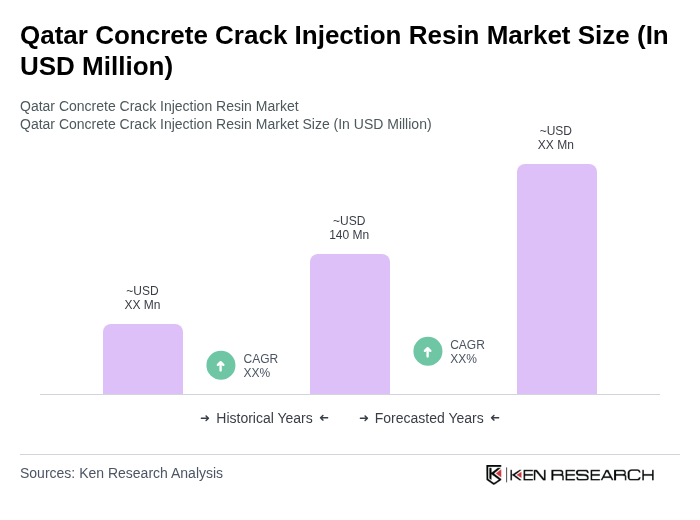
- The Qatar Concrete Crack Injection Resin Market is valued at USD 140 million, based on a five-year historical analysis and its share within the broader Middle East construction chemicals and concrete repair markets. This growth is primarily driven by the increasing demand for infrastructure development, particularly in the construction and maintenance of buildings, industrial facilities, transport infrastructure, and energy projects under Qatar National Vision 2030. The rising focus on life-cycle cost optimization, structural integrity of existing assets, and adoption of specialized repair solutions for aggressive coastal and high?temperature environments has further fueled market expansion.
- Key demand hubs in this market include Doha, Al Rayyan, and Al Wakrah, which dominate due to their significant concentration of construction activities and urban development projects. The high density of commercial and residential buildings, transport corridors, stadiums, industrial plants, and public infrastructure in these municipalities, along with government-backed programs to upgrade utilities, mobility networks, and social infrastructure, has positioned them as leading consumption centers for concrete crack injection resins.
- In 2023, the Qatari government continued to strengthen construction quality requirements through instruments such as the Qatar Construction Specifications (QCS) 2014, issued by the Ministry of Municipality and Environment and the Public Works Authority (Ashghal), which mandate the use of approved high?performance construction materials and systems for concrete repair and protection in public projects. These specifications set performance criteria for crack injection, repair mortars, coatings, and waterproofing systems in terms of durability, adhesion, chemical resistance, and long-term service life, encouraging the use of advanced resin-based injection technologies to enhance structural safety and reduce maintenance costs.
Qatar Concrete Crack Injection Resin Market Segmentation
By Resin Chemistry:The market is segmented into four main types of resin chemistry: Epoxy Injection Resins, Polyurethane (PU) Injection Resins, Acrylic and Acrylate Injection Gels, and Hybrid & Other Polymer Injection Systems. Each of these subsegments serves different applications and offers unique properties that cater to various construction needs, such as high bond strength for structural stitching, flexible sealing in moving cracks, and low?viscosity systems for micro?crack penetration in aggressive environments.
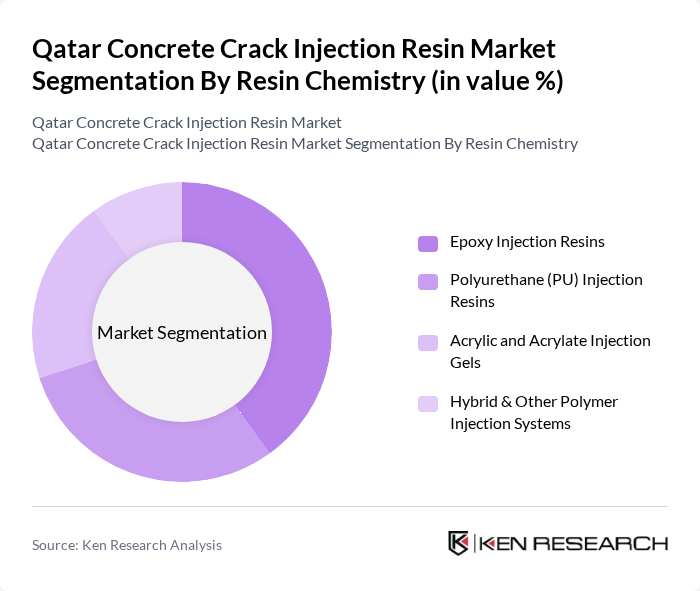
The dominant subsegment in the resin chemistry category is Epoxy Injection Resins, which are favored for their superior bonding strength and durability in structural crack repair, including beams, slabs, columns, and foundations. These resins are widely used in structural applications due to their excellent mechanical properties, strong adhesion to concrete, and resistance to chemicals, chlorides, and moisture ingress in marine or coastal exposure conditions. The increasing focus on long-lasting, code-compliant repairs and asset life extension in infrastructure, oil and gas, marine works, and high?value buildings has led to a higher adoption of epoxy resins, making them a preferred choice among contractors, facility managers, and engineering consultants.
By Function:The market is also segmented based on function into Structural Crack Injection (Load-Bearing), Non-Structural Crack Filling, Leak-Sealing & Waterproofing Injection, and Chemical-Resistant & Protective Injection. Each function addresses specific needs in the repair and maintenance of concrete structures, ranging from structural stitching and reinstatement of load transfer to water cut?off in basements and tunnels, and lining protection in chemically aggressive process environments.
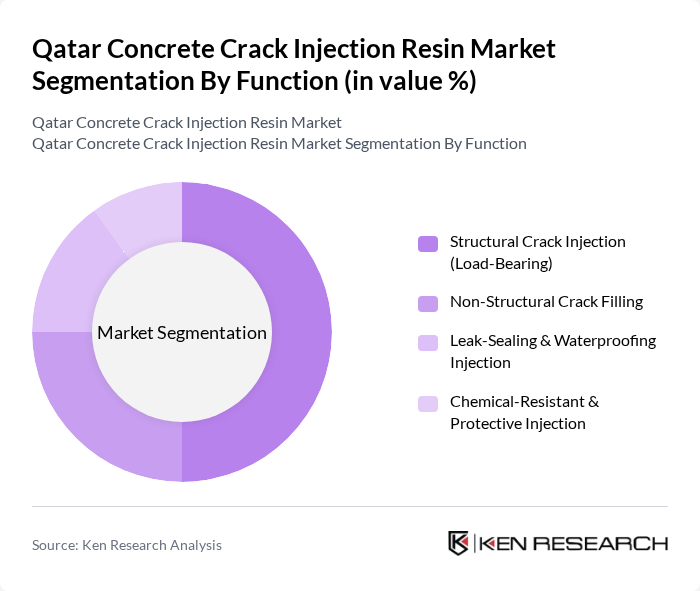
The leading subsegment in the function category is Structural Crack Injection (Load-Bearing), which is essential for maintaining the integrity of critical structures such as bridges, parking structures, podiums, industrial facilities, and high?rise buildings. This segment is driven by the increasing need for safety and serviceability in construction and asset management, as structural cracks can compromise the stability and durability of buildings and infrastructure if left untreated. The focus on stringent project specifications, quality control on repair works, and extending the service life of existing assets under Qatar National Vision 2030 has made this function a priority for consultants, contractors, and asset owners.
Qatar Concrete Crack Injection Resin Market Competitive Landscape
The Qatar Concrete Crack Injection Resin Market is characterized by a dynamic mix of regional and international players. Leading participants such as Sika AG, Mapei S.p.A., Fosroc International Ltd, Master Builders Solutions, BASF SE, Saint-Gobain Weber, The Euclid Chemical Company, GCP Applied Technologies, RPM International Inc. (including Tremco), Hilti Corporation, Simpson Strong-Tie Company Inc., Adhesives Technology Corporation, W. R. Meadows, Inc., Pidilite Industries Ltd, ITW Performance Polymers contribute to innovation, geographic expansion, and service delivery in this space, offering epoxy and polyurethane crack injection systems, repair mortars, protective coatings, and integrated waterproofing solutions tailored to Middle East climatic and exposure conditions.
Qatar Concrete Crack Injection Resin Market Industry Analysis
Growth Drivers
- Increasing Infrastructure Development:Qatar's infrastructure sector is projected to reach $35 billion in future, driven by significant investments in transportation, healthcare, and education. The government’s National Vision 2030 emphasizes sustainable urban development, leading to a surge in construction activities. This growth necessitates effective repair solutions, including concrete crack injection resins, to maintain structural integrity and safety, thereby boosting market demand significantly.
- Rising Demand for Repair and Maintenance:The repair and maintenance sector in Qatar is expected to grow to $6 billion by future, reflecting an increasing focus on preserving existing infrastructure. As buildings and roads age, the need for effective repair solutions becomes critical. Concrete crack injection resins are essential for addressing structural issues, thus driving their demand in both residential and commercial sectors, ensuring safety and longevity of structures.
- Technological Advancements in Resin Formulations:Innovations in resin technology are enhancing the performance and application of concrete crack injection solutions. In future, the introduction of high-performance, eco-friendly resins is anticipated to increase market penetration. These advancements not only improve the efficacy of repairs but also align with global sustainability trends, making them more appealing to environmentally conscious consumers and construction firms in Qatar.
Market Challenges
- High Cost of Raw Materials:The cost of key raw materials for resin production has risen by approximately 20% in the past year due to supply chain disruptions and increased demand. This escalation poses a significant challenge for manufacturers in Qatar, as it directly impacts production costs and profit margins. Consequently, higher prices may deter potential customers from investing in concrete crack injection solutions, limiting market growth.
- Limited Awareness Among End-Users:Despite the benefits of concrete crack injection resins, awareness among end-users remains low, particularly in the residential sector. A recent survey indicated that only 40% of homeowners are familiar with these solutions. This lack of knowledge hampers market penetration, as potential customers may opt for traditional repair methods, thereby stifling the growth of innovative resin products in Qatar's construction landscape.
Qatar Concrete Crack Injection Resin Market Future Outlook
The future of the Qatar concrete crack injection resin market appears promising, driven by ongoing infrastructure projects and a growing emphasis on sustainable construction practices. As the government continues to invest in smart city initiatives, the demand for advanced repair solutions is expected to rise. Additionally, the integration of digital technologies in construction will likely enhance the efficiency of resin applications, further propelling market growth and innovation in the coming years.
Market Opportunities
- Expansion in the Construction Sector:With Qatar's construction sector projected to grow by 8% annually, there is a significant opportunity for concrete crack injection resins. This growth will be fueled by large-scale projects, including stadiums and transportation networks, necessitating effective repair solutions to ensure structural integrity and safety.
- Growing Adoption of Eco-Friendly Resins:The increasing demand for sustainable construction materials presents a lucrative opportunity for eco-friendly concrete crack injection resins. As regulations tighten and consumer preferences shift towards environmentally responsible products, manufacturers can capitalize on this trend by developing innovative, sustainable resin formulations that meet market needs.
Scope of the Report
| Segment | Sub-Segments |
|---|---|
| By Resin Chemistry | Epoxy Injection Resins Polyurethane (PU) Injection Resins Acrylic and Acrylate Injection Gels Hybrid & Other Polymer Injection Systems |
| By Function | Structural Crack Injection (Load-Bearing) Non-Structural Crack Filling Leak-Sealing & Waterproofing Injection Chemical-Resistant & Protective Injection |
| By Crack & Substrate Characteristics | Dry Cracks Damp / Wet Cracks Moving / Dynamic Cracks Static Cracks |
| By Curing / Reaction Profile | Ultra-Fast / Rapid-Set Systems (< 30 minutes) Standard Curing Systems (30 minutes – 4 hours) Slow / Deep-Penetration Systems (> 4 hours) |
| By Delivery & Packaging Format | Dual-Cartridge / Cartridge Systems Bulk Packaging (Pails / Drums / IBCs) Pre-Proportioned Injection Kits Others |
| By Distribution Channel | Direct Sales to Contractors & Applicators Construction Chemical Distributors / Dealers Builder’s Merchants & Trade Retail Online & Project-Based Sales |
| By End-Use Sector | Buildings (Residential & Commercial) Industrial Facilities Infrastructure (Bridges, Tunnels, Roads, Ports) Oil & Gas, Utilities and Public Sector Assets |
| By Region | Doha Al Rayyan Al Wakrah Other Municipalities (Al Khor, Umm Salal, Al Daayen, Al Shamal) |
Key Target Audience
Investors and Venture Capitalist Firms
Government and Regulatory Bodies (e.g., Ministry of Municipality, Qatar Civil Defense)
Manufacturers and Producers of Concrete Repair Materials
Construction and Engineering Companies
Distributors and Retailers of Construction Materials
Real Estate Developers
Infrastructure Development Agencies
Quality Assurance and Testing Laboratories
Players Mentioned in the Report:
Sika AG
Mapei S.p.A.
Fosroc International Ltd
Master Builders Solutions
BASF SE
Saint-Gobain Weber
The Euclid Chemical Company
GCP Applied Technologies
RPM International Inc. (including Tremco)
Hilti Corporation
Simpson Strong-Tie Company Inc.
Adhesives Technology Corporation
W. R. Meadows, Inc.
Pidilite Industries Ltd
ITW Performance Polymers
Table of Contents
Market Assessment Phase
1. Executive Summary and Approach
2. Qatar Concrete Crack Injection Resin Market Overview
2.1 Key Insights and Strategic Recommendations
2.2 Qatar Concrete Crack Injection Resin Market Overview
2.3 Definition and Scope
2.4 Evolution of Market Ecosystem
2.5 Timeline of Key Regulatory Milestones
2.6 Value Chain & Stakeholder Mapping
2.7 Business Cycle Analysis
2.8 Policy & Incentive Landscape
3. Qatar Concrete Crack Injection Resin Market Analysis
3.1 Growth Drivers
3.1.1 Increasing Infrastructure Development
3.1.2 Rising Demand for Repair and Maintenance
3.1.3 Technological Advancements in Resin Formulations
3.1.4 Government Initiatives for Construction Safety
3.2 Market Challenges
3.2.1 High Cost of Raw Materials
3.2.2 Limited Awareness Among End-Users
3.2.3 Stringent Regulatory Compliance
3.2.4 Competition from Alternative Repair Solutions
3.3 Market Opportunities
3.3.1 Expansion in the Construction Sector
3.3.2 Growing Adoption of Eco-Friendly Resins
3.3.3 Increasing Investment in Infrastructure Projects
3.3.4 Development of Smart City Initiatives
3.4 Market Trends
3.4.1 Shift Towards Sustainable Construction Practices
3.4.2 Integration of Digital Technologies in Repair Solutions
3.4.3 Customization of Resin Products for Specific Applications
3.4.4 Rise in DIY Repair Solutions
3.5 Government Regulation
3.5.1 Building Code Compliance
3.5.2 Environmental Protection Regulations
3.5.3 Safety Standards for Construction Materials
3.5.4 Quality Assurance Guidelines
4. SWOT Analysis
5. Stakeholder Analysis
6. Porter's Five Forces Analysis
7. Qatar Concrete Crack Injection Resin Market Market Size, 2019-2024
7.1 By Value
7.2 By Volume
7.3 By Average Selling Price
8. Qatar Concrete Crack Injection Resin Market Segmentation
8.1 By Resin Chemistry
8.1.1 Epoxy Injection Resins
8.1.2 Polyurethane (PU) Injection Resins
8.1.3 Acrylic and Acrylate Injection Gels
8.1.4 Hybrid & Other Polymer Injection Systems
8.2 By Function
8.2.1 Structural Crack Injection (Load-Bearing)
8.2.2 Non-Structural Crack Filling
8.2.3 Leak-Sealing & Waterproofing Injection
8.2.4 Chemical-Resistant & Protective Injection
8.3 By Crack & Substrate Characteristics
8.3.1 Dry Cracks
8.3.2 Damp / Wet Cracks
8.3.3 Moving / Dynamic Cracks
8.3.4 Static Cracks
8.4 By Curing / Reaction Profile
8.4.1 Ultra-Fast / Rapid-Set Systems (< 30 minutes)
8.4.2 Standard Curing Systems (30 minutes – 4 hours)
8.4.3 Slow / Deep-Penetration Systems (> 4 hours)
8.5 By Delivery & Packaging Format
8.5.1 Dual-Cartridge / Cartridge Systems
8.5.2 Bulk Packaging (Pails / Drums / IBCs)
8.5.3 Pre-Proportioned Injection Kits
8.5.4 Others
8.6 By Distribution Channel
8.6.1 Direct Sales to Contractors & Applicators
8.6.2 Construction Chemical Distributors / Dealers
8.6.3 Builder’s Merchants & Trade Retail
8.6.4 Online & Project-Based Sales
8.7 By End-Use Sector
8.7.1 Buildings (Residential & Commercial)
8.7.2 Industrial Facilities
8.7.3 Infrastructure (Bridges, Tunnels, Roads, Ports)
8.7.4 Oil & Gas, Utilities and Public Sector Assets
8.8 By Region
8.8.1 Doha
8.8.2 Al Rayyan
8.8.3 Al Wakrah
8.8.4 Other Municipalities (Al Khor, Umm Salal, Al Daayen, Al Shamal)
9. Qatar Concrete Crack Injection Resin Market Competitive Analysis
9.1 Market Share of Key Players
9.2 Cross Comparison of Key Players
9.2.1 Company Name
9.2.2 Group Size (Global Major, Regional Player, Local Specialist)
9.2.3 Qatar Concrete Crack Injection Resin Revenue (USD, Latest Year)
9.2.4 Qatar Revenue CAGR (Historical 3–5 Years)
9.2.5 Share of Injection Resins in Total Construction Chemicals Portfolio (%)
9.2.6 Number of Crack Injection Systems / SKUs Offered in Qatar
9.2.7 Average Selling Price Positioning vs Market (Premium / Mid / Value)
9.2.8 Project Reference Density in Qatar (No. of Key Projects Using Injection Resins)
9.2.9 Distribution Reach (No. of Distributors / Stock Points in Qatar)
9.2.10 Technical Support Footprint (Local Tech Staff, Training Programs, Site Support)
9.2.11 R&D and Product Innovation Intensity (New Formulations / Launches in Last 3 Years)
9.2.12 Compliance & Certification Coverage (Qatar Construction Standards, ISO, LEED, etc.)
9.3 SWOT Analysis of Top Players
9.4 Pricing Analysis
9.5 Detailed Profile of Major Companies
9.5.1 Sika AG
9.5.2 Mapei S.p.A.
9.5.3 Fosroc International Ltd
9.5.4 Master Builders Solutions
9.5.5 BASF SE
9.5.6 Saint-Gobain Weber
9.5.7 The Euclid Chemical Company
9.5.8 GCP Applied Technologies
9.5.9 RPM International Inc. (including Tremco)
9.5.10 Hilti Corporation
9.5.11 Simpson Strong-Tie Company Inc.
9.5.12 Adhesives Technology Corporation
9.5.13 W. R. Meadows, Inc.
9.5.14 Pidilite Industries Ltd
9.5.15 ITW Performance Polymers
10. Qatar Concrete Crack Injection Resin Market End-User Analysis
10.1 Procurement Behavior of Key Ministries
10.1.1 Ministry of Municipality and Environment
10.1.2 Ministry of Transport and Communications
10.1.3 Ministry of Education and Higher Education
10.1.4 Others
10.2 Corporate Spend on Infrastructure & Energy
10.2.1 Major Infrastructure Projects
10.2.2 Energy Sector Investments
10.2.3 Public-Private Partnerships
10.2.4 Others
10.3 Pain Point Analysis by End-User Category
10.3.1 Residential Sector Challenges
10.3.2 Commercial Sector Challenges
10.3.3 Industrial Sector Challenges
10.3.4 Government Sector Challenges
10.4 User Readiness for Adoption
10.4.1 Awareness Levels
10.4.2 Training and Support Needs
10.4.3 Financial Readiness
10.4.4 Others
10.5 Post-Deployment ROI and Use Case Expansion
10.5.1 ROI Measurement Techniques
10.5.2 Case Studies of Successful Deployments
10.5.3 Future Use Case Opportunities
10.5.4 Others
11. Qatar Concrete Crack Injection Resin Market Future Size, 2025-2030
11.1 By Value
11.2 By Volume
11.3 By Average Selling Price
Go-To-Market Strategy Phase
1. Whitespace Analysis + Business Model Canvas
1.1 Market Gaps Identification
1.2 Business Model Development
2. Marketing and Positioning Recommendations
2.1 Branding Strategies
2.2 Product USPs
3. Distribution Plan
3.1 Urban Retail vs Rural NGO Tie-ups
4. Channel & Pricing Gaps
4.1 Underserved Routes
4.2 Pricing Bands
5. Unmet Demand & Latent Needs
5.1 Category Gaps
5.2 Consumer Segments
6. Customer Relationship
6.1 Loyalty Programs
6.2 After-sales Service
7. Value Proposition
7.1 Sustainability
7.2 Integrated Supply Chains
8. Key Activities
8.1 Regulatory Compliance
8.2 Branding
8.3 Distribution Setup
9. Entry Strategy Evaluation
9.1 Domestic Market Entry Strategy
9.1.1 Product Mix
9.1.2 Pricing Band
9.1.3 Packaging
9.2 Export Entry Strategy
9.2.1 Target Countries
9.2.2 Compliance Roadmap
10. Entry Mode Assessment
10.1 JV
10.2 Greenfield
10.3 M&A
10.4 Distributor Model
11. Capital and Timeline Estimation
11.1 Capital Requirements
11.2 Timelines
12. Control vs Risk Trade-Off
12.1 Ownership vs Partnerships
13. Profitability Outlook
13.1 Breakeven Analysis
13.2 Long-term Sustainability
14. Potential Partner List
14.1 Distributors
14.2 JVs
14.3 Acquisition Targets
15. Execution Roadmap
15.1 Phased Plan for Market Entry
15.1.1 Market Setup
15.1.2 Market Entry
15.1.3 Growth Acceleration
15.1.4 Scale & Stabilize
15.2 Key Activities and Milestones
15.2.1 Milestone Planning
Research Methodology
Phase 1: Approach1
Desk Research
- Industry reports from construction and materials associations in Qatar
- Market analysis publications focusing on construction chemicals and resins
- Government publications and infrastructure development plans impacting the concrete sector
Primary Research
- Interviews with project managers in construction firms utilizing concrete crack injection resins
- Surveys with suppliers and distributors of concrete repair materials
- Field interviews with engineers and contractors specializing in concrete restoration
Validation & Triangulation
- Cross-validation of data from multiple industry sources and expert opinions
- Triangulation of market size estimates using sales data and project pipeline information
- Sanity checks through feedback from industry experts and stakeholders
Phase 2: Market Size Estimation1
Top-down Assessment
- Analysis of national construction spending trends and their impact on resin demand
- Segmentation of the market by application areas such as residential, commercial, and infrastructure
- Incorporation of government initiatives for infrastructure development and maintenance
Bottom-up Modeling
- Volume estimates based on historical consumption data of concrete crack injection resins
- Cost analysis derived from pricing structures of leading resin manufacturers
- Estimation of market share based on sales data from key players in the region
Forecasting & Scenario Analysis
- Multi-variable regression analysis considering construction growth rates and economic indicators
- Scenario planning based on potential regulatory changes and environmental considerations
- Development of baseline, optimistic, and pessimistic forecasts through 2030
Phase 3: CATI Sample Composition1
| Scope Item/Segment | Sample Size | Target Respondent Profiles |
|---|---|---|
| Residential Construction Projects | 120 | Project Managers, Site Engineers |
| Commercial Building Maintenance | 90 | Facility Managers, Maintenance Supervisors |
| Infrastructure Repair Initiatives | 80 | Public Works Officials, Civil Engineers |
| Specialty Contractors in Concrete Repair | 70 | Business Owners, Technical Directors |
| Suppliers of Construction Chemicals | 100 | Sales Managers, Product Development Leads |
Frequently Asked Questions
What is the current value of the Qatar Concrete Crack Injection Resin Market?
The Qatar Concrete Crack Injection Resin Market is valued at approximately USD 140 million, reflecting its significance within the broader Middle East construction chemicals and concrete repair markets, driven by infrastructure development and maintenance needs.
What factors are driving the growth of the Qatar Concrete Crack Injection Resin Market?
Which regions in Qatar are the primary demand hubs for concrete crack injection resins?
What are the main types of resin chemistry used in the Qatar Concrete Crack Injection Resin Market?
Other Regional/Country Reports
Indonesia Concrete Crack Injection Resin Market
Malaysia Concrete Crack Injection Resin Market
KSA Concrete Crack Injection Resin Market
APAC Concrete Crack Injection Resin Market
SEA Concrete Crack Injection Resin Market
Vietnam Concrete Crack Injection Resin Market
Other Adjacent Reports
Singapore Concrete Repair Mortars Market
Malaysia Construction Chemicals Market Size, Share & Forecast, By Product Type, End-Use Sector & Application, 2026–2031KSA Waterproofing Systems Market
Ksa Epoxy Resins Market Size, Share, Growth Drivers, Trends, Opportunities & Forecast 2025–2030Qatar Polyurethane Resins Market
Global Protective Coatings Market Size, Share & Forecast, By Resin Type, Technology & End-Use Industry, 2025-2032Qatar Sealants And Adhesives Market
Kuwait Structural Reinforcement Market
KSA Building Maintenance Services Market
Thailand Infrastructure Rehabilitation Market
Why Buy From Us?

What makes us stand out is that our consultants follow Robust, Refine and Result (RRR) methodology. Robust for clear definitions, approaches and sanity checking, Refine for differentiating respondents' facts and opinions, and Result for presenting data with story.

We have set a benchmark in the industry by offering our clients with syndicated and customized market research reports featuring coverage of entire market as well as meticulous research and analyst insights.

While we don't replace traditional research, we flip the method upside down. Our dual approach of Top Bottom & Bottom Top ensures quality deliverable by not just verifying company fundamentals but also looking at the sector and macroeconomic factors.

With one step in the future, our research team constantly tries to show you the bigger picture. We help with some of the tough questions you may encounter along the way: How is the industry positioned? Best marketing channel? KPI's of competitors? By aligning every element, we help maximize success.

Our report gives you instant access to the answers and sources that other companies might choose to hide. We elaborate each steps of research methodology we have used and showcase you the sample size to earn your trust.

If you need any support, we are here! We pride ourselves on universe strength, data quality, and quick, friendly, and professional service.