About the Report
Base Year 2024Qatar Digital Asset Trading Platforms Market Overview
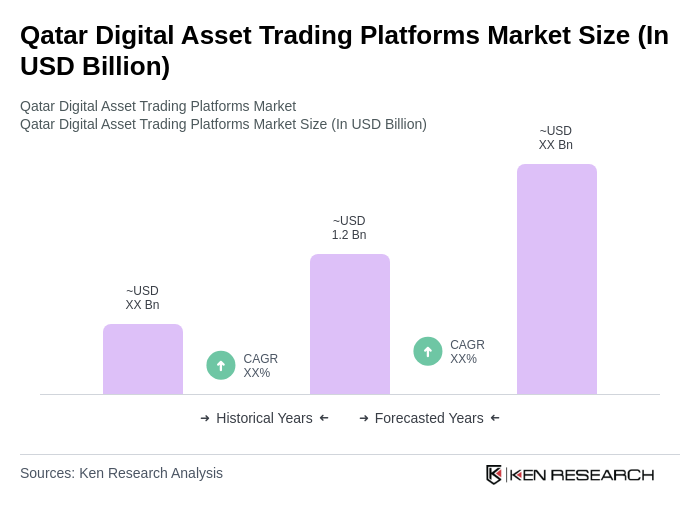
- The Qatar Digital Asset Trading Platforms Market is valued at USD 1.2 billion, based on a five-year historical analysis. This growth is primarily driven by the increasing adoption of cryptocurrencies, technological advancements in blockchain, and a growing interest in digital assets among investors. The market has seen a surge in trading volumes and user engagement, reflecting a robust ecosystem for digital asset trading.
- Key players in this market include Doha Bank, Qatar National Bank, and various fintech startups that have established a strong presence in the digital asset space. Qatar's strategic location and its status as a financial hub in the Middle East contribute to its dominance in the market, attracting both local and international investors seeking to capitalize on digital asset opportunities.
- In 2023, the Qatari government implemented a regulatory framework for digital assets, which includes licensing requirements for trading platforms and compliance with anti-money laundering (AML) and know-your-customer (KYC) regulations. This initiative aims to enhance investor protection and promote a secure trading environment, fostering confidence in the digital asset market.
Qatar Digital Asset Trading Platforms Market Segmentation
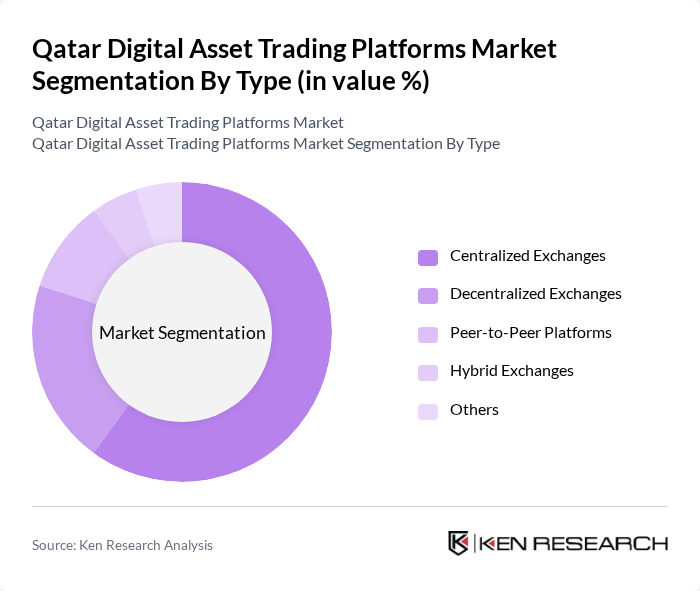
By Type:The market is segmented into various types of trading platforms, including centralized exchanges, decentralized exchanges, peer-to-peer platforms, hybrid exchanges, and others. Centralized exchanges dominate the market due to their user-friendly interfaces and high liquidity, making them the preferred choice for most traders. Decentralized exchanges are gaining traction as users seek more control over their assets and enhanced privacy. Peer-to-peer platforms cater to users looking for direct transactions without intermediaries, while hybrid exchanges combine features of both centralized and decentralized platforms.
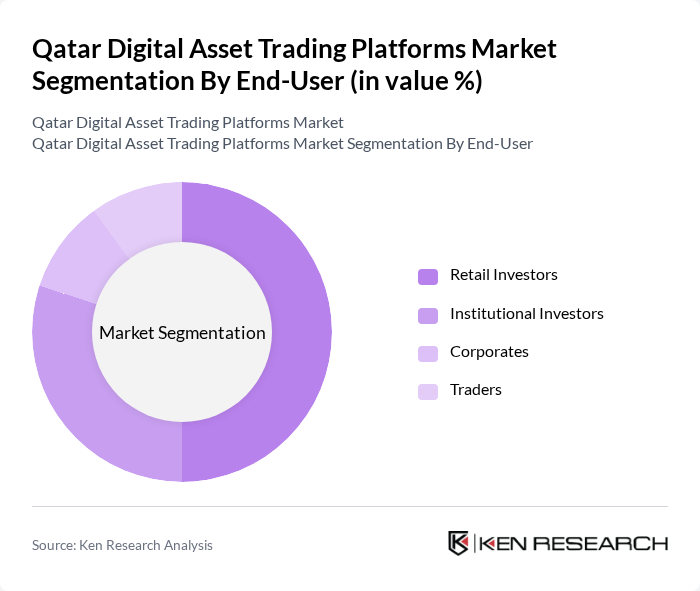
By End-User:The end-user segmentation includes retail investors, institutional investors, corporates, and traders. Retail investors represent the largest segment, driven by the increasing accessibility of digital assets and the rise of mobile trading applications. Institutional investors are gradually entering the market, seeking to diversify their portfolios with digital assets. Corporates are exploring blockchain technology for various applications, while traders leverage platforms for short-term gains and market analysis.
Qatar Digital Asset Trading Platforms Market Competitive Landscape
The Qatar Digital Asset Trading Platforms Market is characterized by a dynamic mix of regional and international players. Leading participants such as Binance, BitOasis, Kraken, eToro, CoinMENA, Huobi, OKEx, Bitstamp, Bittrex, Gemini, KuCoin, Bybit, CEX.IO, Phemex, Crypto.com contribute to innovation, geographic expansion, and service delivery in this space.
Qatar Digital Asset Trading Platforms Market Industry Analysis
Growth Drivers
- Increasing Adoption of Cryptocurrencies:The cryptocurrency market in Qatar has seen significant growth, with over 1.5 million users engaging in digital asset trading as of future. This surge is driven by a growing acceptance of cryptocurrencies among the population, with a reported 30% increase in transactions year-on-year. The total value of cryptocurrency transactions in Qatar reached approximately $1.2 billion in the previous year, indicating a robust demand for digital assets and a shift towards a more digital economy.
- Regulatory Support for Digital Assets:Qatar's government has implemented supportive regulations, including the establishment of a legal framework for digital assets. The Qatar Financial Centre (QFC) has issued licenses to over 20 digital asset firms, fostering a conducive environment for innovation. In future, the QFC reported a 40% increase in licensed digital asset companies, reflecting the government's commitment to creating a secure and regulated market that attracts both local and international investors.
- Rising Demand for Decentralized Finance (DeFi):The DeFi sector in Qatar is experiencing rapid growth, with total value locked (TVL) in DeFi protocols reaching $300 million in early future. This growth is fueled by increased interest from retail and institutional investors seeking alternatives to traditional finance. The number of DeFi users in Qatar has doubled in the past year, indicating a strong shift towards decentralized financial solutions that offer greater accessibility and transparency in financial transactions.
Market Challenges
- Regulatory Uncertainty:Despite supportive regulations, uncertainty remains a significant challenge for the digital asset market in Qatar. The lack of clear guidelines on taxation and compliance has led to hesitance among potential investors. In future, approximately 25% of surveyed investors cited regulatory ambiguity as a primary concern, which could hinder market growth and deter new entrants from participating in the digital asset ecosystem.
- Security Concerns and Cyber Threats:Security remains a critical issue for digital asset trading platforms in Qatar. In the previous year, cyberattacks on cryptocurrency exchanges globally resulted in losses exceeding $3 billion. As the market matures, the risk of hacking and fraud poses a significant threat to user confidence. In future, 60% of users expressed concerns about the security of their digital assets, highlighting the need for enhanced security measures and protocols within trading platforms.
Qatar Digital Asset Trading Platforms Market Future Outlook
The future of the digital asset trading platforms market in Qatar appears promising, driven by technological advancements and increasing user engagement. As blockchain technology continues to evolve, platforms are expected to integrate more sophisticated features, enhancing user experience and security. Additionally, the growing interest in NFTs and DeFi will likely attract a broader audience, further solidifying Qatar's position as a regional hub for digital assets. The government's proactive approach to regulation will also play a crucial role in shaping the market landscape.
Market Opportunities
- Expansion of Institutional Investment:Institutional interest in digital assets is on the rise, with major financial institutions in Qatar exploring blockchain technology. In future, it is estimated that institutional investments in digital assets could exceed $500 million, providing a significant boost to the market and enhancing liquidity.
- Development of New Trading Products:The introduction of innovative trading products, such as tokenized assets and derivatives, presents a substantial opportunity for growth. By future, the market for tokenized assets in Qatar is projected to reach $200 million, attracting diverse investors and expanding the range of available investment options.
Scope of the Report
| Segment | Sub-Segments |
|---|---|
| By Type | Centralized Exchanges Decentralized Exchanges Peer-to-Peer Platforms Hybrid Exchanges Others |
| By End-User | Retail Investors Institutional Investors Corporates Traders |
| By Trading Volume | High Volume Traders Medium Volume Traders Low Volume Traders |
| By Payment Method | Credit/Debit Cards Bank Transfers Cryptocurrencies E-Wallets |
| By Security Features | Two-Factor Authentication Cold Storage Solutions Insurance Coverage |
| By Geographic Focus | Local Market Regional Market International Market |
| By User Experience | Beginner-Friendly Platforms Advanced Trading Platforms Customizable Interfaces |
Key Target Audience
Investors and Venture Capitalist Firms
Government and Regulatory Bodies (e.g., Qatar Financial Centre Regulatory Authority, Qatar Central Bank)
Cryptocurrency Exchanges
Blockchain Technology Providers
Payment Service Providers
Financial Institutions
Wealth Management Firms
Insurance Companies
Players Mentioned in the Report:
Binance
BitOasis
Kraken
eToro
CoinMENA
Huobi
OKEx
Bitstamp
Bittrex
Gemini
KuCoin
Bybit
CEX.IO
Phemex
Crypto.com
Table of Contents
Market Assessment Phase
1. Executive Summary and Approach
2. Qatar Digital Asset Trading Platforms Market Overview
2.1 Key Insights and Strategic Recommendations
2.2 Qatar Digital Asset Trading Platforms Market Overview
2.3 Definition and Scope
2.4 Evolution of Market Ecosystem
2.5 Timeline of Key Regulatory Milestones
2.6 Value Chain & Stakeholder Mapping
2.7 Business Cycle Analysis
2.8 Policy & Incentive Landscape
3. Qatar Digital Asset Trading Platforms Market Analysis
3.1 Growth Drivers
3.1.1 Increasing Adoption of Cryptocurrencies
3.1.2 Regulatory Support for Digital Assets
3.1.3 Rising Demand for Decentralized Finance (DeFi)
3.1.4 Technological Advancements in Blockchain
3.2 Market Challenges
3.2.1 Regulatory Uncertainty
3.2.2 Security Concerns and Cyber Threats
3.2.3 Market Volatility
3.2.4 Limited Public Awareness
3.3 Market Opportunities
3.3.1 Expansion of Institutional Investment
3.3.2 Development of New Trading Products
3.3.3 Partnerships with Financial Institutions
3.3.4 Growth of NFT Marketplaces
3.4 Market Trends
3.4.1 Integration of AI in Trading Platforms
3.4.2 Rise of Mobile Trading Applications
3.4.3 Increased Focus on User Experience
3.4.4 Emergence of Regulatory Sandboxes
3.5 Government Regulation
3.5.1 Licensing Requirements for Exchanges
3.5.2 Anti-Money Laundering (AML) Regulations
3.5.3 Consumer Protection Laws
3.5.4 Taxation Policies on Digital Assets
4. SWOT Analysis
5. Stakeholder Analysis
6. Porter's Five Forces Analysis
7. Qatar Digital Asset Trading Platforms Market Market Size, 2019-2024
7.1 By Value
7.2 By Volume
7.3 By Average Selling Price
8. Qatar Digital Asset Trading Platforms Market Segmentation
8.1 By Type
8.1.1 Centralized Exchanges
8.1.2 Decentralized Exchanges
8.1.3 Peer-to-Peer Platforms
8.1.4 Hybrid Exchanges
8.1.5 Others
8.2 By End-User
8.2.1 Retail Investors
8.2.2 Institutional Investors
8.2.3 Corporates
8.2.4 Traders
8.3 By Trading Volume
8.3.1 High Volume Traders
8.3.2 Medium Volume Traders
8.3.3 Low Volume Traders
8.4 By Payment Method
8.4.1 Credit/Debit Cards
8.4.2 Bank Transfers
8.4.3 Cryptocurrencies
8.4.4 E-Wallets
8.5 By Security Features
8.5.1 Two-Factor Authentication
8.5.2 Cold Storage Solutions
8.5.3 Insurance Coverage
8.6 By Geographic Focus
8.6.1 Local Market
8.6.2 Regional Market
8.6.3 International Market
8.7 By User Experience
8.7.1 Beginner-Friendly Platforms
8.7.2 Advanced Trading Platforms
8.7.3 Customizable Interfaces
9. Qatar Digital Asset Trading Platforms Market Competitive Analysis
9.1 Market Share of Key Players
9.2 Cross Comparison of Key Players
9.2.1 Company Name
9.2.2 Group Size (Large, Medium, or Small as per industry convention)
9.2.3 Trading Volume
9.2.4 User Growth Rate
9.2.5 Customer Retention Rate
9.2.6 Pricing Strategy
9.2.7 Market Penetration Rate
9.2.8 Average Transaction Fee
9.2.9 Customer Satisfaction Score
9.2.10 Technology Adoption Rate
9.3 SWOT Analysis of Top Players
9.4 Pricing Analysis
9.5 Detailed Profile of Major Companies
9.5.1 Binance
9.5.2 BitOasis
9.5.3 Kraken
9.5.4 eToro
9.5.5 CoinMENA
9.5.6 Huobi
9.5.7 OKEx
9.5.8 Bitstamp
9.5.9 Bittrex
9.5.10 Gemini
9.5.11 KuCoin
9.5.12 Bybit
9.5.13 CEX.IO
9.5.14 Phemex
9.5.15 Crypto.com
10. Qatar Digital Asset Trading Platforms Market End-User Analysis
10.1 Procurement Behavior of Key Ministries
10.1.1 Ministry of Finance
10.1.2 Ministry of Economy and Commerce
10.1.3 Ministry of Transport and Communications
10.2 Corporate Spend on Infrastructure & Energy
10.2.1 Investment in Digital Infrastructure
10.2.2 Budget Allocation for Technology
10.2.3 Spending on Cybersecurity
10.3 Pain Point Analysis by End-User Category
10.3.1 Retail Investors
10.3.2 Institutional Investors
10.3.3 Corporates
10.4 User Readiness for Adoption
10.4.1 Awareness Levels
10.4.2 Technical Skills
10.4.3 Trust in Digital Platforms
10.5 Post-Deployment ROI and Use Case Expansion
10.5.1 ROI Measurement Techniques
10.5.2 Use Case Development
10.5.3 Long-term Value Assessment
11. Qatar Digital Asset Trading Platforms Market Future Size, 2025-2030
11.1 By Value
11.2 By Volume
11.3 By Average Selling Price
Go-To-Market Strategy Phase
1. Whitespace Analysis + Business Model Canvas
1.1 Market Gaps Identification
1.2 Business Model Development
2. Marketing and Positioning Recommendations
2.1 Branding Strategies
2.2 Product USPs
3. Distribution Plan
3.1 Urban Retail vs Rural NGO Tie-ups
4. Channel & Pricing Gaps
4.1 Underserved Routes
4.2 Pricing Bands
5. Unmet Demand & Latent Needs
5.1 Category Gaps
5.2 Consumer Segments
6. Customer Relationship
6.1 Loyalty Programs
6.2 After-sales Service
7. Value Proposition
7.1 Sustainability
7.2 Integrated Supply Chains
8. Key Activities
8.1 Regulatory Compliance
8.2 Branding
8.3 Distribution Setup
9. Entry Strategy Evaluation
9.1 Domestic Market Entry Strategy
9.1.1 Product Mix
9.1.2 Pricing Band
9.1.3 Packaging
9.2 Export Entry Strategy
9.2.1 Target Countries
9.2.2 Compliance Roadmap
10. Entry Mode Assessment
10.1 JV
10.2 Greenfield
10.3 M&A
10.4 Distributor Model
11. Capital and Timeline Estimation
11.1 Capital Requirements
11.2 Timelines
12. Control vs Risk Trade-Off
12.1 Ownership vs Partnerships
13. Profitability Outlook
13.1 Breakeven Analysis
13.2 Long-term Sustainability
14. Potential Partner List
14.1 Distributors
14.2 JVs
14.3 Acquisition Targets
15. Execution Roadmap
15.1 Phased Plan for Market Entry
15.1.1 Market Setup
15.1.2 Market Entry
15.1.3 Growth Acceleration
15.1.4 Scale & Stabilize
15.2 Key Activities and Milestones
15.2.1 Activity Planning
15.2.2 Milestone Tracking
Research Methodology
Phase 1: Approach1
Desk Research
- Analysis of market reports from financial institutions and blockchain research firms
- Review of regulatory frameworks and guidelines from Qatar Central Bank and other relevant authorities
- Examination of industry publications and white papers on digital asset trading trends
Primary Research
- Interviews with executives from leading digital asset trading platforms in Qatar
- Surveys targeting retail and institutional investors engaged in digital asset trading
- Focus groups with blockchain technology experts and financial analysts
Validation & Triangulation
- Cross-validation of findings through multiple data sources including trade volumes and user demographics
- Triangulation of insights from primary interviews with secondary data trends
- Sanity checks conducted through expert panel reviews and feedback sessions
Phase 2: Market Size Estimation1
Top-down Assessment
- Estimation of total market size based on global digital asset trading growth rates
- Segmentation by asset type (cryptocurrencies, tokens, etc.) and user demographics
- Incorporation of regulatory impacts and adoption rates in the Qatari market
Bottom-up Modeling
- Analysis of transaction volumes and fees from major trading platforms operating in Qatar
- Estimation of user growth rates based on historical data and market trends
- Calculation of revenue projections based on average transaction values and frequency
Forecasting & Scenario Analysis
- Multi-factor regression analysis incorporating economic indicators and technological advancements
- Scenario modeling based on potential regulatory changes and market adoption rates
- Development of baseline, optimistic, and pessimistic forecasts through 2028
Phase 3: CATI Sample Composition1
| Scope Item/Segment | Sample Size | Target Respondent Profiles |
|---|---|---|
| Retail Investor Engagement | 150 | Individual Traders, Crypto Enthusiasts |
| Institutional Investor Insights | 100 | Portfolio Managers, Investment Analysts |
| Regulatory Compliance Perspectives | 80 | Compliance Officers, Legal Advisors |
| Technology Adoption in Trading | 70 | IT Managers, Blockchain Developers |
| Market Trends and Sentiment Analysis | 90 | Market Analysts, Financial Advisors |
Frequently Asked Questions
What is the current value of the Qatar Digital Asset Trading Platforms Market?
The Qatar Digital Asset Trading Platforms Market is valued at approximately USD 1.2 billion, reflecting significant growth driven by increased cryptocurrency adoption, technological advancements in blockchain, and heightened investor interest in digital assets.
Who are the key players in the Qatar Digital Asset Trading Platforms Market?
What regulatory measures has the Qatari government implemented for digital assets?
What types of trading platforms are available in Qatar?
Other Regional/Country Reports
Indonesia Digital Asset Trading Platforms Market
Malaysia Digital Asset Trading Platforms Market
APAC Digital Asset Trading Platforms Market
SEA Digital Asset Trading Platforms Market
Other Adjacent Reports
Oman Cryptocurrency Exchange Market
APAC blockchain technology market Size, Share, Growth Drivers, Trends, Opportunities & Forecast 2025–2030Kuwait Fintech Services Market
Qatar decentralized finance market report size, share, growth drivers, trends, opportunities & forecast 2025–2030Brazil NFT Marketplace Market
Mexico Digital Wallet Market
GCC regulatory technology market size, share, growth drivers, trends, opportunities & forecast 2025–2030Singapore Cybersecurity Solutions Market
Belgium Investment Platform Market
Oman Payment Processing Market
Why Buy From Us?

What makes us stand out is that our consultants follow Robust, Refine and Result (RRR) methodology. Robust for clear definitions, approaches and sanity checking, Refine for differentiating respondents' facts and opinions, and Result for presenting data with story.

We have set a benchmark in the industry by offering our clients with syndicated and customized market research reports featuring coverage of entire market as well as meticulous research and analyst insights.

While we don't replace traditional research, we flip the method upside down. Our dual approach of Top Bottom & Bottom Top ensures quality deliverable by not just verifying company fundamentals but also looking at the sector and macroeconomic factors.

With one step in the future, our research team constantly tries to show you the bigger picture. We help with some of the tough questions you may encounter along the way: How is the industry positioned? Best marketing channel? KPI's of competitors? By aligning every element, we help maximize success.

Our report gives you instant access to the answers and sources that other companies might choose to hide. We elaborate each steps of research methodology we have used and showcase you the sample size to earn your trust.

If you need any support, we are here! We pride ourselves on universe strength, data quality, and quick, friendly, and professional service.