About the Report
Base Year 2024Saudi Arabia Digital Asset Trading Platforms Market Overview
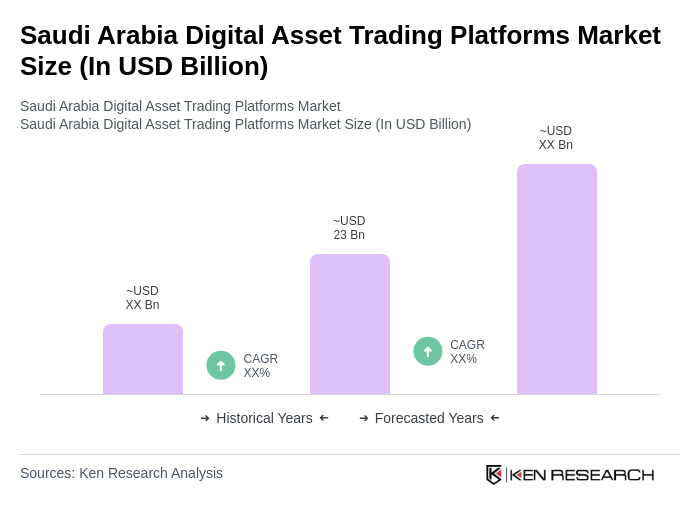
- The Saudi Arabia Digital Asset Trading Platforms Market is valued at USD 23 billion, based on a five-year historical analysis. This growth is primarily driven by the increasing adoption of cryptocurrencies, rising interest in blockchain technology, and a growing number of retail and institutional investors entering the market. The market’s expansion is further supported by government-backed digital transformation initiatives, the proliferation of fintech startups, and the rising use of digital wallets and decentralized finance solutions. Saudi Arabia is recognized as one of the fastest-growing crypto economies in the MENA region, with robust year-over-year growth and significant institutional participation .
- Key cities such as Riyadh, Jeddah, and Dammam dominate the market due to their robust financial infrastructure, high internet penetration rates, and a young, tech-savvy population eager to engage in digital asset trading. These urban centers serve as hubs for innovation and investment in the digital economy, attracting both local and international digital asset service providers .
- The regulatory landscape for digital asset trading platforms in Saudi Arabia is defined by the Anti-Money Laundering Law (Royal Decree No. M/20, issued by the Council of Ministers, 2017) and its implementing regulations, which require all digital asset trading platforms to register with the Saudi Central Bank (SAMA) and comply with anti-money laundering (AML) and counter-terrorism financing (CTF) obligations. These regulations mandate robust customer due diligence, transaction monitoring, and reporting requirements, aiming to enhance consumer protection and promote a secure trading environment .
Saudi Arabia Digital Asset Trading Platforms Market Segmentation
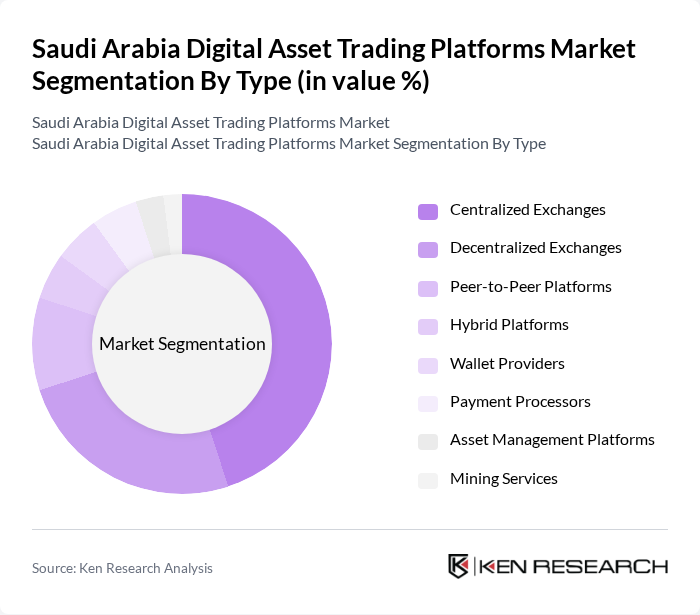
By Type:The market is segmented into various types of platforms that cater to different trading needs and preferences. Centralized exchanges dominate the market due to their user-friendly interfaces and high liquidity, making them the preferred choice for most traders. Decentralized exchanges are gaining traction as users seek more control over their assets, while peer-to-peer platforms facilitate direct transactions between users. Hybrid platforms combine features of both centralized and decentralized exchanges, appealing to a broader audience. Wallet providers and payment processors are essential for secure transactions, while asset management platforms and mining services support the growing interest in digital assets. The dominance of centralized exchanges is reinforced by the regulatory clarity and higher institutional participation, while decentralized and peer-to-peer platforms are increasingly popular among tech-savvy users seeking privacy and autonomy .
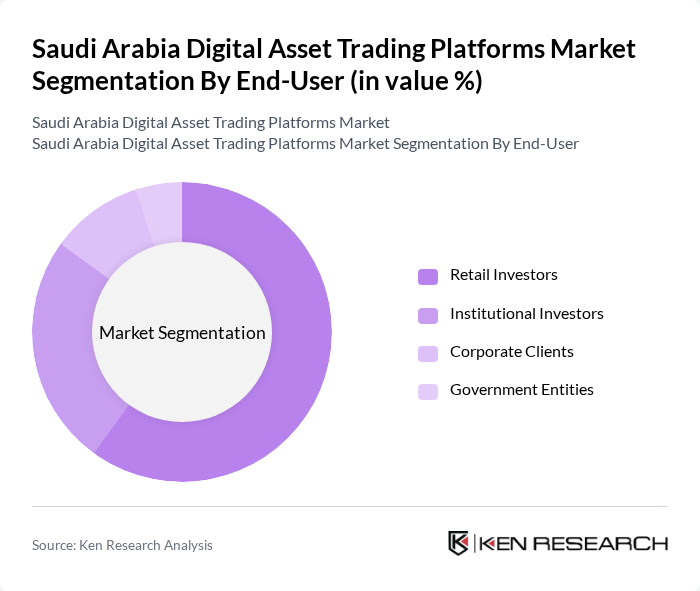
By End-User:The end-user segmentation highlights the diverse range of participants in the digital asset trading ecosystem. Retail investors represent the largest segment, driven by the increasing accessibility of trading platforms and the growing popularity of cryptocurrencies. Institutional investors are also becoming significant players, as they seek to diversify their portfolios and capitalize on the potential of digital assets. Corporate clients are exploring blockchain technology for various applications, while government entities are beginning to engage with digital assets for regulatory and financial purposes. The surge in institutional adoption is notable, with financial institutions and corporations actively investing in digital assets and blockchain infrastructure .
Saudi Arabia Digital Asset Trading Platforms Market Competitive Landscape
The Saudi Arabia Digital Asset Trading Platforms Market is characterized by a dynamic mix of regional and international players. Leading participants such as Binance, BitOasis, Rain Financial, eToro, Kraken, CoinMENA, Huobi, Bitfinex, Bittrex, OKX, Gemini, KuCoin, Poloniex, Bybit, Matrixport, Bitstamp, LocalBitcoins, Paxful, MENA-focused platforms (e.g., Palmex, ArabianChain) contribute to innovation, geographic expansion, and service delivery in this space.
Saudi Arabia Digital Asset Trading Platforms Market Industry Analysis
Growth Drivers
- Increasing Adoption of Blockchain Technology:The Saudi Arabian government has invested approximately $1.5 billion in blockchain initiatives, aiming to enhance transparency and efficiency across various sectors. This investment aligns with the Vision 2030 strategy, which emphasizes digital transformation. In future, over 70% of enterprises in the region are expected to adopt blockchain solutions, driving demand for digital asset trading platforms. This growing adoption is crucial for fostering a robust digital economy and attracting foreign investments.
- Rising Interest in Cryptocurrencies:In future, the number of cryptocurrency users in Saudi Arabia is projected to reach 5 million, reflecting a significant increase from 1.5 million. This surge is driven by the growing acceptance of cryptocurrencies as alternative investment vehicles. Additionally, the total market capitalization of cryptocurrencies in the region is expected to exceed $20 billion, indicating a strong appetite for digital assets. This trend is further supported by increasing media coverage and educational initiatives surrounding cryptocurrencies.
- Government Support for Digital Innovation:The Saudi government has launched several initiatives to promote digital innovation, including the establishment of the Saudi Fintech Hub, which aims to support over 300 fintech startups by 2025. In future, the government is expected to allocate $1 billion to enhance digital infrastructure and regulatory frameworks. This proactive approach not only fosters a conducive environment for digital asset trading platforms but also encourages local and international investments in the sector.
Market Challenges
- Regulatory Uncertainties:The regulatory landscape for digital assets in Saudi Arabia remains ambiguous, with no comprehensive framework established in future. This uncertainty poses significant challenges for trading platforms, as they face difficulties in compliance and operational stability. The lack of clear guidelines can deter potential investors, with an estimated $5 billion in potential investments at risk due to regulatory hesitance. This situation necessitates urgent attention from policymakers to create a balanced regulatory environment.
- Security Concerns Regarding Digital Assets:Security remains a paramount concern for digital asset trading platforms, with cyberattacks on exchanges increasing by 40% in 2023. In future, it is estimated that losses from security breaches could exceed $2 billion globally, impacting user trust in digital assets. The need for robust security measures is critical, as platforms must invest in advanced technologies to protect user data and funds, which can strain operational budgets and resources.
Saudi Arabia Digital Asset Trading Platforms Market Future Outlook
The future of digital asset trading platforms in Saudi Arabia appears promising, driven by technological advancements and increasing user engagement. As blockchain technology matures, platforms are likely to enhance their offerings, integrating features that improve user experience and security. Furthermore, the anticipated regulatory clarity will foster a more stable environment, encouraging investment. The rise of decentralized finance (DeFi) and non-fungible tokens (NFTs) will also play a pivotal role in shaping market dynamics, attracting a diverse range of participants and driving innovation.
Market Opportunities
- Development of New Trading Platforms:The emergence of innovative trading platforms tailored to local needs presents a significant opportunity. In future, at least ten new platforms are expected to launch, focusing on user-friendly interfaces and localized services. This development can enhance market accessibility and attract a broader user base, potentially increasing trading volumes significantly.
- Integration of AI and Machine Learning:The integration of AI and machine learning technologies into trading platforms can optimize trading strategies and enhance risk management. In future, platforms utilizing these technologies could see a 30% increase in user engagement and transaction efficiency. This technological advancement not only improves operational capabilities but also positions platforms as leaders in a competitive market landscape.
Scope of the Report
| Segment | Sub-Segments |
|---|---|
| By Type | Centralized Exchanges Decentralized Exchanges Peer-to-Peer Platforms Hybrid Platforms Wallet Providers Payment Processors Asset Management Platforms Mining Services |
| By End-User | Retail Investors Institutional Investors Corporate Clients Government Entities |
| By Asset Class | Cryptocurrencies Tokens Stablecoins Central Bank Digital Currencies (CBDCs) |
| By Trading Volume | High Volume Traders Medium Volume Traders Low Volume Traders |
| By User Demographics | Age Group (18-24, 25-34, 35-44, 45+) Gender Income Level |
| By Geographic Distribution | Urban Areas Rural Areas Other Regions |
| By Regulatory Compliance | Fully Compliant Platforms Partially Compliant Platforms Non-Compliant Platforms |
| By Application | Investment Remittances Payments Fundraising |
| By Investment Size | Small Investments Medium Investments Large Investments |
Key Target Audience
Investors and Venture Capitalist Firms
Government and Regulatory Bodies (e.g., Saudi Arabian Monetary Authority, Capital Market Authority)
Digital Asset Exchanges
Blockchain Technology Providers
Payment Service Providers
Financial Institutions
Wealth Management Firms
Insurance Companies
Players Mentioned in the Report:
Binance
BitOasis
Rain Financial
eToro
Kraken
CoinMENA
Huobi
Bitfinex
Bittrex
OKX
Gemini
KuCoin
Poloniex
Bybit
Matrixport
Bitstamp
LocalBitcoins
Paxful
MENA-focused platforms (e.g., Palmex, ArabianChain)
Table of Contents
Market Assessment Phase
1. Executive Summary and Approach
2. Saudi Arabia Digital Asset Trading Platforms Market Overview
2.1 Key Insights and Strategic Recommendations
2.2 Saudi Arabia Digital Asset Trading Platforms Market Overview
2.3 Definition and Scope
2.4 Evolution of Market Ecosystem
2.5 Timeline of Key Regulatory Milestones
2.6 Value Chain & Stakeholder Mapping
2.7 Business Cycle Analysis
2.8 Policy & Incentive Landscape
3. Saudi Arabia Digital Asset Trading Platforms Market Analysis
3.1 Growth Drivers
3.1.1 Increasing adoption of blockchain technology
3.1.2 Rising interest in cryptocurrencies
3.1.3 Government support for digital innovation
3.1.4 Expansion of internet and mobile penetration
3.2 Market Challenges
3.2.1 Regulatory uncertainties
3.2.2 Security concerns regarding digital assets
3.2.3 Limited public awareness and education
3.2.4 Competition from traditional financial institutions
3.3 Market Opportunities
3.3.1 Development of new trading platforms
3.3.2 Integration of AI and machine learning
3.3.3 Partnerships with financial institutions
3.3.4 Expansion into regional markets
3.4 Market Trends
3.4.1 Growth of decentralized finance (DeFi)
3.4.2 Increasing regulatory clarity
3.4.3 Rise of non-fungible tokens (NFTs)
3.4.4 Enhanced user experience through technology
3.5 Government Regulation
3.5.1 Licensing requirements for trading platforms
3.5.2 Anti-money laundering (AML) regulations
3.5.3 Consumer protection laws
3.5.4 Taxation policies on digital assets
4. SWOT Analysis
5. Stakeholder Analysis
6. Porter's Five Forces Analysis
7. Saudi Arabia Digital Asset Trading Platforms Market Market Size, 2019-2024
7.1 By Value
7.2 By Volume
7.3 By Average Selling Price
8. Saudi Arabia Digital Asset Trading Platforms Market Segmentation
8.1 By Type
8.1.1 Centralized Exchanges
8.1.2 Decentralized Exchanges
8.1.3 Peer-to-Peer Platforms
8.1.4 Hybrid Platforms
8.1.5 Wallet Providers
8.1.6 Payment Processors
8.1.7 Asset Management Platforms
8.1.8 Mining Services
8.2 By End-User
8.2.1 Retail Investors
8.2.2 Institutional Investors
8.2.3 Corporate Clients
8.2.4 Government Entities
8.3 By Asset Class
8.3.1 Cryptocurrencies
8.3.2 Tokens
8.3.3 Stablecoins
8.3.4 Central Bank Digital Currencies (CBDCs)
8.4 By Trading Volume
8.4.1 High Volume Traders
8.4.2 Medium Volume Traders
8.4.3 Low Volume Traders
8.5 By User Demographics
8.5.1 Age Group (18-24, 25-34, 35-44, 45+)
8.5.2 Gender
8.5.3 Income Level
8.6 By Geographic Distribution
8.6.1 Urban Areas
8.6.2 Rural Areas
8.6.3 Other Regions
8.7 By Regulatory Compliance
8.7.1 Fully Compliant Platforms
8.7.2 Partially Compliant Platforms
8.7.3 Non-Compliant Platforms
8.8 By Application
8.8.1 Investment
8.8.2 Remittances
8.8.3 Payments
8.8.4 Fundraising
8.9 By Investment Size
8.9.1 Small Investments
8.9.2 Medium Investments
8.9.3 Large Investments
9. Saudi Arabia Digital Asset Trading Platforms Market Competitive Analysis
9.1 Market Share of Key Players
9.2 Cross Comparison of Key Players
9.2.1 Company Name
9.2.2 Group Size (Large, Medium, or Small as per industry convention)
9.2.3 User Acquisition Cost
9.2.4 Customer Retention Rate
9.2.5 Trading Volume Growth Rate
9.2.6 Average Revenue Per User (ARPU)
9.2.7 Pricing Strategy
9.2.8 Market Penetration Rate
9.2.9 Customer Satisfaction Score
9.2.10 Operational Efficiency Ratio
9.2.11 Regulatory Compliance Score
9.2.12 Platform Security Index
9.2.13 Mobile App Adoption Rate
9.2.14 Institutional Client Share
9.2.15 Average Transaction Value
9.3 SWOT Analysis of Top Players
9.4 Pricing Analysis
9.5 Detailed Profile of Major Companies
9.5.1 Binance
9.5.2 BitOasis
9.5.3 Rain Financial
9.5.4 eToro
9.5.5 Kraken
9.5.6 CoinMENA
9.5.7 Huobi
9.5.8 Bitfinex
9.5.9 Bittrex
9.5.10 OKX
9.5.11 Gemini
9.5.12 KuCoin
9.5.13 Poloniex
9.5.14 Bybit
9.5.15 Matrixport
9.5.16 Bitstamp
9.5.17 LocalBitcoins
9.5.18 Paxful
9.5.19 MENA-focused platforms (e.g., Palmex, ArabianChain)
10. Saudi Arabia Digital Asset Trading Platforms Market End-User Analysis
10.1 Procurement Behavior of Key Ministries
10.1.1 Ministry of Finance
10.1.2 Ministry of Communications and Information Technology
10.1.3 Ministry of Investment
10.2 Corporate Spend on Infrastructure & Energy
10.2.1 Investment in Digital Infrastructure
10.2.2 Budget Allocation for Technology Adoption
10.2.3 Spending on Cybersecurity Measures
10.3 Pain Point Analysis by End-User Category
10.3.1 Security Concerns
10.3.2 Lack of User-Friendly Interfaces
10.3.3 Limited Access to Information
10.4 User Readiness for Adoption
10.4.1 Awareness Levels
10.4.2 Technical Proficiency
10.4.3 Trust in Digital Platforms
10.5 Post-Deployment ROI and Use Case Expansion
10.5.1 Measurement of ROI
10.5.2 Expansion into New Use Cases
10.5.3 Long-term User Engagement
11. Saudi Arabia Digital Asset Trading Platforms Market Future Size, 2025-2030
11.1 By Value
11.2 By Volume
11.3 By Average Selling Price
Go-To-Market Strategy Phase
1. Whitespace Analysis + Business Model Canvas
1.1 Market Gaps Identification
1.2 Value Proposition Development
1.3 Revenue Streams Analysis
1.4 Customer Segmentation
1.5 Key Partnerships
1.6 Cost Structure Analysis
1.7 Competitive Advantage
2. Marketing and Positioning Recommendations
2.1 Branding Strategies
2.2 Product USPs
2.3 Target Audience Identification
2.4 Communication Channels
2.5 Marketing Budget Allocation
3. Distribution Plan
3.1 Urban Retail Strategies
3.2 Rural NGO Tie-ups
3.3 Online Distribution Channels
3.4 Partnerships with Local Businesses
4. Channel & Pricing Gaps
4.1 Underserved Routes
4.2 Pricing Bands Analysis
4.3 Competitor Pricing Comparison
4.4 Customer Willingness to Pay
5. Unmet Demand & Latent Needs
5.1 Category Gaps
5.2 Consumer Segments Analysis
5.3 Emerging Trends Identification
5.4 Feedback Mechanisms
6. Customer Relationship
6.1 Loyalty Programs
6.2 After-sales Service
6.3 Customer Feedback Loops
6.4 Community Engagement
7. Value Proposition
7.1 Sustainability Initiatives
7.2 Integrated Supply Chains
7.3 Unique Selling Points
7.4 Customer-Centric Innovations
8. Key Activities
8.1 Regulatory Compliance
8.2 Branding Efforts
8.3 Distribution Setup
8.4 Training and Development
9. Entry Strategy Evaluation
9.1 Domestic Market Entry Strategy
9.1.1 Product Mix
9.1.2 Pricing Band
9.1.3 Packaging
9.2 Export Entry Strategy
9.2.1 Target Countries
9.2.2 Compliance Roadmap
10. Entry Mode Assessment
10.1 Joint Ventures
10.2 Greenfield Investments
10.3 Mergers & Acquisitions
10.4 Distributor Model
11. Capital and Timeline Estimation
11.1 Capital Requirements
11.2 Timelines
12. Control vs Risk Trade-Off
12.1 Ownership vs Partnerships
13. Profitability Outlook
13.1 Breakeven Analysis
13.2 Long-term Sustainability
14. Potential Partner List
14.1 Distributors
14.2 Joint Ventures
14.3 Acquisition Targets
15. Execution Roadmap
15.1 Phased Plan for Market Entry
15.1.1 Market Setup
15.1.2 Market Entry
15.1.3 Growth Acceleration
15.1.4 Scale & Stabilize
15.2 Key Activities and Milestones
15.2.1 Milestone Planning
15.2.2 Activity Tracking
Research Methodology
Phase 1: Approach1
Desk Research
- Analysis of regulatory frameworks governing digital asset trading in Saudi Arabia
- Review of market reports and white papers from financial institutions and blockchain organizations
- Examination of transaction volumes and user demographics from existing digital asset platforms
Primary Research
- Interviews with executives from leading digital asset trading platforms in Saudi Arabia
- Surveys targeting retail and institutional investors engaged in digital asset trading
- Focus groups with cryptocurrency enthusiasts and blockchain technology experts
Validation & Triangulation
- Cross-validation of findings through multiple data sources including government publications and industry reports
- Triangulation of insights from primary interviews with quantitative data from desk research
- Sanity checks conducted through expert panels comprising financial analysts and market strategists
Phase 2: Market Size Estimation1
Top-down Assessment
- Estimation of total market size based on national financial technology growth rates
- Segmentation of the market by user type: retail investors, institutional investors, and traders
- Incorporation of macroeconomic factors influencing digital asset adoption in Saudi Arabia
Bottom-up Modeling
- Collection of transaction data from major digital asset exchanges operating in the region
- Estimation of average trading volumes and fees associated with digital asset transactions
- Analysis of user growth rates and retention metrics from platform analytics
Forecasting & Scenario Analysis
- Development of predictive models based on historical trading data and market trends
- Scenario analysis considering regulatory changes and technological advancements in blockchain
- Projections of market growth under various adoption rates through 2030
Phase 3: CATI Sample Composition1
| Scope Item/Segment | Sample Size | Target Respondent Profiles |
|---|---|---|
| Retail Investor Insights | 100 | Individual Traders, Cryptocurrency Enthusiasts |
| Institutional Investor Perspectives | 60 | Investment Managers, Financial Analysts |
| Platform User Experience | 50 | Active Users, New Registrants |
| Regulatory Impact Assessment | 40 | Compliance Officers, Legal Advisors |
| Technological Adoption Trends | 40 | Blockchain Developers, IT Managers |
Frequently Asked Questions
What is the current value of the Saudi Arabia Digital Asset Trading Platforms Market?
The Saudi Arabia Digital Asset Trading Platforms Market is valued at approximately USD 23 billion, reflecting significant growth driven by increased cryptocurrency adoption, blockchain technology interest, and a rise in both retail and institutional investors.
What factors are driving the growth of digital asset trading platforms in Saudi Arabia?
Which cities in Saudi Arabia are leading in digital asset trading?
What regulatory framework governs digital asset trading in Saudi Arabia?
Other Regional/Country Reports
Indonesia Digital Asset Trading Platforms Market
Malaysia Digital Asset Trading Platforms Market
KSA Digital Asset Trading Platforms Market
APAC Digital Asset Trading Platforms Market
Other Adjacent Reports
South Africa Cryptocurrency Exchange Market
APAC blockchain technology market Size, Share, Growth Drivers, Trends, Opportunities & Forecast 2025–2030Bahrain Fintech Innovation Market
Egypt Digital Wallet Market
Qatar decentralized finance market report size, share, growth drivers, trends, opportunities & forecast 2025–2030Japan Non-Fungible Token Market
Saudi Arabia Crypto Asset Management Market Report Size, Share, Growth Drivers, Trends, Opportunities & Forecast 2025–2030GCC regulatory technology market size, share, growth drivers, trends, opportunities & forecast 2025–2030Philippines Payment Processing Market
Oman Cybersecurity Solutions Market
Why Buy From Us?

What makes us stand out is that our consultants follow Robust, Refine and Result (RRR) methodology. Robust for clear definitions, approaches and sanity checking, Refine for differentiating respondents' facts and opinions, and Result for presenting data with story.

We have set a benchmark in the industry by offering our clients with syndicated and customized market research reports featuring coverage of entire market as well as meticulous research and analyst insights.

While we don't replace traditional research, we flip the method upside down. Our dual approach of Top Bottom & Bottom Top ensures quality deliverable by not just verifying company fundamentals but also looking at the sector and macroeconomic factors.

With one step in the future, our research team constantly tries to show you the bigger picture. We help with some of the tough questions you may encounter along the way: How is the industry positioned? Best marketing channel? KPI's of competitors? By aligning every element, we help maximize success.

Our report gives you instant access to the answers and sources that other companies might choose to hide. We elaborate each steps of research methodology we have used and showcase you the sample size to earn your trust.

If you need any support, we are here! We pride ourselves on universe strength, data quality, and quick, friendly, and professional service.