About the Report
Base Year 2024Qatar Emergency Contraceptive Pills Market Overview
- The Qatar Emergency Contraceptive Pills Market is valued at approximately USD 10–11 million, based on a five-year historical analysis and benchmarking against the share of the Middle East & Africa within the global emergency contraceptive pills market and Qatar’s share of the regional pharmaceuticals market. This growth is primarily driven by increasing awareness of reproductive health, rising demand for family planning solutions, and the growing acceptance of emergency contraceptive methods among women, in line with global trends in emergency contraception uptake. The market has seen a steady rise in usage supported by educational campaigns, improved access to primary healthcare centers, and broader availability of hormonal contraceptives across Qatar’s expanding pharmacy network.
- Key cities such as Doha and Al Rayyan dominate the market due to their higher population density, concentration of women of reproductive age, and better healthcare infrastructure relative to other municipalities in Qatar. The urban population in these areas is more likely to seek emergency contraceptive options, supported by a growing number of community pharmacies, private hospitals, and polyclinics that provide contraceptive counseling and products. Additionally, cultural shifts towards more open discussions about reproductive health, driven by public health campaigns on family planning and maternal health, contribute to the market’s growth in these regions.
- In Qatar, the government has implemented regulations to ensure the quality, availability, and appropriate use of hormonal products, including emergency contraceptive pills, through its national medicines and pharmacy framework. The Ministry of Public Health, acting under the Pharmaceutical Law issued by Emiri Decree No. 3 of 1983 and associated implementing regulations, oversees registration, import, distribution, and dispensing of medicinal products via the Pharmacy and Drug Control Department, requiring that contraceptive medicines be registered, dispensed through licensed pharmacies, and comply with pharmacovigilance and labeling standards. Within this framework, community and hospital pharmacies can stock emergency contraceptive pills subject to prescription and professional guidance requirements defined by the Ministry of Public Health, supporting efforts to reduce unintended pregnancies and promote responsible family planning among the population.
Qatar Emergency Contraceptive Pills Market Segmentation
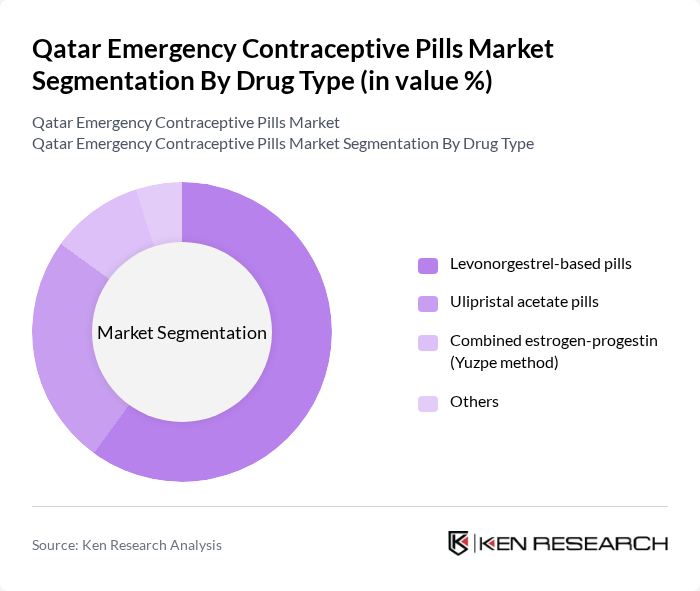
By Drug Type:The market is segmented into various drug types, including Levonorgestrel-based pills, Ulipristal acetate pills, Combined estrogen-progestin (Yuzpe method), and Others, in line with global clinical practice for emergency contraception. Among these, Levonorgestrel-based pills are the most widely used due to their established efficacy, favorable safety profile, single-dose convenience, and broad regulatory acceptance worldwide. The preference for this type is driven by consumer familiarity, wide availability of branded and generic formulations, and the endorsement of healthcare professionals and international guidelines. Ulipristal acetate pills are gaining traction as an alternative, particularly among women seeking a more effective option up to 120 hours after unprotected intercourse. The Combined estrogen-progestin (Yuzpe) method is less common due to higher rates of side effects and the availability of better-tolerated regimens, but it remains relevant where dedicated emergency contraceptive products are not immediately accessible. The Others category generally includes mifepristone-based regimens and newer hormonal combinations used in some markets.
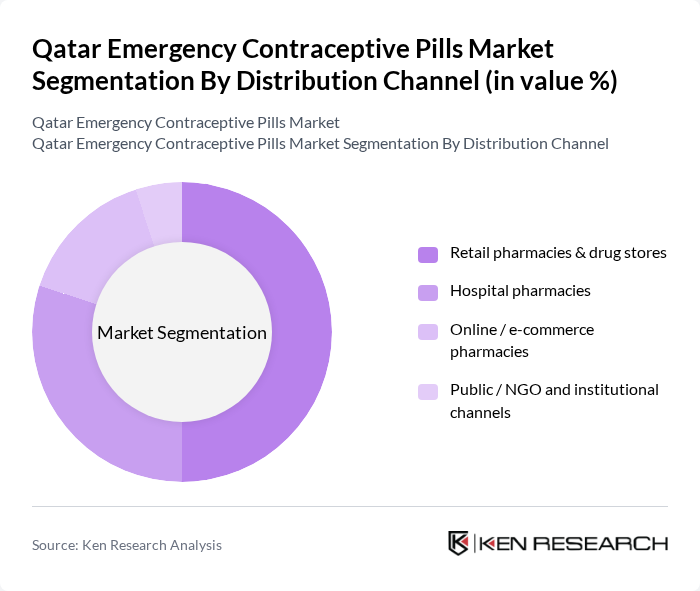
By Distribution Channel:The distribution channels for emergency contraceptive pills include Retail pharmacies & drug stores, Hospital pharmacies, Online / e-commerce pharmacies, and Public / NGO and institutional channels, mirroring the global emergency contraceptive pills distribution structure. Retail pharmacies dominate the market due to their widespread presence, extended opening hours, and immediate accessibility for consumers, as seen in other Middle East markets. Hospital pharmacies also play a significant role, particularly for women seeking advice from healthcare professionals in emergency departments, obstetrics-gynecology clinics, or after sexual assault. The rise of online and e-commerce pharmacies is notable in the Gulf region, as they offer convenience, discreet purchasing, and integration with teleconsultation services, appealing especially to younger, digitally engaged consumers. Public and NGO channels are crucial for outreach, counseling, and subsidized access for vulnerable groups, especially in the context of broader reproductive health and family planning programs.
Qatar Emergency Contraceptive Pills Market Competitive Landscape
The Qatar Emergency Contraceptive Pills Market is characterized by a dynamic mix of regional and international players. Leading participants such as Bayer AG, Pfizer Inc., Teva Pharmaceutical Industries Ltd., Viatris Inc. (including legacy Mylan), HRA Pharma (a Perrigo company), Gedeon Richter Plc., Organon & Co., Johnson & Johnson, Sandoz Group AG, Apotex Inc., Ferring Pharmaceuticals, Cipla Ltd., Aurobindo Pharma, Sun Pharmaceutical Industries Ltd., and local and regional generic manufacturers in GCC contribute to innovation, geographic expansion, and service delivery in this space.
Qatar Emergency Contraceptive Pills Market Industry Analysis
Growth Drivers
- Increasing Awareness of Reproductive Health:The awareness of reproductive health in Qatar has significantly increased, with 70% of women aged 18-49 reporting knowledge of emergency contraceptive pills in future. This rise is attributed to educational initiatives by the Ministry of Public Health, which allocated QAR 15 million for reproductive health campaigns. As a result, more women are seeking information and access to emergency contraceptive options, driving market growth.
- Rising Demand for Family Planning Solutions:The demand for family planning solutions in Qatar has surged, with a reported 25% increase in contraceptive use among women in the last five years. This trend is supported by the country's population growth rate of 1.5% annually, leading to a greater need for effective family planning methods. The government’s focus on reducing unplanned pregnancies further fuels the demand for emergency contraceptive pills.
- Government Initiatives Promoting Women's Health:The Qatari government has implemented various initiatives to promote women's health, including the National Health Strategy 2018-2022, which emphasizes reproductive health services. In future, the government invested QAR 20 million in women's health programs, enhancing access to emergency contraceptive pills. These initiatives are crucial in improving awareness and availability, thus driving market growth.
Market Challenges
- Cultural Stigma Surrounding Contraceptive Use:Cultural stigma remains a significant barrier to the acceptance of emergency contraceptive pills in Qatar. Approximately 40% of women express discomfort discussing contraceptive options due to societal norms. This stigma can hinder open conversations about reproductive health, limiting the market's potential growth and accessibility for women seeking these products.
- Regulatory Hurdles in Product Approval:The regulatory landscape for emergency contraceptive pills in Qatar presents challenges, with an average approval time of 18 months for new contraceptive products. This lengthy process can deter manufacturers from entering the market, limiting the availability of diverse options for consumers. Additionally, stringent regulations can stifle innovation in product development, impacting overall market growth.
Qatar Emergency Contraceptive Pills Market Future Outlook
The future of the Qatar emergency contraceptive pills market appears promising, driven by increasing awareness and government support for women's health initiatives. As cultural attitudes gradually shift, more women are likely to seek emergency contraceptive options. The expansion of online pharmacies and telemedicine services will further enhance accessibility, allowing for a more personalized healthcare experience. These trends indicate a potential for significant market growth in future, fostering a more informed and health-conscious population.
Market Opportunities
- Expansion of Online Pharmacies:The rise of e-commerce in Qatar presents a significant opportunity for emergency contraceptive pills. With online pharmacy sales projected to reach QAR 500 million by future, this channel can enhance accessibility and convenience for consumers, particularly in urban areas where traditional pharmacies may be limited.
- Collaborations with Healthcare Providers:Collaborating with healthcare providers can create opportunities for educational campaigns and improved distribution of emergency contraceptive pills. By partnering with clinics and hospitals, manufacturers can increase awareness and accessibility, potentially reaching an additional 30% of women who may not be aware of these options.
Scope of the Report
| Segment | Sub-Segments |
|---|---|
| By Drug Type | Levonorgestrel-based pills Ulipristal acetate pills Combined estrogen-progestin (Yuzpe method) Others |
| By Distribution Channel | Retail pharmacies & drug stores Hospital pharmacies Online / e-commerce pharmacies Public / NGO and institutional channels |
| By Prescription Status | Prescription-based (Rx) Over-the-counter (OTC) |
| By Age Group | –24 years –34 years –44 years years and above |
| By Setting of Use | Urban Semi-urban Rural |
Key Target Audience
Investors and Venture Capitalist Firms
Government and Regulatory Bodies (e.g., Ministry of Public Health, Qatar Pharmacy and Drug Control Department)
Manufacturers and Producers
Distributors and Retailers
Healthcare Providers and Clinics
Pharmaceutical Wholesalers
Non-Governmental Organizations (NGOs) focused on women's health
Health Insurance Companies
Players Mentioned in the Report:
Bayer AG
Pfizer Inc.
Teva Pharmaceutical Industries Ltd.
Viatris Inc. (including legacy Mylan)
HRA Pharma (a Perrigo company)
Gedeon Richter Plc.
Organon & Co.
Johnson & Johnson
Sandoz Group AG
Apotex Inc.
Ferring Pharmaceuticals
Cipla Ltd.
Aurobindo Pharma
Sun Pharmaceutical Industries Ltd.
Local and regional generic manufacturers in GCC
Table of Contents
Market Assessment Phase
1. Executive Summary and Approach
2. Qatar Emergency Contraceptive Pills Market Overview
2.1 Key Insights and Strategic Recommendations
2.2 Qatar Emergency Contraceptive Pills Market Overview
2.3 Definition and Scope
2.4 Evolution of Market Ecosystem
2.5 Timeline of Key Regulatory Milestones
2.6 Value Chain & Stakeholder Mapping
2.7 Business Cycle Analysis
2.8 Policy & Incentive Landscape
3. Qatar Emergency Contraceptive Pills Market Analysis
3.1 Growth Drivers
3.1.1 Increasing awareness of reproductive health
3.1.2 Rising demand for family planning solutions
3.1.3 Government initiatives promoting women's health
3.1.4 Accessibility of emergency contraceptive options
3.2 Market Challenges
3.2.1 Cultural stigma surrounding contraceptive use
3.2.2 Regulatory hurdles in product approval
3.2.3 Limited distribution channels
3.2.4 Misconceptions about emergency contraceptive pills
3.3 Market Opportunities
3.3.1 Expansion of online pharmacies
3.3.2 Collaborations with healthcare providers
3.3.3 Introduction of new product formulations
3.3.4 Educational campaigns targeting young adults
3.4 Market Trends
3.4.1 Shift towards over-the-counter availability
3.4.2 Increasing focus on women's health initiatives
3.4.3 Growth of telemedicine services
3.4.4 Rising popularity of personalized healthcare solutions
3.5 Government Regulation
3.5.1 Approval processes for new contraceptive products
3.5.2 Guidelines for advertising and promotion
3.5.3 Regulations on distribution and sales
3.5.4 Policies supporting reproductive health education
4. SWOT Analysis
5. Stakeholder Analysis
6. Porter's Five Forces Analysis
7. Qatar Emergency Contraceptive Pills Market Size, 2019-2024
7.1 By Value
7.2 By Volume
7.3 By Average Selling Price
8. Qatar Emergency Contraceptive Pills Market Segmentation
8.1 By Drug Type
8.1.1 Levonorgestrel-based pills
8.1.2 Ulipristal acetate pills
8.1.3 Combined estrogen-progestin (Yuzpe method)
8.1.4 Others
8.2 By Distribution Channel
8.2.1 Retail pharmacies & drug stores
8.2.2 Hospital pharmacies
8.2.3 Online / e-commerce pharmacies
8.2.4 Public / NGO and institutional channels
8.3 By Prescription Status
8.3.1 Prescription-based (Rx)
8.3.2 Over-the-counter (OTC)
8.4 By Age Group
8.4.1 15–24 years
8.4.2 25–34 years
8.4.3 35–44 years
8.4.4 45 years and above
8.5 By Setting of Use
8.5.1 Urban
8.5.2 Semi-urban
8.5.3 Rural
9. Qatar Emergency Contraceptive Pills Market Competitive Analysis
9.1 Market Share of Key Players
9.2 Cross Comparison of Key Players
9.2.1 Company name
9.2.2 Regional presence (domestic vs multinational)
9.2.3 Annual ECP revenue in Qatar (USD million)
9.2.4 ECP volume sold in Qatar (thousand packs per year)
9.2.5 Market share by value (%)
9.2.6 Market share by volume (%)
9.2.7 3-year revenue CAGR in Qatar ECP portfolio (%)
9.2.8 Gross margin on ECP portfolio (%)
9.2.9 Average selling price per pack (USD)
9.2.10 Number of SKUs in ECP portfolio
9.2.11 Pharmacy coverage in Qatar (% of registered pharmacies reached)
9.2.12 Share of online / e-commerce sales in total ECP sales (%)
9.2.13 Marketing & promotion spend as % of ECP sales
9.2.14 New ECP / formulation launches in last 3 years (number)
9.2.15 Regulatory / pharmacovigilance compliance track record (flags, warnings)
9.3 SWOT Analysis of Top Players
9.4 Pricing Analysis
9.5 Detailed Profile of Major Companies
9.5.1 Bayer AG
9.5.2 Pfizer Inc.
9.5.3 Teva Pharmaceutical Industries Ltd.
9.5.4 Viatris Inc. (including legacy Mylan)
9.5.5 HRA Pharma (a Perrigo company)
9.5.6 Gedeon Richter Plc.
9.5.7 Organon & Co.
9.5.8 Johnson & Johnson
9.5.9 Sandoz Group AG
9.5.10 Apotex Inc.
9.5.11 Ferring Pharmaceuticals
9.5.12 Cipla Ltd.
9.5.13 Aurobindo Pharma
9.5.14 Sun Pharmaceutical Industries Ltd.
9.5.15 Local and regional generic manufacturers in GCC
10. Qatar Emergency Contraceptive Pills Market End-User Analysis
10.1 Procurement Behavior of Key Ministries
10.1.1 Ministry of Public Health
10.1.2 Ministry of Education
10.1.3 Ministry of Social Development
10.1.4 Others
10.2 Corporate Spend on Infrastructure & Energy
10.2.1 Healthcare infrastructure investments
10.2.2 Funding for reproductive health programs
10.2.3 Corporate partnerships with NGOs
10.2.4 Others
10.3 Pain Point Analysis by End-User Category
10.3.1 Accessibility issues
10.3.2 Affordability concerns
10.3.3 Lack of awareness
10.3.4 Others
10.4 User Readiness for Adoption
10.4.1 Attitudes towards emergency contraception
10.4.2 Knowledge of available options
10.4.3 Willingness to seek medical advice
10.4.4 Others
10.5 Post-Deployment ROI and Use Case Expansion
10.5.1 Effectiveness of emergency contraceptive pills
10.5.2 User satisfaction rates
10.5.3 Opportunities for product line expansion
10.5.4 Others
11. Qatar Emergency Contraceptive Pills Market Future Size, 2025-2030
11.1 By Value
11.2 By Volume
11.3 By Average Selling Price
Go-To-Market Strategy Phase
1. Whitespace Analysis + Business Model Canvas
1.1 Market gaps identification
1.2 Business model development
2. Marketing and Positioning Recommendations
2.1 Branding strategies
2.2 Product USPs
3. Distribution Plan
3.1 Urban retail vs rural NGO tie-ups
4. Channel & Pricing Gaps
4.1 Underserved routes
4.2 Pricing bands
5. Unmet Demand & Latent Needs
5.1 Category gaps
5.2 Consumer segments
6. Customer Relationship
6.1 Loyalty programs
6.2 After-sales service
7. Value Proposition
7.1 Sustainability
7.2 Integrated supply chains
8. Key Activities
8.1 Regulatory compliance
8.2 Branding
8.3 Distribution setup
9. Entry Strategy Evaluation
9.1 Domestic Market Entry Strategy
9.1.1 Product mix
9.1.2 Pricing band
9.1.3 Packaging
9.2 Export Entry Strategy
9.2.1 Target countries
9.2.2 Compliance roadmap
10. Entry Mode Assessment
10.1 JV
10.2 Greenfield
10.3 M&A
10.4 Distributor Model
11. Capital and Timeline Estimation
11.1 Capital requirements
11.2 Timelines
12. Control vs Risk Trade-Off
12.1 Ownership vs Partnerships
13. Profitability Outlook
13.1 Breakeven analysis
13.2 Long-term sustainability
14. Potential Partner List
14.1 Distributors
14.2 JVs
14.3 Acquisition targets
15. Execution Roadmap
15.1 Phased Plan for Market Entry
15.1.1 Market Setup
15.1.2 Market Entry
15.1.3 Growth Acceleration
15.1.4 Scale & Stabilize
15.2 Key Activities and Milestones
15.2.1 Milestone tracking
15.2.2 Activity scheduling
Research Methodology
Phase 1: Approach1
Desk Research
- Analysis of market reports from health organizations and pharmaceutical associations in Qatar
- Review of academic journals and publications on emergency contraceptive usage and trends
- Examination of demographic and health surveys to understand population needs and preferences
Primary Research
- Interviews with healthcare professionals, including gynecologists and pharmacists
- Surveys conducted with women of reproductive age to gauge awareness and usage of emergency contraceptive pills
- Focus group discussions with community health workers to understand cultural perceptions and barriers
Validation & Triangulation
- Cross-validation of findings through multiple data sources, including government health statistics
- Triangulation of qualitative insights from interviews with quantitative data from surveys
- Sanity checks through expert panel reviews comprising healthcare professionals and market analysts
Phase 2: Market Size Estimation1
Top-down Assessment
- Estimation of total market size based on national health expenditure and contraceptive spending
- Segmentation of the market by age group, income level, and urban vs. rural distribution
- Incorporation of government health initiatives promoting family planning and reproductive health
Bottom-up Modeling
- Collection of sales data from pharmacies and healthcare providers offering emergency contraceptive pills
- Estimation of average price points and volume sold across different distribution channels
- Analysis of consumer purchasing behavior and frequency of emergency contraceptive use
Forecasting & Scenario Analysis
- Multi-factor regression analysis considering factors such as population growth and changing societal attitudes towards contraception
- Scenario modeling based on potential changes in healthcare policies and access to contraceptive methods
- Development of baseline, optimistic, and pessimistic market projections through 2030
Phase 3: CATI Sample Composition1
| Scope Item/Segment | Sample Size | Target Respondent Profiles |
|---|---|---|
| Healthcare Professionals | 100 | Gynecologists, Family Medicine Doctors |
| Pharmacy Representatives | 80 | Pharmacists, Pharmacy Managers |
| Women of Reproductive Age | 150 | Women aged 18-45, Diverse Socioeconomic Backgrounds |
| Community Health Workers | 60 | Health Educators, Outreach Coordinators |
| Policy Makers | 50 | Government Health Officials, NGO Representatives |
Frequently Asked Questions
What is the current value of the Qatar Emergency Contraceptive Pills Market?
The Qatar Emergency Contraceptive Pills Market is valued at approximately USD 1011 million, reflecting a steady growth trend driven by increased awareness of reproductive health and demand for family planning solutions among women in Qatar.
What factors are driving the growth of the emergency contraceptive pills market in Qatar?
Which cities in Qatar dominate the emergency contraceptive pills market?
What types of emergency contraceptive pills are available in Qatar?
Other Regional/Country Reports
Other Adjacent Reports
Indonesia Hormonal Contraceptives Market
Belgium Family Planning Market
Japan Womens Health Market
Bahrain Reproductive Health Market
Malaysia Oral Contraceptives Market
Vietnam Pharmaceutical Distribution Market
Thailand Online Pharmacy Market
South Africa Generic Pharmaceuticals Market
UAE Over-the-Counter Drugs Market
Germany Sexual Health Market
Why Buy From Us?

What makes us stand out is that our consultants follow Robust, Refine and Result (RRR) methodology. Robust for clear definitions, approaches and sanity checking, Refine for differentiating respondents' facts and opinions, and Result for presenting data with story.

We have set a benchmark in the industry by offering our clients with syndicated and customized market research reports featuring coverage of entire market as well as meticulous research and analyst insights.

While we don't replace traditional research, we flip the method upside down. Our dual approach of Top Bottom & Bottom Top ensures quality deliverable by not just verifying company fundamentals but also looking at the sector and macroeconomic factors.

With one step in the future, our research team constantly tries to show you the bigger picture. We help with some of the tough questions you may encounter along the way: How is the industry positioned? Best marketing channel? KPI's of competitors? By aligning every element, we help maximize success.

Our report gives you instant access to the answers and sources that other companies might choose to hide. We elaborate each steps of research methodology we have used and showcase you the sample size to earn your trust.

If you need any support, we are here! We pride ourselves on universe strength, data quality, and quick, friendly, and professional service.