Ken Research Logo

Qatar Gas Electric Pressure Cooker Market Size, Share, Growth Drivers, Trends, Opportunities & Forecast 2025–2030

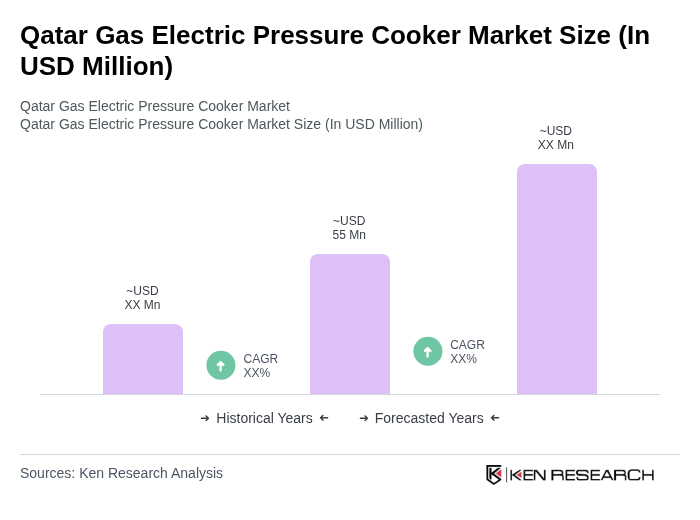
The Qatar gas electric pressure cooker market, valued at USD 55 million, is growing due to convenient cooking needs, energy efficiency, and e-commerce expansion.

Region:Middle East

Author(s):Rebecca

Product Code:KRAD2903

Pages:88

Published On:November 2025
About the Report

Base Year 2024

Qatar Gas Electric Pressure Cooker Market Overview

  • The Qatar Gas Electric Pressure Cooker Market is valued at USD 55 million, based on a five-year historical analysis. This growth is primarily driven by the increasing demand for convenient cooking solutions among busy households and the rising trend of home cooking, especially during the pandemic. The market has seen a surge in interest for energy-efficient appliances, which has further propelled the sales of electric pressure cookers. Urbanization and a growing expatriate population are also contributing to the adoption of modern kitchen appliances in Qatar .
  • Key cities such as Doha and Al Rayyan dominate the market due to their high population density and urban lifestyle, which fosters a demand for modern kitchen appliances. Additionally, the affluent consumer base in these areas is more inclined to invest in advanced cooking technologies, contributing to the market's growth. The expansion of retail infrastructure and e-commerce platforms has further facilitated access to a wide range of pressure cooker models .
  • In 2023, the Qatari government implemented the Qatar Energy Efficiency Standards and Labelling Regulations, which set mandatory energy performance requirements for household appliances, including electric pressure cookers. This initiative encourages manufacturers to adhere to energy-saving standards, thereby enhancing the market's sustainability and reducing the overall carbon footprint of household cooking appliances.
Qatar Gas Electric Pressure Cooker Market Size

Qatar Gas Electric Pressure Cooker Market Segmentation

By Type:The market is segmented into four main types: Standard Gas Pressure Cookers, Standard Electric Pressure Cookers, Multi-Function (Gas/Electric) Pressure Cookers, and Smart/Connected Pressure Cookers. Among these, Standard Electric Pressure Cookers are gaining significant traction due to their ease of use and energy efficiency. The trend towards smart cooking solutions is also on the rise, with Smart/Connected Pressure Cookers appealing to tech-savvy consumers. Multi-function models are increasingly preferred for their versatility in both gas and electric cooking environments .
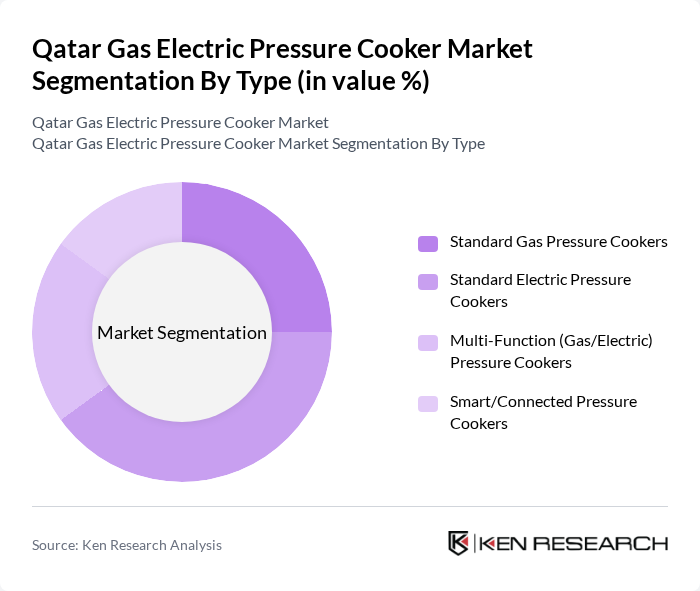
Qatar Gas Electric Pressure Cooker Market segmentation by Type.

By End-User:The market is categorized into Residential, Commercial (Hotels, Restaurants, Catering), and Institutional (Schools, Hospitals, Canteens) segments. The Residential segment is the largest, driven by the growing trend of home cooking and the increasing number of households investing in modern kitchen appliances. Commercial establishments are also adopting electric pressure cookers for their efficiency and speed in food preparation, particularly in response to rising labor costs and the need for rapid service in hotels and restaurants .
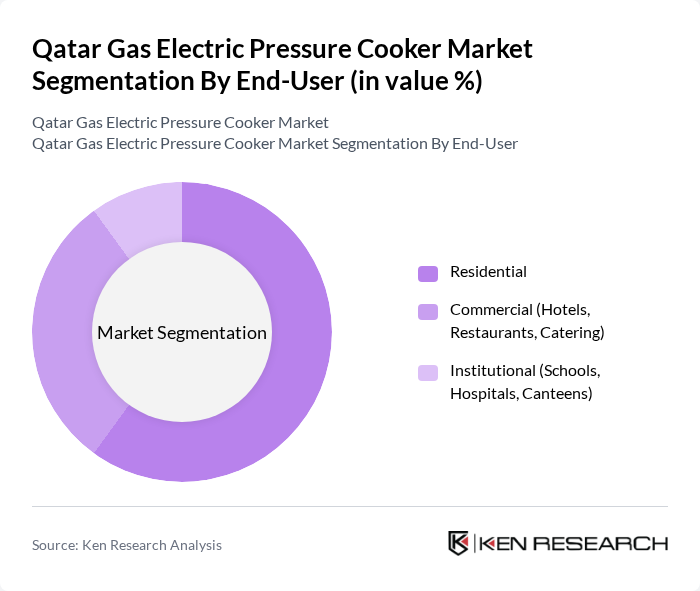
Qatar Gas Electric Pressure Cooker Market segmentation by End-User.

Qatar Gas Electric Pressure Cooker Market Competitive Landscape

The Qatar Gas Electric Pressure Cooker Market is characterized by a dynamic mix of regional and international players. Leading participants such as Philips (Koninklijke Philips N.V.), Tefal (Groupe SEB), Instant Pot (Instant Brands Inc.), Black+Decker (Stanley Black & Decker, Inc.), Cuisinart (Conair Corporation), Prestige (TTK Prestige Ltd.), Morphy Richards (Glen Dimplex Group), Panasonic (Panasonic Corporation), Breville (Breville Group Limited), Zojirushi (Zojirushi Corporation), Hamilton Beach (Hamilton Beach Brands Holding Company), Crock-Pot (Newell Brands Inc.), Aroma Housewares (Aroma Housewares Company), Russell Hobbs (Spectrum Brands Holdings, Inc.), Kenwood (Kenwood Limited, De'Longhi Group) contribute to innovation, geographic expansion, and service delivery in this space.

Philips

1891

Amsterdam, Netherlands

Tefal

1956

Rumilly, France

Instant Pot

2009

Toronto, Canada

Black+Decker

1910

Towson, Maryland, USA

Cuisinart

1973

East Windsor, New Jersey, USA

Company

Establishment Year

Headquarters

Company Size (Large, Medium, Small)

Annual Revenue (USD/QAR)

Market Share in Qatar (%)

Sales Volume (Units Sold in Qatar)

Product Portfolio Breadth (Number of Models/Types)

Distribution Network Coverage (Number of Retail Outlets/Channels)

Qatar Gas Electric Pressure Cooker Market Industry Analysis

Growth Drivers

  • Increasing Consumer Demand for Energy-Efficient Cooking Solutions:The demand for energy-efficient cooking appliances in Qatar is on the rise, driven by a growing awareness of energy conservation. In future, Qatar's energy consumption is projected to reach 1,600 TWh, with households increasingly seeking appliances that reduce energy usage. Gas electric pressure cookers, which can save up to 75% more energy compared to traditional cooking methods, are becoming popular among consumers looking to lower their utility bills while maintaining cooking efficiency.
  • Rising Awareness of Health Benefits Associated with Pressure Cooking:Health-conscious consumers in Qatar are increasingly recognizing the nutritional advantages of pressure cooking. Studies indicate that pressure cooking can preserve up to 92% of vitamins and minerals in food, compared to other cooking methods. With Qatar's obesity rate at 38% in future, the shift towards healthier cooking options is significant. This trend is driving sales of gas electric pressure cookers, as they offer a quick and healthy cooking alternative for busy families.
  • Expansion of Retail Channels and E-commerce Platforms:The retail landscape in Qatar is evolving, with a notable increase in e-commerce adoption. In future, online retail sales are expected to reach QAR 6 billion, reflecting a 25% growth from the previous year. This expansion allows consumers easier access to gas electric pressure cookers through various platforms. Retailers are also enhancing their online presence, offering promotions and discounts that attract tech-savvy consumers, further boosting market growth.

Market Challenges

  • High Initial Cost of Gas Electric Pressure Cookers:One of the significant barriers to market growth is the high initial cost associated with gas electric pressure cookers. The average price of these appliances in Qatar is around QAR 1,300, which can deter price-sensitive consumers. With the average household income in Qatar projected at QAR 16,000 in future, many consumers may opt for cheaper, traditional cooking methods, limiting the market's potential for expansion.
  • Competition from Traditional Cooking Methods:Traditional cooking methods remain deeply ingrained in Qatari culture, posing a challenge to the adoption of gas electric pressure cookers. Many households still prefer conventional stoves and pots, which are perceived as more reliable. In future, approximately 62% of households continue to use traditional cooking methods, indicating a strong resistance to change. This cultural preference can hinder the market penetration of newer cooking technologies.

Qatar Gas Electric Pressure Cooker Market Future Outlook

The future of the gas electric pressure cooker market in Qatar appears promising, driven by technological advancements and changing consumer preferences. As more households embrace smart home technologies, the integration of IoT features in cooking appliances is expected to gain traction. Additionally, the increasing focus on sustainability will likely push manufacturers to innovate eco-friendly products, aligning with global trends. These factors will create a conducive environment for market growth, enhancing the overall consumer experience in the kitchen.

Market Opportunities

  • Growing Trend of Smart Home Appliances:The rise of smart home technology presents a significant opportunity for gas electric pressure cooker manufacturers. In future, the smart appliance market in Qatar is projected to grow by 18%, indicating a shift towards connected devices. By incorporating smart features, brands can attract tech-savvy consumers looking for convenience and efficiency in their cooking experiences.
  • Potential for Product Innovation and Customization:There is a growing demand for customized cooking solutions in Qatar. Consumers are increasingly seeking products that cater to their specific dietary needs and preferences. In future, the market for personalized kitchen appliances is expected to expand, providing manufacturers with the opportunity to innovate and offer tailored features, such as programmable settings and specialized cooking modes, enhancing user satisfaction.

Scope of the Report

SegmentSub-Segments
By Type

Standard Gas Pressure Cookers

Standard Electric Pressure Cookers

Multi-Function (Gas/Electric) Pressure Cookers

Smart/Connected Pressure Cookers

By End-User

Residential

Commercial (Hotels, Restaurants, Catering)

Institutional (Schools, Hospitals, Canteens)

By Material

Stainless Steel

Aluminum

Non-Stick Coated

Others (Composite, Ceramic-Coated)

By Capacity

Less than 3 Liters

to 5 Liters

More than 5 Liters

By Distribution Channel

Online Retail (E-commerce Platforms)

Offline Retail (Hypermarkets, Specialty Stores)

Direct Sales (Brand Stores, Distributors)

By Brand

Local Qatari Brands

International Brands

Private Labels

By Price Range

Budget

Mid-Range

Premium

Key Target Audience

Investors and Venture Capitalist Firms

Government and Regulatory Bodies (e.g., Ministry of Energy and Industry, Qatar General Electricity and Water Corporation)

Manufacturers and Producers

Distributors and Retailers

Energy Sector Stakeholders

Technology Providers

Industry Associations (e.g., Qatar Chamber of Commerce)

Financial Institutions

Players Mentioned in the Report:

Philips (Koninklijke Philips N.V.)

Tefal (Groupe SEB)

Instant Pot (Instant Brands Inc.)

Black+Decker (Stanley Black & Decker, Inc.)

Cuisinart (Conair Corporation)

Prestige (TTK Prestige Ltd.)

Morphy Richards (Glen Dimplex Group)

Panasonic (Panasonic Corporation)

Breville (Breville Group Limited)

Zojirushi (Zojirushi Corporation)

Hamilton Beach (Hamilton Beach Brands Holding Company)

Crock-Pot (Newell Brands Inc.)

Aroma Housewares (Aroma Housewares Company)

Russell Hobbs (Spectrum Brands Holdings, Inc.)

Kenwood (Kenwood Limited, De'Longhi Group)

Table of Contents

Market Assessment Phase

1. Executive Summary and Approach


2. Qatar Gas Electric Pressure Cooker Market Overview

2.1 Key Insights and Strategic Recommendations

2.2 Qatar Gas Electric Pressure Cooker Market Overview

2.3 Definition and Scope

2.4 Evolution of Market Ecosystem

2.5 Timeline of Key Regulatory Milestones

2.6 Value Chain & Stakeholder Mapping

2.7 Business Cycle Analysis

2.8 Policy & Incentive Landscape


3. Qatar Gas Electric Pressure Cooker Market Analysis

3.1 Growth Drivers

3.1.1 Increasing Consumer Demand for Energy-Efficient Cooking Solutions
3.1.2 Rising Awareness of Health Benefits Associated with Pressure Cooking
3.1.3 Expansion of Retail Channels and E-commerce Platforms
3.1.4 Technological Advancements in Cooking Appliances

3.2 Market Challenges

3.2.1 High Initial Cost of Gas Electric Pressure Cookers
3.2.2 Competition from Traditional Cooking Methods
3.2.3 Limited Consumer Awareness in Certain Segments
3.2.4 Regulatory Compliance and Safety Standards

3.3 Market Opportunities

3.3.1 Growing Trend of Smart Home Appliances
3.3.2 Potential for Product Innovation and Customization
3.3.3 Expansion into Untapped Rural Markets
3.3.4 Collaborations with Culinary Influencers and Chefs

3.4 Market Trends

3.4.1 Increasing Popularity of Multi-Functional Cookers
3.4.2 Shift Towards Sustainable and Eco-Friendly Products
3.4.3 Rise in Online Cooking Classes and Tutorials
3.4.4 Enhanced Focus on User-Friendly Interfaces and Smart Features

3.5 Government Regulation

3.5.1 Safety Standards for Electrical Appliances
3.5.2 Energy Efficiency Regulations
3.5.3 Import Tariffs and Trade Policies
3.5.4 Consumer Protection Laws

4. SWOT Analysis


5. Stakeholder Analysis


6. Porter's Five Forces Analysis


7. Qatar Gas Electric Pressure Cooker Market Market Size, 2019-2024

7.1 By Value

7.2 By Volume

7.3 By Average Selling Price


8. Qatar Gas Electric Pressure Cooker Market Segmentation

8.1 By Type

8.1.1 Standard Gas Pressure Cookers
8.1.2 Standard Electric Pressure Cookers
8.1.3 Multi-Function (Gas/Electric) Pressure Cookers
8.1.4 Smart/Connected Pressure Cookers

8.2 By End-User

8.2.1 Residential
8.2.2 Commercial (Hotels, Restaurants, Catering)
8.2.3 Institutional (Schools, Hospitals, Canteens)

8.3 By Material

8.3.1 Stainless Steel
8.3.2 Aluminum
8.3.3 Non-Stick Coated
8.3.4 Others (Composite, Ceramic-Coated)

8.4 By Capacity

8.4.1 Less than 3 Liters
8.4.2 3 to 5 Liters
8.4.3 More than 5 Liters

8.5 By Distribution Channel

8.5.1 Online Retail (E-commerce Platforms)
8.5.2 Offline Retail (Hypermarkets, Specialty Stores)
8.5.3 Direct Sales (Brand Stores, Distributors)

8.6 By Brand

8.6.1 Local Qatari Brands
8.6.2 International Brands
8.6.3 Private Labels

8.7 By Price Range

8.7.1 Budget
8.7.2 Mid-Range
8.7.3 Premium

9. Qatar Gas Electric Pressure Cooker Market Competitive Analysis

9.1 Market Share of Key Players

9.2 Cross Comparison of Key Players

9.2.1 Company Name
9.2.2 Company Size (Large, Medium, Small)
9.2.3 Annual Revenue (USD/QAR)
9.2.4 Market Share in Qatar (%)
9.2.5 Sales Volume (Units Sold in Qatar)
9.2.6 Product Portfolio Breadth (Number of Models/Types)
9.2.7 Distribution Network Coverage (Number of Retail Outlets/Channels)
9.2.8 Average Retail Price (QAR)
9.2.9 After-Sales Service Availability (Service Centers in Qatar)
9.2.10 Customer Satisfaction Score (Qatar Market)

9.3 SWOT Analysis of Top Players

9.4 Pricing Analysis

9.5 Detailed Profile of Major Companies

9.5.1 Philips (Koninklijke Philips N.V.)
9.5.2 Tefal (Groupe SEB)
9.5.3 Instant Pot (Instant Brands Inc.)
9.5.4 Black+Decker (Stanley Black & Decker, Inc.)
9.5.5 Cuisinart (Conair Corporation)
9.5.6 Prestige (TTK Prestige Ltd.)
9.5.7 Morphy Richards (Glen Dimplex Group)
9.5.8 Panasonic (Panasonic Corporation)
9.5.9 Breville (Breville Group Limited)
9.5.10 Zojirushi (Zojirushi Corporation)
9.5.11 Hamilton Beach (Hamilton Beach Brands Holding Company)
9.5.12 Crock-Pot (Newell Brands Inc.)
9.5.13 Aroma Housewares (Aroma Housewares Company)
9.5.14 Russell Hobbs (Spectrum Brands Holdings, Inc.)
9.5.15 Kenwood (Kenwood Limited, De'Longhi Group)

10. Qatar Gas Electric Pressure Cooker Market End-User Analysis

10.1 Procurement Behavior of Key Ministries

10.1.1 Budget Allocation for Kitchen Appliances
10.1.2 Preference for Energy-Efficient Products
10.1.3 Supplier Selection Criteria
10.1.4 Procurement Timelines

10.2 Corporate Spend on Infrastructure & Energy

10.2.1 Investment in Modern Kitchen Equipment
10.2.2 Budgeting for Employee Welfare Programs
10.2.3 Trends in Corporate Gifting
10.2.4 Energy Management Initiatives

10.3 Pain Point Analysis by End-User Category

10.3.1 High Energy Costs
10.3.2 Limited Cooking Space
10.3.3 Need for Quick Meal Preparation
10.3.4 Safety Concerns with Traditional Cooking Methods

10.4 User Readiness for Adoption

10.4.1 Awareness of Benefits of Pressure Cooking
10.4.2 Availability of User Training and Support
10.4.3 Consumer Feedback and Reviews
10.4.4 Accessibility of Products in Retail Outlets

10.5 Post-Deployment ROI and Use Case Expansion

10.5.1 Cost Savings on Energy Bills
10.5.2 Increased Cooking Efficiency
10.5.3 Expansion of Recipe Options
10.5.4 User Satisfaction and Repeat Purchases

11. Qatar Gas Electric Pressure Cooker Market Future Size, 2025-2030

11.1 By Value

11.2 By Volume

11.3 By Average Selling Price


Go-To-Market Strategy Phase

1. Whitespace Analysis + Business Model Canvas

1.1 Market Gaps Identification

1.2 Value Proposition Development

1.3 Revenue Streams Analysis

1.4 Cost Structure Evaluation

1.5 Key Partnerships Exploration

1.6 Customer Segmentation

1.7 Channels of Distribution


2. Marketing and Positioning Recommendations

2.1 Branding Strategies

2.2 Product USPs

2.3 Target Audience Identification

2.4 Communication Strategy

2.5 Digital Marketing Tactics

2.6 Offline Marketing Approaches

2.7 Performance Metrics


3. Distribution Plan

3.1 Urban Retail Strategies

3.2 Rural NGO Tie-Ups

3.3 E-commerce Partnerships

3.4 Logistics and Supply Chain Management

3.5 Inventory Management Solutions

3.6 Customer Service Framework

3.7 Distribution Channel Optimization


4. Channel & Pricing Gaps

4.1 Underserved Routes

4.2 Pricing Bands Analysis

4.3 Competitor Pricing Strategies

4.4 Consumer Price Sensitivity

4.5 Promotional Pricing Tactics

4.6 Price Adjustment Mechanisms

4.7 Value-Based Pricing Models


5. Unmet Demand & Latent Needs

5.1 Category Gaps Identification

5.2 Consumer Segments Analysis

5.3 Product Feature Demand

5.4 Market Entry Opportunities

5.5 Innovation Needs Assessment

5.6 Customer Feedback Integration

5.7 Future Trends Anticipation


6. Customer Relationship

6.1 Loyalty Programs

6.2 After-sales Service

6.3 Customer Engagement Strategies

6.4 Feedback Mechanisms

6.5 Community Building Initiatives

6.6 Customer Education Programs

6.7 Relationship Management Tools


7. Value Proposition

7.1 Sustainability Initiatives

7.2 Integrated Supply Chains

7.3 Unique Selling Points

7.4 Customer-Centric Innovations

7.5 Competitive Advantage Analysis

7.6 Market Differentiation Strategies

7.7 Value Communication Strategies


8. Key Activities

8.1 Regulatory Compliance

8.2 Branding Initiatives

8.3 Distribution Setup

8.4 Marketing Campaigns

8.5 Training and Development

8.6 Performance Monitoring

8.7 Risk Management Strategies


9. Entry Strategy Evaluation

9.1 Domestic Market Entry Strategy

9.1.1 Product Mix Considerations
9.1.2 Pricing Band Analysis
9.1.3 Packaging Strategies

9.2 Export Entry Strategy

9.2.1 Target Countries Identification
9.2.2 Compliance Roadmap Development

10. Entry Mode Assessment

10.1 Joint Ventures

10.2 Greenfield Investments

10.3 Mergers & Acquisitions

10.4 Distributor Model Evaluation

10.5 Risk Assessment

10.6 Strategic Fit Analysis

10.7 Long-term Viability Considerations


11. Capital and Timeline Estimation

11.1 Capital Requirements

11.2 Timelines for Implementation

11.3 Financial Projections

11.4 Funding Sources Exploration

11.5 Budget Allocation Strategies

11.6 Cost-Benefit Analysis

11.7 Financial Risk Management


12. Control vs Risk Trade-Off

12.1 Ownership vs Partnerships

12.2 Risk Mitigation Strategies

12.3 Control Mechanisms

12.4 Partnership Evaluation Criteria

12.5 Long-term Control Strategies

12.6 Risk Assessment Framework

12.7 Strategic Decision-Making Processes


13. Profitability Outlook

13.1 Breakeven Analysis

13.2 Long-term Sustainability

13.3 Profit Margin Projections

13.4 Revenue Growth Strategies

13.5 Cost Management Techniques

13.6 Financial Health Indicators

13.7 Market Positioning for Profitability


14. Potential Partner List

14.1 Distributors

14.2 Joint Ventures

14.3 Acquisition Targets

14.4 Strategic Alliances

14.5 Supplier Partnerships

14.6 Industry Collaborations

14.7 Networking Opportunities


15. Execution Roadmap

15.1 Phased Plan for Market Entry

15.1.1 Market Setup
15.1.2 Market Entry
15.1.3 Growth Acceleration
15.1.4 Scale & Stabilize

15.2 Key Activities and Milestones

15.2.1 Activity Planning
15.2.2 Milestone Tracking
15.2.3 Performance Evaluation
15.2.4 Adjustment Strategies</h

Research Methodology

ApproachModellingSample

Phase 1: Approach1

Desk Research

  • Analysis of market reports from Qatar's Ministry of Energy and Industry
  • Review of consumer behavior studies published by local universities
  • Examination of import/export data from Qatar's Customs Authority

Primary Research

  • Interviews with product managers at leading kitchen appliance retailers
  • Surveys conducted with consumers who own electric pressure cookers
  • Focus groups with culinary experts and home chefs in Qatar

Validation & Triangulation

  • Cross-validation of findings with industry reports and consumer feedback
  • Triangulation of data from sales figures and market trends
  • Sanity checks through expert consultations with market analysts

Phase 2: Market Size Estimation1

Top-down Assessment

  • Estimation of market size based on national household appliance spending
  • Segmentation by consumer demographics and purchasing patterns
  • Incorporation of growth trends in the home cooking segment

Bottom-up Modeling

  • Volume estimates derived from sales data of major retailers in Qatar
  • Cost analysis based on average retail prices of electric pressure cookers
  • Calculation of market size using unit sales and average selling price

Forecasting & Scenario Analysis

  • Multi-variable forecasting considering economic growth and consumer trends
  • Scenario analysis based on potential shifts in consumer preferences
  • Baseline and optimistic projections through 2028

Phase 3: CATI Sample Composition1

Scope Item/SegmentSample SizeTarget Respondent Profiles
Household Electric Pressure Cooker Users150Homeowners, Cooking Enthusiasts
Retailers of Kitchen Appliances40Store Managers, Sales Representatives
Professional Chefs and Culinary Experts50Restaurant Owners, Culinary Instructors
Market Analysts and Industry Experts40Market Researchers, Industry Consultants
Consumers Interested in Kitchen Innovations80Tech-Savvy Home Cooks, Food Bloggers

Frequently Asked Questions

What is the current value of the Qatar Gas Electric Pressure Cooker Market?

The Qatar Gas Electric Pressure Cooker Market is valued at approximately USD 55 million, reflecting a growing demand for convenient and energy-efficient cooking solutions, particularly during the pandemic and amidst rising home cooking trends.

What factors are driving the growth of the Qatar Gas Electric Pressure Cooker Market?

Which cities in Qatar are leading in the Gas Electric Pressure Cooker Market?

What types of pressure cookers are available in the Qatar market?

Other Regional/Country Reports

Indonesia Gas Electric Pressure Cooker Market

Malaysia Gas Electric Pressure Cooker Market

KSA Gas Electric Pressure Cooker Market

APAC Gas Electric Pressure Cooker Market

SEA Gas Electric Pressure Cooker Market

Vietnam Gas Electric Pressure Cooker Market

Why Buy From Us?

Refine Robust Result (RRR) Framework

What makes us stand out is that our consultants follow Robust, Refine and Result (RRR) methodology. Robust for clear definitions, approaches and sanity checking, Refine for differentiating respondents' facts and opinions, and Result for presenting data with story.

Our Reach Is Unmatched

We have set a benchmark in the industry by offering our clients with syndicated and customized market research reports featuring coverage of entire market as well as meticulous research and analyst insights.

Shifting the Research Paradigm

While we don't replace traditional research, we flip the method upside down. Our dual approach of Top Bottom & Bottom Top ensures quality deliverable by not just verifying company fundamentals but also looking at the sector and macroeconomic factors.

More Insights-Better Decisions

With one step in the future, our research team constantly tries to show you the bigger picture. We help with some of the tough questions you may encounter along the way: How is the industry positioned? Best marketing channel? KPI's of competitors? By aligning every element, we help maximize success.

Transparency and Trust

Our report gives you instant access to the answers and sources that other companies might choose to hide. We elaborate each steps of research methodology we have used and showcase you the sample size to earn your trust.

Round the Clock Support

If you need any support, we are here! We pride ourselves on universe strength, data quality, and quick, friendly, and professional service.

Why Clients Choose Us?

400000+
Reports in repository
150+
Consulting projects a year
100+
Analysts
8000+
Client Queries in 2022








