Qatar Hospital Outsourcing Market Size, Share, Growth Drivers, Trends, Opportunities & Forecast 2025–2030

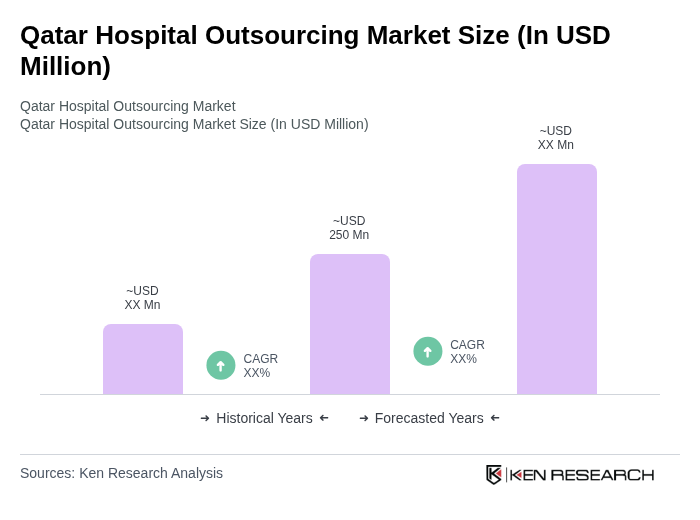
Qatar Hospital Outsourcing Market, valued at USD 250 million, grows due to specialized healthcare demand, operational efficiency, and government initiatives for better infrastructure.

Region:Middle East

Author(s):Rebecca

Product Code:KRAD7447

Pages:86

Published On:December 2025
About the Report

Base Year 2024

Qatar Hospital Outsourcing Market Overview

  • The Qatar Hospital Outsourcing Market is valued at USD 250 million, based on a five-year historical analysis. This growth is primarily driven by the increasing demand for specialized healthcare services, the rising cost of healthcare delivery, the need for hospitals to focus on core competencies while outsourcing non-core functions, and government initiatives to enhance operational efficiency in healthcare infrastructure. The market is also supported by advancements in technology, the growing trend of telemedicine, and expansion of private healthcare facilities.
  • Key players in this market include the United Arab Emirates, Saudi Arabia, and Qatar, which dominate due to their advanced healthcare infrastructure, high patient volumes, and the presence of leading healthcare providers. These locations are strategically positioned and have invested significantly in healthcare facilities, making them attractive for outsourcing services.
  • The Ministerial Decision No. 6 of 2021 issued by the Ministry of Public Health mandates licensing and accreditation for healthcare facilities and services, including outsourced operations, requiring compliance with quality standards, performance metrics, and operational thresholds such as minimum staffing ratios and facility inspections to ensure patient safety and service quality. This initiative is part of Qatar's broader strategy to improve healthcare delivery and patient outcomes.
Qatar Hospital Outsourcing Market Size

Qatar Hospital Outsourcing Market Segmentation

By Service Type:The service type segmentation includes various categories such as clinical outsourcing, non-clinical outsourcing, IT & healthcare IT outsourcing, revenue cycle & administrative outsourcing, facilities management & support services, staffing & workforce management services, and others. Among these, clinical outsourcing is currently the leading sub-segment due to the increasing demand for specialized medical services and the growing trend of telemedicine. Non-clinical outsourcing is also gaining traction as hospitals seek to reduce operational costs and improve efficiency.
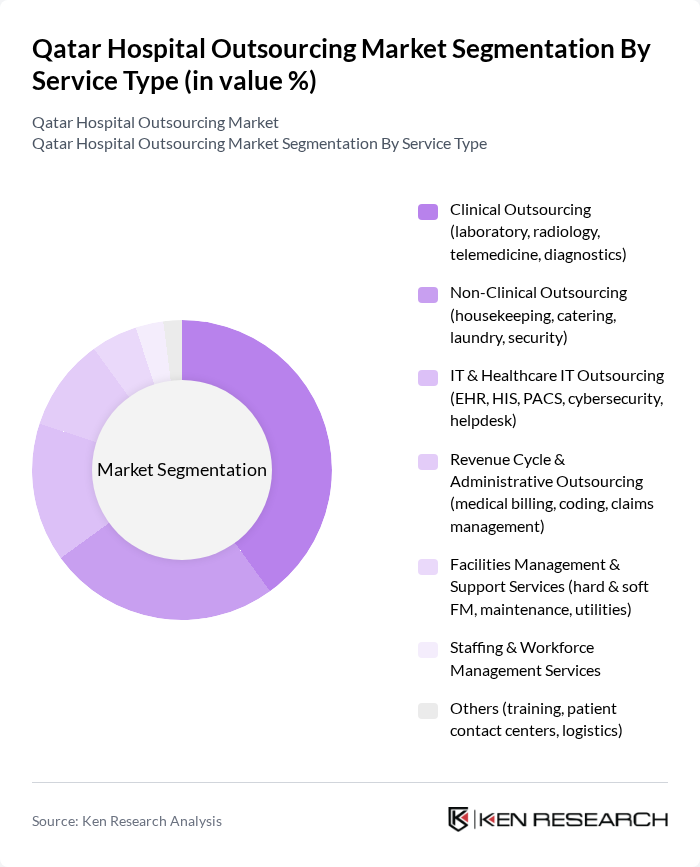
Qatar Hospital Outsourcing Market segmentation by Service Type.

By End-User Facility:The end-user facility segmentation encompasses public hospitals, private general hospitals, specialty & single-specialty hospitals, day surgery & outpatient centers, rehabilitation & long-term care facilities, clinics & polyclinics, and others. Public hospitals, particularly those under the Hamad Medical Corporation network, dominate this segment due to their extensive patient base and government support. Private general hospitals are also significant players, driven by the increasing number of expatriates seeking quality healthcare services.
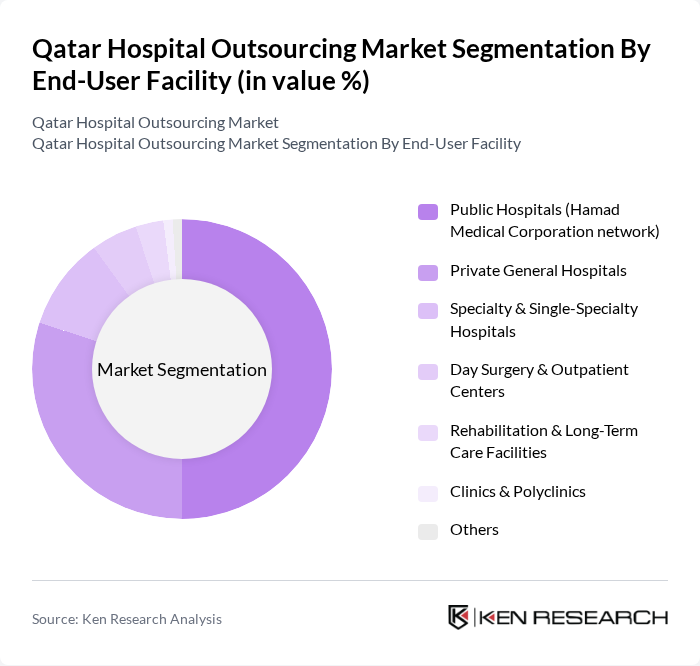
Qatar Hospital Outsourcing Market segmentation by End-User Facility.

Qatar Hospital Outsourcing Market Competitive Landscape

The Qatar Hospital Outsourcing Market is characterized by a dynamic mix of regional and international players. Leading participants such as Hamad Medical Corporation, Sidra Medicine, Aspetar Orthopaedic and Sports Medicine Hospital, Aster DM Healthcare (Aster Hospital, Aster Medical Centers Qatar), Al Ahli Hospital, Doha Clinic Hospital, Al Emadi Hospital, Turkish Hospital (Qatar Turkish Hospital), The View Hospital (an affiliate of Cedars-Sinai), Seha Healthcare (Seha Qatar), Naseem Healthcare (Naseem Al Rabeeh Medical Group), Elegancia Healthcare (Barzan Holdings Group), OCS Qatar (OCS Group for facilities & support services), Sodexo Qatar Services, Serco Middle East (Qatar healthcare and FM contracts) contribute to innovation, geographic expansion, and service delivery in this space.

Hamad Medical Corporation

1972

Doha, Qatar

Sidra Medicine

2018

Doha, Qatar

Aspetar Orthopaedic and Sports Medicine Hospital

2007

Doha, Qatar

Aster DM Healthcare

1987

Dubai, UAE

Al Ahli Hospital

1997

Doha, Qatar

Company

Establishment Year

Headquarters

Group Size (Global, Regional, or Local)

Qatar Hospital Outsourcing Revenue (QAR million)

Revenue Growth Rate in Qatar Hospital Outsourcing (%)

Share of Healthcare/Hospital Contracts in Total Qatar Portfolio (%)

Number of Hospital Facilities Served in Qatar

Average Contract Tenure (years)

Qatar Hospital Outsourcing Market Industry Analysis

Growth Drivers

  • Increasing Demand for Specialized Healthcare Services:Qatar's healthcare sector is experiencing a surge in demand for specialized services, driven by a growing population and rising chronic disease prevalence. The World Health Organization reported that Qatar's population reached approximately 3 million, with chronic diseases affecting over 30% of adults. This demand is pushing hospitals to outsource specialized services, allowing them to focus on core competencies while meeting patient needs effectively.
  • Cost Efficiency and Operational Flexibility:The Qatar healthcare system is increasingly prioritizing cost efficiency, with healthcare expenditure projected to reach QAR 25–30 billion. Outsourcing non-core functions enables hospitals to reduce operational costs by up to 20%, allowing them to allocate resources more effectively. This operational flexibility is crucial for adapting to fluctuating patient volumes and ensuring high-quality care without compromising financial stability.
  • Technological Advancements in Healthcare:The integration of advanced technologies, such as telemedicine and AI, is transforming healthcare delivery in Qatar. The Ministry of Public Health reported a significant increase in telemedicine consultations, reflecting a shift towards digital health solutions. These advancements facilitate outsourcing by enabling remote monitoring and consultation, thus expanding access to specialized care while improving patient outcomes and operational efficiency.

Market Challenges

  • Regulatory Compliance Complexities:Navigating the regulatory landscape in Qatar poses significant challenges for healthcare outsourcing. The Ministry of Public Health has stringent licensing requirements, with over 50 regulations governing healthcare providers. Compliance with these regulations can be resource-intensive, leading to delays in service implementation and increased operational costs, which may deter potential outsourcing partnerships.
  • Limited Awareness Among Healthcare Providers:Many healthcare providers in Qatar lack awareness of the benefits of outsourcing, which can hinder market growth. A survey conducted by the Qatar Chamber of Commerce indicated that only 30% of healthcare providers were familiar with outsourcing options. This limited understanding can result in missed opportunities for cost savings and improved service delivery, ultimately affecting patient care quality.

Qatar Hospital Outsourcing Market Future Outlook

The future of the Qatar hospital outsourcing market appears promising, driven by ongoing technological advancements and a growing emphasis on patient-centered care. As healthcare providers increasingly adopt value-based care models, the demand for specialized services is expected to rise. Additionally, the integration of AI and data analytics will enhance operational efficiency, enabling hospitals to deliver high-quality care while managing costs effectively. This evolving landscape presents significant opportunities for growth and innovation in the sector.

Market Opportunities

  • Expansion of Telemedicine Services:The rapid growth of telemedicine presents a significant opportunity for outsourcing in Qatar. With telemedicine consultations projected to exceed 1 million, healthcare providers can leverage this trend to outsource remote patient monitoring and consultation services, enhancing access to care while reducing operational burdens.
  • Partnerships with International Healthcare Providers:Collaborating with international healthcare providers can enhance service offerings in Qatar. By forming strategic partnerships, local hospitals can access specialized expertise and advanced technologies, improving patient outcomes and expanding their service portfolio, which is crucial in a competitive market.

Scope of the Report

SegmentSub-Segments
By Service Type

Clinical Outsourcing (laboratory, radiology, telemedicine, diagnostics)

Non-Clinical Outsourcing (housekeeping, catering, laundry, security)

IT & Healthcare IT Outsourcing (EHR, HIS, PACS, cybersecurity, helpdesk)

Revenue Cycle & Administrative Outsourcing (medical billing, coding, claims management)

Facilities Management & Support Services (hard & soft FM, maintenance, utilities)

Staffing & Workforce Management Services

Others (training, patient contact centers, logistics)

By End-User Facility

Public Hospitals (Hamad Medical Corporation network)

Private General Hospitals

Specialty & Single-Specialty Hospitals

Day Surgery & Outpatient Centers

Rehabilitation & Long-Term Care Facilities

Clinics & Polyclinics

Others

By Service Delivery Model

Full Outsourcing (comprehensive multi-function contracts)

Partial/Selective Outsourcing

Project-Based & Short-Term Outsourcing

Managed Services & Long-Term Management Contracts

By Contracting Entity

Government & Public Sector Contracts

Private Hospital Group Contracts

PPP & Joint-Venture Outsourcing Contracts

Others

By Technology Intensity

Low-Technology Services (basic FM and soft services)

Medium-Technology Services (standard IT, basic HCIT)

High-Technology Services (advanced HCIT, AI, analytics, telehealth)

Others

By Provider Type

Local Qatar-Based Service Providers

Regional GCC Service Providers

Global Multinational Outsourcing Providers

Joint Ventures & Consortiums

By Hospital Size

Large Tertiary & Quaternary Care Hospitals

Medium-Size General Hospitals

Small Hospitals & Specialized Centers

Key Target Audience

Investors and Venture Capitalist Firms

Government and Regulatory Bodies (e.g., Ministry of Public Health, Qatar Financial Centre Regulatory Authority)

Healthcare Providers and Hospital Administrators

Insurance Companies and Health Plans

Medical Equipment Suppliers

Pharmaceutical Companies

Healthcare IT Solutions Providers

Private Equity Firms

Players Mentioned in the Report:

Hamad Medical Corporation

Sidra Medicine

Aspetar Orthopaedic and Sports Medicine Hospital

Aster DM Healthcare (Aster Hospital, Aster Medical Centers Qatar)

Al Ahli Hospital

Doha Clinic Hospital

Al Emadi Hospital

Turkish Hospital (Qatar Turkish Hospital)

The View Hospital (an affiliate of Cedars-Sinai)

Seha Healthcare (Seha Qatar)

Naseem Healthcare (Naseem Al Rabeeh Medical Group)

Elegancia Healthcare (Barzan Holdings Group)

OCS Qatar (OCS Group for facilities & support services)

Sodexo Qatar Services

Serco Middle East (Qatar healthcare and FM contracts)

Table of Contents

Market Assessment Phase

1. Executive Summary and Approach


2. Qatar Hospital Outsourcing Market Overview

2.1 Key Insights and Strategic Recommendations

2.2 Qatar Hospital Outsourcing Market Overview

2.3 Definition and Scope

2.4 Evolution of Market Ecosystem

2.5 Timeline of Key Regulatory Milestones

2.6 Value Chain & Stakeholder Mapping

2.7 Business Cycle Analysis

2.8 Policy & Incentive Landscape


3. Qatar Hospital Outsourcing Market Analysis

3.1 Growth Drivers

3.1.1 Increasing demand for specialized healthcare services
3.1.2 Cost efficiency and operational flexibility
3.1.3 Technological advancements in healthcare
3.1.4 Government initiatives to enhance healthcare quality

3.2 Market Challenges

3.2.1 Regulatory compliance complexities
3.2.2 Limited awareness among healthcare providers
3.2.3 High competition among service providers
3.2.4 Economic fluctuations affecting budgets

3.3 Market Opportunities

3.3.1 Expansion of telemedicine services
3.3.2 Partnerships with international healthcare providers
3.3.3 Growth in outpatient services
3.3.4 Increasing focus on patient-centered care

3.4 Market Trends

3.4.1 Rise of value-based care models
3.4.2 Integration of AI and data analytics in healthcare
3.4.3 Shift towards preventive healthcare services
3.4.4 Emphasis on sustainability in healthcare operations

3.5 Government Regulation

3.5.1 Licensing requirements for healthcare outsourcing
3.5.2 Quality assurance standards
3.5.3 Data protection regulations
3.5.4 Incentives for local healthcare providers

4. SWOT Analysis


5. Stakeholder Analysis


6. Porter's Five Forces Analysis


7. Qatar Hospital Outsourcing Market Market Size, 2019-2024

7.1 By Value

7.2 By Volume

7.3 By Average Selling Price


8. Qatar Hospital Outsourcing Market Segmentation

8.1 By Service Type

8.1.1 Clinical Outsourcing (laboratory, radiology, telemedicine, diagnostics)
8.1.2 Non-Clinical Outsourcing (housekeeping, catering, laundry, security)
8.1.3 IT & Healthcare IT Outsourcing (EHR, HIS, PACS, cybersecurity, helpdesk)
8.1.4 Revenue Cycle & Administrative Outsourcing (medical billing, coding, claims management)
8.1.5 Facilities Management & Support Services (hard & soft FM, maintenance, utilities)
8.1.6 Staffing & Workforce Management Services
8.1.7 Others (training, patient contact centers, logistics)

8.2 By End-User Facility

8.2.1 Public Hospitals (Hamad Medical Corporation network)
8.2.2 Private General Hospitals
8.2.3 Specialty & Single-Specialty Hospitals
8.2.4 Day Surgery & Outpatient Centers
8.2.5 Rehabilitation & Long-Term Care Facilities
8.2.6 Clinics & Polyclinics
8.2.7 Others

8.3 By Service Delivery Model

8.3.1 Full Outsourcing (comprehensive multi-function contracts)
8.3.2 Partial/Selective Outsourcing
8.3.3 Project-Based & Short-Term Outsourcing
8.3.4 Managed Services & Long-Term Management Contracts

8.4 By Contracting Entity

8.4.1 Government & Public Sector Contracts
8.4.2 Private Hospital Group Contracts
8.4.3 PPP & Joint-Venture Outsourcing Contracts
8.4.4 Others

8.5 By Technology Intensity

8.5.1 Low-Technology Services (basic FM and soft services)
8.5.2 Medium-Technology Services (standard IT, basic HCIT)
8.5.3 High-Technology Services (advanced HCIT, AI, analytics, telehealth)
8.5.4 Others

8.6 By Provider Type

8.6.1 Local Qatar-Based Service Providers
8.6.2 Regional GCC Service Providers
8.6.3 Global Multinational Outsourcing Providers
8.6.4 Joint Ventures & Consortiums

8.7 By Hospital Size

8.7.1 Large Tertiary & Quaternary Care Hospitals
8.7.2 Medium-Size General Hospitals
8.7.3 Small Hospitals & Specialized Centers

9. Qatar Hospital Outsourcing Market Competitive Analysis

9.1 Market Share of Key Players

9.2 Cross Comparison of Key Players

9.2.1 Company Name
9.2.2 Group Size (Global, Regional, or Local)
9.2.3 Qatar Hospital Outsourcing Revenue (QAR million)
9.2.4 Revenue Growth Rate in Qatar Hospital Outsourcing (%)
9.2.5 Share of Healthcare/Hospital Contracts in Total Qatar Portfolio (%)
9.2.6 Number of Hospital Facilities Served in Qatar
9.2.7 Average Contract Tenure (years)
9.2.8 EBITDA Margin from Hospital Outsourcing Contracts (%)
9.2.9 Service Quality & Compliance Score (JCI/MoPH audit-based index)
9.2.10 SLA Adherence Rate (% of KPIs met)
9.2.11 Client Retention Rate for Hospital Contracts (%)
9.2.12 Average TAT Improvement for Key Outsourced Processes (%)
9.2.13 Technology Adoption Level (HCIT, CAFM, IoT, automation index)
9.2.14 Qatar Market Share in Hospital Outsourcing Segment (%)

9.3 SWOT Analysis of Top Players

9.4 Pricing Analysis

9.5 Detailed Profile of Major Companies

9.5.1 Hamad Medical Corporation
9.5.2 Sidra Medicine
9.5.3 Aspetar Orthopaedic and Sports Medicine Hospital
9.5.4 Aster DM Healthcare (Aster Hospital, Aster Medical Centers Qatar)
9.5.5 Al Ahli Hospital
9.5.6 Doha Clinic Hospital
9.5.7 Al Emadi Hospital
9.5.8 Turkish Hospital (Qatar Turkish Hospital)
9.5.9 The View Hospital (an affiliate of Cedars-Sinai)
9.5.10 Seha Healthcare (Seha Qatar)
9.5.11 Naseem Healthcare (Naseem Al Rabeeh Medical Group)
9.5.12 Elegancia Healthcare (Barzan Holdings Group)
9.5.13 OCS Qatar (OCS Group for facilities & support services)
9.5.14 Sodexo Qatar Services
9.5.15 Serco Middle East (Qatar healthcare and FM contracts)

10. Qatar Hospital Outsourcing Market End-User Analysis

10.1 Procurement Behavior of Key Ministries

10.1.1 Ministry of Public Health
10.1.2 Ministry of Education
10.1.3 Ministry of Defense
10.1.4 Ministry of Interior

10.2 Corporate Spend on Infrastructure & Energy

10.2.1 Healthcare Infrastructure Investments
10.2.2 Energy Efficiency Initiatives
10.2.3 Technology Upgrades
10.2.4 Others

10.3 Pain Point Analysis by End-User Category

10.3.1 Cost Management Issues
10.3.2 Quality of Care Concerns
10.3.3 Access to Specialized Services
10.3.4 Others

10.4 User Readiness for Adoption

10.4.1 Awareness of Outsourcing Benefits
10.4.2 Training and Support Needs
10.4.3 Technology Adoption Readiness
10.4.4 Others

10.5 Post-Deployment ROI and Use Case Expansion

10.5.1 Measurement of ROI
10.5.2 Expansion of Services Offered
10.5.3 Client Feedback Mechanisms
10.5.4 Others

11. Qatar Hospital Outsourcing Market Future Size, 2025-2030

11.1 By Value

11.2 By Volume

11.3 By Average Selling Price


Go-To-Market Strategy Phase

1. Whitespace Analysis + Business Model Canvas

1.1 Market Gaps Identification

1.2 Business Model Development


2. Marketing and Positioning Recommendations

2.1 Branding Strategies

2.2 Product USPs


3. Distribution Plan

3.1 Urban Retail vs Rural NGO Tie-ups


4. Channel & Pricing Gaps

4.1 Underserved Routes

4.2 Pricing Bands


5. Unmet Demand & Latent Needs

5.1 Category Gaps

5.2 Consumer Segments


6. Customer Relationship

6.1 Loyalty Programs

6.2 After-sales Service


7. Value Proposition

7.1 Sustainability

7.2 Integrated Supply Chains


8. Key Activities

8.1 Regulatory Compliance

8.2 Branding

8.3 Distribution Setup


9. Entry Strategy Evaluation

9.1 Domestic Market Entry Strategy

9.1.1 Product Mix
9.1.2 Pricing Band
9.1.3 Packaging

9.2 Export Entry Strategy

9.2.1 Target Countries
9.2.2 Compliance Roadmap

10. Entry Mode Assessment

10.1 JV

10.2 Greenfield

10.3 M&A

10.4 Distributor Model


11. Capital and Timeline Estimation

11.1 Capital Requirements

11.2 Timelines


12. Control vs Risk Trade-Off

12.1 Ownership vs Partnerships


13. Profitability Outlook

13.1 Breakeven Analysis

13.2 Long-term Sustainability


14. Potential Partner List

14.1 Distributors

14.2 JVs

14.3 Acquisition Targets


15. Execution Roadmap

15.1 Phased Plan for Market Entry

15.1.1 Market Setup
15.1.2 Market Entry
15.1.3 Growth Acceleration
15.1.4 Scale & Stabilize

15.2 Key Activities and Milestones

15.2.1 Milestone Planning

Research Methodology

ApproachModellingSample

Phase 1: Approach1

Desk Research

  • Analysis of healthcare expenditure reports from the Qatar Ministry of Public Health
  • Review of industry publications and market reports on hospital outsourcing trends
  • Examination of regulatory frameworks and policies affecting healthcare outsourcing in Qatar

Primary Research

  • Interviews with hospital administrators and procurement managers in Qatar
  • Surveys targeting healthcare consultants and outsourcing service providers
  • Field interviews with healthcare professionals involved in outsourcing decisions

Validation & Triangulation

  • Cross-validation of findings through multiple data sources including government and industry reports
  • Triangulation of qualitative insights from interviews with quantitative data from surveys
  • Sanity checks conducted through expert panel reviews comprising healthcare industry veterans

Phase 2: Market Size Estimation1

Top-down Assessment

  • Estimation of total healthcare spending in Qatar and its allocation to outsourcing services
  • Segmentation of the market by service type, including clinical and non-clinical outsourcing
  • Incorporation of demographic trends and healthcare needs projections in Qatar

Bottom-up Modeling

  • Collection of data on service pricing from leading outsourcing firms operating in Qatar
  • Volume estimates based on the number of hospitals and healthcare facilities in the region
  • Cost analysis based on operational efficiencies gained through outsourcing

Forecasting & Scenario Analysis

  • Multi-factor regression analysis incorporating population growth and healthcare demand trends
  • Scenario modeling based on potential changes in healthcare policies and economic conditions
  • Development of baseline, optimistic, and pessimistic forecasts through 2030

Phase 3: CATI Sample Composition1

Scope Item/SegmentSample SizeTarget Respondent Profiles
Clinical Outsourcing Services120Hospital Administrators, Clinical Directors
Non-Clinical Support Services100Procurement Managers, Facility Managers
Telemedicine and Remote Care Solutions80IT Managers, Telehealth Coordinators
Healthcare Staffing Solutions110HR Managers, Staffing Coordinators
Healthcare IT Outsourcing90Chief Information Officers, IT Directors

Frequently Asked Questions

What is the current value of the Qatar Hospital Outsourcing Market?

The Qatar Hospital Outsourcing Market is valued at approximately USD 250 million, reflecting a five-year historical analysis. This growth is driven by the increasing demand for specialized healthcare services and government initiatives aimed at enhancing operational efficiency in healthcare infrastructure.

What factors are driving the growth of the Qatar Hospital Outsourcing Market?

What are the main types of services included in hospital outsourcing in Qatar?

Who are the key players in the Qatar Hospital Outsourcing Market?

Other Regional/Country Reports

Indonesia Hospital Outsourcing Market

Malaysia Hospital Outsourcing Market

KSA Hospital Outsourcing Market

APAC Hospital Outsourcing Market

SEA Hospital Outsourcing Market

Vietnam Hospital Outsourcing Market

Why Buy From Us?

Refine Robust Result (RRR) Framework

What makes us stand out is that our consultants follow Robust, Refine and Result (RRR) methodology. Robust for clear definitions, approaches and sanity checking, Refine for differentiating respondents' facts and opinions, and Result for presenting data with story.

Our Reach Is Unmatched

We have set a benchmark in the industry by offering our clients with syndicated and customized market research reports featuring coverage of entire market as well as meticulous research and analyst insights.

Shifting the Research Paradigm

While we don't replace traditional research, we flip the method upside down. Our dual approach of Top Bottom & Bottom Top ensures quality deliverable by not just verifying company fundamentals but also looking at the sector and macroeconomic factors.

More Insights-Better Decisions

With one step in the future, our research team constantly tries to show you the bigger picture. We help with some of the tough questions you may encounter along the way: How is the industry positioned? Best marketing channel? KPI's of competitors? By aligning every element, we help maximize success.

Transparency and Trust

Our report gives you instant access to the answers and sources that other companies might choose to hide. We elaborate each steps of research methodology we have used and showcase you the sample size to earn your trust.

Round the Clock Support

If you need any support, we are here! We pride ourselves on universe strength, data quality, and quick, friendly, and professional service.

Why Clients Choose Us?

400000+
Reports in repository
150+
Consulting projects a year
100+
Analysts
8000+
Client Queries in 2022








