About the Report
Base Year 2024Saudi Arabia Healthcare Supply Chain Management Market Overview
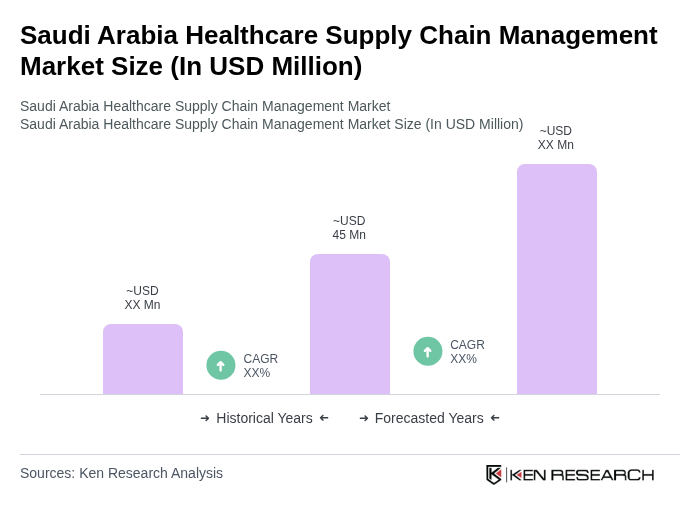
- The Saudi Arabia Healthcare Supply Chain Management Market is valued at approximately USD 45 million, based on a five?year historical analysis. This market has expanded in line with broader healthcare digitization, rising healthcare expenditure, and efforts to professionalize logistics and procurement under Saudi Vision 2030. Growth is driven by increasing demand for efficient healthcare services, the rollout of electronic procurement and inventory systems, and government initiatives to centralize purchasing and improve resilience of medical supply chains. Additional drivers include population growth, a high and rising burden of chronic diseases, and the push to localize pharmaceutical and medical?device manufacturing, which together increase complexity and volume in healthcare logistics.
- Key cities dominating the market include Riyadh, Jeddah, and Dammam, which host the largest clusters of hospitals, specialized medical centers, and distribution hubs and therefore anchor most healthcare IT and logistics investments. Riyadh, as the capital and administrative center, concentrates national?level institutions and centralized procurement functions, while Jeddah and Dammam serve as critical seaports and gateways for imported pharmaceuticals and devices, supporting warehousing and cold?chain infrastructure.
- The government has implemented related reforms such as centralizing purchasing through the National Unified Procurement Company (NUPCO), expanding SFDA’s Drug Track serialization system, and advancing digital procurement and logistics standards as part of Vision 2030 health?sector transformation. These efforts collectively aim to optimize procurement processes, enhance supply?chain visibility, reduce costs, and ensure reliable access to medicines, vaccines, and medical equipment across public and private providers.
Saudi Arabia Healthcare Supply Chain Management Market Segmentation
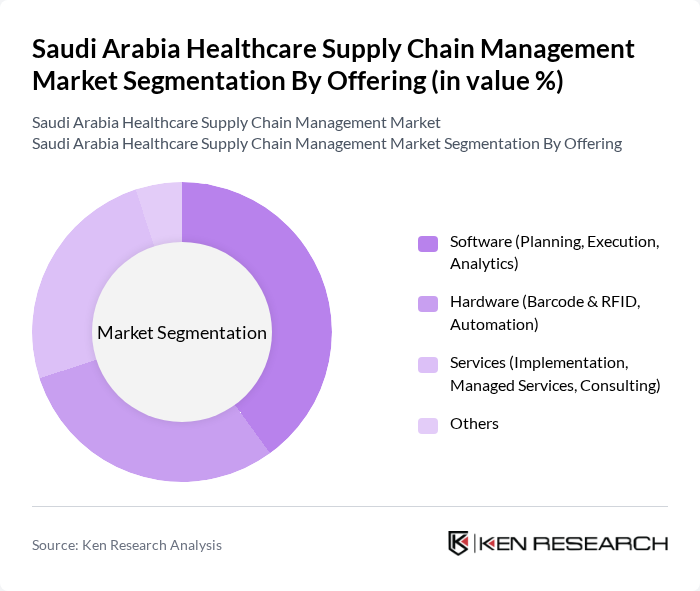
By Offering:The market is segmented into software, hardware, services, and others. Software includes planning, execution, and analytics tools that support forecasting, inventory optimization, and real?time tracking, and this segment is gaining traction as hospitals and distributors seek data?driven decision?making and integration with electronic medical records and enterprise resource planning systems. Hardware solutions such as barcode scanners, RFID tags, and automated storage and retrieval systems remain the largest product component in Saudi Arabia, reflecting continuing investments in traceability, cold?chain monitoring, and warehouse automation. Services—spanning implementation, managed services, and consulting—are increasingly important as healthcare providers rely on external expertise to design processes, integrate systems, comply with SFDA track?and?trace requirements, and support cloud and on?premise deployments.
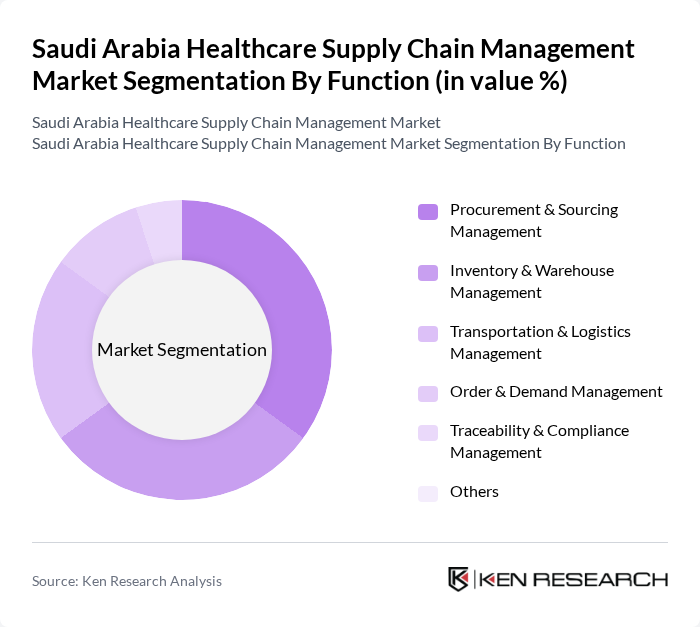
By Function:The market is segmented into procurement & sourcing management, inventory & warehouse management, transportation & logistics management, order & demand management, traceability & compliance management, and others. Procurement and sourcing management is critical for ensuring that healthcare providers have access to the necessary supplies at competitive prices. Inventory and warehouse management functions are increasingly digitized, using automated systems and real?time monitoring to manage high?value drugs, temperature?sensitive products, and large multisite hospital networks. Transportation and logistics management ensure timely and compliant delivery, with growing emphasis on cold?chain capabilities, last?mile reliability, and integration with SFDA’s Drug Track system.
Saudi Arabia Healthcare Supply Chain Management Market Competitive Landscape
The Saudi Arabia Healthcare Supply Chain Management Market is characterized by a dynamic mix of regional and international players. Leading participants such as Ministry of Health (MOH) – Health Holding Company / Seha Virtual Hospital, Saudi Food and Drug Authority (SFDA) – RSD / Drug Track Platform, National Unified Procurement Company (NUPCO), Saudi Pharmaceutical Industries and Medical Appliances Corporation (SPIMACO), Nahdi Medical Company, Al-Dawaa Medical Services Co. (Al-Dawaa Pharmacies), Jamjoom Pharma (Jamjoom Pharmaceuticals Co.), Tamer Group, Banaja Holdings Company (Banaja Healthcare), Saudi German Health (Saudi German Hospitals Group), Mouwasat Medical Services Co., Dr. Sulaiman Al Habib Medical Services Group, Bupa Arabia for Cooperative Insurance, SAP SE – Saudi Arabia, Oracle Corporation – Saudi Arabia contribute to innovation, geographic expansion, and service delivery in this space.
Saudi Arabia Healthcare Supply Chain Management Market Industry Analysis
Growth Drivers
- Increasing Demand for Healthcare Services:The Saudi Arabian healthcare sector is experiencing significant growth, driven by a population of approximately 36 million and an increasing life expectancy of 77 years. The World Bank reported that healthcare expenditure reached SAR 180 billion, reflecting a 6% annual increase. This rising demand for healthcare services necessitates efficient supply chain management to ensure timely delivery of medical supplies and services, thereby enhancing patient care and operational efficiency.
- Technological Advancements in Supply Chain Management:The integration of advanced technologies such as IoT and AI is transforming supply chain management in Saudi Arabia's healthcare sector. In the current period, investments in healthcare technology reached SAR 15 billion, with a projected increase of 12% in the following period. These technologies enhance inventory management, reduce waste, and improve logistics efficiency, enabling healthcare providers to respond swiftly to patient needs and optimize resource allocation.
- Government Initiatives to Enhance Healthcare Infrastructure:The Saudi government is actively investing in healthcare infrastructure, with a budget allocation of SAR 220 billion for health services in the upcoming period. Initiatives such as the National Health Strategy aim to improve healthcare accessibility and quality. These investments are expected to bolster the healthcare supply chain by fostering partnerships with private sectors and enhancing logistics capabilities, ultimately leading to better healthcare delivery across the nation.
Market Challenges
- Complex Regulatory Environment:The healthcare supply chain in Saudi Arabia faces challenges due to a complex regulatory framework. Compliance with various regulations, including those from the Saudi Food and Drug Authority (SFDA), can be cumbersome. In the current period, over 65% of healthcare providers reported difficulties in navigating these regulations, which can lead to delays in procurement and increased operational costs, hindering overall supply chain efficiency.
- High Operational Costs:Operational costs in the Saudi healthcare supply chain are significantly high, with logistics and warehousing expenses accounting for approximately SAR 35 billion. Factors such as rising fuel prices and labor costs contribute to these expenses. As healthcare providers strive to maintain quality services while managing costs, the pressure on supply chain efficiency intensifies, posing a challenge to sustainable growth in the sector.
Saudi Arabia Healthcare Supply Chain Management Market Future Outlook
The future of the healthcare supply chain management market in Saudi Arabia appears promising, driven by ongoing technological innovations and government support. The anticipated growth in telehealth services and the integration of AI in supply chain processes are expected to enhance operational efficiency. Additionally, the focus on sustainability and value-based care will likely reshape supply chain strategies, ensuring that healthcare providers can meet evolving patient needs while optimizing resource utilization and reducing waste.
Market Opportunities
- Expansion of Telehealth Services:The rise of telehealth services presents a significant opportunity for the healthcare supply chain. With an estimated 25% increase in telehealth consultations, healthcare providers can leverage this trend to streamline supply chain processes, ensuring that medical supplies are efficiently delivered to patients, thereby enhancing service delivery and patient satisfaction.
- Adoption of AI and Machine Learning:The adoption of AI and machine learning technologies in supply chain processes is poised to revolutionize the healthcare sector. In the near future, it is projected that 35% of healthcare providers will implement AI-driven solutions, improving demand forecasting and inventory management. This shift will enable more accurate supply chain operations, reducing costs and enhancing service delivery across the healthcare landscape.
Scope of the Report
| Segment | Sub-Segments |
|---|---|
| By Offering | Software (Planning, Execution, Analytics) Hardware (Barcode & RFID, Automation) Services (Implementation, Managed Services, Consulting) Others |
| By Function | Procurement & Sourcing Management Inventory & Warehouse Management Transportation & Logistics Management Order & Demand Management Traceability & Compliance Management Others |
| By Mode of Delivery | On-premise Solutions Cloud-based Solutions Web-based Solutions Others |
| By End-User | Healthcare Providers (Hospitals & Clinics) Healthcare Manufacturers (Pharmaceuticals & Medical Devices) Distributors & Wholesalers Third-Party Logistics (3PL) & Specialized Healthcare Logistics Others |
| By Product Managed | Pharmaceuticals & Biologics Medical Devices & Equipment Consumables & Disposables Cold-chain / Temperature-sensitive Products Others |
| By Technology Utilization | Barcode-based Systems RFID and Real-time Location Systems (RTLS) Cloud & SaaS Platforms Advanced Analytics, AI & Automation Others |
| By Geographic Region | Central Region Eastern Region Western Region Southern & Northern Regions |
Key Target Audience
Investors and Venture Capitalist Firms
Government and Regulatory Bodies (e.g., Ministry of Health, Saudi Food and Drug Authority)
Healthcare Providers and Hospitals
Pharmaceutical Manufacturers
Medical Device Manufacturers
Logistics and Supply Chain Companies
Healthcare IT Solution Providers
Insurance Companies and Payers
Players Mentioned in the Report:
Ministry of Health (MOH) Health Holding Company / Seha Virtual Hospital
Saudi Food and Drug Authority (SFDA) RSD / Drug Track Platform
National Unified Procurement Company (NUPCO)
Saudi Pharmaceutical Industries and Medical Appliances Corporation (SPIMACO)
Nahdi Medical Company
Al-Dawaa Medical Services Co. (Al-Dawaa Pharmacies)
Jamjoom Pharma (Jamjoom Pharmaceuticals Co.)
Tamer Group
Banaja Holdings Company (Banaja Healthcare)
Saudi German Health (Saudi German Hospitals Group)
Mouwasat Medical Services Co.
Dr. Sulaiman Al Habib Medical Services Group
Bupa Arabia for Cooperative Insurance
SAP SE Saudi Arabia
Oracle Corporation Saudi Arabia
Table of Contents
Market Assessment Phase
1. Executive Summary and Approach
2. Saudi Arabia Healthcare Supply Chain Management Market Overview
2.1 Key Insights and Strategic Recommendations
2.2 Saudi Arabia Healthcare Supply Chain Management Market Overview
2.3 Definition and Scope
2.4 Evolution of Market Ecosystem
2.5 Timeline of Key Regulatory Milestones
2.6 Value Chain & Stakeholder Mapping
2.7 Business Cycle Analysis
2.8 Policy & Incentive Landscape
3. Saudi Arabia Healthcare Supply Chain Management Market Analysis
3.1 Growth Drivers
3.1.1 Increasing demand for healthcare services
3.1.2 Technological advancements in supply chain management
3.1.3 Government initiatives to enhance healthcare infrastructure
3.1.4 Rising focus on cost efficiency and waste reduction
3.2 Market Challenges
3.2.1 Complex regulatory environment
3.2.2 Limited integration of technology in existing systems
3.2.3 High operational costs
3.2.4 Supply chain disruptions due to geopolitical factors
3.3 Market Opportunities
3.3.1 Expansion of telehealth services
3.3.2 Adoption of AI and machine learning in supply chain processes
3.3.3 Growth in e-commerce for medical supplies
3.3.4 Partnerships with international healthcare suppliers
3.4 Market Trends
3.4.1 Shift towards value-based care
3.4.2 Increased focus on sustainability in supply chains
3.4.3 Rise of digital health solutions
3.4.4 Integration of blockchain for transparency
3.5 Government Regulation
3.5.1 Implementation of the National Health Strategy
3.5.2 Regulations on medical device procurement
3.5.3 Standards for pharmaceutical supply chains
3.5.4 Compliance requirements for healthcare providers
4. SWOT Analysis
5. Stakeholder Analysis
6. Porter's Five Forces Analysis
7. Saudi Arabia Healthcare Supply Chain Management Market Market Size, 2019-2024
7.1 By Value
7.2 By Volume
7.3 By Average Selling Price
8. Saudi Arabia Healthcare Supply Chain Management Market Segmentation
8.1 By Offering
8.1.1 Software (Planning, Execution, Analytics)
8.1.2 Hardware (Barcode & RFID, Automation)
8.1.3 Services (Implementation, Managed Services, Consulting)
8.1.4 Others
8.2 By Function
8.2.1 Procurement & Sourcing Management
8.2.2 Inventory & Warehouse Management
8.2.3 Transportation & Logistics Management
8.2.4 Order & Demand Management
8.2.5 Traceability & Compliance Management
8.2.6 Others
8.3 By Mode of Delivery
8.3.1 On-premise Solutions
8.3.2 Cloud-based Solutions
8.3.3 Web-based Solutions
8.3.4 Others
8.4 By End-User
8.4.1 Healthcare Providers (Hospitals & Clinics)
8.4.2 Healthcare Manufacturers (Pharmaceuticals & Medical Devices)
8.4.3 Distributors & Wholesalers
8.4.4 Third-Party Logistics (3PL) & Specialized Healthcare Logistics
8.4.5 Others
8.5 By Product Managed
8.5.1 Pharmaceuticals & Biologics
8.5.2 Medical Devices & Equipment
8.5.3 Consumables & Disposables
8.5.4 Cold-chain / Temperature-sensitive Products
8.5.5 Others
8.6 By Technology Utilization
8.6.1 Barcode-based Systems
8.6.2 RFID and Real-time Location Systems (RTLS)
8.6.3 Cloud & SaaS Platforms
8.6.4 Advanced Analytics, AI & Automation
8.6.5 Others
8.7 By Geographic Region
8.7.1 Central Region
8.7.2 Eastern Region
8.7.3 Western Region
8.7.4 Southern & Northern Regions
9. Saudi Arabia Healthcare Supply Chain Management Market Competitive Analysis
9.1 Market Share of Key Players
9.2 Cross Comparison of Key Players
9.2.1 Company Name
9.2.2 Core Offering (Software, Hardware, Services, Integrated Solutions)
9.2.3 Revenue from Saudi Healthcare SCM (Latest Year)
9.2.4 3-year Revenue CAGR in Saudi Healthcare SCM
9.2.5 Installed Base / Number of Healthcare Customers in KSA
9.2.6 Share of Cloud-based Deployments in KSA Portfolio
9.2.7 Average Contract Value (ACV) / Deal Size in KSA
9.2.8 Geographic Coverage within KSA (Regions / Cities Served)
9.2.9 Integration Depth with Hospital HIS/EMR & ERP Systems
9.2.10 On-time Order Fulfilment Rate for Healthcare Clients
9.2.11 Inventory Turnover & Stock-out Reduction Delivered for Clients
9.2.12 Implementation Timeframe & Go-live Success Rate
9.2.13 After-sales Support SLAs (Response & Resolution Times)
9.2.14 Compliance & Traceability Capabilities (Track & Trace, Serialization, Cold Chain)
9.2.15 Overall Customer Satisfaction / NPS in Saudi Healthcare Accounts
9.3 SWOT Analysis of Top Players
9.4 Pricing Analysis
9.5 Detailed Profile of Major Companies
9.5.1 Ministry of Health (MOH) – Health Holding Company / Seha Virtual Hospital
9.5.2 Saudi Food and Drug Authority (SFDA) – RSD / Drug Track Platform
9.5.3 National Unified Procurement Company (NUPCO)
9.5.4 Saudi Pharmaceutical Industries and Medical Appliances Corporation (SPIMACO)
9.5.5 Nahdi Medical Company
9.5.6 Al-Dawaa Medical Services Co. (Al-Dawaa Pharmacies)
9.5.7 Jamjoom Pharma (Jamjoom Pharmaceuticals Co.)
9.5.8 Tamer Group
9.5.9 Banaja Holdings Company (Banaja Healthcare)
9.5.10 Saudi German Health (Saudi German Hospitals Group)
9.5.11 Mouwasat Medical Services Co.
9.5.12 Dr. Sulaiman Al Habib Medical Services Group
9.5.13 Bupa Arabia for Cooperative Insurance
9.5.14 SAP SE – Saudi Arabia
9.5.15 Oracle Corporation – Saudi Arabia
10. Saudi Arabia Healthcare Supply Chain Management Market End-User Analysis
10.1 Procurement Behavior of Key Ministries
10.1.1 Ministry of Health
10.1.2 Ministry of Defense
10.1.3 Ministry of Education
10.1.4 Others
10.2 Corporate Spend on Infrastructure & Energy
10.2.1 Healthcare Facilities
10.2.2 Medical Equipment
10.2.3 IT Infrastructure
10.2.4 Others
10.3 Pain Point Analysis by End-User Category
10.3.1 Hospitals
10.3.2 Clinics
10.3.3 Pharmacies
10.3.4 Others
10.4 User Readiness for Adoption
10.4.1 Technology Adoption Levels
10.4.2 Training and Support Needs
10.4.3 Budget Constraints
10.4.4 Others
10.5 Post-Deployment ROI and Use Case Expansion
10.5.1 Cost Savings
10.5.2 Efficiency Gains
10.5.3 Service Quality Improvement
10.5.4 Others
11. Saudi Arabia Healthcare Supply Chain Management Market Future Size, 2025-2030
11.1 By Value
11.2 By Volume
11.3 By Average Selling Price
Go-To-Market Strategy Phase
1. Whitespace Analysis + Business Model Canvas
1.1 Market Gaps Identification
1.2 Business Model Development
2. Marketing and Positioning Recommendations
2.1 Branding Strategies
2.2 Product USPs
3. Distribution Plan
3.1 Urban Retail vs Rural NGO Tie-ups
4. Channel & Pricing Gaps
4.1 Underserved Routes
4.2 Pricing Bands
5. Unmet Demand & Latent Needs
5.1 Category Gaps
5.2 Consumer Segments
6. Customer Relationship
6.1 Loyalty Programs
6.2 After-sales Service
7. Value Proposition
7.1 Sustainability
7.2 Integrated Supply Chains
8. Key Activities
8.1 Regulatory Compliance
8.2 Branding
8.3 Distribution Setup
9. Entry Strategy Evaluation
9.1 Domestic Market Entry Strategy
9.1.1 Product Mix
9.1.2 Pricing Band
9.1.3 Packaging
9.2 Export Entry Strategy
9.2.1 Target Countries
9.2.2 Compliance Roadmap
10. Entry Mode Assessment
10.1 JV
10.2 Greenfield
10.3 M&A
10.4 Distributor Model
11. Capital and Timeline Estimation
11.1 Capital Requirements
11.2 Timelines
12. Control vs Risk Trade-Off
12.1 Ownership vs Partnerships
13. Profitability Outlook
13.1 Breakeven Analysis
13.2 Long-term Sustainability
14. Potential Partner List
14.1 Distributors
14.2 JVs
14.3 Acquisition Targets
15. Execution Roadmap
15.1 Phased Plan for Market Entry
15.1.1 Market Setup
15.1.2 Market Entry
15.1.3 Growth Acceleration
15.1.4 Scale & Stabilize
15.2 Key Activities and Milestones
15.2.1 Milestone Planning
15.2.2 Activity Tracking
Research Methodology
Phase 1: Approach1
Desk Research
- Analysis of healthcare expenditure reports from the Saudi Ministry of Health
- Review of industry publications and white papers on healthcare supply chain trends
- Examination of logistics and supply chain frameworks from regional healthcare organizations
Primary Research
- Interviews with supply chain managers at major hospitals and healthcare facilities
- Telephonic surveys with pharmaceutical distributors and medical equipment suppliers
- Field interviews with logistics coordinators involved in healthcare delivery
Validation & Triangulation
- Cross-validation of findings through multiple data sources including government and private sector reports
- Triangulation of insights from primary interviews with secondary data trends
- Sanity checks conducted through expert panel discussions with industry veterans
Phase 2: Market Size Estimation1
Top-down Assessment
- Estimation of total healthcare spending in Saudi Arabia as a baseline for supply chain analysis
- Segmentation of healthcare supply chain components by pharmaceuticals, medical devices, and consumables
- Incorporation of government initiatives aimed at improving healthcare logistics efficiency
Bottom-up Modeling
- Collection of data on procurement volumes from leading healthcare providers
- Operational cost analysis based on service contracts with logistics providers
- Volume and cost calculations for various healthcare supply chain segments
Forecasting & Scenario Analysis
- Multi-factor regression analysis incorporating population growth and healthcare demand trends
- Scenario modeling based on potential regulatory changes and technological advancements
- Development of baseline, optimistic, and pessimistic forecasts through 2030
Phase 3: CATI Sample Composition1
| Scope Item/Segment | Sample Size | Target Respondent Profiles |
|---|---|---|
| Pharmaceutical Supply Chain Management | 120 | Supply Chain Managers, Procurement Officers |
| Medical Equipment Distribution | 90 | Logistics Coordinators, Operations Managers |
| Healthcare Facility Inventory Management | 80 | Inventory Managers, Healthcare Administrators |
| Patient Care Logistics | 70 | Clinical Operations Managers, Patient Services Directors |
| Telehealth Supply Chain Integration | 60 | IT Managers, Telehealth Coordinators |
Frequently Asked Questions
What is the current value of the Saudi Arabia Healthcare Supply Chain Management Market?
The Saudi Arabia Healthcare Supply Chain Management Market is valued at approximately USD 45 million, reflecting growth driven by healthcare digitization, increased healthcare expenditure, and government initiatives under Saudi Vision 2030.
What factors are driving the growth of the healthcare supply chain management market in Saudi Arabia?
Which cities are key players in the Saudi Arabia Healthcare Supply Chain Management Market?
What role does the National Unified Procurement Company (NUPCO) play in the healthcare supply chain?
Other Regional/Country Reports
Indonesia Healthcare Supply Chain Management Market
Malaysia Healthcare Supply Chain Management Market
Other Adjacent Reports
Thailand Medical Device Supply Chain Market
Bahrain inventory management software market report Size, Share, Growth Drivers, Trends, Opportunities & Forecast 2025–2030Belgium Procurement Solutions Market
Japan Cold Chain Logistics Market Size, Share & Forecast, By Service Type, Mode of Transport & End-Use Industry, 2025–2032Vietnam Warehouse Automation Market Size, Share & Forecast, By Solution Type, End-Use Industry & Technology, 2025–2032Africa Transportation Management Systems Market Size, Share & Forecast, By Solution Type, Deployment Model & End-Use Industry, 2025-2032United States Healthcare Analytics Market Outlook to 2030: Size, Share, Growth and TrendsBrazil Regulatory Compliance Services Market
Why Buy From Us?

What makes us stand out is that our consultants follow Robust, Refine and Result (RRR) methodology. Robust for clear definitions, approaches and sanity checking, Refine for differentiating respondents' facts and opinions, and Result for presenting data with story.

We have set a benchmark in the industry by offering our clients with syndicated and customized market research reports featuring coverage of entire market as well as meticulous research and analyst insights.

While we don't replace traditional research, we flip the method upside down. Our dual approach of Top Bottom & Bottom Top ensures quality deliverable by not just verifying company fundamentals but also looking at the sector and macroeconomic factors.

With one step in the future, our research team constantly tries to show you the bigger picture. We help with some of the tough questions you may encounter along the way: How is the industry positioned? Best marketing channel? KPI's of competitors? By aligning every element, we help maximize success.

Our report gives you instant access to the answers and sources that other companies might choose to hide. We elaborate each steps of research methodology we have used and showcase you the sample size to earn your trust.

If you need any support, we are here! We pride ourselves on universe strength, data quality, and quick, friendly, and professional service.