Qatar neurocosmetics market report size, share, growth drivers, trends, opportunities & forecast 2025–2030

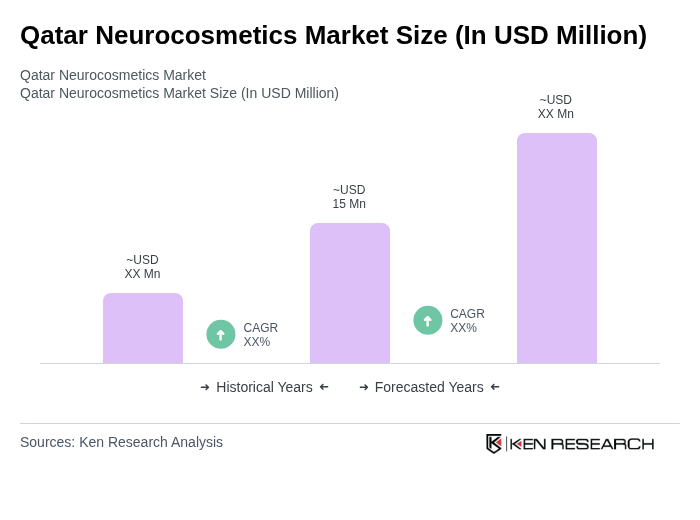
The Qatar Neurocosmetics Market, valued at USD 15 million, is growing due to demand for products enhancing appearance and psychological benefits.

Region:Middle East

Author(s):Shubham

Product Code:KRAA8632

Pages:91

Published On:November 2025
About the Report

Base Year 2024

Qatar Neurocosmetics Market Overview

  • The Qatar Neurocosmetics Market is valued at USD 15 million, based on a five-year historical analysis. This growth is primarily driven by increasing consumer awareness of mental well-being, the benefits of neuroactive ingredients in beauty products, and a strong preference for premium and multifunctional cosmetics. The rising demand for products that not only enhance appearance but also promote psychological benefits has significantly contributed to the market's expansion .
  • Key players in this market include Doha, Al Rayyan, and Lusail, which dominate due to their affluent populations and high consumer spending on beauty and wellness products. The concentration of luxury retail outlets and a growing trend towards holistic beauty solutions in these cities further solidify their market leadership .
  • The regulation of neurocosmetic products in Qatar is governed under the “Cosmetic Products Regulation, 2021” issued by the Ministry of Public Health. This regulation mandates pre-market notification, clinical safety assessments for active ingredients, and comprehensive labeling requirements, including disclosure of functional claims and psychological benefits. These measures are designed to ensure product safety, efficacy, and consumer transparency .
Qatar Neurocosmetics Market Size

Qatar Neurocosmetics Market Segmentation

By Product Type:The product type segmentation includes various categories such as Face Care (Creams, Serums, Masks), Body Care, Hair Care, Bath Products, Color Cosmetics with Neuroactive Ingredients, and Others. Among these, Face Care products are leading the market due to high demand for anti-aging and skin rejuvenation solutions. The increasing focus on skincare routines and the popularity of serums and masks that offer neuroactive benefits have made this segment particularly appealing to consumers .
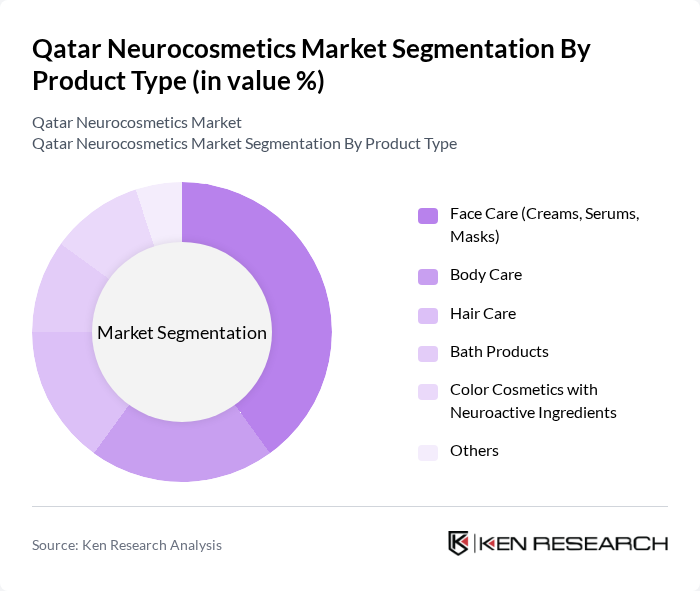
Qatar Neurocosmetics Market segmentation by Product Type.

By Application:The application segmentation includes Anti-aging, Skin Repair, Moisturization, Stress Relief/Soothing, and Others. The Anti-aging segment is currently dominating the market, driven by a growing aging population and increasing consumer interest in maintaining youthful skin. Products that offer neuroactive benefits alongside anti-aging properties are particularly popular, as they address both aesthetic and psychological needs .
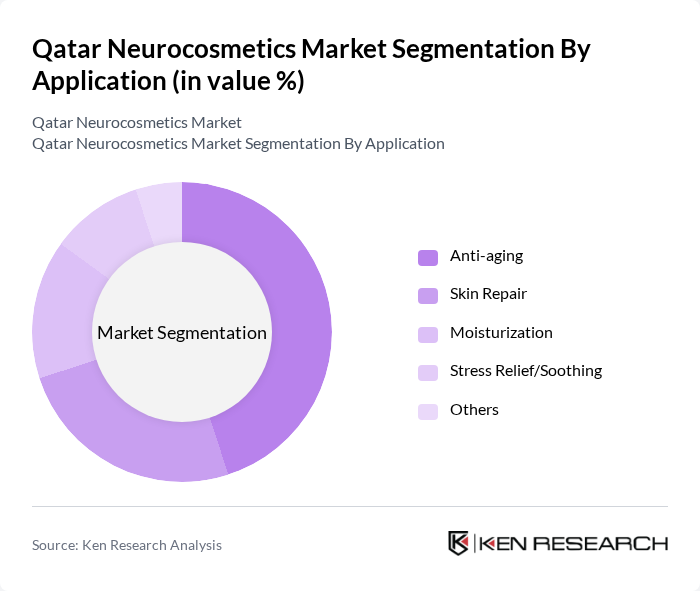
Qatar Neurocosmetics Market segmentation by Application.

Qatar Neurocosmetics Market Competitive Landscape

The Qatar Neurocosmetics Market is characterized by a dynamic mix of regional and international players. Leading participants such as L'Oréal Group, Estée Lauder Companies Inc., Johnson & Johnson (Neutrogena, CeraVe), Shiseido Company, Limited, Procter & Gamble (Olay, SK-II), Beiersdorf AG (NIVEA, Eucerin), Galderma S.A., SkinCeuticals, La Roche-Posay, Vichy Laboratories, Dr. Dennis Gross Skincare, Murad, LLC, Kiehl's (L'Oréal), Bioderma (NAOS), The Ordinary (DECIEM) contribute to innovation, geographic expansion, and service delivery in this space .

L'Oréal Group

1909

Paris, France

Estée Lauder Companies Inc.

1946

New York, USA

Johnson & Johnson

1886

New Brunswick, USA

Shiseido Company, Limited

1872

Tokyo, Japan

Procter & Gamble

1837

Cincinnati, USA

Company

Establishment Year

Headquarters

Group Size (Large, Medium, Small)

Revenue in Qatar Neurocosmetics Segment

Revenue Growth Rate (YoY, %)

Market Share in Qatar Neurocosmetics (%)

Number of Neurocosmetic SKUs Launched (Last 3 Years)

R&D Investment as % of Revenue

Qatar Neurocosmetics Market Industry Analysis

Growth Drivers

  • Increasing Consumer Awareness of Neurocosmetics Benefits:The growing awareness among consumers regarding the benefits of neurocosmetics is a significant growth driver. In future, approximately 60% of consumers in Qatar are expected to prioritize products that enhance mental well-being alongside physical appearance. This shift is supported by a 15% increase in online searches for neurocosmetic products, indicating a rising interest in formulations that claim to improve mood and cognitive function, thus driving market demand.
  • Rising Demand for Anti-Aging Products:The anti-aging segment is projected to see substantial growth, with the market for anti-aging products in Qatar expected to reach QAR 1.2 billion in future. This demand is fueled by a demographic shift, as 30% of the population is aged 40 and above, leading to increased spending on skincare solutions that promise youthful skin. The focus on neurocosmetics that offer both aesthetic and psychological benefits is particularly appealing to this age group.
  • Growth in the Wellness and Self-Care Industry:The wellness and self-care industry in Qatar is anticipated to grow by 20% in future, with consumers increasingly investing in products that promote holistic health. Neurocosmetics, which combine skincare with mental wellness benefits, align perfectly with this trend. The rise in wellness tourism, projected to attract 1.5 million visitors in future, further supports the demand for innovative beauty products that cater to health-conscious consumers.

Market Challenges

  • High Competition Among Established Brands:The Qatar neurocosmetics market faces intense competition, with over 50 established brands vying for market share. This saturation leads to price wars and aggressive marketing strategies, making it challenging for new entrants to gain traction. In future, the top five brands are expected to control 70% of the market, limiting opportunities for smaller companies to differentiate themselves and capture consumer interest effectively.
  • Regulatory Hurdles in Product Approvals:Navigating the regulatory landscape poses a significant challenge for neurocosmetics brands in Qatar. The approval process for new products can take up to 18 months, with stringent safety and efficacy testing requirements. In future, it is estimated that only 30% of new product applications will receive timely approval, hindering innovation and delaying market entry for potentially successful neurocosmetic products.

Qatar Neurocosmetics Market Future Outlook

The future of the Qatar neurocosmetics market appears promising, driven by evolving consumer preferences and a growing emphasis on mental wellness. As the market matures, brands are likely to invest in research and development to create innovative formulations that cater to the dual needs of beauty and mental health. Additionally, the integration of technology in product development and marketing strategies will enhance consumer engagement, paving the way for sustainable growth in the coming years.

Market Opportunities

  • Introduction of Innovative Product Formulations:There is a significant opportunity for brands to develop unique neurocosmetic formulations that incorporate cutting-edge ingredients. By leveraging advancements in neuroscience and dermatology, companies can create products that not only enhance skin appearance but also promote emotional well-being, appealing to a broader consumer base.
  • Collaborations with Dermatologists and Skincare Experts:Partnering with dermatologists and skincare professionals presents a valuable opportunity for brands to enhance credibility and consumer trust. Such collaborations can lead to the development of clinically-backed products that address specific skin concerns while promoting mental wellness, thereby attracting a discerning clientele willing to invest in high-quality neurocosmetics.

Scope of the Report

SegmentSub-Segments
By Product Type

Face Care (Creams, Serums, Masks)

Body Care

Hair Care

Bath Products

Color Cosmetics with Neuroactive Ingredients

Others

By Application

Anti-aging

Skin Repair

Moisturization

Stress Relief/Soothing

Others

By Consumer Group

Women

Men

Unisex

By Ingredient Type

Natural Ingredients

Synthetic Ingredients

Bioactive Compounds (e.g., peptides, neuropeptides)

Others

By Distribution Channel

Specialty Beauty Stores

Pharmacies and Drug Stores

Supermarkets/Hypermarkets

Online Retail

Others

By Price Category

Mass

Premium

By Nature

Organic

Conventional

Key Target Audience

Investors and Venture Capitalist Firms

Government and Regulatory Bodies (e.g., Ministry of Public Health, Qatar National Research Fund)

Manufacturers and Producers

Distributors and Retailers

Pharmaceutical Companies

Cosmetic and Skincare Brands

Health and Wellness Clinics

Beauty and Aesthetic Practitioners

Players Mentioned in the Report:

L'Oreal Group

Estee Lauder Companies Inc.

Johnson & Johnson (Neutrogena, CeraVe)

Shiseido Company, Limited

Procter & Gamble (Olay, SK-II)

Beiersdorf AG (NIVEA, Eucerin)

Galderma S.A.

SkinCeuticals

La Roche-Posay

Vichy Laboratories

Dr. Dennis Gross Skincare

Murad, LLC

Kiehl's (L'Oreal)

Bioderma (NAOS)

The Ordinary (DECIEM)

Table of Contents

Market Assessment Phase

1. Executive Summary and Approach


2. Qatar Neurocosmetics Market Overview

2.1 Key Insights and Strategic Recommendations

2.2 Qatar Neurocosmetics Market Overview

2.3 Definition and Scope

2.4 Evolution of Market Ecosystem

2.5 Timeline of Key Regulatory Milestones

2.6 Value Chain & Stakeholder Mapping

2.7 Business Cycle Analysis

2.8 Policy & Incentive Landscape


3. Qatar Neurocosmetics Market Analysis

3.1 Growth Drivers

3.1.1 Increasing consumer awareness of neurocosmetics benefits
3.1.2 Rising demand for anti-aging products
3.1.3 Growth in the wellness and self-care industry
3.1.4 Expansion of e-commerce platforms for beauty products

3.2 Market Challenges

3.2.1 High competition among established brands
3.2.2 Regulatory hurdles in product approvals
3.2.3 Limited consumer education on neurocosmetics
3.2.4 Economic fluctuations affecting consumer spending

3.3 Market Opportunities

3.3.1 Introduction of innovative product formulations
3.3.2 Collaborations with dermatologists and skincare experts
3.3.3 Expansion into untapped demographic segments
3.3.4 Increasing investment in marketing and branding

3.4 Market Trends

3.4.1 Shift towards natural and organic ingredients
3.4.2 Growing popularity of personalized skincare solutions
3.4.3 Rise of social media influencers in product promotion
3.4.4 Emphasis on sustainability and eco-friendly packaging

3.5 Government Regulation

3.5.1 Stricter guidelines on product labeling
3.5.2 Enhanced safety testing requirements
3.5.3 Regulations on advertising claims
3.5.4 Import tariffs on cosmetic ingredients

4. SWOT Analysis


5. Stakeholder Analysis


6. Porter's Five Forces Analysis


7. Qatar Neurocosmetics Market Market Size, 2019-2024

7.1 By Value

7.2 By Volume

7.3 By Average Selling Price


8. Qatar Neurocosmetics Market Segmentation

8.1 By Product Type

8.1.1 Face Care (Creams, Serums, Masks)
8.1.2 Body Care
8.1.3 Hair Care
8.1.4 Bath Products
8.1.5 Color Cosmetics with Neuroactive Ingredients
8.1.6 Others

8.2 By Application

8.2.1 Anti-aging
8.2.2 Skin Repair
8.2.3 Moisturization
8.2.4 Stress Relief/Soothing
8.2.5 Others

8.3 By Consumer Group

8.3.1 Women
8.3.2 Men
8.3.3 Unisex

8.4 By Ingredient Type

8.4.1 Natural Ingredients
8.4.2 Synthetic Ingredients
8.4.3 Bioactive Compounds (e.g., peptides, neuropeptides)
8.4.4 Others

8.5 By Distribution Channel

8.5.1 Specialty Beauty Stores
8.5.2 Pharmacies and Drug Stores
8.5.3 Supermarkets/Hypermarkets
8.5.4 Online Retail
8.5.5 Others

8.6 By Price Category

8.6.1 Mass
8.6.2 Premium

8.7 By Nature

8.7.1 Organic
8.7.2 Conventional

9. Qatar Neurocosmetics Market Competitive Analysis

9.1 Market Share of Key Players

9.2 KPIs for Cross Comparison of Key Players

9.2.1 Company Name
9.2.2 Group Size (Large, Medium, Small)
9.2.3 Revenue in Qatar Neurocosmetics Segment
9.2.4 Revenue Growth Rate (YoY, %)
9.2.5 Market Share in Qatar Neurocosmetics (%)
9.2.6 Number of Neurocosmetic SKUs Launched (Last 3 Years)
9.2.7 R&D Investment as % of Revenue
9.2.8 Distribution Channel Coverage (No. of Outlets/Platforms)
9.2.9 Brand Awareness Index (Qatar)
9.2.10 Customer Satisfaction Score (Qatar)
9.2.11 Regulatory Compliance Record
9.2.12 Price Positioning (Mass/Premium)

9.3 SWOT Analysis of Top Players

9.4 Pricing Analysis

9.5 List of Major Companies

9.5.1 L'Oréal Group
9.5.2 Estée Lauder Companies Inc.
9.5.3 Johnson & Johnson (Neutrogena, CeraVe)
9.5.4 Shiseido Company, Limited
9.5.5 Procter & Gamble (Olay, SK-II)
9.5.6 Beiersdorf AG (NIVEA, Eucerin)
9.5.7 Galderma S.A.
9.5.8 SkinCeuticals
9.5.9 La Roche-Posay
9.5.10 Vichy Laboratories
9.5.11 Dr. Dennis Gross Skincare
9.5.12 Murad, LLC
9.5.13 Kiehl's (L'Oréal)
9.5.14 Bioderma (NAOS)
9.5.15 The Ordinary (DECIEM)

10. Qatar Neurocosmetics Market End-User Analysis

10.1 Procurement Behavior of Key Ministries

10.1.1 Government Health Initiatives
10.1.2 Budget Allocations for Skincare Products
10.1.3 Partnerships with Cosmetic Brands
10.1.4 Others

10.2 Corporate Spend on Infrastructure & Energy

10.2.1 Investment in Wellness Programs
10.2.2 Expenditure on Employee Skincare Products
10.2.3 Collaborations with Dermatology Clinics
10.2.4 Others

10.3 Pain Point Analysis by End-User Category

10.3.1 Skin Sensitivity Issues
10.3.2 Lack of Awareness about Neurocosmetics
10.3.3 Accessibility of Products
10.3.4 Others

10.4 User Readiness for Adoption

10.4.1 Awareness Campaigns
10.4.2 Availability of Products
10.4.3 Consumer Education Programs
10.4.4 Others

10.5 Post-Deployment ROI and Use Case Expansion

10.5.1 Effectiveness of Neurocosmetics
10.5.2 Customer Feedback Mechanisms
10.5.3 Expansion into New Markets
10.5.4 Others

11. Qatar Neurocosmetics Market Future Size, 2025-2030

11.1 By Value

11.2 By Volume

11.3 By Average Selling Price


Go-To-Market Strategy Phase

1. Whitespace Analysis + Business Model Canvas

1.1 Market Gaps Identification

1.2 Business Model Development


2. Marketing and Positioning Recommendations

2.1 Branding Strategies

2.2 Product USPs


3. Distribution Plan

3.1 Urban Retail vs Rural NGO Tie-ups


4. Channel & Pricing Gaps

4.1 Underserved Routes

4.2 Pricing Bands


5. Unmet Demand & Latent Needs

5.1 Category Gaps

5.2 Consumer Segments


6. Customer Relationship

6.1 Loyalty Programs

6.2 After-sales Service


7. Value Proposition

7.1 Sustainability

7.2 Integrated Supply Chains


8. Key Activities

8.1 Regulatory Compliance

8.2 Branding

8.3 Distribution Setup


9. Entry Strategy Evaluation

9.1 Domestic Market Entry Strategy

9.1.1 Product Mix
9.1.2 Pricing Band
9.1.3 Packaging

9.2 Export Entry Strategy

9.2.1 Target Countries
9.2.2 Compliance Roadmap

10. Entry Mode Assessment

10.1 JV

10.2 Greenfield

10.3 M&A

10.4 Distributor Model


11. Capital and Timeline Estimation

11.1 Capital Requirements

11.2 Timelines


12. Control vs Risk Trade-Off

12.1 Ownership vs Partnerships


13. Profitability Outlook

13.1 Breakeven Analysis

13.2 Long-term Sustainability


14. Potential Partner List

14.1 Distributors

14.2 JVs

14.3 Acquisition Targets


15. Execution Roadmap

15.1 Phased Plan for Market Entry

15.1.1 Market Setup
15.1.2 Market Entry
15.1.3 Growth Acceleration
15.1.4 Scale & Stabilize

15.2 Key Activities and Milestones

15.2.1 Milestone Planning
15.2.2 Activity Tracking

Research Methodology

ApproachModellingSample

Phase 1: Approach1

Desk Research

  • Analysis of market reports from industry associations and trade publications specific to neurocosmetics
  • Review of academic journals and white papers focusing on the intersection of neuroscience and cosmetic products
  • Examination of demographic and psychographic data from government databases and market research firms

Primary Research

  • In-depth interviews with dermatologists and cosmetic chemists specializing in neurocosmetics
  • Surveys targeting consumers to gauge awareness and purchasing behavior related to neurocosmetic products
  • Focus groups with beauty industry professionals to discuss trends and innovations in neurocosmetics

Validation & Triangulation

  • Cross-referencing findings from primary interviews with secondary data sources for consistency
  • Utilizing expert panels to validate market trends and consumer insights
  • Sanity checks through comparative analysis with adjacent markets such as skincare and wellness

Phase 2: Market Size Estimation1

Top-down Assessment

  • Estimation of total market size based on overall beauty and personal care market growth in Qatar
  • Segmentation of the neurocosmetics market by product type, including serums, creams, and treatments
  • Incorporation of consumer spending trends and shifts towards wellness-oriented products

Bottom-up Modeling

  • Collection of sales data from key retailers and e-commerce platforms specializing in neurocosmetics
  • Estimation of average selling prices and volume sold for various neurocosmetic products
  • Analysis of distribution channels and their impact on market penetration and growth

Forecasting & Scenario Analysis

  • Development of predictive models based on historical sales data and emerging consumer trends
  • Scenario planning considering factors such as regulatory changes and economic conditions in Qatar
  • Creation of multiple growth trajectories (baseline, optimistic, and pessimistic) through 2030

Phase 3: CATI Sample Composition1

Scope Item/SegmentSample SizeTarget Respondent Profiles
Consumer Awareness of Neurocosmetics120Beauty Product Users, Health-Conscious Consumers
Retail Insights on Neurocosmetic Sales60Store Managers, Beauty Advisors
Professional Opinions on Neurocosmetic Efficacy40Dermatologists, Cosmetic Scientists
Market Trends in Beauty and Wellness70Industry Analysts, Market Researchers
Consumer Preferences in Neurocosmetic Products50Millennial and Gen Z Consumers, Wellness Enthusiasts

Frequently Asked Questions

What is the current value of the Qatar Neurocosmetics Market?

The Qatar Neurocosmetics Market is valued at approximately USD 15 million, reflecting a growing consumer interest in products that enhance both physical appearance and mental well-being, driven by the demand for premium and multifunctional cosmetics.

What are the main drivers of growth in the Qatar Neurocosmetics Market?

Which cities in Qatar are leading in the Neurocosmetics Market?

What regulatory framework governs neurocosmetic products in Qatar?

Other Regional/Country Reports

Indonesia Neurocosmetics Market

Malaysia Neurocosmetics Market

KSA Neurocosmetics Market

APAC Neurocosmetics Market

SEA Neurocosmetics Market

Vietnam Neurocosmetics Market

Other Adjacent Reports

Why Buy From Us?

Refine Robust Result (RRR) Framework

What makes us stand out is that our consultants follow Robust, Refine and Result (RRR) methodology. Robust for clear definitions, approaches and sanity checking, Refine for differentiating respondents' facts and opinions, and Result for presenting data with story.

Our Reach Is Unmatched

We have set a benchmark in the industry by offering our clients with syndicated and customized market research reports featuring coverage of entire market as well as meticulous research and analyst insights.

Shifting the Research Paradigm

While we don't replace traditional research, we flip the method upside down. Our dual approach of Top Bottom & Bottom Top ensures quality deliverable by not just verifying company fundamentals but also looking at the sector and macroeconomic factors.

More Insights-Better Decisions

With one step in the future, our research team constantly tries to show you the bigger picture. We help with some of the tough questions you may encounter along the way: How is the industry positioned? Best marketing channel? KPI's of competitors? By aligning every element, we help maximize success.

Transparency and Trust

Our report gives you instant access to the answers and sources that other companies might choose to hide. We elaborate each steps of research methodology we have used and showcase you the sample size to earn your trust.

Round the Clock Support

If you need any support, we are here! We pride ourselves on universe strength, data quality, and quick, friendly, and professional service.

Why Clients Choose Us?

400000+
Reports in repository
150+
Consulting projects a year
100+
Analysts
8000+
Client Queries in 2022








