Qatar psyllium market report size, share, growth drivers, trends, opportunities & forecast 2025–2030

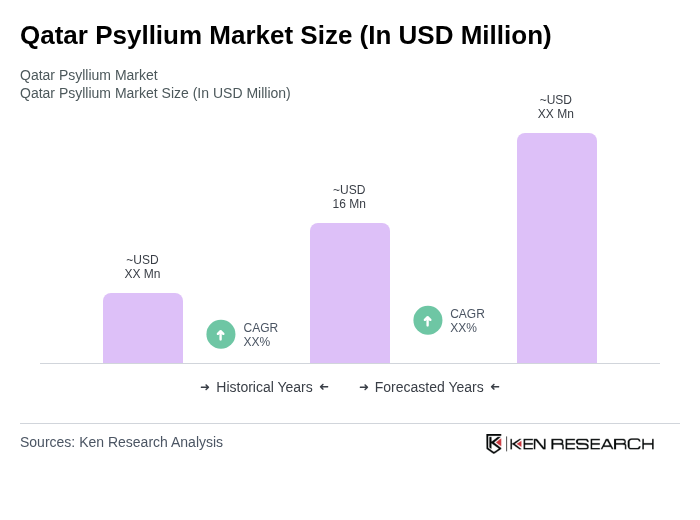
The Qatar Psyllium Market, valued at USD 16 million, is growing due to rising health consciousness and applications in dietary supplements and functional foods.

Region:Middle East

Author(s):Shubham

Product Code:KRAA8801

Pages:83

Published On:November 2025
About the Report

Base Year 2024

Qatar Psyllium Market Overview

  • The Qatar Psyllium Market is valued at USD 16 million, based on a five-year historical analysis. This growth is primarily driven by increasing consumer awareness of the health benefits associated with psyllium, including its positive impact on digestive health, weight management, and blood sugar regulation. The rising demand for natural dietary supplements and functional foods continues to propel the market, as consumers increasingly seek plant-based and organic alternatives to synthetic products. The expansion of psyllium applications into bakery, ready-to-eat meals, and gluten-free products further supports market growth.
  • Key commercial hubs for psyllium distribution in Qatar include Doha, Al Rayyan, and Al Wakrah, which dominate due to their strategic locations and robust logistics infrastructure. These cities facilitate efficient access to both local and international markets. The growing health-conscious population in these urban centers has contributed to increased consumption of psyllium-based products, particularly in the context of rising interest in functional foods and dietary supplements.
  • The “Qatar Food and Drug Authority Dietary Supplements Regulation, 2023” issued by the Ministry of Public Health mandates that all dietary supplements, including psyllium products, undergo pre-market registration, laboratory testing, and certification for quality and safety. This regulation covers ingredient verification, labeling requirements, and batch testing, ensuring that only certified products reach consumers and aligning with international safety standards.
Qatar Psyllium Market Size

Qatar Psyllium Market Segmentation

By Type:The psyllium market is segmented into four main types: Whole Psyllium Seeds, Psyllium Husk, Psyllium Husk Powder, and Psyllium Industrial Powder (Khakha Powder). Among these, Psyllium Husk remains the most dominant segment, widely used in dietary supplements and functional foods due to its high soluble fiber content and recognized health benefits. The segment’s growth is further supported by increasing consumer preference for natural and organic products. Whole Psyllium Seeds and Psyllium Husk Powder also hold significant market shares, serving applications in the food, nutraceutical, and pharmaceutical industries.
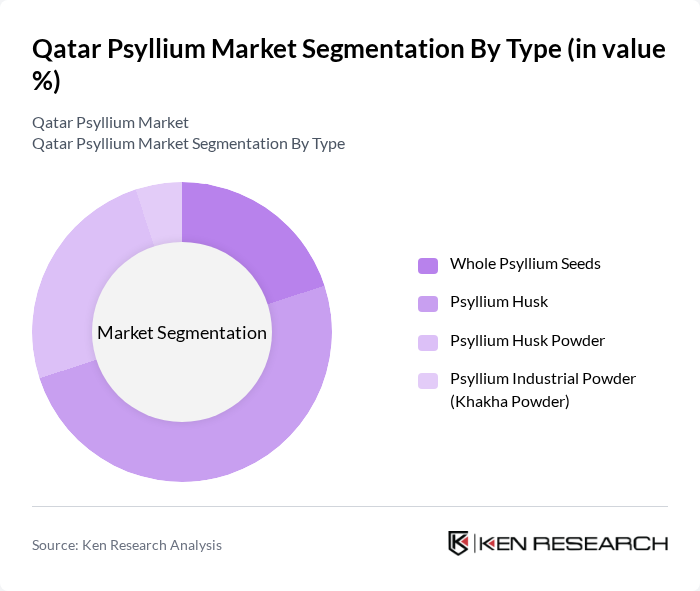
Qatar Psyllium Market segmentation by Type.

By End-User:The psyllium market is segmented by end-user into the Food Industry, Pharmaceutical Industry, Nutraceuticals, Cosmetic Industry, Animal Nutrition, and Others. The Food Industry leads the market, driven by the growing trend of health and wellness and the increased use of psyllium in gluten-free and functional food products. The Pharmaceutical Industry is a significant segment, utilizing psyllium for its clinically recognized laxative and dietary fiber properties. Nutraceuticals are also gaining traction as consumers seek functional foods with added health benefits.
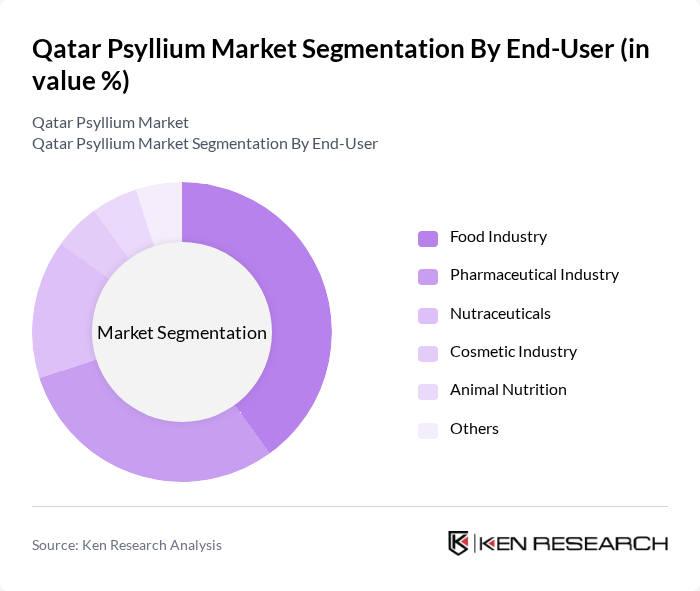
Qatar Psyllium Market segmentation by End-User.

Qatar Psyllium Market Competitive Landscape

The Qatar Psyllium Market is characterized by a dynamic mix of regional and international players. Leading participants such as Satnam Psyllium Industries, Virdhara International, Jyotindra International, Shree Mahalaxmi Psyllium Pvt. Ltd., Rajganga Agro Product Pvt. Ltd., Keyur Industries, Abhyuday Industries, Shubh Psyllium Industries, Premcem Gums Pvt. Ltd., Urvesh Psyllium Industries, Atlas Industries, Psyllium Labs LLC, Gayatri Psyllium Industries, Ispasen Remedies Private Limited, and BulkSupplements.com contribute to innovation, geographic expansion, and service delivery in this space.

Satnam Psyllium Industries

2002

Unjha, India

Virdhara International

2005

Unjha, India

Jyotindra International

1982

Unjha, India

Shree Mahalaxmi Psyllium Pvt. Ltd.

1997

Unjha, India

Rajganga Agro Product Pvt. Ltd.

2008

Unjha, India

Company

Establishment Year

Headquarters

Group Size (Large, Medium, or Small as per industry convention)

Revenue Growth Rate

Market Penetration Rate

Customer Retention Rate

Pricing Strategy

Product Portfolio Breadth

Qatar Psyllium Market Industry Analysis

Growth Drivers

  • Increasing Health Awareness:The growing awareness of health and wellness among Qatar's population is a significant driver for the psyllium market. In future, approximately 65% of Qatari consumers are expected to prioritize health-conscious choices, leading to a surge in demand for dietary fibers. The World Health Organization reports that dietary fiber intake can reduce the risk of chronic diseases, further motivating consumers to seek psyllium as a natural supplement. This trend is supported by a 20% increase in health-related product sales in the region.
  • Rising Demand for Natural Dietary Supplements:The demand for natural dietary supplements in Qatar is projected to reach QAR 1.5 billion in future, driven by a shift towards organic and plant-based products. Consumers are increasingly seeking alternatives to synthetic supplements, with psyllium gaining popularity due to its health benefits, including digestive health and weight management. The Qatar National Food Security Strategy emphasizes the importance of natural products, further supporting this trend and encouraging local businesses to invest in psyllium production.
  • Expansion of Food and Beverage Industry:Qatar's food and beverage industry is expected to grow by 10% annually, reaching QAR 25 billion in future. This expansion is creating new opportunities for psyllium incorporation into various products, such as baked goods and health bars. The increasing number of health-focused restaurants and cafes is also contributing to the demand for psyllium as a functional ingredient. The Qatar Chamber of Commerce reports that health-oriented food products are becoming a significant market segment, further driving psyllium's growth.

Market Challenges

  • Limited Local Production:Qatar's psyllium market faces challenges due to limited local production capabilities. Currently, over 80% of psyllium is imported, primarily from India and Pakistan. This reliance on imports can lead to supply chain vulnerabilities and increased costs. The Qatar Ministry of Commerce and Industry has noted that local production initiatives are still in their infancy, which hampers the ability to meet rising domestic demand effectively and sustainably.
  • Price Volatility of Raw Materials:The psyllium market in Qatar is significantly affected by the price volatility of raw materials. In future, the price of psyllium husk is projected to fluctuate between QAR 20 to QAR 30 per kilogram due to global supply chain disruptions and climatic factors affecting harvests. This volatility can impact profit margins for local businesses and deter new entrants into the market, as consistent pricing is crucial for long-term planning and investment.

Qatar Psyllium Market Future Outlook

The future of the psyllium market in Qatar appears promising, driven by increasing health consciousness and a growing preference for natural products. As the food and beverage sector continues to expand, opportunities for psyllium integration into various health-oriented products will likely increase. Additionally, the government's support for local production initiatives may enhance supply stability. With the rise of e-commerce, consumers will have greater access to psyllium products, further boosting market growth and innovation in product offerings.

Market Opportunities

  • Export Potential to Neighboring Markets:Qatar's strategic location offers significant export potential for psyllium products to neighboring Gulf Cooperation Council (GCC) countries. With a combined population of over 55 million, these markets present lucrative opportunities for local producers. The Qatar Development Bank has identified the food sector as a priority for export growth, encouraging businesses to explore regional markets for psyllium-based products.
  • Development of Value-Added Products:There is a growing opportunity for the development of value-added psyllium products, such as fortified foods and dietary supplements. The increasing consumer demand for convenience and health benefits can drive innovation in product formulations. Local companies can leverage this trend by creating unique offerings that cater to health-conscious consumers, potentially increasing market share and profitability in the competitive landscape.

Scope of the Report

SegmentSub-Segments
By Type

Whole Psyllium Seeds

Psyllium Husk

Psyllium Husk Powder

Psyllium Industrial Powder (Khakha Powder)

By End-User

Food Industry

Pharmaceutical Industry

Nutraceuticals

Cosmetic Industry

Animal Nutrition

Others

By Distribution Channel

Online Retail

Supermarkets/Hypermarkets

Health Food Stores

Direct Sales (B2B)

Others

By Application

Dietary Supplements

Functional Foods

Animal Feed

Pharmaceuticals

Personal Care Products

Industrial Use

Others

By Packaging Type

Bulk Packaging

Retail Packaging

Eco-Friendly Packaging

Others

By Source

Organic Psyllium

Conventional Psyllium

Others

By Region

Central Qatar

Northern Qatar

Southern Qatar

Others

Key Target Audience

Investors and Venture Capitalist Firms

Government and Regulatory Bodies (e.g., Ministry of Public Health, Qatar Food Safety Department)

Manufacturers and Producers of Psyllium Products

Distributors and Retailers of Health Supplements

Pharmaceutical Companies

Health and Wellness Organizations

Food and Beverage Companies

Importers and Exporters of Herbal Products

Players Mentioned in the Report:

Satnam Psyllium Industries

Virdhara International

Jyotindra International

Shree Mahalaxmi Psyllium Pvt. Ltd.

Rajganga Agro Product Pvt. Ltd.

Keyur Industries

Abhyuday Industries

Shubh Psyllium Industries

Premcem Gums Pvt. Ltd.

Urvesh Psyllium Industries

Atlas Industries

Psyllium Labs LLC

Gayatri Psyllium Industries

Ispasen Remedies Private Limited

BulkSupplements.com

Table of Contents

Market Assessment Phase

1. Executive Summary and Approach


2. Qatar Psyllium Market Overview

2.1 Key Insights and Strategic Recommendations

2.2 Qatar Psyllium Market Overview

2.3 Definition and Scope

2.4 Evolution of Market Ecosystem

2.5 Timeline of Key Regulatory Milestones

2.6 Value Chain & Stakeholder Mapping

2.7 Business Cycle Analysis

2.8 Policy & Incentive Landscape


3. Qatar Psyllium Market Analysis

3.1 Growth Drivers

3.1.1 Increasing Health Awareness
3.1.2 Rising Demand for Natural Dietary Supplements
3.1.3 Expansion of Food and Beverage Industry
3.1.4 Government Initiatives Promoting Health Foods

3.2 Market Challenges

3.2.1 Limited Local Production
3.2.2 Price Volatility of Raw Materials
3.2.3 Regulatory Compliance Issues
3.2.4 Competition from Alternative Fiber Sources

3.3 Market Opportunities

3.3.1 Export Potential to Neighboring Markets
3.3.2 Development of Value-Added Products
3.3.3 Increasing Online Retail Channels
3.3.4 Collaborations with Health and Wellness Brands

3.4 Market Trends

3.4.1 Growing Popularity of Plant-Based Diets
3.4.2 Innovations in Psyllium Processing Techniques
3.4.3 Rising Consumer Preference for Organic Products
3.4.4 Increased Focus on Sustainable Sourcing

3.5 Government Regulation

3.5.1 Food Safety Standards Compliance
3.5.2 Labeling and Marketing Regulations
3.5.3 Import Tariffs on Psyllium Products
3.5.4 Health Claims Regulations for Dietary Supplements

4. SWOT Analysis


5. Stakeholder Analysis


6. Porter's Five Forces Analysis


7. Qatar Psyllium Market Market Size, 2019-2024

7.1 By Value

7.2 By Volume

7.3 By Average Selling Price


8. Qatar Psyllium Market Segmentation

8.1 By Type

8.1.1 Whole Psyllium Seeds
8.1.2 Psyllium Husk
8.1.3 Psyllium Husk Powder
8.1.4 Psyllium Industrial Powder (Khakha Powder)

8.2 By End-User

8.2.1 Food Industry
8.2.2 Pharmaceutical Industry
8.2.3 Nutraceuticals
8.2.4 Cosmetic Industry
8.2.5 Animal Nutrition
8.2.6 Others

8.3 By Distribution Channel

8.3.1 Online Retail
8.3.2 Supermarkets/Hypermarkets
8.3.3 Health Food Stores
8.3.4 Direct Sales (B2B)
8.3.5 Others

8.4 By Application

8.4.1 Dietary Supplements
8.4.2 Functional Foods
8.4.3 Animal Feed
8.4.4 Pharmaceuticals
8.4.5 Personal Care Products
8.4.6 Industrial Use
8.4.7 Others

8.5 By Packaging Type

8.5.1 Bulk Packaging
8.5.2 Retail Packaging
8.5.3 Eco-Friendly Packaging
8.5.4 Others

8.6 By Source

8.6.1 Organic Psyllium
8.6.2 Conventional Psyllium
8.6.3 Others

8.7 By Region

8.7.1 Central Qatar
8.7.2 Northern Qatar
8.7.3 Southern Qatar
8.7.4 Others

9. Qatar Psyllium Market Competitive Analysis

9.1 Market Share of Key Players

9.2 Cross Comparison of Key Players

9.2.1 Company Name
9.2.2 Group Size (Large, Medium, or Small as per industry convention)
9.2.3 Revenue Growth Rate
9.2.4 Market Penetration Rate
9.2.5 Customer Retention Rate
9.2.6 Pricing Strategy
9.2.7 Product Portfolio Breadth
9.2.8 Supply Chain Reliability
9.2.9 Brand Recognition (Regional & International)
9.2.10 Regulatory Compliance Score
9.2.11 Innovation Index (New Product Launches, R&D Investment)
9.2.12 Export Share (for import-dependent markets)

9.3 SWOT Analysis of Top Players

9.4 Pricing Analysis

9.5 Detailed Profile of Major Companies

9.5.1 Satnam Psyllium Industries
9.5.2 Virdhara International
9.5.3 Jyotindra International
9.5.4 Shree Mahalaxmi Psyllium Pvt. Ltd.
9.5.5 Rajganga Agro Product Pvt. Ltd.
9.5.6 Keyur Industries
9.5.7 Abhyuday Industries
9.5.8 Shubh Psyllium Industries
9.5.9 Premcem Gums Pvt. Ltd.
9.5.10 Urvesh Psyllium Industries
9.5.11 Atlas Industries
9.5.12 Psyllium Labs LLC
9.5.13 Gayatri Psyllium Industries
9.5.14 Ispasen Remedies Private Limited
9.5.15 BulkSupplements.com

10. Qatar Psyllium Market End-User Analysis

10.1 Procurement Behavior of Key Ministries

10.1.1 Ministry of Health
10.1.2 Ministry of Commerce and Industry
10.1.3 Ministry of Agriculture and Fisheries
10.1.4 Others

10.2 Corporate Spend on Infrastructure & Energy

10.2.1 Investment in Health Initiatives
10.2.2 Funding for Nutritional Programs
10.2.3 Expenditure on Research and Development
10.2.4 Others

10.3 Pain Point Analysis by End-User Category

10.3.1 Food Manufacturers
10.3.2 Health Product Retailers
10.3.3 Nutraceutical Companies
10.3.4 Others

10.4 User Readiness for Adoption

10.4.1 Awareness Levels
10.4.2 Training and Support Needs
10.4.3 Infrastructure Readiness
10.4.4 Others

10.5 Post-Deployment ROI and Use Case Expansion

10.5.1 Measurement of Success Metrics
10.5.2 Case Studies of Successful Implementations
10.5.3 Feedback Mechanisms
10.5.4 Others

11. Qatar Psyllium Market Future Size, 2025-2030

11.1 By Value

11.2 By Volume

11.3 By Average Selling Price


Go-To-Market Strategy Phase

1. Whitespace Analysis + Business Model Canvas

1.1 Market Gaps Identification

1.2 Value Proposition Development

1.3 Revenue Streams Analysis

1.4 Cost Structure Evaluation

1.5 Key Partnerships Exploration

1.6 Customer Segments Definition

1.7 Channels Strategy


2. Marketing and Positioning Recommendations

2.1 Branding Strategies

2.2 Product USPs


3. Distribution Plan

3.1 Urban Retail vs Rural NGO Tie-ups


4. Channel & Pricing Gaps

4.1 Underserved Routes

4.2 Pricing Bands


5. Unmet Demand & Latent Needs

5.1 Category Gaps

5.2 Consumer Segments


6. Customer Relationship

6.1 Loyalty Programs

6.2 After-sales Service


7. Value Proposition

7.1 Sustainability

7.2 Integrated Supply Chains


8. Key Activities

8.1 Regulatory Compliance

8.2 Branding

8.3 Distribution Setup


9. Entry Strategy Evaluation

9.1 Domestic Market Entry Strategy

9.1.1 Product Mix
9.1.2 Pricing Band
9.1.3 Packaging

9.2 Export Entry Strategy

9.2.1 Target Countries
9.2.2 Compliance Roadmap

10. Entry Mode Assessment

10.1 JV

10.2 Greenfield

10.3 M&A

10.4 Distributor Model


11. Capital and Timeline Estimation

11.1 Capital Requirements

11.2 Timelines


12. Control vs Risk Trade-Off

12.1 Ownership vs Partnerships


13. Profitability Outlook

13.1 Breakeven Analysis

13.2 Long-term Sustainability


14. Potential Partner List

14.1 Distributors

14.2 JVs

14.3 Acquisition Targets


15. Execution Roadmap

15.1 Phased Plan for Market Entry

15.1.1 Market Setup
15.1.2 Market Entry
15.1.3 Growth Acceleration
15.1.4 Scale & Stabilize

15.2 Key Activities and Milestones

15.2.1 Milestone Planning
15.2.2 Activity Tracking

Research Methodology

ApproachModellingSample

Phase 1: Approach1

Desk Research

  • Analysis of trade statistics from the Qatar Ministry of Commerce and Industry
  • Review of market reports from local agricultural and health organizations
  • Examination of academic publications and journals focusing on psyllium and dietary fibers

Primary Research

  • Interviews with key stakeholders in the psyllium supply chain, including farmers and distributors
  • Surveys conducted with health food retailers and pharmacies regarding psyllium product offerings
  • Field visits to processing facilities to understand production methods and capacity

Validation & Triangulation

  • Cross-validation of data through multiple sources, including government reports and industry publications
  • Triangulation of findings from primary interviews with secondary data insights
  • Sanity checks through expert consultations with market analysts and industry veterans

Phase 2: Market Size Estimation1

Top-down Assessment

  • Estimation of total market size based on national health trends and dietary fiber consumption
  • Segmentation of the market by end-user categories such as food, pharmaceuticals, and cosmetics
  • Incorporation of government health initiatives promoting dietary fiber intake

Bottom-up Modeling

  • Volume estimates derived from production data of local psyllium suppliers
  • Cost analysis based on pricing strategies of major psyllium products in the market
  • Calculation of market size using volume x price methodology for each segment

Forecasting & Scenario Analysis

  • Multi-variable forecasting model incorporating health trends, population growth, and dietary shifts
  • Scenario analysis based on potential regulatory changes affecting health supplements
  • Development of baseline, optimistic, and pessimistic market growth projections through 2030

Phase 3: CATI Sample Composition1

Scope Item/SegmentSample SizeTarget Respondent Profiles
Health Food Retailers100Store Managers, Product Buyers
Pharmaceutical Distributors70Sales Representatives, Distribution Managers
Farmers Cultivating Psyllium50Farm Owners, Agricultural Consultants
Nutritionists and Dieticians60Health Professionals, Wellness Coaches
Food Manufacturers Using Psyllium80Product Development Managers, Quality Assurance Officers

Frequently Asked Questions

What is the current value of the Qatar Psyllium Market?

The Qatar Psyllium Market is valued at approximately USD 16 million, reflecting a growing interest in health benefits associated with psyllium, such as digestive health and weight management, alongside rising demand for natural dietary supplements.

What are the main drivers of growth in the Qatar Psyllium Market?

Which cities are the primary commercial hubs for psyllium distribution in Qatar?

What regulations govern the psyllium market in Qatar?

Other Regional/Country Reports

Indonesia Psyllium Market

Malaysia Psyllium Market

KSA Psyllium Market

APAC Psyllium Market

SEA Psyllium Market

Vietnam Psyllium Market

Why Buy From Us?

Refine Robust Result (RRR) Framework

What makes us stand out is that our consultants follow Robust, Refine and Result (RRR) methodology. Robust for clear definitions, approaches and sanity checking, Refine for differentiating respondents' facts and opinions, and Result for presenting data with story.

Our Reach Is Unmatched

We have set a benchmark in the industry by offering our clients with syndicated and customized market research reports featuring coverage of entire market as well as meticulous research and analyst insights.

Shifting the Research Paradigm

While we don't replace traditional research, we flip the method upside down. Our dual approach of Top Bottom & Bottom Top ensures quality deliverable by not just verifying company fundamentals but also looking at the sector and macroeconomic factors.

More Insights-Better Decisions

With one step in the future, our research team constantly tries to show you the bigger picture. We help with some of the tough questions you may encounter along the way: How is the industry positioned? Best marketing channel? KPI's of competitors? By aligning every element, we help maximize success.

Transparency and Trust

Our report gives you instant access to the answers and sources that other companies might choose to hide. We elaborate each steps of research methodology we have used and showcase you the sample size to earn your trust.

Round the Clock Support

If you need any support, we are here! We pride ourselves on universe strength, data quality, and quick, friendly, and professional service.

Why Clients Choose Us?

400000+
Reports in repository
150+
Consulting projects a year
100+
Analysts
8000+
Client Queries in 2022








