About the Report
Base Year 2024Russia Financial Brokerage and Trading Market Overview
- The Russia Financial Brokerage and Trading Market is valued at USD 1,150 million, based on a five-year historical analysis. This growth is primarily driven by the increasing participation of retail investors, advancements in technology, and the expansion of online trading platforms. The market has seen a significant rise in trading volumes, particularly in equities and derivatives, as investors seek to capitalize on market fluctuations. Retail investors' assets in brokerage accounts have grown substantially, with net contributions reaching RUB 574 billion, nearly double the previous year's amount, driven by decreased deposit rates and expectations of further monetary policy easing.
- Key cities dominating this market include Moscow and St. Petersburg, which serve as financial hubs due to their robust infrastructure, concentration of financial institutions, and access to international markets. Moscow, in particular, is home to the Moscow Exchange (MOEX), the largest exchange in Russia, facilitating a wide range of trading activities and attracting both domestic and foreign investors. However, the market has experienced significant capital outflows, with Russians transferring record amounts to foreign brokers amid market uncertainty and sanctions-related restrictions.
- The Federal Law on Organized Trading, 2011 issued by the Federal Assembly of the Russian Federation establishes the regulatory framework for securities markets and trading activities. This comprehensive legislation mandates that all brokerage firms must maintain minimum capital requirements of RUB 100 million for professional securities market participants, adhere to strict reporting standards including quarterly financial statements and risk management reports, and conduct regular compliance audits to ensure adherence to market conduct rules and client asset protection requirements.

Russia Financial Brokerage and Trading Market Segmentation
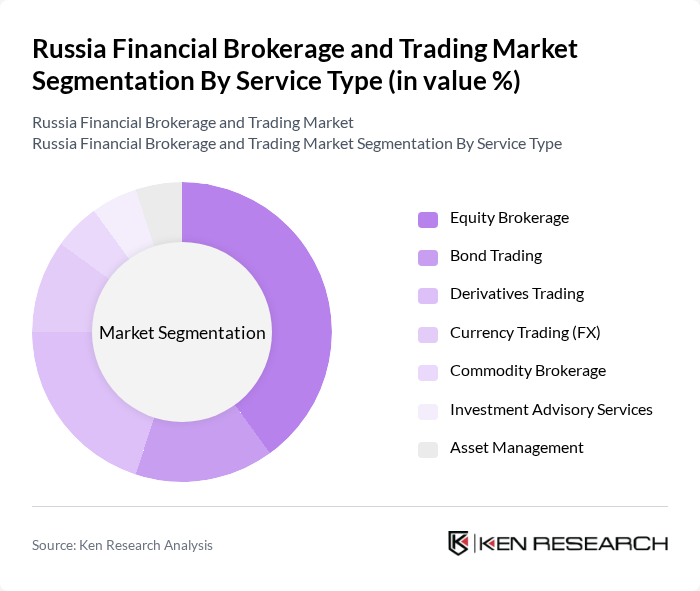
By Service Type:The service type segmentation includes various offerings such as equity brokerage, bond trading, derivatives trading, currency trading (FX), commodity brokerage, investment advisory services, and asset management. Among these, equity brokerage has emerged as the leading sub-segment, driven by the growing interest of retail investors in stock markets and the increasing availability of online trading platforms. The demand for equity trading services has surged, reflecting a shift in consumer behavior towards more active investment strategies. Notably, the structure of retail investments has evolved, with bonds increasing their share to 35% as investors anticipate rate cuts and seek to lock in high yields on long-term government bonds and corporate securities.
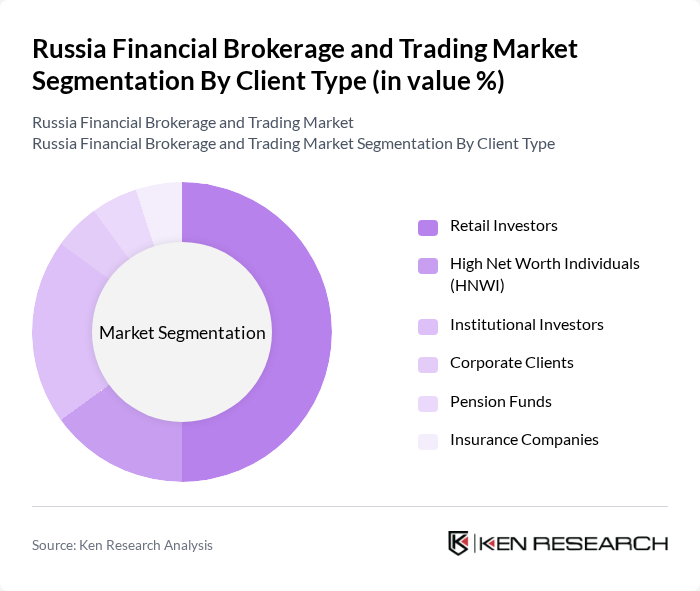
By Client Type:The client type segmentation encompasses retail investors, high net worth individuals (HNWI), institutional investors, corporate clients, pension funds, and insurance companies. Retail investors have become the dominant segment, largely due to the rise of online trading platforms that have made investing more accessible. This trend is further supported by educational initiatives aimed at increasing financial literacy among the general population, leading to a surge in retail participation in the financial markets. The number of retail clients with more than RUB 10,000 in their brokerage accounts has reached 5.1 million people, demonstrating the significant expansion of retail market participation.
Russia Financial Brokerage and Trading Market Competitive Landscape
The Russia Financial Brokerage and Trading Market is characterized by a dynamic mix of regional and international players. Leading participants such as Sberbank CIB, VTB Capital, Tinkoff Investments, BCS Global Markets, Alfa Capital, Gazprombank Investment, Otkritie Broker, Renaissance Capital, Finam, ITI Capital, Freedom Finance, Aton, Kit Finance, Solid Management, PSB Brokerage contribute to innovation, geographic expansion, and service delivery in this space.
Russia Financial Brokerage and Trading Market Industry Analysis
Growth Drivers
- Increasing Retail Investor Participation:The number of retail investors in Russia has surged, reaching approximately 15 million in future, up from 10 million in 2020. This growth is driven by a combination of factors, including increased access to online trading platforms and a growing interest in personal finance. The Russian government has also promoted investment through educational initiatives, which have contributed to a more informed investor base, enhancing overall market liquidity and activity.
- Technological Advancements in Trading Platforms:The adoption of advanced trading technologies has transformed the brokerage landscape in Russia. In future, over 60% of trades are executed via mobile applications, reflecting a shift towards digital solutions. Major brokerage firms have invested heavily in technology, with spending exceeding 30 billion rubles on platform enhancements. These innovations have improved user experience, reduced transaction times, and attracted a younger demographic of investors seeking efficient trading solutions.
- Regulatory Reforms Enhancing Market Access:Recent regulatory changes have significantly improved market access for both domestic and foreign investors. The introduction of the "Sandbox" initiative in future allows fintech companies to test new products with reduced regulatory burdens. Additionally, the number of licensed brokerage firms has increased to 300, up from 250 in 2020, fostering competition and innovation. These reforms are expected to enhance investor confidence and stimulate market growth.
Market Challenges
- Economic Sanctions Impacting Foreign Investment:Ongoing economic sanctions have severely restricted foreign investment in the Russian financial markets. In future, foreign direct investment (FDI) is projected to be around $20 billion, a significant decline from $40 billion in 2020. This reduction limits the capital available for brokerage firms and constrains their ability to expand services, ultimately affecting market liquidity and investor confidence.
- High Market Volatility and Risk Perception:The Russian financial market has experienced significant volatility, with the RTS Index fluctuating by over 30% in the previous year alone. This instability has heightened risk perception among investors, leading to a cautious approach to trading. In future, the average daily trading volume is expected to remain below 1 trillion rubles, as investors prioritize capital preservation over aggressive trading strategies, impacting overall market activity.
Russia Financial Brokerage and Trading Market Future Outlook
The future of the Russian financial brokerage and trading market appears promising, driven by technological advancements and evolving investor preferences. As digital trading platforms continue to gain traction, the market is likely to see increased participation from younger investors. Additionally, the expansion of innovative financial products, including ESG and cryptocurrency offerings, will cater to diverse investment strategies. However, ongoing geopolitical tensions and regulatory challenges may pose risks that require careful navigation by market participants.
Market Opportunities
- Growth of Fintech Solutions in Brokerage Services:The rise of fintech solutions presents a significant opportunity for brokerage firms to enhance service delivery. In future, investments in fintech are expected to exceed 50 billion rubles, enabling firms to offer personalized services and automated trading solutions. This trend will likely attract tech-savvy investors seeking innovative and efficient trading experiences.
- Increasing Interest in Cryptocurrency Trading:The growing interest in cryptocurrency trading is reshaping the investment landscape in Russia. In future, the volume of cryptocurrency transactions is projected to reach 1 trillion rubles, driven by retail investors seeking alternative assets. Brokerage firms that integrate cryptocurrency trading into their platforms can capitalize on this trend, attracting a new segment of investors looking for diversification.
Scope of the Report
| Segment | Sub-Segments |
|---|---|
| By Service Type | Equity Brokerage Bond Trading Derivatives Trading Currency Trading (FX) Commodity Brokerage Investment Advisory Services Asset Management |
| By Client Type | Retail Investors High Net Worth Individuals (HNWI) Institutional Investors Corporate Clients Pension Funds Insurance Companies |
| By Trading Platform | Online Trading Platforms Mobile Trading Applications Traditional Branch-Based Services Robo-Advisory Platforms |
| By Market Segment | Moscow Exchange (MOEX) Over-the-Counter (OTC) Markets International Markets Access Alternative Trading Systems |
| By Revenue Model | Commission-Based Fee-Based Advisory Spread-Based Trading Subscription-Based Services |
| By Geographic Region | Moscow Federal City St. Petersburg Central Federal District Siberian Federal District Ural Federal District Far Eastern Federal District |
| By Investment Product | Russian Equities Government Bonds (OFZ) Corporate Bonds Mutual Funds Exchange-Traded Funds (ETFs) Structured Products |
Key Target Audience
Investors and Venture Capitalist Firms
Government and Regulatory Bodies (e.g., Central Bank of Russia, Federal Financial Markets Service)
Brokerage Firms and Trading Platforms
Investment Banks
Hedge Funds and Asset Management Companies
Private Equity Firms
Financial Technology (FinTech) Companies
Stock Exchanges and Trading Venues
Players Mentioned in the Report:
Sberbank CIB
VTB Capital
Tinkoff Investments
BCS Global Markets
Alfa Capital
Gazprombank Investment
Otkritie Broker
Renaissance Capital
Finam
ITI Capital
Freedom Finance
Aton
Kit Finance
Solid Management
PSB Brokerage
Table of Contents
Market Assessment Phase
1. Executive Summary and Approach
2. Russia Financial Brokerage and Trading Market Overview
2.1 Key Insights and Strategic Recommendations
2.2 Russia Financial Brokerage and Trading Market Overview
2.3 Definition and Scope
2.4 Evolution of Market Ecosystem
2.5 Timeline of Key Regulatory Milestones
2.6 Value Chain & Stakeholder Mapping
2.7 Business Cycle Analysis
2.8 Policy & Incentive Landscape
3. Russia Financial Brokerage and Trading Market Analysis
3.1 Growth Drivers
3.1.1 Increasing Retail Investor Participation
3.1.2 Technological Advancements in Trading Platforms
3.1.3 Regulatory Reforms Enhancing Market Access
3.1.4 Rising Demand for Diversified Investment Products
3.2 Market Challenges
3.2.1 Economic Sanctions Impacting Foreign Investment
3.2.2 High Market Volatility and Risk Perception
3.2.3 Limited Financial Literacy Among Retail Investors
3.2.4 Regulatory Compliance Burdens
3.3 Market Opportunities
3.3.1 Growth of Fintech Solutions in Brokerage Services
3.3.2 Expansion of ESG Investment Products
3.3.3 Increasing Interest in Cryptocurrency Trading
3.3.4 Development of New Trading Instruments
3.4 Market Trends
3.4.1 Shift Towards Digital Trading Platforms
3.4.2 Rise of Algorithmic Trading
3.4.3 Increased Focus on Customer Experience
3.4.4 Growing Popularity of Social Trading
3.5 Government Regulation
3.5.1 Implementation of New Financial Market Laws
3.5.2 Enhanced Investor Protection Regulations
3.5.3 Tax Incentives for Investment in Securities
3.5.4 Licensing Requirements for Brokerage Firms
4. SWOT Analysis
5. Stakeholder Analysis
6. Porter's Five Forces Analysis
7. Russia Financial Brokerage and Trading Market Market Size, 2019-2024
7.1 By Value
7.2 By Volume
7.3 By Average Selling Price
8. Russia Financial Brokerage and Trading Market Segmentation
8.1 By Service Type
8.1.1 Equity Brokerage
8.1.2 Bond Trading
8.1.3 Derivatives Trading
8.1.4 Currency Trading (FX)
8.1.5 Commodity Brokerage
8.1.6 Investment Advisory Services
8.1.7 Asset Management
8.2 By Client Type
8.2.1 Retail Investors
8.2.2 High Net Worth Individuals (HNWI)
8.2.3 Institutional Investors
8.2.4 Corporate Clients
8.2.5 Pension Funds
8.2.6 Insurance Companies
8.3 By Trading Platform
8.3.1 Online Trading Platforms
8.3.2 Mobile Trading Applications
8.3.3 Traditional Branch-Based Services
8.3.4 Robo-Advisory Platforms
8.4 By Market Segment
8.4.1 Moscow Exchange (MOEX)
8.4.2 Over-the-Counter (OTC) Markets
8.4.3 International Markets Access
8.4.4 Alternative Trading Systems
8.5 By Revenue Model
8.5.1 Commission-Based
8.5.2 Fee-Based Advisory
8.5.3 Spread-Based Trading
8.5.4 Subscription-Based Services
8.6 By Geographic Region
8.6.1 Moscow Federal City
8.6.2 St. Petersburg
8.6.3 Central Federal District
8.6.4 Siberian Federal District
8.6.5 Ural Federal District
8.6.6 Far Eastern Federal District
8.7 By Investment Product
8.7.1 Russian Equities
8.7.2 Government Bonds (OFZ)
8.7.3 Corporate Bonds
8.7.4 Mutual Funds
8.7.5 Exchange-Traded Funds (ETFs)
8.7.6 Structured Products
9. Russia Financial Brokerage and Trading Market Competitive Analysis
9.1 Market Share of Key Players
9.2 Cross Comparison of Key Players
9.2.1 Company Name
9.2.2 Assets Under Management (AUM)
9.2.3 Number of Active Clients
9.2.4 Daily Trading Volume
9.2.5 Commission Revenue Growth Rate
9.2.6 Market Share by Trading Volume
9.2.7 Client Acquisition Cost (CAC)
9.2.8 Average Revenue Per User (ARPU)
9.2.9 Digital Platform Adoption Rate
9.2.10 Regulatory Capital Adequacy Ratio
9.3 SWOT Analysis of Top Players
9.4 Pricing Analysis
9.5 Detailed Profile of Major Companies
9.5.1 Sberbank CIB
9.5.2 VTB Capital
9.5.3 Tinkoff Investments
9.5.4 BCS Global Markets
9.5.5 Alfa Capital
9.5.6 Gazprombank Investment
9.5.7 Otkritie Broker
9.5.8 Renaissance Capital
9.5.9 Finam
9.5.10 ITI Capital
9.5.11 Freedom Finance
9.5.12 Aton
9.5.13 Kit Finance
9.5.14 Solid Management
9.5.15 PSB Brokerage
10. Russia Financial Brokerage and Trading Market End-User Analysis
10.1 Procurement Behavior of Key Ministries
10.1.1 Investment Strategies
10.1.2 Budget Allocation
10.1.3 Risk Management Practices
10.2 Corporate Spend on Infrastructure & Energy
10.2.1 Investment in Financial Technologies
10.2.2 Spending on Compliance and Regulation
10.2.3 Budget for Trading Platforms
10.3 Pain Point Analysis by End-User Category
10.3.1 Access to Information
10.3.2 Cost of Trading
10.3.3 Complexity of Regulations
10.4 User Readiness for Adoption
10.4.1 Technology Adoption Rates
10.4.2 Training and Support Needs
10.4.3 Awareness of Financial Products
10.5 Post-Deployment ROI and Use Case Expansion
10.5.1 Performance Metrics
10.5.2 Scalability of Solutions
10.5.3 Long-term Investment Returns
11. Russia Financial Brokerage and Trading Market Future Size, 2025-2030
11.1 By Value
11.2 By Volume
11.3 By Average Selling Price
Go-To-Market Strategy Phase
1. Whitespace Analysis + Business Model Canvas
1.1 Market Gaps Identification
1.2 Business Model Framework
2. Marketing and Positioning Recommendations
2.1 Branding Strategies
2.2 Product USPs
3. Distribution Plan
3.1 Urban Retail Strategies
3.2 Rural NGO Tie-ups
4. Channel & Pricing Gaps
4.1 Underserved Routes
4.2 Pricing Bands
5. Unmet Demand & Latent Needs
5.1 Category Gaps
5.2 Consumer Segments
6. Customer Relationship
6.1 Loyalty Programs
6.2 After-sales Service
7. Value Proposition
7.1 Sustainability Initiatives
7.2 Integrated Supply Chains
8. Key Activities
8.1 Regulatory Compliance
8.2 Branding Efforts
8.3 Distribution Setup
9. Entry Strategy Evaluation
9.1 Domestic Market Entry Strategy
9.1.1 Product Mix
9.1.2 Pricing Band
9.1.3 Packaging Strategies
9.2 Export Entry Strategy
9.2.1 Target Countries
9.2.2 Compliance Roadmap
10. Entry Mode Assessment
10.1 Joint Ventures
10.2 Greenfield Investments
10.3 Mergers & Acquisitions
10.4 Distributor Model
11. Capital and Timeline Estimation
11.1 Capital Requirements
11.2 Timelines
12. Control vs Risk Trade-Off
12.1 Ownership vs Partnerships
13. Profitability Outlook
13.1 Breakeven Analysis
13.2 Long-term Sustainability
14. Potential Partner List
14.1 Distributors
14.2 Joint Ventures
14.3 Acquisition Targets
15. Execution Roadmap
15.1 Phased Plan for Market Entry
15.1.1 Market Setup
15.1.2 Market Entry
15.1.3 Growth Acceleration
15.1.4 Scale & Stabilize
15.2 Key Activities and Milestones
15.2.1 Milestone Planning
15.2.2 Activity Tracking
Research Methodology
Phase 1: Approach1
Desk Research
- Analysis of financial reports from major Russian brokerage firms and trading platforms
- Review of market studies and white papers published by financial regulatory bodies in Russia
- Examination of economic indicators and trends from the Central Bank of Russia and other financial institutions
Primary Research
- Interviews with senior executives from leading financial brokerages and trading firms
- Surveys targeting retail investors and institutional clients to gauge market sentiment
- Focus groups with financial analysts and market strategists to discuss emerging trends
Validation & Triangulation
- Cross-validation of findings through multiple data sources, including trade volumes and transaction values
- Triangulation of qualitative insights from interviews with quantitative data from market reports
- Sanity checks through expert panel reviews comprising economists and market analysts
Phase 2: Market Size Estimation1
Top-down Assessment
- Estimation of total market size based on national financial services expenditure and brokerage activity
- Segmentation of the market by asset classes, including equities, bonds, and derivatives
- Incorporation of macroeconomic factors such as GDP growth and foreign investment trends
Bottom-up Modeling
- Collection of transaction data from a sample of brokerage firms to establish average commission rates
- Estimation of client acquisition costs and retention rates across different brokerage models
- Volume x commission basis for revenue projections across various trading segments
Forecasting & Scenario Analysis
- Multi-factor regression analysis incorporating variables such as market volatility and investor confidence
- Scenario modeling based on potential regulatory changes and geopolitical developments
- Baseline, optimistic, and pessimistic forecasts for market growth through 2030
Phase 3: CATI Sample Composition1
| Scope Item/Segment | Sample Size | Target Respondent Profiles |
|---|---|---|
| Retail Brokerage Services | 100 | Individual Investors, Financial Advisors |
| Institutional Trading Platforms | 80 | Portfolio Managers, Institutional Investors |
| Derivatives Trading | 60 | Traders, Risk Management Analysts |
| Forex Trading Services | 50 | Forex Traders, Financial Analysts |
| Investment Advisory Services | 40 | Investment Advisors, Wealth Managers |
Frequently Asked Questions
What is the current value of the Russia Financial Brokerage and Trading Market?
The Russia Financial Brokerage and Trading Market is valued at approximately USD 1,150 million, reflecting significant growth driven by increased retail investor participation, technological advancements, and the expansion of online trading platforms.
Which cities are the main financial hubs in Russia?
What are the key regulatory frameworks governing the Russian brokerage market?
How has retail investor participation changed in Russia?
Other Regional/Country Reports
Malaysia Financial Brokerage and Trading Market
KSA Financial Brokerage and Trading Market
APAC Financial Brokerage and Trading Market
SEA Financial Brokerage and Trading Market
Other Adjacent Reports
Qatar Fintech Solutions Market
Cryptocurrency Trading MarketJapan Wealth Management Market Outlook to 2030: Size, Share, Growth and TrendsBelgium Payment Processing Market
Japan Stock Exchange Operations Market
Vietnam Derivatives Trading Market
Malaysia Forex Trading Market
Europe Insurance Brokerage MarketWhy Buy From Us?

What makes us stand out is that our consultants follow Robust, Refine and Result (RRR) methodology. Robust for clear definitions, approaches and sanity checking, Refine for differentiating respondents' facts and opinions, and Result for presenting data with story.

We have set a benchmark in the industry by offering our clients with syndicated and customized market research reports featuring coverage of entire market as well as meticulous research and analyst insights.

While we don't replace traditional research, we flip the method upside down. Our dual approach of Top Bottom & Bottom Top ensures quality deliverable by not just verifying company fundamentals but also looking at the sector and macroeconomic factors.

With one step in the future, our research team constantly tries to show you the bigger picture. We help with some of the tough questions you may encounter along the way: How is the industry positioned? Best marketing channel? KPI's of competitors? By aligning every element, we help maximize success.

Our report gives you instant access to the answers and sources that other companies might choose to hide. We elaborate each steps of research methodology we have used and showcase you the sample size to earn your trust.

If you need any support, we are here! We pride ourselves on universe strength, data quality, and quick, friendly, and professional service.