About the Report
Base Year 2024Russia Power Market Overview
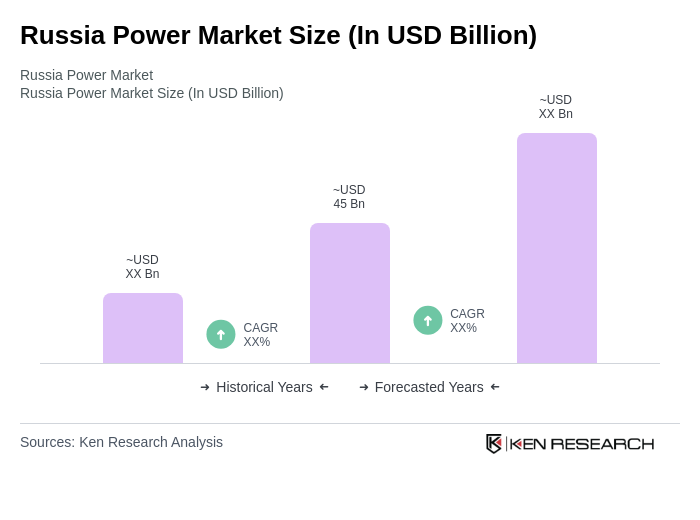
- The Russia Power Market is valued at USD 45 billion, based on a five-year historical analysis. This growth is primarily driven by rising electricity demand, continued government investment in grid and generation assets, and efficiency and diversification policies that emphasize modernizing thermal fleets, expanding hydro and nuclear, and selectively adding renewables.
- Key players in this market include large state-linked utilities and generators operating across major demand centers such as Moscow and other industrial regions; however, cities like Moscow, St. Petersburg, and Novosibirsk are demand hubs rather than market “players.” Generation and networks are dominated by companies such as Rosseti (transmission and distribution), Inter RAO (generation and trading), RusHydro (hydropower and RES), Gazprom Energoholding (thermal), and Rosatom/Rosenergoatom (nuclear).
- In 2023, Russia continued broader efficiency and modernization efforts within its Energy Strategy framework, but there is no official federal regulation publicly documented that mandates an across-the-board 15% energy waste reduction by 2025 for all producers and consumers. Current policy direction emphasizes improving energy efficiency, grid upgrades, and diversification, with targets and initiatives embedded in long-term strategies rather than a singular 2023 mandate of 15% by 2025.
Russia Power Market Segmentation
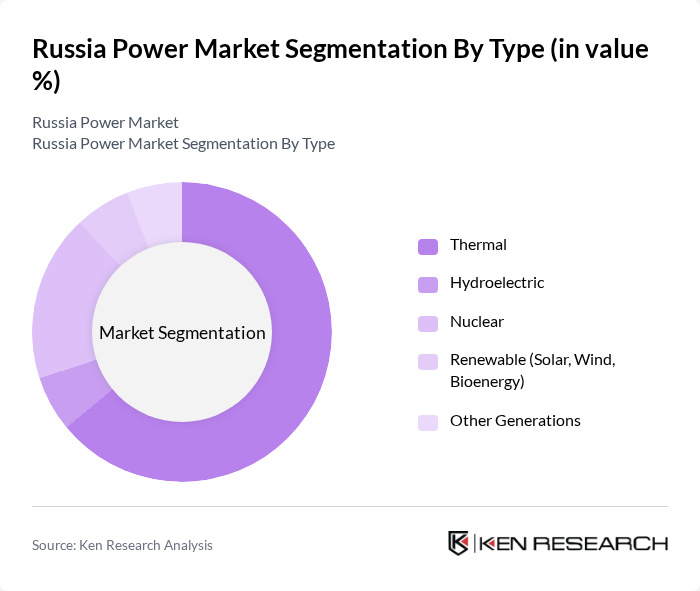
By Type:The market is segmented into various types of energy generation, including Thermal, Hydroelectric, Nuclear, Renewable (Solar, Wind, Bioenergy), and Other Generations. Each type plays a crucial role in meeting the energy demands of the country, with Thermal and Hydroelectric being the most established forms of energy production. The Renewable segment is rapidly growing due to increasing environmental awareness and government support.
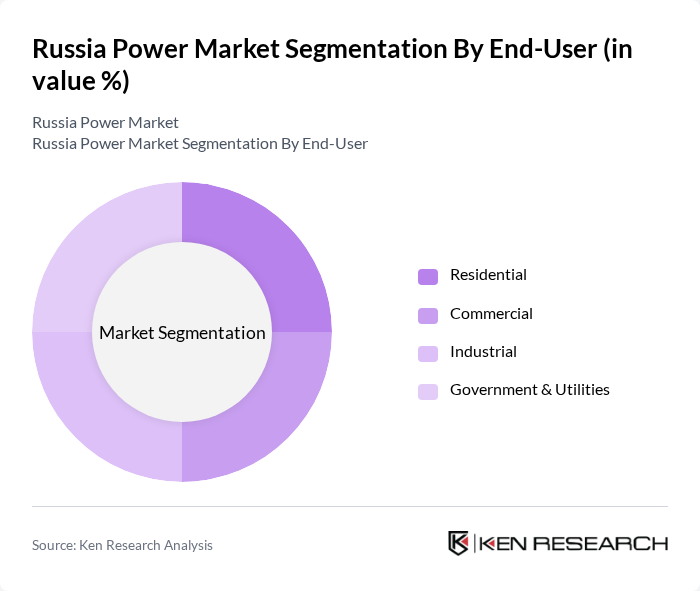
By End-User:The end-user segmentation includes Residential, Commercial, Industrial, and Government & Utilities. Each segment has distinct energy needs, with the Industrial sector being the largest consumer, driven by metals, chemicals, and manufacturing load. The Residential sector follows closely, due to the high number of households.
Russia Power Market Competitive Landscape
The Russia Power Market is characterized by a dynamic mix of regional and national players. Leading participants such as Gazprom Energoholding, Rosseti (PJSC Rosseti), Inter RAO UES, RusHydro, Unipro (formerly E.ON Russia), TGC-1 (PJSC TGC-1), Rosatom State Atomic Energy Corporation, Power Machines (Silovye Mashiny), SUEK (Siberian Coal Energy Company), LUKOIL, NOVATEK, Rusatom Energy International (JSC), Inter RAO – Engineering, Rosseti FGC UES (Federal Grid Company), Rosseti Lenenergo contribute to innovation, geographic expansion, and service delivery in this space.
Russia Power Market Industry Analysis
Growth Drivers
- Increasing Energy Demand:The energy demand in Russia is projected to reach 1,100 terawatt-hours (TWh) in future, driven by industrial growth and urbanization. The World Bank estimates that the industrial sector will contribute approximately 60% of this demand, particularly in manufacturing and mining. Additionally, the residential sector is expected to account for 25% of total energy consumption, reflecting a growing population and rising living standards. This increasing demand is a significant driver for investments in power generation capacity.
- Government Investments in Infrastructure:The Russian government has allocated over $25 billion for energy infrastructure projects in future, focusing on modernizing existing facilities and expanding grid capacity. This investment aims to enhance energy security and reliability, particularly in remote regions. The Ministry of Energy reports that approximately 12,000 kilometers of transmission lines will be upgraded, which is crucial for accommodating the rising energy demand and integrating renewable sources into the grid.
- Renewable Energy Initiatives:Russia's commitment to renewable energy is evident in its goal to increase the share of renewables to 4.5% of the total energy mix in future, translating to an additional 6 gigawatts (GW) of installed capacity. The government has introduced incentives, including feed-in tariffs, to attract investments in solar and wind projects. As of now, the installed capacity of renewables reached 3 GW, indicating a robust growth trajectory that supports energy diversification and sustainability.
Market Challenges
- Regulatory Uncertainty:The regulatory landscape in Russia remains complex, with frequent changes impacting the energy sector. In future, the government proposed amendments to energy laws that could alter investment conditions, creating uncertainty for stakeholders. This unpredictability can deter foreign investments, which are crucial for technology transfer and infrastructure development. The International Energy Agency (IEA) highlights that regulatory stability is essential for fostering a conducive environment for energy projects.
- Aging Infrastructure:A significant portion of Russia's energy infrastructure is over 30 years old, leading to inefficiencies and increased maintenance costs. The Ministry of Energy estimates that approximately 35% of power plants require modernization or replacement in future. This aging infrastructure poses risks to energy reliability and security, as outdated systems are more prone to failures and outages, which can disrupt supply and impact economic growth.
Russia Power Market Future Outlook
The future of the Russia power market is poised for transformation, driven by technological advancements and a shift towards sustainable energy solutions. In future, the integration of smart grid technologies is expected to enhance energy management and efficiency. Additionally, the expansion of renewable energy sources will play a crucial role in diversifying the energy mix, supported by government initiatives and international collaborations. These trends indicate a progressive transition towards a more resilient and environmentally friendly energy landscape in Russia.
Market Opportunities
- Expansion of Renewable Energy Sources:The Russian government’s commitment to increasing renewable energy capacity presents significant opportunities for investment. With a target of 6 GW of new renewable installations in future, companies can capitalize on this growth by developing solar and wind projects. This expansion not only aligns with global sustainability trends but also enhances energy security and reduces dependence on fossil fuels.
- Smart Grid Technologies:The adoption of smart grid technologies is a key opportunity for enhancing energy efficiency and reliability. In future, investments in smart grid infrastructure are expected to exceed $12 billion, facilitating better energy management and integration of renewable sources. This technological shift will enable real-time monitoring and optimization of energy distribution, ultimately leading to reduced operational costs and improved service delivery.
Scope of the Report
| Segment | Sub-Segments |
|---|---|
| By Type | Thermal Hydroelectric Nuclear Renewable (Solar, Wind, Bioenergy) Other Generations |
| By End-User | Residential Commercial Industrial Government & Utilities |
| By Region | Central Federal District North-Western Federal District Southern & North Caucasus Federal Districts Volga Federal District Ural Federal District Siberian Federal District Far Eastern Federal District |
| By Technology | Gas-Fired (CCGT/CHP) Coal-Fired Large Hydro (Reservoir/Run-of-River) Nuclear Reactor (VVER/RBMK/BN) Solar PV Onshore Wind Biomass & Waste-to-Energy |
| By Application | Grid-Connected (Unified Energy System) Isolated/Off-Grid (Far North & Far East) Rooftop/Distributed Generation Utility-Scale Projects |
| By Investment Source | Domestic (State & Private) Foreign Direct Investment (FDI) Public-Private Partnerships (PPP) Government Support Mechanisms (CSA/Capacity Market) |
| By Policy Support | Subsidies & Capacity Payments Tax Incentives Renewable Support (DPM/CSA for RES) Feed-in Premiums/Contracts for Capacity |
Key Target Audience
Investors and Venture Capitalist Firms
Government and Regulatory Bodies (e.g., Ministry of Energy of the Russian Federation)
Energy Producers and Utility Companies
Infrastructure Development Agencies
Environmental Protection Agencies (e.g., Federal Service for Supervision of Natural Resources)
Energy Technology Providers
Industry Associations (e.g., Russian Union of Industrialists and Entrepreneurs)
Financial Institutions and Banks
Players Mentioned in the Report:
Gazprom Energoholding
Rosseti (PJSC Rosseti)
Inter RAO UES
RusHydro
Unipro (formerly E.ON Russia)
TGC-1 (PJSC TGC-1)
Rosatom State Atomic Energy Corporation
Power Machines (Silovye Mashiny)
SUEK (Siberian Coal Energy Company)
LUKOIL
NOVATEK
Rusatom Energy International (JSC)
Inter RAO Engineering
Rosseti FGC UES (Federal Grid Company)
Rosseti Lenenergo
Table of Contents
Market Assessment Phase
1. Executive Summary and Approach
2. Russia Power Market Overview
2.1 Key Insights and Strategic Recommendations
2.2 Russia Power Market Overview
2.3 Definition and Scope
2.4 Evolution of Market Ecosystem
2.5 Timeline of Key Regulatory Milestones
2.6 Value Chain & Stakeholder Mapping
2.7 Business Cycle Analysis
2.8 Policy & Incentive Landscape
3. Russia Power Market Analysis
3.1 Growth Drivers
3.1.1 Increasing Energy Demand
3.1.2 Government Investments in Infrastructure
3.1.3 Renewable Energy Initiatives
3.1.4 Technological Advancements
3.2 Market Challenges
3.2.1 Regulatory Uncertainty
3.2.2 Aging Infrastructure
3.2.3 Economic Sanctions
3.2.4 Environmental Concerns
3.3 Market Opportunities
3.3.1 Expansion of Renewable Energy Sources
3.3.2 Energy Efficiency Programs
3.3.3 International Collaborations
3.3.4 Smart Grid Technologies
3.4 Market Trends
3.4.1 Shift Towards Decentralized Energy Production
3.4.2 Increased Investment in Clean Energy
3.4.3 Digitalization of Energy Management
3.4.4 Focus on Energy Storage Solutions
3.5 Government Regulation
3.5.1 Renewable Energy Legislation
3.5.2 Emission Standards
3.5.3 Tariff Regulations
3.5.4 Energy Efficiency Mandates
4. SWOT Analysis
5. Stakeholder Analysis
6. Porter's Five Forces Analysis
7. Russia Power Market Market Size, 2019-2024
7.1 By Value
7.2 By Volume
7.3 By Average Selling Price
8. Russia Power Market Segmentation
8.1 By Type
8.1.1 Thermal
8.1.2 Hydroelectric
8.1.3 Nuclear
8.1.4 Renewable (Solar, Wind, Bioenergy)
8.1.5 Other Generations
8.2 By End-User
8.2.1 Residential
8.2.2 Commercial
8.2.3 Industrial
8.2.4 Government & Utilities
8.3 By Region
8.3.1 Central Federal District
8.3.2 North-Western Federal District
8.3.3 Southern & North Caucasus Federal Districts
8.3.4 Volga Federal District
8.3.5 Ural Federal District
8.3.6 Siberian Federal District
8.3.7 Far Eastern Federal District
8.4 By Technology
8.4.1 Gas-Fired (CCGT/CHP)
8.4.2 Coal-Fired
8.4.3 Large Hydro (Reservoir/Run-of-River)
8.4.4 Nuclear Reactor (VVER/RBMK/BN)
8.4.5 Solar PV
8.4.6 Onshore Wind
8.4.7 Biomass & Waste-to-Energy
8.5 By Application
8.5.1 Grid-Connected (Unified Energy System)
8.5.2 Isolated/Off-Grid (Far North & Far East)
8.5.3 Rooftop/Distributed Generation
8.5.4 Utility-Scale Projects
8.6 By Investment Source
8.6.1 Domestic (State & Private)
8.6.2 Foreign Direct Investment (FDI)
8.6.3 Public-Private Partnerships (PPP)
8.6.4 Government Support Mechanisms (CSA/Capacity Market)
8.7 By Policy Support
8.7.1 Subsidies & Capacity Payments
8.7.2 Tax Incentives
8.7.3 Renewable Support (DPM/CSA for RES)
8.7.4 Feed-in Premiums/Contracts for Capacity
9. Russia Power Market Competitive Analysis
9.1 Market Share of Key Players
9.2 Cross Comparison of Key Players
9.2.1 Company Name
9.2.2 Scale (Installed Capacity, MW)
9.2.3 Generation Mix (% Thermal/Hydro/Nuclear/RES)
9.2.4 Capacity Factor (%)
9.2.5 Average Heat Rate (Thermal, kJ/kWh)
9.2.6 Transmission/Distribution Losses (%) where applicable
9.2.7 Capex per MW (USD/MW)
9.2.8 Opex per MWh (USD/MWh)
9.2.9 EBITDA Margin (%)
9.2.10 Return on Invested Capital (ROIC, %)
9.2.11 Leverage (Net Debt/EBITDA)
9.2.12 HSE Incidents (TRIR) and Unplanned Outage Rate (%)
9.2.13 CO2 Intensity (kgCO2e/MWh) for thermal portfolio
9.2.14 New-Build Pipeline (MW) and Commissioning Timeline
9.3 SWOT Analysis of Top Players
9.4 Pricing Analysis
9.5 Detailed Profile of Major Companies
9.5.1 Gazprom Energoholding
9.5.2 Rosseti (PJSC Rosseti)
9.5.3 Inter RAO UES
9.5.4 RusHydro
9.5.5 Unipro (formerly E.ON Russia)
9.5.6 TGC-1 (PJSC TGC-1)
9.5.7 Rosatom State Atomic Energy Corporation
9.5.8 Power Machines (Silovye Mashiny)
9.5.9 SUEK (Siberian Coal Energy Company)
9.5.10 LUKOIL
9.5.11 NOVATEK
9.5.12 Rusatom Energy International (JSC)
9.5.13 Inter RAO – Engineering
9.5.14 Rosseti FGC UES (Federal Grid Company)
9.5.15 Rosseti Lenenergo
10. Russia Power Market End-User Analysis
10.1 Procurement Behavior of Key Ministries
10.1.1 Ministry of Energy
10.1.2 Ministry of Economic Development
10.1.3 Ministry of Natural Resources
10.2 Corporate Spend on Infrastructure & Energy
10.2.1 Investment Trends
10.2.2 Budget Allocations
10.2.3 Project Financing
10.3 Pain Point Analysis by End-User Category
10.3.1 Residential Users
10.3.2 Commercial Users
10.3.3 Industrial Users
10.4 User Readiness for Adoption
10.4.1 Awareness Levels
10.4.2 Adoption Barriers
10.4.3 Training Needs
10.5 Post-Deployment ROI and Use Case Expansion
10.5.1 Performance Metrics
10.5.2 Case Studies
10.5.3 Future Expansion Plans
11. Russia Power Market Future Size, 2025-2030
11.1 By Value
11.2 By Volume
11.3 By Average Selling Price
Go-To-Market Strategy Phase
1. Whitespace Analysis + Business Model Canvas
1.1 Market Gaps Identification
1.2 Business Model Framework
2. Marketing and Positioning Recommendations
2.1 Branding Strategies
2.2 Product USPs
3. Distribution Plan
3.1 Urban Retail Strategies
3.2 Rural NGO Tie-ups
4. Channel & Pricing Gaps
4.1 Underserved Routes
4.2 Pricing Bands
5. Unmet Demand & Latent Needs
5.1 Category Gaps
5.2 Consumer Segments
6. Customer Relationship
6.1 Loyalty Programs
6.2 After-sales Service
7. Value Proposition
7.1 Sustainability Initiatives
7.2 Integrated Supply Chains
8. Key Activities
8.1 Regulatory Compliance
8.2 Branding Efforts
8.3 Distribution Setup
9. Entry Strategy Evaluation
9.1 Domestic Market Entry Strategy
9.1.1 Product Mix
9.1.2 Pricing Band
9.1.3 Packaging
9.2 Export Entry Strategy
9.2.1 Target Countries
9.2.2 Compliance Roadmap
10. Entry Mode Assessment
10.1 Joint Ventures
10.2 Greenfield Investments
10.3 Mergers & Acquisitions
10.4 Distributor Model
11. Capital and Timeline Estimation
11.1 Capital Requirements
11.2 Timelines
12. Control vs Risk Trade-Off
12.1 Ownership vs Partnerships
13. Profitability Outlook
13.1 Breakeven Analysis
13.2 Long-term Sustainability
14. Potential Partner List
14.1 Distributors
14.2 Joint Ventures
14.3 Acquisition Targets
15. Execution Roadmap
15.1 Phased Plan for Market Entry
15.1.1 Market Setup
15.1.2 Market Entry
15.1.3 Growth Acceleration
15.1.4 Scale & Stabilize
15.2 Key Activities and Milestones
15.2.1 Milestone Planning
15.2.2 Activity Tracking
Research Methodology
Phase 1: Approach1
Desk Research
- Analysis of government publications and energy policy documents from the Ministry of Energy of the Russian Federation
- Review of market reports from industry associations such as the Russian Electric Power Industry Association
- Examination of historical data on electricity consumption and generation from Rosstat and other statistical agencies
Primary Research
- Interviews with energy analysts and economists specializing in the Russian power sector
- Surveys with utility company executives to gather insights on operational challenges and market dynamics
- Field interviews with regulatory bodies to understand the impact of policy changes on market operations
Validation & Triangulation
- Cross-validation of findings through multiple data sources, including trade publications and academic journals
- Triangulation of market trends using insights from both primary interviews and secondary data
- Sanity checks through expert panel reviews to ensure the reliability of the data collected
Phase 2: Market Size Estimation1
Top-down Assessment
- Estimation of total electricity demand based on macroeconomic indicators and population growth projections
- Segmentation of the market by generation sources, including fossil fuels, nuclear, and renewables
- Incorporation of government targets for renewable energy adoption and emissions reduction
Bottom-up Modeling
- Collection of operational data from major power generation companies to establish capacity and output metrics
- Cost analysis of electricity generation technologies to determine price per kilowatt-hour
- Volume x price calculations to derive revenue estimates for different segments of the power market
Forecasting & Scenario Analysis
- Multi-factor regression analysis incorporating variables such as GDP growth, energy efficiency improvements, and technological advancements
- Scenario modeling based on potential regulatory changes and shifts in consumer behavior towards energy consumption
- Development of baseline, optimistic, and pessimistic forecasts for the power market through 2030
Phase 3: CATI Sample Composition1
| Scope Item/Segment | Sample Size | Target Respondent Profiles |
|---|---|---|
| Electricity Generation Companies | 90 | CEOs, Operations Managers, Financial Analysts |
| Regulatory Bodies | 45 | Policy Makers, Regulatory Analysts, Compliance Officers |
| Energy Consumers (Industrial) | 80 | Facility Managers, Energy Procurement Officers |
| Renewable Energy Developers | 70 | Project Managers, Business Development Executives |
| Energy Efficiency Consultants | 60 | Consultants, Sustainability Managers, Technical Advisors |
Frequently Asked Questions
What is the current value of the Russia Power Market?
The Russia Power Market is valued at approximately USD 45 billion, driven by increasing electricity demand, government investments in infrastructure, and policies aimed at modernizing energy generation and enhancing efficiency across various energy sources.
Who are the key players in the Russia Power Market?
What are the main types of energy generation in Russia?
What drives the growth of the Russia Power Market?
Why Buy From Us?

What makes us stand out is that our consultants follow Robust, Refine and Result (RRR) methodology. Robust for clear definitions, approaches and sanity checking, Refine for differentiating respondents' facts and opinions, and Result for presenting data with story.

We have set a benchmark in the industry by offering our clients with syndicated and customized market research reports featuring coverage of entire market as well as meticulous research and analyst insights.

While we don't replace traditional research, we flip the method upside down. Our dual approach of Top Bottom & Bottom Top ensures quality deliverable by not just verifying company fundamentals but also looking at the sector and macroeconomic factors.

With one step in the future, our research team constantly tries to show you the bigger picture. We help with some of the tough questions you may encounter along the way: How is the industry positioned? Best marketing channel? KPI's of competitors? By aligning every element, we help maximize success.

Our report gives you instant access to the answers and sources that other companies might choose to hide. We elaborate each steps of research methodology we have used and showcase you the sample size to earn your trust.

If you need any support, we are here! We pride ourselves on universe strength, data quality, and quick, friendly, and professional service.