About the Report
Base Year 2024United States Power Market Overview
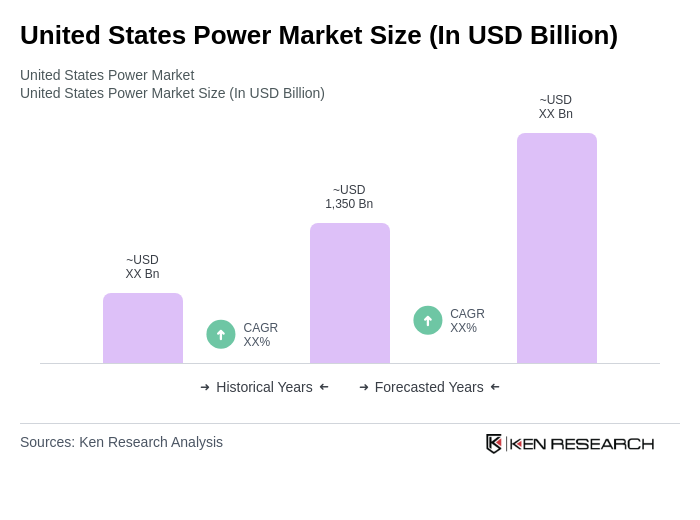
- The United States Power Market is valued at USD 1,350 billion, based on a five-year historical analysis. This valuation reflects sustained growth fueled by surging electricity demand, particularly from data centers, manufacturing, and broader electrification trends. The sector’s expansion is further supported by robust investments in grid modernization, renewable energy infrastructure, and advanced energy storage technologies, all of which are reshaping the market landscape and driving capital flows into both generation and transmission assets .
- Key players in this market includeCalifornia, Texas, and New York, which lead due to their large populations, advanced industrial and commercial sectors, and significant renewable energy investments. California’s leadership is underpinned by its aggressive climate and clean energy policies, Texas benefits from vast wind and solar resources and rapid grid-scale battery deployment, while New York’s focus on energy efficiency, grid innovation, and ambitious decarbonization targets further cements its position .
- TheInflation Reduction Act of 2022(Public Law No: 117-169), enacted by the United States Congress, introduced comprehensive tax credits and incentives for renewable energy projects. The Act provides production and investment tax credits for solar, wind, energy storage, and other clean energy technologies, with operational requirements for domestic content and prevailing wage. This legislation is accelerating the deployment of clean energy by lowering project costs and catalyzing private investment across the sector .
United States Power Market Segmentation
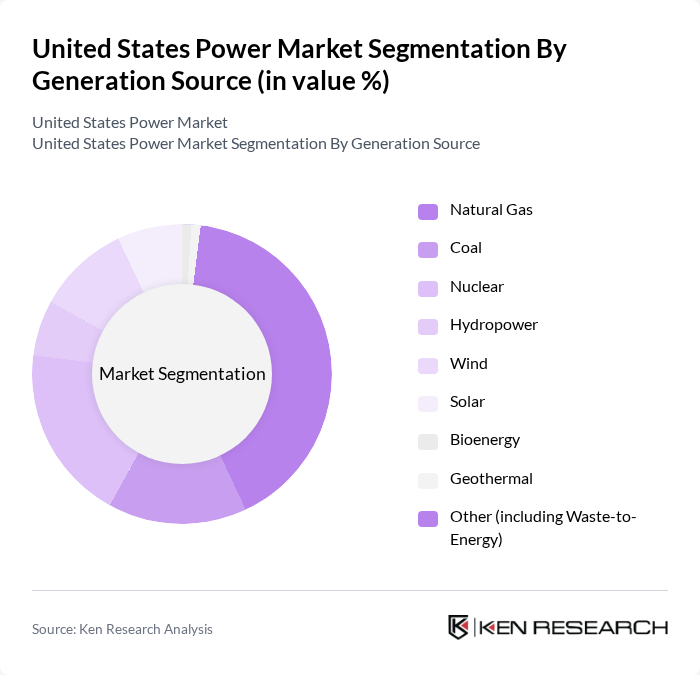
By Generation Source:The generation sources in the United States Power Market include Natural Gas, Coal, Nuclear, Hydropower, Wind, Solar, Bioenergy, Geothermal, and Other (including Waste-to-Energy).Natural Gasremains the dominant source, supplying over two-fifths of total generation due to its cost-effectiveness, reliability, and lower emissions compared to coal. However, the rapid growth of renewables—particularly wind and solar—has shifted the generation mix, with wind and solar now collectively surpassing coal’s share. Grid-scale battery storage is increasingly integrated to support renewable penetration and grid reliability .
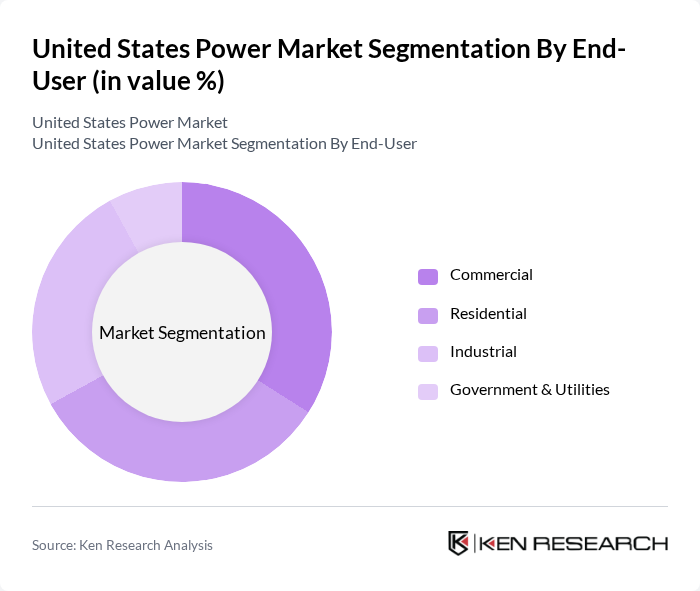
By End-User:The end-user segments in the United States Power Market include Residential, Commercial, Industrial, and Government & Utilities. TheCommercialsector is now the largest, driven by data center expansion, electrification of commercial buildings, and increased business activity. The Residential segment follows, with continued growth in household electricity demand for heating, cooling, and appliances. Industrial demand is also rising, supported by manufacturing reshoring and electrification initiatives .
United States Power Market Competitive Landscape
The United States Power Market is characterized by a dynamic mix of regional and international players. Leading participants such as NextEra Energy, Inc., Duke Energy Corporation, Southern Company, Exelon Corporation, Pacific Gas and Electric Company (PG&E Corporation), Dominion Energy, Inc., FirstEnergy Corp., Public Service Enterprise Group (PSEG), NRG Energy, Inc., The AES Corporation, Entergy Corporation, Xcel Energy Inc., Eversource Energy, Avangrid, Inc., CenterPoint Energy, Inc. contribute to innovation, geographic expansion, and service delivery in this space.
United States Power Market Industry Analysis
Growth Drivers
- Increasing Demand for Renewable Energy:The U.S. renewable energy sector is projected to generate approximately 1,040 terawatt-hours (TWh) in future, driven by a surge in solar and wind installations. The Energy Information Administration (EIA) reported that renewable sources accounted for about 21% of total electricity generation, up from 20% previously. This growth is fueled by consumer preferences for sustainable energy solutions, with 70% of Americans supporting increased renewable energy use, according to a recent Gallup poll.
- Technological Advancements in Energy Storage:The energy storage market in the U.S. is expected to reach a capacity of 16 gigawatts (GW) in future, up from 10 GW previously. Innovations in battery technology, particularly lithium-ion batteries, have reduced costs by approximately 89% since 2010, according to BloombergNEF. This reduction enables more efficient integration of renewable energy sources, allowing for better management of supply and demand, thus enhancing grid reliability and stability.
- Government Incentives for Clean Energy:Federal and state governments are projected to allocate over $30 billion in incentives for renewable energy projects in future. The Inflation Reduction Act has expanded tax credits for solar and wind projects, with the U.S. Department of Energy estimating that these incentives could lead to the installation of an additional 100 GW of renewable capacity in future. This financial support is crucial for accelerating the transition to a low-carbon energy system.
Market Challenges
- Regulatory Uncertainty:The U.S. power market faces significant regulatory challenges, with over 50% of energy companies citing regulatory uncertainty as a major barrier to investment. The fluctuating policies at both federal and state levels create an unpredictable environment, hindering long-term planning. The National Renewable Energy Laboratory (NREL) indicates that inconsistent regulations can delay project approvals by an average of 18 months, impacting overall market growth.
- Aging Infrastructure:Approximately 70% of the U.S. power grid infrastructure is over 25 years old, leading to increased maintenance costs and reliability issues. The American Society of Civil Engineers (ASCE) estimates that $4.5 trillion is needed to upgrade the nation’s energy infrastructure in future. This aging infrastructure not only poses risks of outages but also limits the integration of new technologies essential for modern energy demands.
United States Power Market Future Outlook
The U.S. power market is poised for transformative changes driven by technological advancements and a strong push for sustainability. As the adoption of smart grid technologies and energy-efficient solutions accelerates, the market will likely see enhanced operational efficiencies. Additionally, the increasing integration of artificial intelligence in energy management systems will optimize resource allocation and consumption patterns. These trends, coupled with a growing emphasis on energy resilience, will shape the future landscape of the power sector, fostering innovation and investment.
Market Opportunities
- Expansion of Smart Grid Technologies:The smart grid market is expected to grow to $100 billion in future, driven by the need for improved energy management. Investments in smart meters and grid automation can enhance efficiency and reliability, reducing operational costs by up to 20%. This presents a significant opportunity for companies to innovate and provide solutions that meet evolving energy demands.
- Growth in Electric Vehicle Adoption:The U.S. electric vehicle (EV) market is projected to reach 7 million units sold in future, up from 3 million previously. This surge will drive demand for charging infrastructure, creating opportunities for energy providers to expand their services. The integration of EVs into the grid can also facilitate energy storage solutions, further enhancing grid stability and efficiency.
Scope of the Report
| Segment | Sub-Segments |
|---|---|
| By Generation Source | Natural Gas Coal Nuclear Hydropower Wind Solar Bioenergy Geothermal Other (including Waste-to-Energy) |
| By End-User | Residential Commercial Industrial Government & Utilities |
| By Application | Grid-Connected Off-Grid Rooftop Installations Utility-Scale Projects |
| By Investment Source | Domestic Foreign Direct Investment (FDI) Public-Private Partnerships (PPP) Government Schemes |
| By Policy Support | Subsidies Tax Exemptions Renewable Energy Certificates (RECs) |
| By Distribution Mode | Regulated Utilities Competitive Retail Providers Community Choice Aggregators |
| By Pricing Mechanism | Regulated Tariffs Market-Based Pricing Power Purchase Agreements (PPAs) |
Key Target Audience
Investors and Venture Capitalist Firms
Government and Regulatory Bodies (e.g., Federal Energy Regulatory Commission, Department of Energy)
Utility Companies
Energy Producers and Generators
Transmission and Distribution Operators
Energy Storage Solution Providers
Environmental Advocacy Groups
Energy Market Analysts
Players Mentioned in the Report:
NextEra Energy, Inc.
Duke Energy Corporation
Southern Company
Exelon Corporation
Pacific Gas and Electric Company (PG&E Corporation)
Dominion Energy, Inc.
FirstEnergy Corp.
Public Service Enterprise Group (PSEG)
NRG Energy, Inc.
The AES Corporation
Entergy Corporation
Xcel Energy Inc.
Eversource Energy
Avangrid, Inc.
CenterPoint Energy, Inc.
Table of Contents
Market Assessment Phase
1. Executive Summary and Approach
2. United States Power Market Overview
2.1 Key Insights and Strategic Recommendations
2.2 United States Power Market Overview
2.3 Definition and Scope
2.4 Evolution of Market Ecosystem
2.5 Timeline of Key Regulatory Milestones
2.6 Value Chain & Stakeholder Mapping
2.7 Business Cycle Analysis
2.8 Policy & Incentive Landscape
3. United States Power Market Analysis
3.1 Growth Drivers
3.1.1 Increasing Demand for Renewable Energy
3.1.2 Technological Advancements in Energy Storage
3.1.3 Government Incentives for Clean Energy
3.1.4 Infrastructure Investments
3.2 Market Challenges
3.2.1 Regulatory Uncertainty
3.2.2 Aging Infrastructure
3.2.3 Competition from Alternative Energy Sources
3.2.4 Environmental Concerns
3.3 Market Opportunities
3.3.1 Expansion of Smart Grid Technologies
3.3.2 Growth in Electric Vehicle Adoption
3.3.3 Investment in Energy Efficiency Programs
3.3.4 Development of Microgrid Solutions
3.4 Market Trends
3.4.1 Shift Towards Decentralized Energy Production
3.4.2 Increasing Role of Artificial Intelligence in Energy Management
3.4.3 Rise of Community Solar Projects
3.4.4 Focus on Energy Resilience and Security
3.5 Government Regulation
3.5.1 Clean Power Plan Initiatives
3.5.2 Renewable Portfolio Standards
3.5.3 Federal Tax Credits for Renewable Energy
3.5.4 Emission Reduction Targets
4. SWOT Analysis
5. Stakeholder Analysis
6. Porter's Five Forces Analysis
7. United States Power Market Market Size, 2019-2024
7.1 By Value
7.2 By Volume
7.3 By Average Selling Price
8. United States Power Market Segmentation
8.1 By Generation Source
8.1.1 Natural Gas
8.1.2 Coal
8.1.3 Nuclear
8.1.4 Hydropower
8.1.5 Wind
8.1.6 Solar
8.1.7 Bioenergy
8.1.8 Geothermal
8.1.9 Other (including Waste-to-Energy)
8.2 By End-User
8.2.1 Residential
8.2.2 Commercial
8.2.3 Industrial
8.2.4 Government & Utilities
8.3 By Application
8.3.1 Grid-Connected
8.3.2 Off-Grid
8.3.3 Rooftop Installations
8.3.4 Utility-Scale Projects
8.4 By Investment Source
8.4.1 Domestic
8.4.2 Foreign Direct Investment (FDI)
8.4.3 Public-Private Partnerships (PPP)
8.4.4 Government Schemes
8.5 By Policy Support
8.5.1 Subsidies
8.5.2 Tax Exemptions
8.5.3 Renewable Energy Certificates (RECs)
8.6 By Distribution Mode
8.6.1 Regulated Utilities
8.6.2 Competitive Retail Providers
8.6.3 Community Choice Aggregators
8.7 By Pricing Mechanism
8.7.1 Regulated Tariffs
8.7.2 Market-Based Pricing
8.7.3 Power Purchase Agreements (PPAs)
9. United States Power Market Competitive Analysis
9.1 Market Share of Key Players
9.2 Cross Comparison of Key Players
9.2.1 Company Name
9.2.2 Generation Capacity (MW/GW)
9.2.3 Fuel Mix (% by source: gas, coal, nuclear, renewables, etc.)
9.2.4 Revenue (USD, latest fiscal year)
9.2.5 EBITDA Margin (%)
9.2.6 Net Income Margin (%)
9.2.7 Capital Expenditure (CapEx, USD)
9.2.8 Return on Invested Capital (ROIC, %)
9.2.9 Market Share (%)
9.2.10 Customer Base (number of customers/meters served)
9.2.11 Grid Reliability Metrics (SAIDI/SAIFI)
9.2.12 Renewable Portfolio Share (%)
9.2.13 Carbon Emissions Intensity (gCO2/kWh)
9.2.14 Credit Rating
9.2.15 Dividend Yield (%)
9.3 SWOT Analysis of Top Players
9.4 Pricing Analysis
9.5 Detailed Profile of Major Companies
9.5.1 NextEra Energy, Inc.
9.5.2 Duke Energy Corporation
9.5.3 Southern Company
9.5.4 Exelon Corporation
9.5.5 Pacific Gas and Electric Company (PG&E Corporation)
9.5.6 Dominion Energy, Inc.
9.5.7 FirstEnergy Corp.
9.5.8 Public Service Enterprise Group (PSEG)
9.5.9 NRG Energy, Inc.
9.5.10 The AES Corporation
9.5.11 Entergy Corporation
9.5.12 Xcel Energy Inc.
9.5.13 Eversource Energy
9.5.14 Avangrid, Inc.
9.5.15 CenterPoint Energy, Inc.
10. United States Power Market End-User Analysis
10.1 Procurement Behavior of Key Ministries
10.1.1 Federal Energy Management Program
10.1.2 Department of Energy Initiatives
10.1.3 State Energy Offices
10.2 Corporate Spend on Infrastructure & Energy
10.2.1 Investment in Renewable Energy Projects
10.2.2 Budget Allocations for Energy Efficiency
10.2.3 Expenditures on Smart Grid Technologies
10.3 Pain Point Analysis by End-User Category
10.3.1 High Energy Costs
10.3.2 Reliability of Supply
10.3.3 Regulatory Compliance Burdens
10.4 User Readiness for Adoption
10.4.1 Awareness of Renewable Options
10.4.2 Financial Incentives Understanding
10.4.3 Infrastructure Readiness
10.5 Post-Deployment ROI and Use Case Expansion
10.5.1 Performance Metrics Tracking
10.5.2 Scalability of Solutions
10.5.3 Long-term Cost Savings
11. United States Power Market Future Size, 2025-2030
11.1 By Value
11.2 By Volume
11.3 By Average Selling Price
Go-To-Market Strategy Phase
1. Whitespace Analysis + Business Model Canvas
1.1 Market Gaps Identification
1.2 Value Proposition Development
1.3 Revenue Streams Analysis
1.4 Cost Structure Evaluation
1.5 Key Partnerships Exploration
1.6 Customer Segments Definition
1.7 Channels Strategy
2. Marketing and Positioning Recommendations
2.1 Branding Strategies
2.2 Product USPs
3. Distribution Plan
3.1 Urban Retail vs Rural NGO Tie-ups
4. Channel & Pricing Gaps
4.1 Underserved Routes
4.2 Pricing Bands
5. Unmet Demand & Latent Needs
5.1 Category Gaps
5.2 Consumer Segments
6. Customer Relationship
6.1 Loyalty Programs
6.2 After-sales Service
7. Value Proposition
7.1 Sustainability
7.2 Integrated Supply Chains
8. Key Activities
8.1 Regulatory Compliance
8.2 Branding
8.3 Distribution Setup
9. Entry Strategy Evaluation
9.1 Domestic Market Entry Strategy
9.1.1 Product Mix
9.1.2 Pricing Band
9.1.3 Packaging
9.2 Export Entry Strategy
9.2.1 Target Countries
9.2.2 Compliance Roadmap
10. Entry Mode Assessment
10.1 JV
10.2 Greenfield
10.3 M&A
10.4 Distributor Model
11. Capital and Timeline Estimation
11.1 Capital Requirements
11.2 Timelines
12. Control vs Risk Trade-Off
12.1 Ownership vs Partnerships
13. Profitability Outlook
13.1 Breakeven Analysis
13.2 Long-term Sustainability
14. Potential Partner List
14.1 Distributors
14.2 JVs
14.3 Acquisition Targets
15. Execution Roadmap
15.1 Phased Plan for Market Entry
15.1.1 Market Setup
15.1.2 Market Entry
15.1.3 Growth Acceleration
15.1.4 Scale & Stabilize
15.2 Key Activities and Milestones
15.2.1 Milestone Planning
15.2.2 Activity Tracking
Research Methodology
Phase 1: Approach1
Desk Research
- Analysis of market reports from the U.S. Energy Information Administration (EIA)
- Review of regulatory frameworks and policy documents from the Federal Energy Regulatory Commission (FERC)
- Examination of industry publications and white papers from energy think tanks and associations
Primary Research
- Interviews with energy market analysts and economists specializing in power markets
- Surveys with utility executives and grid operators to gather insights on operational challenges
- Field interviews with renewable energy project managers to understand market dynamics
Validation & Triangulation
- Cross-validation of findings using historical data trends from multiple sources
- Triangulation of insights from primary interviews with secondary data findings
- Sanity checks through expert panel reviews and feedback sessions
Phase 2: Market Size Estimation1
Top-down Assessment
- Estimation of total electricity consumption based on national energy consumption statistics
- Segmentation of the market by energy source (renewable vs. non-renewable)
- Incorporation of state-level renewable energy mandates and incentives
Bottom-up Modeling
- Analysis of capacity and generation data from major power plants across the U.S.
- Cost modeling based on operational expenses and capital investments in infrastructure
- Volume x price analysis for electricity sales across different consumer segments
Forecasting & Scenario Analysis
- Multi-factor regression analysis incorporating economic growth, technological advancements, and policy changes
- Scenario modeling based on varying levels of renewable energy adoption and grid modernization
- Baseline, optimistic, and pessimistic projections through 2035
Phase 3: CATI Sample Composition1
| Scope Item/Segment | Sample Size | Target Respondent Profiles |
|---|---|---|
| Utility Sector Insights | 120 | Utility Executives, Regulatory Affairs Managers |
| Renewable Energy Projects | 80 | Project Managers, Sustainability Directors |
| Energy Policy Analysis | 60 | Policy Analysts, Government Officials |
| Consumer Energy Usage | 100 | Residential Energy Managers, Commercial Facility Managers |
| Grid Management Practices | 70 | Grid Operators, System Planners |
Frequently Asked Questions
What is the current valuation of the United States Power Market?
The United States Power Market is valued at approximately USD 1,350 billion, reflecting significant growth driven by increasing electricity demand, investments in renewable energy, and advancements in grid modernization and energy storage technologies.
Which states are the key players in the U.S. Power Market?
How has the Inflation Reduction Act of 2022 impacted the power market?
What are the primary sources of electricity generation in the U.S.?
Why Buy From Us?

What makes us stand out is that our consultants follow Robust, Refine and Result (RRR) methodology. Robust for clear definitions, approaches and sanity checking, Refine for differentiating respondents' facts and opinions, and Result for presenting data with story.

We have set a benchmark in the industry by offering our clients with syndicated and customized market research reports featuring coverage of entire market as well as meticulous research and analyst insights.

While we don't replace traditional research, we flip the method upside down. Our dual approach of Top Bottom & Bottom Top ensures quality deliverable by not just verifying company fundamentals but also looking at the sector and macroeconomic factors.

With one step in the future, our research team constantly tries to show you the bigger picture. We help with some of the tough questions you may encounter along the way: How is the industry positioned? Best marketing channel? KPI's of competitors? By aligning every element, we help maximize success.

Our report gives you instant access to the answers and sources that other companies might choose to hide. We elaborate each steps of research methodology we have used and showcase you the sample size to earn your trust.

If you need any support, we are here! We pride ourselves on universe strength, data quality, and quick, friendly, and professional service.