KSA 3d reconstruction technology market report size, share, growth drivers, trends, opportunities & forecast 2025–2030

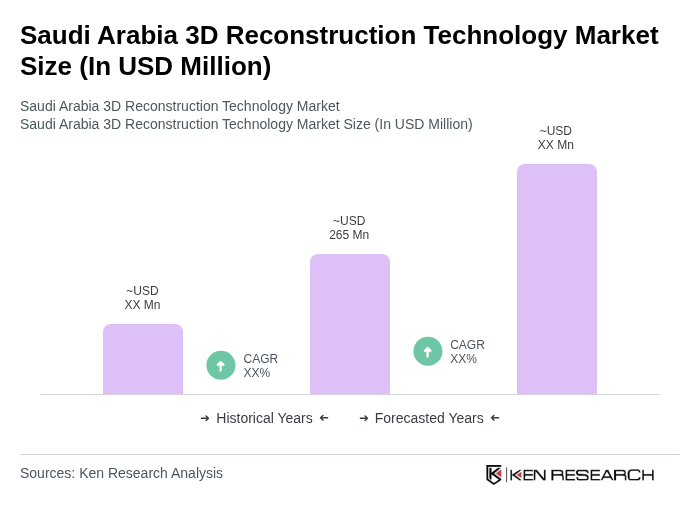
The Saudi Arabia 3D Reconstruction Technology Market, valued at USD 265 million, is growing due to urbanization, Vision 2030 initiatives, and adoption in key sectors like construction and healthcare.

Region:Middle East

Author(s):Geetanshi

Product Code:KRAA9121

Pages:85

Published On:November 2025
About the Report

Base Year 2024

Saudi Arabia 3D Reconstruction Technology Market Overview

  • The Saudi Arabia 3D Reconstruction Technology Market is valued at USD 265 million, based on recent industry analysis. This growth is primarily driven by the increasing demand for advanced imaging and modeling technologies in sectors such as construction, healthcare, and entertainment. The surge in urbanization and large-scale infrastructure projects—especially those aligned with Vision 2030—has accelerated the adoption of 3D reconstruction solutions, improving project efficiency and accuracy .
  • Key cities including Riyadh, Jeddah, and Dammam are at the forefront of market activity due to rapid urban development and substantial infrastructure investments. Riyadh leads in government-backed initiatives and innovation hubs, Jeddah’s port and logistics sector drives technology uptake, and Dammam’s industrial base supports the growing demand for 3D reconstruction in manufacturing and energy. These cities are central to advancing technology adoption across Saudi Arabia .
  • The “Saudi Building Code (SBC), 2018” issued by the Ministry of Municipal and Rural Affairs and Housing, mandates the use of Building Information Modeling (BIM) and 3D visualization techniques in public sector construction projects. This regulation requires that all new large-scale infrastructure projects incorporate digital modeling to enhance planning, execution, and stakeholder collaboration, thereby improving resource management and project outcomes .
Saudi Arabia 3D Reconstruction Technology Market Size

Saudi Arabia 3D Reconstruction Technology Market Segmentation

By Component:

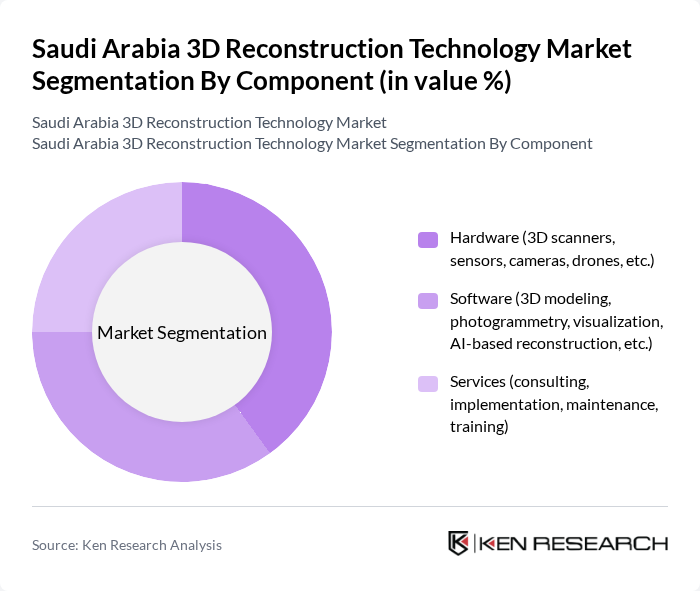
Saudi Arabia 3D Reconstruction Technology Market segmentation by Component.

The component segmentation of the Saudi Arabia 3D Reconstruction Technology Market shows thathardwareremains the leading segment, accounting for a significant portion of the market share. The increasing demand for high-precision 3D scanners, sensors, and drones in applications such as construction, healthcare, and industrial inspection is a major driver. Rapid advancements in hardware capabilities, such as improved accuracy and portability, further reinforce hardware’s dominance.Softwaresolutions are also critical, enabling advanced data processing, modeling, and visualization, and are increasingly leveraging AI and cloud integration to enhance workflow automation and collaboration .

By Technology:
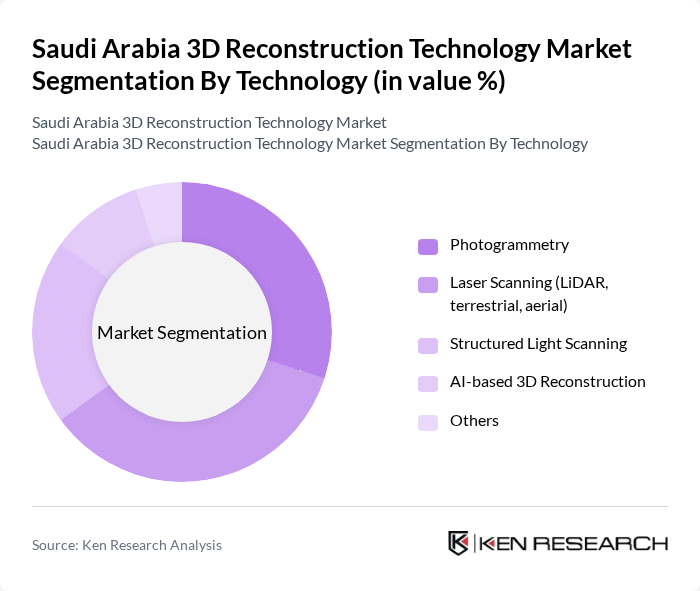
Saudi Arabia 3D Reconstruction Technology Market segmentation by Technology.

Within the technology segmentation,laser scanning(including LiDAR, terrestrial, and aerial) is the dominant sub-segment, valued for its precision and ability to capture complex geometries in large-scale projects. The adoption of LiDAR in urban planning, infrastructure monitoring, and industrial applications is a key growth driver.Photogrammetryis widely used for its cost-effectiveness and accessibility, especially in cultural heritage documentation and surveying. The integration ofAIin 3D reconstruction is growing, enabling automated feature extraction and real-time modeling, though it currently represents a smaller share compared to established methods .

Saudi Arabia 3D Reconstruction Technology Market Competitive Landscape

The Saudi Arabia 3D Reconstruction Technology Market is characterized by a dynamic mix of regional and international players. Leading participants such as Autodesk, Bentley Systems, Trimble, Dassault Systèmes, Siemens, Hexagon AB, FARO Technologies, 3D Systems, Pix4D, RealityCapture (Capturing Reality), Vricon (now part of Maxar Technologies), GeoSLAM, Artec 3D, Matterport, NavVis, Leica Geosystems (part of Hexagon AB), Topcon Positioning Systems, Saudi Geoinformatics Company (GEOSAUDI), FalconViz, and Saudi Aramco (Digital Transformation Division) contribute to innovation, geographic expansion, and service delivery in this space.

Autodesk

1982

San Rafael, California, USA

Bentley Systems

1984

Exton, Pennsylvania, USA

Trimble

1978

Sunnyvale, California, USA

Siemens

1847

Munich, Germany

Hexagon AB

1992

Stockholm, Sweden

Company

Establishment Year

Headquarters

Group Size (Large, Medium, or Small as per industry convention)

Revenue in Saudi Arabia (USD Million)

Revenue Growth Rate (Saudi Arabia, % YoY)

Number of Major Saudi Projects Delivered

Market Penetration Rate (Share of Addressable Market)

Customer Acquisition Cost (CAC)

Saudi Arabia 3D Reconstruction Technology Market Industry Analysis

Growth Drivers

  • Increasing Demand for Realistic Visualizations:The demand for realistic visualizations in sectors such as real estate and urban planning is surging, driven by Saudi Arabia's Vision 2030 initiative. The construction sector alone is projected to contribute approximately SAR 1.2 trillion to the economy in future. This growth is fueled by the need for enhanced project presentations and stakeholder engagement, leading to a significant uptick in the adoption of 3D reconstruction technologies across various industries.
  • Advancements in 3D Scanning Technologies:Technological advancements in 3D scanning are revolutionizing the reconstruction landscape. The introduction of high-resolution scanners and software solutions has improved accuracy and efficiency, reducing project timelines. In future, the market for 3D scanning equipment in Saudi Arabia is expected to reach SAR 500 million, reflecting a growing reliance on these technologies for precise data capture and modeling in construction and heritage preservation.
  • Growing Applications in Construction and Architecture:The construction and architecture sectors are increasingly leveraging 3D reconstruction technologies for design and planning. With over 1,000 ongoing construction projects valued at SAR 1.5 trillion, the need for innovative solutions is paramount. In future, the integration of 3D reconstruction in these sectors is anticipated to enhance project delivery and reduce costs, making it a critical driver of market growth in Saudi Arabia.

Market Challenges

  • High Initial Investment Costs:The high initial investment required for 3D reconstruction technology poses a significant barrier to entry for many companies. The cost of advanced scanning equipment and software can exceed SAR 1 million, deterring smaller firms from adopting these technologies. This financial hurdle limits market penetration and slows the overall growth of the 3D reconstruction sector in Saudi Arabia, particularly among startups and SMEs.
  • Limited Awareness and Understanding of Technology:A lack of awareness and understanding of 3D reconstruction technologies among potential users remains a challenge. Many stakeholders in construction and architecture are not fully informed about the benefits and applications of these technologies. This knowledge gap is evident, as only 30% of industry professionals reported familiarity with 3D reconstruction tools in a recent survey, hindering widespread adoption and innovation in the market.

Saudi Arabia 3D Reconstruction Technology Market Future Outlook

The future of the 3D reconstruction technology market in Saudi Arabia appears promising, driven by ongoing advancements in technology and increasing demand across various sectors. As the government continues to invest in smart city initiatives and infrastructure projects, the integration of 3D reconstruction will become essential for efficient planning and execution. Furthermore, the collaboration between technology providers and educational institutions is expected to foster innovation, ensuring that the market remains dynamic and responsive to emerging trends and needs.

Market Opportunities

  • Expansion in Healthcare Applications:The healthcare sector presents a significant opportunity for 3D reconstruction technologies, particularly in medical imaging and surgical planning. Healthcare spending is projected to reach SAR 200 billion in future, and the integration of 3D modeling can enhance patient outcomes and operational efficiency, driving demand for innovative solutions in this field.
  • Integration with Augmented Reality (AR) and Virtual Reality (VR):The convergence of 3D reconstruction with AR and VR technologies offers exciting opportunities for immersive experiences in training and education. As the AR/VR market in Saudi Arabia is expected to grow to SAR 1 billion in future, leveraging these technologies can enhance user engagement and provide realistic simulations, further expanding the application of 3D reconstruction.

Scope of the Report

SegmentSub-Segments
By Component

Hardware (3D scanners, sensors, cameras, drones, etc.)

Software (3D modeling, photogrammetry, visualization, AI-based reconstruction, etc.)

Services (consulting, implementation, maintenance, training)

By Technology

Photogrammetry

Laser Scanning (LiDAR, terrestrial, aerial)

Structured Light Scanning

AI-based 3D Reconstruction

Others

By Application

Construction & Architecture

Cultural Heritage & Archaeology

Healthcare & Medical Imaging

Industrial & Manufacturing

Media & Entertainment (film, gaming, VR/AR)

Urban Planning & Smart Cities

Forensics & Public Safety

Others

By End-User

Government & Public Sector

Construction & Real Estate Developers

Healthcare Providers

Educational & Research Institutions

Industrial & Manufacturing Companies

Media & Entertainment Firms

Others

By Deployment Mode

On-Premises

Cloud-Based

Hybrid

By Organization Size

Large Enterprises

Small & Medium Enterprises (SMEs)

By Region

Central Region

Eastern Region

Western Region

Southern Region

Key Target Audience

Investors and Venture Capitalist Firms

Government and Regulatory Bodies (e.g., Saudi Arabian General Investment Authority, Ministry of Communications and Information Technology)

Manufacturers and Producers of 3D Reconstruction Technology

Construction and Real Estate Development Companies

Urban Planning and Development Agencies

Architectural and Engineering Firms

Defense and Security Agencies

Healthcare Providers and Medical Institutions

Players Mentioned in the Report:

Autodesk

Bentley Systems

Trimble

Dassault Systemes

Siemens

Hexagon AB

FARO Technologies

3D Systems

Pix4D

RealityCapture (Capturing Reality)

Vricon (now part of Maxar Technologies)

GeoSLAM

Artec 3D

Matterport

NavVis

Leica Geosystems (part of Hexagon AB)

Topcon Positioning Systems

Saudi Geoinformatics Company (GEOSAUDI)

FalconViz

Saudi Aramco (Digital Transformation Division)

Table of Contents

Market Assessment Phase

1. Executive Summary and Approach


2. Saudi Arabia 3D Reconstruction Technology Market Overview

2.1 Key Insights and Strategic Recommendations

2.2 Saudi Arabia 3D Reconstruction Technology Market Overview

2.3 Definition and Scope

2.4 Evolution of Market Ecosystem

2.5 Timeline of Key Regulatory Milestones

2.6 Value Chain & Stakeholder Mapping

2.7 Business Cycle Analysis

2.8 Policy & Incentive Landscape


3. Saudi Arabia 3D Reconstruction Technology Market Analysis

3.1 Growth Drivers

3.1.1 Increasing demand forrealistic visualizationsin various sectors
3.1.2 Advancements in3D scanning technologies
3.1.3 Growing applications inconstruction and architecture
3.1.4 Rising investments insmart city projects

3.2 Market Challenges

3.2.1 High initialinvestment costs
3.2.2 Limitedawareness and understandingof technology
3.2.3 Regulatorybarriersin implementation
3.2.4 Shortage ofskilled professionalsin the field

3.3 Market Opportunities

3.3.1 Expansion inhealthcare applications
3.3.2 Integration withaugmented reality (AR)andvirtual reality (VR)
3.3.3 Collaborations witheducational institutionsfor research
3.3.4 Development ofcustomized solutionsfor various industries

3.4 Market Trends

3.4.1 Increasing use ofcloud-based solutions
3.4.2 Adoption ofAI and machine learningin 3D reconstruction
3.4.3 Growing focus onsustainabilityin construction
3.4.4 Rise ofmobile 3D scanningtechnologies

3.5 Government Regulation

3.5.1 Implementation ofstandards for 3D modeling
3.5.2 Incentives fortechnology adoptionin public projects
3.5.3 Regulations ondata privacyandsecurity
3.5.4 Support forR&D initiativesin 3D technologies

4. SWOT Analysis


5. Stakeholder Analysis


6. Porter's Five Forces Analysis


7. Saudi Arabia 3D Reconstruction Technology Market Market Size, 2019-2024

7.1 By Value

7.2 By Volume

7.3 By Average Selling Price


8. Saudi Arabia 3D Reconstruction Technology Market Segmentation

8.1 By Component

8.1.1 Hardware (3D scanners, sensors, cameras, drones, etc.)
8.1.2 Software (3D modeling, photogrammetry, visualization, AI-based reconstruction, etc.)
8.1.3 Services (consulting, implementation, maintenance, training)

8.2 By Technology

8.2.1 Photogrammetry
8.2.2 Laser Scanning (LiDAR, terrestrial, aerial)
8.2.3 Structured Light Scanning
8.2.4 AI-based 3D Reconstruction
8.2.5 Others

8.3 By Application

8.3.1 Construction & Architecture
8.3.2 Cultural Heritage & Archaeology
8.3.3 Healthcare & Medical Imaging
8.3.4 Industrial & Manufacturing
8.3.5 Media & Entertainment (film, gaming, VR/AR)
8.3.6 Urban Planning & Smart Cities
8.3.7 Forensics & Public Safety
8.3.8 Others

8.4 By End-User

8.4.1 Government & Public Sector
8.4.2 Construction & Real Estate Developers
8.4.3 Healthcare Providers
8.4.4 Educational & Research Institutions
8.4.5 Industrial & Manufacturing Companies
8.4.6 Media & Entertainment Firms
8.4.7 Others

8.5 By Deployment Mode

8.5.1 On-Premises
8.5.2 Cloud-Based
8.5.3 Hybrid

8.6 By Organization Size

8.6.1 Large Enterprises
8.6.2 Small & Medium Enterprises (SMEs)

8.7 By Region

8.7.1 Central Region
8.7.2 Eastern Region
8.7.3 Western Region
8.7.4 Southern Region

9. Saudi Arabia 3D Reconstruction Technology Market Competitive Analysis

9.1 Market Share of Key Players

9.2 Cross Comparison of Key Players

9.2.1 Company Name
9.2.2 Group Size (Large, Medium, or Small as per industry convention)
9.2.3 Revenue in Saudi Arabia (USD Million)
9.2.4 Revenue Growth Rate (Saudi Arabia, % YoY)
9.2.5 Number of Major Saudi Projects Delivered
9.2.6 Market Penetration Rate (Share of Addressable Market)
9.2.7 Customer Acquisition Cost (CAC)
9.2.8 Customer Retention Rate (%)
9.2.9 Average Deal Size (USD)
9.2.10 Return on Investment (ROI) for Saudi Deployments
9.2.11 Local Partnerships/Presence (Offices, JVs, Distributors)
9.2.12 Customer Satisfaction Score (Saudi Clients)
9.2.13 R&D Investment (% of Revenue)
9.2.14 Pricing Strategy (Premium, Value, Volume)

9.3 SWOT Analysis of Top Players

9.4 Pricing Analysis

9.5 Detailed Profile of Major Companies

9.5.1 Autodesk
9.5.2 Bentley Systems
9.5.3 Trimble
9.5.4 Dassault Systèmes
9.5.5 Siemens
9.5.6 Hexagon AB
9.5.7 FARO Technologies
9.5.8 3D Systems
9.5.9 Pix4D
9.5.10 RealityCapture (Capturing Reality)
9.5.11 Vricon (now part of Maxar Technologies)
9.5.12 GeoSLAM
9.5.13 Artec 3D
9.5.14 Matterport
9.5.15 NavVis
9.5.16 Leica Geosystems (part of Hexagon AB)
9.5.17 Topcon Positioning Systems
9.5.18 Saudi Geoinformatics Company (GEOSAUDI)
9.5.19 FalconViz
9.5.20 Saudi Aramco (Digital Transformation Division)

10. Saudi Arabia 3D Reconstruction Technology Market End-User Analysis

10.1 Procurement Behavior of Key Ministries

10.1.1 Ministry of Housing
10.1.2 Ministry of Health
10.1.3 Ministry of Education
10.1.4 Ministry of Culture

10.2 Corporate Spend on Infrastructure & Energy

10.2.1 Investment in Smart Cities
10.2.2 Funding for Healthcare Facilities
10.2.3 Budget Allocation for Educational Institutions
10.2.4 Corporate Partnerships for Technology Adoption

10.3 Pain Point Analysis by End-User Category

10.3.1 Construction Delays
10.3.2 High Operational Costs
10.3.3 Lack of Skilled Workforce
10.3.4 Integration Challenges with Existing Systems

10.4 User Readiness for Adoption

10.4.1 Awareness Levels
10.4.2 Training Needs
10.4.3 Technology Infrastructure
10.4.4 Support from Government Initiatives

10.5 Post-Deployment ROI and Use Case Expansion

10.5.1 Measurement of Success Metrics
10.5.2 Case Studies of Successful Implementations
10.5.3 Feedback Mechanisms for Continuous Improvement
10.5.4 Future Expansion Plans

11. Saudi Arabia 3D Reconstruction Technology Market Future Size, 2025-2030

11.1 By Value

11.2 By Volume

11.3 By Average Selling Price


Go-To-Market Strategy Phase

1. Whitespace Analysis + Business Model Canvas

1.1 Market Gaps Identification

1.2 Business Model Development


2. Marketing and Positioning Recommendations

2.1 Branding Strategies

2.2 Product USPs


3. Distribution Plan

3.1 Urban Retail Strategies

3.2 Rural NGO Tie-Ups


4. Channel & Pricing Gaps

4.1 Underserved Routes

4.2 Pricing Bands Analysis


5. Unmet Demand & Latent Needs

5.1 Category Gaps

5.2 Consumer Segments


6. Customer Relationship

6.1 Loyalty Programs

6.2 After-Sales Service


7. Value Proposition

7.1 Sustainability Initiatives

7.2 Integrated Supply Chains


8. Key Activities

8.1 Regulatory Compliance

8.2 Branding Efforts

8.3 Distribution Setup


9. Entry Strategy Evaluation

9.1 Domestic Market Entry Strategy

9.1.1 Product Mix Considerations
9.1.2 Pricing Band Strategy
9.1.3 Packaging Solutions

9.2 Export Entry Strategy

9.2.1 Target Countries
9.2.2 Compliance Roadmap

10. Entry Mode Assessment

10.1 Joint Ventures

10.2 Greenfield Investments

10.3 Mergers & Acquisitions

10.4 Distributor Model


11. Capital and Timeline Estimation

11.1 Capital Requirements

11.2 Timelines for Implementation


12. Control vs Risk Trade-Off

12.1 Ownership Considerations

12.2 Partnerships Evaluation


13. Profitability Outlook

13.1 Breakeven Analysis

13.2 Long-Term Sustainability


14. Potential Partner List

14.1 Distributors

14.2 Joint Ventures

14.3 Acquisition Targets


15. Execution Roadmap

15.1 Phased Plan for Market Entry

15.1.1 Market Setup
15.1.2 Market Entry
15.1.3 Growth Acceleration
15.1.4 Scale & Stabilize

15.2 Key Activities and Milestones

15.2.1 Milestone Planning
15.2.2 Activity Tracking

Research Methodology

ApproachModellingSample

Phase 1: Approach1

Desk Research

  • Industry reports from government agencies and trade associations in Saudi Arabia
  • Market analysis publications focusing on 3D reconstruction technology trends and applications
  • Academic journals and white papers detailing technological advancements and case studies

Primary Research

  • Interviews with technology leaders in the 3D reconstruction sector
  • Surveys targeting end-users in industries such as construction, healthcare, and entertainment
  • Field interviews with project managers and engineers involved in 3D reconstruction projects

Validation & Triangulation

  • Cross-validation of findings through multiple data sources including market reports and expert opinions
  • Triangulation of data from primary interviews and secondary research to ensure consistency
  • Sanity checks through expert panel reviews to validate assumptions and projections

Phase 2: Market Size Estimation1

Top-down Assessment

  • Analysis of national spending on digital technologies and infrastructure development
  • Segmentation of the market by application areas such as urban planning, cultural heritage, and virtual reality
  • Incorporation of government initiatives promoting digital transformation in various sectors

Bottom-up Modeling

  • Estimation of market size based on revenue data from leading 3D reconstruction technology providers
  • Operational cost analysis derived from project budgets and technology deployment expenses
  • Volume x cost calculations based on the number of projects and average project size

Forecasting & Scenario Analysis

  • Multi-factor regression analysis considering factors like economic growth, urbanization rates, and technology adoption
  • Scenario modeling based on potential regulatory changes and market disruptions
  • Baseline, optimistic, and pessimistic forecasts extending to 2030

Phase 3: CATI Sample Composition1

Scope Item/SegmentSample SizeTarget Respondent Profiles
Construction Industry Applications100Project Managers, Architects, Civil Engineers
Healthcare Sector Implementations60Medical Imaging Specialists, Hospital Administrators
Entertainment and Gaming Development50Game Developers, Creative Directors, VR Specialists
Cultural Heritage Preservation40Museum Curators, Archaeologists, Cultural Managers
Education and Training Programs70Educational Technologists, Curriculum Developers, Trainers

Frequently Asked Questions

What is the current value of the Saudi Arabia 3D Reconstruction Technology Market?

The Saudi Arabia 3D Reconstruction Technology Market is valued at approximately USD 265 million, driven by the increasing demand for advanced imaging and modeling technologies across various sectors, including construction, healthcare, and entertainment.

What factors are driving the growth of the 3D Reconstruction Technology Market in Saudi Arabia?

Which cities in Saudi Arabia are leading in 3D reconstruction technology adoption?

What regulations impact the 3D Reconstruction Technology Market in Saudi Arabia?

Other Regional/Country Reports

Indonesia 3D Reconstruction Technology Market

Malaysia 3D Reconstruction Technology Market

KSA 3D Reconstruction Technology Market

APAC 3D Reconstruction Technology Market

SEA 3D Reconstruction Technology Market

Vietnam 3D Reconstruction Technology Market

Why Buy From Us?

Refine Robust Result (RRR) Framework

What makes us stand out is that our consultants follow Robust, Refine and Result (RRR) methodology. Robust for clear definitions, approaches and sanity checking, Refine for differentiating respondents' facts and opinions, and Result for presenting data with story.

Our Reach Is Unmatched

We have set a benchmark in the industry by offering our clients with syndicated and customized market research reports featuring coverage of entire market as well as meticulous research and analyst insights.

Shifting the Research Paradigm

While we don't replace traditional research, we flip the method upside down. Our dual approach of Top Bottom & Bottom Top ensures quality deliverable by not just verifying company fundamentals but also looking at the sector and macroeconomic factors.

More Insights-Better Decisions

With one step in the future, our research team constantly tries to show you the bigger picture. We help with some of the tough questions you may encounter along the way: How is the industry positioned? Best marketing channel? KPI's of competitors? By aligning every element, we help maximize success.

Transparency and Trust

Our report gives you instant access to the answers and sources that other companies might choose to hide. We elaborate each steps of research methodology we have used and showcase you the sample size to earn your trust.

Round the Clock Support

If you need any support, we are here! We pride ourselves on universe strength, data quality, and quick, friendly, and professional service.

Why Clients Choose Us?

400000+
Reports in repository
150+
Consulting projects a year
100+
Analysts
8000+
Client Queries in 2022