About the Report
Base Year 2024Saudi Arabia Autonomous Truck Market Overview
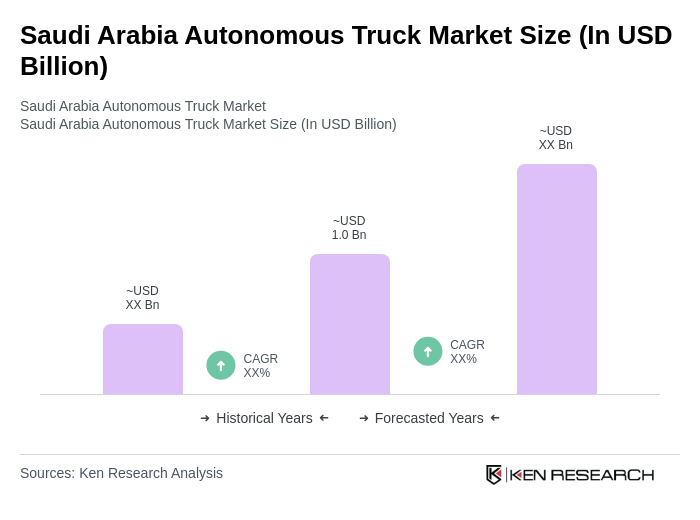
- The Saudi Arabia Autonomous Truck Market is valued at USD 1.0 billion, based on a five-year historical analysis. This estimate aligns with the latest autonomous vehicle market data, which places the Saudi market at just over USD 1 billion, reflecting rapid growth driven by advancements in artificial intelligence, sensor technology, and connectivity. Key growth drivers include increasing demand for freight automation, labor shortages, cost optimization in logistics, and government initiatives supporting digital transformation in transportation infrastructure. The integration of autonomous vehicles is a critical factor in improving operational efficiency and reducing transportation costs, particularly for long-haul and high-volume logistics corridors.
- Key cities such as Riyadh, Jeddah, and Dammam continue to dominate the market due to their strategic locations and robust logistics networks. Riyadh serves as the central hub for trade and commerce, Jeddah's port is pivotal for international shipping, and Dammam's proximity to major industrial zones drives demand for autonomous trucking solutions in these regions. The concentration of logistics infrastructure and freight corridors in these cities accelerates the adoption of autonomous trucks for both domestic and international transport.
- In 2023, the Saudi government enacted the “Regulations for Testing and Operation of Autonomous Vehicles on Public Roads,” issued by the Saudi Standards, Metrology and Quality Organization (SASO). This binding instrument establishes a framework for pilot testing, safety compliance, and operational licensing of autonomous trucks, supporting the Vision 2030 plan’s emphasis on innovation and technological advancement in the transportation sector. The regulation mandates safety standards, data reporting, and insurance requirements for operators, enabling controlled deployment and scaling of autonomous logistics solutions.
Saudi Arabia Autonomous Truck Market Segmentation
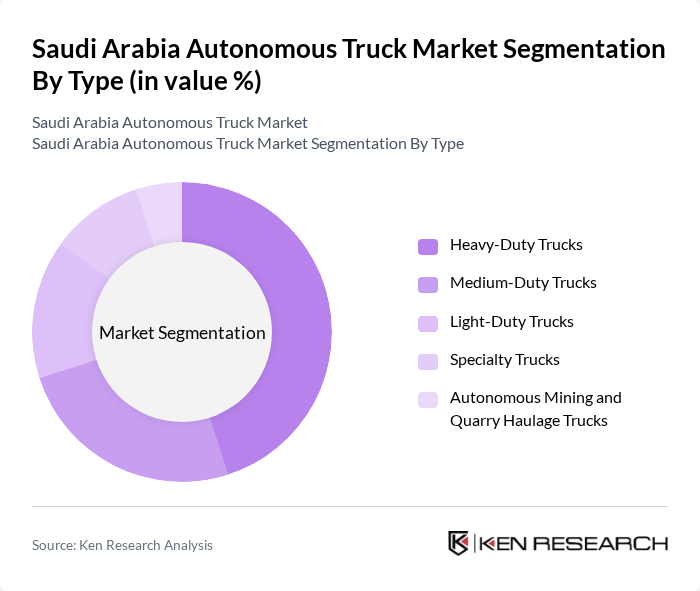
By Type:The market is segmented into Heavy-Duty Trucks, Medium-Duty Trucks, Light-Duty Trucks, Specialty Trucks (including mining, port, and construction autonomous trucks), and Autonomous Mining and Quarry Haulage Trucks. Heavy-Duty Trucks hold the largest share, reflecting their extensive use in long-haul logistics and freight movement across the country. Specialty and mining trucks are gaining traction due to increased automation in industrial and resource extraction operations.
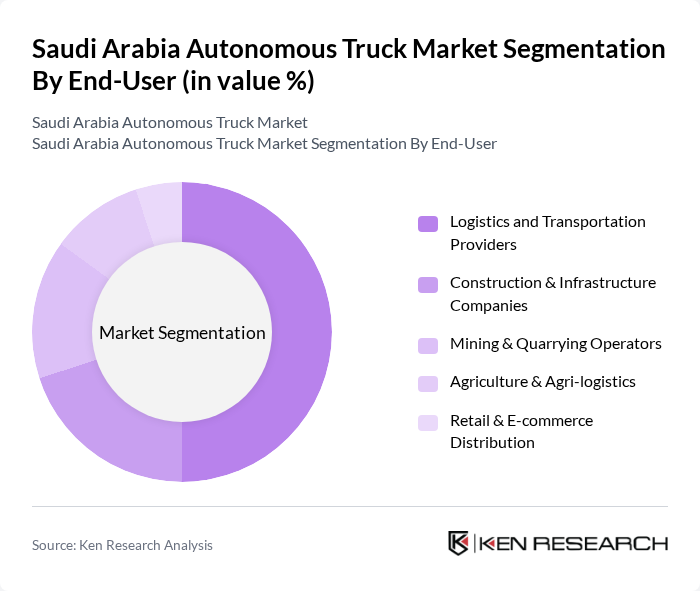
By End-User:The end-user segmentation includes Logistics and Transportation Providers, Construction & Infrastructure Companies, Mining & Quarrying Operators, Agriculture & Agri-logistics, and Retail & E-commerce Distribution. Logistics and Transportation Providers lead the market, driven by the surge in e-commerce and the need for efficient, cost-effective delivery solutions. Mining and infrastructure sectors are rapidly adopting autonomous trucks to enhance safety and productivity in resource-intensive operations.
Saudi Arabia Autonomous Truck Market Competitive Landscape
The Saudi Arabia Autonomous Truck Market features a dynamic mix of regional and international players. Leading participants such as Volvo Group, Daimler Truck AG, Scania AB, MAN Truck & Bus SE, Tesla, Inc., Navistar International Corporation, PACCAR Inc., Einride AB, Aurora Innovation, Inc., Waymo LLC, TuSimple Holdings Inc., Embark Trucks, Inc., Freightliner Trucks (a division of Daimler Truck AG), Xos, Inc., Bahri Logistics (The National Shipping Company of Saudi Arabia), Saudi Public Transport Company (SAPTCO), Almarai Company (logistics fleet operator), and Almajdouie Logistics drive innovation, geographic expansion, and service delivery. These companies are actively involved in pilot deployments, technology partnerships, and scaling autonomous fleet operations in Saudi Arabia’s logistics corridors.
Saudi Arabia Autonomous Truck Market Industry Analysis
Growth Drivers
- Increasing Demand for Logistics Efficiency:The logistics sector in Saudi Arabia is projected to grow significantly, with the market expected to reach SAR 100 billion in future. This growth is driven by the need for enhanced efficiency in supply chain operations, particularly in the wake of Vision 2030, which emphasizes economic diversification. Companies are increasingly adopting autonomous trucks to reduce delivery times and operational costs, which can be as high as 30% in traditional logistics models.
- Government Investment in Smart Transportation:The Saudi government has allocated SAR 1.5 billion for smart transportation initiatives as part of its Vision 2030 plan. This investment aims to modernize the transportation infrastructure, including the development of autonomous vehicle technology. The establishment of testing zones and regulatory frameworks is expected to facilitate the integration of autonomous trucks, enhancing the overall logistics landscape and attracting private sector investments.
- Rising Fuel Costs Driving Automation:With fuel prices in Saudi Arabia projected to rise by 10% in future, logistics companies are increasingly turning to automation to mitigate costs. Autonomous trucks can optimize fuel consumption through advanced routing and driving algorithms, potentially reducing fuel expenses by up to 20%. This shift not only addresses rising operational costs but also aligns with global trends towards sustainability in transportation.
Market Challenges
- High Initial Investment Costs:The adoption of autonomous trucks requires significant upfront investments, estimated at around SAR 2 million per vehicle. This high cost can deter smaller logistics companies from entering the market. Additionally, the need for specialized infrastructure and technology further escalates initial expenditures, making it challenging for businesses to justify the transition to autonomous solutions in a competitive environment.
- Regulatory Hurdles and Compliance Issues:The regulatory landscape for autonomous vehicles in Saudi Arabia is still evolving, with unclear guidelines posing challenges for companies. As of future, there are no comprehensive regulations specifically addressing autonomous trucks, leading to uncertainty in compliance. This lack of clarity can hinder investment and slow down the deployment of autonomous technologies, as companies navigate potential legal liabilities and operational restrictions.
Saudi Arabia Autonomous Truck Market Future Outlook
The future of the Saudi Arabia autonomous truck market appears promising, driven by technological advancements and government support. As logistics companies increasingly adopt automation, the integration of IoT and AI technologies will enhance operational efficiency. Furthermore, the shift towards sustainable transportation solutions will likely accelerate the adoption of autonomous trucks, aligning with global trends. The development of dedicated infrastructure and regulatory frameworks will be crucial in facilitating this transition, ensuring a robust market environment for innovation and growth.
Market Opportunities
- Expansion of E-commerce Logistics:The e-commerce sector in Saudi Arabia is expected to grow to SAR 30 billion in future, creating a substantial demand for efficient logistics solutions. Autonomous trucks can streamline last-mile delivery processes, significantly reducing operational costs and improving service levels, thus presenting a lucrative opportunity for logistics providers.
- Partnerships with Tech Companies for Innovation:Collaborations between logistics firms and technology companies can drive innovation in autonomous truck development. By leveraging advancements in AI and machine learning, these partnerships can enhance vehicle performance and safety features, positioning Saudi Arabia as a leader in autonomous logistics solutions in the region.
Scope of the Report
| Segment | Sub-Segments |
|---|---|
| By Type | Heavy-Duty Trucks Medium-Duty Trucks Light-Duty Trucks Specialty Trucks (e.g., mining, port, and construction autonomous trucks) Autonomous Mining and Quarry Haulage Trucks |
| By End-User | Logistics and Transportation Providers Construction & Infrastructure Companies Mining & Quarrying Operators Agriculture & Agri-logistics Retail & E-commerce Distribution |
| By Payload Capacity | Up to 5 tons to 15 tons to 30 tons Above 30 tons |
| By Application | Long-Haul Freight Transport Port-to-Warehouse Logistics Construction Material Transport Mining & Quarry Haulage Waste Management |
| By Distribution Channel | Direct Sales (OEMs to Fleets) Online Sales Platforms Authorized Distributors Leasing & Rental Services |
| By Fleet Size | Small Fleets (1-10 trucks) Medium Fleets (11-50 trucks) Large Fleets (51+ trucks) |
| By Region | Central Region (including Riyadh) Eastern Region (including Dammam, Jubail) Western Region (including Jeddah, Mecca) Southern Region Northern Region |
Key Target Audience
Investors and Venture Capitalist Firms
Government and Regulatory Bodies (e.g., Saudi Ministry of Transport, Saudi Arabian General Investment Authority)
Manufacturers and Producers of Autonomous Trucks
Logistics and Supply Chain Companies
Fleet Operators and Transportation Companies
Technology Providers and Software Developers
Industry Associations and Trade Organizations
Financial Institutions and Banks
Players Mentioned in the Report:
Volvo Group
Daimler Truck AG
Scania AB
MAN Truck & Bus SE
Tesla, Inc.
Navistar International Corporation
PACCAR Inc.
Einride AB
Aurora Innovation, Inc.
Waymo LLC
TuSimple Holdings Inc.
Embark Trucks, Inc.
Freightliner Trucks (a division of Daimler Truck AG)
Xos, Inc.
Bahri Logistics (The National Shipping Company of Saudi Arabia)
Saudi Public Transport Company (SAPTCO)
Almarai Company (logistics fleet operator)
Almajdouie Logistics
Table of Contents
Market Assessment Phase
1. Executive Summary and Approach
2. Saudi Arabia Autonomous Truck Market Overview
2.1 Key Insights and Strategic Recommendations
2.2 Saudi Arabia Autonomous Truck Market Overview
2.3 Definition and Scope
2.4 Evolution of Market Ecosystem
2.5 Timeline of Key Regulatory Milestones
2.6 Value Chain & Stakeholder Mapping
2.7 Business Cycle Analysis
2.8 Policy & Incentive Landscape
3. Saudi Arabia Autonomous Truck Market Analysis
3.1 Growth Drivers
3.1.1 Increasing demand for logistics efficiency
3.1.2 Government investment in smart transportation
3.1.3 Rising fuel costs driving automation
3.1.4 Technological advancements in AI and robotics
3.2 Market Challenges
3.2.1 High initial investment costs
3.2.2 Regulatory hurdles and compliance issues
3.2.3 Limited infrastructure for autonomous vehicles
3.2.4 Public perception and acceptance of autonomous trucks
3.3 Market Opportunities
3.3.1 Expansion of e-commerce logistics
3.3.2 Partnerships with tech companies for innovation
3.3.3 Development of dedicated autonomous truck lanes
3.3.4 Export potential to neighboring regions
3.4 Market Trends
3.4.1 Increasing integration of IoT in logistics
3.4.2 Shift towards sustainable transportation solutions
3.4.3 Growth of last-mile delivery automation
3.4.4 Rise of data analytics in fleet management
3.5 Government Regulation
3.5.1 Implementation of safety standards for autonomous vehicles
3.5.2 Incentives for companies adopting autonomous technology
3.5.3 Development of testing zones for autonomous trucks
3.5.4 Regulations on data privacy and cybersecurity
4. SWOT Analysis
5. Stakeholder Analysis
6. Porter's Five Forces Analysis
7. Saudi Arabia Autonomous Truck Market Market Size, 2019-2024
7.1 By Value
7.2 By Volume
7.3 By Average Selling Price
8. Saudi Arabia Autonomous Truck Market Segmentation
8.1 By Type
8.1.1 Heavy-Duty Trucks
8.1.2 Medium-Duty Trucks
8.1.3 Light-Duty Trucks
8.1.4 Specialty Trucks (e.g., mining, port, and construction autonomous trucks)
8.1.5 Autonomous Mining and Quarry Haulage Trucks
8.2 By End-User
8.2.1 Logistics and Transportation Providers
8.2.2 Construction & Infrastructure Companies
8.2.3 Mining & Quarrying Operators
8.2.4 Agriculture & Agri-logistics
8.2.5 Retail & E-commerce Distribution
8.3 By Payload Capacity
8.3.1 Up to 5 tons
8.3.2 5 to 15 tons
8.3.3 15 to 30 tons
8.3.4 Above 30 tons
8.4 By Application
8.4.1 Long-Haul Freight Transport
8.4.2 Port-to-Warehouse Logistics
8.4.3 Construction Material Transport
8.4.4 Mining & Quarry Haulage
8.4.5 Waste Management
8.5 By Distribution Channel
8.5.1 Direct Sales (OEMs to Fleets)
8.5.2 Online Sales Platforms
8.5.3 Authorized Distributors
8.5.4 Leasing & Rental Services
8.6 By Fleet Size
8.6.1 Small Fleets (1-10 trucks)
8.6.2 Medium Fleets (11-50 trucks)
8.6.3 Large Fleets (51+ trucks)
8.7 By Region
8.7.1 Central Region (including Riyadh)
8.7.2 Eastern Region (including Dammam, Jubail)
8.7.3 Western Region (including Jeddah, Mecca)
8.7.4 Southern Region
8.7.5 Northern Region
9. Saudi Arabia Autonomous Truck Market Competitive Analysis
9.1 Market Share of Key Players
9.2 Cross Comparison of Key Players
9.2.1 Company Name
9.2.2 Group Size (Large, Medium, or Small as per industry convention)
9.2.3 Revenue Growth Rate (Saudi Arabia autonomous truck segment)
9.2.4 Market Penetration Rate (autonomous trucks deployed in KSA as % of total fleet)
9.2.5 Number of Autonomous Trucks Deployed (in Saudi Arabia)
9.2.6 Fleet Utilization Rate (average % of autonomous fleet in active service)
9.2.7 Average Delivery Time (hours per 100 km, autonomous routes)
9.2.8 Technology Readiness Level (TRL for autonomous systems)
9.2.9 Operational Efficiency Ratio (cost per ton-km, autonomous vs. conventional)
9.2.10 Customer Satisfaction Score (Saudi B2B fleet clients)
9.2.11 Safety Incident Rate (incidents per million km, autonomous trucks)
9.3 SWOT Analysis of Top Players
9.4 Pricing Analysis
9.5 Detailed Profile of Major Companies
9.5.1 Volvo Group
9.5.2 Daimler Truck AG
9.5.3 Scania AB
9.5.4 MAN Truck & Bus SE
9.5.5 Tesla, Inc.
9.5.6 Navistar International Corporation
9.5.7 PACCAR Inc.
9.5.8 Einride AB
9.5.9 Aurora Innovation, Inc.
9.5.10 Waymo LLC
9.5.11 TuSimple Holdings Inc.
9.5.12 Embark Trucks, Inc.
9.5.13 Freightliner Trucks (a division of Daimler Truck AG)
9.5.14 Xos, Inc.
9.5.15 Bahri Logistics (The National Shipping Company of Saudi Arabia)
9.5.16 Saudi Public Transport Company (SAPTCO)
9.5.17 Almarai Company (logistics fleet operator)
9.5.18 Almajdouie Logistics
10. Saudi Arabia Autonomous Truck Market End-User Analysis
10.1 Procurement Behavior of Key Ministries
10.1.1 Ministry of Transport
10.1.2 Ministry of Interior
10.1.3 Ministry of Municipal and Rural Affairs
10.2 Corporate Spend on Infrastructure & Energy
10.2.1 Investment in Smart Transportation
10.2.2 Budget Allocation for Autonomous Technology
10.3 Pain Point Analysis by End-User Category
10.3.1 Logistics Providers
10.3.2 Construction Companies
10.3.3 Agricultural Sector
10.4 User Readiness for Adoption
10.4.1 Awareness of Autonomous Technology
10.4.2 Training and Skill Development Needs
10.5 Post-Deployment ROI and Use Case Expansion
10.5.1 Cost Savings Analysis
10.5.2 Performance Metrics Tracking
11. Saudi Arabia Autonomous Truck Market Future Size, 2025-2030
11.1 By Value
11.2 By Volume
11.3 By Average Selling Price
Go-To-Market Strategy Phase
1. Whitespace Analysis + Business Model Canvas
1.1 Market Gaps Identification
1.2 Value Proposition Development
1.3 Revenue Streams Analysis
1.4 Key Partnerships Exploration
1.5 Cost Structure Assessment
1.6 Customer Segmentation
1.7 Channels of Distribution
2. Marketing and Positioning Recommendations
2.1 Branding Strategies
2.2 Product USPs
2.3 Target Audience Identification
2.4 Communication Strategy
2.5 Digital Marketing Tactics
3. Distribution Plan
3.1 Urban Retail Strategies
3.2 Rural NGO Tie-ups
3.3 Logistics Partnerships
3.4 Distribution Channel Optimization
4. Channel & Pricing Gaps
4.1 Underserved Routes Analysis
4.2 Pricing Bands Evaluation
4.3 Competitor Pricing Comparison
5. Unmet Demand & Latent Needs
5.1 Category Gaps Identification
5.2 Consumer Segments Analysis
5.3 Emerging Trends Exploration
6. Customer Relationship
6.1 Loyalty Programs Development
6.2 After-sales Service Strategies
6.3 Customer Feedback Mechanisms
7. Value Proposition
7.1 Sustainability Initiatives
7.2 Integrated Supply Chains
7.3 Competitive Advantage Analysis
8. Key Activities
8.1 Regulatory Compliance
8.2 Branding Initiatives
8.3 Distribution Setup
9. Entry Strategy Evaluation
9.1 Domestic Market Entry Strategy
9.1.1 Product Mix Considerations
9.1.2 Pricing Band Strategy
9.1.3 Packaging Solutions
9.2 Export Entry Strategy
9.2.1 Target Countries Identification
9.2.2 Compliance Roadmap Development
10. Entry Mode Assessment
10.1 Joint Ventures
10.2 Greenfield Investments
10.3 Mergers & Acquisitions
10.4 Distributor Model Evaluation
11. Capital and Timeline Estimation
11.1 Capital Requirements Analysis
11.2 Timelines for Implementation
12. Control vs Risk Trade-Off
12.1 Ownership vs Partnerships Analysis
13. Profitability Outlook
13.1 Breakeven Analysis
13.2 Long-term Sustainability Assessment
14. Potential Partner List
14.1 Distributors Identification
14.2 Joint Ventures Opportunities
14.3 Acquisition Targets
15. Execution Roadmap
15.1 Phased Plan for Market Entry
15.1.1 Market Setup
15.1.2 Market Entry
15.1.3 Growth Acceleration
15.1.4 Scale & Stabilize
15.2 Key Activities and Milestones
15.2.1 Milestone Planning
15.2.2 Activity Tracking
Research Methodology
Phase 1: Approach1
Desk Research
- Analysis of government reports on transportation and logistics in Saudi Arabia
- Review of industry publications and market analysis reports specific to autonomous vehicles
- Examination of technological advancements and regulatory frameworks affecting autonomous trucking
Primary Research
- Interviews with logistics and transportation experts in the Saudi Arabian market
- Surveys targeting fleet operators and logistics companies utilizing or considering autonomous trucks
- Field interviews with technology providers and manufacturers of autonomous vehicle systems
Validation & Triangulation
- Cross-validation of data through multiple sources including industry reports and expert opinions
- Triangulation of findings from primary interviews with secondary data insights
- Sanity checks conducted through expert panel reviews to ensure data accuracy
Phase 2: Market Size Estimation1
Top-down Assessment
- Estimation of market size based on national logistics expenditure and growth trends
- Segmentation of the market by industry verticals such as retail, construction, and oil & gas
- Incorporation of government initiatives promoting autonomous vehicle adoption
Bottom-up Modeling
- Collection of data on fleet sizes and operational metrics from leading logistics firms
- Cost analysis based on operational efficiencies gained through autonomous trucking
- Volume and cost projections based on anticipated adoption rates and technological advancements
Forecasting & Scenario Analysis
- Multi-factor regression analysis incorporating economic indicators and technological adoption rates
- Scenario modeling based on varying levels of regulatory support and market readiness
- Development of baseline, optimistic, and pessimistic forecasts through 2030
Phase 3: CATI Sample Composition1
| Scope Item/Segment | Sample Size | Target Respondent Profiles |
|---|---|---|
| Logistics and Transportation Companies | 100 | Fleet Managers, Operations Directors |
| Technology Providers for Autonomous Vehicles | 50 | Product Development Managers, R&D Heads |
| Government Regulatory Bodies | 40 | Policy Makers, Transportation Officials |
| Industry Associations and Advocacy Groups | 50 | Executive Directors, Research Analysts |
| End-Users of Autonomous Trucking Solutions | 60 | Supply Chain Managers, Procurement Officers |
Frequently Asked Questions
What is the current value of the Saudi Arabia Autonomous Truck Market?
The Saudi Arabia Autonomous Truck Market is valued at approximately USD 1.0 billion, reflecting significant growth driven by advancements in technology and increasing demand for freight automation in logistics.
What are the key growth drivers for the Saudi Arabia Autonomous Truck Market?
Which cities in Saudi Arabia are leading in autonomous truck adoption?
What regulations govern the operation of autonomous trucks in Saudi Arabia?
Other Regional/Country Reports
Indonesia Autonomous Truck Market
Malaysia Autonomous Truck Market
KSA Autonomous Truck Market
APAC Autonomous Truck Market
SEA Autonomous Truck Market
Vietnam Autonomous Truck Market
Other Adjacent Reports
UAE Autonomous Mining Equipment Market
Asia Pacific Logistics Automation MarketGlobal Electric Truck Market Size, Share & Forecast, By Vehicle Type, Powertrain, Battery Capacity & Application, 2026–2031Philippines AI in Transportation Market
UK Fleet Management Software Market Size, Share & Forecast, By Solution Type, Deployment Model & Enterprise Size, 2026-2031Nigeria Supply Chain Technology Market Size, Share & Forecast, By Solution Type, Deployment Model & End-Use Industry, 2025-2032Thailand Construction Machinery Automation Market
GCC Road Express (Parcel & LTL) E-commerce Logistics Market Size, Share, Growth Drivers, Trends, Opportunities, Competitive Landscape & Forecast 2025–2030Belgium Smart Transportation Infrastructure Market
Qatar Vehicle Sensor Technology Market
Why Buy From Us?

What makes us stand out is that our consultants follow Robust, Refine and Result (RRR) methodology. Robust for clear definitions, approaches and sanity checking, Refine for differentiating respondents' facts and opinions, and Result for presenting data with story.

We have set a benchmark in the industry by offering our clients with syndicated and customized market research reports featuring coverage of entire market as well as meticulous research and analyst insights.

While we don't replace traditional research, we flip the method upside down. Our dual approach of Top Bottom & Bottom Top ensures quality deliverable by not just verifying company fundamentals but also looking at the sector and macroeconomic factors.

With one step in the future, our research team constantly tries to show you the bigger picture. We help with some of the tough questions you may encounter along the way: How is the industry positioned? Best marketing channel? KPI's of competitors? By aligning every element, we help maximize success.

Our report gives you instant access to the answers and sources that other companies might choose to hide. We elaborate each steps of research methodology we have used and showcase you the sample size to earn your trust.

If you need any support, we are here! We pride ourselves on universe strength, data quality, and quick, friendly, and professional service.