About the Report
Base Year 2024Saudi Arabia Licensed Sports Merchandise Market Overview
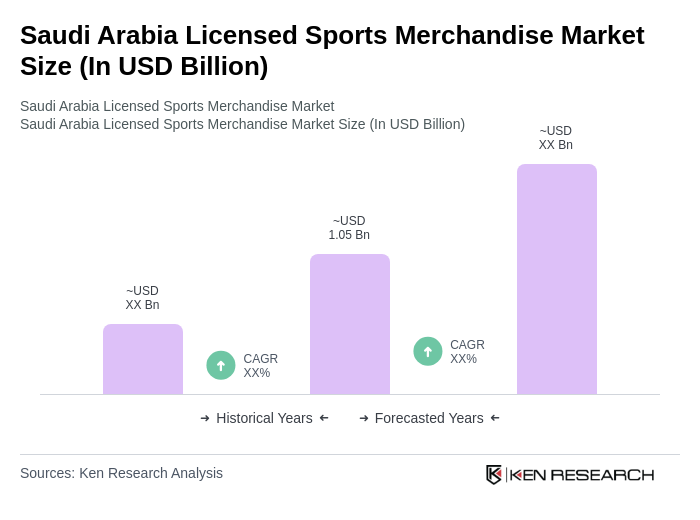
- The Saudi Arabia Licensed Sports Merchandise Market is valued at USD 1.05 billion, based on a five-year historical analysis and regional market share estimates. This growth is primarily driven by the increasing popularity of sports, particularly football, and the rising consumer demand for branded merchandise associated with local and international teams. The market has seen a surge in online retailing, which has made it easier for consumers to access a wide range of licensed products. Apparel remains the largest product segment, reflecting strong consumer interest in team jerseys and athleisure wear .
- Key cities such asRiyadh, Jeddah, and Dammamdominate the market due to their large populations and vibrant sports culture. Riyadh, being the capital, serves as a central hub for sports events and merchandise sales, while Jeddah's coastal location attracts a diverse consumer base. Dammam, with its growing economy, also contributes significantly to the demand for licensed sports merchandise. The expansion of sports clubs and the hosting of international sporting events in these cities further stimulate merchandise sales .
- TheExecutive Regulations for the Protection of Intellectual Property Rights, 2023issued by the Saudi Authority for Intellectual Property (SAIP) mandate that all licensed sports merchandise sold in the Kingdom must comply with registered trademarks and brand licensing requirements. These regulations include incentives for local manufacturers, such as expedited trademark registration and preferential procurement in public sports projects, and require strict documentation of supply chains to prevent counterfeit goods. The enforcement of these rules has enhanced the competitiveness of domestic producers and strengthened consumer trust in licensed brands .
Saudi Arabia Licensed Sports Merchandise Market Segmentation
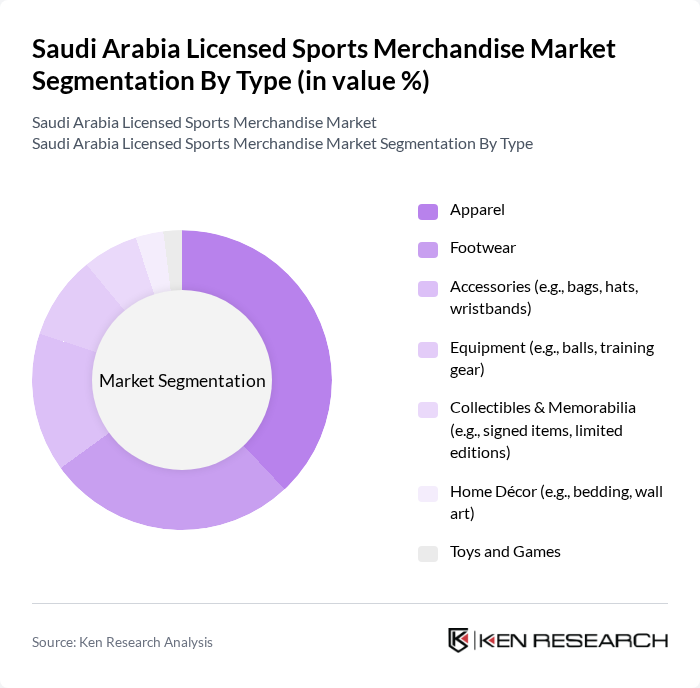
By Type:The market is segmented into various types of licensed sports merchandise, including apparel, footwear, accessories, equipment, collectibles & memorabilia, home décor, and toys and games. Among these,apparelis the leading sub-segment, driven by the high demand for team jerseys and casual wear that reflects sports affiliations. Footwear and accessories also show significant consumer interest, particularly among younger demographics who prioritize style and brand loyalty. The growing influence of athleisure and collaborations between sports clubs and global brands further boost apparel and footwear sales .
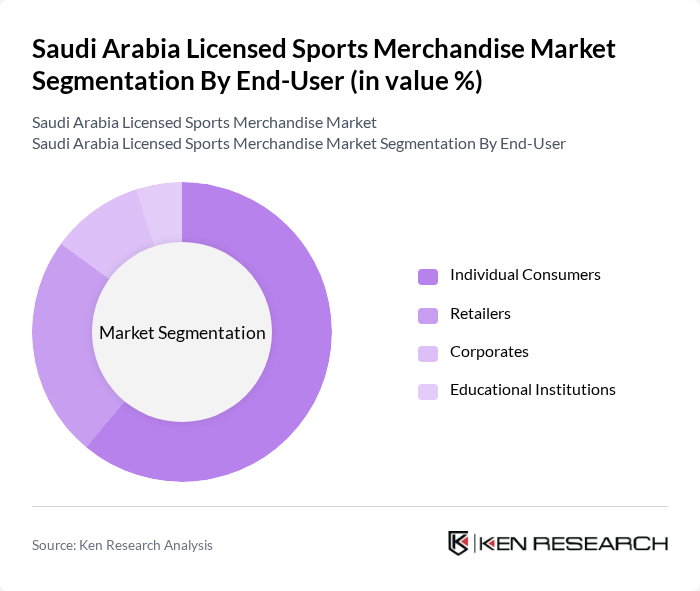
By End-User:The end-user segmentation includes individual consumers, retailers, corporates, and educational institutions.Individual consumersdominate the market, driven by personal purchases for self-use or as gifts. Retailers play a crucial role in distributing licensed merchandise, while corporates and educational institutions contribute to bulk purchases for events and promotions, enhancing brand visibility and engagement. The rise of e-commerce platforms has further empowered individual consumers and small retailers to access a broader assortment of licensed products .
Saudi Arabia Licensed Sports Merchandise Market Competitive Landscape
The Saudi Arabia Licensed Sports Merchandise Market is characterized by a dynamic mix of regional and international players. Leading participants such as Fawaz Abdulaziz Alhokair Co., Jarir Bookstore, Nike (via Sun & Sand Sports), Adidas (via Adidas Saudi Arabia LLC), Puma (via Puma Middle East), Al Hilal FC Official Store, Al Nassr FC Official Store, Namshi (online retailer), Xtep Sports, Decathlon Saudi Arabia, Sun & Sand Sports, Sports Corner, Under Armour (via local distributor), Adidas Originals, Centrepoint (Landmark Group) contribute to innovation, geographic expansion, and service delivery in this space.
Saudi Arabia Licensed Sports Merchandise Market Industry Analysis
Growth Drivers
- Increasing Popularity of Sports Events:The Saudi Arabian sports sector is witnessing a surge in popularity, with over 1.8 million attendees at major events like the Saudi Pro League and international tournaments in the future. This growing interest is expected to drive merchandise sales, as fans increasingly seek to support their teams. The government's investment of approximately $1.2 billion in sports infrastructure further enhances event visibility, creating a robust environment for licensed merchandise growth.
- Rising Disposable Income Among Consumers:Saudi Arabia's GDP per capita is projected to reach $22,000 in the future, reflecting a 10% increase from previous estimates. This rise in disposable income allows consumers to spend more on leisure activities, including sports merchandise. As the middle class expands, the demand for licensed products is expected to grow, with consumers willing to invest in quality items that represent their favorite teams and athletes, thus boosting market potential.
- Expansion of E-commerce Platforms:The e-commerce sector in Saudi Arabia is anticipated to grow to $15 billion in the future, driven by increased internet penetration and mobile usage. This growth facilitates easier access to licensed sports merchandise, allowing consumers to purchase products online without geographical constraints. The rise of platforms like Noon and Souq is expected to enhance product visibility and availability, significantly contributing to market growth in the licensed merchandise sector.
Market Challenges
- Counterfeit Merchandise Issues:The prevalence of counterfeit sports merchandise in Saudi Arabia is a significant challenge, with estimates suggesting that around 25% of sports products sold are unlicensed. This undermines the revenue of legitimate brands and creates consumer distrust. The lack of stringent enforcement against counterfeit goods further complicates the market landscape, making it difficult for licensed merchandise to compete effectively.
- Limited Awareness of Licensed Products:Despite the growing sports culture, awareness of licensed merchandise remains low among consumers, particularly in rural areas. A survey indicated that only 45% of sports fans recognize the difference between licensed and unlicensed products. This lack of awareness hampers market growth, as consumers may opt for cheaper, unlicensed alternatives, impacting the sales of legitimate merchandise significantly.
Saudi Arabia Licensed Sports Merchandise Market Future Outlook
The future of the Saudi Arabia licensed sports merchandise market appears promising, driven by increasing consumer engagement and government support for sports initiatives. As the nation continues to host high-profile events and invest in sports infrastructure, the demand for licensed products is expected to rise. Additionally, the integration of technology in marketing and sales strategies will likely enhance consumer experiences, fostering brand loyalty and expanding market reach in the future.
Market Opportunities
- Growth of Youth Sports Programs:The Saudi government has allocated $600 million to develop youth sports programs in the future, creating a new consumer base for licensed merchandise. This investment is expected to foster a culture of sports among younger generations, leading to increased demand for team apparel and accessories, thus presenting a significant opportunity for brands to capture this emerging market segment.
- Partnerships with Local Sports Teams:Collaborations with local sports teams can enhance brand visibility and credibility. With over 25 professional sports teams in the country, partnerships can lead to exclusive merchandise lines, tapping into the loyal fan bases of these teams. Such strategic alliances are projected to increase sales and strengthen market presence, providing a competitive edge in the licensed merchandise sector.
Scope of the Report
| Segment | Sub-Segments |
|---|---|
| By Type | Apparel Footwear Accessories (e.g., bags, hats, wristbands) Equipment (e.g., balls, training gear) Collectibles & Memorabilia (e.g., signed items, limited editions) Home Décor (e.g., bedding, wall art) Toys and Games |
| By End-User | Individual Consumers Retailers Corporates Educational Institutions |
| By Sales Channel | Online Retail (e-commerce platforms, team stores) Specialty Sports Stores Department Stores & Hypermarkets Sports Events & Stadium Outlets Wholesale Distributors |
| By Price Range | Budget Mid-Range Premium |
| By Brand Affiliation | Local Brands (e.g., Al Hilal FC, Al Nassr FC) International Brands (e.g., Nike, Adidas, Puma) Team-Specific Merchandise |
| By Consumer Demographics | Age Group Gender Income Level |
| By Region | Central Region Eastern Region Western Region Southern Region |
Key Target Audience
Investors and Venture Capitalist Firms
Government and Regulatory Bodies (e.g., Saudi Arabian General Sports Authority, Ministry of Commerce)
Manufacturers and Producers
Distributors and Retailers
Sports Teams and Clubs
Event Organizers and Promoters
Brand Licensing Agencies
Advertising and Marketing Agencies
Players Mentioned in the Report:
Fawaz Abdulaziz Alhokair Co.
Jarir Bookstore
Nike (via Sun & Sand Sports)
Adidas (via Adidas Saudi Arabia LLC)
Puma (via Puma Middle East)
Al Hilal FC Official Store
Al Nassr FC Official Store
Namshi (online retailer)
Xtep Sports
Decathlon Saudi Arabia
Sun & Sand Sports
Sports Corner
Under Armour (via local distributor)
Adidas Originals
Centrepoint (Landmark Group)
Table of Contents
Market Assessment Phase
1. Executive Summary and Approach
2. Saudi Arabia Licensed Sports Merchandise Market Overview
2.1 Key Insights and Strategic Recommendations
2.2 Saudi Arabia Licensed Sports Merchandise Market Overview
2.3 Definition and Scope
2.4 Evolution of Market Ecosystem
2.5 Timeline of Key Regulatory Milestones
2.6 Value Chain & Stakeholder Mapping
2.7 Business Cycle Analysis
2.8 Policy & Incentive Landscape
3. Saudi Arabia Licensed Sports Merchandise Market Analysis
3.1 Growth Drivers
3.1.1 Increasing popularity of sports events
3.1.2 Rising disposable income among consumers
3.1.3 Expansion of e-commerce platforms
3.1.4 Government initiatives to promote sports
3.2 Market Challenges
3.2.1 Counterfeit merchandise issues
3.2.2 Limited awareness of licensed products
3.2.3 High competition from unlicensed products
3.2.4 Economic fluctuations affecting consumer spending
3.3 Market Opportunities
3.3.1 Growth of youth sports programs
3.3.2 Partnerships with local sports teams
3.3.3 Expansion into untapped regions
3.3.4 Development of exclusive merchandise lines
3.4 Market Trends
3.4.1 Increasing demand for sustainable merchandise
3.4.2 Rise of influencer marketing in sports
3.4.3 Growth of online fan engagement platforms
3.4.4 Customization and personalization of products
3.5 Government Regulation
3.5.1 Licensing requirements for merchandise
3.5.2 Import regulations on sports goods
3.5.3 Consumer protection laws
3.5.4 Tax incentives for local manufacturers
4. SWOT Analysis
5. Stakeholder Analysis
6. Porter's Five Forces Analysis
7. Saudi Arabia Licensed Sports Merchandise Market Market Size, 2019-2024
7.1 By Value
7.2 By Volume
7.3 By Average Selling Price
8. Saudi Arabia Licensed Sports Merchandise Market Segmentation
8.1 By Type
8.1.1 Apparel
8.1.2 Footwear
8.1.3 Accessories (e.g., bags, hats, wristbands)
8.1.4 Equipment (e.g., balls, training gear)
8.1.5 Collectibles & Memorabilia (e.g., signed items, limited editions)
8.1.6 Home Décor (e.g., bedding, wall art)
8.1.7 Toys and Games
8.2 By End-User
8.2.1 Individual Consumers
8.2.2 Retailers
8.2.3 Corporates
8.2.4 Educational Institutions
8.3 By Sales Channel
8.3.1 Online Retail (e-commerce platforms, team stores)
8.3.2 Specialty Sports Stores
8.3.3 Department Stores & Hypermarkets
8.3.4 Sports Events & Stadium Outlets
8.3.5 Wholesale Distributors
8.4 By Price Range
8.4.1 Budget
8.4.2 Mid-Range
8.4.3 Premium
8.5 By Brand Affiliation
8.5.1 Local Brands (e.g., Al Hilal FC, Al Nassr FC)
8.5.2 International Brands (e.g., Nike, Adidas, Puma)
8.5.3 Team-Specific Merchandise
8.6 By Consumer Demographics
8.6.1 Age Group
8.6.2 Gender
8.6.3 Income Level
8.7 By Region
8.7.1 Central Region
8.7.2 Eastern Region
8.7.3 Western Region
8.7.4 Southern Region
9. Saudi Arabia Licensed Sports Merchandise Market Competitive Analysis
9.1 Market Share of Key Players
9.2 KPIs for Cross Comparison of Key Players
9.2.1 Company Name
9.2.2 Group Size (Large, Medium, Small)
9.2.3 Annual Revenue from Licensed Sports Merchandise (USD/SAR)
9.2.4 Revenue Growth Rate (YoY %)
9.2.5 Market Penetration Rate (% of target market reached)
9.2.6 Customer Retention Rate (%)
9.2.7 Pricing Strategy (Average price index, discounting frequency)
9.2.8 Product Diversification Index (number of product categories offered)
9.2.9 Brand Equity Score (brand awareness, loyalty metrics)
9.2.10 Distribution Network Efficiency (number of outlets, e-commerce share)
9.2.11 Customer Satisfaction Index (survey/NPS score)
9.2.12 Share of Licensed vs Unlicensed Merchandise Sales (%)
9.3 SWOT Analysis of Top Players
9.4 Pricing Analysis
9.5 Detailed Profile of Major Companies
9.5.1 Fawaz Abdulaziz Alhokair Co.
9.5.2 Jarir Bookstore
9.5.3 Nike (via Sun & Sand Sports)
9.5.4 Adidas (via Adidas Saudi Arabia LLC)
9.5.5 Puma (via Puma Middle East)
9.5.6 Al Hilal FC Official Store
9.5.7 Al Nassr FC Official Store
9.5.8 Namshi (online retailer)
9.5.9 Xtep Sports
9.5.10 Decathlon Saudi Arabia
9.5.11 Sun & Sand Sports
9.5.12 Sports Corner
9.5.13 Under Armour (via local distributor)
9.5.14 Adidas Originals
9.5.15 Centrepoint (Landmark Group)
10. Saudi Arabia Licensed Sports Merchandise Market End-User Analysis
10.1 Procurement Behavior of Key Ministries
10.1.1 Ministry of Sports
10.1.2 Ministry of Education
10.1.3 Ministry of Commerce
10.2 Corporate Spend on Infrastructure & Energy
10.2.1 Corporate Sponsorships
10.2.2 Investment in Sports Facilities
10.3 Pain Point Analysis by End-User Category
10.3.1 Price Sensitivity
10.3.2 Quality Concerns
10.3.3 Availability of Products
10.4 User Readiness for Adoption
10.4.1 Awareness Levels
10.4.2 Engagement with Brands
10.5 Post-Deployment ROI and Use Case Expansion
10.5.1 Measurement of Success
10.5.2 Future Investment Plans
11. Saudi Arabia Licensed Sports Merchandise Market Future Size, 2025-2030
11.1 By Value
11.2 By Volume
11.3 By Average Selling Price
Go-To-Market Strategy Phase
1. Whitespace Analysis + Business Model Canvas
1.1 Market Gaps Identification
1.2 Value Proposition Development
1.3 Revenue Streams Analysis
1.4 Cost Structure Evaluation
1.5 Key Partnerships Exploration
1.6 Customer Segmentation
1.7 Channels of Distribution
2. Marketing and Positioning Recommendations
2.1 Branding Strategies
2.2 Product USPs
3. Distribution Plan
3.1 Urban Retail vs Rural NGO Tie-ups
4. Channel & Pricing Gaps
4.1 Underserved Routes
4.2 Pricing Bands
5. Unmet Demand & Latent Needs
5.1 Category Gaps
5.2 Consumer Segments
6. Customer Relationship
6.1 Loyalty Programs
6.2 After-sales Service
7. Value Proposition
7.1 Sustainability
7.2 Integrated Supply Chains
8. Key Activities
8.1 Regulatory Compliance
8.2 Branding
8.3 Distribution Setup
9. Entry Strategy Evaluation
9.1 Domestic Market Entry Strategy
9.1.1 Product Mix
9.1.2 Pricing Band
9.1.3 Packaging
9.2 Export Entry Strategy
9.2.1 Target Countries
9.2.2 Compliance Roadmap
10. Entry Mode Assessment
10.1 JV
10.2 Greenfield
10.3 M&A
10.4 Distributor Model
11. Capital and Timeline Estimation
11.1 Capital Requirements
11.2 Timelines
12. Control vs Risk Trade-Off
12.1 Ownership vs Partnerships
13. Profitability Outlook
13.1 Breakeven Analysis
13.2 Long-term Sustainability
14. Potential Partner List
14.1 Distributors
14.2 JVs
14.3 Acquisition Targets
15. Execution Roadmap
15.1 Phased Plan for Market Entry
15.1.1 Market Setup
15.1.2 Market Entry
15.1.3 Growth Acceleration
15.1.4 Scale & Stabilize
15.2 Key Activities and Milestones
15.2.1 Activity Planning
15.2.2 Milestone Tracking
Research Methodology
Phase 1: Approach1
Desk Research
- Analysis of market reports from local sports merchandise associations and trade bodies
- Review of government publications on sports and leisure industry regulations in Saudi Arabia
- Examination of consumer behavior studies and demographic data from national statistics agencies
Primary Research
- Interviews with key stakeholders in the sports merchandise supply chain, including manufacturers and distributors
- Surveys targeting retail managers in sports stores and e-commerce platforms
- Focus group discussions with consumers to understand preferences and purchasing behavior
Validation & Triangulation
- Cross-validation of findings through multiple data sources, including sales data and consumer insights
- Triangulation of qualitative insights from interviews with quantitative data from surveys
- Sanity checks conducted through expert panel reviews comprising industry veterans and market analysts
Phase 2: Market Size Estimation1
Top-down Assessment
- Estimation of total market size based on national sports spending and merchandise sales data
- Segmentation of the market by product categories such as apparel, equipment, and accessories
- Incorporation of growth trends in sports participation and tourism in Saudi Arabia
Bottom-up Modeling
- Collection of sales data from leading sports merchandise retailers and e-commerce platforms
- Estimation of average transaction values and purchase frequencies among consumers
- Analysis of inventory turnover rates and supply chain efficiencies in the sports merchandise sector
Forecasting & Scenario Analysis
- Multi-factor regression analysis incorporating economic indicators and sports event calendars
- Scenario modeling based on potential changes in consumer spending and market entry of new brands
- Development of baseline, optimistic, and pessimistic forecasts through 2030
Phase 3: CATI Sample Composition1
| Scope Item/Segment | Sample Size | Target Respondent Profiles |
|---|---|---|
| Retail Sports Merchandise | 100 | Store Managers, Sales Executives |
| E-commerce Sports Sales | 80 | Online Retail Managers, Digital Marketing Specialists |
| Consumer Preferences in Sports Merchandise | 150 | Sports Enthusiasts, Casual Buyers |
| Distribution Channels Analysis | 60 | Logistics Coordinators, Supply Chain Analysts |
| Brand Perception Studies | 90 | Brand Managers, Marketing Directors |
Frequently Asked Questions
What is the current value of the Saudi Arabia Licensed Sports Merchandise Market?
The Saudi Arabia Licensed Sports Merchandise Market is valued at approximately USD 1.05 billion. This valuation is based on a five-year historical analysis and regional market share estimates, reflecting the growing consumer demand for sports-related merchandise.
What factors are driving the growth of the licensed sports merchandise market in Saudi Arabia?
Which cities are the primary markets for licensed sports merchandise in Saudi Arabia?
What types of products are included in the licensed sports merchandise market?
Other Regional/Country Reports
Indonesia Licensed Sports Merchandise Market
Malaysia Licensed Sports Merchandise Market
Other Adjacent Reports
Japan Sports Footwear Market
UAE Sports Accessories Market
Australia Sports Equipment Market Outlook to 2030: Size, Share, Growth and TrendsEgypt Collectibles and Memorabilia Market
India Home Decor Market Outlook to 2030SEA Toys and Games MarketThailand E-commerce Retail Market
Oman Brand Licensing Market
Indonesia Sports Event Management Market
Why Buy From Us?

What makes us stand out is that our consultants follow Robust, Refine and Result (RRR) methodology. Robust for clear definitions, approaches and sanity checking, Refine for differentiating respondents' facts and opinions, and Result for presenting data with story.

We have set a benchmark in the industry by offering our clients with syndicated and customized market research reports featuring coverage of entire market as well as meticulous research and analyst insights.

While we don't replace traditional research, we flip the method upside down. Our dual approach of Top Bottom & Bottom Top ensures quality deliverable by not just verifying company fundamentals but also looking at the sector and macroeconomic factors.

With one step in the future, our research team constantly tries to show you the bigger picture. We help with some of the tough questions you may encounter along the way: How is the industry positioned? Best marketing channel? KPI's of competitors? By aligning every element, we help maximize success.

Our report gives you instant access to the answers and sources that other companies might choose to hide. We elaborate each steps of research methodology we have used and showcase you the sample size to earn your trust.

If you need any support, we are here! We pride ourselves on universe strength, data quality, and quick, friendly, and professional service.