Saudi Arabia neglected tropical disease treatment market size, share, growth drivers, trends, opportunities & forecast 2025–2030

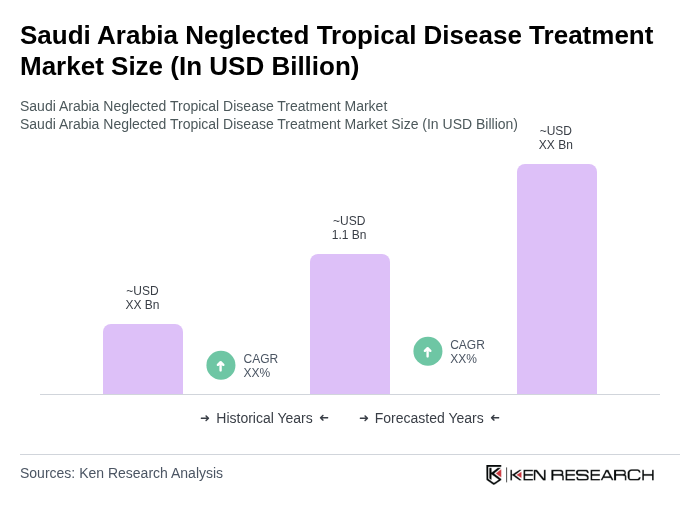
The Saudi Arabia Neglected Tropical Disease Treatment Market, valued at USD 1.1 billion, is growing due to government funding under Vision 2030 and advancements in therapies.

Region:Middle East

Author(s):Rebecca

Product Code:KRAC8413

Pages:97

Published On:November 2025
About the Report

Base Year 2024

Saudi Arabia Neglected Tropical Disease Treatment Market Overview

  • The Saudi Arabia Neglected Tropical Disease Treatment Market is valued at USD 1.1 billion, based on a five-year historical analysis. This growth is primarily driven by increasing awareness of neglected tropical diseases (NTDs), government initiatives to improve healthcare access, and rising investments in pharmaceutical research and development. The market is also supported by international collaborations aimed at eradicating these diseases, which disproportionately affect vulnerable populations. Recent trends include expanded disease surveillance, improved diagnostic capabilities, and the introduction of new antiparasitic and antifungal therapies, reflecting a broader global push for NTD elimination .
  • Key cities such as Riyadh, Jeddah, and Dammam dominate the market due to their advanced healthcare infrastructure and concentration of medical facilities. Riyadh, as the capital, leads in policy-making and funding for health initiatives, while Jeddah and Dammam serve as major hubs for pharmaceutical distribution and healthcare services, facilitating better access to treatments for NTDs. These cities have also seen increased adoption of integrated disease management programs and digital health platforms supporting NTD care delivery .
  • In 2023, the Saudi Arabian government implemented a comprehensive health strategy focusing on the prevention and treatment of neglected tropical diseases. This initiative includes allocating USD 200 million for research and development, enhancing healthcare facilities, and promoting public awareness campaigns to educate communities about NTDs and their prevention. The strategy is governed by the “National Health Transformation Program” under Vision 2030, issued by the Ministry of Health in 2023, which mandates targeted funding, integrated disease surveillance, and compliance with international standards for NTD management .
Saudi Arabia Neglected Tropical Disease Treatment Market Size

Saudi Arabia Neglected Tropical Disease Treatment Market Segmentation

By Type:The market is segmented into various types of treatments, including antiparasitic drugs, antifungal drugs, antibiotics, vaccines, diagnostic tools, combination therapies, and others. Among these, antiparasitic drugs are the most widely used due to the prevalence of parasitic infections such as leishmaniasis and schistosomiasis in the region. The demand for antifungal drugs and vaccines is increasing as awareness of fungal infections and vaccine-preventable diseases grows, supported by expanded immunization programs. Diagnostic tools are essential for accurate disease identification, with molecular and rapid diagnostic tests gaining traction among healthcare providers seeking to improve patient outcomes .

Saudi Arabia Neglected Tropical Disease Treatment Market segmentation by Type.

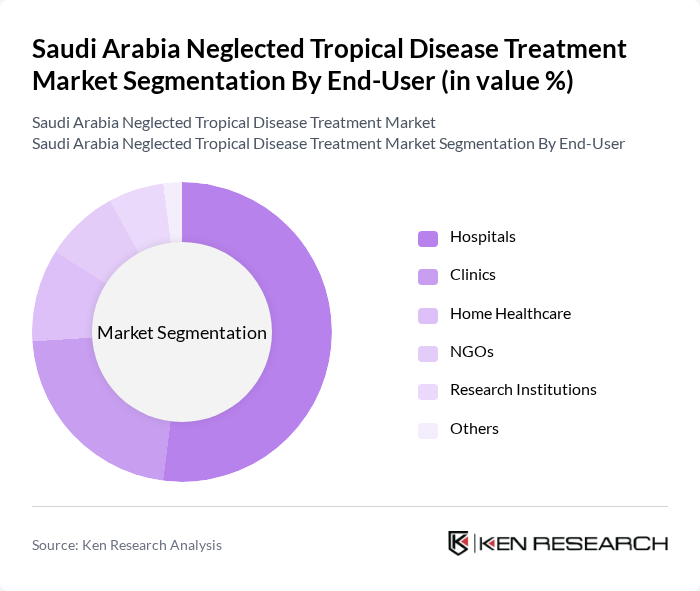
By End-User:The end-user segmentation includes hospitals, clinics, home healthcare, NGOs, research institutions, and others. Hospitals are the primary end-users, as they provide comprehensive care and treatment for patients suffering from neglected tropical diseases, with specialized infectious disease units and advanced laboratory services. Clinics play a significant role, particularly in urban areas where outpatient services are in high demand and early-stage NTD management is prioritized. NGOs contribute to the treatment and prevention of NTDs through community outreach, mass drug administration, and health education campaigns, while research institutions focus on developing new therapies, diagnostics, and epidemiological studies .
Saudi Arabia Neglected Tropical Disease Treatment Market segmentation by End-User.

Saudi Arabia Neglected Tropical Disease Treatment Market Competitive Landscape

The Saudi Arabia Neglected Tropical Disease Treatment Market is characterized by a dynamic mix of regional and international players. Leading participants such as GlaxoSmithKline plc, Merck & Co., Inc., Novartis AG, Sanofi S.A., Pfizer Inc., Johnson & Johnson, AbbVie Inc., AstraZeneca plc, Bayer AG, Takeda Pharmaceutical Company Limited, F. Hoffmann-La Roche AG, Boehringer Ingelheim GmbH, Amgen Inc., Eli Lilly and Company, Gilead Sciences, Inc., Tabuk Pharmaceuticals Manufacturing Co., Jamjoom Pharma, SPIMACO (Saudi Pharmaceutical Industries & Medical Appliances Corporation), Hikma Pharmaceuticals plc, Mylan (Viatris Inc.) contribute to innovation, geographic expansion, and service delivery in this space.

GlaxoSmithKline plc

2000

London, UK

Merck & Co., Inc.

1891

Rahway, New Jersey, USA

Novartis AG

1996

Basel, Switzerland

Sanofi S.A.

2004

Paris, France

Pfizer Inc.

1849

New York City, New York, USA

Company

Establishment Year

Headquarters

Company Type (Multinational, Regional, Local)

Revenue from NTD Treatments (USD Million)

Market Share in Saudi Arabia NTD Segment (%)

Product Portfolio Breadth (Number of NTD Drugs/Diagnostics)

R&D Investment in NTDs (USD Million or % of Revenue)

Number of Partnerships/Collaborations in Saudi Arabia

Saudi Arabia Neglected Tropical Disease Treatment Market Industry Analysis

Growth Drivers

  • Increasing Prevalence of Neglected Tropical Diseases:The World Health Organization reported that approximately 1.2 million cases of neglected tropical diseases (NTDs) were documented in Saudi Arabia in future. This rising incidence is primarily attributed to environmental factors and urbanization, which have exacerbated the spread of diseases such as leishmaniasis and schistosomiasis. The increasing burden on the healthcare system necessitates enhanced treatment options, driving market growth as healthcare providers seek effective solutions to manage these diseases.
  • Government Initiatives and Funding:The Saudi government allocated SAR 1.5 billion (approximately USD 400 million) in future for the control and treatment of NTDs. This funding supports various initiatives, including vaccination programs and public health campaigns aimed at raising awareness. The government's commitment to improving healthcare infrastructure and disease management is expected to significantly boost the market for NTD treatments, facilitating access to necessary medical resources and technologies.
  • Advancements in Treatment Technologies:In future, the introduction of new treatment modalities, including novel drug formulations and combination therapies, has shown promising results in clinical trials. For instance, a new oral treatment for schistosomiasis demonstrated a 95% cure rate in trials conducted in Saudi Arabia. These advancements not only improve patient outcomes but also attract investment from pharmaceutical companies, further propelling the growth of the NTD treatment market in the region.

Market Challenges

  • Limited Healthcare Infrastructure in Rural Areas:Approximately 25% of the Saudi population resides in rural areas, where healthcare facilities are often inadequate. A recent report indicated that only 50% of rural health centers are equipped to handle NTD cases effectively. This lack of infrastructure poses significant challenges in diagnosing and treating NTDs, leading to increased morbidity and complicating efforts to control disease spread in these communities.
  • High Cost of Treatment Options:The average cost of NTD treatments can reach up to SAR 6,000 (approximately USD 1,600) per patient, which is prohibitive for many individuals, especially in lower-income brackets. With a significant portion of the population lacking health insurance, the financial burden of treatment remains a critical barrier. This challenge limits access to necessary therapies and hinders overall market growth in the NTD treatment sector.

Saudi Arabia Neglected Tropical Disease Treatment Market Future Outlook

The future of the Saudi Arabia neglected tropical disease treatment market appears promising, driven by increasing government support and technological advancements. The integration of digital health solutions is expected to enhance patient monitoring and treatment adherence, while partnerships with NGOs will facilitate outreach programs. Additionally, the focus on preventive healthcare will likely lead to a reduction in disease incidence, further stimulating demand for effective treatment options and improving overall public health outcomes in the region.

Market Opportunities

  • Expansion of Telemedicine Services:The rise of telemedicine in Saudi Arabia presents a significant opportunity for NTD treatment. With over 90% of the population having access to smartphones, telehealth platforms can facilitate remote consultations and follow-ups, improving access to care for patients in underserved areas. This innovation can enhance treatment adherence and patient education, ultimately leading to better health outcomes.
  • Development of Affordable Treatment Options:There is a growing demand for cost-effective treatment alternatives for NTDs. Pharmaceutical companies are increasingly focusing on developing generic medications and low-cost therapies, which can significantly reduce the financial burden on patients. This trend not only addresses affordability but also expands market access, allowing more individuals to receive timely and effective treatment for neglected tropical diseases.

Scope of the Report

SegmentSub-Segments
By Type

Antiparasitic Drugs

Antifungal Drugs

Antibiotics

Vaccines

Diagnostic Tools

Combination Therapies

Others

By End-User

Hospitals

Clinics

Home Healthcare

NGOs

Research Institutions

Others

By Disease Type

Schistosomiasis

Lymphatic Filariasis

Leishmaniasis

Onchocerciasis

Soil-Transmitted Helminthiases

Trachoma

Others

By Distribution Channel

Retail Pharmacies

Online Pharmacies

Direct Sales

Hospital Pharmacies

Others

By Region

Central Region

Eastern Region

Western Region

Southern Region

By Treatment Setting

Inpatient Treatment

Outpatient Treatment

Community Health Programs

Others

By Patient Demographics

Pediatric Patients

Adult Patients

Geriatric Patients

Others

Key Target Audience

Investors and Venture Capitalist Firms

Government and Regulatory Bodies (e.g., Ministry of Health, Saudi Food and Drug Authority)

Pharmaceutical Manufacturers

Biotechnology Companies

Healthcare Providers and Hospitals

Non-Governmental Organizations (NGOs) focused on health

Public Health Agencies

International Health Organizations (e.g., World Health Organization)

Players Mentioned in the Report:

GlaxoSmithKline plc

Merck & Co., Inc.

Novartis AG

Sanofi S.A.

Pfizer Inc.

Johnson & Johnson

AbbVie Inc.

AstraZeneca plc

Bayer AG

Takeda Pharmaceutical Company Limited

F. Hoffmann-La Roche AG

Boehringer Ingelheim GmbH

Amgen Inc.

Eli Lilly and Company

Gilead Sciences, Inc.

Tabuk Pharmaceuticals Manufacturing Co.

Jamjoom Pharma

SPIMACO (Saudi Pharmaceutical Industries & Medical Appliances Corporation)

Hikma Pharmaceuticals plc

Mylan (Viatris Inc.)

Table of Contents

Market Assessment Phase

1. Executive Summary and Approach


2. Saudi Arabia Neglected Tropical Disease Treatment Market Overview

2.1 Key Insights and Strategic Recommendations

2.2 Saudi Arabia Neglected Tropical Disease Treatment Market Overview

2.3 Definition and Scope

2.4 Evolution of Market Ecosystem

2.5 Timeline of Key Regulatory Milestones

2.6 Value Chain & Stakeholder Mapping

2.7 Business Cycle Analysis

2.8 Policy & Incentive Landscape


3. Saudi Arabia Neglected Tropical Disease Treatment Market Analysis

3.1 Growth Drivers

3.1.1 Increasing prevalence of neglected tropical diseases
3.1.2 Government initiatives and funding
3.1.3 Rising awareness and education on health issues
3.1.4 Advancements in treatment technologies

3.2 Market Challenges

3.2.1 Limited healthcare infrastructure in rural areas
3.2.2 High cost of treatment options
3.2.3 Lack of trained healthcare professionals
3.2.4 Regulatory hurdles and approval delays

3.3 Market Opportunities

3.3.1 Expansion of telemedicine services
3.3.2 Partnerships with NGOs for outreach
3.3.3 Development of affordable treatment options
3.3.4 Increased investment in healthcare technology

3.4 Market Trends

3.4.1 Growing focus on preventive healthcare
3.4.2 Integration of digital health solutions
3.4.3 Rise in personalized medicine approaches
3.4.4 Collaboration between public and private sectors

3.5 Government Regulation

3.5.1 Implementation of health policies for disease control
3.5.2 Regulatory frameworks for drug approval
3.5.3 Guidelines for clinical trials and research
3.5.4 Incentives for pharmaceutical companies

4. SWOT Analysis


5. Stakeholder Analysis


6. Porter's Five Forces Analysis


7. Saudi Arabia Neglected Tropical Disease Treatment Market Market Size, 2019-2024

7.1 By Value

7.2 By Volume

7.3 By Average Selling Price


8. Saudi Arabia Neglected Tropical Disease Treatment Market Segmentation

8.1 By Type

8.1.1 Antiparasitic Drugs
8.1.2 Antifungal Drugs
8.1.3 Antibiotics
8.1.4 Vaccines
8.1.5 Diagnostic Tools
8.1.6 Combination Therapies
8.1.7 Others

8.2 By End-User

8.2.1 Hospitals
8.2.2 Clinics
8.2.3 Home Healthcare
8.2.4 NGOs
8.2.5 Research Institutions
8.2.6 Others

8.3 By Disease Type

8.3.1 Schistosomiasis
8.3.2 Lymphatic Filariasis
8.3.3 Leishmaniasis
8.3.4 Onchocerciasis
8.3.5 Soil-Transmitted Helminthiases
8.3.6 Trachoma
8.3.7 Others

8.4 By Distribution Channel

8.4.1 Retail Pharmacies
8.4.2 Online Pharmacies
8.4.3 Direct Sales
8.4.4 Hospital Pharmacies
8.4.5 Others

8.5 By Region

8.5.1 Central Region
8.5.2 Eastern Region
8.5.3 Western Region
8.5.4 Southern Region

8.6 By Treatment Setting

8.6.1 Inpatient Treatment
8.6.2 Outpatient Treatment
8.6.3 Community Health Programs
8.6.4 Others

8.7 By Patient Demographics

8.7.1 Pediatric Patients
8.7.2 Adult Patients
8.7.3 Geriatric Patients
8.7.4 Others

9. Saudi Arabia Neglected Tropical Disease Treatment Market Competitive Analysis

9.1 Market Share of Key Players

9.2 Cross Comparison of Key Players

9.2.1 Company Name
9.2.2 Company Type (Multinational, Regional, Local)
9.2.3 Revenue from NTD Treatments (USD Million)
9.2.4 Market Share in Saudi Arabia NTD Segment (%)
9.2.5 Product Portfolio Breadth (Number of NTD Drugs/Diagnostics)
9.2.6 R&D Investment in NTDs (USD Million or % of Revenue)
9.2.7 Number of Partnerships/Collaborations in Saudi Arabia
9.2.8 Distribution Network Coverage (Regions/Facilities Served)
9.2.9 Regulatory Approvals for NTD Products (Count)
9.2.10 Local Manufacturing/Presence (Yes/No)

9.3 SWOT Analysis of Top Players

9.4 Pricing Analysis

9.5 Detailed Profile of Major Companies

9.5.1 GlaxoSmithKline plc
9.5.2 Merck & Co., Inc.
9.5.3 Novartis AG
9.5.4 Sanofi S.A.
9.5.5 Pfizer Inc.
9.5.6 Johnson & Johnson
9.5.7 AbbVie Inc.
9.5.8 AstraZeneca plc
9.5.9 Bayer AG
9.5.10 Takeda Pharmaceutical Company Limited
9.5.11 F. Hoffmann-La Roche AG
9.5.12 Boehringer Ingelheim GmbH
9.5.13 Amgen Inc.
9.5.14 Eli Lilly and Company
9.5.15 Gilead Sciences, Inc.
9.5.16 Tabuk Pharmaceuticals Manufacturing Co.
9.5.17 Jamjoom Pharma
9.5.18 SPIMACO (Saudi Pharmaceutical Industries & Medical Appliances Corporation)
9.5.19 Hikma Pharmaceuticals plc
9.5.20 Mylan (Viatris Inc.)

10. Saudi Arabia Neglected Tropical Disease Treatment Market End-User Analysis

10.1 Procurement Behavior of Key Ministries

10.1.1 Budget Allocation for Health Initiatives
10.1.2 Decision-Making Processes
10.1.3 Supplier Selection Criteria
10.1.4 Contract Management Practices

10.2 Corporate Spend on Infrastructure & Energy

10.2.1 Investment in Healthcare Facilities
10.2.2 Funding for Research and Development
10.2.3 Expenditure on Training and Development
10.2.4 Partnerships with Private Sector

10.3 Pain Point Analysis by End-User Category

10.3.1 Access to Treatment
10.3.2 Affordability of Medications
10.3.3 Availability of Healthcare Services
10.3.4 Quality of Care

10.4 User Readiness for Adoption

10.4.1 Awareness of Treatment Options
10.4.2 Willingness to Pay for Treatments
10.4.3 Acceptance of New Technologies
10.4.4 Training Needs for Healthcare Providers

10.5 Post-Deployment ROI and Use Case Expansion

10.5.1 Measurement of Treatment Outcomes
10.5.2 Long-term Cost Savings
10.5.3 Expansion into New Patient Segments
10.5.4 Feedback Mechanisms for Continuous Improvement

11. Saudi Arabia Neglected Tropical Disease Treatment Market Future Size, 2025-2030

11.1 By Value

11.2 By Volume

11.3 By Average Selling Price


Go-To-Market Strategy Phase

1. Whitespace Analysis + Business Model Canvas

1.1 Market Gaps Identification

1.2 Value Proposition Development

1.3 Revenue Streams Analysis

1.4 Cost Structure Evaluation

1.5 Key Partnerships Exploration

1.6 Customer Segmentation

1.7 Channels of Distribution


2. Marketing and Positioning Recommendations

2.1 Branding Strategies

2.2 Product USPs

2.3 Target Market Identification

2.4 Communication Strategies

2.5 Digital Marketing Approaches

2.6 Community Engagement Plans

2.7 Performance Metrics


3. Distribution Plan

3.1 Urban Retail Strategies

3.2 Rural NGO Tie-ups

3.3 Logistics and Supply Chain Management

3.4 Distribution Channel Optimization

3.5 Partnership with Local Distributors

3.6 Inventory Management Solutions

3.7 Performance Tracking


4. Channel & Pricing Gaps

4.1 Underserved Routes Analysis

4.2 Pricing Bands Evaluation

4.3 Competitor Pricing Strategies

4.4 Customer Willingness to Pay

4.5 Price Sensitivity Analysis

4.6 Discount and Promotion Strategies

4.7 Pricing Model Development


5. Unmet Demand & Latent Needs

5.1 Category Gaps Identification

5.2 Consumer Segments Analysis

5.3 Emerging Trends Exploration

5.4 Future Needs Assessment

5.5 Product Development Opportunities

5.6 Market Entry Barriers

5.7 Stakeholder Engagement


6. Customer Relationship

6.1 Loyalty Programs Design

6.2 After-sales Service Strategies

6.3 Customer Feedback Mechanisms

6.4 Relationship Management Tools

6.5 Community Building Initiatives

6.6 Customer Education Programs

6.7 Performance Metrics


7. Value Proposition

7.1 Sustainability Initiatives

7.2 Integrated Supply Chains

7.3 Unique Selling Points Development

7.4 Customer-Centric Approaches

7.5 Value Communication Strategies

7.6 Competitive Advantage Analysis

7.7 Performance Metrics


8. Key Activities

8.1 Regulatory Compliance Strategies

8.2 Branding Initiatives

8.3 Distribution Setup Plans

8.4 Training and Development Programs

8.5 Performance Monitoring

8.6 Risk Management Strategies

8.7 Stakeholder Engagement


9. Entry Strategy Evaluation

9.1 Domestic Market Entry Strategy

9.1.1 Product Mix Considerations
9.1.2 Pricing Band Analysis
9.1.3 Packaging Strategies

9.2 Export Entry Strategy

9.2.1 Target Countries Identification
9.2.2 Compliance Roadmap Development

10. Entry Mode Assessment

10.1 Joint Ventures

10.2 Greenfield Investments

10.3 Mergers & Acquisitions

10.4 Distributor Model Evaluation

10.5 Risk Assessment

10.6 Strategic Fit Analysis

10.7 Performance Metrics


11. Capital and Timeline Estimation

11.1 Capital Requirements Analysis

11.2 Timelines for Market Entry

11.3 Financial Projections

11.4 Funding Sources Exploration

11.5 Risk Management Strategies

11.6 Performance Metrics


12. Control vs Risk Trade-Off

12.1 Ownership vs Partnerships Analysis

12.2 Risk Mitigation Strategies

12.3 Performance Metrics


13. Profitability Outlook

13.1 Breakeven Analysis

13.2 Long-term Sustainability Strategies

13.3 Financial Health Assessment

13.4 Performance Metrics


14. Potential Partner List

14.1 Distributors Identification

14.2 Joint Ventures Opportunities

14.3 Acquisition Targets Analysis

14.4 Strategic Alliances Exploration

14.5 Performance Metrics


15. Execution Roadmap

15.1 Phased Plan for Market Entry

15.1.1 Market Setup
15.1.2 Market Entry
15.1.3 Growth Acceleration
15.1.4 Scale & Stabilize

15.2 Key Activities and Milestones

15.2.1 Milestone Plannin

Research Methodology

ApproachModellingSample

Phase 1: Approach1

Desk Research

  • Analysis of health ministry reports and publications on neglected tropical diseases (NTDs) in Saudi Arabia
  • Review of academic journals and articles focusing on NTD treatment protocols and market dynamics
  • Examination of demographic and epidemiological data from WHO and local health authorities

Primary Research

  • Interviews with healthcare professionals specializing in infectious diseases and tropical medicine
  • Surveys conducted with pharmaceutical companies involved in NTD treatments
  • Focus group discussions with patient advocacy groups and NGOs working in the NTD space

Validation & Triangulation

  • Cross-validation of findings through multiple data sources including government health statistics and industry reports
  • Triangulation of qualitative insights from interviews with quantitative data from surveys
  • Sanity checks performed by consulting with a panel of experts in tropical disease management

Phase 2: Market Size Estimation1

Top-down Assessment

  • Estimation of total healthcare expenditure allocated to NTDs based on national health budgets
  • Segmentation of market size by disease type and treatment modality (e.g., pharmaceuticals, vaccines)
  • Incorporation of government initiatives and funding aimed at NTD eradication

Bottom-up Modeling

  • Collection of sales data from leading pharmaceutical companies providing NTD treatments
  • Estimation of treatment costs based on pricing strategies and reimbursement policies
  • Volume estimates derived from patient population data and treatment adherence rates

Forecasting & Scenario Analysis

  • Multi-factor regression analysis incorporating factors such as population growth, healthcare access, and disease prevalence
  • Scenario modeling based on potential changes in healthcare policy and funding for NTDs
  • Development of baseline, optimistic, and pessimistic market projections through 2030

Phase 3: CATI Sample Composition1

Scope Item/SegmentSample SizeTarget Respondent Profiles
Healthcare Providers100Doctors, Nurses, Public Health Officials
Pharmaceutical Companies60Product Managers, Market Access Specialists
NGOs and Advocacy Groups50Program Directors, Health Policy Analysts
Patients and Caregivers80Patients with NTDs, Caregivers, Community Health Workers
Government Health Officials40Health Policy Makers, Epidemiologists

Frequently Asked Questions

What is the current value of the Saudi Arabia Neglected Tropical Disease Treatment Market?

The Saudi Arabia Neglected Tropical Disease Treatment Market is valued at approximately USD 1.1 billion, reflecting a five-year historical analysis that highlights growth driven by increased awareness, government initiatives, and investments in pharmaceutical research and development.

What are the main drivers of growth in the Saudi Arabia NTD treatment market?

Which cities in Saudi Arabia are leading in the NTD treatment market?

What types of treatments are available in the Saudi Arabia NTD treatment market?

Other Regional/Country Reports

Indonesia neglected tropical disease treatment market

Malaysia neglected tropical disease treatment market

KSA neglected tropical disease treatment market

APAC neglected tropical disease treatment market

SEA neglected tropical disease treatment market

Vietnam neglected tropical disease treatment market

Other Adjacent Reports

Kuwait Infectious Disease Diagnostics Market

Bahrain Antiparasitic Drugs Market Report Size Share Growth Drivers Trends Opportunities & Forecast 2025–2030APAC antifungal drugs market size, share, growth drivers, trends, opportunities & forecast 2025–2030Kuwait Antibiotics Market Report Size Share Growth Drivers Trends Opportunities & Forecast 2025–2030

South Korea Vaccines Market

Brazil Diagnostic Tools Market

Singapore Combination Therapies Market

Oman Telemedicine Services Market

Japan Pharmaceutical Research Market

South Korea Public Health Initiatives Market

Why Buy From Us?

Refine Robust Result (RRR) Framework

What makes us stand out is that our consultants follow Robust, Refine and Result (RRR) methodology. Robust for clear definitions, approaches and sanity checking, Refine for differentiating respondents' facts and opinions, and Result for presenting data with story.

Our Reach Is Unmatched

We have set a benchmark in the industry by offering our clients with syndicated and customized market research reports featuring coverage of entire market as well as meticulous research and analyst insights.

Shifting the Research Paradigm

While we don't replace traditional research, we flip the method upside down. Our dual approach of Top Bottom & Bottom Top ensures quality deliverable by not just verifying company fundamentals but also looking at the sector and macroeconomic factors.

More Insights-Better Decisions

With one step in the future, our research team constantly tries to show you the bigger picture. We help with some of the tough questions you may encounter along the way: How is the industry positioned? Best marketing channel? KPI's of competitors? By aligning every element, we help maximize success.

Transparency and Trust

Our report gives you instant access to the answers and sources that other companies might choose to hide. We elaborate each steps of research methodology we have used and showcase you the sample size to earn your trust.

Round the Clock Support

If you need any support, we are here! We pride ourselves on universe strength, data quality, and quick, friendly, and professional service.

Why Clients Choose Us?

400000+
Reports in repository
150+
Consulting projects a year
100+
Analysts
8000+
Client Queries in 2022








