Saudi Arabia Network Security Sandbox Market Size, Share, Growth Drivers, Trends, Opportunities & Forecast 2025–2030

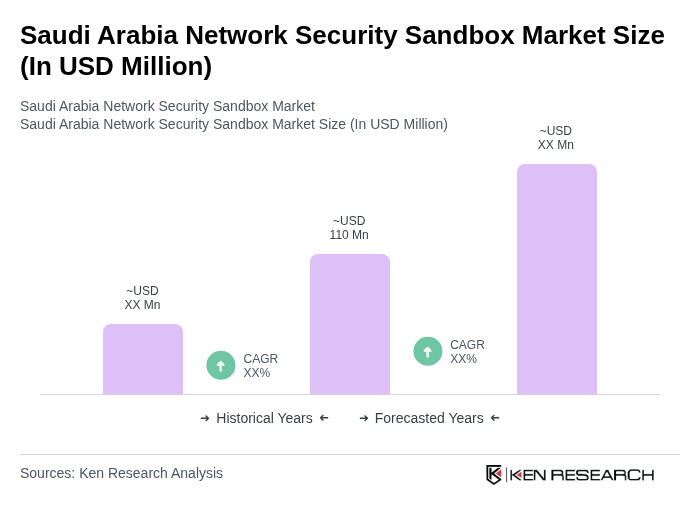
The Saudi Arabia Network Security Sandbox Market, valued at USD 110 million, is growing due to increasing cybersecurity threats and government initiatives like Vision 2030 for digital security.

Region:Middle East

Author(s):Shubham

Product Code:KRAD6741

Pages:94

Published On:December 2025
About the Report

Base Year 2024

Saudi Arabia Network Security Sandbox Market Overview

  • The Saudi Arabia Network Security Sandbox Market is valued at USD 110 million, based on a five-year historical analysis. This growth is primarily driven by the increasing frequency of cyber threats, the rising need for advanced security solutions, and the growing adoption of digital transformation initiatives across various sectors. Organizations are investing in sandbox technologies to enhance their cybersecurity posture and protect sensitive data from evolving threats.
  • Key cities such as Riyadh, Jeddah, and Dammam dominate the Saudi Arabia Network Security Sandbox Market due to their status as economic and technological hubs. Riyadh, being the capital, hosts numerous government and financial institutions that require robust cybersecurity measures. Jeddah and Dammam are also significant due to their strategic locations and the presence of major industries, including oil and gas, which are critical to the national economy.
  • The Essential Cybersecurity Controls (ECC), 2022 issued by the National Cybersecurity Authority (NCA), mandates organizations to implement advanced threat detection mechanisms, including sandboxing technologies, for real-time analysis of suspicious network activities across critical sectors. Compliance requires deployment of controls for malware detonation and behavioral analysis in isolated environments, with annual audits and reporting thresholds for entities handling national critical data infrastructure.
Saudi Arabia Network Security Sandbox Market Size

Saudi Arabia Network Security Sandbox Market Segmentation

By Component:The components of the Saudi Arabia Network Security Sandbox Market include solutions and services. The solutions segment is further divided into standalone sandboxes and integrated sandbox modules, while the services segment encompasses professional and managed security services. The solutions segment is currently leading the market due to the increasing demand for advanced threat detection and response capabilities. Organizations are increasingly adopting integrated sandbox modules that provide comprehensive security solutions, enabling them to effectively combat sophisticated cyber threats.
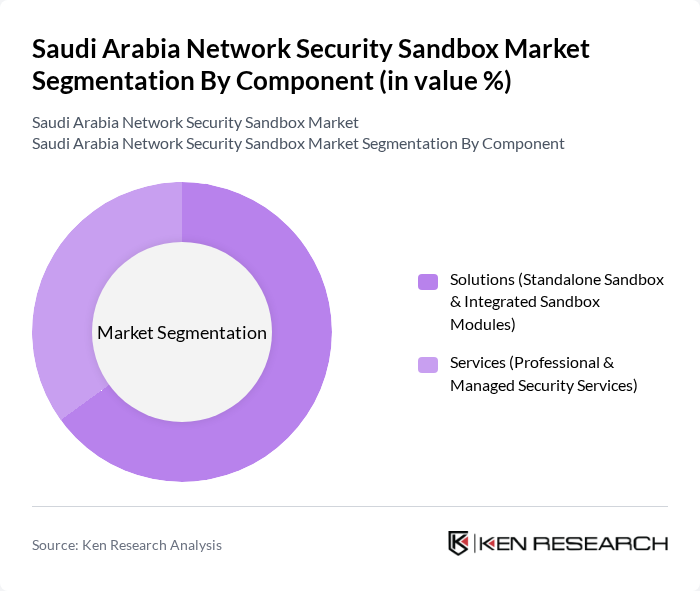
Saudi Arabia Network Security Sandbox Market segmentation by Component.

By Deployment Mode:The deployment modes in the Saudi Arabia Network Security Sandbox Market include on-premises sandbox appliances, cloud-based sandboxes, and hybrid deployment. The cloud-based sandbox segment is gaining traction due to its scalability and cost-effectiveness, allowing organizations to quickly adapt to changing security needs. On-premises solutions remain popular among large enterprises that prioritize data control and compliance, while hybrid deployments are increasingly favored for their flexibility in managing security across various environments.
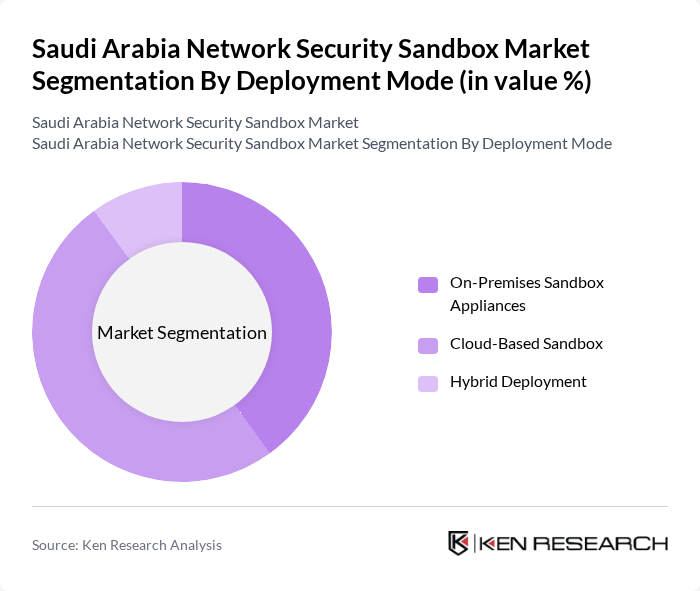
Saudi Arabia Network Security Sandbox Market segmentation by Deployment Mode.

Saudi Arabia Network Security Sandbox Market Competitive Landscape

The Saudi Arabia Network Security Sandbox Market is characterized by a dynamic mix of regional and international players. Leading participants such as Palo Alto Networks, Inc., Fortinet, Inc., Check Point Software Technologies Ltd., Cisco Systems, Inc., Trend Micro Incorporated, Trellix (formerly McAfee Enterprise & FireEye), CrowdStrike Holdings, Inc., Darktrace plc, Kaspersky Lab, Broadcom Inc. (Symantec Enterprise Security), Juniper Networks, Inc., Huawei Technologies Co., Ltd., STC Solutions (Saudi Telecom Company), Cyberani (Saudi Information Technology Company), Sirar by stc contribute to innovation, geographic expansion, and service delivery in this space.

Palo Alto Networks, Inc.

2005

Santa Clara, California, USA

Fortinet, Inc.

2000

Sunnyvale, California, USA

Check Point Software Technologies Ltd.

1993

Tel Aviv, Israel

Cisco Systems, Inc.

1984

San Jose, California, USA

Trend Micro Incorporated

1988

Tokyo, Japan

Company

Establishment Year

Headquarters

Global Revenue from Network Security Sandbox Solutions (Latest FY)

Estimated Revenue from Saudi Arabia / GCC Cybersecurity Markets

Installed Base in Saudi Arabia (Number of Enterprise Deployments)

Key Saudi Arabia Customer Segments Served (BFSI, Government, Oil & Gas, etc.)

Local Presence (Regional HQ, Local Office, or via Partner Only)

Strength of Channel & SI Ecosystem in Saudi Arabia (Number of Active Partners)

Saudi Arabia Network Security Sandbox Market Industry Analysis

Growth Drivers

  • Increasing Cybersecurity Threats:The surge in cyberattacks in Saudi Arabia has been alarming, with the Cybersecurity Authority reporting over 1,000 incidents in 2023 alone. This escalation has prompted organizations to invest heavily in network security solutions, with spending projected to reach SAR 6 billion in future. The increasing sophistication of threats, including ransomware and phishing, necessitates robust security measures, driving demand for network security sandboxes to test and mitigate these risks effectively.
  • Government Initiatives for Digital Transformation:Saudi Arabia's Vision 2030 aims to enhance the digital economy, with the government allocating SAR 15 billion for cybersecurity initiatives in future. This investment is part of a broader strategy to secure critical infrastructure and promote digital innovation. As organizations align with these initiatives, the demand for network security sandboxes is expected to rise, facilitating secure environments for testing new technologies and applications in a rapidly evolving digital landscape.
  • Rising Demand for Secure Network Environments:The increasing reliance on digital platforms has led to a heightened demand for secure network environments. In future, the number of connected devices in Saudi Arabia is projected to exceed 35 million, amplifying the need for effective security solutions. Organizations are prioritizing the establishment of secure networks to protect sensitive data and maintain operational integrity, driving the adoption of network security sandboxes as essential tools for vulnerability assessment and threat simulation.

Market Challenges

  • High Implementation Costs:The initial investment required for deploying network security sandboxes can be substantial, often exceeding SAR 1.2 million for comprehensive solutions. This financial barrier poses a significant challenge, particularly for small and medium-sized enterprises (SMEs) that may lack the necessary resources. As a result, many organizations may delay or forgo implementing these critical security measures, leaving them vulnerable to cyber threats and hindering overall market growth.
  • Lack of Skilled Workforce:The cybersecurity sector in Saudi Arabia faces a critical shortage of skilled professionals, with an estimated deficit of over 35,000 cybersecurity experts in future. This skills gap hampers the effective implementation and management of network security sandboxes, as organizations struggle to find qualified personnel to operate and maintain these systems. Consequently, the lack of expertise can lead to underutilization of security technologies, increasing the risk of cyber incidents and limiting market expansion.

Saudi Arabia Network Security Sandbox Market Future Outlook

The future of the Saudi Arabia network security sandbox market appears promising, driven by ongoing digital transformation and increasing cybersecurity threats. As organizations prioritize security, the integration of advanced technologies such as artificial intelligence and machine learning will enhance threat detection capabilities. Furthermore, collaboration with international cybersecurity firms is expected to bolster local expertise and innovation, fostering a more resilient cybersecurity landscape. This evolving environment will likely create new avenues for growth and investment in the coming years.

Market Opportunities

  • Growth in IoT Devices:The proliferation of IoT devices, projected to reach 55 million in future, presents a significant opportunity for network security sandboxes. These devices often lack robust security measures, making them prime targets for cyberattacks. By leveraging sandboxes, organizations can simulate attacks and develop effective security protocols, ensuring the protection of IoT ecosystems and enhancing overall network security.
  • Expansion of Managed Security Services:The managed security services market in Saudi Arabia is expected to grow to SAR 4 billion in future. This expansion offers opportunities for network security sandbox providers to partner with managed service providers, integrating sandbox solutions into their offerings. Such collaborations can enhance service delivery, improve threat detection, and provide clients with comprehensive security solutions tailored to their specific needs.

Scope of the Report

SegmentSub-Segments
By Component

Solutions (Standalone Sandbox & Integrated Sandbox Modules)

Services (Professional & Managed Security Services)

By Deployment Mode

On-Premises Sandbox Appliances

Cloud-Based Sandbox

Hybrid Deployment

By Organization Size

Large Enterprises

Small & Medium Enterprises (SMEs)

By Application / Use Case

Advanced Threat Protection for Email & Web Gateways

Zero-Day Malware & Ransomware Detection

Network Traffic Analysis & Intrusion Detection

Cloud & SaaS Security

By Industry Vertical

Banking, Financial Services & Insurance (BFSI)

Government & Public Sector

Energy & Utilities (including Oil & Gas)

IT & Telecom

Healthcare

Retail & E?Commerce

Manufacturing & Industrial

By Channel / Procurement Model

Direct Enterprise Sales

Through Local System Integrators & MSPs

Through Telecom Operators & Cloud Service Providers

By Region (Within Saudi Arabia)

Central Region (Riyadh)

Western Region (Jeddah, Makkah, Madinah)

Eastern Province (Dammam, Dhahran, Al Khobar)

Other Regions

Key Target Audience

Investors and Venture Capitalist Firms

Government and Regulatory Bodies (e.g., Saudi Arabian Monetary Authority, National Cybersecurity Authority)

Telecommunications Service Providers

Cybersecurity Solution Providers

Cloud Service Providers

Financial Institutions

Defense and Security Agencies

Technology Startups in Cybersecurity

Players Mentioned in the Report:

Palo Alto Networks, Inc.

Fortinet, Inc.

Check Point Software Technologies Ltd.

Cisco Systems, Inc.

Trend Micro Incorporated

Trellix (formerly McAfee Enterprise & FireEye)

CrowdStrike Holdings, Inc.

Darktrace plc

Kaspersky Lab

Broadcom Inc. (Symantec Enterprise Security)

Juniper Networks, Inc.

Huawei Technologies Co., Ltd.

STC Solutions (Saudi Telecom Company)

Cyberani (Saudi Information Technology Company)

Sirar by stc

Table of Contents

Market Assessment Phase

1. Executive Summary and Approach


2. Saudi Arabia Network Security Sandbox Market Overview

2.1 Key Insights and Strategic Recommendations

2.2 Saudi Arabia Network Security Sandbox Market Overview

2.3 Definition and Scope

2.4 Evolution of Market Ecosystem

2.5 Timeline of Key Regulatory Milestones

2.6 Value Chain & Stakeholder Mapping

2.7 Business Cycle Analysis

2.8 Policy & Incentive Landscape


3. Saudi Arabia Network Security Sandbox Market Analysis

3.1 Growth Drivers

3.1.1 Increasing Cybersecurity Threats
3.1.2 Government Initiatives for Digital Transformation
3.1.3 Rising Demand for Secure Network Environments
3.1.4 Adoption of Cloud-Based Solutions

3.2 Market Challenges

3.2.1 High Implementation Costs
3.2.2 Lack of Skilled Workforce
3.2.3 Rapidly Evolving Threat Landscape
3.2.4 Regulatory Compliance Issues

3.3 Market Opportunities

3.3.1 Growth in IoT Devices
3.3.2 Expansion of Managed Security Services
3.3.3 Increasing Investment in Cybersecurity Startups
3.3.4 Collaboration with International Cybersecurity Firms

3.4 Market Trends

3.4.1 Shift Towards AI-Driven Security Solutions
3.4.2 Integration of Machine Learning in Threat Detection
3.4.3 Rise of Zero Trust Security Models
3.4.4 Growing Focus on Data Privacy Regulations

3.5 Government Regulation

3.5.1 National Cybersecurity Strategy
3.5.2 Data Protection Laws
3.5.3 Compliance with International Standards
3.5.4 Cybersecurity Frameworks for Critical Infrastructure

4. SWOT Analysis


5. Stakeholder Analysis


6. Porter's Five Forces Analysis


7. Saudi Arabia Network Security Sandbox Market Size, 2019-2024

7.1 By Value

7.2 By Volume

7.3 By Average Selling Price


8. Saudi Arabia Network Security Sandbox Market Segmentation

8.1 By Component

8.1.1 Solutions (Standalone Sandbox & Integrated Sandbox Modules)
8.1.2 Services (Professional & Managed Security Services)

8.2 By Deployment Mode

8.2.1 On-Premises Sandbox Appliances
8.2.2 Cloud-Based Sandbox
8.2.3 Hybrid Deployment

8.3 By Organization Size

8.3.1 Large Enterprises
8.3.2 Small & Medium Enterprises (SMEs)

8.4 By Application / Use Case

8.4.1 Advanced Threat Protection for Email & Web Gateways
8.4.2 Zero-Day Malware & Ransomware Detection
8.4.3 Network Traffic Analysis & Intrusion Detection
8.4.4 Cloud & SaaS Security

8.5 By Industry Vertical

8.5.1 Banking, Financial Services & Insurance (BFSI)
8.5.2 Government & Public Sector
8.5.3 Energy & Utilities (including Oil & Gas)
8.5.4 IT & Telecom
8.5.5 Healthcare
8.5.6 Retail & E?Commerce
8.5.7 Manufacturing & Industrial

8.6 By Channel / Procurement Model

8.6.1 Direct Enterprise Sales
8.6.2 Through Local System Integrators & MSPs
8.6.3 Through Telecom Operators & Cloud Service Providers

8.7 By Region (Within Saudi Arabia)

8.7.1 Central Region (Riyadh)
8.7.2 Western Region (Jeddah, Makkah, Madinah)
8.7.3 Eastern Province (Dammam, Dhahran, Al Khobar)
8.7.4 Other Regions

9. Saudi Arabia Network Security Sandbox Market Competitive Analysis

9.1 Market Share of Key Players

9.2 Cross Comparison of Key Players

9.2.1 Company Name
9.2.2 Global Revenue from Network Security Sandbox Solutions (Latest FY)
9.2.3 Estimated Revenue from Saudi Arabia / GCC Cybersecurity Markets
9.2.4 Installed Base in Saudi Arabia (Number of Enterprise Deployments)
9.2.5 Key Saudi Arabia Customer Segments Served (BFSI, Government, Oil & Gas, etc.)
9.2.6 Local Presence (Regional HQ, Local Office, or via Partner Only)
9.2.7 Strength of Channel & SI Ecosystem in Saudi Arabia (Number of Active Partners)
9.2.8 Technology Breadth (Email, Web, Endpoint, Cloud Sandbox Coverage)
9.2.9 Integration with Existing Network Security Stack (Firewalls, SECaaS, XDR)
9.2.10 Average Deal Size in Saudi Arabia (USD)
9.2.11 Share of Subscription / Cloud-Based Revenues
9.2.12 Compliance & Certifications Relevant to KSA (e.g., NCA ECC, ISO 27001)
9.2.13 Average Time to Detection / Response for Advanced Threats
9.2.14 Customer Retention / Renewal Rate in the Middle East

9.3 SWOT Analysis of Top Players

9.4 Pricing Analysis

9.5 Detailed Profile of Major Companies

9.5.1 Palo Alto Networks, Inc.
9.5.2 Fortinet, Inc.
9.5.3 Check Point Software Technologies Ltd.
9.5.4 Cisco Systems, Inc.
9.5.5 Trend Micro Incorporated
9.5.6 Trellix (formerly McAfee Enterprise & FireEye)
9.5.7 CrowdStrike Holdings, Inc.
9.5.8 Darktrace plc
9.5.9 Kaspersky Lab
9.5.10 Broadcom Inc. (Symantec Enterprise Security)
9.5.11 Juniper Networks, Inc.
9.5.12 Huawei Technologies Co., Ltd.
9.5.13 STC Solutions (Saudi Telecom Company)
9.5.14 Cyberani (Saudi Information Technology Company)
9.5.15 Sirar by stc

10. Saudi Arabia Network Security Sandbox Market End-User Analysis

10.1 Procurement Behavior of Key Ministries

10.1.1 Ministry of Interior
10.1.2 Ministry of Communications and Information Technology
10.1.3 Ministry of Health
10.1.4 Ministry of Education

10.2 Corporate Spend on Infrastructure & Energy

10.2.1 IT Infrastructure Investments
10.2.2 Cybersecurity Budget Allocations
10.2.3 Cloud Services Expenditure
10.2.4 Others

10.3 Pain Point Analysis by End-User Category

10.3.1 Financial Sector
10.3.2 Healthcare Sector
10.3.3 Government Sector
10.3.4 Others

10.4 User Readiness for Adoption

10.4.1 Awareness of Cybersecurity Risks
10.4.2 Training and Skill Development
10.4.3 Infrastructure Readiness
10.4.4 Others

10.5 Post-Deployment ROI and Use Case Expansion

10.5.1 Performance Metrics
10.5.2 User Satisfaction Levels
10.5.3 Scalability of Solutions
10.5.4 Others

11. Saudi Arabia Network Security Sandbox Market Future Size, 2025-2030

11.1 By Value

11.2 By Volume

11.3 By Average Selling Price


Go-To-Market Strategy Phase

1. Whitespace Analysis + Business Model Canvas

1.1 Market Gaps Identification

1.2 Business Model Development


2. Marketing and Positioning Recommendations

2.1 Branding Strategies

2.2 Product USPs


3. Distribution Plan

3.1 Urban Retail Strategies

3.2 Rural NGO Tie-Ups


4. Channel & Pricing Gaps

4.1 Underserved Routes

4.2 Pricing Bands


5. Unmet Demand & Latent Needs

5.1 Category Gaps

5.2 Consumer Segments


6. Customer Relationship

6.1 Loyalty Programs

6.2 After-Sales Service


7. Value Proposition

7.1 Sustainability

7.2 Integrated Supply Chains


8. Key Activities

8.1 Regulatory Compliance

8.2 Branding

8.3 Distribution Setup


9. Entry Strategy Evaluation

9.1 Domestic Market Entry Strategy

9.1.1 Product Mix
9.1.2 Pricing Band
9.1.3 Packaging

9.2 Export Entry Strategy

9.2.1 Target Countries
9.2.2 Compliance Roadmap

10. Entry Mode Assessment

10.1 JV

10.2 Greenfield

10.3 M&A

10.4 Distributor Model


11. Capital and Timeline Estimation

11.1 Capital Requirements

11.2 Timelines


12. Control vs Risk Trade-Off

12.1 Ownership vs Partnerships


13. Profitability Outlook

13.1 Breakeven Analysis

13.2 Long-Term Sustainability


14. Potential Partner List

14.1 Distributors

14.2 JVs

14.3 Acquisition Targets


15. Execution Roadmap

15.1 Phased Plan for Market Entry

15.1.1 Market Setup
15.1.2 Market Entry
15.1.3 Growth Acceleration
15.1.4 Scale & Stabilize

15.2 Key Activities and Milestones

15.2.1 Milestone Planning
15.2.2 Activity Tracking

Research Methodology

ApproachModellingSample

Phase 1: Approach1

Desk Research

  • Analysis of government publications and reports on cybersecurity initiatives in Saudi Arabia
  • Review of industry white papers and market analysis reports from cybersecurity firms
  • Examination of academic journals and conference proceedings related to network security technologies

Primary Research

  • Interviews with IT security managers in key sectors such as finance, healthcare, and telecommunications
  • Surveys targeting cybersecurity consultants and service providers operating in Saudi Arabia
  • Focus groups with end-users to understand their experiences and expectations regarding network security solutions

Validation & Triangulation

  • Cross-validation of findings through multiple data sources including government, industry, and academic insights
  • Triangulation of qualitative insights from interviews with quantitative data from surveys
  • Sanity checks conducted through expert panel reviews comprising industry veterans and academic experts

Phase 2: Market Size Estimation1

Top-down Assessment

  • Estimation of total market size based on national IT spending and cybersecurity budget allocations
  • Segmentation of the market by industry verticals and types of network security solutions
  • Incorporation of government initiatives and regulations promoting cybersecurity investments

Bottom-up Modeling

  • Collection of data on revenue and market share from leading network security vendors in Saudi Arabia
  • Estimation of market size based on the number of enterprises and their average spending on network security
  • Analysis of service pricing models and their impact on overall market revenue

Forecasting & Scenario Analysis

  • Multi-factor regression analysis incorporating factors such as digital transformation and cyber threat landscape
  • Scenario modeling based on varying levels of regulatory compliance and technological adoption rates
  • Development of baseline, optimistic, and pessimistic forecasts through 2030

Phase 3: CATI Sample Composition1

Scope Item/SegmentSample SizeTarget Respondent Profiles
Financial Sector Network Security120IT Security Managers, Compliance Officers
Healthcare Cybersecurity Solutions90Chief Information Officers, IT Directors
Telecommunications Security Measures80Network Security Engineers, Operations Managers
Government Cybersecurity Initiatives60Policy Makers, Cybersecurity Analysts
SME Network Security Practices70Business Owners, IT Consultants

Frequently Asked Questions

What is the current value of the Saudi Arabia Network Security Sandbox Market?

The Saudi Arabia Network Security Sandbox Market is valued at approximately USD 110 million, reflecting a significant investment in cybersecurity solutions driven by increasing cyber threats and the need for advanced security measures across various sectors.

What are the key drivers of growth in the Saudi Arabia Network Security Sandbox Market?

Which cities are leading in the Saudi Arabia Network Security Sandbox Market?

What are the components of the Saudi Arabia Network Security Sandbox Market?

Other Regional/Country Reports

Indonesia Network Security Sandbox Market

Malaysia Network Security Sandbox Market

KSA Network Security Sandbox Market

APAC Network Security Sandbox Market

SEA Network Security Sandbox Market

Vietnam Network Security Sandbox Market

Why Buy From Us?

Refine Robust Result (RRR) Framework

What makes us stand out is that our consultants follow Robust, Refine and Result (RRR) methodology. Robust for clear definitions, approaches and sanity checking, Refine for differentiating respondents' facts and opinions, and Result for presenting data with story.

Our Reach Is Unmatched

We have set a benchmark in the industry by offering our clients with syndicated and customized market research reports featuring coverage of entire market as well as meticulous research and analyst insights.

Shifting the Research Paradigm

While we don't replace traditional research, we flip the method upside down. Our dual approach of Top Bottom & Bottom Top ensures quality deliverable by not just verifying company fundamentals but also looking at the sector and macroeconomic factors.

More Insights-Better Decisions

With one step in the future, our research team constantly tries to show you the bigger picture. We help with some of the tough questions you may encounter along the way: How is the industry positioned? Best marketing channel? KPI's of competitors? By aligning every element, we help maximize success.

Transparency and Trust

Our report gives you instant access to the answers and sources that other companies might choose to hide. We elaborate each steps of research methodology we have used and showcase you the sample size to earn your trust.

Round the Clock Support

If you need any support, we are here! We pride ourselves on universe strength, data quality, and quick, friendly, and professional service.

Why Clients Choose Us?

400000+
Reports in repository
150+
Consulting projects a year
100+
Analysts
8000+
Client Queries in 2022








