About the Report
Base Year 2024Saudi Arabia OTC Health Products Market Overview
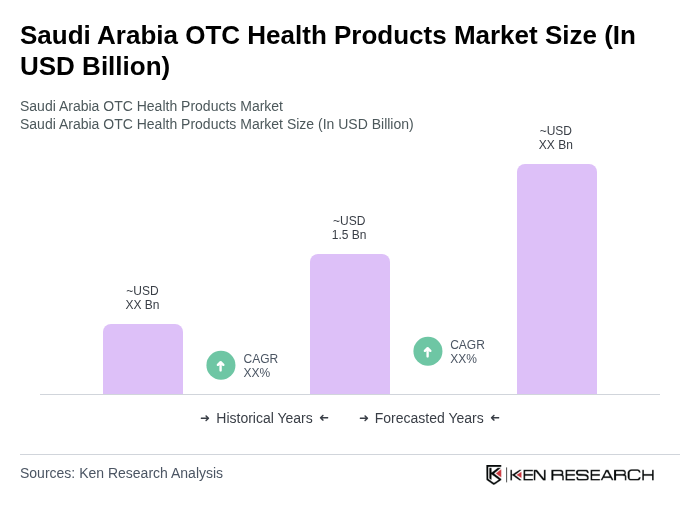
- The Saudi Arabia OTC Health Products Market is valued at approximately USD 1.5 billion, based on a five-year analysis of over-the-counter drugs and consumer health market estimates from multiple industry sources. Market growth is driven by rising health consciousness and preventive healthcare, a sustained shift to self-medication for minor ailments, expanding e-pharmacy and digital health platform usage, and increasing availability of OTC products across community pharmacies, supermarket chains, and online channels. The demand for natural and herbal remedies, nutraceuticals, and vitamins, along with the convenience and cost-effectiveness of OTC treatments, further bolsters market expansion as consumers increasingly integrate supplements and wellness products into daily routines.
- Key players in this market include international pharmaceutical majors like Sanofi, GlaxoSmithKline (now Haleon for consumer health), Johnson & Johnson, Pfizer, Bayer, and Reckitt Benckiser, which contribute through extensive OTC and consumer health portfolios, strong brand recognition, and nationwide distribution networks. The market is characterized by a dynamic mix of regional and international players, including large local pharmacy chains and domestic manufacturers, with a growing preference for self?care, immunity-boosting supplements, and lifestyle-focused wellness products among consumers.
- A pivotal regulatory development is the Saudi Food and Drug Authority’s Drug Track & Trace System, implemented under the SFDA “RSD (Raqeeb) Drug Track and Trace System Requirements”, issued by the Saudi Food and Drug Authority in 2018, which mandates GS1-compliant 2D barcode labeling including GTIN, batch/lot number, and expiry date on pharmaceutical products and requires all registered human drugs, including eligible OTC medicines, to be serialized and tracked through the national system across the supply chain. This framework enhances product safety, reduces counterfeiting, and improves traceability and recall management from manufacturers to pharmacies and hospitals.
Saudi Arabia OTC Health Products Market Segmentation
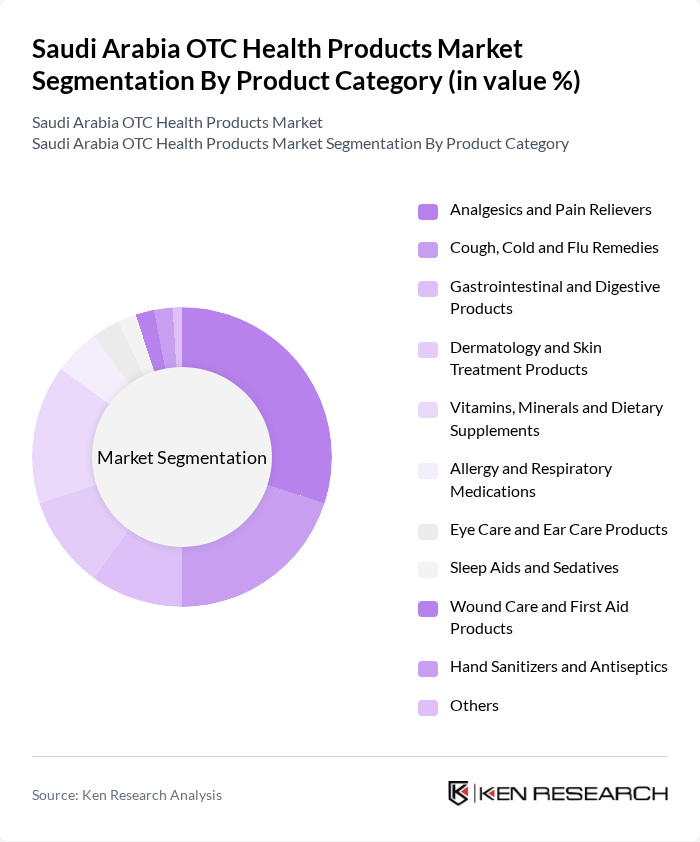
By Product Category:The OTC health products market in Saudi Arabia is diverse, encompassing various product categories that cater to different health needs. Among these, vitamins, minerals, and dietary supplements form one of the largest and fastest-growing segments, supported by strong consumer interest in preventive healthcare, immunity support, and general wellness. Analgesics and pain relievers also account for a substantial share of the market due to their widespread use in managing headaches, musculoskeletal pain, and minor injuries, with self-medication practices helping to drive demand. Other notable categories include cough, cold, and flu remedies, which see seasonal spikes in demand; gastrointestinal and digestive products used for acidity, indigestion, and constipation; and dermatology and skin treatment products for conditions such as acne, allergies, and minor infections. Increasing focus on lifestyle-related concerns has also supported growth in categories such as allergy and respiratory medications, sleep aids, and antiseptics and hand sanitizers.
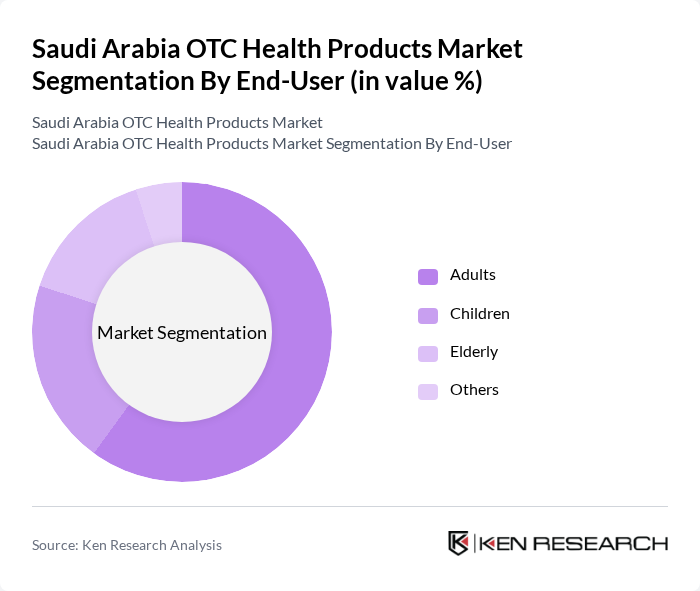
By End-User:The end-user segmentation of the OTC health products market reveals a significant focus on adults, who represent the largest consumer group due to their higher health needs and purchasing power. Children and the elderly also constitute important segments, with products tailored to their specific health requirements. The increasing awareness of preventive healthcare among adults drives the demand for OTC products, while parents seek effective solutions for their children's health issues.
Saudi Arabia OTC Health Products Market Competitive Landscape
The Saudi Arabia OTC Health Products Market is characterized by a dynamic mix of regional and international players. Leading participants such as Nahdi Medical Company, Al-Dawaa Medical Services Co. (Al-Dawaa Pharmacies), United Pharmacies, Saudi Pharmaceutical Industries and Medical Appliances Corporation (SPIMACO), Tabuk Pharmaceuticals Manufacturing Company, Jamjoom Pharma, Gulf Pharmaceutical Industries (Julphar), Pfizer Saudi Limited, GlaxoSmithKline Consumer Healthcare Saudi Arabia, Sanofi Saudi Arabia, Bayer Saudi Arabia, Novartis Saudi Arabia, Merck Sharp & Dohme (MSD) Saudi Arabia, Johnson & Johnson Consumer Health Saudi Arabia, Abbott Laboratories Saudi Arabia contribute to innovation, geographic expansion, and service delivery in this space.
Saudi Arabia OTC Health Products Market Industry Analysis
Growth Drivers
- Population (Young, Working?Age Demographic):The total population of Saudi Arabia reached 35,300,280 in future, with approximately 26,400,000 individuals aged 15–64. This demographic represents a significant consumer base that is increasingly aware of health and wellness, driving demand for OTC health products. The youthful population is more inclined to self-medicate and seek preventive health solutions, contributing to market growth. Source: Saudi Gazette via GASTAT.
- Digital Economy & ICT Infrastructure Expansion:In future, the value of Saudi Arabia's digital economy was SAR 495 billion (approximately USD 132 billion), while the ICT sector market size reached SAR 180 billion (around USD 48 billion). This rapid growth in digital infrastructure facilitates e-commerce channels for OTC products, allowing consumers to access health solutions conveniently online. Enhanced digital capabilities are crucial for the OTC market's expansion. Source: Sharikat Mubasher & Arab News.
- Internet Penetration and Mobile Connectivity:Internet penetration in Saudi Arabia reached 99% in future, with median mobile internet speeds of about 128 Mbps. Additionally, mobile subscriptions exceeded 212% of the population. This high level of connectivity supports online health-product purchases and telehealth services, making it easier for consumers to access OTC health products and information. Source: Wikipedia & digital authorities.
Market Challenges
- Regional Income Disparities:The average monthly disposable income in Riyadh was SAR 26,000 (approximately USD 6,933), which is more than double that of smaller provinces like Najran. These income disparities limit the affordability of OTC products in less affluent regions, creating a challenge for market penetration and growth in those areas. Source: Financial Times.
- Fiscal Constraints from Oil Sector Pressures:In future, Aramco's profit fell to USD 106.25 billion, a 12% decrease, with revenues dropping to USD 436 billion. This decline in oil revenues may lead to reduced public health spending and subsidies, which are essential for supporting the OTC market's growth. Fiscal constraints could hinder the development of healthcare initiatives that promote OTC product usage. Source: Associated Press.
Saudi Arabia OTC Health Products Market Future Outlook
The future of the Saudi Arabia OTC health products market appears promising, driven by digital transformation and a tech-savvy population. The integration of AI and e-commerce is expected to enhance distribution channels, making OTC products more accessible. Additionally, the focus on preventive healthcare will likely encourage consumers to adopt OTC solutions proactively. As the government continues to invest in digital infrastructure, the market is poised for significant growth, particularly in online sales and innovative health solutions.
Market Opportunities
- E?Commerce Channel Expansion for OTC Products:The OTC market revenue in Saudi Arabia is projected at USD 952.89 million in future. This growth presents a significant opportunity for businesses to leverage digital platforms for distribution, enhancing consumer access to OTC health products and driving sales through online channels. Source: Statista.
- Targeting Youth?Driven Segments and Preventive Health:With over 70% of Saudi citizens under age 35, there is a substantial opportunity to target younger demographics who are more likely to adopt OTC health products. This segment is expected to embrace preventive health measures, particularly through online purchasing channels, creating a favorable market environment. Source: GASTAT report via news.
Scope of the Report
| Segment | Sub-Segments |
|---|---|
| By Product Category | Analgesics and Pain Relievers Cough, Cold and Flu Remedies Gastrointestinal and Digestive Products Dermatology and Skin Treatment Products Vitamins, Minerals and Dietary Supplements Allergy and Respiratory Medications Eye Care and Ear Care Products Sleep Aids and Sedatives Wound Care and First Aid Products Hand Sanitizers and Antiseptics Others |
| By End-User | Adults Children Elderly Others |
| By Distribution Channel | Community Pharmacies and Drug Stores Supermarkets/Hypermarkets Online Retail and E-Pharmacies Convenience Stores Health and Specialty Stores Others |
| By Region | Central Region (including Riyadh) Western Region (including Jeddah, Makkah, Madinah) Eastern Region (including Dammam, Khobar, Dhahran) Northern Region Southern Region |
| By Dosage Form | Tablets and Capsules Liquids and Syrups Powders and Granules Creams, Ointments and Gels Sprays and Inhalers Others |
| By Consumer Demographics | Gender Age Group Income Level Others |
| By Health Condition | Pain and Inflammation Respiratory and Allergy Gastrointestinal Disorders Dermatological Conditions Nutritional and Preventive Health Sleep and Stress-related Conditions Others |
Key Target Audience
Investors and Venture Capitalist Firms
Government and Regulatory Bodies (e.g., Saudi Food and Drug Authority, Ministry of Health)
Manufacturers and Producers
Distributors and Retailers
Pharmaceutical Wholesalers
Healthcare Providers and Pharmacies
Industry Associations (e.g., Saudi Pharmaceutical Society)
Financial Institutions
Players Mentioned in the Report:
Nahdi Medical Company
Al-Dawaa Medical Services Co. (Al-Dawaa Pharmacies)
United Pharmacies
Saudi Pharmaceutical Industries and Medical Appliances Corporation (SPIMACO)
Tabuk Pharmaceuticals Manufacturing Company
Jamjoom Pharma
Gulf Pharmaceutical Industries (Julphar)
Pfizer Saudi Limited
GlaxoSmithKline Consumer Healthcare Saudi Arabia
Sanofi Saudi Arabia
Bayer Saudi Arabia
Novartis Saudi Arabia
Merck Sharp & Dohme (MSD) Saudi Arabia
Johnson & Johnson Consumer Health Saudi Arabia
Abbott Laboratories Saudi Arabia
Table of Contents
Market Assessment Phase
1. Executive Summary and Approach
2. Saudi Arabia OTC Health Products Market Overview
2.1 Key Insights and Strategic Recommendations
2.2 Saudi Arabia OTC Health Products Market Overview
2.3 Definition and Scope
2.4 Evolution of Market Ecosystem
2.5 Timeline of Key Regulatory Milestones
2.6 Value Chain & Stakeholder Mapping
2.7 Business Cycle Analysis
2.8 Policy & Incentive Landscape
3. Saudi Arabia OTC Health Products Market Analysis
3.1 Growth Drivers
3.1.1 Increasing Health Awareness
3.1.2 Rise in Self-medication Trends
3.1.3 Expansion of Retail Pharmacies
3.1.4 Government Initiatives for Healthcare Improvement
3.2 Market Challenges
3.2.1 Stringent Regulatory Framework
3.2.2 Competition from Prescription Drugs
3.2.3 Consumer Misinformation
3.2.4 Limited Distribution Channels
3.3 Market Opportunities
3.3.1 Growth in E-commerce Platforms
3.3.2 Development of Innovative Products
3.3.3 Increasing Demand for Natural Remedies
3.3.4 Expansion into Rural Markets
3.4 Market Trends
3.4.1 Shift Towards Preventive Healthcare
3.4.2 Digital Health Integration
3.4.3 Personalized OTC Products
3.4.4 Sustainability in Product Development
3.5 Government Regulation
3.5.1 New Drug Approval Processes
3.5.2 Advertising Regulations for OTC Products
3.5.3 Pricing Controls on Essential Medicines
3.5.4 Quality Assurance Standards
4. SWOT Analysis
5. Stakeholder Analysis
6. Porter's Five Forces Analysis
7. Saudi Arabia OTC Health Products Market Market Size, 2019-2024
7.1 By Value
7.2 By Volume
7.3 By Average Selling Price
8. Saudi Arabia OTC Health Products Market Segmentation
8.1 By Product Category
8.1.1 Analgesics and Pain Relievers
8.1.2 Cough, Cold and Flu Remedies
8.1.3 Gastrointestinal and Digestive Products
8.1.4 Dermatology and Skin Treatment Products
8.1.5 Vitamins, Minerals and Dietary Supplements
8.1.6 Allergy and Respiratory Medications
8.1.7 Eye Care and Ear Care Products
8.1.8 Sleep Aids and Sedatives
8.1.9 Wound Care and First Aid Products
8.1.10 Hand Sanitizers and Antiseptics
8.1.11 Others
8.2 By End-User
8.2.1 Adults
8.2.2 Children
8.2.3 Elderly
8.2.4 Others
8.3 By Distribution Channel
8.3.1 Community Pharmacies and Drug Stores
8.3.2 Supermarkets/Hypermarkets
8.3.3 Online Retail and E-Pharmacies
8.3.4 Convenience Stores
8.3.5 Health and Specialty Stores
8.3.6 Others
8.4 By Region
8.4.1 Central Region (including Riyadh)
8.4.2 Western Region (including Jeddah, Makkah, Madinah)
8.4.3 Eastern Region (including Dammam, Khobar, Dhahran)
8.4.4 Northern Region
8.4.5 Southern Region
8.5 By Dosage Form
8.5.1 Tablets and Capsules
8.5.2 Liquids and Syrups
8.5.3 Powders and Granules
8.5.4 Creams, Ointments and Gels
8.5.5 Sprays and Inhalers
8.5.6 Others
8.6 By Consumer Demographics
8.6.1 Gender
8.6.2 Age Group
8.6.3 Income Level
8.6.4 Others
8.7 By Health Condition
8.7.1 Pain and Inflammation
8.7.2 Respiratory and Allergy
8.7.3 Gastrointestinal Disorders
8.7.4 Dermatological Conditions
8.7.5 Nutritional and Preventive Health
8.7.6 Sleep and Stress-related Conditions
8.7.7 Others
9. Saudi Arabia OTC Health Products Market Competitive Analysis
9.1 Market Share of Key Players
9.2 Cross Comparison of Key Players
9.2.1 Company Name
9.2.2 Group Size (Large, Medium, or Small as per industry convention)
9.2.3 Saudi Arabia OTC Revenue (USD Million)
9.2.4 3-year Revenue CAGR (%)
9.2.5 OTC Market Share (%)
9.2.6 Number of OTC SKUs in Saudi Portfolio
9.2.7 Average Price per Unit (SAR)
9.2.8 Gross Margin (%) on OTC Portfolio
9.2.9 Distribution Reach (Number of Pharmacies/Outlets Covered)
9.2.10 Share of Online/E-pharmacy Sales (%)
9.2.11 Marketing & Promotion Spend on OTC (as % of Sales)
9.2.12 Repeat Purchase / Customer Retention Rate (%)
9.2.13 New Product Launches in Last 3 Years (Count)
9.2.14 SFDA Compliance/Quality Incidents (Count per Year)
9.3 SWOT Analysis of Top Players
9.4 Pricing Analysis
9.5 Detailed Profile of Major Companies
9.5.1 Nahdi Medical Company
9.5.2 Al-Dawaa Medical Services Co. (Al-Dawaa Pharmacies)
9.5.3 United Pharmacies
9.5.4 Saudi Pharmaceutical Industries and Medical Appliances Corporation (SPIMACO)
9.5.5 Tabuk Pharmaceuticals Manufacturing Company
9.5.6 Jamjoom Pharma
9.5.7 Gulf Pharmaceutical Industries (Julphar)
9.5.8 Pfizer Saudi Limited
9.5.9 GlaxoSmithKline Consumer Healthcare Saudi Arabia
9.5.10 Sanofi Saudi Arabia
9.5.11 Bayer Saudi Arabia
9.5.12 Novartis Saudi Arabia
9.5.13 Merck Sharp & Dohme (MSD) Saudi Arabia
9.5.14 Johnson & Johnson Consumer Health Saudi Arabia
9.5.15 Abbott Laboratories Saudi Arabia
10. Saudi Arabia OTC Health Products Market End-User Analysis
10.1 Procurement Behavior of Key Ministries
10.1.1 Ministry of Health
10.1.2 Ministry of Commerce
10.1.3 Ministry of Education
10.1.4 Others
10.2 Corporate Spend on Infrastructure & Energy
10.2.1 Healthcare Facilities
10.2.2 Pharmaceutical Manufacturing
10.2.3 Research and Development
10.2.4 Others
10.3 Pain Point Analysis by End-User Category
10.3.1 Patients
10.3.2 Healthcare Providers
10.3.3 Retailers
10.3.4 Others
10.4 User Readiness for Adoption
10.4.1 Awareness Levels
10.4.2 Accessibility of Products
10.4.3 Affordability
10.4.4 Others
10.5 Post-Deployment ROI and Use Case Expansion
10.5.1 Effectiveness of Products
10.5.2 Customer Feedback
10.5.3 Market Expansion Opportunities
10.5.4 Others
11. Saudi Arabia OTC Health Products Market Future Size, 2025-2030
11.1 By Value
11.2 By Volume
11.3 By Average Selling Price
Go-To-Market Strategy Phase
1. Whitespace Analysis + Business Model Canvas
1.1 Market Gaps Identification
1.2 Business Model Development
2. Marketing and Positioning Recommendations
2.1 Branding Strategies
2.2 Product USPs
3. Distribution Plan
3.1 Urban Retail Strategies
3.2 Rural NGO Tie-ups
4. Channel & Pricing Gaps
4.1 Underserved Routes
4.2 Pricing Bands
5. Unmet Demand & Latent Needs
5.1 Category Gaps
5.2 Consumer Segments
6. Customer Relationship
6.1 Loyalty Programs
6.2 After-sales Service
7. Value Proposition
7.1 Sustainability
7.2 Integrated Supply Chains
8. Key Activities
8.1 Regulatory Compliance
8.2 Branding
8.3 Distribution Setup
9. Entry Strategy Evaluation
9.1 Domestic Market Entry Strategy
9.1.1 Product Mix
9.1.2 Pricing Band
9.1.3 Packaging
9.2 Export Entry Strategy
9.2.1 Target Countries
9.2.2 Compliance Roadmap
10. Entry Mode Assessment
10.1 JV
10.2 Greenfield
10.3 M&A
10.4 Distributor Model
11. Capital and Timeline Estimation
11.1 Capital Requirements
11.2 Timelines
12. Control vs Risk Trade-Off
12.1 Ownership vs Partnerships
13. Profitability Outlook
13.1 Breakeven Analysis
13.2 Long-term Sustainability
14. Potential Partner List
14.1 Distributors
14.2 JVs
14.3 Acquisition Targets
15. Execution Roadmap
15.1 Phased Plan for Market Entry
15.1.1 Market Setup
15.1.2 Market Entry
15.1.3 Growth Acceleration
15.1.4 Scale & Stabilize
15.2 Key Activities and Milestones
15.2.1 Milestone Planning
15.2.2 Activity Tracking
Research Methodology
Phase 1: Approach1
Desk Research
- Analysis of market reports from health authorities in Saudi Arabia
- Review of industry publications and white papers on OTC health products
- Examination of demographic and health statistics from the Saudi Ministry of Health
Primary Research
- Interviews with key opinion leaders in the pharmaceutical and healthcare sectors
- Surveys conducted with pharmacists and retail managers in pharmacies
- Focus group discussions with consumers regarding OTC product preferences
Validation & Triangulation
- Cross-validation of findings through multiple data sources including sales data and consumer feedback
- Triangulation of insights from expert interviews and market reports
- Sanity checks through consultations with industry experts and stakeholders
Phase 2: Market Size Estimation1
Top-down Assessment
- Estimation of total market size based on national healthcare expenditure data
- Segmentation of the market by product categories such as pain relief, cold and flu medications, and dietary supplements
- Incorporation of growth rates from historical data and projected healthcare trends
Bottom-up Modeling
- Collection of sales data from major pharmacy chains and distributors
- Estimation of average selling prices for various OTC health products
- Volume estimates based on consumer purchasing behavior and frequency of use
Forecasting & Scenario Analysis
- Development of forecasting models using historical sales data and market trends
- Scenario analysis based on potential regulatory changes and consumer health trends
- Projections for market growth under different economic conditions through 2030
Phase 3: CATI Sample Composition1
| Scope Item/Segment | Sample Size | Target Respondent Profiles |
|---|---|---|
| Pharmacy Retail Insights | 150 | Pharmacy Owners, Retail Pharmacists |
| Consumer Preferences for OTC Products | 150 | General Consumers, Health-Conscious Individuals |
| Healthcare Professional Perspectives | 100 | Doctors, Nurses, Health Advisors |
| Market Trends in Dietary Supplements | 80 | Nutritionists, Dietitians, Health Coaches |
| Regulatory Impact on OTC Products | 60 | Regulatory Affairs Specialists, Compliance Officers |
Frequently Asked Questions
What is the current value of the Saudi Arabia OTC Health Products Market?
The Saudi Arabia OTC Health Products Market is valued at approximately USD 1.5 billion, reflecting a growing trend towards self-medication and preventive healthcare among consumers, alongside the expansion of e-pharmacy and digital health platforms.
What factors are driving the growth of the OTC health products market in Saudi Arabia?
Who are the major players in the Saudi Arabia OTC Health Products Market?
What regulatory developments impact the OTC health products market in Saudi Arabia?
Other Regional/Country Reports
Indonesia OTC Health Products Market
Malaysia OTC Health Products Market
KSA OTC Health Products Market
APAC OTC Health Products Market
SEA OTC Health Products Market
Vietnam OTC Health Products Market
Other Adjacent Reports
Malaysia Herbal Remedies Market
KSA Vitamins and Supplements Market
Egypt Consumer Health Market
Singapore Self-Care Products Market
Global Africa Telehealth Market Report Size Share Growth Drivers Trends Opportunities & Forecast 2025–2030Oman Healthcare Distribution Market
Why Buy From Us?

What makes us stand out is that our consultants follow Robust, Refine and Result (RRR) methodology. Robust for clear definitions, approaches and sanity checking, Refine for differentiating respondents' facts and opinions, and Result for presenting data with story.

We have set a benchmark in the industry by offering our clients with syndicated and customized market research reports featuring coverage of entire market as well as meticulous research and analyst insights.

While we don't replace traditional research, we flip the method upside down. Our dual approach of Top Bottom & Bottom Top ensures quality deliverable by not just verifying company fundamentals but also looking at the sector and macroeconomic factors.

With one step in the future, our research team constantly tries to show you the bigger picture. We help with some of the tough questions you may encounter along the way: How is the industry positioned? Best marketing channel? KPI's of competitors? By aligning every element, we help maximize success.

Our report gives you instant access to the answers and sources that other companies might choose to hide. We elaborate each steps of research methodology we have used and showcase you the sample size to earn your trust.

If you need any support, we are here! We pride ourselves on universe strength, data quality, and quick, friendly, and professional service.