About the Report
Base Year 2024Singapore Luxury Fashion E-Commerce Market Overview
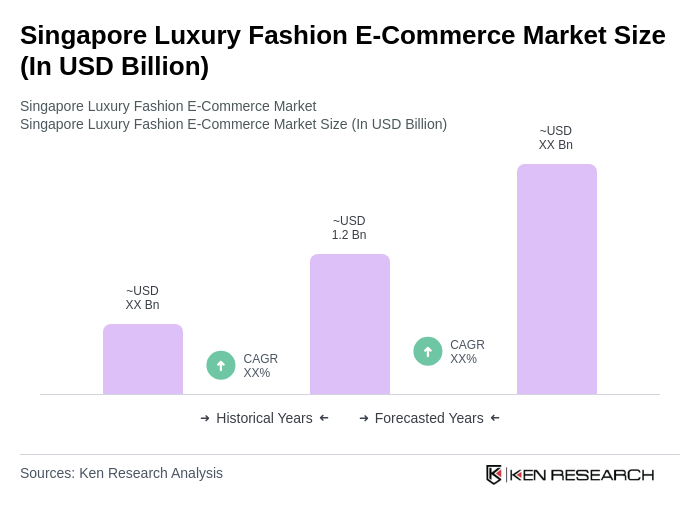
- The Singapore Luxury Fashion E-Commerce Market is valued at USD 1.2 billion, based on a five-year historical analysis. This value is supported by recent industry data, with the luxury fashion segment in Singapore reaching about USD 1.22 billion, reflecting robust demand for premium apparel, footwear, and accessories sold online. Growth is primarily driven by rising disposable incomes, increasing numbers of high-net-worth individuals, and a strong shift toward digital shopping channels among millennials and Gen Z. The pandemic accelerated online luxury sales as consumers prioritized convenience, product variety, and digital-first experiences. Social media influence, celebrity endorsements, and the adoption of virtual try-on technologies are further amplifying market growth .
- Singapore, as a global financial hub, together with cities like Hong Kong and Tokyo, continues to dominate the luxury fashion e-commerce market due to its affluent consumer base and high internet penetration. The city-state is home to over 240,000 millionaires and maintains a strong local and tourist-driven demand for luxury goods. The presence of flagship luxury brands, a sophisticated retail infrastructure, and a reputation as a launchpad for global luxury retail reinforce Singapore’s position as a key player in the regional luxury fashion e-commerce landscape .
- In 2023, the Singapore government strengthened consumer protection in e-commerce through theConsumer Protection (Fair Trading) (Amendment) Act 2023issued by the Ministry of Trade and Industry. This regulation mandates that all online retailers provide clear information regarding product authenticity, return policies, and dispute resolution procedures. The initiative aims to enhance consumer trust and ensure a safer online shopping environment, thereby supporting continued growth in the luxury fashion e-commerce sector .
Singapore Luxury Fashion E-Commerce Market Segmentation
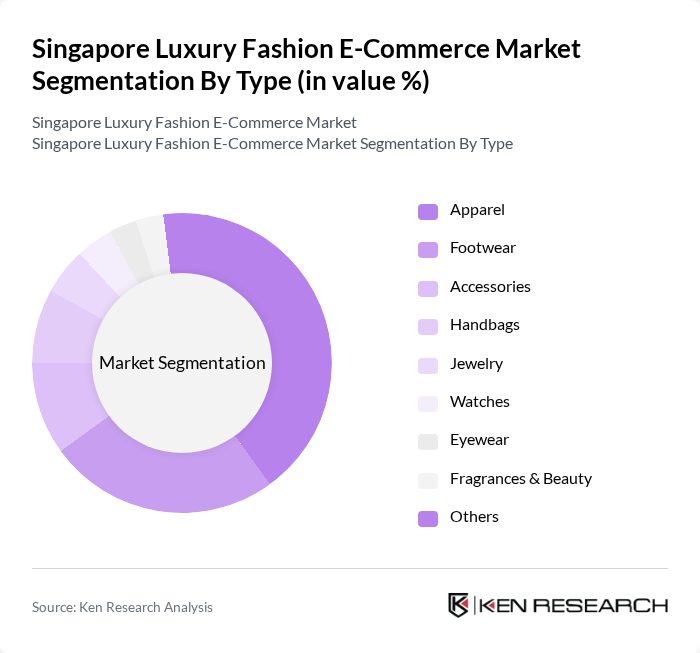
By Type:The luxury fashion e-commerce market in Singapore is segmented into apparel, footwear, accessories, handbags, jewelry, watches, eyewear, fragrances & beauty, and others.Apparelremains the leading sub-segment, driven by demand for high-end clothing and the influence of evolving fashion trends, especially among younger consumers.Footwearandhandbagsalso command significant market presence, appealing to consumers seeking both style and functionality. The market is further characterized by the rise of gender-fluid fashion, sustainable luxury, and niche categories such as techwear and modest wear, which are increasingly popular on digital platforms .
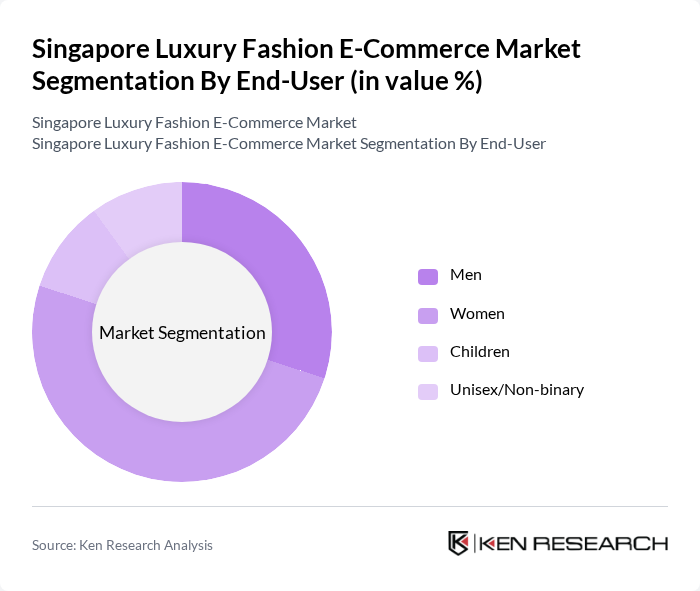
By End-User:The market is segmented by end-user demographics: men, women, children, and unisex/non-binary.Womenrepresent the largest segment, reflecting higher spending on luxury fashion and a strong interest in evolving trends. Themen’ssegment is also substantial, with increasing brand awareness and acceptance of luxury fashion among male consumers. Thechildren’ssegment is expanding as parents invest in premium fashion for their children, whileunisex/non-binarycategories are gaining traction, driven by Gen Z’s preference for gender-fluid and inclusive fashion .
Singapore Luxury Fashion E-Commerce Market Competitive Landscape
The Singapore Luxury Fashion E-Commerce Market is characterized by a dynamic mix of regional and international players. Leading participants such as Zalora, Farfetch, Net-a-Porter, MatchesFashion, SSENSE, Mytheresa, Luisaviaroma, Shopbop, The Outnet, Reebonz, StyleTribute, TheRealReal, Vestiaire Collective, Love, Bonito, OnTheList contribute to innovation, geographic expansion, and service delivery in this space.
Singapore Luxury Fashion E-Commerce Market Industry Analysis
Growth Drivers
- Increasing Disposable Income:Singapore's GDP per capita is projected to reach approximately $88,000, reflecting a steady increase in disposable income. This economic growth enables consumers to spend more on luxury fashion items. The affluent population, with over 240,000 high-net-worth individuals, drives demand for premium products. As disposable income rises, consumers are more inclined to invest in luxury brands, enhancing the e-commerce landscape for high-end fashion retailers.
- Rise in Online Shopping Trends:The e-commerce penetration rate in Singapore is expected to reach 74% of the population, driven by the convenience of online shopping. With over 3.3 million online shoppers, the luxury fashion segment is witnessing significant growth. The COVID-19 pandemic accelerated this trend, leading to a double-digit increase in online luxury sales. This shift towards digital platforms is reshaping consumer behavior, making luxury fashion more accessible than ever.
- Demand for Sustainable Luxury Products:The global luxury market is increasingly influenced by sustainability, with a majority of consumers willing to pay a premium for eco-friendly products. In Singapore, the demand for sustainable luxury fashion is growing, with a significant increase in sales of sustainable brands reported. This trend is supported by government initiatives promoting sustainable practices, encouraging luxury brands to adopt eco-friendly materials and production methods, thus appealing to environmentally conscious consumers.
Market Challenges
- Intense Competition from Local and Global Players:The Singapore luxury fashion e-commerce market is characterized by fierce competition, with over 100 local and international brands vying for market share. Major global players like Louis Vuitton and Gucci compete alongside local boutiques, creating a saturated market. This intense rivalry pressures brands to innovate continuously and enhance customer experiences, making it challenging for new entrants to establish a foothold in this lucrative sector.
- High Customer Expectations for Service and Quality:Singaporean consumers have elevated expectations regarding service quality and product authenticity. With a customer satisfaction rate in luxury retail being high, brands must ensure exceptional service to retain clientele. Failure to meet these expectations can lead to negative reviews and loss of market share. As luxury consumers become more discerning, brands must invest in training staff and improving service delivery to maintain competitive advantage.
Singapore Luxury Fashion E-Commerce Market Future Outlook
The Singapore luxury fashion e-commerce market is poised for significant transformation, driven by technological advancements and changing consumer preferences. As digital marketing strategies evolve, brands will increasingly leverage social media and influencer partnerships to engage consumers. Additionally, the integration of augmented reality (AR) and virtual reality (VR) technologies will enhance online shopping experiences, allowing customers to visualize products better. This dynamic environment will foster innovation and adaptability among luxury brands, ensuring sustained growth in the coming years.
Market Opportunities
- Growth of Mobile Commerce:With mobile commerce projected to account for over 55% of total e-commerce sales in Singapore, luxury brands have a significant opportunity to optimize their mobile platforms. Enhanced mobile shopping experiences can attract tech-savvy consumers, driving sales and engagement. Investing in mobile-friendly websites and apps will be crucial for brands aiming to capture this growing segment of the market.
- Collaborations with Local Influencers:Collaborating with local influencers can significantly enhance brand visibility and credibility in Singapore's luxury market. With over 5.08 million active social media users, brands can leverage these partnerships to reach targeted audiences effectively. Such collaborations can drive traffic to e-commerce platforms, increase brand awareness, and ultimately boost sales in a competitive landscape.
Scope of the Report
| Segment | Sub-Segments |
|---|---|
| By Type | Apparel Footwear Accessories Handbags Jewelry Watches Eyewear Fragrances & Beauty Others |
| By End-User | Men Women Children Unisex/Non-binary |
| By Sales Channel | Direct-to-Consumer (Brand E-Boutiques) Online Marketplaces (Multi-brand Platforms) Social Commerce (Live-streaming, Social Platforms) Resale & Rental Platforms |
| By Price Range | Premium (SGD 500–2,000) Super Premium (SGD 2,000–5,000) Luxury (Above SGD 5,000) |
| By Brand Origin | Local Brands International Brands |
| By Consumer Demographics | Age Group (Gen Z, Millennials, Gen X, Boomers) Income Level Lifestyle Preferences (Eco-conscious, Trend-driven, Classic, etc.) |
| By Shopping Behavior | Impulse Buyers Planned Purchases Seasonal Shoppers Gift Purchasers |
Key Target Audience
Investors and Venture Capitalist Firms
Government and Regulatory Bodies (e.g., Enterprise Singapore, Infocomm Media Development Authority)
Luxury Fashion Brands and Designers
E-Commerce Platforms and Marketplaces
Logistics and Supply Chain Companies
Payment Solution Providers
Marketing and Advertising Agencies
Luxury Goods Trade Associations
Players Mentioned in the Report:
Zalora
Farfetch
Net-a-Porter
MatchesFashion
SSENSE
Mytheresa
Luisaviaroma
Shopbop
The Outnet
Reebonz
StyleTribute
TheRealReal
Vestiaire Collective
Love, Bonito
OnTheList
Table of Contents
Market Assessment Phase
1. Executive Summary and Approach
2. Singapore Luxury Fashion E-Commerce Market Overview
2.1 Key Insights and Strategic Recommendations
2.2 Singapore Luxury Fashion E-Commerce Market Overview
2.3 Definition and Scope
2.4 Evolution of Market Ecosystem
2.5 Timeline of Key Regulatory Milestones
2.6 Value Chain & Stakeholder Mapping
2.7 Business Cycle Analysis
2.8 Policy & Incentive Landscape
3. Singapore Luxury Fashion E-Commerce Market Analysis
3.1 Growth Drivers
3.1.1 Increasing disposable income
3.1.2 Rise in online shopping trends
3.1.3 Demand for sustainable luxury products
3.1.4 Expansion of international luxury brands
3.2 Market Challenges
3.2.1 Intense competition from local and global players
3.2.2 High customer expectations for service and quality
3.2.3 Regulatory compliance and import restrictions
3.2.4 Fluctuating currency exchange rates
3.3 Market Opportunities
3.3.1 Growth of mobile commerce
3.3.2 Collaborations with local influencers
3.3.3 Expansion into Southeast Asian markets
3.3.4 Development of personalized shopping experiences
3.4 Market Trends
3.4.1 Increasing focus on digital marketing
3.4.2 Adoption of AR/VR in shopping experiences
3.4.3 Growth of second-hand luxury fashion
3.4.4 Emphasis on ethical sourcing and production
3.5 Government Regulation
3.5.1 E-commerce regulations and consumer protection laws
3.5.2 Taxation policies on luxury goods
3.5.3 Import/export regulations for luxury items
3.5.4 Data protection and privacy laws
4. SWOT Analysis
5. Stakeholder Analysis
6. Porter's Five Forces Analysis
7. Singapore Luxury Fashion E-Commerce Market Market Size, 2019-2024
7.1 By Value
7.2 By Volume
7.3 By Average Selling Price
8. Singapore Luxury Fashion E-Commerce Market Segmentation
8.1 By Type
8.1.1 Apparel
8.1.2 Footwear
8.1.3 Accessories
8.1.4 Handbags
8.1.5 Jewelry
8.1.6 Watches
8.1.7 Eyewear
8.1.8 Fragrances & Beauty
8.1.9 Others
8.2 By End-User
8.2.1 Men
8.2.2 Women
8.2.3 Children
8.2.4 Unisex/Non-binary
8.3 By Sales Channel
8.3.1 Direct-to-Consumer (Brand E-Boutiques)
8.3.2 Online Marketplaces (Multi-brand Platforms)
8.3.3 Social Commerce (Live-streaming, Social Platforms)
8.3.4 Resale & Rental Platforms
8.4 By Price Range
8.4.1 Premium (SGD 500–2,000)
8.4.2 Super Premium (SGD 2,000–5,000)
8.4.3 Luxury (Above SGD 5,000)
8.5 By Brand Origin
8.5.1 Local Brands
8.5.2 International Brands
8.6 By Consumer Demographics
8.6.1 Age Group (Gen Z, Millennials, Gen X, Boomers)
8.6.2 Income Level
8.6.3 Lifestyle Preferences (Eco-conscious, Trend-driven, Classic, etc.)
8.7 By Shopping Behavior
8.7.1 Impulse Buyers
8.7.2 Planned Purchases
8.7.3 Seasonal Shoppers
8.7.4 Gift Purchasers
9. Singapore Luxury Fashion E-Commerce Market Competitive Analysis
9.1 Market Share of Key Players
9.2 Cross Comparison of Key Players
9.2.1 Company Name
9.2.2 Group Size (Large, Medium, or Small as per industry convention)
9.2.3 Revenue Growth Rate (YoY %)
9.2.4 Gross Merchandise Value (GMV)
9.2.5 Customer Acquisition Cost (CAC)
9.2.6 Average Order Value (AOV)
9.2.7 Customer Retention Rate (%)
9.2.8 Active User Base (Monthly Active Users - MAU)
9.2.9 Conversion Rate (%)
9.2.10 Market Penetration Rate (%)
9.2.11 Return on Advertising Spend (ROAS)
9.2.12 Net Promoter Score (NPS)
9.2.13 Inventory Turnover Ratio
9.2.14 Average Delivery Time
9.2.15 Share of Mobile Transactions (%)
9.3 SWOT Analysis of Top Players
9.4 Pricing Analysis
9.5 Detailed Profile of Major Companies
9.5.1 Zalora
9.5.2 Farfetch
9.5.3 Net-a-Porter
9.5.4 MatchesFashion
9.5.5 SSENSE
9.5.6 Mytheresa
9.5.7 Luisaviaroma
9.5.8 Shopbop
9.5.9 The Outnet
9.5.10 Reebonz
9.5.11 StyleTribute
9.5.12 TheRealReal
9.5.13 Vestiaire Collective
9.5.14 Love, Bonito
9.5.15 OnTheList
10. Singapore Luxury Fashion E-Commerce Market End-User Analysis
10.1 Procurement Behavior of Key Ministries
10.1.1 Government procurement policies
10.1.2 Budget allocation for luxury goods
10.1.3 Supplier selection criteria
10.2 Corporate Spend on Infrastructure & Energy
10.2.1 Investment in e-commerce platforms
10.2.2 Spending on logistics and distribution
10.2.3 Budget for marketing and promotions
10.3 Pain Point Analysis by End-User Category
10.3.1 Quality assurance issues
10.3.2 Delivery time concerns
10.3.3 Customer service challenges
10.4 User Readiness for Adoption
10.4.1 Digital literacy levels
10.4.2 Trust in online transactions
10.4.3 Familiarity with luxury brands
10.5 Post-Deployment ROI and Use Case Expansion
10.5.1 Measurement of customer satisfaction
10.5.2 Analysis of repeat purchase rates
10.5.3 Expansion into new product categories
11. Singapore Luxury Fashion E-Commerce Market Future Size, 2025-2030
11.1 By Value
11.2 By Volume
11.3 By Average Selling Price
Go-To-Market Strategy Phase
1. Whitespace Analysis + Business Model Canvas
1.1 Market gaps identification
1.2 Value proposition development
1.3 Revenue model exploration
1.4 Customer segment analysis
1.5 Key resources and activities
1.6 Cost structure assessment
1.7 Key partnerships
2. Marketing and Positioning Recommendations
2.1 Branding strategies
2.2 Product USPs
2.3 Target audience segmentation
2.4 Digital marketing tactics
2.5 Influencer collaboration strategies
3. Distribution Plan
3.1 Urban retail strategies
3.2 Rural NGO tie-ups
3.3 E-commerce platform partnerships
3.4 Logistics and fulfillment strategies
4. Channel & Pricing Gaps
4.1 Underserved routes
4.2 Pricing bands analysis
4.3 Competitor pricing comparison
4.4 Consumer willingness to pay
5. Unmet Demand & Latent Needs
5.1 Category gaps identification
5.2 Consumer segments analysis
5.3 Emerging trends and preferences
6. Customer Relationship
6.1 Loyalty programs
6.2 After-sales service enhancements
6.3 Customer feedback mechanisms
7. Value Proposition
7.1 Sustainability initiatives
7.2 Integrated supply chains
7.3 Unique selling propositions
8. Key Activities
8.1 Regulatory compliance
8.2 Branding efforts
8.3 Distribution setup
9. Entry Strategy Evaluation
9.1 Domestic Market Entry Strategy
9.1.1 Product mix considerations
9.1.2 Pricing band strategies
9.1.3 Packaging innovations
9.2 Export Entry Strategy
9.2.1 Target countries analysis
9.2.2 Compliance roadmap development
10. Entry Mode Assessment
10.1 Joint Ventures
10.2 Greenfield investments
10.3 Mergers & Acquisitions
10.4 Distributor Model
11. Capital and Timeline Estimation
11.1 Capital requirements
11.2 Timelines for market entry
12. Control vs Risk Trade-Off
12.1 Ownership considerations
12.2 Partnerships evaluation
13. Profitability Outlook
13.1 Breakeven analysis
13.2 Long-term sustainability strategies
14. Potential Partner List
14.1 Distributors
14.2 Joint Ventures
14.3 Acquisition targets
15. Execution Roadmap
15.1 Phased Plan for Market Entry
15.1.1 Market Setup
15.1.2 Market Entry
15.1.3 Growth Acceleration
15.1.4 Scale & Stabilize
15.2 Key Activities and Milestones
15.2.1 Milestone tracking
15.2.2 Activity scheduling
Research Methodology
Phase 1: Approach1
Desk Research
- Analysis of market reports from industry associations and e-commerce platforms
- Review of consumer behavior studies and luxury fashion trends in Singapore
- Examination of government publications on e-commerce regulations and digital economy initiatives
Primary Research
- Interviews with key stakeholders in luxury fashion brands operating in Singapore
- Surveys targeting online shoppers to understand purchasing preferences and behaviors
- Focus groups with fashion influencers and industry experts to gather qualitative insights
Validation & Triangulation
- Cross-validation of findings through multiple data sources, including sales data and consumer feedback
- Triangulation of insights from primary interviews with secondary research findings
- Sanity checks conducted through expert panel reviews and industry roundtables
Phase 2: Market Size Estimation1
Top-down Assessment
- Estimation of total luxury fashion market size based on national retail sales data
- Segmentation of the market by product categories such as apparel, accessories, and footwear
- Incorporation of growth rates from e-commerce penetration statistics in Singapore
Bottom-up Modeling
- Collection of sales data from leading luxury fashion e-commerce platforms
- Estimation of average transaction values and purchase frequencies among consumers
- Analysis of customer demographics to refine market segmentation and targeting
Forecasting & Scenario Analysis
- Development of growth projections based on historical trends and market dynamics
- Scenario modeling considering economic factors, consumer sentiment, and digital adoption rates
- Baseline, optimistic, and pessimistic forecasts through 2028 to account for market volatility
Phase 3: CATI Sample Composition1
| Scope Item/Segment | Sample Size | Target Respondent Profiles |
|---|---|---|
| Luxury Apparel Purchasers | 60 | Fashion Enthusiasts, Online Shoppers |
| Luxury Accessories Buyers | 40 | Accessory Collectors, Trendsetters |
| Footwear Consumers | 50 | Sneakerheads, Fashion Bloggers |
| Luxury Brand Loyalty | 45 | Brand Advocates, Repeat Customers |
| Online Shopping Experience Feedback | 55 | General Consumers, E-commerce Users |
Frequently Asked Questions
What is the current value of the Singapore Luxury Fashion E-Commerce Market?
The Singapore Luxury Fashion E-Commerce Market is valued at approximately USD 1.2 billion, reflecting strong demand for premium apparel, footwear, and accessories sold online, driven by rising disposable incomes and a shift towards digital shopping channels.
What factors are driving growth in the Singapore Luxury Fashion E-Commerce Market?
How has the COVID-19 pandemic affected luxury fashion e-commerce in Singapore?
What are the main segments of the Singapore Luxury Fashion E-Commerce Market?
Other Regional/Country Reports
Indonesia Luxury Fashion E-Commerce Market
Malaysia Luxury Fashion E-Commerce Market
KSA Luxury Fashion E-Commerce Market
APAC Luxury Fashion E-Commerce Market
SEA Luxury Fashion E-Commerce Market
Other Adjacent Reports
Malaysia Luxury Beauty E-Commerce Market
Germany Luxury Accessories E-Commerce Market
Philippines Luxury Jewelry E-Commerce Market
Germany Luxury Watches E-Commerce Market
UAE Sustainable Fashion E-Commerce Market
Vietnam Resale Luxury Goods Market
Thailand Fashion Tech Market
Philippines E-Commerce Logistics MarketBahrain digital payment solutions market size, share, growth drivers, trends, opportunities & forecast 2025–2030Germany Social Media Marketing Market
Why Buy From Us?

What makes us stand out is that our consultants follow Robust, Refine and Result (RRR) methodology. Robust for clear definitions, approaches and sanity checking, Refine for differentiating respondents' facts and opinions, and Result for presenting data with story.

We have set a benchmark in the industry by offering our clients with syndicated and customized market research reports featuring coverage of entire market as well as meticulous research and analyst insights.

While we don't replace traditional research, we flip the method upside down. Our dual approach of Top Bottom & Bottom Top ensures quality deliverable by not just verifying company fundamentals but also looking at the sector and macroeconomic factors.

With one step in the future, our research team constantly tries to show you the bigger picture. We help with some of the tough questions you may encounter along the way: How is the industry positioned? Best marketing channel? KPI's of competitors? By aligning every element, we help maximize success.

Our report gives you instant access to the answers and sources that other companies might choose to hide. We elaborate each steps of research methodology we have used and showcase you the sample size to earn your trust.

If you need any support, we are here! We pride ourselves on universe strength, data quality, and quick, friendly, and professional service.