About the Report
Base Year 2024South Africa Organic Waste Management Market Overview
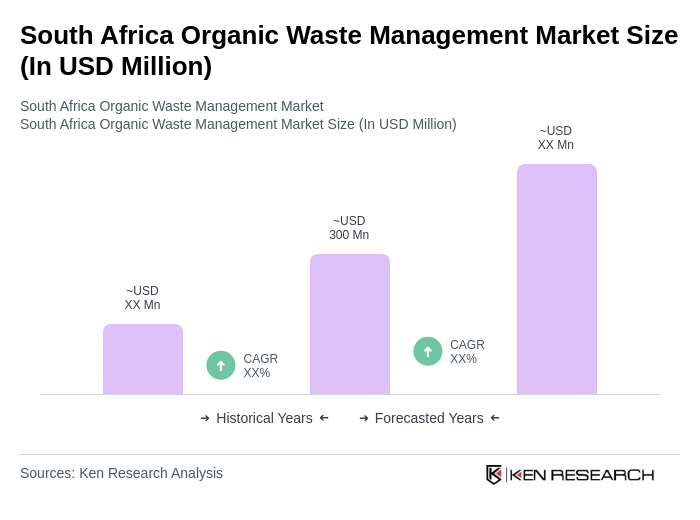
- The South Africa Organic Waste Management Market is valued at USD 300 million, based on a five-year historical analysis. This growth is primarily driven by increasing urbanization, heightened awareness of environmental sustainability, and government initiatives aimed at reducing landfill waste. The market is also supported by the growing demand for organic fertilizers and renewable energy production from organic waste .
- Key cities such as Johannesburg, Cape Town, and Durban dominate the market due to their high population density and significant waste generation. These urban centers have implemented various waste management strategies, including composting and waste-to-energy projects, which contribute to their leadership in the organic waste management sector .
- The South African government has introduced the National Waste Management Strategy, which aims to promote waste minimization, recycling, and the recovery of organic waste. This regulation emphasizes the importance of sustainable waste management practices and encourages local municipalities to adopt innovative solutions for organic waste processing .
South Africa Organic Waste Management Market Segmentation
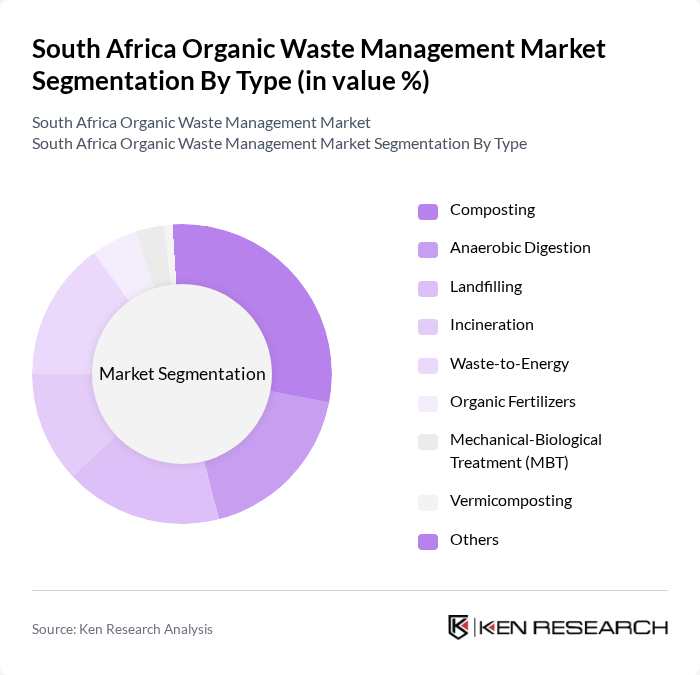
By Type:The organic waste management market can be segmented into various types, including composting, anaerobic digestion, landfilling, incineration, waste-to-energy, organic fertilizers, mechanical-biological treatment (MBT), vermicomposting, and others. Among these, composting and waste-to-energy are the most prominent methods due to their effectiveness in reducing waste volume and generating renewable energy .
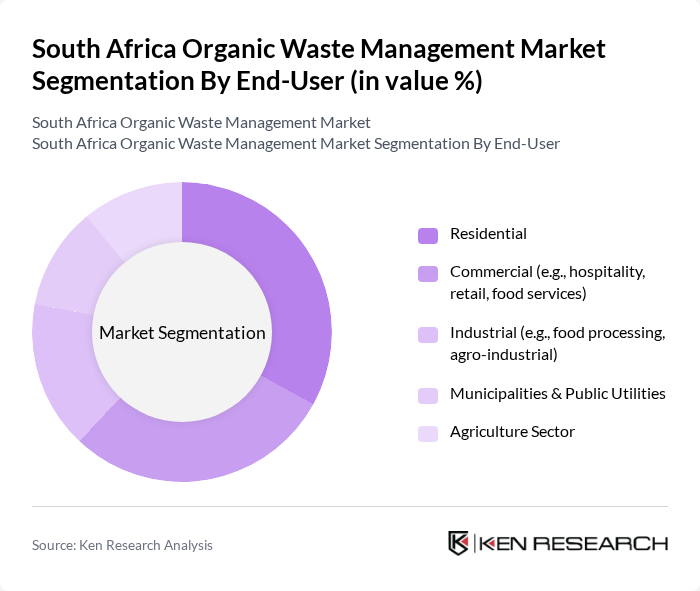
By End-User:The end-user segmentation includes residential, commercial (e.g., hospitality, retail, food services), industrial (e.g., food processing, agro-industrial), municipalities & public utilities, and the agriculture sector. The residential and commercial sectors are the largest contributors to organic waste generation, driven by increasing consumer awareness and the need for sustainable waste management solutions .
South Africa Organic Waste Management Market Competitive Landscape
The South Africa Organic Waste Management Market is characterized by a dynamic mix of regional and international players. Leading participants such as WastePlan, Interwaste, EnviroServ, Biogas Energy (Pty) Ltd, GreenCape, EcoWaste, Remade Recycling, Waste Management SA, SUEZ Recycling and Recovery South Africa, Veolia Services Southern Africa, EnviroServ Waste Management, Barloworld Logistics, Mpact Recycling, WasteTech (Pty) Ltd, The Waste Group contribute to innovation, geographic expansion, and service delivery in this space.
South Africa Organic Waste Management Market Industry Analysis
Growth Drivers
- Increasing Environmental Awareness:The South African population is becoming increasingly aware of environmental issues, with 60% of citizens expressing concern about waste management practices. This awareness is driving demand for sustainable waste solutions. The government reported that organic waste constitutes approximately 30% of total waste generated, highlighting the need for effective management strategies. As a result, initiatives promoting composting and recycling are gaining traction, encouraging both individuals and businesses to adopt eco-friendly practices.
- Government Initiatives and Support:The South African government has implemented various initiatives to promote organic waste management, including the National Waste Management Strategy, which aims to reduce waste by 40% in future. Funding of approximately ZAR 1.2 billion has been allocated for waste management projects, including composting facilities and recycling programs. These initiatives not only enhance infrastructure but also create job opportunities, fostering a supportive environment for organic waste management growth across the country.
- Rising Organic Waste Generation:South Africa generates an estimated 55 million tons of waste annually, with organic waste accounting for a significant portion. Projections indicate that organic waste generation will increase by 8% annually due to urbanization and population growth, reaching approximately 24 million tons in future. This surge presents a pressing need for effective organic waste management solutions, driving investments in composting and biogas production technologies to address the growing waste challenge.
Market Challenges
- Lack of Infrastructure:One of the primary challenges facing the organic waste management sector in South Africa is the inadequate infrastructure for waste processing. Currently, only 25% of municipalities have access to proper waste management facilities, leading to inefficient waste disposal practices. This lack of infrastructure hampers the effective collection, processing, and recycling of organic waste, resulting in increased landfill use and environmental degradation, which undermines sustainability efforts.
- High Initial Investment Costs:The high initial investment required for establishing organic waste management facilities poses a significant barrier to market entry. For instance, setting up a composting facility can cost between ZAR 3 million to ZAR 6 million, depending on the scale and technology used. Many municipalities and private investors are deterred by these costs, limiting the development of necessary infrastructure and technologies to manage organic waste effectively, thereby stalling market growth.
South Africa Organic Waste Management Market Future Outlook
The future of the South African organic waste management market appears promising, driven by increasing environmental awareness and supportive government policies. As urbanization continues, the demand for efficient waste management solutions will rise, prompting investments in innovative technologies. Additionally, the integration of smart waste management systems is expected to enhance operational efficiency. The focus on sustainability will likely lead to greater public participation in recycling initiatives, fostering a culture of environmental responsibility and paving the way for a circular economy.
Market Opportunities
- Expansion of Recycling Programs:There is a significant opportunity to expand recycling programs across South Africa, particularly in urban areas. With only 15% of organic waste currently being recycled, enhancing these programs could divert millions of tons from landfills. This expansion can create jobs and stimulate local economies while promoting sustainable practices among communities, ultimately contributing to a cleaner environment.
- Development of New Technologies:The advancement of new technologies in organic waste processing presents a lucrative opportunity for market players. Innovations such as anaerobic digestion and advanced composting techniques can improve efficiency and reduce costs. By investing in research and development, companies can create more effective solutions for organic waste management, positioning themselves as leaders in a growing market focused on sustainability and environmental protection.
Scope of the Report
| Segment | Sub-Segments |
|---|---|
| By Type | Composting Anaerobic Digestion Landfilling Incineration Waste-to-Energy Organic Fertilizers Mechanical-Biological Treatment (MBT) Vermicomposting Others |
| By End-User | Residential Commercial (e.g., hospitality, retail, food services) Industrial (e.g., food processing, agro-industrial) Municipalities & Public Utilities Agriculture Sector |
| By Application | Agriculture (soil amendment, fertilizer) Landscaping & Horticulture Renewable Energy Production (biogas, electricity) Soil Remediation Animal Feed |
| By Investment Source | Domestic Private Investment Foreign Direct Investment (FDI) Public-Private Partnerships (PPP) Government Grants & Subsidies |
| By Policy Support | Subsidies Tax Exemptions Regulatory Compliance Support Training and Capacity Building |
| By Distribution Mode | Direct Sales Online Sales Retail Partnerships Community Collection Programs |
| By Price Range | Low Price Mid Price High Price |
Key Target Audience
Investors and Venture Capitalist Firms
Government and Regulatory Bodies (e.g., Department of Environment, Forestry and Fisheries)
Waste Management Companies
Composting Facilities
Biogas Plant Operators
Local Municipalities and Authorities
Environmental NGOs and Advocacy Groups
Recycling and Upcycling Enterprises
Players Mentioned in the Report:
WastePlan
Interwaste
EnviroServ
Biogas Energy (Pty) Ltd
GreenCape
EcoWaste
Remade Recycling
Waste Management SA
SUEZ Recycling and Recovery South Africa
Veolia Services Southern Africa
EnviroServ Waste Management
Barloworld Logistics
Mpact Recycling
WasteTech (Pty) Ltd
The Waste Group
Table of Contents
Market Assessment Phase
1. Executive Summary and Approach
2. South Africa Organic Waste Management Market Overview
2.1 Key Insights and Strategic Recommendations
2.2 South Africa Organic Waste Management Market Overview
2.3 Definition and Scope
2.4 Evolution of Market Ecosystem
2.5 Timeline of Key Regulatory Milestones
2.6 Value Chain & Stakeholder Mapping
2.7 Business Cycle Analysis
2.8 Policy & Incentive Landscape
3. South Africa Organic Waste Management Market Analysis
3.1 Growth Drivers
3.1.1 Increasing Environmental Awareness
3.1.2 Government Initiatives and Support
3.1.3 Rising Organic Waste Generation
3.1.4 Technological Advancements in Waste Processing
3.2 Market Challenges
3.2.1 Lack of Infrastructure
3.2.2 High Initial Investment Costs
3.2.3 Regulatory Compliance Issues
3.2.4 Public Awareness and Participation
3.3 Market Opportunities
3.3.1 Expansion of Recycling Programs
3.3.2 Development of New Technologies
3.3.3 Partnerships with Private Sector
3.3.4 Export Opportunities for Processed Organic Waste
3.4 Market Trends
3.4.1 Growth of Composting Initiatives
3.4.2 Increase in Biogas Production
3.4.3 Adoption of Circular Economy Practices
3.4.4 Integration of Smart Waste Management Solutions
3.5 Government Regulation
3.5.1 National Waste Management Strategy
3.5.2 Environmental Impact Assessments
3.5.3 Waste Management Licensing Requirements
3.5.4 Incentives for Renewable Energy from Waste
4. SWOT Analysis
5. Stakeholder Analysis
6. Porter's Five Forces Analysis
7. South Africa Organic Waste Management Market Market Size, 2019-2024
7.1 By Value
7.2 By Volume
7.3 By Average Selling Price
8. South Africa Organic Waste Management Market Segmentation
8.1 By Type
8.1.1 Composting
8.1.2 Anaerobic Digestion
8.1.3 Landfilling
8.1.4 Incineration
8.1.5 Waste-to-Energy
8.1.6 Organic Fertilizers
8.1.7 Mechanical-Biological Treatment (MBT)
8.1.8 Vermicomposting
8.1.9 Others
8.2 By End-User
8.2.1 Residential
8.2.2 Commercial (e.g., hospitality, retail, food services)
8.2.3 Industrial (e.g., food processing, agro-industrial)
8.2.4 Municipalities & Public Utilities
8.2.5 Agriculture Sector
8.3 By Application
8.3.1 Agriculture (soil amendment, fertilizer)
8.3.2 Landscaping & Horticulture
8.3.3 Renewable Energy Production (biogas, electricity)
8.3.4 Soil Remediation
8.3.5 Animal Feed
8.4 By Investment Source
8.4.1 Domestic Private Investment
8.4.2 Foreign Direct Investment (FDI)
8.4.3 Public-Private Partnerships (PPP)
8.4.4 Government Grants & Subsidies
8.5 By Policy Support
8.5.1 Subsidies
8.5.2 Tax Exemptions
8.5.3 Regulatory Compliance Support
8.5.4 Training and Capacity Building
8.6 By Distribution Mode
8.6.1 Direct Sales
8.6.2 Online Sales
8.6.3 Retail Partnerships
8.6.4 Community Collection Programs
8.7 By Price Range
8.7.1 Low Price
8.7.2 Mid Price
8.7.3 High Price
9. South Africa Organic Waste Management Market Competitive Analysis
9.1 Market Share of Key Players
9.2 Cross Comparison of Key Players
9.2.1 Company Name
9.2.2 Group Size (Large, Medium, or Small as per industry convention)
9.2.3 Revenue (ZAR million)
9.2.4 Revenue Growth Rate (%)
9.2.5 Market Share (%)
9.2.6 Volume of Organic Waste Processed (tonnes/year)
9.2.7 Number of Processing Facilities
9.2.8 Geographic Coverage (number of provinces/cities served)
9.2.9 Customer Segments Served (e.g., residential, commercial, industrial)
9.2.10 Operational Efficiency (cost/tonne processed)
9.2.11 Diversification of Services (e.g., composting, biogas, recycling)
9.2.12 Environmental Compliance Record
9.2.13 Innovation Index (e.g., patents, R&D spend)
9.2.14 Customer Satisfaction Score
9.2.15 Employee Count
9.3 SWOT Analysis of Top Players
9.4 Pricing Analysis
9.5 Detailed Profile of Major Companies
9.5.1 WastePlan
9.5.2 Interwaste
9.5.3 EnviroServ
9.5.4 Biogas Energy (Pty) Ltd
9.5.5 GreenCape
9.5.6 EcoWaste
9.5.7 Remade Recycling
9.5.8 Waste Management SA
9.5.9 SUEZ Recycling and Recovery South Africa
9.5.10 Veolia Services Southern Africa
9.5.11 EnviroServ Waste Management
9.5.12 Barloworld Logistics
9.5.13 Mpact Recycling
9.5.14 WasteTech (Pty) Ltd
9.5.15 The Waste Group
10. South Africa Organic Waste Management Market End-User Analysis
10.1 Procurement Behavior of Key Ministries
10.1.1 Department of Environmental Affairs
10.1.2 Department of Agriculture, Forestry and Fisheries
10.1.3 Local Municipalities
10.2 Corporate Spend on Infrastructure & Energy
10.2.1 Investment in Waste Processing Facilities
10.2.2 Funding for Renewable Energy Projects
10.3 Pain Point Analysis by End-User Category
10.3.1 Residential Waste Management Issues
10.3.2 Commercial Waste Disposal Challenges
10.3.3 Industrial Waste Treatment Concerns
10.4 User Readiness for Adoption
10.4.1 Awareness of Organic Waste Solutions
10.4.2 Willingness to Participate in Programs
10.5 Post-Deployment ROI and Use Case Expansion
10.5.1 Measurement of Cost Savings
10.5.2 Expansion of Services Offered
11. South Africa Organic Waste Management Market Future Size, 2025-2030
11.1 By Value
11.2 By Volume
11.3 By Average Selling Price
Go-To-Market Strategy Phase
1. Whitespace Analysis + Business Model Canvas
1.1 Identification of Market Gaps
1.2 Business Model Development
2. Marketing and Positioning Recommendations
2.1 Branding Strategies
2.2 Product USPs
3. Distribution Plan
3.1 Urban Retail Strategies
3.2 Rural NGO Tie-ups
4. Channel & Pricing Gaps
4.1 Underserved Routes
4.2 Pricing Bands
5. Unmet Demand & Latent Needs
5.1 Category Gaps
5.2 Consumer Segments
6. Customer Relationship
6.1 Loyalty Programs
6.2 After-sales Service
7. Value Proposition
7.1 Sustainability Initiatives
7.2 Integrated Supply Chains
8. Key Activities
8.1 Regulatory Compliance
8.2 Branding Efforts
8.3 Distribution Setup
9. Entry Strategy Evaluation
9.1 Domestic Market Entry Strategy
9.1.1 Product Mix Considerations
9.1.2 Pricing Band Strategy
9.1.3 Packaging Solutions
9.2 Export Entry Strategy
9.2.1 Target Countries
9.2.2 Compliance Roadmap
10. Entry Mode Assessment
10.1 Joint Ventures
10.2 Greenfield Investments
10.3 Mergers & Acquisitions
10.4 Distributor Model
11. Capital and Timeline Estimation
11.1 Capital Requirements
11.2 Timelines for Implementation
12. Control vs Risk Trade-Off
12.1 Ownership vs Partnerships
13. Profitability Outlook
13.1 Breakeven Analysis
13.2 Long-term Sustainability
14. Potential Partner List
14.1 Distributors
14.2 Joint Ventures
14.3 Acquisition Targets
15. Execution Roadmap
15.1 Phased Plan for Market Entry
15.1.1 Market Setup
15.1.2 Market Entry
15.1.3 Growth Acceleration
15.1.4 Scale & Stabilize
15.2 Key Activities and Milestones
15.2.1 Activity Planning
15.2.2 Milestone Tracking
Research Methodology
Phase 1: Approach1
Desk Research
- Analysis of government reports on organic waste management policies in South Africa
- Review of academic journals and publications on organic waste recycling and composting
- Examination of industry reports from environmental NGOs and waste management associations
Primary Research
- Interviews with municipal waste management officials and policy makers
- Surveys with organic waste processors and composting facility operators
- Focus groups with community leaders and environmental activists
Validation & Triangulation
- Cross-validation of findings through multiple data sources including government and industry reports
- Triangulation of qualitative insights from interviews with quantitative data from surveys
- Sanity checks conducted through expert panel reviews comprising waste management specialists
Phase 2: Market Size Estimation1
Top-down Assessment
- Estimation of total organic waste generated in South Africa based on national waste statistics
- Segmentation of organic waste by source: residential, commercial, and agricultural
- Incorporation of government initiatives aimed at increasing organic waste diversion from landfills
Bottom-up Modeling
- Collection of operational data from leading organic waste management companies
- Estimation of processing capacity and cost structures for composting and anaerobic digestion facilities
- Volume and pricing analysis based on service contracts and market rates for organic waste processing
Forecasting & Scenario Analysis
- Multi-variable regression analysis incorporating population growth, urbanization rates, and waste generation trends
- Scenario modeling based on potential regulatory changes and shifts in consumer behavior towards sustainability
- Development of baseline, optimistic, and pessimistic forecasts for the organic waste management market through 2030
Phase 3: CATI Sample Composition1
| Scope Item/Segment | Sample Size | Target Respondent Profiles |
|---|---|---|
| Municipal Waste Management Authorities | 60 | Waste Management Officers, Environmental Policy Makers |
| Organic Waste Processing Facilities | 50 | Facility Managers, Operations Directors |
| Commercial Sector Waste Generators | 40 | Facility Managers, Sustainability Coordinators |
| Community-Based Organizations | 40 | Community Leaders, Environmental Activists |
| Agricultural Waste Management Practices | 50 | Farm Managers, Agricultural Extension Officers |
Frequently Asked Questions
What is the current value of the South Africa Organic Waste Management Market?
The South Africa Organic Waste Management Market is valued at approximately USD 300 million, reflecting a significant growth driven by urbanization, environmental awareness, and government initiatives aimed at reducing landfill waste.
What are the main drivers of growth in the South Africa Organic Waste Management Market?
Which cities are leading in organic waste management in South Africa?
What types of organic waste management methods are most common in South Africa?
Other Regional/Country Reports
Why Buy From Us?

What makes us stand out is that our consultants follow Robust, Refine and Result (RRR) methodology. Robust for clear definitions, approaches and sanity checking, Refine for differentiating respondents' facts and opinions, and Result for presenting data with story.

We have set a benchmark in the industry by offering our clients with syndicated and customized market research reports featuring coverage of entire market as well as meticulous research and analyst insights.

While we don't replace traditional research, we flip the method upside down. Our dual approach of Top Bottom & Bottom Top ensures quality deliverable by not just verifying company fundamentals but also looking at the sector and macroeconomic factors.

With one step in the future, our research team constantly tries to show you the bigger picture. We help with some of the tough questions you may encounter along the way: How is the industry positioned? Best marketing channel? KPI's of competitors? By aligning every element, we help maximize success.

Our report gives you instant access to the answers and sources that other companies might choose to hide. We elaborate each steps of research methodology we have used and showcase you the sample size to earn your trust.

If you need any support, we are here! We pride ourselves on universe strength, data quality, and quick, friendly, and professional service.