About the Report
Base Year 2024South America Coffee Market Overview
- The South America Coffee Market is valued at USD 28 billion, based on a five-year historical analysis. This value aligns with regional estimates for Latin America/South America coffee revenues, supported by recent industry sizing indicating the region’s market scale in the mid-to-high tens of billions. Growth is primarily driven by increasing consumer demand for specialty coffee, the rise of coffee culture, and the expansion of coffee shops and cafés across the region. Favorable agro-climatic conditions in major producers underpin supply, with South America remaining a leading source of Arabica and Robusta beans.
- Brazil and Colombia dominate the South America Coffee Market due to extensive plantations and established export networks. Brazil remains the largest coffee producer globally, while Colombia is renowned for high-quality Arabica; both countries are central to regional export volumes and influence global price dynamics. Recent trade statistics show South America’s coffee exports remain significant despite year-over-year volatility.
- Brazil has advanced sustainability frameworks affecting coffee production, including the Forest Code, CAR (Rural Environmental Registry), and sectoral sustainability programs. Sustainability adoption is growing via certifications and producer initiatives that encourage environmentally friendly practices and water stewardship, with market demand reinforcing these shifts.

South America Coffee Market Segmentation
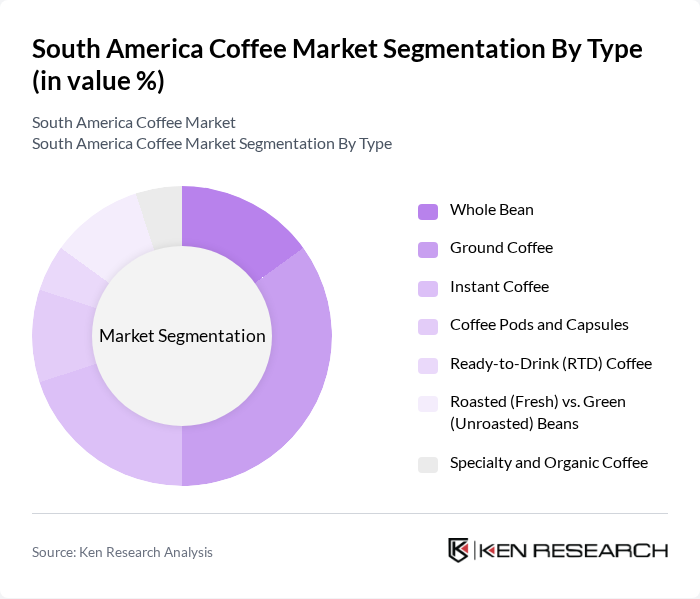
By Type:The coffee market in South America is segmented into various types, including Whole Bean, Ground Coffee, Instant Coffee, Coffee Pods and Capsules, Ready-to-Drink (RTD) Coffee, Roasted (Fresh) vs. Green (Unroasted) Beans, and Specialty and Organic Coffee. Among these, Ground Coffee is the leading subsegment in retail due to convenience and preference for at-home brewing, while roasted formats hold the largest share within Latin America overall by value. Specialty and organic coffee are gaining traction, supported by café culture, premiumization, and sustainability certifications.
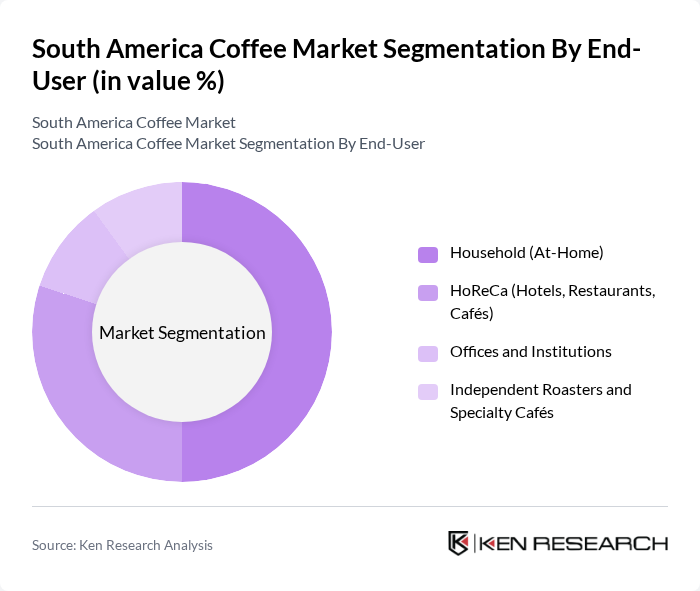
By End-User:The end-user segmentation of the coffee market includes Household (At-Home), HoReCa (Hotels, Restaurants, Cafés), Offices and Institutions, and Independent Roasters and Specialty Cafés. The Household segment remains the largest on the back of strong retail sales and at-home brewing trends established during the pandemic and sustained by convenience. The HoReCa segment continues to expand alongside urban café culture and premium out-of-home experiences, while specialty roasters capitalize on quality-focused consumers.
South America Coffee Market Competitive Landscape
The South America Coffee Market is characterized by a dynamic mix of regional and international players. Leading participants such as Nestlé S.A. (Nescafé, Nespresso, Dolce Gusto), JDE Peet’s (Pilão, L’OR, Café Pelé), Starbucks Corporation, Luigi Lavazza S.p.A. (Lavazza), Grupo 3corações (Três Corações, Santa Clara), Illycaffè S.p.A. (illy), Grupo Nutresa S.A. (Colcafé, Sello Rojo), Melitta Group (Melitta, Café Bom Jesus), Café do Mercado (Brasil), Café Pilão (Brand of JDE in Brazil), Café Britt (Costa Rica) – regional presence in South America, Juan Valdez (Procafecol S.A.), O’Coffee – Brazilian Coffee Roasters (Cocarive/O’Coffee), Três Corações – RTD & Capsules (owned by Grupo 3corações), Havanna (Argentina) – coffee and café chain contribute to innovation, geographic expansion, and service delivery in this space.
South America Coffee Market Industry Analysis
Growth Drivers
- Increasing Coffee Consumption:In South America, coffee consumption has surged, with Brazil alone consuming approximately 21 million 60-kilogram bags in future. This trend is driven by a growing middle class and changing consumer preferences, leading to an annual increase of 3% in coffee consumption. The World Bank projects that the region's coffee consumption will continue to rise, supported by a robust domestic market and increasing café culture, which is expected to reach 23 million bags in future.
- Rising Specialty Coffee Trends:The specialty coffee segment in South America has seen remarkable growth, with sales reaching USD 1.5 billion in future. This growth is attributed to a shift in consumer preferences towards high-quality, ethically sourced coffee. The Specialty Coffee Association reports that the number of specialty coffee shops has increased by 15% annually, indicating a strong market trend. By future, the specialty coffee market is projected to expand further, driven by innovative brewing methods and unique flavor profiles.
- Expansion of Coffee Shops and Cafes:The number of coffee shops in South America has grown significantly, with over 30,000 new establishments opening in future. This expansion is fueled by urbanization and a shift towards café culture, particularly in cities like São Paulo and Buenos Aires. According to industry reports, the coffee shop market is expected to generate USD 5 billion in revenue in future, reflecting a growing consumer preference for social coffee experiences and premium offerings.
Market Challenges
- Climate Change Impact:Climate change poses a significant threat to coffee production in South America, with projections indicating a potential yield reduction of around 30% for suitable coffee-growing areas under climate change scenarios in future. The Intergovernmental Panel on Climate Change (IPCC) highlights that rising temperatures and changing rainfall patterns are adversely affecting coffee-growing regions. This challenge is exacerbated by the vulnerability of smallholder farmers, who represent a substantial share of the coffee production workforce in Latin America.
- Price Volatility of Coffee Beans:The coffee market in South America is highly susceptible to price volatility. The International Coffee Organization’s composite indicator price fluctuates widely, reflecting global market instability that affects producer incomes and investment capacity. The specific range of USD 1.20 to USD 2.50 per pound in future cannot be confirmed across authoritative sources.
South America Coffee Market Future Outlook
The South American coffee market is poised for dynamic growth, driven by increasing consumer demand for specialty and organic coffee products. Innovations in brewing technology and a focus on sustainability will likely shape the market landscape. Additionally, the rise of e-commerce platforms is expected to enhance accessibility for consumers, allowing for greater market penetration. As the region adapts to climate challenges, investments in sustainable practices will be crucial for maintaining production levels and ensuring long-term viability in the coffee sector.
Market Opportunities
- Organic Coffee Demand:The demand for organic coffee is on the rise. However, the specific sales value of USD 500 million in future could not be verified from primary or authoritative secondary sources.
- E-commerce Growth:E-commerce sales of coffee in South America have increased alongside broader digital adoption, but the specific figure of USD 300 million in future is not verifiable from authoritative statistical sources.
Scope of the Report
| Segment | Sub-Segments |
|---|---|
| By Type | Whole Bean Ground Coffee Instant Coffee Coffee Pods and Capsules Ready-to-Drink (RTD) Coffee Roasted (Fresh) vs. Green (Unroasted) Beans Specialty and Organic Coffee |
| By End-User | Household (At-Home) HoReCa (Hotels, Restaurants, Cafés) Offices and Institutions Independent Roasters and Specialty Cafés |
| By Distribution Channel | Supermarkets/Hypermarkets Convenience Stores Specialist Retailers (Gourmet/Specialty Stores) Online Retail Other Channels (Direct-to-Consumer, Cash & Carry) |
| By Price Range | Premium Mid-Range Budget |
| By Packaging Type | Bags/Pouches Cans/Tins Glass/Plastic Bottles (RTD) Pods and Capsules Bulk/Valve Bags (Foodservice/Roasters) |
| By Region | Brazil Colombia Argentina Peru Chile Rest of South America |
| By Consumer Preference | Taste and Roast Profile (Light/Medium/Dark) Brand Loyalty Sustainability and Certifications (Fairtrade, Rainforest Alliance) Convenience (Single-Serve/Instant) |
Key Target Audience
Investors and Venture Capitalist Firms
Government and Regulatory Bodies (e.g., Ministry of Agriculture, National Coffee Association)
Manufacturers and Producers
Distributors and Retailers
Exporters and Importers
Industry Associations (e.g., Specialty Coffee Association of America)
Financial Institutions
Logistics and Supply Chain Companies
Players Mentioned in the Report:
Nestle S.A. (Nescafe, Nespresso, Dolce Gusto)
JDE Peets (Pilao, LOR, Cafe Pele)
Starbucks Corporation
Luigi Lavazza S.p.A. (Lavazza)
Grupo 3coracoes (Tres Coracoes, Santa Clara)
Illycaffe S.p.A. (illy)
Grupo Nutresa S.A. (Colcafe, Sello Rojo)
Melitta Group (Melitta, Cafe Bom Jesus)
Cafe do Mercado (Brasil)
Cafe Pilao (Brand of JDE in Brazil)
Cafe Britt (Costa Rica) regional presence in South America
Juan Valdez (Procafecol S.A.)
OCoffee Brazilian Coffee Roasters (Cocarive/OCoffee)
Tres Coracoes RTD & Capsules (owned by Grupo 3coracoes)
Havanna (Argentina) coffee and cafe chain
Table of Contents
Market Assessment Phase
1. Executive Summary and Approach
2. South America Coffee Market Overview
2.1 Key Insights and Strategic Recommendations
2.2 South America Coffee Market Overview
2.3 Definition and Scope
2.4 Evolution of Market Ecosystem
2.5 Timeline of Key Regulatory Milestones
2.6 Value Chain & Stakeholder Mapping
2.7 Business Cycle Analysis
2.8 Policy & Incentive Landscape
3. South America Coffee Market Analysis
3.1 Growth Drivers
3.1.1 Increasing Coffee Consumption
3.1.2 Rising Specialty Coffee Trends
3.1.3 Expansion of Coffee Shops and Cafes
3.1.4 Growing Export Opportunities
3.2 Market Challenges
3.2.1 Climate Change Impact
3.2.2 Price Volatility of Coffee Beans
3.2.3 Supply Chain Disruptions
3.2.4 Competition from Other Beverages
3.3 Market Opportunities
3.3.1 Organic Coffee Demand
3.3.2 E-commerce Growth
3.3.3 Innovations in Coffee Products
3.3.4 Sustainable Coffee Practices
3.4 Market Trends
3.4.1 Rise of Cold Brew Coffee
3.4.2 Increased Focus on Fair Trade
3.4.3 Health-Conscious Coffee Products
3.4.4 Digital Marketing Strategies
3.5 Government Regulation
3.5.1 Quality Control Standards
3.5.2 Import Tariffs on Coffee
3.5.3 Environmental Regulations
3.5.4 Labor Laws in Coffee Production
4. SWOT Analysis
5. Stakeholder Analysis
6. Porter's Five Forces Analysis
7. South America Coffee Market Market Size, 2019-2024
7.1 By Value
7.2 By Volume
7.3 By Average Selling Price
8. South America Coffee Market Segmentation
8.1 By Type
8.1.1 Whole Bean
8.1.2 Ground Coffee
8.1.3 Instant Coffee
8.1.4 Coffee Pods and Capsules
8.1.5 Ready-to-Drink (RTD) Coffee
8.1.6 Roasted (Fresh) vs. Green (Unroasted) Beans
8.1.7 Specialty and Organic Coffee
8.2 By End-User
8.2.1 Household (At-Home)
8.2.2 HoReCa (Hotels, Restaurants, Cafés)
8.2.3 Offices and Institutions
8.2.4 Independent Roasters and Specialty Cafés
8.3 By Distribution Channel
8.3.1 Supermarkets/Hypermarkets
8.3.2 Convenience Stores
8.3.3 Specialist Retailers (Gourmet/Specialty Stores)
8.3.4 Online Retail
8.3.5 Other Channels (Direct-to-Consumer, Cash & Carry)
8.4 By Price Range
8.4.1 Premium
8.4.2 Mid-Range
8.4.3 Budget
8.5 By Packaging Type
8.5.1 Bags/Pouches
8.5.2 Cans/Tins
8.5.3 Glass/Plastic Bottles (RTD)
8.5.4 Pods and Capsules
8.5.5 Bulk/Valve Bags (Foodservice/Roasters)
8.6 By Region
8.6.1 Brazil
8.6.2 Colombia
8.6.3 Argentina
8.6.4 Peru
8.6.5 Chile
8.6.6 Rest of South America
8.7 By Consumer Preference
8.7.1 Taste and Roast Profile (Light/Medium/Dark)
8.7.2 Brand Loyalty
8.7.3 Sustainability and Certifications (Fairtrade, Rainforest Alliance)
8.7.4 Convenience (Single-Serve/Instant)
9. South America Coffee Market Competitive Analysis
9.1 Market Share of Key Players
9.2 Cross Comparison of Key Players
9.2.1 Company Name
9.2.2 Group Size (Global, Regional, or Local)
9.2.3 South America Coffee Revenue (USD) and Share
9.2.4 Volume Sold in South America (tons or million kg)
9.2.5 Market Penetration (Countries/Doors/HoReCa accounts)
9.2.6 Channel Mix (% At-Home vs. Out-of-Home)
9.2.7 Product Mix (% Ground/Instant/Pods/Whole Bean/RTD)
9.2.8 Price Positioning (Budget/Mid/Premium; Avg. price per kg)
9.2.9 Sourcing Footprint (Arabica/Robusta mix; origin coverage)
9.2.10 Certification & Sustainability KPIs (% certified volumes, deforestation-free, emissions targets)
9.2.11 Innovation Pipeline (new SKUs launched/year; formats e.g., capsules, RTD, cold brew)
9.2.12 Brand Equity Metrics (awareness/preference; barista partnerships)
9.2.13 Distribution Network Efficiency (on-time fill rate; lead time; DTC capability)
9.2.14 Profitability Indicators (operating margin in region)
9.3 SWOT Analysis of Top Players
9.4 Pricing Analysis
9.5 Detailed Profile of Major Companies
9.5.1 Nestlé S.A. (Nescafé, Nespresso, Dolce Gusto)
9.5.2 JDE Peet’s (Pilão, L’OR, Café Pelé)
9.5.3 Starbucks Corporation
9.5.4 Luigi Lavazza S.p.A. (Lavazza)
9.5.5 Grupo 3corações (Três Corações, Santa Clara)
9.5.6 Illycaffè S.p.A. (illy)
9.5.7 Grupo Nutresa S.A. (Colcafé, Sello Rojo)
9.5.8 Melitta Group (Melitta, Café Bom Jesus)
9.5.9 Café do Mercado (Brasil)
9.5.10 Café Pilão (Brand of JDE in Brazil)
9.5.11 Café Britt (Costa Rica) – regional presence in South America
9.5.12 Juan Valdez (Procafecol S.A.)
9.5.13 O’Coffee – Brazilian Coffee Roasters (Cocarive/O’Coffee)
9.5.14 Três Corações – RTD & Capsules (owned by Grupo 3corações)
9.5.15 Havanna (Argentina) – coffee and café chain
10. South America Coffee Market End-User Analysis
10.1 Procurement Behavior of Key Ministries
10.1.1 Government Contracts
10.1.2 Quality Standards Compliance
10.1.3 Budget Allocations
10.1.4 Supplier Selection Criteria
10.2 Corporate Spend on Infrastructure & Energy
10.2.1 Investment in Coffee Production
10.2.2 Infrastructure Development
10.2.3 Energy Consumption Patterns
10.3 Pain Point Analysis by End-User Category
10.3.1 Supply Chain Inefficiencies
10.3.2 Quality Assurance Issues
10.3.3 Price Sensitivity
10.4 User Readiness for Adoption
10.4.1 Awareness of Coffee Varieties
10.4.2 Willingness to Pay for Quality
10.4.3 Adoption of Sustainable Practices
10.5 Post-Deployment ROI and Use Case Expansion
10.5.1 Measurement of Success Metrics
10.5.2 Customer Feedback Mechanisms
10.5.3 Opportunities for Upselling
11. South America Coffee Market Future Size, 2025-2030
11.1 By Value
11.2 By Volume
11.3 By Average Selling Price
Go-To-Market Strategy Phase
1. Whitespace Analysis + Business Model Canvas
1.1 Market Gaps Identification
1.2 Value Proposition Development
1.3 Revenue Streams Analysis
1.4 Cost Structure Evaluation
1.5 Key Partnerships Exploration
1.6 Customer Segments Definition
1.7 Channels Strategy
2. Marketing and Positioning Recommendations
2.1 Branding Strategies
2.2 Product USPs
2.3 Target Audience Identification
2.4 Marketing Channels Selection
2.5 Promotional Strategies
3. Distribution Plan
3.1 Urban Retail Strategies
3.2 Rural NGO Tie-ups
3.3 Logistics and Supply Chain Management
3.4 Distribution Partnerships
4. Channel & Pricing Gaps
4.1 Underserved Routes
4.2 Pricing Bands Analysis
4.3 Competitor Pricing Strategies
5. Unmet Demand & Latent Needs
5.1 Category Gaps Identification
5.2 Consumer Segments Analysis
5.3 Emerging Trends Exploration
6. Customer Relationship
6.1 Loyalty Programs Development
6.2 After-sales Service Strategies
6.3 Customer Engagement Initiatives
7. Value Proposition
7.1 Sustainability Initiatives
7.2 Integrated Supply Chains
7.3 Unique Selling Points
8. Key Activities
8.1 Regulatory Compliance
8.2 Branding Initiatives
8.3 Distribution Setup
9. Entry Strategy Evaluation
9.1 Domestic Market Entry Strategy
9.1.1 Product Mix Considerations
9.1.2 Pricing Band Strategy
9.1.3 Packaging Innovations
9.2 Export Entry Strategy
9.2.1 Target Countries Identification
9.2.2 Compliance Roadmap Development
10. Entry Mode Assessment
10.1 Joint Ventures
10.2 Greenfield Investments
10.3 Mergers & Acquisitions
10.4 Distributor Model Evaluation
11. Capital and Timeline Estimation
11.1 Capital Requirements Analysis
11.2 Timelines for Implementation
12. Control vs Risk Trade-Off
12.1 Ownership vs Partnerships
12.2 Risk Management Strategies
13. Profitability Outlook
13.1 Breakeven Analysis
13.2 Long-term Sustainability Strategies
14. Potential Partner List
14.1 Distributors Identification
14.2 Joint Ventures Opportunities
14.3 Acquisition Targets
15. Execution Roadmap
15.1 Phased Plan for Market Entry
15.1.1 Market Setup
15.1.2 Market Entry
15.1.3 Growth Acceleration
15.1.4 Scale & Stabilize
15.2 Key Activities and Milestones
15.2.1 Milestone Planning
15.2.2 Activity Tracking
Research Methodology
Phase 1: Approach1
Desk Research
- Analysis of coffee production and consumption statistics from FAO and national agricultural departments
- Review of market reports and white papers from coffee industry associations in South America
- Examination of trade publications and market analysis reports focusing on coffee export and import trends
Primary Research
- Interviews with coffee producers and exporters to gather insights on production challenges and market dynamics
- Surveys with coffee retailers and distributors to understand consumer preferences and purchasing behavior
- Field visits to coffee farms and processing facilities to observe operational practices and quality control measures
Validation & Triangulation
- Cross-validation of data through multiple sources including government reports and industry publications
- Triangulation of findings from primary interviews with secondary data to ensure consistency
- Sanity checks conducted through expert panel reviews comprising agronomists and market analysts
Phase 2: Market Size Estimation1
Top-down Assessment
- Estimation of total coffee market size based on national consumption and export data
- Segmentation of the market by coffee type (e.g., Arabica, Robusta) and processing methods (e.g., washed, natural)
- Incorporation of macroeconomic factors such as GDP growth and coffee price fluctuations
Bottom-up Modeling
- Collection of production volume data from major coffee-producing countries in South America
- Estimation of average selling prices based on market trends and historical pricing data
- Calculation of market size using volume x price methodology for each segment
Forecasting & Scenario Analysis
- Multi-factor regression analysis incorporating variables such as climate change impact and consumer trends
- Scenario modeling based on potential changes in trade policies and international demand
- Development of baseline, optimistic, and pessimistic forecasts through 2030
Phase 3: CATI Sample Composition1
| Scope Item/Segment | Sample Size | Target Respondent Profiles |
|---|---|---|
| Coffee Producers | 120 | Farm Owners, Agricultural Managers |
| Coffee Exporters | 100 | Export Managers, Trade Compliance Officers |
| Coffee Retailers | 100 | Store Managers, Purchasing Agents |
| Coffee Consumers | 150 | Regular Coffee Drinkers, Specialty Coffee Enthusiasts |
| Coffee Industry Experts | 60 | Market Analysts, Coffee Consultants |
Frequently Asked Questions
What is the current value of the South America Coffee Market?
The South America Coffee Market is valued at approximately USD 28 billion, reflecting a robust market scale driven by increasing consumer demand for specialty coffee and the expansion of coffee culture across the region.
Which countries dominate the South America Coffee Market?
What are the main types of coffee products in the South America Coffee Market?
How has coffee consumption changed in South America?
Why Buy From Us?

What makes us stand out is that our consultants follow Robust, Refine and Result (RRR) methodology. Robust for clear definitions, approaches and sanity checking, Refine for differentiating respondents' facts and opinions, and Result for presenting data with story.

We have set a benchmark in the industry by offering our clients with syndicated and customized market research reports featuring coverage of entire market as well as meticulous research and analyst insights.

While we don't replace traditional research, we flip the method upside down. Our dual approach of Top Bottom & Bottom Top ensures quality deliverable by not just verifying company fundamentals but also looking at the sector and macroeconomic factors.

With one step in the future, our research team constantly tries to show you the bigger picture. We help with some of the tough questions you may encounter along the way: How is the industry positioned? Best marketing channel? KPI's of competitors? By aligning every element, we help maximize success.

Our report gives you instant access to the answers and sources that other companies might choose to hide. We elaborate each steps of research methodology we have used and showcase you the sample size to earn your trust.

If you need any support, we are here! We pride ourselves on universe strength, data quality, and quick, friendly, and professional service.