About the Report
Base Year 2024Listen to the audio summary
South Korea Domestic Courier Express And Parcel Market Overview
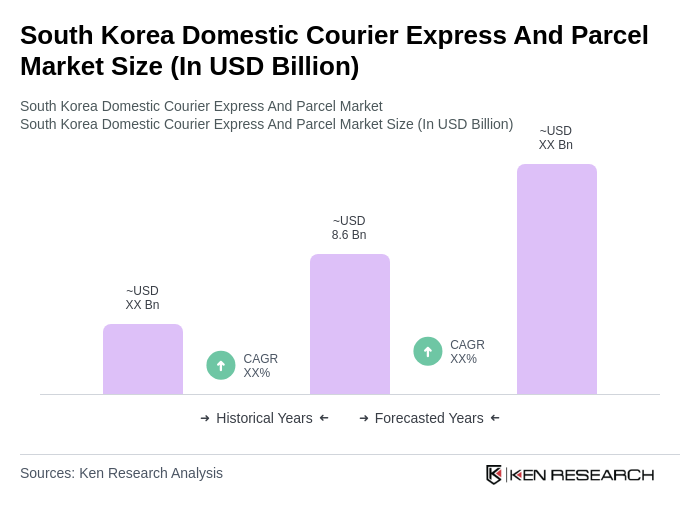
- The South Korea Domestic Courier Express and Parcel Market is valued at USD 8.6 billion, based on a five-year historical analysis. This growth is primarily driven by the rapid expansion of e-commerce, increased consumer demand for fast delivery services (same-day and next-day), and advancements in logistics automation and route optimization technologies. The market has seen a significant rise in parcel volumes aligned with strong online retail sales and convenience-based services (including dawn delivery), reflecting changing consumer behavior toward online shopping and efficient home delivery.
- Key cities such as Seoul, Busan, and Incheon dominate the market due to high population density, robust multimodal infrastructure, and concentration of businesses; Seoul functions as the principal logistics hub, while Busan’s major port assets underpin high-throughput logistics flows that support domestic and international shipping linkages.
- In 2023, the South Korean government advanced policies to enhance logistics sector efficiency under frameworks governing logistics industry development, focusing on service quality, technology adoption, and fair competition to streamline operations and support CEP growth.
South Korea Domestic Courier Express And Parcel Market Segmentation
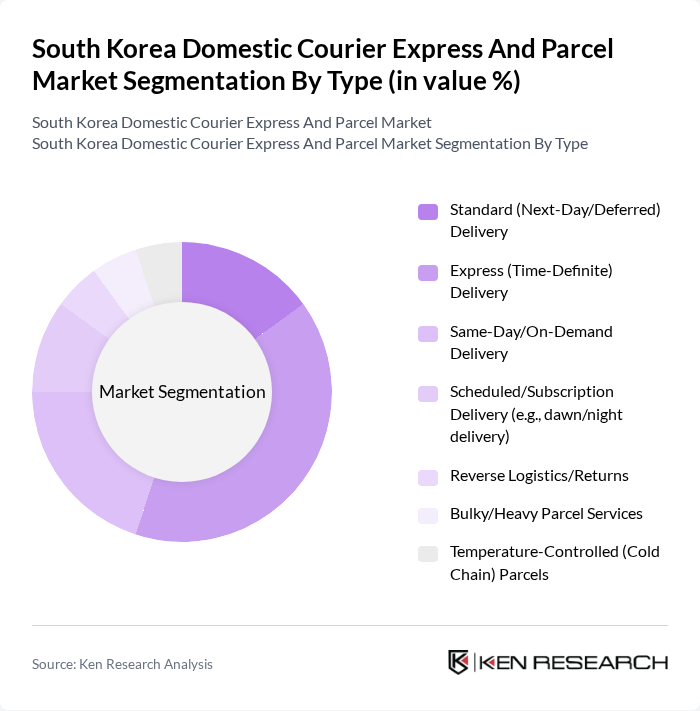
By Type:The market can be segmented into various types of delivery services, including Standard (Next-Day/Deferred) Delivery, Express (Time-Definite) Delivery, Same-Day/On-Demand Delivery, Scheduled/Subscription Delivery, Reverse Logistics/Returns, Bulky/Heavy Parcel Services, and Temperature-Controlled (Cold Chain) Parcels. Among these, Express (Time-Definite) Delivery is the leading sub-segment, driven by growing consumer expectations for rapid fulfillment, e-commerce service-level differentiation, and retailer partnerships offering guaranteed delivery windows.
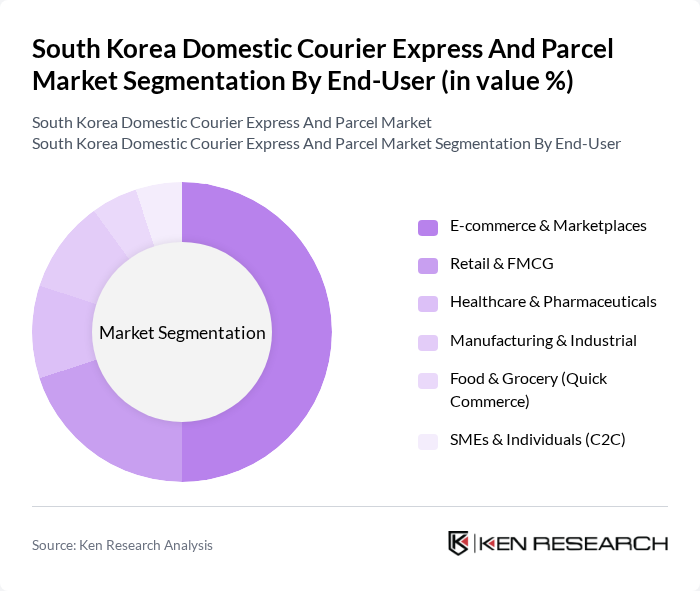
By End-User:The end-user segmentation includes E-commerce & Marketplaces, Retail & FMCG, Healthcare & Pharmaceuticals, Manufacturing & Industrial, Food & Grocery (Quick Commerce), and SMEs & Individuals (C2C). The E-commerce & Marketplaces segment is the dominant player, underpinned by sustained growth in online retail transactions and high penetration of digital shopping, which accelerates parcel demand and last-mile throughput.
South Korea Domestic Courier Express And Parcel Market Competitive Landscape
The South Korea Domestic Courier Express and Parcel Market is characterized by a dynamic mix of regional and international players. Leading participants such as CJ Logistics Corporation, Hanjin Transportation Co., Ltd., Lotte Global Logistics Co., Ltd., Korea Post (Korea Post Logistics Service), Logen Co., Ltd. (Logen Logistics), GS Postbox (CVSnet Co., Ltd.), LX Pantos Co., Ltd. (formerly Pantos Logistics), Hyundai Glovis Co., Ltd., CU??? ?? (BGF Retail CU Convenience Store Parcel), Mesh Korea Co., Ltd. (VROONG), Coupang Logistics Services (Rocket Delivery), Woowa Bros. (Baemin) – Baemin Connect/Delivery, Naver Fulfillment Alliance Partners (e.g., CJ, Logen), KCTC Co., Ltd., Sagawa Express Korea Co., Ltd. contribute to innovation, geographic expansion, and service delivery in this space.
South Korea Domestic Courier Express And Parcel Market Industry Analysis
Growth Drivers
- Increasing E-commerce Activities:The South Korean e-commerce market is projected to reach approximately one hundred billion dollars in future, driven by a twenty percent annual growth rate. This surge in online shopping is significantly boosting demand for courier services, as consumers increasingly expect quick and reliable delivery options. The rise in mobile commerce, with over eighty percent of online purchases made via smartphones, further emphasizes the need for efficient logistics solutions to meet consumer expectations.
- Demand for Same-Day Delivery Services:In future, the demand for same-day delivery services in South Korea is expected to increase by thirty percent, reflecting a growing consumer preference for immediate gratification. Major players are investing heavily in infrastructure to support this trend, with companies like CJ Logistics expanding their networks to ensure timely deliveries. This shift is crucial as sixty percent of consumers indicate they are willing to pay extra for faster delivery options, highlighting the market's responsiveness to consumer needs.
- Technological Advancements in Logistics:The integration of advanced technologies in logistics is transforming the courier industry in South Korea. In future, investments in logistics technology are projected to exceed one billion dollars, focusing on automation, AI, and data analytics. These innovations enhance operational efficiency, reduce delivery times, and improve customer satisfaction. As a result, companies leveraging technology are likely to gain a competitive edge, catering to the increasing demand for seamless delivery experiences.
Market Challenges
- Intense Competition Among Service Providers:The South Korean courier market is characterized by fierce competition, with over two hundred registered courier companies vying for market share. This saturation leads to price wars, which can erode profit margins. In future, the average profit margin for courier services is expected to decline to around five percent, compelling companies to innovate and differentiate their offerings to maintain profitability amidst this competitive landscape.
- Regulatory Compliance and Costs:Compliance with stringent regulations poses a significant challenge for courier services in South Korea. In future, companies are expected to allocate approximately ten percent of their operational budgets to meet regulatory requirements, including safety standards and environmental regulations. This financial burden can limit investment in growth initiatives, making it essential for companies to navigate the regulatory landscape effectively to sustain their operations and competitiveness.
South Korea Domestic Courier Express And Parcel Market Future Outlook
The South Korean domestic courier market is poised for significant evolution, driven by technological advancements and changing consumer preferences. As e-commerce continues to thrive, companies will increasingly adopt automation and AI to enhance operational efficiency. Additionally, the demand for sustainable practices will shape logistics strategies, with a focus on eco-friendly delivery options. The integration of innovative last-mile solutions will also be critical in meeting consumer expectations for speed and reliability, ensuring a dynamic and competitive market landscape.
Market Opportunities
- Expansion of Last-Mile Delivery Solutions:The last-mile delivery segment is expected to grow significantly, with investments projected to reach five hundred million dollars in future. Companies that develop efficient last-mile solutions can capitalize on the increasing demand for quick deliveries, enhancing customer satisfaction and loyalty in a competitive market.
- Adoption of Green Logistics Practices:With rising environmental concerns, the adoption of green logistics practices presents a lucrative opportunity. In future, the market for eco-friendly delivery solutions is anticipated to grow by twenty-five percent, as consumers increasingly prefer companies that prioritize sustainability, allowing businesses to differentiate themselves and attract environmentally conscious customers.
Scope of the Report
| Segment | Sub-Segments |
|---|---|
| By Type | Standard (Next-Day/Deferred) Delivery Express (Time-Definite) Delivery Same-Day/On-Demand Delivery Scheduled/Subscription Delivery (e.g., dawn/night delivery) Reverse Logistics/Returns Bulky/Heavy Parcel Services Temperature-Controlled (Cold Chain) Parcels |
| By End-User | E-commerce & Marketplaces Retail & FMCG Healthcare & Pharmaceuticals Manufacturing & Industrial Food & Grocery (Quick Commerce) SMEs & Individuals (C2C) |
| By Delivery Mode | Road (Two-wheeler/Van/Truck) Air (Domestic Air Express) Rail (Parcel/Container Services) Sea (Inter-island/Jeju lanes) Pickup & Locker Networks (PUDO) |
| By Package Size | Documents & Small Parcels (?2 kg) Medium Parcels (2–20 kg) Large Parcels (20–30 kg) Oversized/Heavy Parcels (>30 kg) |
| By Pricing Model | Flat Rate/Flat Box Weight- and Distance-Based Tiered/Volume Contracts (B2B) Dynamic/Peak Pricing |
| By Payment Method | Cards (Credit/Debit) Digital Wallets (e.g., Naver Pay, Kakao Pay) Cash on Delivery Bank Transfers/Invoicing |
| By Service Type | B2B B2C C2C Fulfillment & Value-Added Services (warehousing, installation) |
Key Target Audience
Investors and Venture Capitalist Firms
Government and Regulatory Bodies (e.g., Ministry of Land, Infrastructure and Transport)
Logistics and Supply Chain Companies
E-commerce Platforms
Retail Chains and Supermarkets
Technology Providers (e.g., Software and Automation Solutions)
Industry Associations (e.g., Korea Express Association)
Financial Institutions (e.g., Banks and Investment Firms)
Players Mentioned in the Report:
CJ Logistics Corporation
Hanjin Transportation Co., Ltd.
Lotte Global Logistics Co., Ltd.
Korea Post (Korea Post Logistics Service)
Logen Co., Ltd. (Logen Logistics)
GS Postbox (CVSnet Co., Ltd.)
LX Pantos Co., Ltd. (formerly Pantos Logistics)
Hyundai Glovis Co., Ltd.
CU (BGF Retail CU Convenience Store Parcel)
Mesh Korea Co., Ltd. (VROONG)
Coupang Logistics Services (Rocket Delivery)
Woowa Bros. (Baemin) Baemin Connect/Delivery
Naver Fulfillment Alliance Partners (e.g., CJ, Logen)
KCTC Co., Ltd.
Sagawa Express Korea Co., Ltd.
Table of Contents
Market Assessment Phase
1. Executive Summary and Approach
2. South Korea Domestic Courier Express And Parcel Market Overview
2.1 Key Insights and Strategic Recommendations
2.2 South Korea Domestic Courier Express And Parcel Market Overview
2.3 Definition and Scope
2.4 Evolution of Market Ecosystem
2.5 Timeline of Key Regulatory Milestones
2.6 Value Chain & Stakeholder Mapping
2.7 Business Cycle Analysis
2.8 Policy & Incentive Landscape
3. South Korea Domestic Courier Express And Parcel Market Analysis
3.1 Growth Drivers
3.1.1 Increasing E-commerce Activities
3.1.2 Demand for Same-Day Delivery Services
3.1.3 Technological Advancements in Logistics
3.1.4 Rising Consumer Expectations for Fast Delivery
3.2 Market Challenges
3.2.1 Intense Competition Among Service Providers
3.2.2 Regulatory Compliance and Costs
3.2.3 Infrastructure Limitations in Urban Areas
3.2.4 Fluctuating Fuel Prices
3.3 Market Opportunities
3.3.1 Expansion of Last-Mile Delivery Solutions
3.3.2 Growth in Cross-Border E-commerce
3.3.3 Adoption of Green Logistics Practices
3.3.4 Integration of AI and Automation in Operations
3.4 Market Trends
3.4.1 Shift Towards Contactless Delivery Options
3.4.2 Increasing Use of Drones for Delivery
3.4.3 Rise of Subscription-Based Delivery Services
3.4.4 Focus on Sustainability and Eco-Friendly Practices
3.5 Government Regulation
3.5.1 Implementation of Delivery Service Standards
3.5.2 Regulations on Vehicle Emissions
3.5.3 Licensing Requirements for Courier Services
3.5.4 Safety Regulations for Delivery Personnel
4. SWOT Analysis
5. Stakeholder Analysis
6. Porter's Five Forces Analysis
7. South Korea Domestic Courier Express And Parcel Market Market Size, 2019-2024
7.1 By Value
7.2 By Volume
7.3 By Average Selling Price
8. South Korea Domestic Courier Express And Parcel Market Segmentation
8.1 By Type
8.1.1 Standard (Next-Day/Deferred) Delivery
8.1.2 Express (Time-Definite) Delivery
8.1.3 Same-Day/On-Demand Delivery
8.1.4 Scheduled/Subscription Delivery (e.g., dawn/night delivery)
8.1.5 Reverse Logistics/Returns
8.1.6 Bulky/Heavy Parcel Services
8.1.7 Temperature-Controlled (Cold Chain) Parcels
8.2 By End-User
8.2.1 E-commerce & Marketplaces
8.2.2 Retail & FMCG
8.2.3 Healthcare & Pharmaceuticals
8.2.4 Manufacturing & Industrial
8.2.5 Food & Grocery (Quick Commerce)
8.2.6 SMEs & Individuals (C2C)
8.3 By Delivery Mode
8.3.1 Road (Two-wheeler/Van/Truck)
8.3.2 Air (Domestic Air Express)
8.3.3 Rail (Parcel/Container Services)
8.3.4 Sea (Inter-island/Jeju lanes)
8.3.5 Pickup & Locker Networks (PUDO)
8.4 By Package Size
8.4.1 Documents & Small Parcels (?2 kg)
8.4.2 Medium Parcels (2–20 kg)
8.4.3 Large Parcels (20–30 kg)
8.4.4 Oversized/Heavy Parcels (>30 kg)
8.5 By Pricing Model
8.5.1 Flat Rate/Flat Box
8.5.2 Weight- and Distance-Based
8.5.3 Tiered/Volume Contracts (B2B)
8.5.4 Dynamic/Peak Pricing
8.6 By Payment Method
8.6.1 Cards (Credit/Debit)
8.6.2 Digital Wallets (e.g., Naver Pay, Kakao Pay)
8.6.3 Cash on Delivery
8.6.4 Bank Transfers/Invoicing
8.7 By Service Type
8.7.1 B2B
8.7.2 B2C
8.7.3 C2C
8.7.4 Fulfillment & Value-Added Services (warehousing, installation)
9. South Korea Domestic Courier Express And Parcel Market Competitive Analysis
9.1 Market Share of Key Players
9.2 Cross Comparison of Key Players
9.2.1 Company Name
9.2.2 Network Scale (hubs, DCs, last-mile stations)
9.2.3 Domestic Parcel Volume (annual, million parcels)
9.2.4 Revenue (Domestic CEP, KRW, latest year)
9.2.5 Revenue Growth Rate (YoY, %)
9.2.6 On-Time Delivery Rate (% within SLA)
9.2.7 First-Attempt Delivery Success Rate (%)
9.2.8 Average Delivery Time (metro/2-day, hours)
9.2.9 Cost per Stop / Cost per Parcel (KRW)
9.2.10 Return/Reverse Logistics Rate (%)
9.2.11 Coverage (cities/Jeju, % population within 24h)
9.2.12 PUDO/Locker Footprint (locations)
9.2.13 ESG Metrics (CO2e per parcel, electric fleet share %)
9.2.14 Complaints per 10,000 Parcels / CSAT
9.3 SWOT Analysis of Top Players
9.4 Pricing Analysis
9.5 Detailed Profile of Major Companies
9.5.1 CJ Logistics Corporation
9.5.2 Hanjin Transportation Co., Ltd.
9.5.3 Lotte Global Logistics Co., Ltd.
9.5.4 Korea Post (Korea Post Logistics Service)
9.5.5 Logen Co., Ltd. (Logen Logistics)
9.5.6 GS Postbox (CVSnet Co., Ltd.)
9.5.7 LX Pantos Co., Ltd. (formerly Pantos Logistics)
9.5.8 Hyundai Glovis Co., Ltd.
9.5.9 CU??? ?? (BGF Retail CU Convenience Store Parcel)
9.5.10 Mesh Korea Co., Ltd. (VROONG)
9.5.11 Coupang Logistics Services (Rocket Delivery)
9.5.12 Woowa Bros. (Baemin) – Baemin Connect/Delivery
9.5.13 Naver Fulfillment Alliance Partners (e.g., CJ, Logen)
9.5.14 KCTC Co., Ltd.
9.5.15 Sagawa Express Korea Co., Ltd.
10. South Korea Domestic Courier Express And Parcel Market End-User Analysis
10.1 Procurement Behavior of Key Ministries
10.1.1 Key Procurement Trends
10.1.2 Budget Allocation for Courier Services
10.1.3 Preferred Service Providers
10.2 Corporate Spend on Infrastructure & Energy
10.2.1 Investment in Logistics Infrastructure
10.2.2 Spending on Technology Upgrades
10.2.3 Budget for Sustainability Initiatives
10.3 Pain Point Analysis by End-User Category
10.3.1 Delivery Delays
10.3.2 Cost of Services
10.3.3 Lack of Transparency in Tracking
10.4 User Readiness for Adoption
10.4.1 Awareness of New Delivery Solutions
10.4.2 Willingness to Pay for Premium Services
10.4.3 Adoption of Technology in Logistics
10.5 Post-Deployment ROI and Use Case Expansion
10.5.1 Measurement of Delivery Efficiency
10.5.2 Customer Retention Rates
10.5.3 Expansion into New Markets
11. South Korea Domestic Courier Express And Parcel Market Future Size, 2025-2030
11.1 By Value
11.2 By Volume
11.3 By Average Selling Price
Go-To-Market Strategy Phase
1. Whitespace Analysis + Business Model Canvas
1.1 Market Gaps Identification
1.2 Business Model Framework
2. Marketing and Positioning Recommendations
2.1 Branding Strategies
2.2 Product USPs
3. Distribution Plan
3.1 Urban Retail vs Rural NGO Tie-ups
4. Channel & Pricing Gaps
4.1 Underserved Routes
4.2 Pricing Bands
5. Unmet Demand & Latent Needs
5.1 Category Gaps
5.2 Consumer Segments
6. Customer Relationship
6.1 Loyalty Programs
6.2 After-sales Service
7. Value Proposition
7.1 Sustainability
7.2 Integrated Supply Chains
8. Key Activities
8.1 Regulatory Compliance
8.2 Branding
8.3 Distribution Setup
9. Entry Strategy Evaluation
9.1 Domestic Market Entry Strategy
9.1.1 Product Mix
9.1.2 Pricing Band
9.1.3 Packaging
9.2 Export Entry Strategy
9.2.1 Target Countries
9.2.2 Compliance Roadmap
10. Entry Mode Assessment
10.1 JV
10.2 Greenfield
10.3 M&A
10.4 Distributor Model
11. Capital and Timeline Estimation
11.1 Capital Requirements
11.2 Timelines
12. Control vs Risk Trade-Off
12.1 Ownership vs Partnerships
13. Profitability Outlook
13.1 Breakeven Analysis
13.2 Long-term Sustainability
14. Potential Partner List
14.1 Distributors
14.2 JVs
14.3 Acquisition Targets
15. Execution Roadmap
15.1 Phased Plan for Market Entry
15.1.1 Market Setup
15.1.2 Market Entry
15.1.3 Growth Acceleration
15.1.4 Scale & Stabilize
15.2 Key Activities and Milestones
15.2.1 Activity Timeline
15.2.2 Milestone Tracking
Research Methodology
Phase 1: Approach1
Desk Research
- Analysis of government reports and publications on logistics and transportation in South Korea
- Review of industry white papers and market analysis reports from logistics associations
- Examination of statistical data from the Korean Statistical Information Service (KOSIS) related to courier services
Primary Research
- Interviews with executives from leading domestic courier companies to gather insights on market trends
- Surveys conducted with logistics managers in various sectors to understand service requirements and challenges
- Focus group discussions with end-users to assess customer satisfaction and service expectations
Validation & Triangulation
- Cross-validation of findings through comparison with historical market data and growth trends
- Triangulation of insights from primary interviews with secondary data sources for accuracy
- Sanity checks through expert reviews from industry veterans and academic professionals
Phase 2: Market Size Estimation1
Top-down Assessment
- Estimation of total market size based on national logistics expenditure and courier service penetration rates
- Segmentation of the market by service type, including express delivery, standard delivery, and parcel services
- Incorporation of macroeconomic factors such as GDP growth and e-commerce expansion rates
Bottom-up Modeling
- Collection of operational data from major courier firms to establish volume and pricing benchmarks
- Analysis of service frequency and average delivery costs across different customer segments
- Calculation of market size based on aggregated data from individual courier operations
Forecasting & Scenario Analysis
- Development of predictive models using historical growth rates and emerging market trends
- Scenario planning based on potential regulatory changes and shifts in consumer behavior
- Creation of multiple forecasts (baseline, optimistic, and pessimistic) to assess future market dynamics
Phase 3: CATI Sample Composition1
| Scope Item/Segment | Sample Size | Target Respondent Profiles |
|---|---|---|
| Express Delivery Services | 120 | Operations Managers, Logistics Coordinators |
| Parcel Delivery for E-commerce | 100 | eCommerce Managers, Supply Chain Analysts |
| Standard Delivery Services | 80 | Customer Service Managers, Delivery Supervisors |
| Last-Mile Delivery Solutions | 70 | Urban Logistics Planners, Fleet Managers |
| Corporate Logistics Solutions | 90 | Procurement Managers, Business Development Executives |
Frequently Asked Questions
What is the current value of the South Korea Domestic Courier Express and Parcel Market?
The South Korea Domestic Courier Express and Parcel Market is valued at approximately USD 8.6 billion, reflecting significant growth driven by e-commerce expansion and consumer demand for fast delivery services.
What factors are driving growth in the South Korean courier market?
Which cities are the primary hubs for courier services in South Korea?
What types of delivery services are offered in the South Korean courier market?
Other Regional/Country Reports
Why Buy From Us?

What makes us stand out is that our consultants follow Robust, Refine and Result (RRR) methodology. Robust for clear definitions, approaches and sanity checking, Refine for differentiating respondents' facts and opinions, and Result for presenting data with story.

We have set a benchmark in the industry by offering our clients with syndicated and customized market research reports featuring coverage of entire market as well as meticulous research and analyst insights.

While we don't replace traditional research, we flip the method upside down. Our dual approach of Top Bottom & Bottom Top ensures quality deliverable by not just verifying company fundamentals but also looking at the sector and macroeconomic factors.

With one step in the future, our research team constantly tries to show you the bigger picture. We help with some of the tough questions you may encounter along the way: How is the industry positioned? Best marketing channel? KPI's of competitors? By aligning every element, we help maximize success.

Our report gives you instant access to the answers and sources that other companies might choose to hide. We elaborate each steps of research methodology we have used and showcase you the sample size to earn your trust.

If you need any support, we are here! We pride ourselves on universe strength, data quality, and quick, friendly, and professional service.