About the Report
Base Year 2024Thailand Digital Marketing Software Market Overview
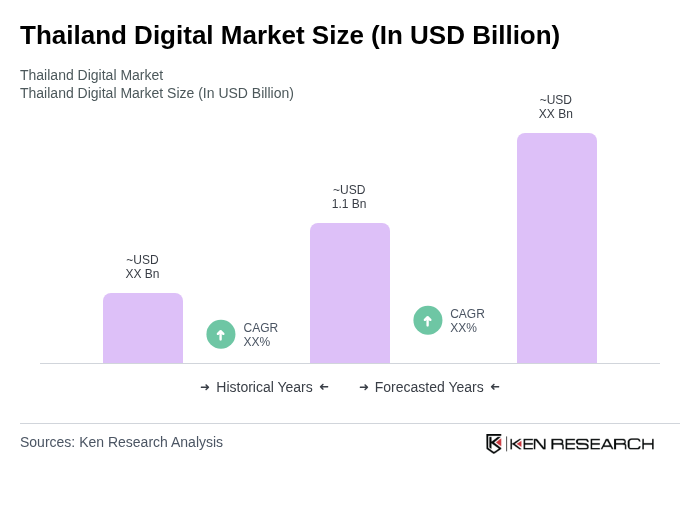
- The Thailand Digital Marketing Software Market is valued at USD 1.1 billion, based on a five-year historical analysis of regional software and digital market benchmarks and the share typically attributable to marketing technologies within overall software and software services spending in Thailand. This growth is primarily driven by the increasing adoption of digital technologies by businesses, the rapid expansion of e-commerce, and the growing importance of data analytics and AI in marketing strategies. Companies are investing in digital marketing software to enhance customer engagement, run omnichannel campaigns, personalize experiences, and optimize their marketing efforts across search, social, messaging, and marketplaces.
- Bangkok is the dominant city in the Thailand Digital Marketing Software Market due to its status as the economic and technological hub of the country, concentrating a large share of enterprises, agencies, and digital talent. The concentration of businesses, startups, and tech companies in Bangkok fosters innovation and competition, leading to a higher demand for digital marketing solutions. Other cities like Chiang Mai and Phuket are also emerging as significant players, driven by tourism, creative industries, and local businesses seeking to enhance their online presence, particularly through social media, influencer marketing, and performance advertising targeted at domestic and international visitors.
- The Thai government promotes the growth of the digital economy, including digital marketing, through the Digital Economy Promotion Agency (DEPA) under the Ministry of Digital Economy and Society, which implements programs and incentives to support digital technology adoption among businesses. Key instruments include measures under the Digital Development for Economy and Society Act, B.E. 2560 (2017), and DEPA’s subsidy and grant schemes that provide financial support, training, and advisory services for small and medium enterprises to adopt digital tools such as e-commerce, marketing platforms, and analytics, thereby enhancing their competitiveness in the global market.
Thailand Digital Marketing Software Market Segmentation
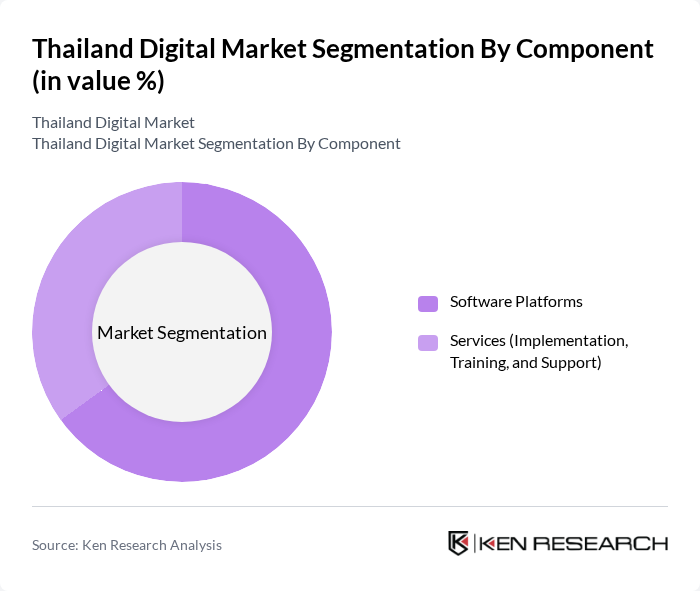
By Component:The market is segmented into Software Platforms and Services (Implementation, Training, and Support). Software platforms are increasingly favored due to their ability to provide comprehensive, integrated solutions across CRM, automation, analytics, and content management for businesses of different sizes, while services are essential for ensuring effective implementation, localization, integration with existing IT systems, and ongoing optimization and support.
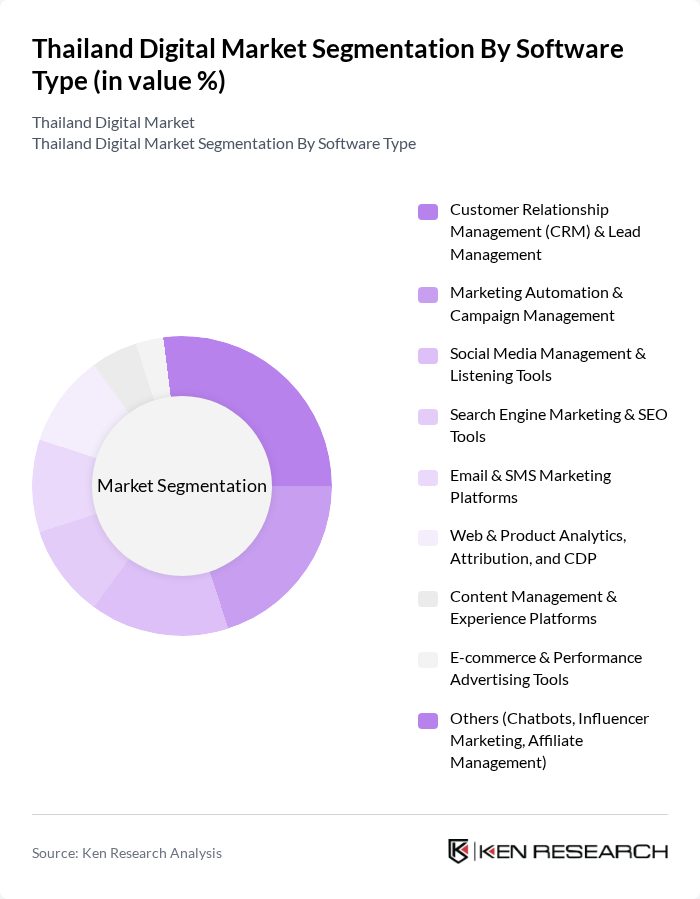
By Software Type:The market is further segmented into various software types, including Customer Relationship Management (CRM) & Lead Management, Marketing Automation & Campaign Management, Social Media Management & Listening Tools, Search Engine Marketing & SEO Tools, Email & SMS Marketing Platforms, Web & Product Analytics, Attribution, and CDP, Content Management & Experience Platforms, E-commerce & Performance Advertising Tools, and Others (Chatbots, Influencer Marketing, Affiliate Management). The CRM & Lead Management segment is currently leading the market due to the increasing need for businesses to manage customer relationships effectively, unify customer data, and support sales and service functions, while strong adoption is also seen in marketing automation and social media management as Thai consumers spend a high share of time on social and messaging platforms.
Thailand Digital Marketing Software Market Competitive Landscape
The Thailand Digital Marketing Software Market is characterized by a dynamic mix of regional and international players. Leading participants such as Google (Google Marketing Platform & Google Ads), Meta (Facebook & Instagram Ads), LINE Company (LINE Ads Platform & LINE Official Account), HubSpot, Semrush, Mailchimp, Adobe Experience Cloud, Salesforce Marketing Cloud, Hootsuite, Zoho Marketing Plus, Buffer, Sprout Social, Mixpanel, Hotjar, ClickFunnels contribute to innovation, geographic expansion, and service delivery in this space.
Thailand Digital Market Industry Analysis
Growth Drivers
- Increasing Internet Penetration:Thailand's internet penetration rate reached approximately 61 million users, representing approximately 85% of the population. This growth is driven by affordable mobile data plans and increased smartphone adoption, with around 97% of users accessing the internet via mobile devices. The World Bank projects that continued investments in digital infrastructure will further enhance connectivity, enabling more businesses to engage in online activities and consumers to access digital services, thus fueling market growth.
- Rise of E-commerce:The e-commerce sector in Thailand generated approximately THB 20 billion (USD 20 billion) in gross merchandise value for online retail, reflecting a significant increase from previous years. Factors contributing to this growth include the rise of online shopping platforms and changing consumer behavior favoring convenience. The Thai government’s initiatives to promote digital commerce, including tax incentives for e-commerce businesses, are expected to further stimulate this sector, making it a key driver of the digital market in future.
- Mobile Device Usage:As of now, Thailand had over 95 million mobile subscriptions, indicating a mobile penetration rate of around 130%. This high level of mobile device usage facilitates access to digital services and applications, driving engagement in various sectors, including finance and retail. The increasing availability of mobile payment solutions, such as e-wallets, is also enhancing consumer confidence in mobile transactions, thereby supporting the overall growth of the digital market in Thailand.
Market Challenges
- Data Privacy Concerns:With the implementation of the Personal Data Protection Act (PDPA), businesses in Thailand face significant challenges regarding data compliance. A survey indicated that 60% of companies are still unprepared for the stringent requirements, leading to potential legal repercussions and loss of consumer trust. This uncertainty can hinder digital marketing efforts and slow down the adoption of new technologies, impacting overall market growth.
- High Competition:The digital market in Thailand is characterized by intense competition, with a large number of e-commerce platforms vying for consumer attention. This saturation leads to price wars and reduced profit margins, making it difficult for new entrants to establish themselves. According to industry reports, 70% of startups in the digital space struggle to achieve profitability within their first three years, highlighting the challenges posed by a crowded marketplace and the need for differentiation.
Thailand Digital Market Future Outlook
The future of Thailand's digital market appears promising, driven by ongoing technological advancements and increasing consumer adoption of digital services. As businesses invest in innovative solutions, such as artificial intelligence and data analytics, the market is expected to evolve rapidly in future. Additionally, the government's commitment to enhancing digital infrastructure will likely facilitate greater access to online platforms, fostering a more inclusive digital economy. This environment will encourage collaboration between traditional businesses and tech startups, paving the way for new growth opportunities.
Market Opportunities
- Growth in Social Media Marketing:With over 50 million active social media users in Thailand, businesses have a significant opportunity to leverage these platforms for targeted marketing. The increasing engagement rates on social media channels present a lucrative avenue for brands to connect with consumers, enhancing brand loyalty and driving sales through personalized content and influencer partnerships.
- Expansion of Digital Payment Solutions:The digital payment landscape in Thailand is rapidly evolving, with the value of digital transactions expected to exceed THB 3 trillion (USD 90 billion) in future. The rise of e-wallets and contactless payment options is creating opportunities for businesses to streamline transactions and enhance customer experiences, positioning them favorably in a competitive market.
Scope of the Report
| Segment | Sub-Segments |
|---|---|
| By Component | Software Platforms Services (Implementation, Training, and Support) |
| By Software Type | Customer Relationship Management (CRM) & Lead Management Marketing Automation & Campaign Management Social Media Management & Listening Tools Search Engine Marketing & SEO Tools Email & SMS Marketing Platforms Web & Product Analytics, Attribution, and CDP Content Management & Experience Platforms E-commerce & Performance Advertising Tools Others (Chatbots, Influencer Marketing, Affiliate Management) |
| By Deployment Mode | Cloud / SaaS On-premise Hybrid |
| By Organization Size | Small and Medium Enterprises (SMEs) Large Enterprises |
| By End-User Industry | Retail & E-commerce Banking, Financial Services & Insurance (BFSI) Travel, Tourism & Hospitality Healthcare & Wellness Education & EdTech Media, Entertainment & Gaming Automotive & Transportation Others (Real Estate, Government, NGOs) |
| By Marketing Channel Supported | Search (SEO & SEM) Social Media (Facebook, Instagram, LINE, TikTok, Others) Email & Messaging (Email, LINE OA, SMS) Display & Video Advertising Affiliate & Influencer Marketing Omnichannel / Cross-channel Orchestration |
| By Buyer Segment | B2B B2C D2C and Marketplaces Sellers |
Key Target Audience
Investors and Venture Capitalist Firms
Government and Regulatory Bodies (e.g., Ministry of Digital Economy and Society, National Broadcasting and Telecommunications Commission)
Digital Marketing Agencies
Advertising and Media Companies
Software Development Firms
E-commerce Platforms
Telecommunications Companies
Market Research and Analytics Firms
Players Mentioned in the Report:
Google (Google Marketing Platform & Google Ads)
Meta (Facebook & Instagram Ads)
LINE Company (LINE Ads Platform & LINE Official Account)
HubSpot
Semrush
Mailchimp
Adobe Experience Cloud
Salesforce Marketing Cloud
Hootsuite
Zoho Marketing Plus
Buffer
Sprout Social
Mixpanel
Hotjar
ClickFunnels
Table of Contents
Market Assessment Phase
1. Executive Summary and Approach
2. Thailand Digital Market Overview
2.1 Key Insights and Strategic Recommendations
2.2 Thailand Digital Market Overview
2.3 Definition and Scope
2.4 Evolution of Market Ecosystem
2.5 Timeline of Key Regulatory Milestones
2.6 Value Chain & Stakeholder Mapping
2.7 Business Cycle Analysis
2.8 Policy & Incentive Landscape
3. Thailand Digital Market Analysis
3.1 Growth Drivers
3.1.1 Increasing Internet Penetration
3.1.2 Rise of E-commerce
3.1.3 Mobile Device Usage
3.1.4 Government Initiatives for Digital Transformation
3.2 Market Challenges
3.2.1 Data Privacy Concerns
3.2.2 High Competition
3.2.3 Limited Digital Literacy
3.2.4 Infrastructure Limitations
3.3 Market Opportunities
3.3.1 Growth in Social Media Marketing
3.3.2 Expansion of Digital Payment Solutions
3.3.3 Increased Investment in AI and Automation
3.3.4 Demand for Analytics and Data-Driven Marketing
3.4 Market Trends
3.4.1 Personalization in Marketing
3.4.2 Influencer Marketing Growth
3.4.3 Integration of Augmented Reality
3.4.4 Shift Towards Omnichannel Strategies
3.5 Government Regulation
3.5.1 Personal Data Protection Act
3.5.2 E-commerce Law
3.5.3 Digital Economy Promotion Act
3.5.4 Advertising Standards Regulations
4. SWOT Analysis
5. Stakeholder Analysis
6. Porter's Five Forces Analysis
7. Thailand Digital Market Market Size, 2019-2024
7.1 By Value
7.2 By Volume
7.3 By Average Selling Price
8. Thailand Digital Marketing Software Market Segmentation
8.1 By Component
8.1.1 Software Platforms
8.1.2 Services (Implementation, Training, and Support)
8.2 By Software Type
8.2.1 Customer Relationship Management (CRM) & Lead Management
8.2.2 Marketing Automation & Campaign Management
8.2.3 Social Media Management & Listening Tools
8.2.4 Search Engine Marketing & SEO Tools
8.2.5 Email & SMS Marketing Platforms
8.2.6 Web & Product Analytics, Attribution, and CDP
8.2.7 Content Management & Experience Platforms
8.2.8 E-commerce & Performance Advertising Tools
8.2.9 Others (Chatbots, Influencer Marketing, Affiliate Management)
8.3 By Deployment Mode
8.3.1 Cloud / SaaS
8.3.2 On-premise
8.3.3 Hybrid
8.4 By Organization Size
8.4.1 Small and Medium Enterprises (SMEs)
8.4.2 Large Enterprises
8.5 By End-User Industry
8.5.1 Retail & E-commerce
8.5.2 Banking, Financial Services & Insurance (BFSI)
8.5.3 Travel, Tourism & Hospitality
8.5.4 Healthcare & Wellness
8.5.5 Education & EdTech
8.5.6 Media, Entertainment & Gaming
8.5.7 Automotive & Transportation
8.5.8 Others (Real Estate, Government, NGOs)
8.6 By Marketing Channel Supported
8.6.1 Search (SEO & SEM)
8.6.2 Social Media (Facebook, Instagram, LINE, TikTok, Others)
8.6.3 Email & Messaging (Email, LINE OA, SMS)
8.6.4 Display & Video Advertising
8.6.5 Affiliate & Influencer Marketing
8.6.6 Omnichannel / Cross-channel Orchestration
8.7 By Buyer Segment
8.7.1 B2B
8.7.2 B2C
8.7.3 D2C and Marketplaces Sellers
9. Thailand Digital Market Competitive Analysis
9.1 Market Share of Key Players
9.2 Cross Comparison of Key Players
9.2.1 Company Name
9.2.2 Group Size (Large, Medium, or Small as per industry convention)
9.2.3 Annual Recurring Revenue (ARR)
9.2.4 Number of Paying Customers in Thailand
9.2.5 Average Revenue per Account (ARPA)
9.2.6 Customer Acquisition Cost (CAC)
9.2.7 Customer Lifetime Value (LTV)
9.2.8 Payback Period on CAC
9.2.9 Net Revenue Retention (NRR)
9.2.10 Gross Margin
9.2.11 Churn Rate (Logo and Revenue Churn)
9.2.12 Market Penetration (Share of Addressable Accounts in Thailand)
9.2.13 Share of Revenue from Thailand in Global Portfolio
9.2.14 Average Deal Size / Contract Value
9.2.15 Return on Marketing Investment (ROMI)
9.3 SWOT Analysis of Top Players
9.4 Pricing Analysis
9.5 Detailed Profile of Major Companies
9.5.1 Google (Google Marketing Platform & Google Ads)
9.5.2 Meta (Facebook & Instagram Ads)
9.5.3 LINE Company (LINE Ads Platform & LINE Official Account)
9.5.4 HubSpot
9.5.5 Semrush
9.5.6 Mailchimp
9.5.7 Adobe Experience Cloud
9.5.8 Salesforce Marketing Cloud
9.5.9 Hootsuite
9.5.10 Zoho Marketing Plus
9.5.11 Buffer
9.5.12 Sprout Social
9.5.13 Mixpanel
9.5.14 Hotjar
9.5.15 ClickFunnels
10. Thailand Digital Market End-User Analysis
10.1 Procurement Behavior of Key Ministries
10.1.1 Digital Marketing Budget Allocation
10.1.2 Preferred Software Solutions
10.1.3 Decision-Making Process
10.1.4 Vendor Selection Criteria
10.2 Corporate Spend on Infrastructure & Energy
10.2.1 Investment in Digital Tools
10.2.2 Budget Trends
10.2.3 ROI Expectations
10.2.4 Spending on Training and Development
10.3 Pain Point Analysis by End-User Category
10.3.1 Lack of Integration
10.3.2 High Costs of Implementation
10.3.3 Insufficient Support Services
10.3.4 Data Security Concerns
10.4 User Readiness for Adoption
10.4.1 Awareness of Digital Solutions
10.4.2 Training Needs
10.4.3 Technology Adoption Rates
10.4.4 Feedback Mechanisms
10.5 Post-Deployment ROI and Use Case Expansion
10.5.1 Measurement of Success
10.5.2 Case Studies of Successful Implementations
10.5.3 Future Expansion Plans
10.5.4 User Satisfaction Levels
11. Thailand Digital Market Future Size, 2025-2030
11.1 By Value
11.2 By Volume
11.3 By Average Selling Price
Go-To-Market Strategy Phase
1. Whitespace Analysis + Business Model Canvas
1.1 Market Gaps Identification
1.2 Business Model Framework
2. Marketing and Positioning Recommendations
2.1 Branding Strategies
2.2 Product USPs
3. Distribution Plan
3.1 Urban Retail vs Rural NGO Tie-ups
4. Channel & Pricing Gaps
4.1 Underserved Routes
4.2 Pricing Bands
5. Unmet Demand & Latent Needs
5.1 Category Gaps
5.2 Consumer Segments
6. Customer Relationship
6.1 Loyalty Programs
6.2 After-sales Service
7. Value Proposition
7.1 Sustainability
7.2 Integrated Supply Chains
8. Key Activities
8.1 Regulatory Compliance
8.2 Branding
8.3 Distribution Setup
9. Entry Strategy Evaluation
9.1 Domestic Market Entry Strategy
9.1.1 Product Mix
9.1.2 Pricing Band
9.1.3 Packaging
9.2 Export Entry Strategy
9.2.1 Target Countries
9.2.2 Compliance Roadmap
10. Entry Mode Assessment
10.1 JV
10.2 Greenfield
10.3 M&A
10.4 Distributor Model
11. Capital and Timeline Estimation
11.1 Capital Requirements
11.2 Timelines
12. Control vs Risk Trade-Off
12.1 Ownership vs Partnerships
13. Profitability Outlook
13.1 Breakeven Analysis
13.2 Long-term Sustainability
14. Potential Partner List
14.1 Distributors
14.2 JVs
14.3 Acquisition Targets
15. Execution Roadmap
15.1 Phased Plan for Market Entry
15.1.1 Market Setup
15.1.2 Market Entry
15.1.3 Growth Acceleration
15.1.4 Scale & Stabilize
15.2 Key Activities and Milestones
15.2.1 Milestone Planning
15.2.2 Activity Tracking
Research Methodology
Phase 1: Approach1
Desk Research
- Analysis of digital market reports from the National Statistical Office of Thailand
- Review of e-commerce growth statistics from the Electronic Transactions Development Agency (ETDA)
- Examination of consumer behavior studies published by local universities and research institutions
Primary Research
- Interviews with digital marketing experts and consultants in Thailand
- Surveys targeting online retailers and e-commerce platforms
- Focus groups with consumers to understand digital purchasing habits
Validation & Triangulation
- Cross-validation of findings with data from industry associations and government reports
- Triangulation of insights from expert interviews and consumer surveys
- Sanity checks through peer reviews and feedback from industry stakeholders
Phase 2: Market Size Estimation1
Top-down Assessment
- Estimation of total digital market size based on national GDP contribution from e-commerce
- Segmentation of market size by product categories and consumer demographics
- Incorporation of growth rates from previous years to project future trends
Bottom-up Modeling
- Collection of sales data from leading e-commerce platforms operating in Thailand
- Estimation of average transaction values and frequency of purchases
- Analysis of customer acquisition costs and marketing expenditures
Forecasting & Scenario Analysis
- Multi-variable forecasting using economic indicators and digital adoption rates
- Scenario analysis based on potential regulatory changes and technological advancements
- Development of best-case, worst-case, and most-likely market scenarios through 2030
Phase 3: CATI Sample Composition1
| Scope Item/Segment | Sample Size | Target Respondent Profiles |
|---|---|---|
| E-commerce Retailers | 120 | Marketing Managers, Business Development Executives |
| Digital Payment Solutions | 90 | Product Managers, Financial Analysts |
| Online Consumer Behavior | 150 | General Consumers, Frequent Online Shoppers |
| Social Media Marketing | 80 | Social Media Managers, Content Strategists |
| Logistics and Delivery Services | 70 | Operations Managers, Logistics Coordinators |
Frequently Asked Questions
What is the current value of the Thailand Digital Marketing Software Market?
The Thailand Digital Marketing Software Market is valued at approximately USD 1.1 billion. This valuation is based on a five-year historical analysis and reflects the increasing adoption of digital technologies and the growth of e-commerce in the region.
Which city is the hub for digital marketing in Thailand?
What are the main components of the Thailand Digital Marketing Software Market?
What types of software are included in the Thailand Digital Marketing Software Market?
Other Regional/Country Reports
Other Adjacent Reports
Thailand E-commerce Software Market
Philippines Customer Relationship Management Market Size, Share & Forecast 2026–2031Brazil Marketing Automation Market
Apac Social Media Management Market Report Size, Share, Growth Drivers, Trends, Opportunities & Forecast 2025–2030Thailand Search Engine Optimization Market
Brazil Email Marketing Platform Market
Oman data analytics software market report size, share, growth drivers, trends, opportunities & forecast 2025–2030KSA Artificial Intelligence Market Size, Share & Forecast, By Solution Type, Deployment Model & End-Use Industry, 2026-2031KSA Digital Advertising Market Size, Share & Forecast, By Advertising Format, Platform, End-Use Industry & Pricing Model, 2026–2031Bahrain digital payment solutions market size, share, growth drivers, trends, opportunities & forecast 2025–2030Why Buy From Us?

What makes us stand out is that our consultants follow Robust, Refine and Result (RRR) methodology. Robust for clear definitions, approaches and sanity checking, Refine for differentiating respondents' facts and opinions, and Result for presenting data with story.

We have set a benchmark in the industry by offering our clients with syndicated and customized market research reports featuring coverage of entire market as well as meticulous research and analyst insights.

While we don't replace traditional research, we flip the method upside down. Our dual approach of Top Bottom & Bottom Top ensures quality deliverable by not just verifying company fundamentals but also looking at the sector and macroeconomic factors.

With one step in the future, our research team constantly tries to show you the bigger picture. We help with some of the tough questions you may encounter along the way: How is the industry positioned? Best marketing channel? KPI's of competitors? By aligning every element, we help maximize success.

Our report gives you instant access to the answers and sources that other companies might choose to hide. We elaborate each steps of research methodology we have used and showcase you the sample size to earn your trust.

If you need any support, we are here! We pride ourselves on universe strength, data quality, and quick, friendly, and professional service.