About the Report
Base Year 2024UAE Black Mass Recycling Market Overview
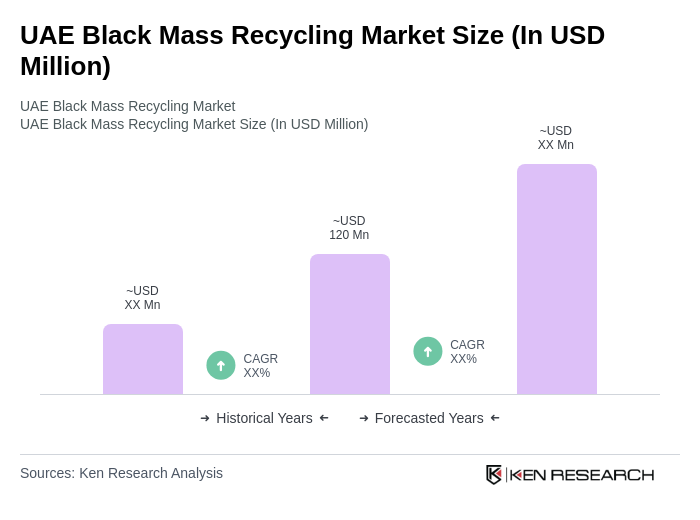
- The UAE Black Mass Recycling Market is valued at USD 120 million, based on a five-year historical analysis. This market is experiencing robust growth, primarily driven by the rising demand for sustainable waste management solutions, the rapid adoption of electric vehicles, and the increasing generation of battery waste. Government initiatives to promote recycling and reduce environmental impact further support market expansion. The UAE’s market size is a small but rapidly growing segment within the broader Middle East and global black mass recycling industry, which is valued in the tens of billions globally .
- Key players in this market include Dubai and Abu Dhabi, which lead due to their advanced infrastructure, supportive regulatory environment, and significant investments in clean technologies. The presence of major automotive, electronics, and battery recycling companies in these cities further strengthens their position, as they generate and process substantial volumes of black mass from battery waste .
- The UAE’s regulatory framework for battery waste is governed by the “Waste Management Law, Federal Law No. 12 of 2018,” issued by the Ministry of Climate Change and Environment. This law mandates the safe collection, treatment, and recycling of hazardous waste, including spent batteries, and requires licensed facilities to comply with strict operational and reporting standards. The law supports the national target of diverting at least 75% of waste from landfills and promotes a circular economy through mandatory recycling quotas for hazardous materials .
UAE Black Mass Recycling Market Segmentation
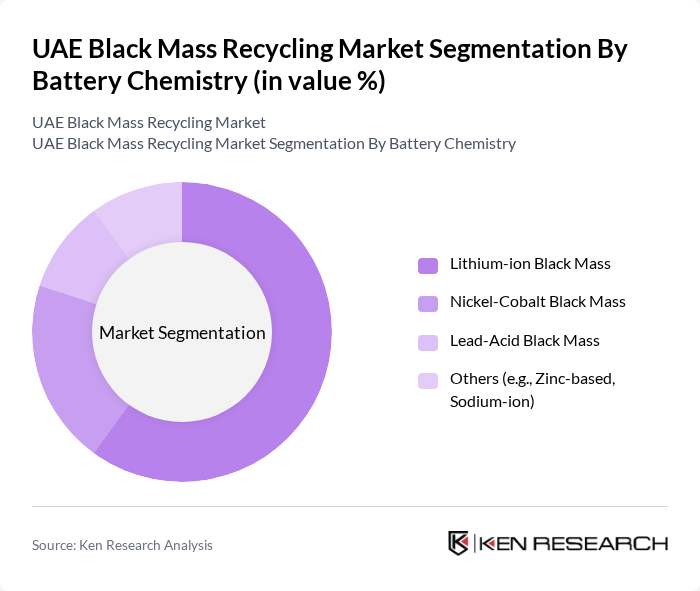
By Battery Chemistry:The battery chemistry segment covers various types of black mass derived from different battery technologies. The subsegments are Lithium-ion Black Mass, Nickel-Cobalt Black Mass, Lead-Acid Black Mass, and Others (such as Zinc-based and Sodium-ion). Lithium-ion Black Mass is the most dominant, reflecting the rapid growth of electric vehicles and portable electronics, both of which rely heavily on lithium-ion batteries. The increasing focus on recycling these batteries to recover valuable materials like lithium, cobalt, and nickel is a primary market driver .
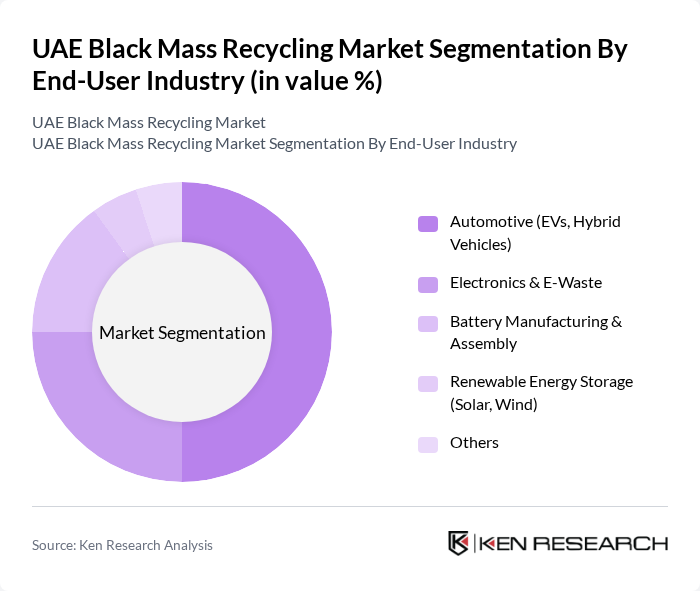
By End-User Industry:The end-user industry segment includes sectors that utilize recycled black mass. The subsegments are Automotive (EVs, Hybrid Vehicles), Electronics & E-Waste, Battery Manufacturing & Assembly, Renewable Energy Storage (Solar, Wind), and Others. The Automotive sector, especially electric vehicles, is the leading segment, driving demand for battery recycling to recover critical materials. The growth in EV production and the push for sustainable practices in the automotive industry are key contributors to this dominance .
UAE Black Mass Recycling Market Competitive Landscape
The UAE Black Mass Recycling Market features a dynamic mix of regional and international players. Leading participants such as Witthal Gulf Industries, BEEAH Group with Lohum Cleantech, Enviroserve The Recycling Hub, Ecyclex International Recycling, Madenat Al Nokhba Recycling Services, Tadweer Group, Batte-re Li-Ion Battery Recycling Ltd., AllRecycling, Exitcom Recycling, Battarity, Fortum, Umicore, BASF, Duesenfeld GmbH, and Aqua Metals contribute to innovation, geographic expansion, and service delivery in this space .
UAE Black Mass Recycling Market Industry Analysis
Growth Drivers
- Increasing Demand for Sustainable Waste Management Solutions:The UAE's waste generation reached approximately 3.5 million tons, with projections indicating a rise to 4.5 million tons. This surge in waste has driven the demand for sustainable waste management solutions, including black mass recycling. The UAE government aims to recycle 75% of its waste, highlighting the urgent need for effective recycling methods to manage this growing waste stream.
- Government Initiatives Promoting Recycling:The UAE government has allocated AED 1.5 billion (approximately USD 408 million) for waste management initiatives. This funding supports various recycling programs and infrastructure development, aiming to enhance recycling rates. Additionally, the introduction of the National Waste Management Strategy emphasizes recycling as a key component, fostering a conducive environment for black mass recycling operations to thrive.
- Rising Awareness of Environmental Issues:Public awareness regarding environmental sustainability has significantly increased, with 68% of UAE residents expressing concern about waste management. This growing consciousness has led to higher participation in recycling programs and initiatives. Educational campaigns and community engagement efforts are expected to further boost recycling rates, creating a favorable market for black mass recycling solutions in the UAE.
Market Challenges
- High Initial Investment Costs:Establishing black mass recycling facilities requires substantial capital investment, often exceeding AED 10 million (approximately USD 2.7 million) for advanced processing technologies. This financial barrier can deter new entrants and limit the expansion of existing operations. The high costs associated with technology acquisition and facility setup pose significant challenges for market players aiming to capitalize on the growing demand for recycling.
- Regulatory Compliance Complexities:The UAE's regulatory landscape for waste management is evolving, with stringent compliance requirements for recycling operations. Companies must navigate complex regulations, which can involve multiple governmental agencies. Non-compliance can result in fines exceeding AED 500,000 (approximately USD 136,000) and operational shutdowns. This regulatory complexity can hinder market growth and deter investment in black mass recycling initiatives.
UAE Black Mass Recycling Market Future Outlook
The future of the UAE black mass recycling market appears promising, driven by increasing government support and technological advancements. As the UAE aims to achieve its sustainability goals, investments in recycling infrastructure and innovative technologies are expected to rise. Furthermore, public-private partnerships will likely play a crucial role in enhancing recycling capabilities. The focus on circular economy principles will also encourage the development of new recycling methods, ensuring a sustainable approach to waste management in the region.
Market Opportunities
- Expansion of Recycling Infrastructure:The UAE's commitment to enhancing its recycling infrastructure presents significant opportunities for investment. With plans to establish 20 new recycling facilities, companies can capitalize on this growth by providing innovative recycling solutions and technologies, thereby increasing their market presence and profitability.
- Partnerships with Technology Providers:Collaborating with technology providers can enhance the efficiency of black mass recycling processes. By leveraging advanced sorting and processing technologies, companies can improve recovery rates and reduce operational costs. Such partnerships are essential for driving innovation and ensuring competitiveness in the rapidly evolving recycling market.
Scope of the Report
| Segment | Sub-Segments |
|---|---|
| By Battery Chemistry | Lithium-ion Black Mass Nickel-Cobalt Black Mass Lead-Acid Black Mass Others (e.g., Zinc-based, Sodium-ion) |
| By End-User Industry | Automotive (EVs, Hybrid Vehicles) Electronics & E-Waste Battery Manufacturing & Assembly Renewable Energy Storage (Solar, Wind) Others |
| By Collection Channel | Industrial Collection (OEMs, Large Facilities) Municipal Collection (Households, SMEs) Specialized Drop-off Centers Mobile Collection Units Others |
| By Processing Technology | Mechanical Processing Hydrometallurgical Processing Pyrometallurgical Processing Hybrid/Advanced Processing Others |
| By Geographic Region (UAE) | Abu Dhabi Dubai Sharjah Northern Emirates Others |
| By Regulatory Compliance Level | Fully Compliant (ISO, UAE Regulations) Partially Compliant Non-Compliant |
| By Investment Source | Private Investments Government Funding International Grants Joint Ventures & Partnerships Others |
Key Target Audience
Investors and Venture Capitalist Firms
Government and Regulatory Bodies (e.g., Ministry of Climate Change and Environment, Federal Authority for Nuclear Regulation)
Manufacturers and Producers of Black Mass Materials
Recycling Facility Operators
Battery Manufacturers
Waste Management Companies
Environmental NGOs and Advocacy Groups
Logistics and Supply Chain Companies
Players Mentioned in the Report:
Witthal Gulf Industries
BEEAH Group with Lohum Cleantech
Enviroserve The Recycling Hub
Ecyclex International Recycling
Madenat Al Nokhba Recycling Services
Tadweer Group
Batte-re Li-Ion Battery Recycling Ltd.
AllRecycling
Exitcom Recycling
Battarity
Fortum
Umicore
BASF
Duesenfeld GmbH
Aqua Metals
Table of Contents
Market Assessment Phase
1. Executive Summary and Approach
2. UAE Black Mass Recycling Market Overview
2.1 Key Insights and Strategic Recommendations
2.2 UAE Black Mass Recycling Market Overview
2.3 Definition and Scope
2.4 Evolution of Market Ecosystem
2.5 Timeline of Key Regulatory Milestones
2.6 Value Chain & Stakeholder Mapping
2.7 Business Cycle Analysis
2.8 Policy & Incentive Landscape
3. UAE Black Mass Recycling Market Analysis
3.1 Growth Drivers
3.1.1 Increasing demand for sustainable waste management solutions
3.1.2 Government initiatives promoting recycling
3.1.3 Rising awareness of environmental issues
3.1.4 Technological advancements in recycling processes
3.2 Market Challenges
3.2.1 High initial investment costs
3.2.2 Limited consumer awareness
3.2.3 Regulatory compliance complexities
3.2.4 Competition from alternative waste management solutions
3.3 Market Opportunities
3.3.1 Expansion of recycling infrastructure
3.3.2 Partnerships with technology providers
3.3.3 Development of new recycling technologies
3.3.4 Increasing export potential of recycled materials
3.4 Market Trends
3.4.1 Growth in circular economy initiatives
3.4.2 Adoption of advanced sorting technologies
3.4.3 Increased investment in green technologies
3.4.4 Focus on consumer education and engagement
3.5 Government Regulation
3.5.1 Implementation of recycling mandates
3.5.2 Incentives for recycling businesses
3.5.3 Stricter waste disposal regulations
3.5.4 Support for public-private partnerships in recycling
4. SWOT Analysis
5. Stakeholder Analysis
6. Porter's Five Forces Analysis
7. UAE Black Mass Recycling Market Market Size, 2019-2024
7.1 By Value
7.2 By Volume
7.3 By Average Selling Price
8. UAE Black Mass Recycling Market Segmentation
8.1 By Battery Chemistry
8.1.1 Lithium-ion Black Mass
8.1.2 Nickel-Cobalt Black Mass
8.1.3 Lead-Acid Black Mass
8.1.4 Others (e.g., Zinc-based, Sodium-ion)
8.2 By End-User Industry
8.2.1 Automotive (EVs, Hybrid Vehicles)
8.2.2 Electronics & E-Waste
8.2.3 Battery Manufacturing & Assembly
8.2.4 Renewable Energy Storage (Solar, Wind)
8.2.5 Others
8.3 By Collection Channel
8.3.1 Industrial Collection (OEMs, Large Facilities)
8.3.2 Municipal Collection (Households, SMEs)
8.3.3 Specialized Drop-off Centers
8.3.4 Mobile Collection Units
8.3.5 Others
8.4 By Processing Technology
8.4.1 Mechanical Processing
8.4.2 Hydrometallurgical Processing
8.4.3 Pyrometallurgical Processing
8.4.4 Hybrid/Advanced Processing
8.4.5 Others
8.5 By Geographic Region (UAE)
8.5.1 Abu Dhabi
8.5.2 Dubai
8.5.3 Sharjah
8.5.4 Northern Emirates
8.5.5 Others
8.6 By Regulatory Compliance Level
8.6.1 Fully Compliant (ISO, UAE Regulations)
8.6.2 Partially Compliant
8.6.3 Non-Compliant
8.7 By Investment Source
8.7.1 Private Investments
8.7.2 Government Funding
8.7.3 International Grants
8.7.4 Joint Ventures & Partnerships
8.7.5 Others
9. UAE Black Mass Recycling Market Competitive Analysis
9.1 Market Share of Key Players
9.2 Cross Comparison of Key Players
9.2.1 Company Name
9.2.2 Group Size (Large, Medium, Small)
9.2.3 Revenue Growth Rate (YoY %)
9.2.4 Market Penetration Rate (UAE market share %)
9.2.5 Customer Retention Rate (%)
9.2.6 Operational Efficiency Ratio (Output/Input, %)
9.2.7 Pricing Strategy (per ton, per kg, contract terms)
9.2.8 Return on Investment (ROI, %)
9.2.9 Average Order Value (AOV, AED/USD)
9.2.10 Customer Acquisition Cost (CAC, AED/USD)
9.2.11 Recovery Rate of Critical Metals (%)
9.2.12 Facility Utilization Rate (%)
9.2.13 Compliance Score (ISO/UAE regulatory adherence)
9.2.14 R&D Investment (% of revenue)
9.3 SWOT Analysis of Top Players
9.4 Pricing Analysis
9.5 Detailed Profile of Major Companies
9.5.1 Witthal Gulf Industries
9.5.2 BEEAH Group with Lohum Cleantech
9.5.3 Enviroserve The Recycling Hub
9.5.4 Ecyclex International Recycling
9.5.5 Madenat Al Nokhba Recycling Services
9.5.6 Tadweer Group
9.5.7 Batte-re Li-Ion Battery Recycling Ltd.
9.5.8 AllRecycling
9.5.9 Exitcom Recycling
9.5.10 Battarity
9.5.11 Fortum
9.5.12 Umicore
9.5.13 BASF
9.5.14 Duesenfeld GmbH
9.5.15 Aqua Metals
10. UAE Black Mass Recycling Market End-User Analysis
10.1 Procurement Behavior of Key Ministries
10.1.1 Ministry of Climate Change and Environment
10.1.2 Ministry of Energy and Infrastructure
10.1.3 Ministry of Industry and Advanced Technology
10.2 Corporate Spend on Infrastructure & Energy
10.2.1 Investment in Recycling Facilities
10.2.2 Budget Allocation for Sustainability Initiatives
10.2.3 Expenditure on Technology Upgrades
10.3 Pain Point Analysis by End-User Category
10.3.1 Cost of Recycling Services
10.3.2 Availability of Recycling Options
10.3.3 Quality of Recycled Materials
10.4 User Readiness for Adoption
10.4.1 Awareness of Recycling Benefits
10.4.2 Availability of Infrastructure
10.4.3 Willingness to Pay for Recycling Services
10.5 Post-Deployment ROI and Use Case Expansion
10.5.1 Measurement of Cost Savings
10.5.2 Assessment of Environmental Impact
10.5.3 Opportunities for Scaling Operations
11. UAE Black Mass Recycling Market Future Size, 2025-2030
11.1 By Value
11.2 By Volume
11.3 By Average Selling Price
Go-To-Market Strategy Phase
1. Whitespace Analysis + Business Model Canvas
1.1 Market Gaps Identification
1.2 Business Model Framework
2. Marketing and Positioning Recommendations
2.1 Branding Strategies
2.2 Product USPs
3. Distribution Plan
3.1 Urban Retail vs Rural NGO Tie-ups
4. Channel & Pricing Gaps
4.1 Underserved Routes
4.2 Pricing Bands
5. Unmet Demand & Latent Needs
5.1 Category Gaps
5.2 Consumer Segments
6. Customer Relationship
6.1 Loyalty Programs
6.2 After-sales Service
7. Value Proposition
7.1 Sustainability
7.2 Integrated Supply Chains
8. Key Activities
8.1 Regulatory Compliance
8.2 Branding
8.3 Distribution Setup
9. Entry Strategy Evaluation
9.1 Domestic Market Entry Strategy
9.1.1 Product Mix
9.1.2 Pricing Band
9.1.3 Packaging
9.2 Export Entry Strategy
9.2.1 Target Countries
9.2.2 Compliance Roadmap
10. Entry Mode Assessment
10.1 JV
10.2 Greenfield
10.3 M&A
10.4 Distributor Model
11. Capital and Timeline Estimation
11.1 Capital Requirements
11.2 Timelines
12. Control vs Risk Trade-Off
12.1 Ownership vs Partnerships
13. Profitability Outlook
13.1 Breakeven Analysis
13.2 Long-term Sustainability
14. Potential Partner List
14.1 Distributors
14.2 JVs
14.3 Acquisition Targets
15. Execution Roadmap
15.1 Phased Plan for Market Entry
15.1.1 Market Setup
15.1.2 Market Entry
15.1.3 Growth Acceleration
15.1.4 Scale & Stabilize
15.2 Key Activities and Milestones
15.2.1 Activity Timeline
15.2.2 Milestone Tracking
Research Methodology
Phase 1: Approach1
Desk Research
- Analysis of government reports on waste management and recycling policies in the UAE
- Review of industry publications and white papers on black mass recycling technologies
- Examination of market reports from environmental agencies and sustainability organizations
Primary Research
- Interviews with key stakeholders in the recycling industry, including facility operators and waste management companies
- Surveys targeting manufacturers of electronic products to understand their recycling practices
- Field visits to recycling plants to gather firsthand insights on operational processes and challenges
Validation & Triangulation
- Cross-validation of data from multiple sources, including government statistics and industry reports
- Triangulation of findings from primary interviews with secondary data insights
- Sanity checks through expert panels comprising industry veterans and academic researchers
Phase 2: Market Size Estimation1
Top-down Assessment
- Estimation of total waste generated in the UAE and the proportion suitable for black mass recycling
- Analysis of the growth of the electronics market and its impact on recycling volumes
- Incorporation of government initiatives aimed at promoting circular economy practices
Bottom-up Modeling
- Collection of data on recycling rates from existing facilities and projected capacity expansions
- Cost analysis of recycling processes, including labor, technology, and logistics
- Volume estimates based on historical data and projected growth in electronic waste generation
Forecasting & Scenario Analysis
- Development of predictive models based on trends in consumer electronics and sustainability regulations
- Scenario planning considering varying levels of regulatory enforcement and market adoption of recycling practices
- Creation of baseline, optimistic, and pessimistic forecasts for the black mass recycling market through 2030
Phase 3: CATI Sample Composition1
| Scope Item/Segment | Sample Size | Target Respondent Profiles |
|---|---|---|
| Consumer Electronics Recycling | 100 | Product Managers, Sustainability Coordinators |
| Battery Recycling Initiatives | 60 | Operations Managers, Environmental Compliance Officers |
| Metal Recovery from E-Waste | 55 | Recycling Plant Managers, Process Engineers |
| Government Policy Impact Assessment | 40 | Policy Makers, Regulatory Affairs Specialists |
| Corporate Sustainability Programs | 70 | CSR Managers, Environmental Strategists |
Frequently Asked Questions
What is the current value of the UAE Black Mass Recycling Market?
The UAE Black Mass Recycling Market is valued at approximately USD 120 million, reflecting a robust growth trajectory driven by increasing demand for sustainable waste management solutions and the rising generation of battery waste.
What factors are driving the growth of the UAE Black Mass Recycling Market?
Which cities in the UAE are leading in black mass recycling?
What types of battery chemistries are involved in black mass recycling?
Other Regional/Country Reports
Indonesia Black Mass Recycling Market
Malaysia Black Mass Recycling Market
APAC Black Mass Recycling Market
SEA Black Mass Recycling Market
Vietnam Black Mass Recycling Market
Other Adjacent Reports
Belgium E-Waste Management Market
Singapore Renewable Energy Storage Market
Malaysia Critical Minerals Mining Market
UAE Sustainable Materials Market
Us Automotive Battery Market Size, Share, Growth Drivers, Trends, Opportunities & Forecast 2025–2030Mexico Circular Economy Market
Indonesia Waste-to-Energy Market
Why Buy From Us?

What makes us stand out is that our consultants follow Robust, Refine and Result (RRR) methodology. Robust for clear definitions, approaches and sanity checking, Refine for differentiating respondents' facts and opinions, and Result for presenting data with story.

We have set a benchmark in the industry by offering our clients with syndicated and customized market research reports featuring coverage of entire market as well as meticulous research and analyst insights.

While we don't replace traditional research, we flip the method upside down. Our dual approach of Top Bottom & Bottom Top ensures quality deliverable by not just verifying company fundamentals but also looking at the sector and macroeconomic factors.

With one step in the future, our research team constantly tries to show you the bigger picture. We help with some of the tough questions you may encounter along the way: How is the industry positioned? Best marketing channel? KPI's of competitors? By aligning every element, we help maximize success.

Our report gives you instant access to the answers and sources that other companies might choose to hide. We elaborate each steps of research methodology we have used and showcase you the sample size to earn your trust.

If you need any support, we are here! We pride ourselves on universe strength, data quality, and quick, friendly, and professional service.