About the Report
Base Year 2024UAE Chatbot-Based Mental Health Apps Market Overview
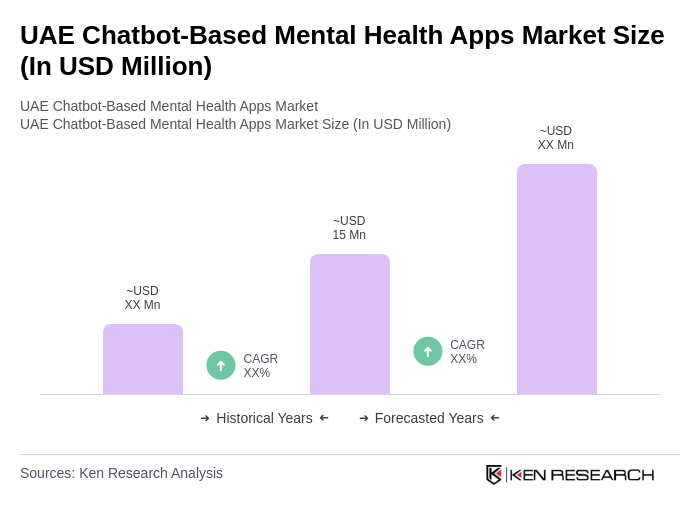
- The UAE Chatbot-Based Mental Health Apps Market is valued at USD 15 million, based on a five-year historical analysis. This growth is primarily driven by increasing awareness of mental health issues, the rising prevalence of mental health disorders, and the growing acceptance of digital health solutions among the population. The integration of advanced technologies such as artificial intelligence and machine learning in these applications has further enhanced their effectiveness and user engagement .
- Key cities dominating the market include Dubai and Abu Dhabi, which are known for their advanced healthcare infrastructure and high internet penetration rates. The UAE's diverse population and the government's focus on mental health initiatives have also contributed to the growth of this market. Additionally, the increasing number of expatriates seeking mental health support has further fueled demand for chatbot-based solutions .
- In 2023, the UAE government implemented a new regulation mandating that all mental health apps must comply with the Federal Decree-Law No. 45 of 2021 on the Protection of Personal Data, issued by the UAE Cabinet. This regulation requires mental health app providers to ensure user privacy, obtain explicit consent for data processing, and implement robust security measures, thereby enhancing the credibility of digital mental health solutions and fostering trust among users.
UAE Chatbot-Based Mental Health Apps Market Segmentation
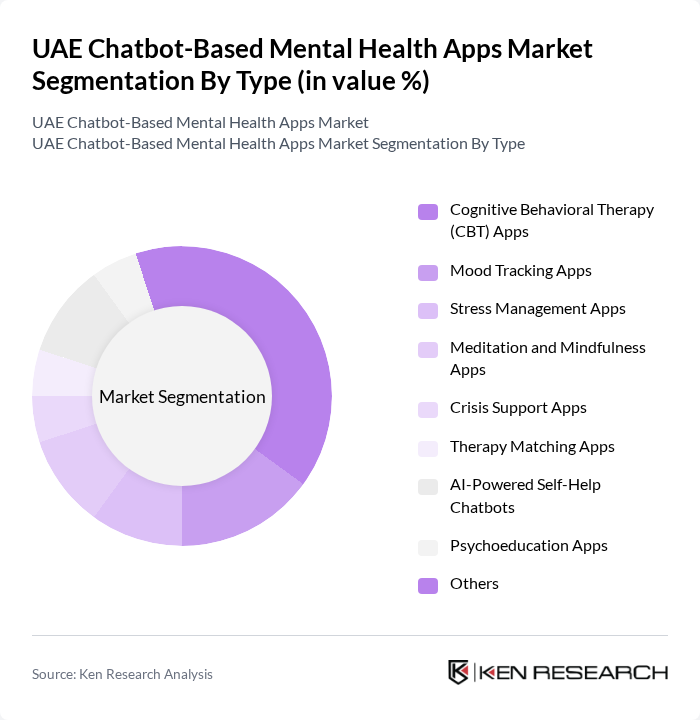
By Type:The market is segmented into various types of applications that cater to different mental health needs. The subsegments include Cognitive Behavioral Therapy (CBT) Apps, Mood Tracking Apps, Stress Management Apps, Meditation and Mindfulness Apps, Crisis Support Apps, Therapy Matching Apps, AI-Powered Self-Help Chatbots, Psychoeducation Apps, and Others. Among these, Cognitive Behavioral Therapy (CBT) Apps are leading the market due to their proven effectiveness in treating various mental health conditions and their widespread adoption in digital therapy protocols .
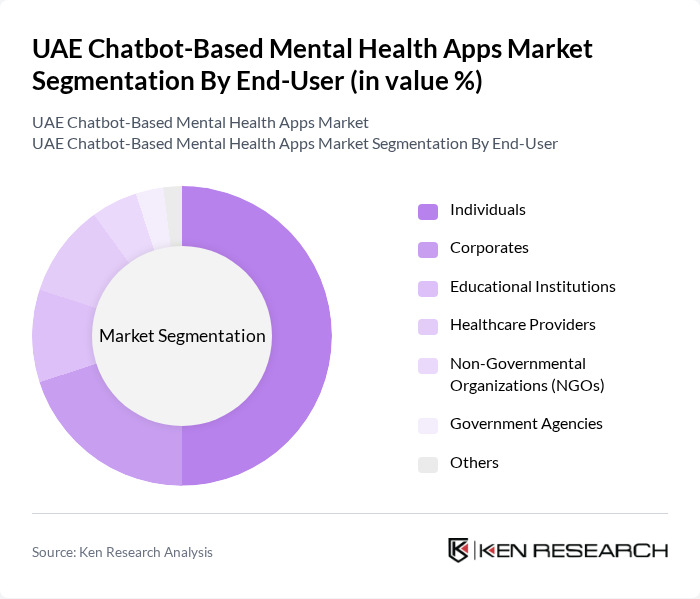
By End-User:The market is also segmented based on the end-users of these applications, which include Individuals, Corporates, Educational Institutions, Healthcare Providers, Non-Governmental Organizations (NGOs), Government Agencies, and Others. The Individual segment is the largest, driven by the increasing number of people seeking mental health support through accessible and convenient digital platforms. Corporates and healthcare providers are also expanding adoption, reflecting a growing emphasis on employee well-being and integrated care models .
UAE Chatbot-Based Mental Health Apps Market Competitive Landscape
The UAE Chatbot-Based Mental Health Apps Market is characterized by a dynamic mix of regional and international players. Leading participants such as Woebot Health, Inc., Wysa Ltd., Replika (Luka, Inc.), Youper, Inc., Sanvello Health, Inc., Headspace Health, Earkick AG, Marigold Health, MindDoc Health GmbH, 7 Cups of Tea Co., SilverCloud Health (Amwell), Lyra Health, Inc., Cognoa, Inc., Happify Health, Life Clips, Inc. (Biobeat) contribute to innovation, geographic expansion, and service delivery in this space.
UAE Chatbot-Based Mental Health Apps Market Industry Analysis
Growth Drivers
- Increasing Awareness of Mental Health Issues:The UAE has seen a significant rise in mental health awareness, with 70% of the population acknowledging mental health as a critical issue. This awareness is bolstered by campaigns from the Ministry of Health and Prevention, which allocated AED 50 million for mental health initiatives. The growing recognition of mental health's importance is driving demand for innovative solutions, including chatbot-based applications that provide immediate support and resources to users.
- Rising Demand for Accessible Mental Health Solutions:With over 99% of UAE residents owning smartphones, the demand for accessible mental health solutions is surging. The UAE's population of approximately 9.5 million includes a diverse demographic, many of whom seek convenient mental health resources. The government reported a 40% increase in telehealth consultations, indicating a shift towards digital solutions, including chatbot applications that offer 24/7 support and resources tailored to individual needs.
- Integration of AI Technology in Healthcare:The UAE is investing heavily in AI technology, with the government allocating AED 1 billion towards AI initiatives in healthcare. This investment is fostering the development of advanced chatbot-based mental health applications that utilize AI for personalized user experiences. The integration of AI allows for real-time data analysis and tailored mental health support, enhancing user engagement and satisfaction, which is crucial for the growth of this market segment.
Market Challenges
- Stigma Associated with Mental Health:Despite increasing awareness, stigma surrounding mental health remains a significant barrier in the UAE. A survey conducted recently revealed that 30% of respondents still feel uncomfortable discussing mental health issues openly. This stigma can deter potential users from seeking help through chatbot applications, limiting market growth and user engagement. Addressing this stigma is essential for increasing adoption rates of mental health solutions.
- Regulatory Hurdles for App Approval:The regulatory landscape for mental health apps in the UAE is complex, with stringent requirements for app approval. The Ministry of Health and Prevention introduced new guidelines that require extensive testing and validation of mental health applications. This process can take up to four months, delaying market entry for innovative solutions. Navigating these regulatory hurdles is crucial for developers aiming to launch effective chatbot-based mental health apps.
UAE Chatbot-Based Mental Health Apps Market Future Outlook
The future of the UAE chatbot-based mental health apps market appears promising, driven by technological advancements and increasing user acceptance. As the government continues to promote mental health initiatives, the integration of AI and telehealth services will enhance the effectiveness of these applications. Furthermore, the focus on personalized user experiences and the development of multilingual support will cater to the diverse population, ensuring that mental health resources are accessible to all segments of society.
Market Opportunities
- Expansion into Underserved Demographics:There is a significant opportunity to target underserved demographics, particularly expatriates and low-income groups. Approximately 88% of the UAE's population consists of expatriates, many of whom may lack access to traditional mental health services. Developing chatbot applications that cater specifically to these groups can enhance accessibility and engagement, ultimately improving mental health outcomes.
- Partnerships with Healthcare Providers:Collaborating with healthcare providers presents a valuable opportunity for chatbot-based mental health apps. By partnering with hospitals and clinics, developers can integrate their solutions into existing healthcare frameworks. This collaboration can facilitate referrals and enhance user trust, as healthcare providers can recommend these applications to patients, thereby increasing user adoption and retention rates.
Scope of the Report
| Segment | Sub-Segments |
|---|---|
| By Type | Cognitive Behavioral Therapy (CBT) Apps Mood Tracking Apps Stress Management Apps Meditation and Mindfulness Apps Crisis Support Apps Therapy Matching Apps AI-Powered Self-Help Chatbots Psychoeducation Apps Others |
| By End-User | Individuals Corporates Educational Institutions Healthcare Providers Non-Governmental Organizations (NGOs) Government Agencies Others |
| By User Demographics | Age Groups (Children, Adolescents, Adults, Seniors) Gender Socioeconomic Status Geographic Location (Urban, Semi-Urban, Rural) |
| By Subscription Model | Free Freemium Monthly Subscription Annual Subscription Pay-Per-Session |
| By Distribution Channel | App Stores Direct Downloads Partnerships with Healthcare Providers Corporate Wellness Programs Telehealth Platforms |
| By Language Support | English Arabic Other Regional Languages Multilingual Support |
| By User Engagement Features | Chatbot Interaction Community Support Progress Tracking Personalized Recommendations Gamification Elements Integration with Wearables |
Key Target Audience
Investors and Venture Capitalist Firms
Government and Regulatory Bodies (e.g., Ministry of Health and Prevention, Dubai Health Authority)
Healthcare Providers and Clinics
Insurance Companies
Technology Developers and Software Companies
Telecommunications Companies
Non-Governmental Organizations (NGOs) focused on mental health
Corporate Wellness Program Managers
Players Mentioned in the Report:
Woebot Health, Inc.
Wysa Ltd.
Replika (Luka, Inc.)
Youper, Inc.
Sanvello Health, Inc.
Headspace Health
Earkick AG
Marigold Health
MindDoc Health GmbH
7 Cups of Tea Co.
SilverCloud Health (Amwell)
Lyra Health, Inc.
Cognoa, Inc.
Happify Health
Life Clips, Inc. (Biobeat)
Table of Contents
Market Assessment Phase
1. Executive Summary and Approach
2. UAE Chatbot-Based Mental Health Apps Market Overview
2.1 Key Insights and Strategic Recommendations
2.2 UAE Chatbot-Based Mental Health Apps Market Overview
2.3 Definition and Scope
2.4 Evolution of Market Ecosystem
2.5 Timeline of Key Regulatory Milestones
2.6 Value Chain & Stakeholder Mapping
2.7 Business Cycle Analysis
2.8 Policy & Incentive Landscape
3. UAE Chatbot-Based Mental Health Apps Market Analysis
3.1 Growth Drivers
3.1.1 Increasing awareness of mental health issues
3.1.2 Rising demand for accessible mental health solutions
3.1.3 Integration of AI technology in healthcare
3.1.4 Government initiatives promoting mental health
3.2 Market Challenges
3.2.1 Stigma associated with mental health
3.2.2 Regulatory hurdles for app approval
3.2.3 Data privacy concerns
3.2.4 Limited user engagement and retention
3.3 Market Opportunities
3.3.1 Expansion into underserved demographics
3.3.2 Partnerships with healthcare providers
3.3.3 Development of multilingual support
3.3.4 Utilization of telehealth integration
3.4 Market Trends
3.4.1 Increased personalization in mental health apps
3.4.2 Growth of subscription-based models
3.4.3 Use of gamification to enhance user experience
3.4.4 Focus on holistic mental wellness solutions
3.5 Government Regulation
3.5.1 Licensing requirements for mental health apps
3.5.2 Data protection regulations
3.5.3 Guidelines for telehealth services
3.5.4 Standards for app efficacy and safety
4. SWOT Analysis
5. Stakeholder Analysis
6. Porter's Five Forces Analysis
7. UAE Chatbot-Based Mental Health Apps Market Market Size, 2019-2024
7.1 By Value
7.2 By Volume
7.3 By Average Selling Price
8. UAE Chatbot-Based Mental Health Apps Market Segmentation
8.1 By Type
8.1.1 Cognitive Behavioral Therapy (CBT) Apps
8.1.2 Mood Tracking Apps
8.1.3 Stress Management Apps
8.1.4 Meditation and Mindfulness Apps
8.1.5 Crisis Support Apps
8.1.6 Therapy Matching Apps
8.1.7 AI-Powered Self-Help Chatbots
8.1.8 Psychoeducation Apps
8.1.9 Others
8.2 By End-User
8.2.1 Individuals
8.2.2 Corporates
8.2.3 Educational Institutions
8.2.4 Healthcare Providers
8.2.5 Non-Governmental Organizations (NGOs)
8.2.6 Government Agencies
8.2.7 Others
8.3 By User Demographics
8.3.1 Age Groups (Children, Adolescents, Adults, Seniors)
8.3.2 Gender
8.3.3 Socioeconomic Status
8.3.4 Geographic Location (Urban, Semi-Urban, Rural)
8.4 By Subscription Model
8.4.1 Free
8.4.2 Freemium
8.4.3 Monthly Subscription
8.4.4 Annual Subscription
8.4.5 Pay-Per-Session
8.5 By Distribution Channel
8.5.1 App Stores
8.5.2 Direct Downloads
8.5.3 Partnerships with Healthcare Providers
8.5.4 Corporate Wellness Programs
8.5.5 Telehealth Platforms
8.6 By Language Support
8.6.1 English
8.6.2 Arabic
8.6.3 Other Regional Languages
8.6.4 Multilingual Support
8.7 By User Engagement Features
8.7.1 Chatbot Interaction
8.7.2 Community Support
8.7.3 Progress Tracking
8.7.4 Personalized Recommendations
8.7.5 Gamification Elements
8.7.6 Integration with Wearables
9. UAE Chatbot-Based Mental Health Apps Market Competitive Analysis
9.1 Market Share of Key Players
9.2 Cross Comparison of Key Players
9.2.1 Company Name
9.2.2 Group Size (Large, Medium, or Small as per industry convention)
9.2.3 Number of Monthly Active Users (MAU)
9.2.4 User Acquisition Cost (UAC)
9.2.5 Customer Lifetime Value (CLV)
9.2.6 Retention Rate (30/90/180 days)
9.2.7 Average Session Duration
9.2.8 Churn Rate
9.2.9 Revenue Growth Rate (YoY)
9.2.10 Market Penetration Rate (UAE-specific)
9.2.11 Customer Satisfaction Score (CSAT/NPS)
9.2.12 Regulatory Compliance (HIPAA/GDPR/UAE Data Law)
9.2.13 Language Support (Arabic/English/Other)
9.2.14 AI Capabilities (NLP, Sentiment Analysis, Personalization)
9.2.15 Partnerships with UAE Healthcare Entities
9.3 SWOT Analysis of Top Players
9.4 Pricing Analysis
9.5 Detailed Profile of Major Companies
9.5.1 Woebot Health, Inc.
9.5.2 Wysa Ltd.
9.5.3 Replika (Luka, Inc.)
9.5.4 Youper, Inc.
9.5.5 Sanvello Health, Inc.
9.5.6 Headspace Health
9.5.7 Earkick AG
9.5.8 Marigold Health
9.5.9 MindDoc Health GmbH
9.5.10 7 Cups of Tea Co.
9.5.11 SilverCloud Health (Amwell)
9.5.12 Lyra Health, Inc.
9.5.13 Cognoa, Inc.
9.5.14 Happify Health
9.5.15 Life Clips, Inc. (Biobeat)
10. UAE Chatbot-Based Mental Health Apps Market End-User Analysis
10.1 Procurement Behavior of Key Ministries
10.1.1 Budget Allocation for Mental Health Initiatives
10.1.2 Evaluation Criteria for App Selection
10.1.3 Collaboration with Tech Providers
10.2 Corporate Spend on Infrastructure & Energy
10.2.1 Investment in Employee Wellness Programs
10.2.2 Budget for Digital Health Solutions
10.3 Pain Point Analysis by End-User Category
10.3.1 Accessibility Issues
10.3.2 Affordability Concerns
10.3.3 Lack of Awareness
10.4 User Readiness for Adoption
10.4.1 Familiarity with Technology
10.4.2 Willingness to Use Digital Solutions
10.5 Post-Deployment ROI and Use Case Expansion
10.5.1 Measurement of User Engagement
10.5.2 Assessment of Mental Health Outcomes
11. UAE Chatbot-Based Mental Health Apps Market Future Size, 2025-2030
11.1 By Value
11.2 By Volume
11.3 By Average Selling Price
Go-To-Market Strategy Phase
1. Whitespace Analysis + Business Model Canvas
1.1 Market Gaps Identification
1.2 Business Model Framework
2. Marketing and Positioning Recommendations
2.1 Branding Strategies
2.2 Product USPs
3. Distribution Plan
3.1 Urban Retail vs Rural NGO Tie-ups
4. Channel & Pricing Gaps
4.1 Underserved Routes
4.2 Pricing Bands
5. Unmet Demand & Latent Needs
5.1 Category Gaps
5.2 Consumer Segments
6. Customer Relationship
6.1 Loyalty Programs
6.2 After-sales Service
7. Value Proposition
7.1 Sustainability
7.2 Integrated Supply Chains
8. Key Activities
8.1 Regulatory Compliance
8.2 Branding
8.3 Distribution Setup
9. Entry Strategy Evaluation
9.1 Domestic Market Entry Strategy
9.1.1 Product Mix
9.1.2 Pricing Band
9.1.3 Packaging
9.2 Export Entry Strategy
9.2.1 Target Countries
9.2.2 Compliance Roadmap
10. Entry Mode Assessment
10.1 JV
10.2 Greenfield
10.3 M&A
10.4 Distributor Model
11. Capital and Timeline Estimation
11.1 Capital Requirements
11.2 Timelines
12. Control vs Risk Trade-Off
12.1 Ownership vs Partnerships
13. Profitability Outlook
13.1 Breakeven Analysis
13.2 Long-term Sustainability
14. Potential Partner List
14.1 Distributors
14.2 JVs
14.3 Acquisition Targets
15. Execution Roadmap
15.1 Phased Plan for Market Entry
15.1.1 Market Setup
15.1.2 Market Entry
15.1.3 Growth Acceleration
15.1.4 Scale & Stabilize
15.2 Key Activities and Milestones
15.2.1 Activity Timeline
15.2.2 Milestone Tracking
Research Methodology
Phase 1: Approach1
Desk Research
- Analysis of existing literature on mental health trends in the UAE
- Review of government health reports and statistics on mental health issues
- Examination of market reports on mobile health technologies and chatbot applications
Primary Research
- Interviews with mental health professionals and therapists in the UAE
- Surveys targeting users of mental health apps to gather user experience data
- Focus groups with stakeholders in the healthcare and technology sectors
Validation & Triangulation
- Cross-validation of findings with academic research on digital mental health solutions
- Triangulation of data from user surveys and expert interviews
- Sanity checks through feedback from a panel of mental health experts
Phase 2: Market Size Estimation1
Top-down Assessment
- Estimation of the total addressable market based on national health expenditure
- Segmentation of the market by user demographics and app functionalities
- Incorporation of growth rates from related sectors such as telehealth
Bottom-up Modeling
- Analysis of user acquisition rates from leading mental health apps in the UAE
- Cost analysis of app development and operational expenses
- Revenue projections based on subscription models and in-app purchases
Forecasting & Scenario Analysis
- Multi-variable forecasting using trends in mental health awareness and technology adoption
- Scenario modeling based on potential regulatory changes and market entry of new players
- Baseline, optimistic, and pessimistic projections through 2030
Phase 3: CATI Sample Composition1
| Scope Item/Segment | Sample Size | Target Respondent Profiles |
|---|---|---|
| General User Experience with Mental Health Apps | 120 | App Users, Mental Health Advocates |
| Professional Insights from Mental Health Practitioners | 60 | Psychologists, Psychiatrists, Counselors |
| Technology Adoption in Healthcare | 50 | Healthcare IT Managers, Digital Health Innovators |
| User Demographics and Preferences | 90 | Young Adults, Parents, Caregivers |
| Market Trends and Future Outlook | 40 | Industry Analysts, Market Researchers |
Frequently Asked Questions
What is the current value of the UAE Chatbot-Based Mental Health Apps Market?
The UAE Chatbot-Based Mental Health Apps Market is valued at approximately USD 15 million, reflecting a significant growth driven by increased awareness of mental health issues and the acceptance of digital health solutions among the population.
What factors are driving the growth of chatbot-based mental health apps in the UAE?
Which cities in the UAE are leading in the chatbot-based mental health apps market?
What types of applications are included in the UAE chatbot-based mental health apps market?
Other Regional/Country Reports
Indonesia Chatbot Based Mental Health Apps Market
Malaysia Chatbot Based Mental Health Apps Market
KSA Chatbot Based Mental Health Apps Market
APAC Chatbot Based Mental Health Apps Market
SEA Chatbot Based Mental Health Apps Market
Vietnam Chatbot Based Mental Health Apps Market
Other Adjacent Reports
Mexico Behavioral Health Software Market
Kuwait Wellness Apps Market Report Size Share Growth Drivers Trends Opportunities & Forecast 2025–2030Kuwait Chatbot Technology Market
Mexico Healthcare IT Solutions Market
UAE E-Health Platforms Market
Why Buy From Us?

What makes us stand out is that our consultants follow Robust, Refine and Result (RRR) methodology. Robust for clear definitions, approaches and sanity checking, Refine for differentiating respondents' facts and opinions, and Result for presenting data with story.

We have set a benchmark in the industry by offering our clients with syndicated and customized market research reports featuring coverage of entire market as well as meticulous research and analyst insights.

While we don't replace traditional research, we flip the method upside down. Our dual approach of Top Bottom & Bottom Top ensures quality deliverable by not just verifying company fundamentals but also looking at the sector and macroeconomic factors.

With one step in the future, our research team constantly tries to show you the bigger picture. We help with some of the tough questions you may encounter along the way: How is the industry positioned? Best marketing channel? KPI's of competitors? By aligning every element, we help maximize success.

Our report gives you instant access to the answers and sources that other companies might choose to hide. We elaborate each steps of research methodology we have used and showcase you the sample size to earn your trust.

If you need any support, we are here! We pride ourselves on universe strength, data quality, and quick, friendly, and professional service.