About the Report
Base Year 2024UAE the Enterprise Wearables Market Overview
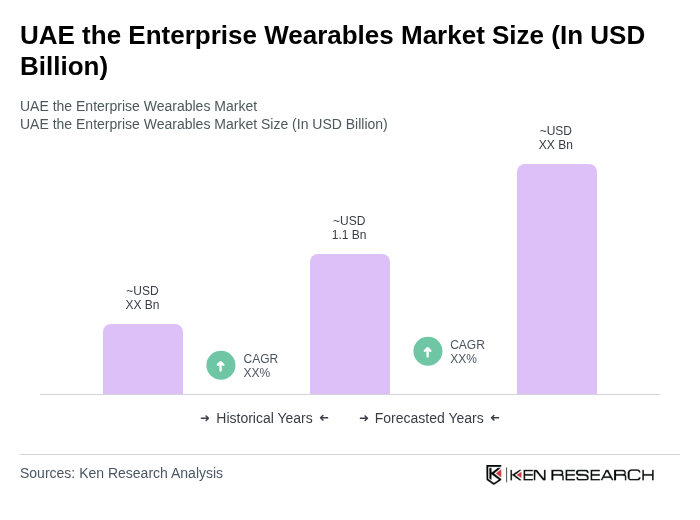
- The UAE Enterprise Wearables Market is valued at USD 1.1 billion, based on a five-year historical analysis. This growth is primarily driven by the increasing adoption of wearable technology across sectors such as healthcare, manufacturing, logistics, oil and gas, and utilities, as organizations seek to enhance productivity, enable hands-free workflows, and improve employee safety. The demand for advanced wearable devices that facilitate real-time data collection, communication, health and vital sign monitoring, and location tracking is also contributing to market expansion.
- Dubai and Abu Dhabi are the dominant cities in the UAE Enterprise Wearables Market due to their status as economic hubs with strong smart city, Industry 4.0, and digital transformation initiatives, including Dubai’s Smart Dubai agenda and Abu Dhabi’s Ghadan 21 and industrial strategy. The presence of numerous multinational corporations, regional headquarters, and a growing number of technology startups and system integrators in these cities further accelerates the adoption of enterprise wearables, making them key centers for deployment in healthcare, logistics, aviation, retail, and government services.
- To strengthen worker protection in high?risk environments, the UAE has progressively embedded technology-enabled safety and monitoring requirements into sectoral regulations and guidelines, including the Ministerial Resolution No. 44 of 2022 on Occupational Health and Safety in Establishments issued by the UAE Ministry of Human Resources and Emiratisation, which requires employers in hazardous industries such as construction and manufacturing to implement systems and equipment that monitor and mitigate occupational risks. In parallel, initiatives such as the Dubai 3D Digital Twin and smart construction programs, as well as safety mandates from entities like ADNOC and major construction clients, are encouraging the use of connected personal protective equipment, location-tracking badges, and vital-sign monitoring wearables to enhance compliance, incident prevention, and emergency response.
UAE the Enterprise Wearables Market Segmentation
By Device Type:
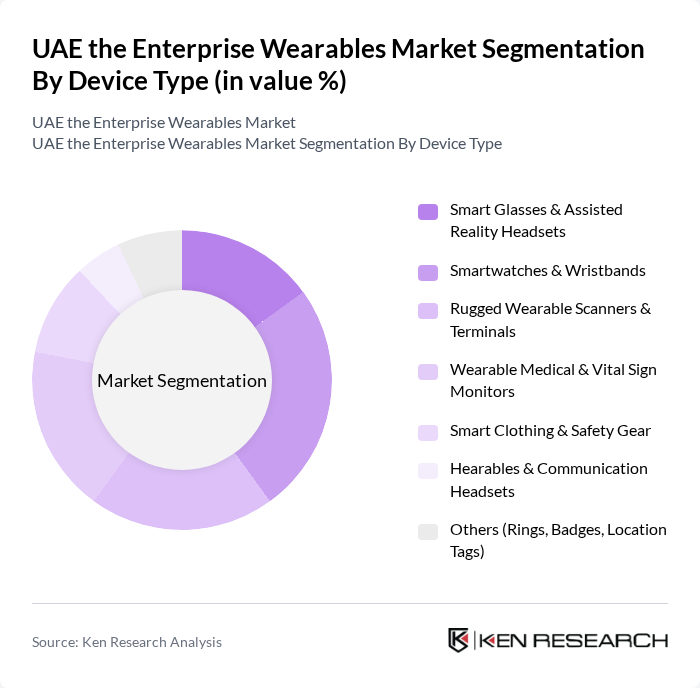
The device type segment of the UAE Enterprise Wearables Market is led by Smartwatches & Wristbands, which account for a significant share due to their versatility and widespread adoption across industries for health and vital sign monitoring, activity tracking, and real-time notifications. These devices are favored for their ability to monitor health metrics, facilitate communication, and enhance productivity in use cases such as corporate wellness programs, lone-worker monitoring, and shift management. The increasing focus on employee wellness, heat-stress management, and safety in sectors like healthcare, logistics, construction, and oil and gas has further propelled the demand for these wearables, making them a preferred choice among enterprises looking to leverage technology for operational efficiency.
By Use Case:
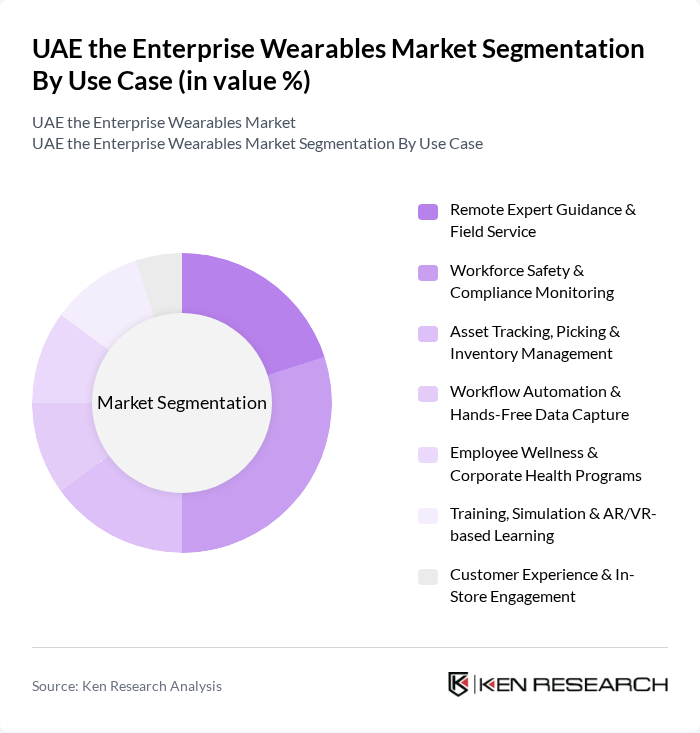
The Use Case segment is dominated by Workforce Safety & Compliance Monitoring, which is critical in industries such as construction, oil and gas, utilities, and manufacturing, where wearables are used to track worker location, detect falls, monitor exposure to heat and hazardous environments, and ensure adherence to safety protocols. Companies are increasingly adopting wearables to ensure compliance with occupational health and safety requirements and to monitor employee health in real-time, often integrating devices with command-center dashboards and incident management systems. This trend is driven by the need to reduce workplace accidents, improve emergency response, and enhance overall safety, making it a key focus area for enterprises investing in wearable technology.
UAE the Enterprise Wearables Market Competitive Landscape
The UAE Enterprise Wearables Market is characterized by a dynamic mix of regional and international players. Leading participants such as Samsung Electronics Co., Ltd., Apple Inc., Microsoft Corporation, Google LLC, Fitbit Inc., Garmin Ltd., Huawei Technologies Co., Ltd., Sony Corporation, Vuzix Corporation, Seiko Epson Corporation, RealWear, Inc., Zebra Technologies Corporation, Honeywell International Inc., Magic Leap, Inc., Other Emerging Enterprise Wearable Vendors (Regional & Niche) contribute to innovation, geographic expansion, and service delivery in this space.
UAE the Enterprise Wearables Market Industry Analysis
Growth Drivers
- Increasing Demand for Remote Monitoring Solutions:The UAE's healthcare sector is projected to grow to AED 78 billion by 2025, driving the demand for remote monitoring solutions. With a population of approximately 9.5 million, the need for efficient health management systems is critical. Wearable devices that facilitate remote patient monitoring are becoming essential, especially in chronic disease management, which affects around 35% of the population, thus enhancing the market for enterprise wearables significantly.
- Rising Adoption of IoT in Enterprise Applications:The UAE's IoT market is expected to reach AED 40 billion by 2025, with enterprises increasingly integrating IoT solutions into their operations. This integration enhances operational efficiency and data collection, making wearables a vital component. As of now, over 70% of businesses in the UAE have adopted IoT technologies, indicating a robust trend towards smart devices, including wearables, that facilitate real-time data access and decision-making.
- Enhanced Productivity through Wearable Technology:Companies in the UAE are recognizing the productivity benefits of wearable technology, with studies showing a potential increase in productivity by up to 25%. In sectors like logistics and manufacturing, wearables streamline processes and reduce downtime. The UAE's focus on becoming a global business hub, with initiatives like the Dubai Industrial Strategy 2030, further supports the integration of wearables to enhance workforce efficiency and operational effectiveness.
Market Challenges
- High Initial Investment Costs:The upfront costs associated with implementing wearable technology can be significant, often exceeding AED 120,000 for comprehensive enterprise solutions. Many small to medium-sized enterprises (SMEs) in the UAE face budget constraints, limiting their ability to invest in such technologies. This financial barrier can hinder the widespread adoption of wearables, despite their potential benefits in improving operational efficiency and employee safety.
- Data Privacy and Security Concerns:With the UAE's data protection laws becoming more stringent, enterprises face challenges in ensuring compliance while utilizing wearable technology. The cost of non-compliance can reach AED 1.2 million, creating apprehension among businesses. Additionally, the risk of data breaches remains a significant concern, as 75% of organizations report increased anxiety over data security, which can deter investment in wearable solutions that collect sensitive information.
UAE the Enterprise Wearables Market Future Outlook
The future of the enterprise wearables market in the UAE appears promising, driven by technological advancements and increasing digital transformation initiatives. As organizations prioritize employee health and safety, the integration of wearables into workplace environments is expected to rise. Furthermore, the collaboration between technology providers and enterprises will likely foster innovative solutions tailored to specific industry needs, enhancing overall productivity and operational efficiency in the coming years.
Market Opportunities
- Expansion in Healthcare Applications:The healthcare sector's growth presents significant opportunities for wearables, particularly in telemedicine and chronic disease management. With the UAE's healthcare spending projected to reach AED 78 billion by 2025, wearables that monitor health metrics can play a crucial role in improving patient outcomes and reducing hospital visits, thus driving market growth.
- Integration with AI and Machine Learning:The convergence of wearables with AI and machine learning technologies offers substantial market potential. In future, the AI market in the UAE is expected to reach AED 10 billion, enabling wearables to provide predictive analytics and personalized insights. This integration can enhance decision-making processes in enterprises, making wearables more valuable and appealing to businesses.
Scope of the Report
| Segment | Sub-Segments |
|---|---|
| By Device Type | Smart Glasses & Assisted Reality Headsets Smartwatches & Wristbands Rugged Wearable Scanners & Terminals Wearable Medical & Vital Sign Monitors Smart Clothing & Safety Gear Hearables & Communication Headsets Others (Rings, Badges, Location Tags) |
| By Use Case | Remote Expert Guidance & Field Service Workforce Safety & Compliance Monitoring Asset Tracking, Picking & Inventory Management Workflow Automation & Hands-Free Data Capture Employee Wellness & Corporate Health Programs Training, Simulation & AR/VR-based Learning Customer Experience & In-Store Engagement |
| By Industry Vertical | Healthcare Providers & Home Care Oil & Gas, Utilities and Heavy Industries Manufacturing & Industrial Automation Transportation, Logistics & Warehousing Retail, Hospitality & Smart Venues Government, Defense & Public Safety Others (Education, Corporate Offices, BFSI) |
| By Functionality | Health & Vital Sign Monitoring Real-Time Communication & Collaboration Location & Movement Tracking Data Collection, Sensing & Analytics AR/VR Visualization & Guided Workflows Access Control & Authentication |
| By Connectivity | Bluetooth / BLE Wi-Fi / Wi-Fi 6 Cellular (4G/5G, NB-IoT, LTE-M) NFC / RFID Others (LoRaWAN, Proprietary Protocols) |
| By Deployment Mode | On-Premises Cloud-Based (SaaS) Hybrid |
| By Emirate / Region | Abu Dhabi Dubai Sharjah Ajman Ras Al Khaimah Fujairah Umm Al Quwain & Others |
Key Target Audience
Investors and Venture Capitalist Firms
Government and Regulatory Bodies (e.g., UAE Ministry of Economy, Telecommunications and Digital Government Regulatory Authority)
Manufacturers and Producers
Distributors and Retailers
Healthcare Providers and Institutions
Logistics and Supply Chain Companies
Telecommunications Companies
Insurance Companies
Players Mentioned in the Report:
Samsung Electronics Co., Ltd.
Apple Inc.
Microsoft Corporation
Google LLC
Fitbit Inc.
Garmin Ltd.
Huawei Technologies Co., Ltd.
Sony Corporation
Vuzix Corporation
Seiko Epson Corporation
RealWear, Inc.
Zebra Technologies Corporation
Honeywell International Inc.
Magic Leap, Inc.
Other Emerging Enterprise Wearable Vendors (Regional & Niche)
Table of Contents
Market Assessment Phase
1. Executive Summary and Approach
2. UAE the Enterprise Wearables Market Overview
2.1 Key Insights and Strategic Recommendations
2.2 UAE the Enterprise Wearables Market Overview
2.3 Definition and Scope
2.4 Evolution of Market Ecosystem
2.5 Timeline of Key Regulatory Milestones
2.6 Value Chain & Stakeholder Mapping
2.7 Business Cycle Analysis
2.8 Policy & Incentive Landscape
3. UAE the Enterprise Wearables Market Analysis
3.1 Growth Drivers
3.1.1 Increasing demand for remote monitoring solutions
3.1.2 Rising adoption of IoT in enterprise applications
3.1.3 Enhanced productivity through wearable technology
3.1.4 Growing focus on employee health and safety
3.2 Market Challenges
3.2.1 High initial investment costs
3.2.2 Data privacy and security concerns
3.2.3 Limited interoperability with existing systems
3.2.4 Rapid technological changes
3.3 Market Opportunities
3.3.1 Expansion in healthcare applications
3.3.2 Integration with AI and machine learning
3.3.3 Development of customized solutions for industries
3.3.4 Increasing government support for digital transformation
3.4 Market Trends
3.4.1 Shift towards augmented reality wearables
3.4.2 Growth of smart glasses in enterprise settings
3.4.3 Emphasis on data analytics for performance improvement
3.4.4 Rise of subscription-based wearable services
3.5 Government Regulation
3.5.1 Compliance with data protection laws
3.5.2 Standards for wearable device safety
3.5.3 Regulations on health monitoring devices
3.5.4 Incentives for technology adoption in enterprises
4. SWOT Analysis
5. Stakeholder Analysis
6. Porter's Five Forces Analysis
7. UAE the Enterprise Wearables Market Market Size, 2019-2024
7.1 By Value
7.2 By Volume
7.3 By Average Selling Price
8. UAE the Enterprise Wearables Market Segmentation
8.1 By Device Type
8.1.1 Smart Glasses & Assisted Reality Headsets
8.1.2 Smartwatches & Wristbands
8.1.3 Rugged Wearable Scanners & Terminals
8.1.4 Wearable Medical & Vital Sign Monitors
8.1.5 Smart Clothing & Safety Gear
8.1.6 Hearables & Communication Headsets
8.1.7 Others (Rings, Badges, Location Tags)
8.2 By Use Case
8.2.1 Remote Expert Guidance & Field Service
8.2.2 Workforce Safety & Compliance Monitoring
8.2.3 Asset Tracking, Picking & Inventory Management
8.2.4 Workflow Automation & Hands-Free Data Capture
8.2.5 Employee Wellness & Corporate Health Programs
8.2.6 Training, Simulation & AR/VR-based Learning
8.2.7 Customer Experience & In-Store Engagement
8.3 By Industry Vertical
8.3.1 Healthcare Providers & Home Care
8.3.2 Oil & Gas, Utilities and Heavy Industries
8.3.3 Manufacturing & Industrial Automation
8.3.4 Transportation, Logistics & Warehousing
8.3.5 Retail, Hospitality & Smart Venues
8.3.6 Government, Defense & Public Safety
8.3.7 Others (Education, Corporate Offices, BFSI)
8.4 By Functionality
8.4.1 Health & Vital Sign Monitoring
8.4.2 Real-Time Communication & Collaboration
8.4.3 Location & Movement Tracking
8.4.4 Data Collection, Sensing & Analytics
8.4.5 AR/VR Visualization & Guided Workflows
8.4.6 Access Control & Authentication
8.5 By Connectivity
8.5.1 Bluetooth / BLE
8.5.2 Wi-Fi / Wi-Fi 6
8.5.3 Cellular (4G/5G, NB-IoT, LTE-M)
8.5.4 NFC / RFID
8.5.5 Others (LoRaWAN, Proprietary Protocols)
8.6 By Deployment Mode
8.6.1 On-Premises
8.6.2 Cloud-Based (SaaS)
8.6.3 Hybrid
8.7 By Emirate / Region
8.7.1 Abu Dhabi
8.7.2 Dubai
8.7.3 Sharjah
8.7.4 Ajman
8.7.5 Ras Al Khaimah
8.7.6 Fujairah
8.7.7 Umm Al Quwain & Others
9. UAE the Enterprise Wearables Market Competitive Analysis
9.1 Market Share of Key Players
9.2 Cross Comparison of Key Players
9.2.1 Company Name
9.2.2 Enterprise Wearables Revenue from UAE (Latest Year)
9.2.3 3-Year CAGR in Enterprise Wearables Revenue (Global/UAE)
9.2.4 Installed Base of Enterprise Wearable Devices in UAE (Units)
9.2.5 Share of Enterprise vs Consumer Wearables Revenue (%)
9.2.6 Market Share in UAE Enterprise Wearables (%)
9.2.7 Average Deal Size / Contract Value (USD)
9.2.8 Number of Enterprise Clients in UAE
9.2.9 Customer Acquisition Cost (CAC)
9.2.10 Customer Retention / Renewal Rate (%)
9.2.11 R&D Spend on Enterprise Wearables (% of Revenue)
9.2.12 Return on Investment (ROI) for Key Reference Deployments
9.3 SWOT Analysis of Top Players
9.4 Pricing Analysis
9.5 Detailed Profile of Major Companies
9.5.1 Samsung Electronics Co., Ltd.
9.5.2 Apple Inc.
9.5.3 Microsoft Corporation
9.5.4 Google LLC
9.5.5 Fitbit Inc.
9.5.6 Garmin Ltd.
9.5.7 Huawei Technologies Co., Ltd.
9.5.8 Sony Corporation
9.5.9 Vuzix Corporation
9.5.10 Seiko Epson Corporation
9.5.11 RealWear, Inc.
9.5.12 Zebra Technologies Corporation
9.5.13 Honeywell International Inc.
9.5.14 Magic Leap, Inc.
9.5.15 Other Emerging Enterprise Wearable Vendors (Regional & Niche)
10. UAE the Enterprise Wearables Market End-User Analysis
10.1 Procurement Behavior of Key Ministries
10.1.1 Ministry of Health and Prevention
10.1.2 Ministry of Education
10.1.3 Ministry of Interior
10.1.4 Ministry of Human Resources and Emiratisation
10.2 Corporate Spend on Infrastructure & Energy
10.2.1 Investment in Smart Technologies
10.2.2 Budget Allocation for Health and Safety
10.2.3 Expenditure on Employee Wellness Programs
10.2.4 Funding for Digital Transformation Initiatives
10.3 Pain Point Analysis by End-User Category
10.3.1 Healthcare Providers
10.3.2 Manufacturing Firms
10.3.3 Retail Businesses
10.3.4 Logistics Companies
10.4 User Readiness for Adoption
10.4.1 Awareness of Wearable Technologies
10.4.2 Training and Support Needs
10.4.3 Integration with Existing Systems
10.4.4 User Experience Expectations
10.5 Post-Deployment ROI and Use Case Expansion
10.5.1 Measurement of Effectiveness
10.5.2 Scalability of Solutions
10.5.3 Feedback Mechanisms
10.5.4 Future Use Case Identification
11. UAE the Enterprise Wearables Market Future Size, 2025-2030
11.1 By Value
11.2 By Volume
11.3 By Average Selling Price
Go-To-Market Strategy Phase
1. Whitespace Analysis + Business Model Canvas
1.1 Market Gaps Identification
1.2 Value Proposition Development
1.3 Revenue Streams Analysis
1.4 Customer Segmentation
1.5 Key Partnerships
1.6 Cost Structure
1.7 Channels of Distribution
2. Marketing and Positioning Recommendations
2.1 Branding Strategies
2.2 Product USPs
3. Distribution Plan
3.1 Urban Retail vs Rural NGO Tie-ups
4. Channel & Pricing Gaps
4.1 Underserved Routes
4.2 Pricing Bands
5. Unmet Demand & Latent Needs
5.1 Category Gaps
5.2 Consumer Segments
6. Customer Relationship
6.1 Loyalty Programs
6.2 After-sales Service
7. Value Proposition
7.1 Sustainability
7.2 Integrated Supply Chains
8. Key Activities
8.1 Regulatory Compliance
8.2 Branding
8.3 Distribution Setup
9. Entry Strategy Evaluation
9.1 Domestic Market Entry Strategy
9.1.1 Product Mix
9.1.2 Pricing Band
9.1.3 Packaging
9.2 Export Entry Strategy
9.2.1 Target Countries
9.2.2 Compliance Roadmap
10. Entry Mode Assessment
10.1 JV
10.2 Greenfield
10.3 M&A
10.4 Distributor Model
11. Capital and Timeline Estimation
11.1 Capital Requirements
11.2 Timelines
12. Control vs Risk Trade-Off
12.1 Ownership vs Partnerships
13. Profitability Outlook
13.1 Breakeven Analysis
13.2 Long-term Sustainability
14. Potential Partner List
14.1 Distributors
14.2 JVs
14.3 Acquisition Targets
15. Execution Roadmap
15.1 Phased Plan for Market Entry
15.1.1 Market Setup
15.1.2 Market Entry
15.1.3 Growth Acceleration
15.1.4 Scale & Stabilize
15.2 Key Activities and Milestones
15.2.1 Activity Planning
15.2.2 Milestone Tracking
Research Methodology
Phase 1: Approach1
Desk Research
- Industry reports from government agencies and trade associations in the UAE
- Market analysis publications focusing on enterprise wearables and IoT trends
- Academic journals and white papers discussing technological advancements in wearables
Primary Research
- Interviews with IT managers and decision-makers in large enterprises
- Surveys targeting HR professionals regarding employee engagement with wearables
- Field interviews with technology vendors and solution providers in the wearables space
Validation & Triangulation
- Cross-validation of findings through multiple data sources including market reports and expert opinions
- Triangulation of quantitative data with qualitative insights from industry experts
- Sanity checks through feedback from a panel of industry specialists
Phase 2: Market Size Estimation1
Top-down Assessment
- Analysis of overall technology spending in the UAE with a focus on wearables
- Segmentation of the market by industry verticals such as healthcare, manufacturing, and logistics
- Incorporation of government initiatives promoting digital transformation and smart technologies
Bottom-up Modeling
- Estimation of unit sales based on adoption rates in key sectors
- Cost analysis of wearable devices and associated software solutions
- Volume x price calculations to derive revenue projections for the wearables market
Forecasting & Scenario Analysis
- Multi-variable regression analysis incorporating economic indicators and technology adoption rates
- Scenario planning based on potential regulatory changes and market disruptions
- Development of baseline, optimistic, and pessimistic forecasts through 2030
Phase 3: CATI Sample Composition1
| Scope Item/Segment | Sample Size | Target Respondent Profiles |
|---|---|---|
| Healthcare Sector Wearable Adoption | 100 | Healthcare Administrators, IT Directors |
| Manufacturing Wearable Technology Integration | 80 | Operations Managers, Production Supervisors |
| Logistics and Supply Chain Wearables | 70 | Logistics Coordinators, Supply Chain Analysts |
| Corporate Wellness Programs Utilizing Wearables | 60 | HR Managers, Wellness Program Coordinators |
| Retail Sector Wearable Technology Usage | 90 | Store Managers, Customer Experience Directors |
Frequently Asked Questions
What is the current value of the UAE Enterprise Wearables Market?
The UAE Enterprise Wearables Market is valued at approximately USD 1.1 billion, reflecting significant growth driven by the adoption of wearable technology across various sectors, including healthcare, manufacturing, and logistics.
Which cities are leading in the UAE Enterprise Wearables Market?
What are the primary drivers of growth in the UAE Enterprise Wearables Market?
What challenges does the UAE Enterprise Wearables Market face?
Other Regional/Country Reports
Indonesia Enterprise Wearables Market
Malaysia Enterprise Wearables Market
KSA Enterprise Wearables Market
APAC Enterprise Wearables Market
SEA Enterprise Wearables Market
Other Adjacent Reports
Philippines Augmented Reality Devices Market
Vietnam Smart City Technology Market
Vietnam Occupational Safety Equipment Market
UAE Remote Patient Monitoring Market Size, Share, Growth Drivers, Trends, Opportunities & Forecast 2025–2030India Industrial Automation Market Size, Share & Forecast, By Solution Type, Deployment Model & End-Use Industry, 2026-2031Germany Logistics Technology MarketMexico Healthcare IT Solutions Market
Japan Oil and Gas Technology Market
UAE Employee Wellness Technology Market
Why Buy From Us?

What makes us stand out is that our consultants follow Robust, Refine and Result (RRR) methodology. Robust for clear definitions, approaches and sanity checking, Refine for differentiating respondents' facts and opinions, and Result for presenting data with story.

We have set a benchmark in the industry by offering our clients with syndicated and customized market research reports featuring coverage of entire market as well as meticulous research and analyst insights.

While we don't replace traditional research, we flip the method upside down. Our dual approach of Top Bottom & Bottom Top ensures quality deliverable by not just verifying company fundamentals but also looking at the sector and macroeconomic factors.

With one step in the future, our research team constantly tries to show you the bigger picture. We help with some of the tough questions you may encounter along the way: How is the industry positioned? Best marketing channel? KPI's of competitors? By aligning every element, we help maximize success.

Our report gives you instant access to the answers and sources that other companies might choose to hide. We elaborate each steps of research methodology we have used and showcase you the sample size to earn your trust.

If you need any support, we are here! We pride ourselves on universe strength, data quality, and quick, friendly, and professional service.