Region:Middle East
Author(s):Shubham
Product Code:KRAC4209
Pages:94
Published On:October 2025
By Type:The transplantation market can be segmented into various types, including kidney transplants, liver transplants, heart transplants, lung transplants, pancreas transplants, intestinal transplants, artificial organs & bionic implants, and others. Among these, kidney transplants are the most prevalent, accounting for the largest share due to the high incidence of end-stage renal disease and the effectiveness of the procedure. Liver and heart transplants also hold significant shares, driven by the increasing prevalence of liver diseases and cardiovascular conditions. The adoption of artificial organs and bionic implants is rising, supported by technological advancements and the need for alternatives where donor organs are unavailable .

By End-User:The end-user segmentation includes hospitals, transplantation centers, specialty clinics, and research institutions. Hospitals are the leading end-users, as they provide comprehensive care and have the necessary infrastructure for performing complex transplant surgeries. Transplantation centers also play a crucial role, focusing specifically on organ transplants and offering specialized services. Specialty clinics and research institutions contribute to the ecosystem by supporting post-transplant care, research, and innovation in transplantation techniques .

The UAE Transplantation Market is characterized by a dynamic mix of regional and international players. Leading participants such as Cleveland Clinic Abu Dhabi, Sheikh Khalifa Medical City, Dubai Health Authority, Abu Dhabi Health Services Company (SEHA), Mediclinic Middle East, NMC Royal Hospital, Al Zahra Hospital Dubai, Rashid Hospital, Burjeel Hospital, Emirates Health Services, American Hospital Dubai, Saudi German Hospital Dubai, Mediclinic City Hospital, Dubai Hospital, Al Qassimi Hospital contribute to innovation, geographic expansion, and service delivery in this space.
The UAE transplantation market is poised for transformative growth, driven by technological advancements and increased government support. As the healthcare sector continues to evolve, the integration of artificial intelligence in transplant matching processes is expected to enhance efficiency and accuracy. Furthermore, the expansion of transplant centers across the UAE will improve accessibility for patients, while ongoing public awareness campaigns will likely foster a more positive perception of organ donation, ultimately addressing the critical shortage of donors.
| Segment | Sub-Segments |
|---|---|
| By Type | Kidney Transplants Liver Transplants Heart Transplants Lung Transplants Pancreas Transplants Intestinal Transplants Artificial Organs & Bionic Implants Others |
| By End-User | Hospitals Transplantation Centers Specialty Clinics Research Institutions |
| By Patient Demographics | Pediatric Patients Adult Patients Geriatric Patients |
| By Geographic Distribution | Urban Areas Rural Areas |
| By Funding Source | Government Funded Private Insurance Out-of-Pocket |
| By Donor Type | Living Donor Organs Deceased Donor Organs |
| By Procedure Type | Elective Procedures Emergency Procedures Follow-up Procedures |
| By Organ Preservation Solution | University of Wisconsin (UW) Solution Custodial HTK Solution Perfadex Solution Other Solutions |
| Scope Item/Segment | Sample Size | Target Respondent Profiles |
|---|---|---|
| Kidney Transplant Procedures | 45 | Transplant Surgeons, Nephrologists |
| Liver Transplant Programs | 40 | Hepatologists, Transplant Coordinators |
| Heart Transplant Initiatives | 40 | Cardiologists, Cardiac Surgeons |
| Organ Donation Awareness Campaigns | 45 | Public Health Officials, NGO Representatives |
| Patient Experience in Transplantation | 50 | Transplant Recipients, Caregivers |
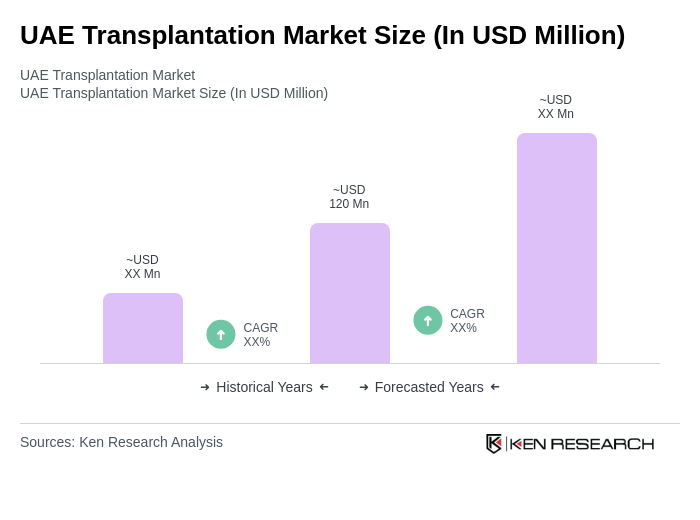
The UAE Transplantation Market is valued at approximately USD 120 million, reflecting a significant growth driven by the rising prevalence of chronic diseases, advancements in medical technology, and increased public awareness regarding organ donation.

What makes us stand out is that our consultants follow Robust, Refine and Result (RRR) methodology. Robust for clear definitions, approaches and sanity checking, Refine for differentiating respondents' facts and opinions, and Result for presenting data with story.

We have set a benchmark in the industry by offering our clients with syndicated and customized market research reports featuring coverage of entire market as well as meticulous research and analyst insights.

While we don't replace traditional research, we flip the method upside down. Our dual approach of Top Bottom & Bottom Top ensures quality deliverable by not just verifying company fundamentals but also looking at the sector and macroeconomic factors.

With one step in the future, our research team constantly tries to show you the bigger picture. We help with some of the tough questions you may encounter along the way: How is the industry positioned? Best marketing channel? KPI's of competitors? By aligning every element, we help maximize success.

Our report gives you instant access to the answers and sources that other companies might choose to hide. We elaborate each steps of research methodology we have used and showcase you the sample size to earn your trust.

If you need any support, we are here! We pride ourselves on universe strength, data quality, and quick, friendly, and professional service.













