About the Report
Base Year 2024United Arab Emirates Textile Flame Retardants Market Overview
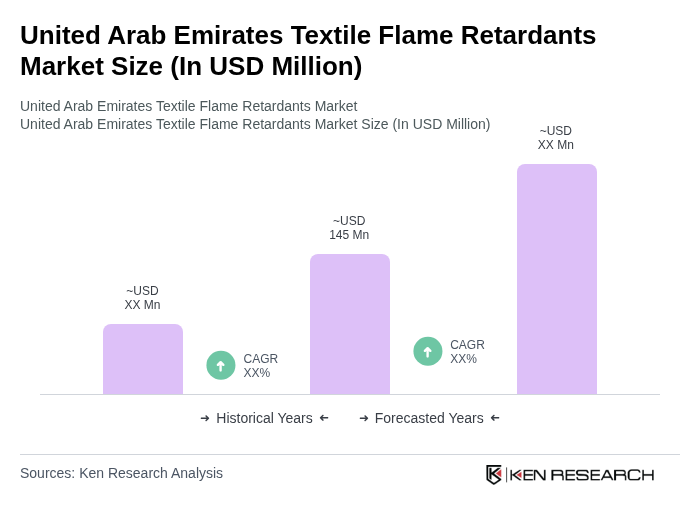
- The United Arab Emirates Textile Flame Retardants Market is valued at USD 140 million, based on a five-year historical analysis. This growth is primarily driven by the increasing demand for safety regulations in various industries, particularly in construction and oil & gas, where flame retardant textiles are essential for worker safety and compliance with stringent fire safety standards.
- Key cities such as Dubai and Abu Dhabi dominate the market due to their rapid urbanization, extensive construction projects, and a strong focus on safety regulations. The presence of major industries and a growing population further contribute to the demand for flame retardant textiles in these regions.
- The UAE Fire and Life Safety Code of Practice 2018, issued by the Civil Defence General Headquarters, mandates the use of flame retardant materials in public buildings and commercial spaces, requiring compliance testing to BS EN standards for textiles with specific flame spread limits and ignition resistance thresholds. This regulation aims to enhance fire safety standards and protect lives, thereby significantly boosting the demand for flame retardants in the textile industry.
United Arab Emirates Textile Flame Retardants Market Segmentation
By Fabric Type:
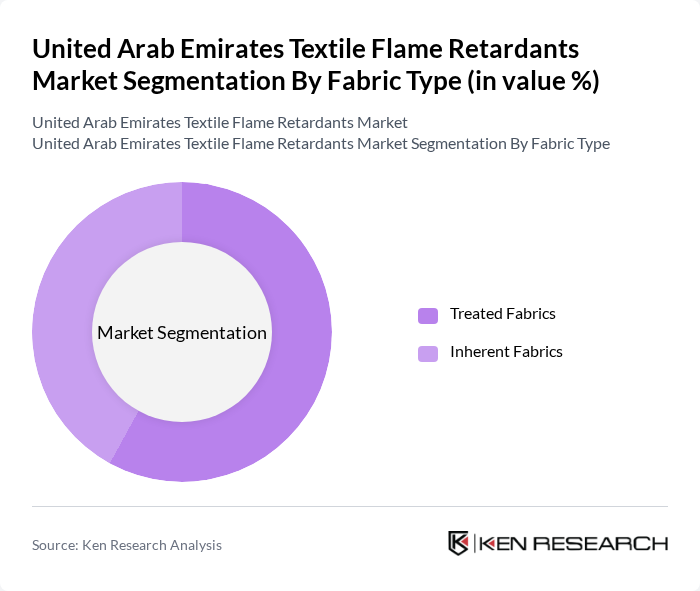
The fabric type segmentation includes Treated Fabrics and Inherent Fabrics. Treated fabrics are gaining traction due to their versatility and cost-effectiveness, making them popular in various applications. Inherent fabrics, while generally more expensive, are favored for their superior flame resistance and durability, particularly in high-risk industries such as oil & gas and construction. The demand for treated fabrics is currently leading the market, driven by their widespread use in protective clothing and industrial applications.
By Product Type:
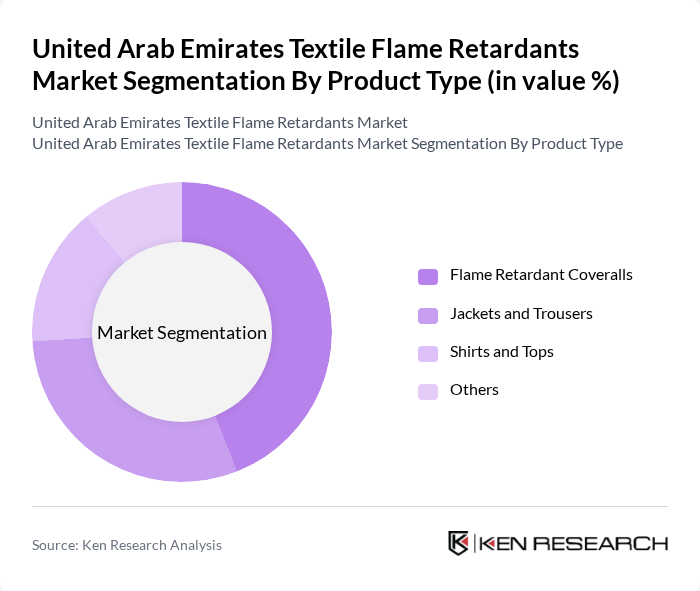
This segmentation includes Flame Retardant Coveralls, Jackets and Trousers, Shirts and Tops, and Others. Flame Retardant Coveralls dominate the market due to their essential role in protecting workers in hazardous environments, particularly in the oil & gas and industrial manufacturing sectors. Jackets and Trousers also see significant demand, especially in construction, where workers require durable and protective clothing. The trend towards safety and compliance with regulations continues to drive the growth of these product types.
United Arab Emirates Textile Flame Retardants Market Competitive Landscape
The United Arab Emirates Textile Flame Retardants Market is characterized by a dynamic mix of regional and international players. Leading participants such as BASF SE, Clariant AG, Lanxess AG, Dow Chemical Company, Solvay S.A., Albemarle Corporation, Huber Engineered Materials, RTP Company, 3M Company, Honeywell International Inc., Ansell Ltd., Benchmark FR, National Safety Apparel, DuPont de Nemours, Inc., Lakeland Industries, Inc. contribute to innovation, geographic expansion, and service delivery in this space.
United Arab Emirates Textile Flame Retardants Market Industry Analysis
Growth Drivers
- Increasing Demand for Safety in Textiles:The United Arab Emirates has witnessed a significant rise in demand for flame-retardant textiles, driven by a growing emphasis on safety across various sectors. In future, the UAE's textile industry is projected to reach AED 14 billion, with a substantial portion allocated to safety-enhancing materials. This trend is particularly evident in hospitality and healthcare sectors, where the need for fire-resistant fabrics is paramount, reflecting a broader commitment to public safety and risk mitigation.
- Stringent Fire Safety Regulations:The UAE government has implemented rigorous fire safety regulations, particularly following high-profile incidents that highlighted the need for improved safety standards. In future, the enforcement of the UAE Fire and Life Safety Code is expected to drive demand for flame retardants, as compliance becomes mandatory for construction and textile manufacturers. This regulatory landscape is anticipated to increase the market for flame retardants by approximately AED 2 billion, underscoring the critical role of safety in textile applications.
- Rising Awareness of Fire Hazards:Public awareness regarding fire hazards has surged in the UAE, particularly in urban areas where high-rise buildings are prevalent. Educational campaigns and media coverage have contributed to a heightened understanding of fire risks, prompting consumers and businesses to prioritize flame-retardant textiles. In future, it is estimated that the demand for flame-retardant materials will increase by 25%, driven by this growing consciousness, particularly in residential and commercial sectors.
Market Challenges
- High Cost of Flame Retardant Materials:The cost of flame retardant materials remains a significant barrier to market growth in the UAE. In future, the average price of high-quality flame retardants is projected to be AED 180 per kilogram, which can deter manufacturers from incorporating these materials into their products. This high cost is particularly challenging for small and medium-sized enterprises, limiting their ability to compete in a market increasingly focused on safety and compliance.
- Environmental Concerns Regarding Chemical Use:The use of certain flame retardant chemicals has raised environmental concerns, leading to increased scrutiny from regulatory bodies and consumers alike. In future, it is expected that stricter regulations will be imposed on harmful substances, impacting the availability of traditional flame retardants. This challenge necessitates a shift towards more sustainable alternatives, which may not yet be widely available or economically viable, complicating compliance for manufacturers.
United Arab Emirates Textile Flame Retardants Market Future Outlook
The future of the UAE textile flame retardants market appears promising, driven by ongoing technological advancements and a shift towards sustainable practices. As manufacturers increasingly adopt eco-friendly formulations, the market is likely to see a rise in innovative products that meet both safety and environmental standards. Additionally, the expansion of the construction and automotive sectors will further bolster demand for flame-retardant textiles, creating a robust landscape for growth and collaboration among industry stakeholders.
Market Opportunities
- Development of Eco-Friendly Flame Retardants:There is a growing opportunity for manufacturers to invest in the development of eco-friendly flame retardants. With increasing regulatory pressure and consumer demand for sustainable products, companies that innovate in this area could capture a significant market share, potentially increasing their revenues by AED 600 million in future.
- Expansion into Emerging Markets:The UAE textile flame retardants market can benefit from expanding into emerging markets in the Middle East and North Africa (MENA) region. As these markets develop, the demand for safety in textiles is expected to rise, presenting an opportunity for UAE manufacturers to leverage their expertise and establish a foothold, potentially increasing exports by AED 400 million in future.
Scope of the Report
| Segment | Sub-Segments |
|---|---|
| By Fabric Type | Treated Fabrics Inherent Fabrics |
| By Product Type | Flame Retardant Coveralls Jackets and Trousers Shirts and Tops Others |
| By End-Use Industry | Oil & Gas Petrochemicals Construction Industrial Manufacturing Others |
| By Durability Type | Durable Flame Retardants Non-Durable Flame Retardants |
| By Region | Abu Dhabi Dubai Sharjah Ajman Others |
Key Target Audience
Investors and Venture Capitalist Firms
Government and Regulatory Bodies (e.g., Ministry of Climate Change and Environment, Abu Dhabi Department of Economic Development)
Manufacturers and Producers of Textile Flame Retardants
Distributors and Retailers of Textile Products
Fire Safety Equipment Suppliers
Textile Industry Associations
Construction and Building Material Companies
Insurance Companies and Risk Management Firms
Players Mentioned in the Report:
BASF SE
Clariant AG
Lanxess AG
Dow Chemical Company
Solvay S.A.
Albemarle Corporation
Huber Engineered Materials
RTP Company
3M Company
Honeywell International Inc.
Ansell Ltd.
Benchmark FR
National Safety Apparel
DuPont de Nemours, Inc.
Lakeland Industries, Inc.
Table of Contents
Market Assessment Phase
1. Executive Summary and Approach
2. United Arab Emirates Textile Flame Retardants Market Overview
2.1 Key Insights and Strategic Recommendations
2.2 United Arab Emirates Textile Flame Retardants Market Overview
2.3 Definition and Scope
2.4 Evolution of Market Ecosystem
2.5 Timeline of Key Regulatory Milestones
2.6 Value Chain & Stakeholder Mapping
2.7 Business Cycle Analysis
2.8 Policy & Incentive Landscape
3. United Arab Emirates Textile Flame Retardants Market Analysis
3.1 Growth Drivers
3.1.1 Increasing demand for safety in textiles
3.1.2 Stringent fire safety regulations
3.1.3 Rising awareness of fire hazards
3.1.4 Growth in the construction and automotive sectors
3.2 Market Challenges
3.2.1 High cost of flame retardant materials
3.2.2 Limited availability of raw materials
3.2.3 Environmental concerns regarding chemical use
3.2.4 Competition from non-flame retardant alternatives
3.3 Market Opportunities
3.3.1 Development of eco-friendly flame retardants
3.3.2 Expansion into emerging markets
3.3.3 Technological advancements in flame retardant formulations
3.3.4 Collaborations with textile manufacturers
3.4 Market Trends
3.4.1 Increasing adoption of sustainable practices
3.4.2 Growth in smart textiles
3.4.3 Innovations in flame retardant technologies
3.4.4 Rising demand for customized solutions
3.5 Government Regulation
3.5.1 Implementation of fire safety standards
3.5.2 Regulations on chemical safety
3.5.3 Incentives for using eco-friendly materials
3.5.4 Compliance requirements for manufacturers
4. SWOT Analysis
5. Stakeholder Analysis
6. Porter's Five Forces Analysis
7. United Arab Emirates Textile Flame Retardants Market Market Size, 2019-2024
7.1 By Value
7.2 By Volume
7.3 By Average Selling Price
8. United Arab Emirates Textile Flame Retardants Market Segmentation
8.1 By Fabric Type
8.1.1 Treated Fabrics
8.1.2 Inherent Fabrics
8.2 By Product Type
8.2.1 Flame Retardant Coveralls
8.2.2 Jackets and Trousers
8.2.3 Shirts and Tops
8.2.4 Others
8.3 By End-Use Industry
8.3.1 Oil & Gas
8.3.2 Petrochemicals
8.3.3 Construction
8.3.4 Industrial Manufacturing
8.3.5 Others
8.4 By Durability Type
8.4.1 Durable Flame Retardants
8.4.2 Non-Durable Flame Retardants
8.5 By Region
8.5.1 Abu Dhabi
8.5.2 Dubai
8.5.3 Sharjah
8.5.4 Ajman
8.5.5 Others
9. United Arab Emirates Textile Flame Retardants Market Competitive Analysis
9.1 Market Share of Key Players
9.2 Cross Comparison of Key Players
9.2.1 Company Name
9.2.2 Market Share (%)
9.2.3 Revenue Growth Rate (CAGR %)
9.2.4 EBITDA Margin (%)
9.2.5 Market Penetration Rate (%)
9.2.6 R&D Investment (% of Revenue)
9.2.7 Production Capacity Utilization (%)
9.2.8 Distribution Network Coverage (Countries)
9.2.9 Customer Acquisition Cost (USD)
9.2.10 Return on Equity (ROE %)
9.3 SWOT Analysis of Top Players
9.4 Pricing Analysis
9.5 Detailed Profile of Major Companies
9.5.1 BASF SE
9.5.2 Clariant AG
9.5.3 Lanxess AG
9.5.4 Dow Chemical Company
9.5.5 Solvay S.A.
9.5.6 Albemarle Corporation
9.5.7 Huber Engineered Materials
9.5.8 RTP Company
9.5.9 3M Company
9.5.10 Honeywell International Inc.
9.5.11 Ansell Ltd.
9.5.12 Benchmark FR
9.5.13 National Safety Apparel
9.5.14 DuPont de Nemours, Inc.
9.5.15 Lakeland Industries, Inc.
10. United Arab Emirates Textile Flame Retardants Market End-User Analysis
10.1 Procurement Behavior of Key Ministries
10.1.1 Ministry of Interior
10.1.2 Ministry of Education
10.1.3 Ministry of Health
10.1.4 Ministry of Infrastructure Development
10.2 Corporate Spend on Infrastructure & Energy
10.2.1 Investment in fire safety measures
10.2.2 Budget allocation for textile safety
10.2.3 Expenditure on compliance and certifications
10.2.4 Funding for research and development
10.3 Pain Point Analysis by End-User Category
10.3.1 Apparel manufacturers
10.3.2 Home textile producers
10.3.3 Industrial textile users
10.3.4 Automotive sector
10.4 User Readiness for Adoption
10.4.1 Awareness of flame retardant benefits
10.4.2 Training and education needs
10.4.3 Availability of resources for implementation
10.4.4 Regulatory compliance readiness
10.5 Post-Deployment ROI and Use Case Expansion
10.5.1 Evaluation of safety improvements
10.5.2 Cost savings from reduced incidents
10.5.3 Opportunities for product diversification
10.5.4 Expansion into new markets
11. United Arab Emirates Textile Flame Retardants Market Future Size, 2025-2030
11.1 By Value
11.2 By Volume
11.3 By Average Selling Price
Go-To-Market Strategy Phase
1. Whitespace Analysis + Business Model Canvas
1.1 Market gaps identification
1.2 Value proposition development
1.3 Revenue model exploration
1.4 Customer segmentation analysis
1.5 Competitive landscape overview
1.6 Key partnerships identification
1.7 Resource allocation strategy
2. Marketing and Positioning Recommendations
2.1 Branding strategies
2.2 Product USPs
2.3 Target audience definition
2.4 Communication strategy
2.5 Digital marketing approach
2.6 Trade show participation
2.7 Customer engagement tactics
3. Distribution Plan
3.1 Urban retail vs rural NGO tie-ups
3.2 E-commerce strategy
3.3 Logistics and supply chain management
3.4 Distributor partnerships
3.5 Inventory management
3.6 Customer service framework
3.7 Performance metrics
4. Channel & Pricing Gaps
4.1 Underserved routes
4.2 Pricing bands
4.3 Competitor pricing analysis
4.4 Value-based pricing strategy
4.5 Discount and promotion strategies
4.6 Price elasticity assessment
4.7 Customer feedback integration
5. Unmet Demand & Latent Needs
5.1 Category gaps
5.2 Consumer segments
5.3 Product development opportunities
5.4 Market entry barriers
5.5 Innovation needs
5.6 Customer pain points
5.7 Future trends analysis
6. Customer Relationship
6.1 Loyalty programs
6.2 After-sales service
6.3 Customer feedback mechanisms
6.4 Relationship management tools
6.5 Community engagement initiatives
6.6 Customer education programs
6.7 Retention strategies
7. Value Proposition
7.1 Sustainability
7.2 Integrated supply chains
7.3 Cost-effectiveness
7.4 Quality assurance
7.5 Customization options
7.6 Brand reputation
7.7 Innovation leadership
8. Key Activities
8.1 Regulatory compliance
8.2 Branding
8.3 Distribution setup
8.4 Market research
8.5 Training and development
8.6 Performance monitoring
8.7 Stakeholder engagement
9. Entry Strategy Evaluation
9.1 Domestic Market Entry Strategy
9.1.1 Product mix
9.1.2 Pricing band
9.1.3 Packaging
9.2 Export Entry Strategy
9.2.1 Target countries
9.2.2 Compliance roadmap
10. Entry Mode Assessment
10.1 JV
10.2 Greenfield
10.3 M&A
10.4 Distributor Model
11. Capital and Timeline Estimation
11.1 Capital requirements
11.2 Timelines
12. Control vs Risk Trade-Off
12.1 Ownership vs Partnerships
13. Profitability Outlook
13.1 Breakeven analysis
13.2 Long-term sustainability
14. Potential Partner List
14.1 Distributors
14.2 JVs
14.3 Acquisition targets
15. Execution Roadmap
15.1 Phased Plan for Market Entry
15.1.1 Market Setup
15.1.2 Market Entry
15.1.3 Growth Acceleration
15.1.4 Scale & Stabilize
15.2 Key Activities and Milestones
15.2.1 Activity timeline
15.2.2 Milestone tracking
Research Methodology
Phase 1: Approach1
Desk Research
- Analysis of industry reports from the UAE Ministry of Economy and relevant trade associations
- Review of market studies and publications from textile and chemical industry journals
- Examination of regulatory frameworks and safety standards related to flame retardants in textiles
Primary Research
- Interviews with key stakeholders in textile manufacturing, including production managers and safety compliance officers
- Surveys targeting procurement specialists in the textile and apparel sectors
- Field visits to textile production facilities to gather insights on flame retardant usage and application
Validation & Triangulation
- Cross-referencing data from multiple sources, including government publications and industry reports
- Triangulation of findings from primary interviews with secondary data insights
- Expert panel reviews to validate assumptions and findings from the research
Phase 2: Market Size Estimation1
Top-down Assessment
- Estimation of market size based on national textile production statistics and flame retardant adoption rates
- Segmentation of the market by end-use applications, such as apparel, home textiles, and industrial textiles
- Incorporation of growth trends in the UAE's construction and automotive sectors influencing textile demand
Bottom-up Modeling
- Collection of data on sales volumes from leading manufacturers of flame retardants in the UAE
- Estimation of average pricing for various types of flame retardants used in textiles
- Calculation of market size based on production capacity and consumption rates in the textile industry
Forecasting & Scenario Analysis
- Development of forecasts using historical data trends and projected growth rates in the textile sector
- Scenario analysis based on potential regulatory changes and shifts in consumer preferences towards safety standards
- Creation of multiple market scenarios (baseline, optimistic, and pessimistic) through 2030
Phase 3: CATI Sample Composition1
| Scope Item/Segment | Sample Size | Target Respondent Profiles |
|---|---|---|
| Textile Manufacturing Sector | 80 | Production Managers, Quality Assurance Officers |
| Apparel Retail Sector | 50 | Merchandising Managers, Compliance Officers |
| Home Textiles Industry | 70 | Product Development Managers, Safety Compliance Specialists |
| Industrial Textiles Applications | 60 | Procurement Managers, Technical Sales Representatives |
| Regulatory Bodies and Standards Organizations | 40 | Regulatory Affairs Managers, Safety Inspectors |
Frequently Asked Questions
What is the current value of the United Arab Emirates Textile Flame Retardants Market?
The United Arab Emirates Textile Flame Retardants Market is valued at approximately USD 140 million, reflecting a significant demand driven by safety regulations in industries such as construction and oil & gas, where flame retardant textiles are essential for compliance and worker safety.
Which cities in the UAE are leading in the Textile Flame Retardants Market?
What regulations impact the UAE Textile Flame Retardants Market?
What are the main fabric types used in the UAE Textile Flame Retardants Market?
Other Regional/Country Reports
Malaysia Textile Flame Retardants Market
Other Adjacent Reports
Bahrain Protective Clothing Market
Japan Flame Retardant Chemicals Market
UAE Textile Additives Market
Mexico Industrial Workwear Market
Qatar Fire Resistant Fabrics Market
Oman Personal Protective Equipment Market Report Size Share Growth Drivers Trends Opportunities & Forecast 2025–2030India Construction Materials Market Outlook to 2030Singapore Oil and Gas Safety Market
USA Specialty Chemicals Market Size Share Growth Drivers Trends Opportunities & Forecast 2025–2030Japan Fire Safety Equipment Market Report Size Share Growth Drivers Trends Opportunities & Forecast 2025–2030Why Buy From Us?

What makes us stand out is that our consultants follow Robust, Refine and Result (RRR) methodology. Robust for clear definitions, approaches and sanity checking, Refine for differentiating respondents' facts and opinions, and Result for presenting data with story.

We have set a benchmark in the industry by offering our clients with syndicated and customized market research reports featuring coverage of entire market as well as meticulous research and analyst insights.

While we don't replace traditional research, we flip the method upside down. Our dual approach of Top Bottom & Bottom Top ensures quality deliverable by not just verifying company fundamentals but also looking at the sector and macroeconomic factors.

With one step in the future, our research team constantly tries to show you the bigger picture. We help with some of the tough questions you may encounter along the way: How is the industry positioned? Best marketing channel? KPI's of competitors? By aligning every element, we help maximize success.

Our report gives you instant access to the answers and sources that other companies might choose to hide. We elaborate each steps of research methodology we have used and showcase you the sample size to earn your trust.

If you need any support, we are here! We pride ourselves on universe strength, data quality, and quick, friendly, and professional service.