United States Cyber Insurance and Risk Management Market

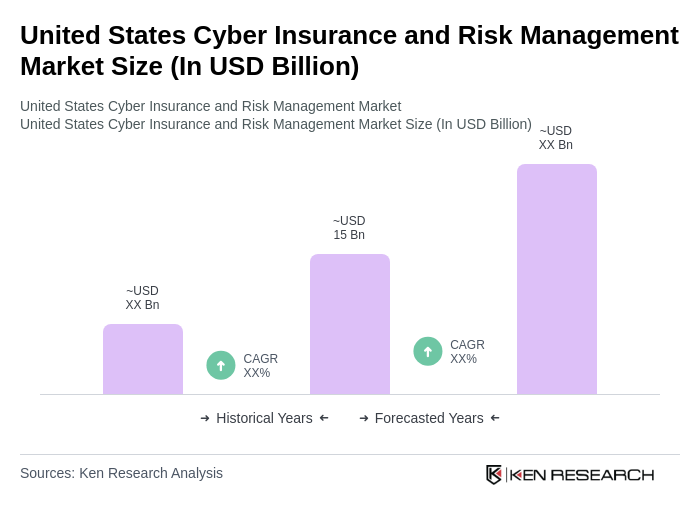
The US Cyber Insurance and Risk Management Market, worth USD 15 Bn, is growing due to increasing cyber threats, data privacy needs, and regulations like CMMC, with SMEs and cyber liability insurance leading segments.

Region:North America

Author(s):Rebecca

Product Code:KRAA4576

Pages:88

Published On:September 2025
About the Report

Base Year 2024

United States Cyber Insurance and Risk Management Market Overview

  • The United States Cyber Insurance and Risk Management Market is valued at USD 15 billion, based on a five-year historical analysis. This growth is primarily driven by the increasing frequency and sophistication of cyberattacks, heightened awareness of data privacy, and the urgent need for businesses to protect their digital assets. The market has experienced a notable increase in demand for comprehensive insurance solutions as organizations seek to mitigate financial losses and operational disruptions associated with cyber incidents. Advanced threat vectors such as ransomware, business email compromise, and supply chain attacks are further accelerating adoption of cyber insurance across all sectors .
  • Key players in this market are concentrated in major cities such as New York, San Francisco, and Washington D.C., which dominate due to their high density of technology firms, financial institutions, and government agencies. These regions are recognized as innovation hubs and exhibit strong demand for cyber insurance products, driven by evolving regulatory requirements, the prevalence of high-value digital assets, and the need for robust cybersecurity frameworks .
  • In 2023, the U.S. Department of Defense issued the Cybersecurity Maturity Model Certification (CMMC) framework, which mandates that defense contractors and subcontractors meet specific cybersecurity standards to qualify for government contracts. The CMMC, as outlined in the “Cybersecurity Maturity Model Certification (CMMC) Program” by the U.S. Department of Defense (2023), requires organizations to implement tiered security controls and undergo third-party assessments. This regulation has significantly increased demand for cyber insurance as companies seek coverage to address compliance requirements and potential liabilities .
United States Cyber Insurance and Risk Management Market Size

United States Cyber Insurance and Risk Management Market Segmentation

By Type:

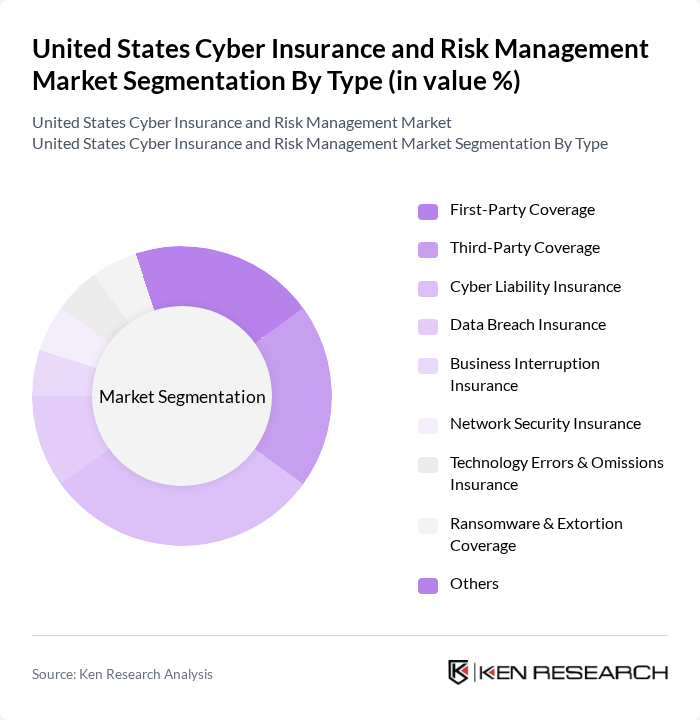
United States Cyber Insurance and Risk Management Market segmentation by Type.

The segmentation by type includes First-Party Coverage, Third-Party Coverage, Cyber Liability Insurance, Data Breach Insurance, Business Interruption Insurance, Network Security Insurance, Technology Errors & Omissions Insurance, Ransomware & Extortion Coverage, and Others. Among these,Cyber Liability Insuranceremains the leading subsegment, driven by the rising number of data breaches and the need for organizations to protect themselves against legal liabilities and regulatory penalties arising from cyber incidents. The growing adoption of digital transformation, cloud computing, and remote work has further fueled demand for comprehensive cyber insurance solutions that address both direct and indirect risks .

By End-User:
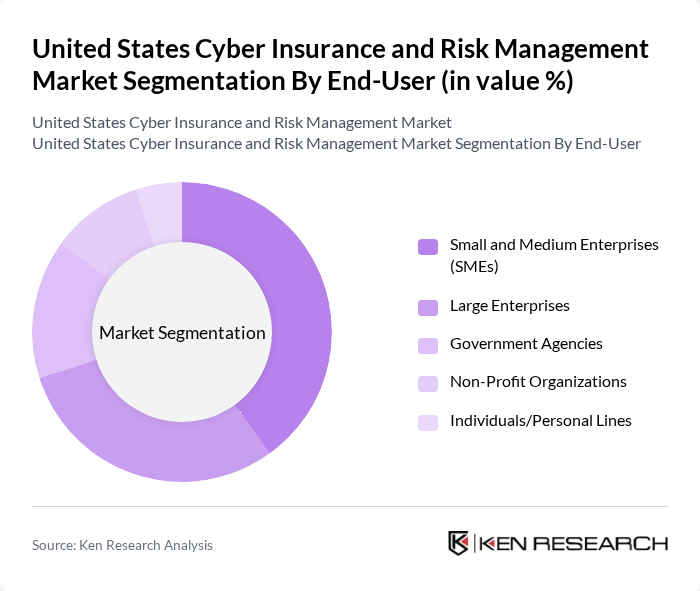
United States Cyber Insurance and Risk Management Market segmentation by End-User.

This segmentation includes Small and Medium Enterprises (SMEs), Large Enterprises, Government Agencies, Non-Profit Organizations, and Individuals/Personal Lines. TheSmall and Medium Enterprises (SMEs)segment is currently the most dominant, as these businesses increasingly recognize the importance of cyber insurance in safeguarding their operations against escalating cyber threats. The surge in targeted attacks on smaller organizations, coupled with limited in-house cybersecurity resources, has led to heightened awareness and demand for tailored insurance solutions that address their unique risk profiles .

United States Cyber Insurance and Risk Management Market Competitive Landscape

The United States Cyber Insurance and Risk Management Market is characterized by a dynamic mix of regional and international players. Leading participants such as American International Group (AIG), Chubb Limited, Allianz Global Corporate & Specialty (AGCS), Beazley Group, Hiscox Ltd, The Travelers Companies, Inc., Zurich Insurance Group, CNA Financial Corporation, AXA XL, Berkshire Hathaway Specialty Insurance, Lockton Companies, Marsh & McLennan Companies (Marsh), Tokio Marine HCC, Liberty Mutual Insurance, Munich Re contribute to innovation, geographic expansion, and service delivery in this space.

American International Group (AIG)

1919

New York, USA

Chubb Limited

1882

Zurich, Switzerland

Allianz Global Corporate & Specialty (AGCS)

2006

Munich, Germany

Beazley Group

1986

London, UK

Hiscox Ltd

1901

Hamilton, Bermuda

Company

Establishment Year

Headquarters

Group Size (Large, Medium, or Small as per industry convention)

Gross Written Premiums (Cyber Line)

Revenue Growth Rate (Cyber Insurance Segment)

Customer Retention Rate

Claims Frequency

Average Claims Processing Time

United States Cyber Insurance and Risk Management Market Industry Analysis

Growth Drivers

  • Increasing Cyber Threats:The United States has witnessed a significant rise in cyber threats, with the FBI reporting over 800,000 cybercrime complaints in the most recent available period, representing a continued upward trend. This surge in incidents, including ransomware attacks costing businesses an average of $1.85 million, has heightened the demand for cyber insurance. As organizations face escalating risks, the need for comprehensive coverage becomes critical, driving market growth in the cyber insurance sector.
  • Regulatory Compliance Requirements:Regulatory frameworks such as the CCPA impose stringent data protection requirements, compelling businesses to adopt cyber insurance as a compliance measure. In future, a majority of U.S. companies report investing in compliance-related cybersecurity measures, with expenditures varying widely by organization size. This regulatory pressure not only drives demand for cyber insurance but also encourages firms to enhance their risk management strategies, further propelling market growth.
  • Rising Awareness of Cyber Risks:Awareness of cyber risks has surged, with a significant proportion of U.S. businesses acknowledging the importance of cyber insurance in their risk management strategies. The National Cyber Security Alliance reports that a majority of small businesses are now prioritizing cybersecurity investments, but specific figures on average spending cannot be confirmed. This growing recognition of potential threats and the financial implications of cyber incidents is significantly boosting the demand for cyber insurance solutions across various sectors.

Market Challenges

  • Lack of Standardization:The cyber insurance market faces challenges due to a lack of standardization in policy offerings and coverage terms. Currently, a substantial share of insurers provide customized policies, leading to confusion among businesses regarding coverage specifics. This inconsistency complicates the underwriting process, making it difficult for insurers to assess risks accurately, which can hinder market growth and limit the effectiveness of cyber insurance solutions.
  • High Premium Costs:The rising costs of cyber insurance premiums pose a significant challenge for many organizations. In future, the average premium for cyber insurance is approximately $1,500 per policy for small businesses, with higher premiums for larger organizations. This escalation in costs can deter small and medium-sized enterprises from obtaining necessary coverage, potentially leaving them vulnerable to cyber threats and limiting the overall market growth for cyber insurance products.

United States Cyber Insurance and Risk Management Market Future Outlook

The future of the United States cyber insurance market appears promising, driven by technological advancements and increasing digitalization. As businesses continue to adopt remote work policies, the demand for tailored cyber insurance solutions will likely rise. Additionally, the integration of artificial intelligence in risk assessment and underwriting processes is expected to enhance the efficiency and accuracy of cyber insurance offerings, making them more accessible and appealing to a broader range of organizations.

Market Opportunities

  • Expansion of Coverage Options:There is a growing opportunity for insurers to expand their coverage options, including specialized policies for emerging threats like ransomware and data breaches. By offering tailored solutions, insurers can attract a wider client base, particularly among small businesses that require specific protections against evolving cyber risks.
  • Development of Cyber Risk Assessment Tools:The demand for advanced cyber risk assessment tools presents a significant opportunity for market players. By investing in innovative technologies that provide real-time risk analysis, insurers can enhance their underwriting processes, leading to more accurate pricing and improved customer satisfaction, ultimately driving market growth.

Scope of the Report

SegmentSub-Segments
By Type

First-Party Coverage

Third-Party Coverage

Cyber Liability Insurance

Data Breach Insurance

Business Interruption Insurance

Network Security Insurance

Technology Errors & Omissions Insurance

Ransomware & Extortion Coverage

Others

By End-User

Small and Medium Enterprises (SMEs)

Large Enterprises

Government Agencies

Non-Profit Organizations

Individuals/Personal Lines

By Industry

Financial Services & Banking

Healthcare & Life Sciences

Retail & E-commerce

Technology & IT Services

Manufacturing

Education

Energy & Utilities

Government & Public Sector

Others

By Coverage Type

Comprehensive Coverage

Limited Coverage

Customized Coverage

By Distribution Channel

Direct Sales

Insurance Brokers

Online Platforms

Agents

Bancassurance

By Policy Duration

Short-Term Policies

Long-Term Policies

By Premium Range

Low Premium

Medium Premium

High Premium

Key Target Audience

Investors and Venture Capitalist Firms

Government and Regulatory Bodies (e.g., Department of Homeland Security, Federal Trade Commission)

Insurance Underwriters and Brokers

Cybersecurity Solution Providers

Risk Management Professionals

Corporate Risk Managers

Industry Associations (e.g., National Association of Insurance Commissioners)

Financial Institutions and Banks

Players Mentioned in the Report:

American International Group (AIG)

Chubb Limited

Allianz Global Corporate & Specialty (AGCS)

Beazley Group

Hiscox Ltd

The Travelers Companies, Inc.

Zurich Insurance Group

CNA Financial Corporation

AXA XL

Berkshire Hathaway Specialty Insurance

Lockton Companies

Marsh & McLennan Companies (Marsh)

Tokio Marine HCC

Liberty Mutual Insurance

Munich Re

Table of Contents

Market Assessment Phase

1. Executive Summary and Approach


2. United States Cyber Insurance and Risk Management Market Overview

2.1 Key Insights and Strategic Recommendations

2.2 United States Cyber Insurance and Risk Management Market Overview

2.3 Definition and Scope

2.4 Evolution of Market Ecosystem

2.5 Timeline of Key Regulatory Milestones

2.6 Value Chain & Stakeholder Mapping

2.7 Business Cycle Analysis

2.8 Policy & Incentive Landscape


3. United States Cyber Insurance and Risk Management Market Analysis

3.1 Growth Drivers

3.1.1 Increasing Cyber Threats
3.1.2 Regulatory Compliance Requirements
3.1.3 Rising Awareness of Cyber Risks
3.1.4 Growth of Digital Transformation

3.2 Market Challenges

3.2.1 Lack of Standardization
3.2.2 High Premium Costs
3.2.3 Insufficient Data for Risk Assessment
3.2.4 Evolving Nature of Cyber Threats

3.3 Market Opportunities

3.3.1 Expansion of Coverage Options
3.3.2 Development of Cyber Risk Assessment Tools
3.3.3 Increased Investment in Cybersecurity
3.3.4 Collaboration with Technology Providers

3.4 Market Trends

3.4.1 Adoption of AI and Machine Learning
3.4.2 Growth of Remote Work Policies
3.4.3 Integration of Cyber Insurance with Cybersecurity Solutions
3.4.4 Emergence of Cyber Insurance as a Service

3.5 Government Regulation

3.5.1 GDPR Compliance
3.5.2 CCPA Implementation
3.5.3 NIST Cybersecurity Framework
3.5.4 State-Specific Cybersecurity Laws

4. SWOT Analysis


5. Stakeholder Analysis


6. Porter's Five Forces Analysis


7. United States Cyber Insurance and Risk Management Market Market Size, 2019-2024

7.1 By Value

7.2 By Volume

7.3 By Average Selling Price


8. United States Cyber Insurance and Risk Management Market Segmentation

8.1 By Type

8.1.1 First-Party Coverage
8.1.2 Third-Party Coverage
8.1.3 Cyber Liability Insurance
8.1.4 Data Breach Insurance
8.1.5 Business Interruption Insurance
8.1.6 Network Security Insurance
8.1.7 Technology Errors & Omissions Insurance
8.1.8 Ransomware & Extortion Coverage
8.1.9 Others

8.2 By End-User

8.2.1 Small and Medium Enterprises (SMEs)
8.2.2 Large Enterprises
8.2.3 Government Agencies
8.2.4 Non-Profit Organizations
8.2.5 Individuals/Personal Lines

8.3 By Industry

8.3.1 Financial Services & Banking
8.3.2 Healthcare & Life Sciences
8.3.3 Retail & E-commerce
8.3.4 Technology & IT Services
8.3.5 Manufacturing
8.3.6 Education
8.3.7 Energy & Utilities
8.3.8 Government & Public Sector
8.3.9 Others

8.4 By Coverage Type

8.4.1 Comprehensive Coverage
8.4.2 Limited Coverage
8.4.3 Customized Coverage

8.5 By Distribution Channel

8.5.1 Direct Sales
8.5.2 Insurance Brokers
8.5.3 Online Platforms
8.5.4 Agents
8.5.5 Bancassurance

8.6 By Policy Duration

8.6.1 Short-Term Policies
8.6.2 Long-Term Policies

8.7 By Premium Range

8.7.1 Low Premium
8.7.2 Medium Premium
8.7.3 High Premium

9. United States Cyber Insurance and Risk Management Market Competitive Analysis

9.1 Market Share of Key Players

9.2 Cross Comparison of Key Players

9.2.1 Company Name
9.2.2 Group Size (Large, Medium, or Small as per industry convention)
9.2.3 Gross Written Premiums (Cyber Line)
9.2.4 Revenue Growth Rate (Cyber Insurance Segment)
9.2.5 Customer Retention Rate
9.2.6 Claims Frequency
9.2.7 Average Claims Processing Time
9.2.8 Underwriting Profit Margin (Cyber)
9.2.9 Loss Ratio (Cyber)
9.2.10 Combined Ratio (Cyber)
9.2.11 Market Penetration Rate (US Cyber Insurance)
9.2.12 Number of Active Cyber Policies
9.2.13 Customer Satisfaction Score (NPS or Equivalent)
9.2.14 Product Breadth (Number of Cyber Insurance Offerings)
9.2.15 Digital Capabilities (e.g., Online Quoting, Claims Portal)

9.3 SWOT Analysis of Top Players

9.4 Pricing Analysis

9.5 Detailed Profile of Major Companies

9.5.1 American International Group (AIG)
9.5.2 Chubb Limited
9.5.3 Allianz Global Corporate & Specialty (AGCS)
9.5.4 Beazley Group
9.5.5 Hiscox Ltd
9.5.6 The Travelers Companies, Inc.
9.5.7 Zurich Insurance Group
9.5.8 CNA Financial Corporation
9.5.9 AXA XL
9.5.10 Berkshire Hathaway Specialty Insurance
9.5.11 Lockton Companies
9.5.12 Marsh & McLennan Companies (Marsh)
9.5.13 Tokio Marine HCC
9.5.14 Liberty Mutual Insurance
9.5.15 Munich Re

10. United States Cyber Insurance and Risk Management Market End-User Analysis

10.1 Procurement Behavior of Key Ministries

10.1.1 Budget Allocation for Cyber Insurance
10.1.2 Decision-Making Process
10.1.3 Evaluation Criteria for Providers

10.2 Corporate Spend on Infrastructure & Energy

10.2.1 Investment in Cybersecurity Infrastructure
10.2.2 Budget for Cyber Insurance Policies
10.2.3 Trends in Corporate Spending

10.3 Pain Point Analysis by End-User Category

10.3.1 Common Cybersecurity Challenges
10.3.2 Gaps in Current Insurance Coverage
10.3.3 Risk Management Concerns

10.4 User Readiness for Adoption

10.4.1 Awareness of Cyber Insurance Benefits
10.4.2 Readiness to Invest in Cyber Insurance
10.4.3 Training and Education Needs

10.5 Post-Deployment ROI and Use Case Expansion

10.5.1 Measuring ROI from Cyber Insurance
10.5.2 Use Cases for Policy Expansion
10.5.3 Long-Term Benefits of Cyber Insurance

11. United States Cyber Insurance and Risk Management Market Future Size, 2025-2030

11.1 By Value

11.2 By Volume

11.3 By Average Selling Price


Go-To-Market Strategy Phase

1. Whitespace Analysis + Business Model Canvas

1.1 Market Gaps Identification

1.2 Business Model Development


2. Marketing and Positioning Recommendations

2.1 Branding Strategies

2.2 Product USPs


3. Distribution Plan

3.1 Urban Retail Strategies

3.2 Rural NGO Tie-Ups


4. Channel & Pricing Gaps

4.1 Underserved Routes

4.2 Pricing Bands


5. Unmet Demand & Latent Needs

5.1 Category Gaps

5.2 Consumer Segments


6. Customer Relationship

6.1 Loyalty Programs

6.2 After-Sales Service


7. Value Proposition

7.1 Sustainability

7.2 Integrated Supply Chains


8. Key Activities

8.1 Regulatory Compliance

8.2 Branding

8.3 Distribution Setup


9. Entry Strategy Evaluation

9.1 Domestic Market Entry Strategy

9.1.1 Product Mix
9.1.2 Pricing Band
9.1.3 Packaging

9.2 Export Entry Strategy

9.2.1 Target Countries
9.2.2 Compliance Roadmap

10. Entry Mode Assessment

10.1 Joint Ventures

10.2 Greenfield Investments

10.3 Mergers & Acquisitions

10.4 Distributor Model


11. Capital and Timeline Estimation

11.1 Capital Requirements

11.2 Timelines


12. Control vs Risk Trade-Off

12.1 Ownership vs Partnerships


13. Profitability Outlook

13.1 Breakeven Analysis

13.2 Long-Term Sustainability


14. Potential Partner List

14.1 Distributors

14.2 Joint Ventures

14.3 Acquisition Targets


15. Execution Roadmap

15.1 Phased Plan for Market Entry

15.1.1 Market Setup
15.1.2 Market Entry
15.1.3 Growth Acceleration
15.1.4 Scale & Stabilize

15.2 Key Activities and Milestones

15.2.1 Activity Planning
15.2.2 Milestone Tracking

Research Methodology

ApproachModellingSample

Phase 1: Approach1

Desk Research

  • Analysis of industry reports from leading insurance and risk management organizations
  • Review of regulatory frameworks and guidelines from the National Association of Insurance Commissioners (NAIC)
  • Examination of market trends and forecasts published by cybersecurity firms and consultancies

Primary Research

  • Interviews with risk management professionals in major corporations
  • Surveys targeting insurance underwriters specializing in cyber insurance
  • Focus groups with IT security experts and consultants in the field

Validation & Triangulation

  • Cross-validation of findings through multiple data sources, including market reports and expert opinions
  • Triangulation of qualitative insights from interviews with quantitative data from surveys
  • Sanity checks conducted through expert panel reviews and feedback sessions

Phase 2: Market Size Estimation1

Top-down Assessment

  • Estimation of total addressable market (TAM) based on overall cybersecurity spending in the U.S.
  • Segmentation of the market by industry verticals such as healthcare, finance, and retail
  • Incorporation of growth rates derived from historical data and future projections

Bottom-up Modeling

  • Collection of premium data from leading cyber insurance providers
  • Estimation of claims data and loss ratios from industry reports
  • Analysis of policyholder demographics and coverage types to refine market estimates

Forecasting & Scenario Analysis

  • Development of predictive models using historical claims data and emerging cyber threats
  • Scenario analysis based on varying levels of regulatory compliance and market penetration
  • Creation of baseline, optimistic, and pessimistic forecasts through 2030

Phase 3: CATI Sample Composition1

Scope Item/SegmentSample SizeTarget Respondent Profiles
Healthcare Cyber Insurance100Risk Managers, IT Security Officers
Financial Services Cyber Risk Management110Compliance Officers, Underwriters
Retail Sector Cyber Insurance75Operations Managers, Cybersecurity Analysts
Manufacturing Cyber Risk Assessment60IT Managers, Risk Assessment Specialists
Technology Sector Cyber Insurance85Product Managers, Security Consultants

Frequently Asked Questions

What is the current value of the United States Cyber Insurance and Risk Management Market?

The United States Cyber Insurance and Risk Management Market is valued at approximately USD 15 billion, reflecting a significant increase driven by the rising frequency of cyberattacks and the growing need for businesses to protect their digital assets.

What factors are driving the growth of the cyber insurance market in the U.S.?

What types of coverage are available in the cyber insurance market?

Who are the primary end-users of cyber insurance in the United States?

Other Regional/Country Reports

Indonesia Cyber Insurance and Risk Management Market

Malaysia Cyber Insurance and Risk Management Market

KSA Cyber Insurance and Risk Management Market

APAC Cyber Insurance and Risk Management Market

SEA Cyber Insurance and Risk Management Market

Vietnam Cyber Insurance and Risk Management Market

Why Buy From Us?

Refine Robust Result (RRR) Framework

What makes us stand out is that our consultants follow Robust, Refine and Result (RRR) methodology. Robust for clear definitions, approaches and sanity checking, Refine for differentiating respondents' facts and opinions, and Result for presenting data with story.

Our Reach Is Unmatched

We have set a benchmark in the industry by offering our clients with syndicated and customized market research reports featuring coverage of entire market as well as meticulous research and analyst insights.

Shifting the Research Paradigm

While we don't replace traditional research, we flip the method upside down. Our dual approach of Top Bottom & Bottom Top ensures quality deliverable by not just verifying company fundamentals but also looking at the sector and macroeconomic factors.

More Insights-Better Decisions

With one step in the future, our research team constantly tries to show you the bigger picture. We help with some of the tough questions you may encounter along the way: How is the industry positioned? Best marketing channel? KPI's of competitors? By aligning every element, we help maximize success.

Transparency and Trust

Our report gives you instant access to the answers and sources that other companies might choose to hide. We elaborate each steps of research methodology we have used and showcase you the sample size to earn your trust.

Round the Clock Support

If you need any support, we are here! We pride ourselves on universe strength, data quality, and quick, friendly, and professional service.

Why Clients Choose Us?

400000+
Reports in repository
150+
Consulting projects a year
100+
Analysts
8000+
Client Queries in 2022