About the Report
Base Year 2024United States Payments Market Overview
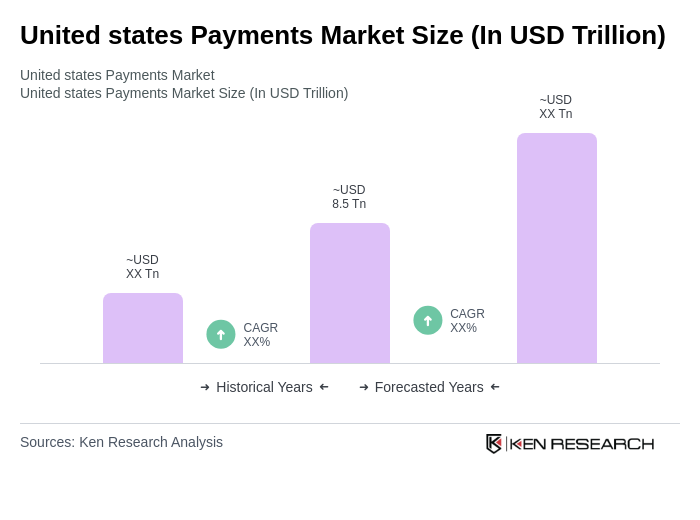
- The United States Payments Market is valued at USD 8.5 trillion, based on a five-year historical analysis of cards and payments transactions. This growth is primarily driven by the increasing adoption of digital payment solutions, the rapid expansion of e-commerce, and consumer preferences shifting towards contactless and mobile transactions. The market has seen significant transformation with the integration of advanced technologies such as blockchain, artificial intelligence, and real-time payment rails, all of which enhance transaction security, speed, and efficiency .
- Key players in this market are concentrated in major cities such as New York, San Francisco, and Chicago, which dominate due to their robust financial infrastructure, high population density, and concentration of technology firms. These urban centers are recognized as hubs for fintech innovation and investment, making them critical to the ongoing evolution of payment solutions in the United States .
- There is no federal law such as the Payment Choice Act mandating that all businesses offer at least one digital payment option alongside traditional methods as of the most recent updates. However, several states and municipalities have enacted or proposed regulations to ensure businesses accept cash, while the broader trend is toward increased digital payment acceptance to promote financial inclusion and modernize the payments ecosystem .
United States Payments Market Segmentation
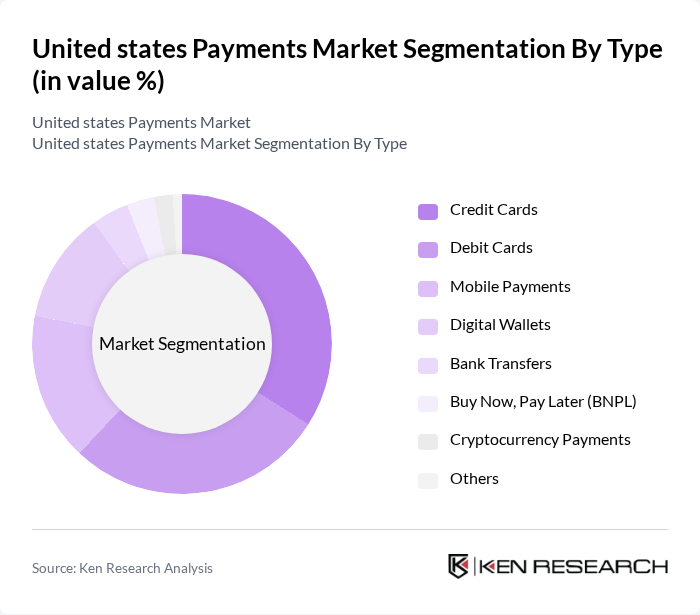
By Type:The segmentation by type includes a wide array of payment methods reflecting evolving consumer preferences and technological advancements. The primary subsegments are Credit Cards, Debit Cards, Mobile Payments, Digital Wallets, Bank Transfers, Buy Now, Pay Later (BNPL), Cryptocurrency Payments, and Others. Each subsegment plays a distinct role in shaping market dynamics, with credit and debit cards remaining dominant, while mobile and digital wallet adoption accelerates, and BNPL and cryptocurrency payments gain traction among younger demographics .
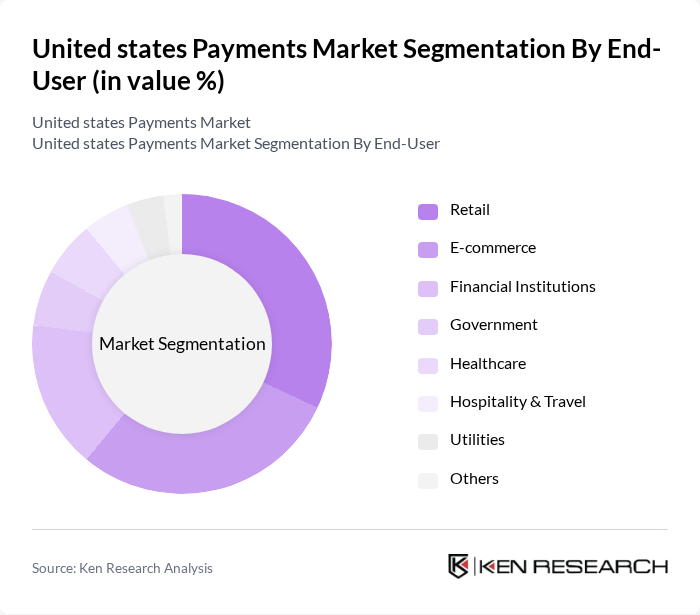
By End-User:The segmentation by end-user covers a diverse range of sectors utilizing payment solutions, including Retail, E-commerce, Financial Institutions, Government, Healthcare, Hospitality & Travel, Utilities, and Others. Each sector has unique transaction requirements and adoption patterns, with retail and e-commerce leading in digital and contactless payment adoption, while sectors like healthcare and government are increasingly integrating electronic payment systems for efficiency and compliance .
United States Payments Market Competitive Landscape
The United States Payments Market is characterized by a dynamic mix of regional and international players. Leading participants such as PayPal Holdings, Inc., Block, Inc. (formerly Square, Inc.), Stripe, Inc., Visa Inc., Mastercard Incorporated, American Express Company, Discover Financial Services, Fiserv, Inc., Adyen N.V., Worldpay, Inc. (FIS), Global Payments Inc., Payoneer Inc., Affirm, Inc., Early Warning Services, LLC (Zelle), Venmo (a PayPal service), JPMorgan Chase & Co., Bank of America Corporation, Wells Fargo & Company, Capital One Financial Corporation, and PNC Financial Services Group, Inc. contribute to innovation, geographic expansion, and service delivery in this space.
United states Payments Market Industry Analysis
Growth Drivers
- Increasing Digital Payment Adoption:The United States has seen a significant rise in digital payment adoption, with over 75% of consumers using online payment methods in future. According to the Federal Reserve, digital payment transactions reached approximately 34 billion in future, reflecting a 13% increase from the previous period. This trend is driven by the convenience and speed of digital transactions, as well as the growing number of mobile wallets, which are projected to exceed 100 million users in future.
- Rise of E-commerce Transactions:E-commerce sales in the United States reached approximately USD 1.1 trillion in future, marking a 10% increase from the previous period. The U.S. Census Bureau reports that e-commerce now accounts for about 15% of total retail sales, a figure expected to grow as more consumers shift to online shopping. This surge in e-commerce is driving demand for efficient payment solutions, with online payment processing volumes projected to exceed 22 billion transactions in future, further fueling market growth.
- Technological Advancements in Payment Solutions:The payments landscape is rapidly evolving due to technological advancements, with investments in payment technology estimated at over USD 55 billion in future. Innovations such as contactless payments and blockchain technology are enhancing transaction speed and security. The integration of AI in fraud detection systems is expected to reduce fraud losses by up to 25% in future, making payment solutions more attractive to consumers and businesses alike.
Market Challenges
- Cybersecurity Threats:The rise in digital payments has also led to increased cybersecurity threats, with the FBI reporting a significant increase in cybercrime incidents in future. Financial institutions faced losses exceeding USD 7 billion due to fraud and data breaches. As payment systems become more interconnected, the potential for cyberattacks grows, posing significant risks to consumer trust and market stability, which could hinder further adoption of digital payment solutions.
- Regulatory Compliance Issues:The payments industry is heavily regulated, with compliance costs for financial institutions reaching approximately USD 32 billion annually. Regulations such as the Dodd-Frank Act and Anti-Money Laundering (AML) laws impose strict requirements that can be challenging for smaller payment providers to meet. Non-compliance can result in hefty fines, which may deter innovation and limit market entry for new players, ultimately stifling competition.
United states Payments Market Future Outlook
The future of the United States payments market is poised for transformative growth, driven by technological innovations and evolving consumer preferences. As digital payment adoption continues to rise, the integration of advanced technologies such as AI and blockchain will enhance transaction security and efficiency. Additionally, the shift towards cashless transactions is expected to accelerate, with more consumers embracing mobile wallets and contactless payment methods. This dynamic landscape presents both challenges and opportunities for payment providers as they adapt to changing regulatory environments and consumer expectations.
Market Opportunities
- Expansion of Mobile Payment Solutions:The mobile payment market is projected to grow significantly, with over 55% of U.S. consumers expected to use mobile wallets in future. This growth presents opportunities for payment providers to develop user-friendly applications that enhance customer experience and streamline transactions, potentially increasing market share and customer loyalty.
- Development of Blockchain Technology:Blockchain technology is gaining traction in the payments sector, with investments expected to reach USD 12 billion in future. Its potential to enhance transaction transparency and reduce costs presents a significant opportunity for payment providers to innovate and offer more secure, efficient solutions, thereby attracting a broader customer base.
Scope of the Report
| Segment | Sub-Segments |
|---|---|
| By Type | Credit Cards Debit Cards Mobile Payments Digital Wallets Bank Transfers Buy Now, Pay Later (BNPL) Cryptocurrency Payments Others |
| By End-User | Retail E-commerce Financial Institutions Government Healthcare Hospitality & Travel Utilities Others |
| By Payment Method | Online Payments In-Store Payments Recurring Payments Peer-to-Peer Payments Contactless Payments Others |
| By Industry Vertical | Retail and E-commerce Travel and Hospitality Healthcare Education Utilities Entertainment and Digital Content Others |
| By Transaction Size | Micro Transactions (<$10) Small Transactions ($10-$100) Medium Transactions ($100-$1,000) Large Transactions (>$1,000) Others |
| By Customer Segment | Individual Consumers Small Businesses Large Enterprises Government Entities Others |
| By Geographic Distribution | Urban Areas Suburban Areas Rural Areas Others |
Key Target Audience
Investors and Venture Capitalist Firms
Government and Regulatory Bodies (e.g., Federal Reserve, Consumer Financial Protection Bureau)
Payment Processors and Gateways
Financial Technology (FinTech) Companies
Retail Chains and Merchants
Payment Network Providers
Banking Institutions
Payment Security and Fraud Prevention Firms
Players Mentioned in the Report:
PayPal Holdings, Inc.
Block, Inc. (formerly Square, Inc.)
Stripe, Inc.
Visa Inc.
Mastercard Incorporated
American Express Company
Discover Financial Services
Fiserv, Inc.
Adyen N.V.
Worldpay, Inc. (FIS)
Global Payments Inc.
Payoneer Inc.
Affirm, Inc.
Early Warning Services, LLC (Zelle)
Venmo (a PayPal service)
JPMorgan Chase & Co.
Bank of America Corporation
Wells Fargo & Company
Capital One Financial Corporation
PNC Financial Services Group, Inc.
Table of Contents
Market Assessment Phase
1. Executive Summary and Approach
2. United states Payments Market Overview
2.1 Key Insights and Strategic Recommendations
2.2 United states Payments Market Overview
2.3 Definition and Scope
2.4 Evolution of Market Ecosystem
2.5 Timeline of Key Regulatory Milestones
2.6 Value Chain & Stakeholder Mapping
2.7 Business Cycle Analysis
2.8 Policy & Incentive Landscape
3. United states Payments Market Analysis
3.1 Growth Drivers
3.1.1 Increasing Digital Payment Adoption
3.1.2 Rise of E-commerce Transactions
3.1.3 Technological Advancements in Payment Solutions
3.1.4 Consumer Demand for Contactless Payments
3.2 Market Challenges
3.2.1 Cybersecurity Threats
3.2.2 Regulatory Compliance Issues
3.2.3 High Competition Among Payment Providers
3.2.4 Consumer Trust and Adoption Barriers
3.3 Market Opportunities
3.3.1 Expansion of Mobile Payment Solutions
3.3.2 Integration of AI and Machine Learning
3.3.3 Growth in Cross-Border Transactions
3.3.4 Development of Blockchain Technology
3.4 Market Trends
3.4.1 Shift Towards Cashless Societies
3.4.2 Increasing Use of Biometric Authentication
3.4.3 Emergence of Fintech Startups
3.4.4 Focus on Sustainable Payment Solutions
3.5 Government Regulation
3.5.1 Payment Card Industry Data Security Standard (PCI DSS)
3.5.2 Dodd-Frank Act Regulations
3.5.3 Anti-Money Laundering (AML) Regulations
3.5.4 Consumer Financial Protection Bureau (CFPB) Guidelines
4. SWOT Analysis
5. Stakeholder Analysis
6. Porter's Five Forces Analysis
7. United states Payments Market Market Size, 2019-2024
7.1 By Value
7.2 By Volume
7.3 By Average Selling Price
8. United states Payments Market Segmentation
8.1 By Type
8.1.1 Credit Cards
8.1.2 Debit Cards
8.1.3 Mobile Payments
8.1.4 Digital Wallets
8.1.5 Bank Transfers
8.1.6 Buy Now, Pay Later (BNPL)
8.1.7 Cryptocurrency Payments
8.1.8 Others
8.2 By End-User
8.2.1 Retail
8.2.2 E-commerce
8.2.3 Financial Institutions
8.2.4 Government
8.2.5 Healthcare
8.2.6 Hospitality & Travel
8.2.7 Utilities
8.2.8 Others
8.3 By Payment Method
8.3.1 Online Payments
8.3.2 In-Store Payments
8.3.3 Recurring Payments
8.3.4 Peer-to-Peer Payments
8.3.5 Contactless Payments
8.3.6 Others
8.4 By Industry Vertical
8.4.1 Retail and E-commerce
8.4.2 Travel and Hospitality
8.4.3 Healthcare
8.4.4 Education
8.4.5 Utilities
8.4.6 Entertainment and Digital Content
8.4.7 Others
8.5 By Transaction Size
8.5.1 Micro Transactions (<$10)
8.5.2 Small Transactions ($10-$100)
8.5.3 Medium Transactions ($100-$1,000)
8.5.4 Large Transactions (>$1,000)
8.5.5 Others
8.6 By Customer Segment
8.6.1 Individual Consumers
8.6.2 Small Businesses
8.6.3 Large Enterprises
8.6.4 Government Entities
8.6.5 Others
8.7 By Geographic Distribution
8.7.1 Urban Areas
8.7.2 Suburban Areas
8.7.3 Rural Areas
8.7.4 Others
9. United states Payments Market Competitive Analysis
9.1 Market Share of Key Players
9.2 Cross Comparison of Key Players
9.2.1 Company Name
9.2.2 Group Size (Large, Medium, or Small as per industry convention)
9.2.3 Total Transaction Volume
9.2.4 Revenue Growth Rate
9.2.5 Market Share (%)
9.2.6 Customer Acquisition Cost (CAC)
9.2.7 Active User Base
9.2.8 Market Penetration Rate
9.2.9 Customer Retention Rate
9.2.10 Average Transaction Value
9.2.11 Take Rate (Revenue as % of TPV)
9.2.12 Fraud Loss Rate
9.2.13 Net Promoter Score (NPS)
9.2.14 Operational Efficiency Ratio
9.2.15 Pricing Strategy
9.3 SWOT Analysis of Top Players
9.4 Pricing Analysis
9.5 Detailed Profile of Major Companies
9.5.1 PayPal Holdings, Inc.
9.5.2 Block, Inc. (formerly Square, Inc.)
9.5.3 Stripe, Inc.
9.5.4 Visa Inc.
9.5.5 Mastercard Incorporated
9.5.6 American Express Company
9.5.7 Discover Financial Services
9.5.8 Fiserv, Inc.
9.5.9 Adyen N.V.
9.5.10 Worldpay, Inc. (FIS)
9.5.11 Global Payments Inc.
9.5.12 Payoneer Inc.
9.5.13 Affirm, Inc.
9.5.14 Early Warning Services, LLC (Zelle)
9.5.15 Venmo (a PayPal service)
9.5.16 JPMorgan Chase & Co.
9.5.17 Bank of America Corporation
9.5.18 Wells Fargo & Company
9.5.19 Capital One Financial Corporation
9.5.20 PNC Financial Services Group, Inc.
10. United states Payments Market End-User Analysis
10.1 Procurement Behavior of Key Ministries
10.1.1 Budget Allocation for Digital Payments
10.1.2 Evaluation Criteria for Payment Solutions
10.1.3 Decision-Making Process
10.1.4 Preferred Payment Methods
10.2 Corporate Spend on Infrastructure & Energy
10.2.1 Investment in Payment Technologies
10.2.2 Budget for Cybersecurity Measures
10.2.3 Expenditure on Compliance and Regulation
10.3 Pain Point Analysis by End-User Category
10.3.1 Transaction Delays
10.3.2 High Transaction Fees
10.3.3 Security Concerns
10.3.4 Lack of Integration with Existing Systems
10.4 User Readiness for Adoption
10.4.1 Awareness of Digital Payment Options
10.4.2 Training and Support Needs
10.4.3 Trust in Digital Payment Security
10.5 Post-Deployment ROI and Use Case Expansion
10.5.1 Measurement of Cost Savings
10.5.2 User Satisfaction Metrics
10.5.3 Opportunities for Upselling
11. United states Payments Market Future Size, 2025-2030
11.1 By Value
11.2 By Volume
11.3 By Average Selling Price
Go-To-Market Strategy Phase
1. Whitespace Analysis + Business Model Canvas
1.1 Identification of Market Gaps
1.2 Value Proposition Development
1.3 Revenue Streams Analysis
1.4 Cost Structure Evaluation
1.5 Key Partnerships Identification
1.6 Customer Segments Definition
1.7 Channels for Delivery
2. Marketing and Positioning Recommendations
2.1 Branding Strategies
2.2 Product USPs
2.3 Target Audience Identification
2.4 Communication Strategy
2.5 Digital Marketing Tactics
3. Distribution Plan
3.1 Urban Retail Strategies
3.2 Rural NGO Tie-Ups
3.3 Online Distribution Channels
3.4 Partnerships with Financial Institutions
4. Channel & Pricing Gaps
4.1 Underserved Routes
4.2 Pricing Bands Analysis
4.3 Competitor Pricing Comparison
5. Unmet Demand & Latent Needs
5.1 Category Gaps Identification
5.2 Consumer Segments Analysis
5.3 Emerging Trends Exploration
6. Customer Relationship
6.1 Loyalty Programs Development
6.2 After-Sales Service Strategies
6.3 Customer Feedback Mechanisms
7. Value Proposition
7.1 Sustainability Initiatives
7.2 Integrated Supply Chains
7.3 Unique Selling Points
8. Key Activities
8.1 Regulatory Compliance
8.2 Branding Efforts
8.3 Distribution Setup
9. Entry Strategy Evaluation
9.1 Domestic Market Entry Strategy
9.1.1 Product Mix Considerations
9.1.2 Pricing Band Strategy
9.1.3 Packaging Options
9.2 Export Entry Strategy
9.2.1 Target Countries Identification
9.2.2 Compliance Roadmap Development
10. Entry Mode Assessment
10.1 Joint Ventures
10.2 Greenfield Investments
10.3 Mergers & Acquisitions
10.4 Distributor Model Evaluation
11. Capital and Timeline Estimation
11.1 Capital Requirements Analysis
11.2 Timelines for Market Entry
12. Control vs Risk Trade-Off
12.1 Ownership vs Partnerships
13. Profitability Outlook
13.1 Breakeven Analysis
13.2 Long-Term Sustainability Strategies
14. Potential Partner List
14.1 Distributors Identification
14.2 Joint Ventures Opportunities
14.3 Acquisition Targets
15. Execution Roadmap
15.1 Phased Plan for Market Entry
15.1.1 Market Setup
15.1.2 Market Entry
15.1.3 Growth Acceleration
15.1.4 Scale & Stabilize
15.2 Key Activities and Milestones
15.2.1 Milestone Planning
15.2.2 Activity Tracking
Research Methodology
Phase 1: Approach1
Desk Research
- Analysis of industry reports from financial institutions and market research firms
- Review of government publications and regulatory frameworks affecting payment systems
- Examination of consumer behavior studies and payment trends from reputable sources
Primary Research
- Interviews with executives from major payment processing companies
- Surveys targeting small to medium-sized enterprises (SMEs) regarding payment preferences
- Focus groups with consumers to understand payment method adoption and usage
Validation & Triangulation
- Cross-validation of findings with multiple data sources, including financial reports and consumer surveys
- Triangulation of qualitative insights from interviews with quantitative data from surveys
- Sanity checks through expert panel reviews to ensure data reliability and relevance
Phase 2: Market Size Estimation1
Top-down Assessment
- Estimation of total transaction volume based on national payment statistics
- Segmentation of the market by payment method (credit cards, digital wallets, etc.)
- Incorporation of macroeconomic indicators such as GDP growth and consumer spending trends
Bottom-up Modeling
- Collection of transaction data from leading payment processors and banks
- Estimation of average transaction values across different payment methods
- Calculation of market size based on transaction volume and average transaction value
Forecasting & Scenario Analysis
- Multi-factor regression analysis incorporating technological advancements and consumer adoption rates
- Scenario modeling based on potential regulatory changes and economic conditions
- Development of baseline, optimistic, and pessimistic forecasts through 2030
Phase 3: CATI Sample Composition1
| Scope Item/Segment | Sample Size | Target Respondent Profiles |
|---|---|---|
| Consumer Payment Preferences | 100 | General Consumers, Millennials, Gen Z |
| SME Payment Processing Insights | 60 | Business Owners, Financial Managers |
| Corporate Payment Solutions | 40 | CFOs, Treasury Managers |
| Digital Wallet Adoption Trends | 80 | Tech-Savvy Consumers, Early Adopters |
| Impact of Regulatory Changes | 50 | Compliance Officers, Legal Advisors |
Frequently Asked Questions
What is the current value of the United States Payments Market?
The United States Payments Market is valued at approximately USD 8.5 trillion, driven by the increasing adoption of digital payment solutions, e-commerce growth, and consumer preferences for contactless and mobile transactions.
What are the main drivers of growth in the U.S. Payments Market?
Which cities are the primary hubs for payment solutions in the U.S.?
Are there any federal laws mandating digital payment options for businesses?
Why Buy From Us?

What makes us stand out is that our consultants follow Robust, Refine and Result (RRR) methodology. Robust for clear definitions, approaches and sanity checking, Refine for differentiating respondents' facts and opinions, and Result for presenting data with story.

We have set a benchmark in the industry by offering our clients with syndicated and customized market research reports featuring coverage of entire market as well as meticulous research and analyst insights.

While we don't replace traditional research, we flip the method upside down. Our dual approach of Top Bottom & Bottom Top ensures quality deliverable by not just verifying company fundamentals but also looking at the sector and macroeconomic factors.

With one step in the future, our research team constantly tries to show you the bigger picture. We help with some of the tough questions you may encounter along the way: How is the industry positioned? Best marketing channel? KPI's of competitors? By aligning every element, we help maximize success.

Our report gives you instant access to the answers and sources that other companies might choose to hide. We elaborate each steps of research methodology we have used and showcase you the sample size to earn your trust.

If you need any support, we are here! We pride ourselves on universe strength, data quality, and quick, friendly, and professional service.