United States Plant-Based Meat & Alternative Proteins Market

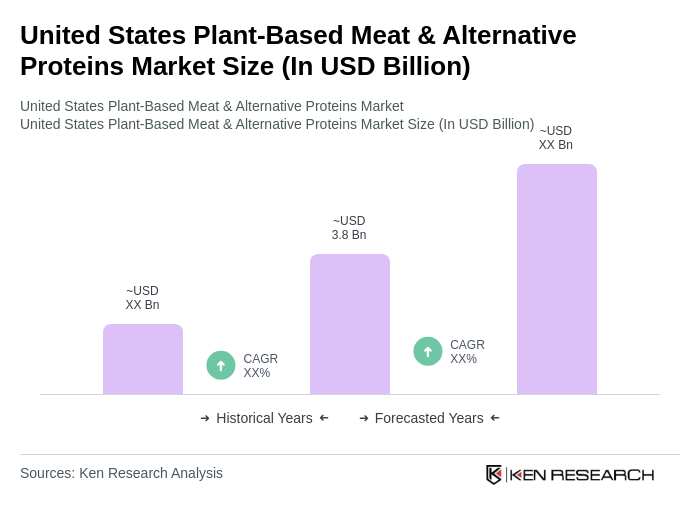
United States Plant-Based Meat & Alternative Proteins Market is worth USD 3.8 Bn, fueled by consumer shift to healthier, eco-friendly proteins and tech advancements in burgers, sausages, and more.

Region:North America

Author(s):Rebecca

Product Code:KRAA4871

Pages:92

Published On:September 2025
About the Report

Base Year 2024

United States Plant-Based Meat & Alternative Proteins Market Overview

  • The United States Plant-Based Meat & Alternative Proteins Market is valued at USD 3.8 billion, based on a five-year historical analysis. This market size reflects the latest available data for the U.S. market, which is driven by increasing consumer demand for healthier and sustainable food options, heightened awareness of the environmental impact of traditional meat production, and ongoing innovation in food technology. Growth is further supported by the popularity of clean-label, protein-rich foods and the expansion of e-commerce and direct-to-consumer channels .
  • Key states driving market volume includeCalifornia, New York, and Texas, which benefit from large populations, progressive food trends, and robust retail infrastructures. These states have seen a surge in plant-based product offerings, supported by both local startups and established food companies investing in alternative protein technologies .
  • The regulatory framework for plant-based foods is governed by theFood Labeling: Plant-Based Milk and Alternatives Act, 2023issued by the U.S. Congress. This act sets labeling standards for plant-based products, mandates clear ingredient disclosure, and supports research and development in alternative proteins through federal funding for sustainable agricultural practices. These measures enhance market transparency and foster innovation in the sector .
United States Plant-Based Meat & Alternative Proteins Market Size

United States Plant-Based Meat & Alternative Proteins Market Segmentation

By Type:The market is segmented into various types of plant-based meat alternatives, including burgers, sausages, meatballs, nuggets, deli slices, ground meat alternatives, strips & tenders, seafood alternatives, and others.Burgers and sausagesremain the most popular subsegments due to their versatility, familiarity, and widespread availability in both retail and foodservice channels. Nuggets and meatballs also show strong consumer acceptance, while seafood alternatives are gaining traction as innovation expands in this category .
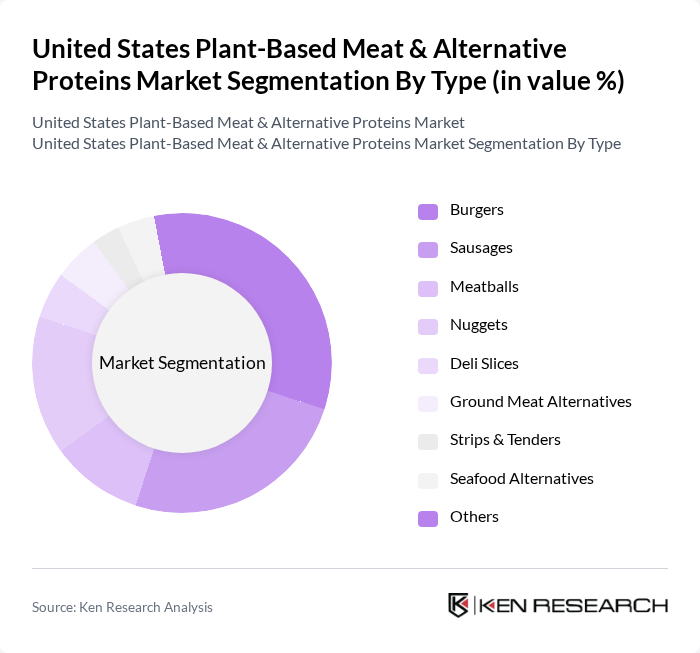
United States Plant-Based Meat & Alternative Proteins Market segmentation by Type.

By End-User:The market is segmented by end-users, including retail consumers, food service providers, meal kit services, and institutional buyers.Retail consumersaccount for the largest share, driven by demand for convenient, healthy, and sustainable meal options in grocery stores and supermarkets. Food service providers are expanding their plant-based offerings, while meal kit services and institutional buyers contribute to category growth through targeted product innovation and menu diversification .
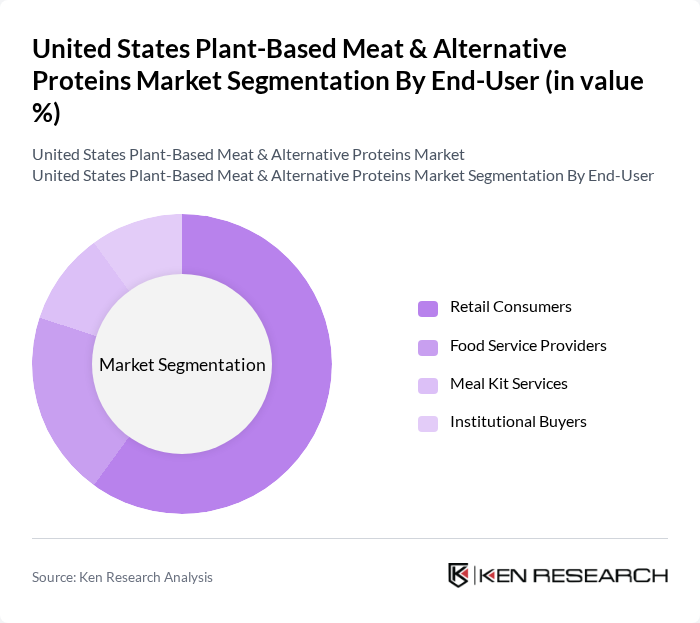
United States Plant-Based Meat & Alternative Proteins Market segmentation by End-User.

United States Plant-Based Meat & Alternative Proteins Market Competitive Landscape

The United States Plant-Based Meat & Alternative Proteins Market is characterized by a dynamic mix of regional and international players. Leading participants such as Beyond Meat, Impossible Foods, MorningStar Farms, Tofurky, Gardein, Field Roast, Lightlife, Quorn, Amy's Kitchen, Oumph!, Daring Foods, Good Catch, Plant Power Fast Food, The Very Good Food Company, Eat Just, Maple Leaf Foods, No Evil Foods, Alpha Foods, Sweet Earth Foods, Yves Veggie Cuisine contribute to innovation, geographic expansion, and service delivery in this space.

Beyond Meat

2009

El Segundo, California

Impossible Foods

2011

Redwood City, California

MorningStar Farms

1975

Battle Creek, Michigan

Tofurky

1980

Hood River, Oregon

Gardein

2003

Richmond, British Columbia

Company

Establishment Year

Headquarters

Group Size (Large, Medium, or Small as per industry convention)

Revenue Growth Rate (YoY %)

Market Penetration Rate (% of U.S. households or retail locations)

Customer Retention Rate (%)

Product Innovation Rate (new SKUs launched per year)

Distribution Network Efficiency (number of distribution points, D2C reach)

United States Plant-Based Meat & Alternative Proteins Market Industry Analysis

Growth Drivers

  • Increasing Consumer Demand for Sustainable Protein Sources:The U.S. plant-based meat market is experiencing a surge in demand, with sales reaching approximatelyUSD 1.4 billionin future. This growth is driven by a significant shift in consumer preferences towards sustainable protein sources, as60%of consumers express a desire to reduce their meat consumption. The World Bank projects that in future, the demand for plant-based proteins will continue to rise, supported by environmental concerns and climate change awareness.
  • Rising Health Consciousness Among Consumers:Health trends are increasingly influencing consumer choices, with70%of Americans actively seeking healthier food options. The plant-based meat segment has benefited from this trend, as products are often perceived as lower in saturated fats and higher in fiber. According to the USDA, the health food market is expected to grow byUSD 100 billionin future, further propelling the demand for plant-based alternatives as consumers prioritize wellness and nutrition.
  • Innovations in Product Development and Technology:The plant-based meat industry is witnessing rapid innovations, withover 200new products launched in future alone. Companies are investing heavily in R&D, with expenditures exceedingUSD 1 billion, focusing on improving taste, texture, and nutritional profiles. The Food and Drug Administration (FDA) supports these advancements, which are expected to enhance consumer acceptance and expand market reach, particularly among younger demographics who prioritize innovative food experiences.

Market Challenges

  • Price Competitiveness with Traditional Meat Products:One of the significant challenges facing the plant-based meat market is its price competitiveness. In future, the average price of plant-based burgers was approximatelyUSD 5.50per pound, compared toUSD 4.00per pound for traditional beef. This price gap poses a barrier to widespread adoption, particularly among price-sensitive consumers. As inflation continues to impact food prices, maintaining competitive pricing will be crucial for market growth.
  • Consumer Perception and Acceptance Issues:Despite growing interest, consumer perception remains a challenge, with40%of consumers still skeptical about the taste and quality of plant-based meats. This skepticism is compounded by misinformation regarding nutritional benefits. Industry reports indicate that overcoming these perception barriers is essential for market expansion, as consumer education and effective marketing strategies will play a pivotal role in enhancing acceptance and driving sales.

United States Plant-Based Meat & Alternative Proteins Market Future Outlook

The future of the U.S. plant-based meat and alternative proteins market appears promising, driven by evolving consumer preferences and increasing health awareness. As more individuals adopt flexitarian diets, the demand for innovative, sustainable protein sources is expected to rise. Additionally, advancements in technology and product development will likely enhance the appeal of plant-based options, making them more accessible and acceptable to a broader audience. The market is poised for significant growth as these trends continue to evolve.

Market Opportunities

  • Growth in E-commerce and Online Sales Channels:The rise of e-commerce presents a significant opportunity for plant-based meat brands, with online grocery sales projected to reachUSD 100 billionin future. This shift allows companies to reach a wider audience, particularly younger consumers who prefer online shopping. Enhanced digital marketing strategies can further capitalize on this trend, driving sales and brand loyalty in the competitive landscape.
  • Development of New Product Lines:There is a growing opportunity for companies to diversify their product offerings, with plant-based seafood and dairy alternatives gaining traction. The market for plant-based dairy is expected to exceedUSD 30 billionin future, indicating a strong demand for innovative alternatives. By expanding product lines, companies can cater to diverse consumer preferences and tap into new market segments, enhancing overall growth potential.

Scope of the Report

SegmentSub-Segments
By Type

Burgers

Sausages

Meatballs

Nuggets

Deli Slices

Ground Meat Alternatives

Strips & Tenders

Seafood Alternatives

Others

By End-User

Retail Consumers

Food Service Providers

Meal Kit Services

Institutional Buyers

By Distribution Channel

Supermarkets and Hypermarkets

Online Retail

Specialty Stores

Convenience Stores

Direct-to-Consumer (D2C)

By Product Form

Frozen

Refrigerated

Shelf-Stable

By Packaging Type

Bulk Packaging

Retail Packaging

Eco-Friendly Packaging

By Price Range

Premium

Mid-Range

Budget

By Nutritional Profile

High Protein

Low Carb

Gluten-Free

Soy-Free

Others

Key Target Audience

Investors and Venture Capitalist Firms

Government and Regulatory Bodies (e.g., U.S. Department of Agriculture, Food and Drug Administration)

Manufacturers and Producers

Distributors and Retailers

Food Service Providers

Health and Nutrition Organizations

Industry Associations (e.g., Plant Based Foods Association)

Financial Institutions

Players Mentioned in the Report:

Beyond Meat

Impossible Foods

MorningStar Farms

Tofurky

Gardein

Field Roast

Lightlife

Quorn

Amy's Kitchen

Oumph!

Daring Foods

Good Catch

Plant Power Fast Food

The Very Good Food Company

Eat Just

Maple Leaf Foods

No Evil Foods

Alpha Foods

Sweet Earth Foods

Yves Veggie Cuisine

Table of Contents

Market Assessment Phase

1. Executive Summary and Approach


2. United States Plant-Based Meat & Alternative Proteins Market Overview

2.1 Key Insights and Strategic Recommendations

2.2 United States Plant-Based Meat & Alternative Proteins Market Overview

2.3 Definition and Scope

2.4 Evolution of Market Ecosystem

2.5 Timeline of Key Regulatory Milestones

2.6 Value Chain & Stakeholder Mapping

2.7 Business Cycle Analysis

2.8 Policy & Incentive Landscape


3. United States Plant-Based Meat & Alternative Proteins Market Analysis

3.1 Growth Drivers

3.1.1 Increasing Consumer Demand for Sustainable Protein Sources
3.1.2 Rising Health Consciousness Among Consumers
3.1.3 Innovations in Product Development and Technology
3.1.4 Expansion of Distribution Channels

3.2 Market Challenges

3.2.1 Price Competitiveness with Traditional Meat Products
3.2.2 Consumer Perception and Acceptance Issues
3.2.3 Supply Chain Disruptions
3.2.4 Regulatory Hurdles

3.3 Market Opportunities

3.3.1 Growth in E-commerce and Online Sales Channels
3.3.2 Development of New Product Lines
3.3.3 Partnerships with Food Service Providers
3.3.4 Increasing Investment in Research and Development

3.4 Market Trends

3.4.1 Rise of Flexitarian Diets
3.4.2 Focus on Clean Label Products
3.4.3 Emergence of Lab-Grown Meat Alternatives
3.4.4 Sustainability and Ethical Sourcing Initiatives

3.5 Government Regulation

3.5.1 Labeling Requirements for Plant-Based Products
3.5.2 Food Safety Standards
3.5.3 Subsidies for Alternative Protein Development
3.5.4 Environmental Regulations Impacting Production

4. SWOT Analysis


5. Stakeholder Analysis


6. Porter's Five Forces Analysis


7. United States Plant-Based Meat & Alternative Proteins Market Market Size, 2019-2024

7.1 By Value

7.2 By Volume

7.3 By Average Selling Price


8. United States Plant-Based Meat & Alternative Proteins Market Segmentation

8.1 By Type

8.1.1 Burgers
8.1.2 Sausages
8.1.3 Meatballs
8.1.4 Nuggets
8.1.5 Deli Slices
8.1.6 Ground Meat Alternatives
8.1.7 Strips & Tenders
8.1.8 Seafood Alternatives
8.1.9 Others

8.2 By End-User

8.2.1 Retail Consumers
8.2.2 Food Service Providers
8.2.3 Meal Kit Services
8.2.4 Institutional Buyers

8.3 By Distribution Channel

8.3.1 Supermarkets and Hypermarkets
8.3.2 Online Retail
8.3.3 Specialty Stores
8.3.4 Convenience Stores
8.3.5 Direct-to-Consumer (D2C)

8.4 By Product Form

8.4.1 Frozen
8.4.2 Refrigerated
8.4.3 Shelf-Stable

8.5 By Packaging Type

8.5.1 Bulk Packaging
8.5.2 Retail Packaging
8.5.3 Eco-Friendly Packaging

8.6 By Price Range

8.6.1 Premium
8.6.2 Mid-Range
8.6.3 Budget

8.7 By Nutritional Profile

8.7.1 High Protein
8.7.2 Low Carb
8.7.3 Gluten-Free
8.7.4 Soy-Free
8.7.5 Others

9. United States Plant-Based Meat & Alternative Proteins Market Competitive Analysis

9.1 Market Share of Key Players

9.2 Cross Comparison of Key Players

9.2.1 Company Name
9.2.2 Group Size (Large, Medium, or Small as per industry convention)
9.2.3 Revenue Growth Rate (YoY %)
9.2.4 Market Penetration Rate (% of U.S. households or retail locations)
9.2.5 Customer Retention Rate (%)
9.2.6 Product Innovation Rate (new SKUs launched per year)
9.2.7 Distribution Network Efficiency (number of distribution points, D2C reach)
9.2.8 Average Selling Price (USD/lb or USD/unit)
9.2.9 Brand Recognition (consumer survey score or aided recall %)
9.2.10 Sustainability Initiatives (carbon footprint reduction, plant-based sourcing %)
9.2.11 R&D Spend as % of Revenue
9.2.12 Gross Margin (%)

9.3 SWOT Analysis of Top Players

9.4 Pricing Analysis

9.5 Detailed Profile of Major Companies

9.5.1 Beyond Meat
9.5.2 Impossible Foods
9.5.3 MorningStar Farms
9.5.4 Tofurky
9.5.5 Gardein
9.5.6 Field Roast
9.5.7 Lightlife
9.5.8 Quorn
9.5.9 Amy's Kitchen
9.5.10 Oumph!
9.5.11 Daring Foods
9.5.12 Good Catch
9.5.13 Plant Power Fast Food
9.5.14 The Very Good Food Company
9.5.15 Eat Just
9.5.16 Maple Leaf Foods
9.5.17 No Evil Foods
9.5.18 Alpha Foods
9.5.19 Sweet Earth Foods
9.5.20 Yves Veggie Cuisine

10. United States Plant-Based Meat & Alternative Proteins Market End-User Analysis

10.1 Procurement Behavior of Key Ministries

10.1.1 Government Initiatives for Sustainable Food Sources
10.1.2 Budget Allocations for Alternative Proteins
10.1.3 Collaboration with Private Sector

10.2 Corporate Spend on Infrastructure & Energy

10.2.1 Investment in Sustainable Practices
10.2.2 Funding for Research and Development
10.2.3 Expenditure on Marketing and Branding

10.3 Pain Point Analysis by End-User Category

10.3.1 Cost Sensitivity Among Consumers
10.3.2 Supply Chain Reliability Issues
10.3.3 Quality and Taste Concerns

10.4 User Readiness for Adoption

10.4.1 Awareness of Plant-Based Options
10.4.2 Willingness to Experiment with New Products
10.4.3 Accessibility of Products

10.5 Post-Deployment ROI and Use Case Expansion

10.5.1 Metrics for Success in Adoption
10.5.2 Expansion into New Markets
10.5.3 Long-term Customer Engagement Strategies

11. United States Plant-Based Meat & Alternative Proteins Market Future Size, 2025-2030

11.1 By Value

11.2 By Volume

11.3 By Average Selling Price


Go-To-Market Strategy Phase

1. Whitespace Analysis + Business Model Canvas

1.1 Market Gaps and Opportunities

1.2 Business Model Framework


2. Marketing and Positioning Recommendations

2.1 Branding Strategies

2.2 Product USPs


3. Distribution Plan

3.1 Urban Retail Strategies

3.2 Rural NGO Tie-Ups


4. Channel & Pricing Gaps

4.1 Underserved Routes

4.2 Pricing Bands


5. Unmet Demand & Latent Needs

5.1 Category Gaps

5.2 Consumer Segments


6. Customer Relationship

6.1 Loyalty Programs

6.2 After-Sales Service


7. Value Proposition

7.1 Sustainability Initiatives

7.2 Integrated Supply Chains


8. Key Activities

8.1 Regulatory Compliance

8.2 Branding Efforts

8.3 Distribution Setup


9. Entry Strategy Evaluation

9.1 Domestic Market Entry Strategy

9.1.1 Product Mix
9.1.2 Pricing Band
9.1.3 Packaging Considerations

9.2 Export Entry Strategy

9.2.1 Target Countries
9.2.2 Compliance Roadmap

10. Entry Mode Assessment

10.1 Joint Ventures

10.2 Greenfield Investments

10.3 Mergers & Acquisitions

10.4 Distributor Model


11. Capital and Timeline Estimation

11.1 Capital Requirements

11.2 Timelines for Implementation


12. Control vs Risk Trade-Off

12.1 Ownership Considerations

12.2 Partnerships


13. Profitability Outlook

13.1 Breakeven Analysis

13.2 Long-Term Sustainability


14. Potential Partner List

14.1 Distributors

14.2 Joint Ventures

14.3 Acquisition Targets


15. Execution Roadmap

15.1 Phased Plan for Market Entry

15.1.1 Market Setup
15.1.2 Market Entry
15.1.3 Growth Acceleration
15.1.4 Scale & Stabilize

15.2 Key Activities and Milestones

15.2.1 Milestone Planning
15.2.2 Activity Tracking

Research Methodology

ApproachModellingSample

Phase 1: Approach1

Desk Research

  • Analysis of industry reports from market research firms focusing on plant-based meat trends
  • Review of government publications and dietary guidelines related to alternative proteins
  • Examination of consumer behavior studies and market surveys on plant-based diets

Primary Research

  • Interviews with product development managers at leading plant-based meat companies
  • Surveys with nutritionists and dietitians regarding consumer preferences
  • Focus groups with consumers to understand perceptions and barriers to adoption

Validation & Triangulation

  • Cross-validation of findings with sales data from major retailers
  • Triangulation of insights from consumer interviews and industry expert opinions
  • Sanity checks through feedback from a panel of food industry experts

Phase 2: Market Size Estimation1

Top-down Assessment

  • Estimation of market size based on national food consumption statistics and trends
  • Segmentation of the market by product type, including burgers, sausages, and meat alternatives
  • Incorporation of growth rates from related sectors such as vegan and vegetarian food markets

Bottom-up Modeling

  • Collection of sales data from key players in the plant-based meat sector
  • Estimation of average selling prices and volume sold across different product categories
  • Analysis of distribution channels and their impact on market penetration

Forecasting & Scenario Analysis

  • Utilization of time-series analysis to project future market growth based on historical data
  • Scenario modeling based on potential regulatory changes and consumer health trends
  • Development of best-case, worst-case, and most-likely market scenarios through 2030

Phase 3: CATI Sample Composition1

Scope Item/SegmentSample SizeTarget Respondent Profiles
Retail Market Insights100Store Managers, Category Buyers
Consumer Preferences Survey120Health-Conscious Consumers, Vegans, Flexitarians
Food Service Sector Analysis80Restaurant Owners, Menu Planners
Nutritionist Insights60Registered Dietitians, Nutrition Consultants
Market Trend Analysis70Food Industry Analysts, Market Researchers

Frequently Asked Questions

What is the current value of the United States Plant-Based Meat & Alternative Proteins Market?

The United States Plant-Based Meat & Alternative Proteins Market is valued at approximately USD 3.8 billion, reflecting a significant growth driven by consumer demand for healthier and sustainable food options, as well as innovations in food technology.

Which states are leading in the plant-based meat market in the U.S.?

What are the main types of plant-based meat alternatives available?

Who are the major players in the U.S. plant-based meat market?

Other Regional/Country Reports

Indonesia Plant-Based Meat & Alternative Proteins Market

Malaysia Plant-Based Meat & Alternative Proteins Market

KSA Plant-Based Meat & Alternative Proteins Market

APAC Plant-Based Meat & Alternative Proteins Market

SEA Plant-Based Meat & Alternative Proteins Market

Vietnam Plant-Based Meat & Alternative Proteins Market

Other Adjacent Reports

Indonesia Plant-Based Dairy Alternatives MarketMiddle East Vegan Snacks Market

Malaysia Alternative Protein Supplements Market

Bahrain Sustainable Food Packaging Market

Indonesia Organic Produce Market

Egypt Health and Wellness Foods Market

Singapore Food Biotechnology Market

GCC greece nutraceuticals market report Size, Share, Growth Drivers, Trends, Opportunities & Forecast 2025–2030

Indonesia E-Commerce Grocery Market

Germany Food Delivery Services Market

Why Buy From Us?

Refine Robust Result (RRR) Framework

What makes us stand out is that our consultants follow Robust, Refine and Result (RRR) methodology. Robust for clear definitions, approaches and sanity checking, Refine for differentiating respondents' facts and opinions, and Result for presenting data with story.

Our Reach Is Unmatched

We have set a benchmark in the industry by offering our clients with syndicated and customized market research reports featuring coverage of entire market as well as meticulous research and analyst insights.

Shifting the Research Paradigm

While we don't replace traditional research, we flip the method upside down. Our dual approach of Top Bottom & Bottom Top ensures quality deliverable by not just verifying company fundamentals but also looking at the sector and macroeconomic factors.

More Insights-Better Decisions

With one step in the future, our research team constantly tries to show you the bigger picture. We help with some of the tough questions you may encounter along the way: How is the industry positioned? Best marketing channel? KPI's of competitors? By aligning every element, we help maximize success.

Transparency and Trust

Our report gives you instant access to the answers and sources that other companies might choose to hide. We elaborate each steps of research methodology we have used and showcase you the sample size to earn your trust.

Round the Clock Support

If you need any support, we are here! We pride ourselves on universe strength, data quality, and quick, friendly, and professional service.

Why Clients Choose Us?

400000+
Reports in repository
150+
Consulting projects a year
100+
Analysts
8000+
Client Queries in 2022








