About the Report
Base Year 2024United States Smart Tv Market Overview
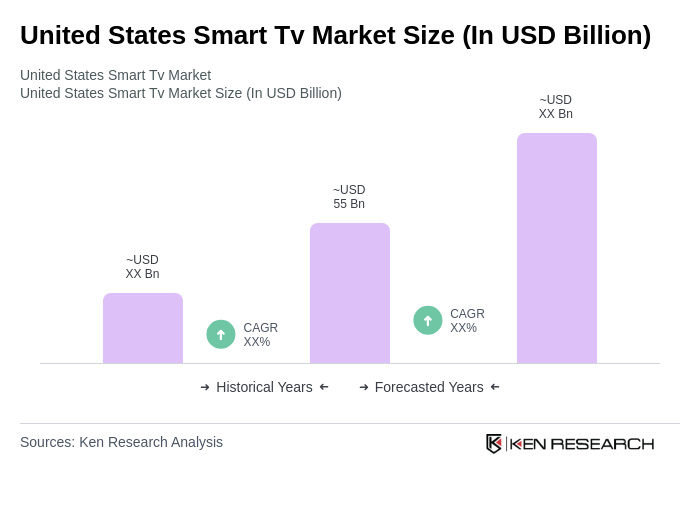
- The United States Smart TV market is valued at approximately USD 55 billion, based on a five-year historical analysis. This valuation aligns with recent industry reporting that places the market near USD 55 billion, underpinned by robust adoption of streaming, broader smart-home integration, and ongoing display and OS innovation. The proliferation of subscription streaming services and connected TV usage remains a central demand driver.
- Key cities dominating the market include New York, Los Angeles, and Chicago, where higher disposable incomes, dense retail footprints, and strong broadband penetration support demand for advanced television technologies and premium screens. These metros are also critical omnichannel hubs for big-box and e-commerce sell-through of smart TVs, reinforcing their role in market concentration.
- In 2023, federal attention to consumer protection around connected devices focused on clearer disclosures and privacy expectations; however, there was no specific FCC rule mandating standardized smart TV energy or data privacy labels that year. Energy labeling for televisions in the U.S. has historically been overseen via EnergyGuide under the FTC framework, while privacy practices are governed by a mix of federal and state rules; smart TV privacy has seen regulatory scrutiny but not an FCC-specific labeling mandate in 2023.
United States Smart Tv Market Segmentation
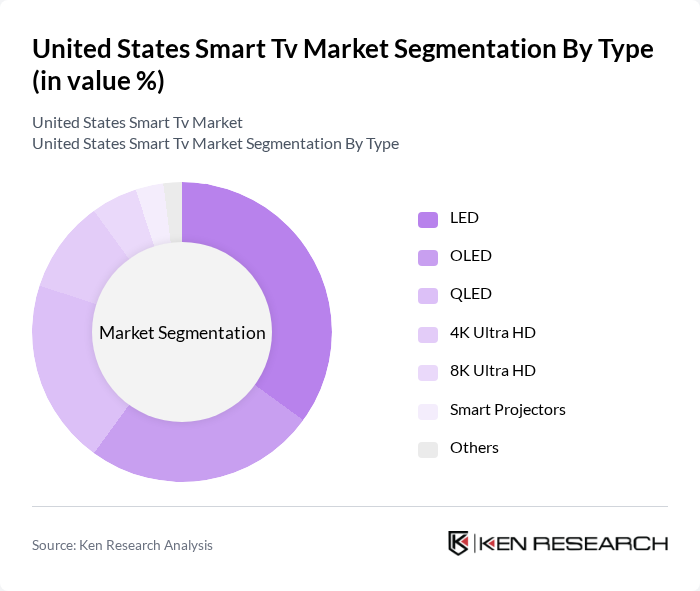
By Type:The market is segmented into various types of smart TVs, including LED, OLED, QLED, 4K Ultra HD, 8K Ultra HD, smart projectors, and others. Each type caters to different consumer preferences and technological advancements, influencing market dynamics.
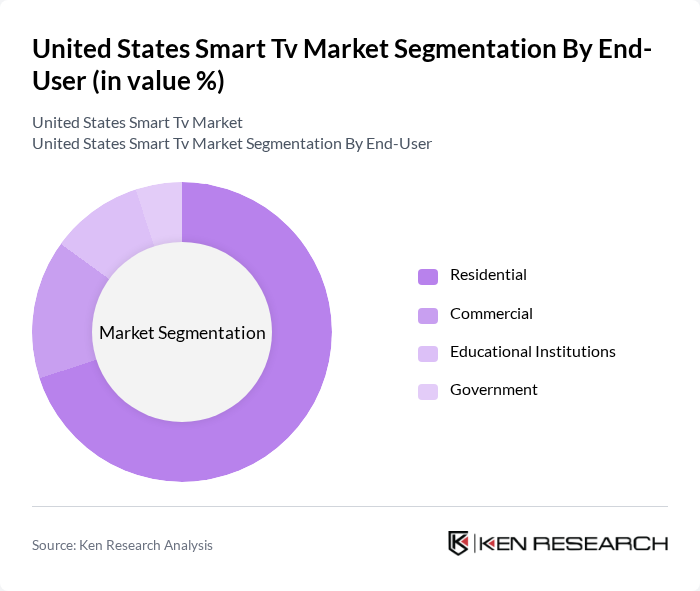
By End-User:The smart TV market is segmented by end-user categories, including residential, commercial, educational institutions, and government. Each segment has unique requirements and purchasing behaviors that influence market trends.
United States Smart Tv Market Competitive Landscape
The United States Smart TV market is characterized by a dynamic mix of regional and international players. Leading participants such as Samsung Electronics, LG Electronics, Sony Corporation, TCL Technology, Vizio Inc., Hisense USA, Panasonic Corporation, Sharp Electronics, Philips Electronics, Insignia (Best Buy Co., Inc.), Amazon (Fire TV Edition), Roku Inc., Apple Inc. (Apple TV Integration), Google LLC (Android TV/Google TV), Skyworth Group contribute to innovation, geographic expansion, and service delivery in this space.
United States Smart Tv Market Industry Analysis
Growth Drivers
- Increasing Consumer Demand for Smart Features:The demand for smart TVs in the United States is driven by consumer preferences for integrated features. In the future, approximately 75 million households are expected to own smart TVs, reflecting a 7% increase from the prior period. This surge is attributed to the growing desire for seamless access to streaming platforms, social media, and gaming applications, which enhance user experience and engagement. The average consumer is willing to spend around eight hundred dollars on a smart TV, indicating a robust market appetite.
- Rise in Streaming Services Subscription:The proliferation of streaming services has significantly influenced smart TV sales. As of early in the future, over 100 million U.S. households subscribe to at least one streaming service, a 10% increase from the previous year. This trend is bolstered by the availability of exclusive content and original programming, which encourages consumers to invest in smart TVs that provide optimal viewing experiences. The average household spends approximately fifty dollars monthly on streaming subscriptions, further driving the demand for compatible devices.
- Technological Advancements in Display Quality:Innovations in display technology, such as OLED and QLED, are pivotal in the smart TV market. In the future, the market for high-definition displays is projected to reach fifteen billion dollars, with 8K resolution TVs gaining traction among consumers. Enhanced picture quality, coupled with features like HDR (High Dynamic Range), is attracting tech-savvy buyers. As a result, manufacturers are investing heavily in R&D, with spending expected to exceed two billion dollars, ensuring continuous improvement in display technologies.
Market Challenges
- High Competition Among Brands:The smart TV market in the United States is characterized by intense competition, with over 25 major brands vying for market share. In the future, the top five brands account for approximately 65% of total sales, leading to aggressive pricing strategies. This competition pressures profit margins, as brands must continuously innovate and offer attractive features to differentiate themselves. The average price of smart TVs has decreased by 4% annually, further intensifying the competitive landscape.
- Cybersecurity Concerns:As smart TVs become more integrated with the internet and smart home devices, cybersecurity risks have escalated. In the future, it is estimated that 35% of smart TV users have experienced security breaches, raising concerns about data privacy. Manufacturers are under pressure to enhance security features, which can increase production costs. The potential for data theft and unauthorized access poses a significant challenge, as consumers become more cautious about adopting new technologies without robust security measures.
United States Smart Tv Market Future Outlook
The future of the smart TV market in the United States appears promising, driven by technological advancements and evolving consumer preferences. As 5G technology expands, it will enhance streaming capabilities and enable higher-quality content delivery. Additionally, the integration of artificial intelligence in smart TVs is expected to improve user experience through personalized recommendations and voice control. These trends indicate a shift towards more interactive and user-friendly devices, positioning the market for sustained growth in the coming years.
Market Opportunities
- Expansion of 5G Technology:The rollout of 5G networks presents a significant opportunity for smart TV manufacturers. With faster internet speeds and lower latency, consumers will enjoy seamless streaming experiences. In the future, it is projected that 55% of U.S. households will have access to 5G, creating a favorable environment for smart TV adoption and enhancing the overall viewing experience.
- Partnerships with Content Providers:Collaborations between smart TV manufacturers and content providers can drive market growth. In the future, partnerships with major streaming services are expected to increase by 30%, allowing manufacturers to offer exclusive content bundles. This strategy not only enhances the value proposition for consumers but also strengthens brand loyalty, positioning companies for long-term success in a competitive landscape.
Scope of the Report
| Segment | Sub-Segments |
|---|---|
| By Type | LED OLED QLED K Ultra HD K Ultra HD Smart Projectors Others |
| By End-User | Residential Commercial Educational Institutions Government |
| By Sales Channel | Online Retail Offline Retail Direct Sales Distributors |
| By Price Range | Budget Mid-Range Premium |
| By Brand | Samsung LG Sony TCL Vizio Hisense Insignia Philips Sharp Panasonic Others |
| By Features | Smart Home Integration Voice Control Gaming Features (e.g., HDMI 2.1, VRR, ALLM) Streaming Capabilities (Built-in Apps, App Store) Multi-User Profiles Parental Controls |
| By Distribution Mode | Direct-to-Consumer Retail Partnerships E-commerce Platforms Others |
Key Target Audience
Investors and Venture Capitalist Firms
Government and Regulatory Bodies (e.g., Federal Communications Commission, National Telecommunications and Information Administration)
Manufacturers and Producers
Distributors and Retailers
Content Providers and Streaming Services
Telecommunications Companies
Advertising Agencies
Market Analysts and Industry Experts
Players Mentioned in the Report:
Samsung Electronics
LG Electronics
Sony Corporation
TCL Technology
Vizio Inc.
Hisense USA
Panasonic Corporation
Sharp Electronics
Philips Electronics
Insignia (Best Buy Co., Inc.)
Amazon (Fire TV Edition)
Roku Inc.
Apple Inc. (Apple TV Integration)
Google LLC (Android TV/Google TV)
Skyworth Group
Table of Contents
Market Assessment Phase
1. Executive Summary and Approach
2. United States Smart Tv Market Overview
2.1 Key Insights and Strategic Recommendations
2.2 United States Smart Tv Market Overview
2.3 Definition and Scope
2.4 Evolution of Market Ecosystem
2.5 Timeline of Key Regulatory Milestones
2.6 Value Chain & Stakeholder Mapping
2.7 Business Cycle Analysis
2.8 Policy & Incentive Landscape
3. United States Smart Tv Market Analysis
3.1 Growth Drivers
3.1.1 Increasing Consumer Demand for Smart Features
3.1.2 Rise in Streaming Services Subscription
3.1.3 Technological Advancements in Display Quality
3.1.4 Integration with Smart Home Devices
3.2 Market Challenges
3.2.1 High Competition Among Brands
3.2.2 Rapid Technological Changes
3.2.3 Price Sensitivity Among Consumers
3.2.4 Cybersecurity Concerns
3.3 Market Opportunities
3.3.1 Expansion of 5G Technology
3.3.2 Growth in E-commerce Sales
3.3.3 Increasing Adoption of AI in Smart TVs
3.3.4 Partnerships with Content Providers
3.4 Market Trends
3.4.1 Shift Towards 8K Resolution TVs
3.4.2 Growth of Voice-Controlled Interfaces
3.4.3 Emphasis on Energy Efficiency
3.4.4 Rise of Subscription-Based TV Models
3.5 Government Regulation
3.5.1 Energy Efficiency Standards
3.5.2 Consumer Privacy Regulations
3.5.3 Import Tariffs on Electronics
3.5.4 Compliance with FCC Guidelines
4. SWOT Analysis
5. Stakeholder Analysis
6. Porter's Five Forces Analysis
7. United States Smart Tv Market Market Size, 2019-2024
7.1 By Value
7.2 By Volume
7.3 By Average Selling Price
8. United States Smart Tv Market Segmentation
8.1 By Type
8.1.1 LED
8.1.2 OLED
8.1.3 QLED
8.1.4 4K Ultra HD
8.1.5 8K Ultra HD
8.1.6 Smart Projectors
8.1.7 Others
8.2 By End-User
8.2.1 Residential
8.2.2 Commercial
8.2.3 Educational Institutions
8.2.4 Government
8.3 By Sales Channel
8.3.1 Online Retail
8.3.2 Offline Retail
8.3.3 Direct Sales
8.3.4 Distributors
8.4 By Price Range
8.4.1 Budget
8.4.2 Mid-Range
8.4.3 Premium
8.5 By Brand
8.5.1 Samsung
8.5.2 LG
8.5.3 Sony
8.5.4 TCL
8.5.5 Vizio
8.5.6 Hisense
8.5.7 Insignia
8.5.8 Philips
8.5.9 Sharp
8.5.10 Panasonic
8.5.11 Others
8.6 By Features
8.6.1 Smart Home Integration
8.6.2 Voice Control
8.6.3 Gaming Features (e.g., HDMI 2.1, VRR, ALLM)
8.6.4 Streaming Capabilities (Built-in Apps, App Store)
8.6.5 Multi-User Profiles
8.6.6 Parental Controls
8.7 By Distribution Mode
8.7.1 Direct-to-Consumer
8.7.2 Retail Partnerships
8.7.3 E-commerce Platforms
8.7.4 Others
9. United States Smart Tv Market Competitive Analysis
9.1 Market Share of Key Players
9.2 Cross Comparison of Key Players
9.2.1 Company Name
9.2.2 Group Size (Large, Medium, or Small as per industry convention)
9.2.3 Revenue Growth Rate (US Smart TV Segment)
9.2.4 Market Share (US Smart TV Market)
9.2.5 Average Selling Price (ASP)
9.2.6 Product Portfolio Breadth (Screen Sizes, Resolutions, OS)
9.2.7 Distribution Channel Coverage (Online, Offline, DTC)
9.2.8 Customer Satisfaction Index (US Market)
9.2.9 Return Rate / Warranty Claims
9.2.10 Brand Awareness Score (US)
9.2.11 R&D/Innovation Investment (as % of revenue)
9.2.12 Smart Feature Adoption Rate (Voice, AI, IoT Integration)
9.2.13 Energy Efficiency Ratings Compliance
9.2.14 After-Sales Service Network Strength
9.3 SWOT Analysis of Top Players
9.4 Pricing Analysis
9.5 Detailed Profile of Major Companies
9.5.1 Samsung Electronics
9.5.2 LG Electronics
9.5.3 Sony Corporation
9.5.4 TCL Technology
9.5.5 Vizio Inc.
9.5.6 Hisense USA
9.5.7 Panasonic Corporation
9.5.8 Sharp Electronics
9.5.9 Philips Electronics
9.5.10 Insignia (Best Buy Co., Inc.)
9.5.11 Amazon (Fire TV Edition)
9.5.12 Roku Inc.
9.5.13 Apple Inc. (Apple TV Integration)
9.5.14 Google LLC (Android TV/Google TV)
9.5.15 Skyworth Group
10. United States Smart Tv Market End-User Analysis
10.1 Procurement Behavior of Key Ministries
10.1.1 Government Procurement Policies
10.1.2 Budget Allocation for Technology
10.1.3 Evaluation Criteria for Smart TVs
10.2 Corporate Spend on Infrastructure & Energy
10.2.1 Investment in Smart Technologies
10.2.2 Budget Trends in Corporate Sector
10.2.3 Adoption of Smart TVs in Offices
10.3 Pain Point Analysis by End-User Category
10.3.1 Residential User Concerns
10.3.2 Commercial User Challenges
10.3.3 Educational User Needs
10.4 User Readiness for Adoption
10.4.1 Awareness of Smart TV Features
10.4.2 Technical Support Availability
10.4.3 User Training Programs
10.5 Post-Deployment ROI and Use Case Expansion
10.5.1 Measurement of ROI
10.5.2 Use Case Scenarios
10.5.3 Long-term Benefits Analysis
11. United States Smart Tv Market Future Size, 2025-2030
11.1 By Value
11.2 By Volume
11.3 By Average Selling Price
Go-To-Market Strategy Phase
1. Whitespace Analysis + Business Model Canvas
1.1 Market Gaps Identification
1.2 Business Model Framework
2. Marketing and Positioning Recommendations
2.1 Branding Strategies
2.2 Product USPs
3. Distribution Plan
3.1 Urban Retail Strategies
3.2 Rural NGO Tie-ups
4. Channel & Pricing Gaps
4.1 Underserved Routes
4.2 Pricing Bands Analysis
5. Unmet Demand & Latent Needs
5.1 Category Gaps
5.2 Consumer Segments
6. Customer Relationship
6.1 Loyalty Programs
6.2 After-sales Service
7. Value Proposition
7.1 Sustainability Initiatives
7.2 Integrated Supply Chains
8. Key Activities
8.1 Regulatory Compliance
8.2 Branding Efforts
8.3 Distribution Setup
9. Entry Strategy Evaluation
9.1 Domestic Market Entry Strategy
9.1.1 Product Mix Considerations
9.1.2 Pricing Band Strategy
9.1.3 Packaging Solutions
9.2 Export Entry Strategy
9.2.1 Target Countries Analysis
9.2.2 Compliance Roadmap
10. Entry Mode Assessment
10.1 Joint Ventures
10.2 Greenfield Investments
10.3 Mergers & Acquisitions
10.4 Distributor Model
11. Capital and Timeline Estimation
11.1 Capital Requirements
11.2 Timelines for Implementation
12. Control vs Risk Trade-Off
12.1 Ownership vs Partnerships
13. Profitability Outlook
13.1 Breakeven Analysis
13.2 Long-term Sustainability
14. Potential Partner List
14.1 Distributors
14.2 Joint Ventures
14.3 Acquisition Targets
15. Execution Roadmap
15.1 Phased Plan for Market Entry
15.1.1 Market Setup
15.1.2 Market Entry
15.1.3 Growth Acceleration
15.1.4 Scale & Stabilize
15.2 Key Activities and Milestones
15.2.1 Milestone Planning
15.2.2 Activity Tracking
Research Methodology
Phase 1: Approach1
Desk Research
- Market reports from industry associations and research firms focusing on smart TV trends
- Consumer electronics sales data from government and trade publications
- Analysis of technological advancements and consumer preferences through white papers and journals
Primary Research
- Interviews with product managers at leading smart TV manufacturers
- Surveys targeting consumers to understand purchasing behavior and preferences
- Focus groups with tech-savvy users to gather insights on features and usability
Validation & Triangulation
- Cross-validation of findings with sales data and consumer feedback
- Triangulation of insights from primary interviews and secondary data sources
- Sanity checks through expert reviews from industry analysts and consultants
Phase 2: Market Size Estimation1
Top-down Assessment
- Estimation of total market size based on overall consumer electronics spending trends
- Segmentation by smart TV types, including OLED, QLED, and LED
- Incorporation of growth rates from historical data and market forecasts
Bottom-up Modeling
- Volume estimates based on unit sales from major retailers and e-commerce platforms
- Price analysis of various smart TV models to determine average selling prices
- Calculation of market size using unit sales multiplied by average prices
Forecasting & Scenario Analysis
- Multi-factor regression analysis incorporating economic indicators and consumer trends
- Scenario modeling based on potential shifts in technology adoption and market dynamics
- Baseline, optimistic, and pessimistic forecasts through 2030 based on varying growth assumptions
Phase 3: CATI Sample Composition1
| Scope Item/Segment | Sample Size | Target Respondent Profiles |
|---|---|---|
| Consumer Purchase Behavior | 140 | Smart TV Owners, Recent Buyers |
| Retail Insights | 90 | Store Managers, Electronics Retail Staff |
| Technological Adoption Trends | 80 | Tech Enthusiasts, Early Adopters |
| Market Trends Analysis | 70 | Industry Analysts, Market Researchers |
| Consumer Preferences Survey | 120 | General Consumers, Focus Group Participants |
Frequently Asked Questions
What is the current value of the United States Smart TV market?
The United States Smart TV market is valued at approximately USD 55 billion, driven by the increasing adoption of streaming services, smart-home integration, and advancements in display technology and operating systems.
Which cities are the largest markets for Smart TVs in the U.S.?
What are the main types of Smart TVs available in the market?
How is the U.S. Smart TV market segmented by end-user?
Other Regional/Country Reports
Malaysia Smart Tv Market
Why Buy From Us?

What makes us stand out is that our consultants follow Robust, Refine and Result (RRR) methodology. Robust for clear definitions, approaches and sanity checking, Refine for differentiating respondents' facts and opinions, and Result for presenting data with story.

We have set a benchmark in the industry by offering our clients with syndicated and customized market research reports featuring coverage of entire market as well as meticulous research and analyst insights.

While we don't replace traditional research, we flip the method upside down. Our dual approach of Top Bottom & Bottom Top ensures quality deliverable by not just verifying company fundamentals but also looking at the sector and macroeconomic factors.

With one step in the future, our research team constantly tries to show you the bigger picture. We help with some of the tough questions you may encounter along the way: How is the industry positioned? Best marketing channel? KPI's of competitors? By aligning every element, we help maximize success.

Our report gives you instant access to the answers and sources that other companies might choose to hide. We elaborate each steps of research methodology we have used and showcase you the sample size to earn your trust.

If you need any support, we are here! We pride ourselves on universe strength, data quality, and quick, friendly, and professional service.