Region:North America
Author(s):Geetanshi
Product Code:KRAB1137
Pages:89
Published On:January 2026
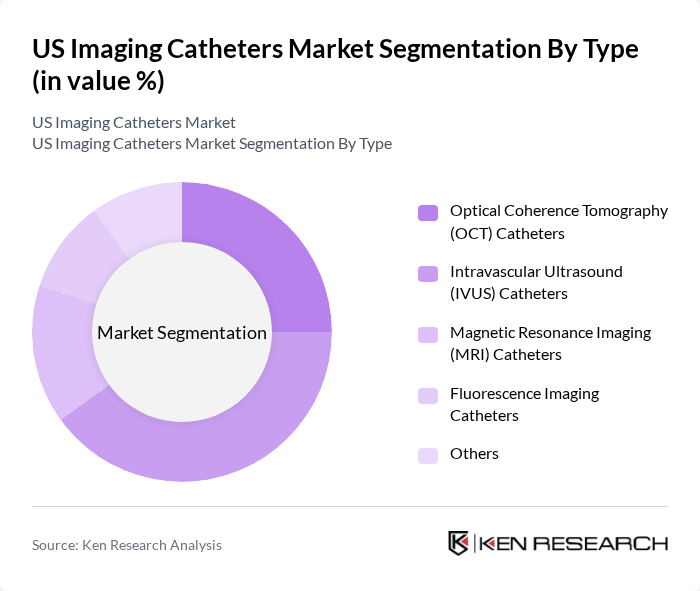
By Type:The imaging catheters market is segmented into various types, including Optical Coherence Tomography (OCT) Catheters, Intravascular Ultrasound (IVUS) Catheters, Magnetic Resonance Imaging (MRI) Catheters, Fluorescence Imaging Catheters, and Others. Among these, Intravascular Ultrasound (IVUS) Catheters are leading the market due to their widespread use in cardiovascular imaging, providing real-time imaging of blood vessels and aiding in the assessment of plaque morphology. The demand for OCT Catheters is also growing, driven by their high-resolution imaging capabilities, which are crucial for diagnosing coronary artery diseases.
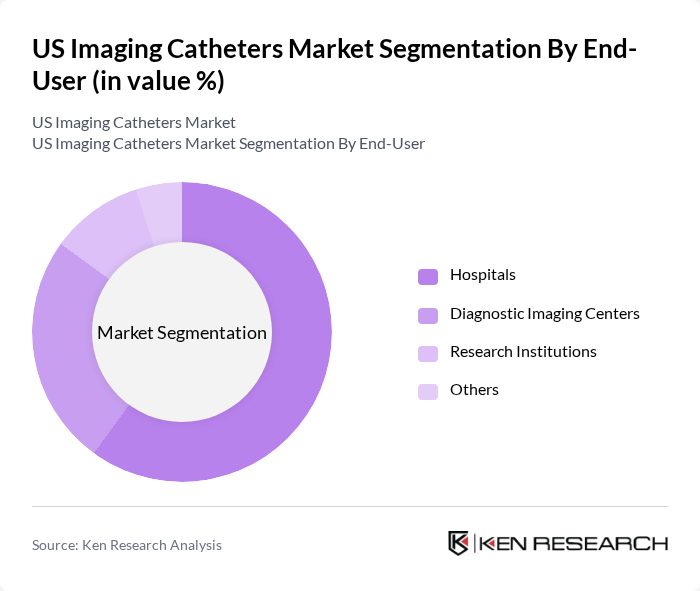
By End-User:The end-user segmentation includes Hospitals, Diagnostic Imaging Centers, Research Institutions, and Others. Hospitals are the dominant end-user segment, accounting for a significant share of the market. This is primarily due to the high volume of diagnostic and interventional procedures performed in these settings, where imaging catheters are essential for accurate diagnosis and treatment planning. Diagnostic Imaging Centers also contribute to market growth, as they increasingly adopt advanced imaging technologies to enhance patient care.
The US Imaging Catheters Market is characterized by a dynamic mix of regional and international players. Leading participants such as Boston Scientific Corporation, Abbott Laboratories, Medtronic plc, Johnson & Johnson, Philips Healthcare, Siemens Healthineers, GE Healthcare, Canon Medical Systems, Stryker Corporation, Terumo Corporation, B. Braun Melsungen AG, Cook Medical, Hologic, Inc., Cardiovascular Systems, Inc., and iRhythm Technologies, Inc. contribute to innovation, geographic expansion, and service delivery in this space.
Emerging technologies, such as AI-enhanced imaging and OCT catheters, are set to revolutionize the capabilities of imaging catheters, providing near-microscopic resolution and improving diagnostic accuracy. The digital transformation in healthcare, characterized by the integration of AI diagnostics and modular analytics, will support smarter catheter usage in interventional procedures. Additionally, the industry is increasingly focusing on sustainability and supply resilience, with strategies like reshoring production to mitigate geopolitical disruptions.
| Segment | Sub-Segments |
|---|---|
| By Type | Optical Coherence Tomography (OCT) Catheters Intravascular Ultrasound (IVUS) Catheters Magnetic Resonance Imaging (MRI) Catheters Fluorescence Imaging Catheters Others |
| By End-User | Hospitals Diagnostic Imaging Centers Research Institutions Others |
| By Application | Cardiovascular Imaging Neurological Imaging Oncology Imaging Others |
| By Material | Polymer-based Catheters Metal-based Catheters Composite Material Catheters Others |
| By Distribution Channel | Direct Sales Distributors Online Sales Others |
| By Region | Northeast Midwest South West |
| By Technology | D Imaging Technology D Imaging Technology Hybrid Imaging Technology Others |
| Scope Item/Segment | Sample Size | Target Respondent Profiles |
|---|---|---|
| Cardiology Imaging Catheters | 150 | Interventional Cardiologists, Cardiology Department Heads |
| Radiology Imaging Catheters | 100 | Radiologists, Imaging Center Managers |
| Oncology Imaging Catheters | 80 | Oncologists, Cancer Treatment Facility Administrators |
| Emergency Medical Services | 70 | Emergency Room Physicians, EMS Coordinators |
| Research and Development in Medical Devices | 60 | R&D Managers, Product Development Engineers |
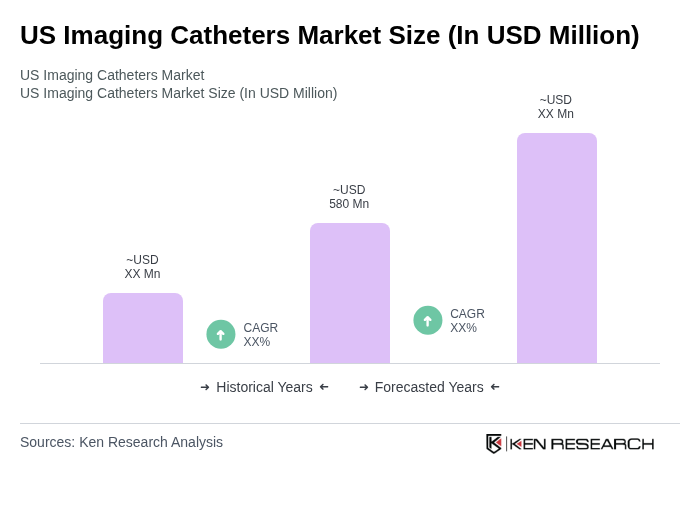
The US Imaging Catheters Market is valued at approximately USD 580 million, reflecting a significant growth driven by the increasing prevalence of cardiovascular diseases and the adoption of minimally invasive procedures.

What makes us stand out is that our consultants follow Robust, Refine and Result (RRR) methodology. Robust for clear definitions, approaches and sanity checking, Refine for differentiating respondents' facts and opinions, and Result for presenting data with story.

We have set a benchmark in the industry by offering our clients with syndicated and customized market research reports featuring coverage of entire market as well as meticulous research and analyst insights.

While we don't replace traditional research, we flip the method upside down. Our dual approach of Top Bottom & Bottom Top ensures quality deliverable by not just verifying company fundamentals but also looking at the sector and macroeconomic factors.

With one step in the future, our research team constantly tries to show you the bigger picture. We help with some of the tough questions you may encounter along the way: How is the industry positioned? Best marketing channel? KPI's of competitors? By aligning every element, we help maximize success.

Our report gives you instant access to the answers and sources that other companies might choose to hide. We elaborate each steps of research methodology we have used and showcase you the sample size to earn your trust.

If you need any support, we are here! We pride ourselves on universe strength, data quality, and quick, friendly, and professional service.













