US Quantum Computing Solutions Market

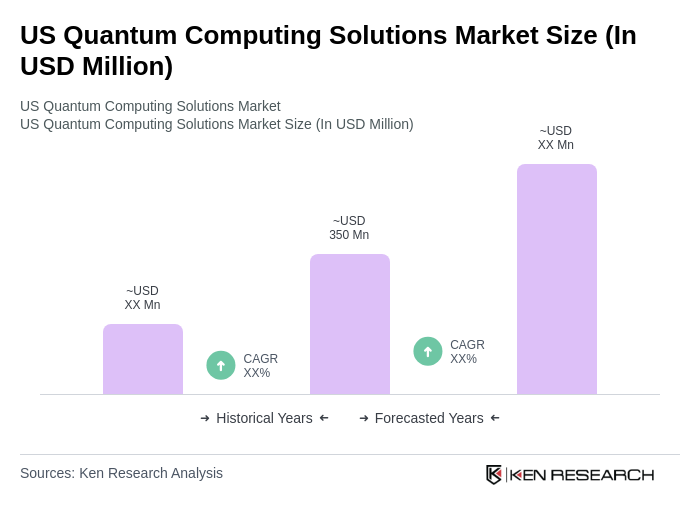
US Quantum Computing Solutions Market at USD 350M, fueled by innovations, govt funding of USD 1.2B, and applications in BFSI, healthcare. Key segments: Hardware & Systems leading.

Region:North America

Author(s):Rebecca

Product Code:KRAA4596

Pages:98

Published On:September 2025
About the Report

Base Year 2024

US Quantum Computing Solutions Market Overview

  • The US Quantum Computing Solutions Market is valued at USD 350 million, based on a five-year historical analysis. This growth is primarily driven by advancements in quantum technologies, increased investment from both public and private sectors, and the rising demand for high-performance computing solutions across various industries, including finance, healthcare, and telecommunications .
  • Key players in this market include major technology hubs such asCalifornia, Massachusetts, and New York. These regions dominate due to their robust research institutions, access to venture capital, and a concentration of tech companies that foster innovation and collaboration in quantum computing .
  • In 2023, the US government implemented theNational Quantum Initiative Act, which aims to accelerate quantum research and development. This initiative includes a commitment ofUSD 1.2 billionover five years to support quantum information science and technology, enhancing the US's competitive edge in the global quantum landscape. The National Quantum Initiative Act, 2018, issued by the US Congress, establishes a coordinated federal program to advance quantum information science and technology, requiring agencies to support research, workforce development, and standards .
US Quantum Computing Solutions Market Size

US Quantum Computing Solutions Market Segmentation

By Type:The market is segmented into various types, including Quantum Hardware & Systems, Quantum Software & Development Tools, Quantum Services (Consulting, QCaaS), Quantum Algorithms & Applications, Quantum Communication & Networking, Quantum Simulation & Emulation, and Error Correction & Quantum Memory. Among these,Quantum Hardware & Systemsis currently the leading segment due to the increasing demand for advanced computing capabilities and the development of quantum processors. The growing interest in quantum applications across industries is also driving the adoption of Quantum Software & Development Tools .
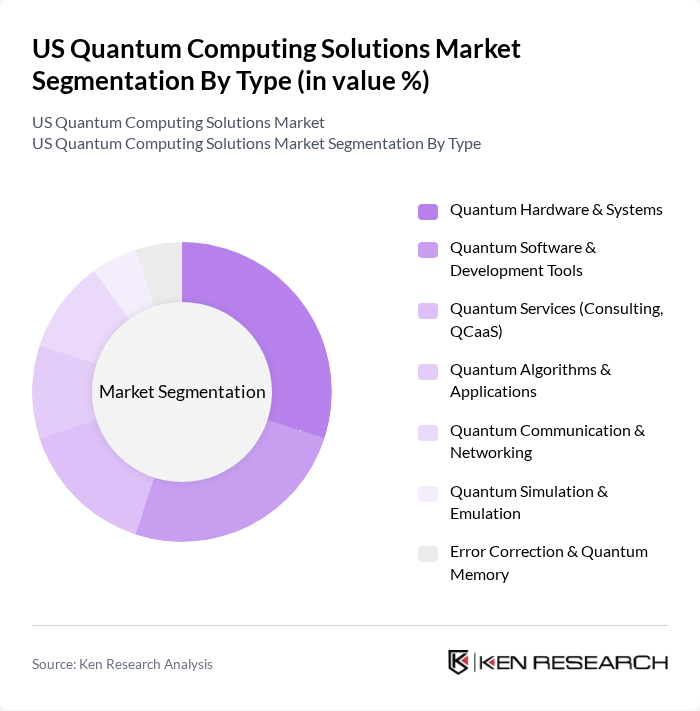
US Quantum Computing Solutions Market segmentation by Type.

By End-User:The end-user segmentation includes Aerospace & Defense, Healthcare & Life Sciences, Banking, Financial Services & Insurance (BFSI), Telecommunications, Energy & Utilities, Chemicals & Materials Science, and Others. TheBFSI sectoris currently the dominant end-user, driven by the need for enhanced data security and complex financial modeling capabilities. The healthcare sector is also witnessing significant growth as quantum computing offers innovative solutions for drug discovery and personalized medicine .
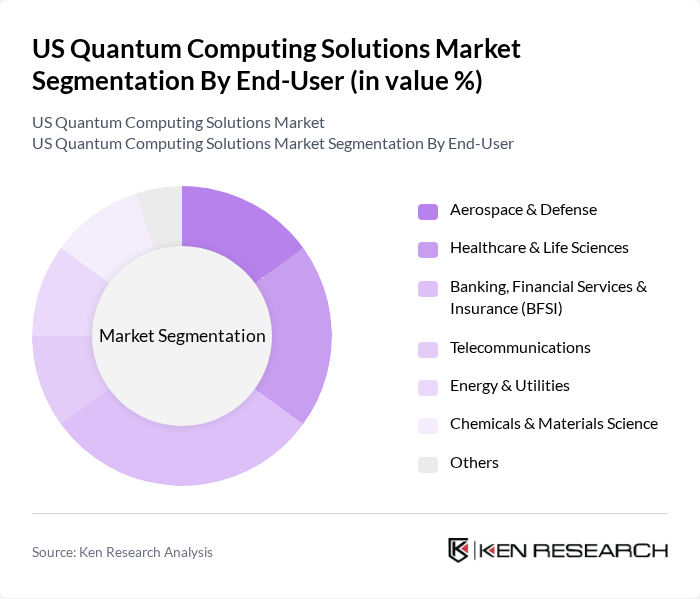
US Quantum Computing Solutions Market segmentation by End-User.

US Quantum Computing Solutions Market Competitive Landscape

The US Quantum Computing Solutions Market is characterized by a dynamic mix of regional and international players. Leading participants such as IBM Corporation, Google LLC, Rigetti Computing Inc., D-Wave Quantum Inc., IonQ Inc., Microsoft Corporation, Quantinuum (Honeywell Quantum Solutions + Cambridge Quantum), Zapata Computing Inc., Quantum Computing Inc. (QCI), PsiQuantum, ColdQuanta (now Infleqtion), Xanadu Quantum Technologies, Amazon Web Services (AWS) Braket, Q-CTRL, Riverlane contribute to innovation, geographic expansion, and service delivery in this space.

IBM Corporation

1911

Armonk, New York

Google LLC

1998

Mountain View, California

Rigetti Computing Inc.

2013

Berkeley, California

D-Wave Quantum Inc.

1999

Burnaby, Canada

IonQ Inc.

2015

College Park, Maryland

Company

Establishment Year

Headquarters

Company Size (Large, Medium, Small)

Annual Revenue (USD, latest year)

Revenue Growth Rate (3-year CAGR)

Market Penetration (US market share %)

Number of US-based Customers/Deployments

R&D Spending (% of revenue or USD)

US Quantum Computing Solutions Market Industry Analysis

Growth Drivers

  • Increased Investment in Quantum Research:In future, the US government allocated approximately $1.2 billion to quantum research initiatives, reflecting a significant commitment to advancing this technology. This funding is part of the National Quantum Initiative, which aims to enhance the US's competitive edge in quantum technologies. Additionally, private sector investments have surged, with companies like IBM and Google investing over $600 million each in quantum research and development, driving innovation and attracting talent to the sector.
  • Demand for Advanced Computing Power:The global demand for advanced computing power is projected to reach $1.2 trillion in future, with quantum computing playing a pivotal role in meeting this need. Industries such as pharmaceuticals, finance, and logistics are increasingly seeking quantum solutions to solve complex problems that classical computers cannot efficiently address. This demand is further fueled by the need for faster data processing and enhanced simulation capabilities, which quantum computing uniquely provides, thereby driving market growth.
  • Strategic Partnerships and Collaborations:In future, over 40 strategic partnerships have been formed between tech companies and academic institutions to accelerate quantum computing advancements. Collaborations such as those between Microsoft and universities have led to the development of innovative quantum algorithms and hardware. These partnerships not only enhance research capabilities but also facilitate knowledge transfer, ensuring that the workforce is equipped with the necessary skills to drive the industry forward, thus fostering market growth.

Market Challenges

  • High Development Costs:The average cost of developing a quantum computing system is estimated to exceed $12 million, posing a significant barrier for startups and smaller companies. This high financial requirement limits the number of players in the market and slows down innovation. Furthermore, the need for specialized materials and components, which can be scarce and expensive, adds to the overall development costs, making it challenging for new entrants to compete effectively.
  • Limited Skilled Workforce:The US quantum computing sector faces a critical shortage of skilled professionals, with an estimated 60,000 positions unfilled in future. This gap is primarily due to the specialized knowledge required in quantum mechanics, computer science, and engineering. Universities are struggling to produce graduates with the necessary expertise, which hampers the industry's growth potential. As a result, companies are investing heavily in training programs to bridge this skills gap, but progress remains slow.

US Quantum Computing Solutions Market Future Outlook

The future of the US quantum computing solutions market appears promising, driven by ongoing advancements in technology and increasing applications across various sectors. As industries recognize the potential of quantum computing to solve complex problems, investment in research and development is expected to rise. Additionally, the integration of quantum technologies with artificial intelligence and machine learning will likely create new opportunities for innovation, enhancing the overall market landscape and fostering a competitive environment.

Market Opportunities

  • Expansion into Emerging Markets:Emerging markets in Asia and Africa are beginning to recognize the potential of quantum computing, with investments projected to reach $300 million in future. This expansion presents significant opportunities for US companies to establish a foothold in these regions, leveraging their advanced technologies to meet local demands for computational power and innovation.
  • Development of Quantum Software Solutions:The quantum software market is expected to grow significantly, with an estimated value of $1.5 billion in future. This growth is driven by the need for specialized software to harness quantum hardware capabilities. Companies focusing on developing quantum algorithms and applications will find substantial opportunities, particularly in sectors like finance and healthcare, where complex problem-solving is essential.

Scope of the Report

SegmentSub-Segments
By Type

Quantum Hardware & Systems

Quantum Software & Development Tools

Quantum Services (Consulting, QCaaS)

Quantum Algorithms & Applications

Quantum Communication & Networking

Quantum Simulation & Emulation

Error Correction & Quantum Memory

By End-User

Aerospace & Defense

Healthcare & Life Sciences

Banking, Financial Services & Insurance (BFSI)

Telecommunications

Energy & Utilities

Chemicals & Materials Science

Others

By Application

Drug Discovery & Molecular Modeling

Financial Modeling & Portfolio Optimization

Supply Chain & Logistics Optimization

Cryptography & Cybersecurity

Machine Learning & AI

Materials Science & Chemistry

Others

By Component

Quantum Processors (Superconducting, Trapped Ion, etc.)

Control & Cryogenic Systems

Software Development Kits (SDKs) & Tools

Quantum Sensors

Quantum Memory

Others

By Sales Channel

Direct Sales

Online Sales

Distributors

Resellers

Others

By Investment Source

Private Investments

Government Grants

Venture Capital

Corporate Investments

Others

By Policy Support

Federal Funding Programs

Tax Incentives

Research Grants

Public-Private Partnerships

Others

Key Target Audience

Investors and Venture Capitalist Firms

Government and Regulatory Bodies (e.g., National Institute of Standards and Technology, Department of Energy)

Technology Providers

Defense and Aerospace Contractors

Telecommunications Companies

Pharmaceutical and Biotechnology Firms

Financial Services Firms

Energy Sector Companies

Players Mentioned in the Report:

IBM Corporation

Google LLC

Rigetti Computing Inc.

D-Wave Quantum Inc.

IonQ Inc.

Microsoft Corporation

Quantinuum (Honeywell Quantum Solutions + Cambridge Quantum)

Zapata Computing Inc.

Quantum Computing Inc. (QCI)

PsiQuantum

ColdQuanta (now Infleqtion)

Xanadu Quantum Technologies

Amazon Web Services (AWS) Braket

Q-CTRL

Riverlane

Table of Contents

Market Assessment Phase

1. Executive Summary and Approach


2. US Quantum Computing Solutions Market Overview

2.1 Key Insights and Strategic Recommendations

2.2 US Quantum Computing Solutions Market Overview

2.3 Definition and Scope

2.4 Evolution of Market Ecosystem

2.5 Timeline of Key Regulatory Milestones

2.6 Value Chain & Stakeholder Mapping

2.7 Business Cycle Analysis

2.8 Policy & Incentive Landscape


3. US Quantum Computing Solutions Market Analysis

3.1 Growth Drivers

3.1.1 Increased Investment in Quantum Research
3.1.2 Demand for Advanced Computing Power
3.1.3 Strategic Partnerships and Collaborations
3.1.4 Government Support and Funding Initiatives

3.2 Market Challenges

3.2.1 High Development Costs
3.2.2 Limited Skilled Workforce
3.2.3 Regulatory Hurdles
3.2.4 Market Competition

3.3 Market Opportunities

3.3.1 Expansion into Emerging Markets
3.3.2 Development of Quantum Software Solutions
3.3.3 Integration with AI and Machine Learning
3.3.4 Commercialization of Quantum Technologies

3.4 Market Trends

3.4.1 Growing Interest in Quantum Cryptography
3.4.2 Advancements in Quantum Hardware
3.4.3 Increased Focus on Quantum Education
3.4.4 Rise of Quantum-as-a-Service Models

3.5 Government Regulation

3.5.1 National Quantum Initiative Act
3.5.2 Export Control Regulations
3.5.3 Funding for Quantum Research Programs
3.5.4 Data Privacy and Security Regulations

4. SWOT Analysis


5. Stakeholder Analysis


6. Porter's Five Forces Analysis


7. US Quantum Computing Solutions Market Market Size, 2019-2024

7.1 By Value

7.2 By Volume

7.3 By Average Selling Price


8. US Quantum Computing Solutions Market Segmentation

8.1 By Type

8.1.1 Quantum Hardware & Systems
8.1.2 Quantum Software & Development Tools
8.1.3 Quantum Services (Consulting, QCaaS)
8.1.4 Quantum Algorithms & Applications
8.1.5 Quantum Communication & Networking
8.1.6 Quantum Simulation & Emulation
8.1.7 Error Correction & Quantum Memory

8.2 By End-User

8.2.1 Aerospace & Defense
8.2.2 Healthcare & Life Sciences
8.2.3 Banking, Financial Services & Insurance (BFSI)
8.2.4 Telecommunications
8.2.5 Energy & Utilities
8.2.6 Chemicals & Materials Science
8.2.7 Others

8.3 By Application

8.3.1 Drug Discovery & Molecular Modeling
8.3.2 Financial Modeling & Portfolio Optimization
8.3.3 Supply Chain & Logistics Optimization
8.3.4 Cryptography & Cybersecurity
8.3.5 Machine Learning & AI
8.3.6 Materials Science & Chemistry
8.3.7 Others

8.4 By Component

8.4.1 Quantum Processors (Superconducting, Trapped Ion, etc.)
8.4.2 Control & Cryogenic Systems
8.4.3 Software Development Kits (SDKs) & Tools
8.4.4 Quantum Sensors
8.4.5 Quantum Memory
8.4.6 Others

8.5 By Sales Channel

8.5.1 Direct Sales
8.5.2 Online Sales
8.5.3 Distributors
8.5.4 Resellers
8.5.5 Others

8.6 By Investment Source

8.6.1 Private Investments
8.6.2 Government Grants
8.6.3 Venture Capital
8.6.4 Corporate Investments
8.6.5 Others

8.7 By Policy Support

8.7.1 Federal Funding Programs
8.7.2 Tax Incentives
8.7.3 Research Grants
8.7.4 Public-Private Partnerships
8.7.5 Others

9. US Quantum Computing Solutions Market Competitive Analysis

9.1 Market Share of Key Players

9.2 Cross Comparison of Key Players

9.2.1 Company Name
9.2.2 Company Size (Large, Medium, Small)
9.2.3 Annual Revenue (USD, latest year)
9.2.4 Revenue Growth Rate (3-year CAGR)
9.2.5 Market Penetration (US market share %)
9.2.6 Number of US-based Customers/Deployments
9.2.7 R&D Spending (% of revenue or USD)
9.2.8 Patent Portfolio Size (US patents granted)
9.2.9 Commercial Partnerships (notable US partners)
9.2.10 Product Portfolio Breadth (hardware, software, services)
9.2.11 Quantum Volume or Qubit Count (if applicable)
9.2.12 Time-to-Market for New Solutions
9.2.13 Customer Retention Rate (%)
9.2.14 Average Deal Size (USD)
9.2.15 Return on Investment (ROI)

9.3 SWOT Analysis of Top Players

9.4 Pricing Analysis

9.5 Detailed Profile of Major Companies

9.5.1 IBM Corporation
9.5.2 Google LLC
9.5.3 Rigetti Computing Inc.
9.5.4 D-Wave Quantum Inc.
9.5.5 IonQ Inc.
9.5.6 Microsoft Corporation
9.5.7 Quantinuum (Honeywell Quantum Solutions + Cambridge Quantum)
9.5.8 Zapata Computing Inc.
9.5.9 Quantum Computing Inc. (QCI)
9.5.10 PsiQuantum
9.5.11 ColdQuanta (now Infleqtion)
9.5.12 Xanadu Quantum Technologies
9.5.13 Amazon Web Services (AWS) Braket
9.5.14 Q-CTRL
9.5.15 Riverlane

10. US Quantum Computing Solutions Market End-User Analysis

10.1 Procurement Behavior of Key Ministries

10.1.1 Federal Agencies' Quantum Initiatives
10.1.2 Budget Allocations for Quantum Research
10.1.3 Collaboration with Private Sector
10.1.4 Procurement Processes and Challenges

10.2 Corporate Spend on Infrastructure & Energy

10.2.1 Investment in Quantum Infrastructure
10.2.2 Budget Trends in Quantum Technologies
10.2.3 Corporate Partnerships for Quantum Solutions

10.3 Pain Point Analysis by End-User Category

10.3.1 Technical Limitations in Current Systems
10.3.2 Integration Challenges with Existing Technologies
10.3.3 Cost Constraints for Adoption

10.4 User Readiness for Adoption

10.4.1 Awareness of Quantum Technologies
10.4.2 Training and Skill Development Needs
10.4.3 Infrastructure Readiness

10.5 Post-Deployment ROI and Use Case Expansion

10.5.1 Measurement of ROI in Early Adopters
10.5.2 Expansion of Use Cases in Various Industries
10.5.3 Long-term Benefits of Quantum Solutions

11. US Quantum Computing Solutions Market Future Size, 2025-2030

11.1 By Value

11.2 By Volume

11.3 By Average Selling Price


Go-To-Market Strategy Phase

1. Whitespace Analysis + Business Model Canvas

1.1 Market Gaps Identification

1.2 Business Model Development


2. Marketing and Positioning Recommendations

2.1 Branding Strategies

2.2 Product USPs


3. Distribution Plan

3.1 Urban Retail Strategies

3.2 Rural NGO Tie-ups


4. Channel & Pricing Gaps

4.1 Underserved Routes

4.2 Pricing Bands Analysis


5. Unmet Demand & Latent Needs

5.1 Category Gaps

5.2 Consumer Segments


6. Customer Relationship

6.1 Loyalty Programs

6.2 After-sales Service


7. Value Proposition

7.1 Sustainability Initiatives

7.2 Integrated Supply Chains


8. Key Activities

8.1 Regulatory Compliance

8.2 Branding Efforts

8.3 Distribution Setup


9. Entry Strategy Evaluation

9.1 Domestic Market Entry Strategy

9.1.1 Product Mix Considerations
9.1.2 Pricing Band Strategy
9.1.3 Packaging Approaches

9.2 Export Entry Strategy

9.2.1 Target Countries for Expansion
9.2.2 Compliance Roadmap

10. Entry Mode Assessment

10.1 Joint Ventures

10.2 Greenfield Investments

10.3 Mergers & Acquisitions

10.4 Distributor Model


11. Capital and Timeline Estimation

11.1 Capital Requirements

11.2 Timelines for Implementation


12. Control vs Risk Trade-Off

12.1 Ownership vs Partnerships


13. Profitability Outlook

13.1 Breakeven Analysis

13.2 Long-term Sustainability


14. Potential Partner List

14.1 Distributors

14.2 Joint Ventures

14.3 Acquisition Targets


15. Execution Roadmap

15.1 Phased Plan for Market Entry

15.1.1 Market Setup
15.1.2 Market Entry
15.1.3 Growth Acceleration
15.1.4 Scale & Stabilize

15.2 Key Activities and Milestones

15.2.1 Milestone Planning
15.2.2 Activity Tracking

Research Methodology

ApproachModellingSample

Phase 1: Approach1

Desk Research

  • Analysis of industry reports from leading research firms focusing on quantum computing trends
  • Review of government publications and white papers on quantum technology initiatives in the US
  • Examination of academic journals and conference proceedings related to quantum computing advancements

Primary Research

  • Interviews with key stakeholders in quantum computing firms, including CTOs and R&D heads
  • Surveys targeting industry experts and analysts to gather insights on market dynamics
  • Field interviews with university researchers and technology transfer offices involved in quantum projects

Validation & Triangulation

  • Cross-validation of findings through multiple data sources, including market reports and expert opinions
  • Triangulation of quantitative data with qualitative insights from industry interviews
  • Sanity checks through expert panel reviews to ensure data accuracy and relevance

Phase 2: Market Size Estimation1

Top-down Assessment

  • Estimation of the overall quantum computing market size based on national technology spending
  • Segmentation of the market by application areas such as finance, healthcare, and cybersecurity
  • Incorporation of federal funding and investment trends in quantum research and development

Bottom-up Modeling

  • Collection of revenue data from leading quantum computing companies and startups
  • Estimation of market share based on product offerings and service capabilities
  • Volume and pricing analysis for quantum computing hardware and software solutions

Forecasting & Scenario Analysis

  • Multi-factor regression analysis incorporating technological advancements and market adoption rates
  • Scenario modeling based on potential regulatory changes and funding shifts in quantum research
  • Development of baseline, optimistic, and pessimistic forecasts through 2030

Phase 3: CATI Sample Composition1

Scope Item/SegmentSample SizeTarget Respondent Profiles
Quantum Computing Hardware Providers60Product Managers, Technical Directors
Software Development for Quantum Applications50Software Engineers, Project Managers
Research Institutions and Universities40Research Scientists, Academic Professors
Government Agencies Funding Quantum Initiatives40Policy Makers, Program Managers
End-Users in Financial Services50Risk Analysts, IT Managers

Frequently Asked Questions

What is the current value of the US Quantum Computing Solutions Market?

The US Quantum Computing Solutions Market is valued at approximately USD 350 million, reflecting significant growth driven by advancements in quantum technologies and increased investments from both public and private sectors.

What are the key drivers of growth in the US Quantum Computing Solutions Market?

Which regions are leading in the US Quantum Computing Solutions Market?

What is the National Quantum Initiative Act?

Other Regional/Country Reports

United States Quantum Computing Solutions Market

Indonesia Quantum Computing Solutions Market

Malaysia Quantum Computing Solutions Market

KSA Quantum Computing Solutions Market

APAC Quantum Computing Solutions Market

SEA Quantum Computing Solutions Market

Why Buy From Us?

Refine Robust Result (RRR) Framework

What makes us stand out is that our consultants follow Robust, Refine and Result (RRR) methodology. Robust for clear definitions, approaches and sanity checking, Refine for differentiating respondents' facts and opinions, and Result for presenting data with story.

Our Reach Is Unmatched

We have set a benchmark in the industry by offering our clients with syndicated and customized market research reports featuring coverage of entire market as well as meticulous research and analyst insights.

Shifting the Research Paradigm

While we don't replace traditional research, we flip the method upside down. Our dual approach of Top Bottom & Bottom Top ensures quality deliverable by not just verifying company fundamentals but also looking at the sector and macroeconomic factors.

More Insights-Better Decisions

With one step in the future, our research team constantly tries to show you the bigger picture. We help with some of the tough questions you may encounter along the way: How is the industry positioned? Best marketing channel? KPI's of competitors? By aligning every element, we help maximize success.

Transparency and Trust

Our report gives you instant access to the answers and sources that other companies might choose to hide. We elaborate each steps of research methodology we have used and showcase you the sample size to earn your trust.

Round the Clock Support

If you need any support, we are here! We pride ourselves on universe strength, data quality, and quick, friendly, and professional service.

Why Clients Choose Us?

400000+
Reports in repository
150+
Consulting projects a year
100+
Analysts
8000+
Client Queries in 2022








