About the Report
Base Year 2024US Retail Automation Market Overview
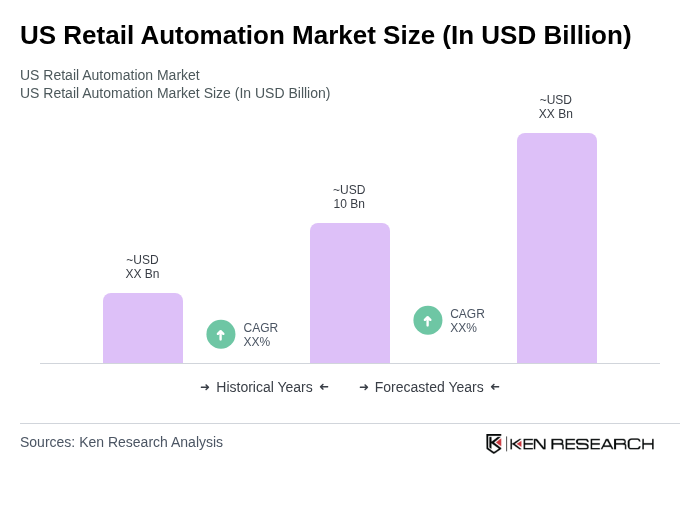
- The US Retail Automation Market is valued at USD 10 billion, based on a five-year historical analysis. This growth is primarily driven by the increasing demand for operational efficiency, enhanced customer experience, and the integration of advanced technologies such as AI and IoT in retail operations. Retailers are increasingly adopting automation solutions to streamline processes, reduce labor costs, and improve inventory management.
- Key players in this market are technology and solution vendors (such as POS providers, robotics and computer-vision firms, and cloud platforms) and large retail chains, rather than cities themselves. New York, Los Angeles, Chicago, and states such as California and Texas are correctly described as major demand centers with dense store networks and high digital maturity, but they are geographic concentrations of deployments, not “key players” in the competitive sense.
- In 2023, retailers faced tightening expectations around data protection, encryption, access control, and incident response for automated and AI-enabled systems, which can help foster consumer trust and support further investment in automation.
US Retail Automation Market Segmentation
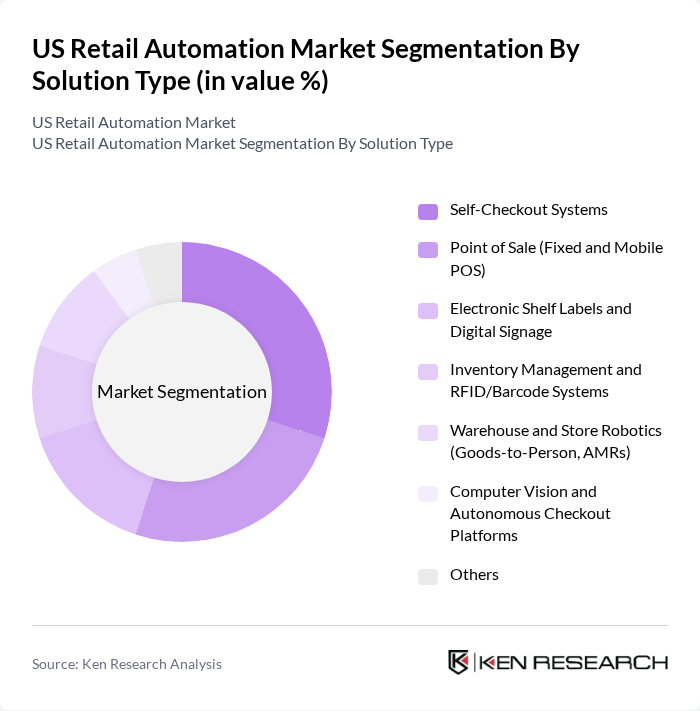
By Solution Type:The solution type segmentation includes various subsegments that cater to different aspects of retail automation. The primary subsegments are Self-Checkout Systems, Point of Sale (Fixed and Mobile POS), Electronic Shelf Labels and Digital Signage, Inventory Management and RFID/Barcode Systems, Warehouse and Store Robotics (Goods-to-Person, AMRs), Computer Vision and Autonomous Checkout Platforms, and Others. Among these, Self-Checkout Systems are leading the market due to their ability to enhance customer experience by reducing wait times and providing a seamless checkout process.
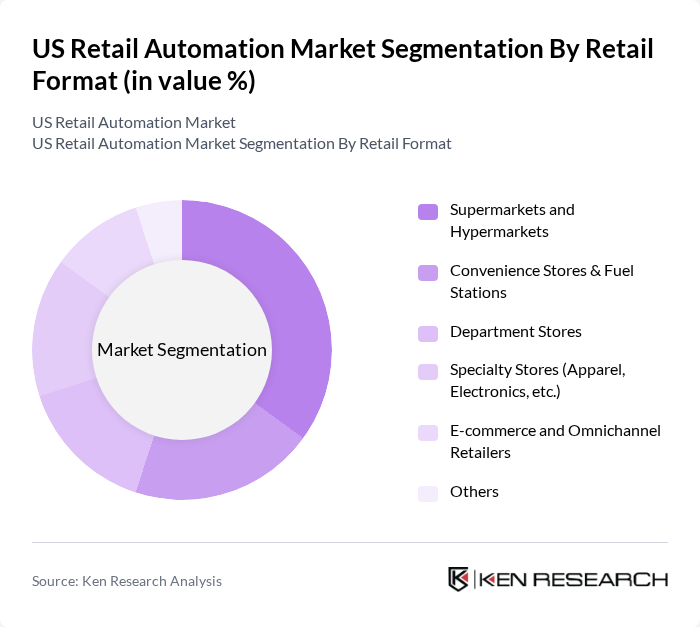
By Retail Format:The retail format segmentation encompasses various types of retail environments, including Supermarkets and Hypermarkets, Convenience Stores & Fuel Stations, Department Stores, Specialty Stores (Apparel, Electronics, etc.), E-commerce and Omnichannel Retailers, and Others. Supermarkets and Hypermarkets dominate this segment due to their extensive product offerings and high foot traffic, which necessitate efficient automation solutions to manage operations effectively.
US Retail Automation Market Competitive Landscape
The US Retail Automation Market is characterized by a dynamic mix of regional and international players. Leading participants such as Amazon (Amazon Go, Amazon Retail Technologies & Amazon Robotics), Walmart (Symbotic Partnership and In-Store Automation Initiatives), NCR Voyix Corporation, Toshiba Global Commerce Solutions, Diebold Nixdorf, Incorporated, Zebra Technologies Corporation, Honeywell International Inc., Fujitsu Limited, Blue Yonder (A Panasonic Company), Shopify Inc., Block, Inc. (Square), NCR-licensed Aloha POS (Hospitality and Quick-Service Retail), BrightSign LLC, Caper AI (Instacart), Standard AI (Standard Cognition) contribute to innovation, geographic expansion, and service delivery in this space.
US Retail Automation Market Industry Analysis
Growth Drivers
- Increased Demand for Contactless Shopping:The COVID-19 pandemic accelerated the shift towards contactless shopping, with a significant portion of consumers preferring contactless payment options. According to the National Retail Federation, contactless transactions in the U.S. are projected to reach USD 100 billion, driven by consumer safety concerns and convenience. Retailers are investing in automation technologies to meet this demand, enhancing their operational efficiency and customer satisfaction.
- Technological Advancements in AI and Robotics:The U.S. retail sector is witnessing significant investments in AI and robotics, with spending expected to exceed USD 20 billion. These technologies streamline operations, improve inventory management, and enhance customer interactions. For instance, AI-driven chatbots are projected to handle a large share of customer inquiries, reducing labor costs and improving service efficiency, thus driving the adoption of retail automation solutions.
- Enhanced Customer Experience Expectations:A majority of consumers expect personalized shopping experiences, prompting retailers to adopt automation technologies. According to a report by McKinsey, businesses that leverage automation to enhance customer experience can see revenue increases of up to USD 30 billion. Retailers are increasingly utilizing data analytics and automation to tailor offerings, thereby meeting evolving consumer expectations and driving market growth.
Market Challenges
- High Initial Investment Costs:The upfront costs associated with implementing retail automation technologies can be prohibitive, with estimates ranging from USD 250,000 to USD 1 million for small to medium-sized retailers. This financial barrier can deter investment, especially in a competitive market where profit margins are already thin. Retailers must weigh these costs against potential long-term savings and efficiency gains, complicating decision-making processes.
- Integration with Legacy Systems:Many retailers still rely on outdated legacy systems, which can complicate the integration of new automation technologies. A survey by Deloitte found that a significant percentage of retailers face challenges in integrating automation with existing systems, leading to operational inefficiencies. This lack of compatibility can hinder the adoption of innovative solutions, limiting the potential benefits of retail automation in enhancing productivity and customer service.
US Retail Automation Market Future Outlook
The US retail automation market is poised for transformative growth, driven by technological advancements and changing consumer behaviors. As retailers increasingly adopt AI, robotics, and data analytics, operational efficiencies will improve significantly. The focus on sustainability and omnichannel strategies will further shape the landscape, encouraging innovation. In future, the integration of advanced technologies will redefine customer experiences, making automation a critical component of retail strategies to remain competitive in a rapidly evolving market.
Market Opportunities
- Expansion of E-commerce Platforms:The e-commerce sector is projected to reach USD 1 trillion in sales, creating opportunities for automation in logistics and customer service. Retailers can leverage automation to streamline order fulfillment and enhance the online shopping experience, positioning themselves to capture a larger market share in this growing segment.
- Adoption of IoT in Retail:The Internet of Things (IoT) is expected to connect a large number of devices, offering retailers new avenues for automation. By utilizing IoT technologies, retailers can optimize inventory management and enhance customer engagement through personalized experiences, driving efficiency and improving sales performance in a competitive landscape.
Scope of the Report
| Segment | Sub-Segments |
|---|---|
| By Solution Type | Self-Checkout Systems Point of Sale (Fixed and Mobile POS) Electronic Shelf Labels and Digital Signage Inventory Management and RFID/Barcode Systems Warehouse and Store Robotics (Goods-to-Person, AMRs) Computer Vision and Autonomous Checkout Platforms Others |
| By Retail Format | Supermarkets and Hypermarkets Convenience Stores & Fuel Stations Department Stores Specialty Stores (Apparel, Electronics, etc.) E-commerce and Omnichannel Retailers Others |
| By Application | In-Store Operations Automation (Checkout, Pricing, Replenishment) Warehouse and Fulfillment Automation Inventory Visibility and Tracking Customer Engagement and Personalization Solutions Loss Prevention and Security Analytics Others |
| By Technology | AI and Machine Learning Analytics Computer Vision and Image Recognition Internet of Things (IoT) and Connected Devices Cloud and Edge Computing Platforms RFID, Sensors, and Advanced Barcode Technologies Others |
| By Deployment Mode | On-Premises Cloud-Based (SaaS) Hybrid Others |
| By Business Size | Small and Independent Retailers Mid-sized Retail Chains Large and Tier-1 Retailers Others |
| By Region | Northeast Midwest South West |
Key Target Audience
Investors and Venture Capitalist Firms
Government and Regulatory Bodies (e.g., Federal Trade Commission, Department of Commerce)
Manufacturers and Producers of Retail Automation Solutions
Distributors and Retailers of Automated Systems
Technology Providers and Software Developers
Industry Associations (e.g., National Retail Federation)
Financial Institutions and Investment Banks
Logistics and Supply Chain Management Companies
Players Mentioned in the Report:
Amazon (Amazon Go, Amazon Retail Technologies & Amazon Robotics)
Walmart (Symbotic Partnership and In-Store Automation Initiatives)
NCR Voyix Corporation
Toshiba Global Commerce Solutions
Diebold Nixdorf, Incorporated
Zebra Technologies Corporation
Honeywell International Inc.
Fujitsu Limited
Blue Yonder (A Panasonic Company)
Shopify Inc.
Block, Inc. (Square)
NCR-licensed Aloha POS (Hospitality and Quick-Service Retail)
BrightSign LLC
Caper AI (Instacart)
Standard AI (Standard Cognition)
Table of Contents
Market Assessment Phase
1. Executive Summary and Approach
2. US Retail Automation Market Overview
2.1 Key Insights and Strategic Recommendations
2.2 US Retail Automation Market Overview
2.3 Definition and Scope
2.4 Evolution of Market Ecosystem
2.5 Timeline of Key Regulatory Milestones
2.6 Value Chain & Stakeholder Mapping
2.7 Business Cycle Analysis
2.8 Policy & Incentive Landscape
3. US Retail Automation Market Analysis
3.1 Growth Drivers
3.1.1 Increased Demand for Contactless Shopping
3.1.2 Technological Advancements in AI and Robotics
3.1.3 Rising Labor Costs
3.1.4 Enhanced Customer Experience Expectations
3.2 Market Challenges
3.2.1 High Initial Investment Costs
3.2.2 Integration with Legacy Systems
3.2.3 Data Security Concerns
3.2.4 Rapid Technological Changes
3.3 Market Opportunities
3.3.1 Expansion of E-commerce Platforms
3.3.2 Growth in Omnichannel Retailing
3.3.3 Adoption of IoT in Retail
3.3.4 Increasing Focus on Sustainability
3.4 Market Trends
3.4.1 Rise of Autonomous Checkout Solutions
3.4.2 Integration of Augmented Reality in Shopping
3.4.3 Use of Big Data Analytics for Personalization
3.4.4 Shift Towards Mobile Payment Solutions
3.5 Government Regulation
3.5.1 Compliance with Data Protection Laws
3.5.2 Regulations on Automated Labor
3.5.3 Standards for Safety in Retail Automation
3.5.4 Incentives for Technology Adoption
4. SWOT Analysis
5. Stakeholder Analysis
6. Porter's Five Forces Analysis
7. US Retail Automation Market Market Size, 2019-2024
7.1 By Value
7.2 By Volume
7.3 By Average Selling Price
8. US Retail Automation Market Segmentation
8.1 By Solution Type
8.1.1 Self-Checkout Systems
8.1.2 Point of Sale (Fixed and Mobile POS)
8.1.3 Electronic Shelf Labels and Digital Signage
8.1.4 Inventory Management and RFID/Barcode Systems
8.1.5 Warehouse and Store Robotics (Goods-to-Person, AMRs)
8.1.6 Computer Vision and Autonomous Checkout Platforms
8.1.7 Others
8.2 By Retail Format
8.2.1 Supermarkets and Hypermarkets
8.2.2 Convenience Stores & Fuel Stations
8.2.3 Department Stores
8.2.4 Specialty Stores (Apparel, Electronics, etc.)
8.2.5 E-commerce and Omnichannel Retailers
8.2.6 Others
8.3 By Application
8.3.1 In-Store Operations Automation (Checkout, Pricing, Replenishment)
8.3.2 Warehouse and Fulfillment Automation
8.3.3 Inventory Visibility and Tracking
8.3.4 Customer Engagement and Personalization Solutions
8.3.5 Loss Prevention and Security Analytics
8.3.6 Others
8.4 By Technology
8.4.1 AI and Machine Learning Analytics
8.4.2 Computer Vision and Image Recognition
8.4.3 Internet of Things (IoT) and Connected Devices
8.4.4 Cloud and Edge Computing Platforms
8.4.5 RFID, Sensors, and Advanced Barcode Technologies
8.4.6 Others
8.5 By Deployment Mode
8.5.1 On-Premises
8.5.2 Cloud-Based (SaaS)
8.5.3 Hybrid
8.5.4 Others
8.6 By Business Size
8.6.1 Small and Independent Retailers
8.6.2 Mid-sized Retail Chains
8.6.3 Large and Tier-1 Retailers
8.6.4 Others
8.7 By Region
8.7.1 Northeast
8.7.2 Midwest
8.7.3 South
8.7.4 West
9. US Retail Automation Market Competitive Analysis
9.1 Market Share of Key Players
9.2 Cross Comparison of Key Players
9.2.1 Company Name
9.2.2 Core Offering (Hardware, Software, or Integrated Platform)
9.2.3 Revenue from Retail Automation (Latest Fiscal Year)
9.2.4 3–5 Year Revenue CAGR in Retail Automation
9.2.5 Installed Base / Number of Deployments in US Retail
9.2.6 Key Retail Segments Served (Grocery, Convenience, Specialty, etc.)
9.2.7 Average Deal Size with Tier-1 Retailers
9.2.8 Recurring Revenue Share (Software, SaaS, and Services)
9.2.9 Innovation Intensity (R&D Spend as % of Sales / Patents Related to Retail Automation)
9.2.10 Partnership Ecosystem Strength (Cloud, Payment, and Retail Partners)
9.2.11 Customer Satisfaction / Net Promoter Score (Where Available)
9.2.12 Profitability Metrics (EBIT Margin for Retail Automation Segment)
9.3 SWOT Analysis of Top Players
9.4 Pricing Analysis
9.5 Detailed Profile of Major Companies
9.5.1 Amazon (Amazon Go, Amazon Retail Technologies & Amazon Robotics)
9.5.2 Walmart (Symbotic Partnership and In-Store Automation Initiatives)
9.5.3 NCR Voyix Corporation
9.5.4 Toshiba Global Commerce Solutions
9.5.5 Diebold Nixdorf, Incorporated
9.5.6 Zebra Technologies Corporation
9.5.7 Honeywell International Inc.
9.5.8 Fujitsu Limited
9.5.9 Blue Yonder (A Panasonic Company)
9.5.10 Shopify Inc.
9.5.11 Block, Inc. (Square)
9.5.12 NCR-licensed Aloha POS (Hospitality and Quick-Service Retail)
9.5.13 BrightSign LLC
9.5.14 Caper AI (Instacart)
9.5.15 Standard AI (Standard Cognition)
10. US Retail Automation Market End-User Analysis
10.1 Procurement Behavior of Key Ministries
10.1.1 Budget Allocation Trends
10.1.2 Decision-Making Processes
10.1.3 Vendor Selection Criteria
10.1.4 Contract Management Practices
10.2 Corporate Spend on Infrastructure & Energy
10.2.1 Investment Trends in Automation
10.2.2 Budgeting for Technology Upgrades
10.2.3 Cost-Benefit Analysis Practices
10.2.4 Long-term Financial Planning
10.3 Pain Point Analysis by End-User Category
10.3.1 Operational Inefficiencies
10.3.2 Customer Experience Challenges
10.3.3 Technology Integration Issues
10.3.4 Compliance and Regulatory Hurdles
10.4 User Readiness for Adoption
10.4.1 Training and Support Needs
10.4.2 Change Management Strategies
10.4.3 Technology Familiarity Levels
10.4.4 Adoption Barriers
10.5 Post-Deployment ROI and Use Case Expansion
10.5.1 Performance Metrics Tracking
10.5.2 Case Studies of Successful Implementations
10.5.3 Scalability of Solutions
10.5.4 Future Investment Plans
11. US Retail Automation Market Future Size, 2025-2030
11.1 By Value
11.2 By Volume
11.3 By Average Selling Price
Go-To-Market Strategy Phase
1. Whitespace Analysis + Business Model Canvas
1.1 Market Gaps Identification
1.2 Value Proposition Development
1.3 Revenue Streams Analysis
1.4 Cost Structure Evaluation
1.5 Key Partnerships Exploration
1.6 Customer Segmentation
1.7 Competitive Advantage Assessment
2. Marketing and Positioning Recommendations
2.1 Branding Strategies
2.2 Product USPs
2.3 Target Audience Identification
2.4 Communication Channels
2.5 Marketing Budget Allocation
2.6 Performance Metrics
2.7 Feedback Mechanisms
3. Distribution Plan
3.1 Urban Retail Strategies
3.2 Rural NGO Tie-ups
3.3 E-commerce Integration
3.4 Logistics and Supply Chain Management
3.5 Distribution Partnerships
3.6 Inventory Management Solutions
3.7 Customer Delivery Options
4. Channel & Pricing Gaps
4.1 Underserved Routes
4.2 Pricing Bands Analysis
4.3 Competitor Pricing Strategies
4.4 Customer Willingness to Pay
4.5 Discounting Strategies
4.6 Bundling Opportunities
4.7 Price Sensitivity Assessment
5. Unmet Demand & Latent Needs
5.1 Category Gaps
5.2 Consumer Segments Analysis
5.3 Emerging Trends Identification
5.4 Customer Feedback Analysis
5.5 Market Research Insights
5.6 Innovation Opportunities
5.7 Future Demand Projections
6. Customer Relationship
6.1 Loyalty Programs
6.2 After-sales Service
6.3 Customer Engagement Strategies
6.4 Feedback and Improvement Processes
6.5 Relationship Management Tools
6.6 Customer Retention Strategies
6.7 Community Building Initiatives
7. Value Proposition
7.1 Sustainability Initiatives
7.2 Integrated Supply Chains
7.3 Unique Selling Points
7.4 Customer-Centric Innovations
7.5 Competitive Differentiation
7.6 Value-Added Services
7.7 Long-term Benefits
8. Key Activities
8.1 Regulatory Compliance
8.2 Branding Initiatives
8.3 Distribution Setup
8.4 Marketing Campaigns
8.5 Training and Development
8.6 Technology Upgrades
8.7 Performance Monitoring
9. Entry Strategy Evaluation
9.1 Domestic Market Entry Strategy
9.1.1 Product Mix Considerations
9.1.2 Pricing Band Strategies
9.1.3 Packaging Innovations
9.2 Export Entry Strategy
9.2.1 Target Countries Analysis
9.2.2 Compliance Roadmap Development
10. Entry Mode Assessment
10.1 Joint Ventures
10.2 Greenfield Investments
10.3 Mergers & Acquisitions
10.4 Distributor Model Evaluation
10.5 Risk Assessment
10.6 Control Considerations
10.7 Partnership Opportunities
11. Capital and Timeline Estimation
11.1 Capital Requirements
11.2 Timelines for Implementation
11.3 Financial Projections
11.4 Funding Sources
11.5 Budget Allocation
11.6 Cost Management Strategies
11.7 Milestone Tracking
12. Control vs Risk Trade-Off
12.1 Ownership Considerations
12.2 Partnership Dynamics
12.3 Risk Mitigation Strategies
12.4 Control Mechanisms
12.5 Long-term Sustainability
12.6 Performance Evaluation
12.7 Exit Strategies
13. Profitability Outlook
13.1 Breakeven Analysis
13.2 Long-term Sustainability
13.3 Profit Margin Projections
13.4 Revenue Growth Forecasts
13.5 Cost Reduction Strategies
13.6 Financial Health Assessment
13.7 Investment Returns
14. Potential Partner List
14.1 Distributors
14.2 Joint Ventures
14.3 Acquisition Targets
14.4 Strategic Alliances
14.5 Technology Partners
14.6 Service Providers
14.7 Industry Associations<
Research Methodology
Phase 1: Approach1
Desk Research
- Industry reports from the National Retail Federation and other relevant trade associations
- Market analysis from government publications and economic surveys
- Academic journals and white papers focusing on retail automation technologies
Primary Research
- Interviews with technology adoption leads at major retail chains
- Surveys targeting IT managers and automation specialists in retail
- Field interviews with store managers implementing automation solutions
Validation & Triangulation
- Cross-validation of findings through multiple industry expert interviews
- Triangulation of data from market reports, expert opinions, and case studies
- Sanity checks through feedback from a panel of retail automation experts
Phase 2: Market Size Estimation1
Top-down Assessment
- Analysis of total retail sales data to estimate automation adoption rates
- Segmentation of the market by retail format (e.g., grocery, apparel, electronics)
- Incorporation of trends in consumer behavior and technology adoption
Bottom-up Modeling
- Data collection from leading automation solution providers on sales volumes
- Cost analysis of automation technologies based on deployment scale
- Estimation of market size based on unit sales and average selling prices
Forecasting & Scenario Analysis
- Multi-variable forecasting using historical growth rates and technology trends
- Scenario modeling based on economic conditions and retail sector growth
- Development of best-case, worst-case, and most-likely market scenarios through 2030
Phase 3: CATI Sample Composition1
| Scope Item/Segment | Sample Size | Target Respondent Profiles |
|---|---|---|
| Grocery Retail Automation | 100 | Store Managers, IT Directors |
| Apparel Retail Technology Adoption | 80 | Operations Managers, E-commerce Directors |
| Electronics Retail Automation Solutions | 70 | Supply Chain Managers, Technology Officers |
| Warehouse Automation in Retail | 90 | Logistics Managers, Warehouse Supervisors |
| Customer Experience Automation | 75 | Customer Service Managers, Marketing Directors |
Frequently Asked Questions
What is the current value of the US Retail Automation Market?
The US Retail Automation Market is valued at approximately USD 10 billion, reflecting a five-year historical analysis. This growth is driven by the demand for operational efficiency, improved customer experiences, and the integration of advanced technologies like AI and IoT in retail operations.
What are the main drivers of growth in the US Retail Automation Market?
What are the major challenges faced by retailers in adopting automation?
Which solution types dominate the US Retail Automation Market?
Other Regional/Country Reports
Indonesia Retail Automation Market
Malaysia Retail Automation Market
KSA Retail Automation Market
APAC Retail Automation Market
Other Adjacent Reports
Kuwait Point of Sale Systems Market
Bahrain inventory management software market report Size, Share, Growth Drivers, Trends, Opportunities & Forecast 2025–2030Indonesia Self-Checkout Systems Market
Qatar Warehouse Robotics Market Size, Share, Growth Drivers, Trends, Opportunities & Forecast 2025–2030South Korea Retail Analytics Market
Kuwait IoT in Retail Market
Brazil Computer Vision Technology Market
Germany Electronic Shelf Labels Market
UAE Omnichannel Retail Solutions Market
Egypt Contactless Payment Systems Market
Why Buy From Us?

What makes us stand out is that our consultants follow Robust, Refine and Result (RRR) methodology. Robust for clear definitions, approaches and sanity checking, Refine for differentiating respondents' facts and opinions, and Result for presenting data with story.

We have set a benchmark in the industry by offering our clients with syndicated and customized market research reports featuring coverage of entire market as well as meticulous research and analyst insights.

While we don't replace traditional research, we flip the method upside down. Our dual approach of Top Bottom & Bottom Top ensures quality deliverable by not just verifying company fundamentals but also looking at the sector and macroeconomic factors.

With one step in the future, our research team constantly tries to show you the bigger picture. We help with some of the tough questions you may encounter along the way: How is the industry positioned? Best marketing channel? KPI's of competitors? By aligning every element, we help maximize success.

Our report gives you instant access to the answers and sources that other companies might choose to hide. We elaborate each steps of research methodology we have used and showcase you the sample size to earn your trust.

If you need any support, we are here! We pride ourselves on universe strength, data quality, and quick, friendly, and professional service.