US smoke evacuation system market size, share, growth drivers, trends, opportunities & forecast 2025–2030

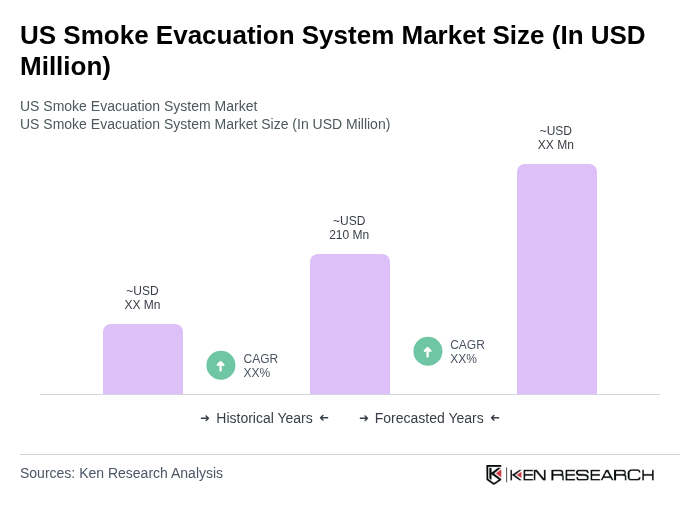
The US Smoke Evacuation System Market, valued at USD 210 million, grows with advancements in portable systems, HEPA/ULPA filters, and increasing minimally invasive surgeries.

Region:North America

Author(s):Geetanshi

Product Code:KRAA9102

Pages:92

Published On:November 2025
About the Report

Base Year 2024

US Smoke Evacuation System Market Overview

  • The US Smoke Evacuation System Market is valued at USD 210 million, based on a five-year historical analysis. This growth is primarily driven by increasing awareness of the health risks associated with surgical smoke, advancements in smoke evacuation technologies, and the rising number of surgical procedures performed annually across various healthcare settings. Recent trends highlight the adoption of portable and integrated smoke evacuation systems, as well as the integration of high-efficiency particulate air (HEPA) and ultra-low penetration air (ULPA) filtration to meet stricter safety standards. The expansion of minimally invasive and robotic surgeries is also accelerating market demand .
  • Key players in this market include major metropolitan areas such as New York, Los Angeles, and Chicago, which dominate due to their high concentration of healthcare facilities, advanced medical research institutions, and a robust patient population. These cities are also at the forefront of adopting innovative medical technologies, further propelling market growth .
  • In 2023, the US government implemented regulations mandating the use of smoke evacuation systems in surgical procedures to enhance patient and staff safety. The “Protecting Healthcare Workers from Surgical Smoke Act, 2023” issued by the Occupational Safety and Health Administration (OSHA) requires all healthcare facilities performing surgeries to install and maintain smoke evacuation systems that meet OSHA and Association of periOperative Registered Nurses (AORN) standards. This regulation covers all operating rooms and outpatient surgical centers, setting compliance thresholds for air quality and filtration efficiency .
US Smoke Evacuation System Market Size

US Smoke Evacuation System Market Segmentation

By Product Type:The product type segmentation includes various subsegments that cater to different needs in smoke evacuation. The leading subsegment is Smoke Evacuating Systems (Standalone Portable and Centralized Units), which is favored for its versatility and effectiveness in various surgical environments. Smoke Evacuation Pencils & Wands are also gaining traction due to their ease of use in specific procedures. The market is characterized by a growing demand for advanced filtration systems, such as Smoke Evacuation Filters (HEPA, ULPA, Charcoal, In-line), which enhance safety and compliance with regulations .
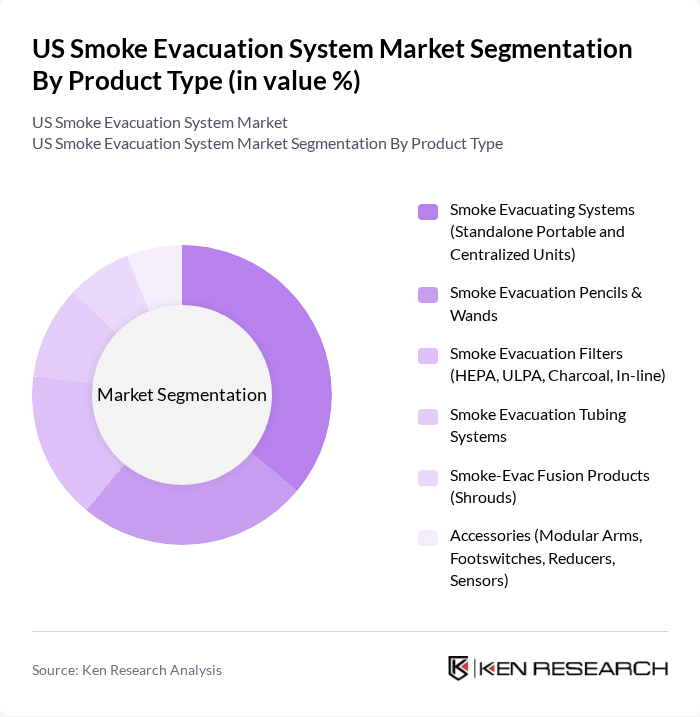
US Smoke Evacuation System Market segmentation by Product Type.

By End-User:The end-user segmentation highlights the various healthcare settings utilizing smoke evacuation systems. Hospitals represent the largest segment due to their extensive surgical operations and stringent safety protocols. Ambulatory Surgical Centers are also significant users, driven by the increasing number of outpatient procedures. Specialty Clinics and Dental Clinics are emerging segments as awareness of surgical smoke hazards grows, leading to increased adoption of smoke evacuation technologies .
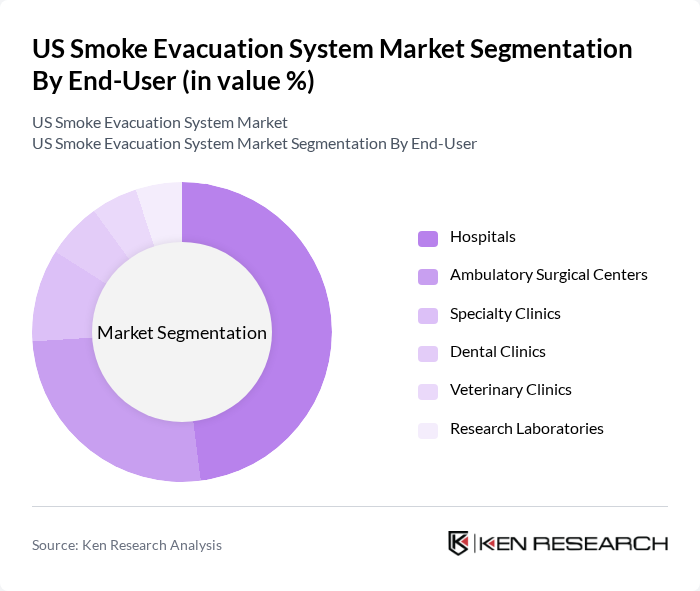
US Smoke Evacuation System Market segmentation by End-User.

US Smoke Evacuation System Market Competitive Landscape

The US Smoke Evacuation System Market is characterized by a dynamic mix of regional and international players. Leading participants such as Medtronic, CONMED Corporation, Stryker Corporation, Zimmer Biomet, Olympus Corporation, Erbe Elektromedizin GmbH, Symmetry Surgical Inc., STERIS plc, KLS Martin Group, Medical Devices Business Services, Inc., Bovie Medical Corporation, Aesculap (B. Braun Melsungen AG) contribute to innovation, geographic expansion, and service delivery in this space.

Medtronic

1949

Dublin, Ireland

CONMED Corporation

1970

Utica, New York, USA

Stryker Corporation

1941

Kalamazoo, Michigan, USA

Zimmer Biomet

1927

Warsaw, Indiana, USA

Olympus Corporation

1919

Tokyo, Japan

Company

Establishment Year

Headquarters

Company Size Classification (Large, Mid-Market, or Specialized)

Year-over-Year Revenue Growth Rate (%)

US Market Penetration Rate (%)

Product Portfolio Breadth (Number of SKUs)

Pricing Strategy (Premium, Mid-Range, Value)

R&D Investment as % of Revenue

US Smoke Evacuation System Market Industry Analysis

Growth Drivers

  • Increasing Demand for Surgical Procedures:The US healthcare system is projected to perform over 50 million surgical procedures in the future, driven by an aging population and rising chronic diseases. This surge necessitates effective smoke evacuation systems to ensure patient and staff safety during surgeries. The American College of Surgeons reported that minimally invasive surgeries, which often produce smoke, are increasing by approximately 10% annually, further amplifying the demand for advanced smoke evacuation solutions.
  • Rising Awareness About Health and Safety Standards:In the future, the US healthcare sector is expected to invest over $1.5 billion in compliance with health and safety regulations. This investment is largely driven by heightened awareness of the risks associated with surgical smoke, which contains harmful chemicals. The Joint Commission emphasizes the importance of smoke evacuation, leading to increased adoption of smoke evacuation systems in surgical settings, thereby enhancing workplace safety and patient care.
  • Technological Advancements in Smoke Evacuation Systems:The market is witnessing rapid technological innovations, with over $300 million allocated to research and development in smoke evacuation technologies in the future. New systems are being developed that integrate real-time monitoring and automated features, improving efficiency and effectiveness. These advancements not only enhance the performance of smoke evacuation systems but also reduce operational costs, making them more appealing to healthcare facilities.

Market Challenges

  • High Initial Investment Costs:The average cost of implementing a comprehensive smoke evacuation system in a surgical facility can exceed $100,000, which poses a significant barrier for many healthcare providers. This high upfront investment can deter smaller outpatient centers from adopting these systems, despite the long-term benefits. As a result, many facilities may continue to rely on outdated methods, compromising safety and compliance with regulations.
  • Limited Awareness Among Healthcare Professionals:A survey conducted by the American Society of Anesthesiologists revealed that nearly 40% of healthcare professionals are unaware of the risks associated with surgical smoke. This lack of awareness can hinder the adoption of smoke evacuation systems, as many practitioners may not prioritize their implementation. Educational initiatives are crucial to address this gap and promote the importance of smoke evacuation in surgical environments.

US Smoke Evacuation System Market Future Outlook

The US Smoke Evacuation System Market is poised for significant growth as healthcare facilities increasingly prioritize patient and staff safety. With the ongoing expansion of outpatient surgical centers and the rising trend of minimally invasive surgeries, the demand for effective smoke evacuation solutions will continue to rise. Additionally, technological advancements will drive innovation, leading to more efficient and user-friendly systems. As awareness of health risks associated with surgical smoke grows, regulatory compliance will further enhance market opportunities, ensuring a safer surgical environment.

Market Opportunities

  • Expansion in Outpatient Surgical Centers:The number of outpatient surgical centers in the US is projected to reach 7,000 in the future, creating a substantial market for smoke evacuation systems. These centers often perform high volumes of procedures, necessitating effective smoke management solutions to ensure compliance with safety standards and enhance patient outcomes.
  • Development of Portable Smoke Evacuation Devices:The demand for portable smoke evacuation devices is expected to grow, with an estimated market value of $150 million in the future. These devices offer flexibility and ease of use in various surgical settings, making them attractive to healthcare providers looking to enhance safety without significant infrastructure changes.

Scope of the Report

SegmentSub-Segments
By Product Type

Smoke Evacuating Systems (Standalone Portable and Centralized Units)

Smoke Evacuation Pencils & Wands

Smoke Evacuation Filters (HEPA, ULPA, Charcoal, In-line)

Smoke Evacuation Tubing Systems

Smoke-Evac Fusion Products (Shrouds)

Accessories (Modular Arms, Footswitches, Reducers, Sensors)

By End-User

Hospitals

Ambulatory Surgical Centers

Specialty Clinics

Dental Clinics

Veterinary Clinics

Research Laboratories

By Application

Laparoscopic Surgeries

General Surgery

Cosmetic/Aesthetic Surgery

Orthopedic Surgery

Urological Surgery

Laser-Based Surgical Procedures

By Distribution Channel

Direct Sales

Value-Added Distributors

Online Retail Platforms

Manufacturers' Representatives

By Region

Northeast

Midwest

South

West

By Technology

Electromechanical Systems

Pneumatic Systems

Hybrid Systems

Sensor-Equipped Advanced Systems

By Power Source

Electric-Powered Systems

Battery-Operated Portable Units

Pneumatic-Powered Systems

Key Target Audience

Investors and Venture Capitalist Firms

Government and Regulatory Bodies (e.g., FDA, OSHA)

Manufacturers and Producers

Distributors and Retailers

Healthcare Facilities and Hospitals

Fire Safety Equipment Suppliers

Industry Associations (e.g., American Society of Anesthesiologists)

Financial Institutions

Players Mentioned in the Report:

Medtronic

CONMED Corporation

Stryker Corporation

Zimmer Biomet

Olympus Corporation

Erbe Elektromedizin GmbH

Symmetry Surgical Inc.

STERIS plc

KLS Martin Group

Medical Devices Business Services, Inc.

Bovie Medical Corporation

Aesculap (B. Braun Melsungen AG)

Table of Contents

Market Assessment Phase

1. Executive Summary and Approach


2. US Smoke Evacuation System Market Overview

2.1 Key Insights and Strategic Recommendations

2.2 US Smoke Evacuation System Market Overview

2.3 Definition and Scope

2.4 Evolution of Market Ecosystem

2.5 Timeline of Key Regulatory Milestones

2.6 Value Chain & Stakeholder Mapping

2.7 Business Cycle Analysis

2.8 Policy & Incentive Landscape


3. US Smoke Evacuation System Market Analysis

3.1 Growth Drivers

3.1.1 Increasing demand for surgical procedures
3.1.2 Rising awareness about health and safety standards
3.1.3 Technological advancements in smoke evacuation systems
3.1.4 Government regulations promoting workplace safety

3.2 Market Challenges

3.2.1 High initial investment costs
3.2.2 Limited awareness among healthcare professionals
3.2.3 Variability in regulatory compliance across states
3.2.4 Competition from alternative smoke management solutions

3.3 Market Opportunities

3.3.1 Expansion in outpatient surgical centers
3.3.2 Development of portable smoke evacuation devices
3.3.3 Increasing focus on minimally invasive surgeries
3.3.4 Collaborations with healthcare providers for training

3.4 Market Trends

3.4.1 Growing adoption of automated smoke evacuation systems
3.4.2 Integration of smoke evacuation systems with surgical tools
3.4.3 Emphasis on eco-friendly and sustainable solutions
3.4.4 Rise in telemedicine and remote surgical procedures

3.5 Government Regulation

3.5.1 OSHA regulations on workplace safety
3.5.2 FDA guidelines for medical devices
3.5.3 State-specific health and safety regulations
3.5.4 Compliance requirements for surgical facilities

4. SWOT Analysis


5. Stakeholder Analysis


6. Porter's Five Forces Analysis


7. US Smoke Evacuation System Market Size, 2019-2024

7.1 By Value

7.2 By Volume

7.3 By Average Selling Price


8. US Smoke Evacuation System Market Segmentation

8.1 By Product Type

8.1.1 Smoke Evacuating Systems (Standalone Portable and Centralized Units)
8.1.2 Smoke Evacuation Pencils & Wands
8.1.3 Smoke Evacuation Filters (HEPA, ULPA, Charcoal, In-line)
8.1.4 Smoke Evacuation Tubing Systems
8.1.5 Smoke-Evac Fusion Products (Shrouds)
8.1.6 Accessories (Modular Arms, Footswitches, Reducers, Sensors)

8.2 By End-User

8.2.1 Hospitals
8.2.2 Ambulatory Surgical Centers
8.2.3 Specialty Clinics
8.2.4 Dental Clinics
8.2.5 Veterinary Clinics
8.2.6 Research Laboratories

8.3 By Application

8.3.1 Laparoscopic Surgeries
8.3.2 General Surgery
8.3.3 Cosmetic/Aesthetic Surgery
8.3.4 Orthopedic Surgery
8.3.5 Urological Surgery
8.3.6 Laser-Based Surgical Procedures

8.4 By Distribution Channel

8.4.1 Direct Sales
8.4.2 Value-Added Distributors
8.4.3 Online Retail Platforms
8.4.4 Manufacturers' Representatives

8.5 By Region

8.5.1 Northeast
8.5.2 Midwest
8.5.3 South
8.5.4 West

8.6 By Technology

8.6.1 Electromechanical Systems
8.6.2 Pneumatic Systems
8.6.3 Hybrid Systems
8.6.4 Sensor-Equipped Advanced Systems

8.7 By Power Source

8.7.1 Electric-Powered Systems
8.7.2 Battery-Operated Portable Units
8.7.3 Pneumatic-Powered Systems

9. US Smoke Evacuation System Market Competitive Analysis

9.1 Market Share of Key Players

9.2 Cross Comparison of Key Players

9.2.1 Company Name
9.2.2 Company Size Classification (Large, Mid-Market, or Specialized)
9.2.3 Year-over-Year Revenue Growth Rate (%)
9.2.4 US Market Penetration Rate (%)
9.2.5 Product Portfolio Breadth (Number of SKUs)
9.2.6 Pricing Strategy (Premium, Mid-Range, Value)
9.2.7 R&D Investment as % of Revenue
9.2.8 Distribution Network Reach (Direct + Indirect Channels)
9.2.9 Regulatory Certifications (FDA 510(k), ISO Standards)
9.2.10 Customer Satisfaction & Net Promoter Score (NPS)

9.3 SWOT Analysis of Top Players

9.4 Pricing Analysis

9.5 Detailed Profile of Major Companies

9.5.1 Medtronic
9.5.2 CONMED Corporation
9.5.3 Stryker Corporation
9.5.4 Zimmer Biomet
9.5.5 Olympus Corporation
9.5.6 Erbe Elektromedizin GmbH
9.5.7 Symmetry Surgical Inc.
9.5.8 STERIS plc
9.5.9 KLS Martin Group
9.5.10 Medical Devices Business Services, Inc.
9.5.11 Bovie Medical Corporation
9.5.12 Aesculap (B. Braun Melsungen AG)

10. US Smoke Evacuation System Market End-User Analysis

10.1 Procurement Behavior of Key Healthcare Facilities

10.1.1 Budget Allocation Trends
10.1.2 Decision-Making Processes
10.1.3 Supplier Selection Criteria
10.1.4 Contracting Practices

10.2 Healthcare Facility Spend on Safety Equipment

10.2.1 Investment Trends in Operating Room Infrastructure
10.2.2 Spending on Air Quality and Safety Equipment
10.2.3 Budgeting for Technology Upgrades and Compliance
10.2.4 Capital Equipment Replacement Cycles

10.3 Pain Point Analysis by End-User Category

10.3.1 Challenges in OSHA and Joint Commission Compliance
10.3.2 Equipment Maintenance and Filter Replacement Issues
10.3.3 Staff Training Gaps and Occupational Safety Awareness
10.3.4 Space Constraints in Operating Rooms

10.4 User Readiness for Adoption

10.4.1 Awareness Levels of Surgical Smoke Hazards
10.4.2 Training and Technical Support Needs
10.4.3 Financial Readiness and Budget Availability
10.4.4 Integration with Existing Surgical Equipment

10.5 Post-Deployment ROI and Use Case Expansion

10.5.1 Measurement of Effectiveness and Safety Outcomes
10.5.2 Case Studies of Successful Implementations
10.5.3 Feedback Mechanisms and Continuous Improvement
10.5.4 Expansion to Additional Surgical Specialties

11. US Smoke Evacuation System Market Future Size, 2025-2035

11.1 By Value

11.2 By Volume

11.3 By Average Selling Price


Go-To-Market Strategy Phase

1. Whitespace Analysis + Business Model Canvas

1.1 Market Gaps Identification

1.2 Value Proposition Development

1.3 Revenue Streams Analysis

1.4 Cost Structure Evaluation

1.5 Key Partnerships Exploration

1.6 Customer Segmentation

1.7 Channels of Distribution


2. Marketing and Positioning Recommendations

2.1 Branding Strategies

2.2 Product USPs

2.3 Target Market Identification

2.4 Communication Strategies

2.5 Digital Marketing Approaches


3. Distribution Plan

3.1 Hospital and Health System Direct Sales

3.2 Ambulatory Surgical Center Partnerships

3.3 Online Distribution Channels

3.4 Medical Device Distributor Networks


4. Channel & Pricing Gaps

4.1 Underserved Healthcare Segments

4.2 Pricing Bands Analysis

4.3 Competitor Pricing Strategies


5. Unmet Demand & Latent Needs

5.1 Category Gaps Identification

5.2 Healthcare Facility Segments Analysis

5.2.1 Small and Rural Surgical Centers
5.2.2 Specialty Surgical Clinics
5.2.3 Dental and Veterinary Practices

5.3 Emerging Trends Exploration


6. Customer Relationship

6.1 Loyalty Programs Development

6.2 After-Sales Service and Support Strategies

6.3 Customer Feedback Mechanisms


7. Value Proposition

7.1 Sustainability and Eco-Friendly Initiatives

7.2 Integrated Supply Chains for Filter and Component Replacement

7.3 Competitive Advantages


8. Key Activities

8.1 Regulatory Compliance Strategies (FDA, OSHA, Joint Commission)

8.2 Branding Initiatives

8.3 Distribution Setup Plans


9. Entry Strategy Evaluation

9.1 Domestic Market Entry Strategy

9.1.1 Product Mix Considerations
9.1.2 Pricing Band Strategies
9.1.3 Packaging and Regulatory Documentation

9.2 Regional Expansion Strategy

9.2.1 High-Opportunity Regional Targets
9.2.2 Compliance Roadmap Development

10. Entry Mode Assessment

10.1 Joint Ventures with Established Medical Device Companies


Research Methodology

ApproachModellingSample

Phase 1: Approach1

Desk Research

  • Industry reports from healthcare and surgical device associations
  • Market analysis publications focusing on smoke evacuation systems
  • Regulatory guidelines and standards from the FDA and OSHA

Primary Research

  • Interviews with surgical staff and operating room managers
  • Surveys targeting hospital procurement departments
  • Field visits to surgical centers to observe smoke evacuation practices

Validation & Triangulation

  • Cross-validation of data from multiple healthcare facilities
  • Triangulation of findings from primary interviews and secondary data
  • Expert panel reviews to ensure data accuracy and relevance

Phase 2: Market Size Estimation1

Top-down Assessment

  • Analysis of total surgical procedures performed annually in the U.S.
  • Estimation of smoke evacuation system adoption rates across specialties
  • Incorporation of trends in minimally invasive surgeries and their impact

Bottom-up Modeling

  • Volume estimates based on sales data from leading smoke evacuation system manufacturers
  • Cost analysis of smoke evacuation systems and their operational expenses
  • Estimation of market share based on hospital and surgical center purchases

Forecasting & Scenario Analysis

  • Multi-factor regression analysis considering surgical volume growth and technology adoption
  • Scenario modeling based on potential regulatory changes and healthcare policies
  • Baseline, optimistic, and pessimistic forecasts through 2030

Phase 3: CATI Sample Composition1

Scope Item/SegmentSample SizeTarget Respondent Profiles
General Surgery Departments45Surgeons, Operating Room Coordinators
Gynecology and Urology Clinics38Gynecologists, Urologists, Clinic Managers
Orthopedic Surgery Centers32Orthopedic Surgeons, Surgical Technologists
Ambulatory Surgical Centers42Facility Administrators, Surgical Nurses
Hospital Procurement Departments28Procurement Officers, Supply Chain Managers

Frequently Asked Questions

What is the current value of the US Smoke Evacuation System Market?

The US Smoke Evacuation System Market is valued at approximately USD 210 million, reflecting a significant growth trend driven by increased awareness of surgical smoke hazards and advancements in smoke evacuation technologies.

What factors are driving the growth of the US Smoke Evacuation System Market?

Which cities are leading in the adoption of smoke evacuation systems?

What regulations have been implemented regarding smoke evacuation systems in the US?

Other Regional/Country Reports

Vietnam Smoke Evacuation System Market Report Size Share Growth Drivers Trends Opportunities & Forecast 2025–2030

Indonesia Smoke Evacuation System Market

Malaysia Smoke Evacuation System Market

KSA Smoke Evacuation System Market

APAC Smoke Evacuation System Market

SEA Smoke Evacuation System Market

Why Buy From Us?

Refine Robust Result (RRR) Framework

What makes us stand out is that our consultants follow Robust, Refine and Result (RRR) methodology. Robust for clear definitions, approaches and sanity checking, Refine for differentiating respondents' facts and opinions, and Result for presenting data with story.

Our Reach Is Unmatched

We have set a benchmark in the industry by offering our clients with syndicated and customized market research reports featuring coverage of entire market as well as meticulous research and analyst insights.

Shifting the Research Paradigm

While we don't replace traditional research, we flip the method upside down. Our dual approach of Top Bottom & Bottom Top ensures quality deliverable by not just verifying company fundamentals but also looking at the sector and macroeconomic factors.

More Insights-Better Decisions

With one step in the future, our research team constantly tries to show you the bigger picture. We help with some of the tough questions you may encounter along the way: How is the industry positioned? Best marketing channel? KPI's of competitors? By aligning every element, we help maximize success.

Transparency and Trust

Our report gives you instant access to the answers and sources that other companies might choose to hide. We elaborate each steps of research methodology we have used and showcase you the sample size to earn your trust.

Round the Clock Support

If you need any support, we are here! We pride ourselves on universe strength, data quality, and quick, friendly, and professional service.

Why Clients Choose Us?

400000+
Reports in repository
150+
Consulting projects a year
100+
Analysts
8000+
Client Queries in 2022








