Region:North America
Author(s):Dev
Product Code:KRAC1978
Pages:96
Published On:October 2025

By Additive Type:The market is segmented into various additive types, including Deposit Control Additives, Cetane Improvers, Antioxidants, Lubricity Improvers, Cold Flow Improvers, Corrosion Inhibitors, and Others. Among these, Deposit Control Additives are leading the market due to their essential role in maintaining engine cleanliness and performance. The increasing focus on fuel efficiency and engine longevity drives the demand for these additives, as they help prevent deposit formation in fuel systems. These additives work by preventing the accumulation of carbon deposits on fuel injectors, intake valves, and combustion chambers, which can impair engine performance, reduce fuel economy, and increase emissions over time.

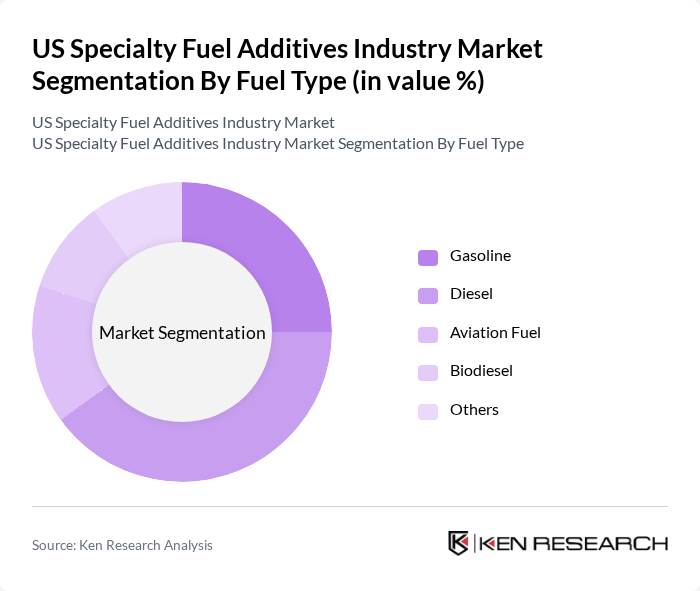
By Fuel Type:The market is categorized into Gasoline, Diesel, Aviation Fuel, Biodiesel, and Others. Diesel fuel is the dominant segment, primarily due to its widespread use in commercial transportation and heavy-duty vehicles. The increasing demand for diesel engines, which require specific additives to enhance performance and reduce emissions, further solidifies this segment's leadership in the market. Diesel fuel additives address multiple operational challenges including improving cetane number for better ignition quality, enhancing lubricity to protect fuel injection systems (especially critical with ultra-low sulfur diesel), preventing wax crystal formation in cold temperatures, and reducing particulate emissions to meet stringent environmental standards.
The US Specialty Fuel Additives Industry Market is characterized by a dynamic mix of regional and international players. Leading participants such as NewMarket Corporation, Innospec Inc., BASF SE, Infineum International Limited, The Lubrizol Corporation, Chevron Oronite Company LLC, Afton Chemical Corporation, Baker Hughes Company, Albemarle Corporation, TotalEnergies SE, Dow Inc., Evonik Industries AG, Clariant AG, Dorf Ketal Chemicals LLC, NALCO Champion (An Ecolab Company) contribute to innovation, geographic expansion, and service delivery in this space.
The future of the US specialty fuel additives market appears promising, driven by ongoing innovations and a shift towards sustainable solutions. As environmental regulations tighten, manufacturers are likely to invest more in R&D, focusing on bio-based and eco-friendly additives. Additionally, the growth of e-commerce platforms is expected to enhance product accessibility, allowing consumers to easily obtain high-performance fuel additives. These trends indicate a dynamic market landscape that will adapt to changing consumer preferences and regulatory demands in the coming years.
| Segment | Sub-Segments |
|---|---|
| By Additive Type | Deposit Control Additives Cetane Improvers Antioxidants Lubricity Improvers Cold Flow Improvers Corrosion Inhibitors Others |
| By Fuel Type | Gasoline Diesel Aviation Fuel Biodiesel Others |
| By Application | Automotive Aviation Marine Industrial & Power Generation Others |
| By Distribution Channel | Direct Sales Distributors Online Retail Others |
| By Region | Northeast Midwest South West Others |
| By Price Range | Low Medium High |
| By Regulatory Compliance | EPA Compliant Non-EPA Compliant Others |
| Scope Item/Segment | Sample Size | Target Respondent Profiles |
|---|---|---|
| Gasoline Additives Market | 120 | Product Managers, R&D Directors |
| Diesel Fuel Additives | 100 | Procurement Managers, Quality Assurance Specialists |
| Biofuel Additives | 80 | Regulatory Affairs Managers, Sustainability Officers |
| Market Trends in Specialty Additives | 120 | Market Analysts, Business Development Managers |
| Technological Innovations in Fuel Additives | 90 | Technical Engineers, Innovation Managers |
The US Specialty Fuel Additives Industry Market is valued at approximately USD 2.5 billion, reflecting a robust growth trajectory driven by the demand for high-performance fuels and stringent environmental regulations.

What makes us stand out is that our consultants follow Robust, Refine and Result (RRR) methodology. Robust for clear definitions, approaches and sanity checking, Refine for differentiating respondents' facts and opinions, and Result for presenting data with story.

We have set a benchmark in the industry by offering our clients with syndicated and customized market research reports featuring coverage of entire market as well as meticulous research and analyst insights.

While we don't replace traditional research, we flip the method upside down. Our dual approach of Top Bottom & Bottom Top ensures quality deliverable by not just verifying company fundamentals but also looking at the sector and macroeconomic factors.

With one step in the future, our research team constantly tries to show you the bigger picture. We help with some of the tough questions you may encounter along the way: How is the industry positioned? Best marketing channel? KPI's of competitors? By aligning every element, we help maximize success.

Our report gives you instant access to the answers and sources that other companies might choose to hide. We elaborate each steps of research methodology we have used and showcase you the sample size to earn your trust.

If you need any support, we are here! We pride ourselves on universe strength, data quality, and quick, friendly, and professional service.













