US Superdisintegrants Market Size Share Growth Drivers Trends Opportunities & Forecast 2025–2030

US Superdisintegrants Market, worth USD 150M, is driven by innovative drug delivery and generic production, featuring key players like BASF and Ashland, with growth in tablets and Croscarmellose Sodium.

Region:North America

Author(s):Shubham

Product Code:KRAD2508

Pages:95

Published On:January 2026
About the Report

Base Year 2024

US Superdisintegrants Market Overview

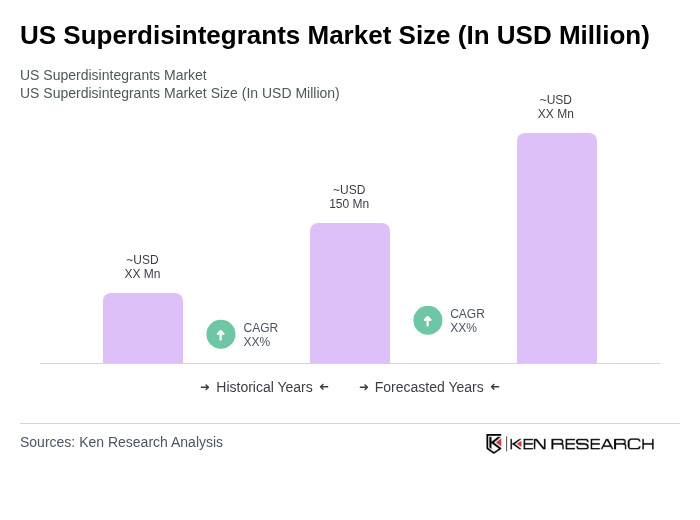
  • The US Superdisintegrants Market is valued at USD 150 million, based on a five-year historical analysis, driven by the increasing demand for efficient oral solid drug formulations and the growing prevalence of chronic diseases. The market is significantly influenced by the pharmaceutical industry's shift towards innovative drug delivery systems, including orally disintegrating tablets and fast-dissolving formulations, which require superdisintegrants to enhance the bioavailability and rapid release of active pharmaceutical ingredients.
  • The dominant regions in the US Superdisintegrants Market include California, New York, and Texas. These states host a high concentration of pharmaceutical manufacturers, contract development and manufacturing organizations (CDMOs), and research institutions, supporting innovation and development in advanced oral solid dosage forms and excipient technologies. The presence of advanced manufacturing facilities, strong biopharmaceutical clusters, and a skilled scientific workforce further contribute to their market prominence in formulation development and scale-up.
  • The use of superdisintegrants in pharmaceutical formulations in the US is governed by excipient quality and safety requirements set out in FDA regulations and guidance, including current good manufacturing practice for finished pharmaceuticals under 21 CFR Parts 210 and 211 and the FDA Guidance for Industry: Nonclinical Studies for the Safety Evaluation of Pharmaceutical Excipients (U.S. Food and Drug Administration, Center for Drug Evaluation and Research, 2005). These instruments emphasize rigorous testing, characterization, and validation of excipients, including superdisintegrants, to ensure the safety, quality, and performance of drug products, thereby supporting market growth through higher assurance of product reliability.
US Superdisintegrants Market Size

US Superdisintegrants Market Segmentation

By Product Type:The product type segmentation includes various superdisintegrants that are essential for enhancing the disintegration of tablets and capsules. The leading subsegment is Croscarmellose Sodium, which holds the largest share in global usage and is widely adopted in both direct compression and wet granulation because of its strong swelling and wicking properties, enabling rapid tablet disintegration even at low concentrations. Crospovidone and Sodium Starch Glycolate also hold significant market shares due to their proven effectiveness across immediate-release formulations and their broad pharmacopeial acceptance. Ion-Exchange Resins and Modified Cellulose are gaining traction as they offer unique benefits, such as modulating disintegration in challenging formulations and improving mouthfeel or stability in certain oral dosage forms, while Other Superdisintegrants cater to niche applications, including specialized fast-dissolving and pediatric formulations.
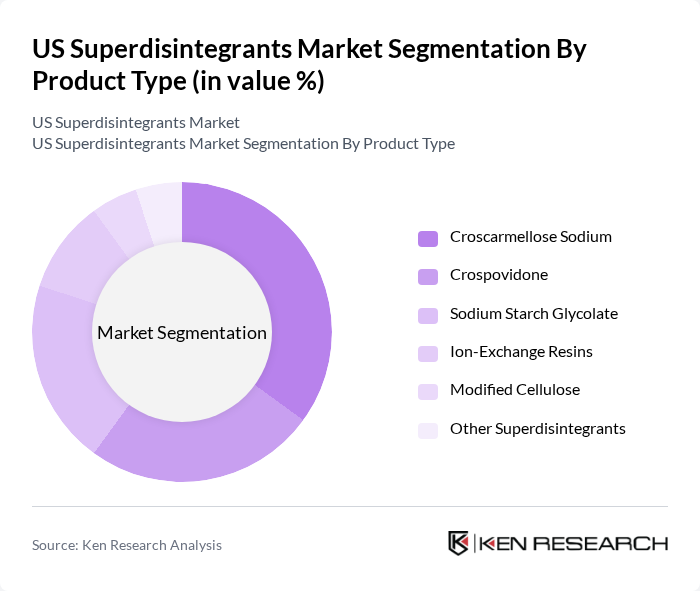
US Superdisintegrants Market segmentation by Product Type.

By Formulation:The formulation segmentation highlights the various forms in which superdisintegrants are utilized, including tablets, capsules, and mouth-dissolving or orally disintegrating films. Tablets dominate this segment due to their widespread use, cost-effectiveness, and the high share of tablets and capsules in global superdisintegrant consumption, reflecting strong preference for solid oral dosage forms in both branded and generic markets. Capsules are also popular, particularly for dietary supplements, high-value APIs, and products requiring flexible fill combinations. Mouth-dissolving and orally disintegrating films are emerging as convenient alternatives for pediatric, geriatric, and dysphagic populations, aligning with the broader trend toward patient-centric dosage forms and improved adherence.
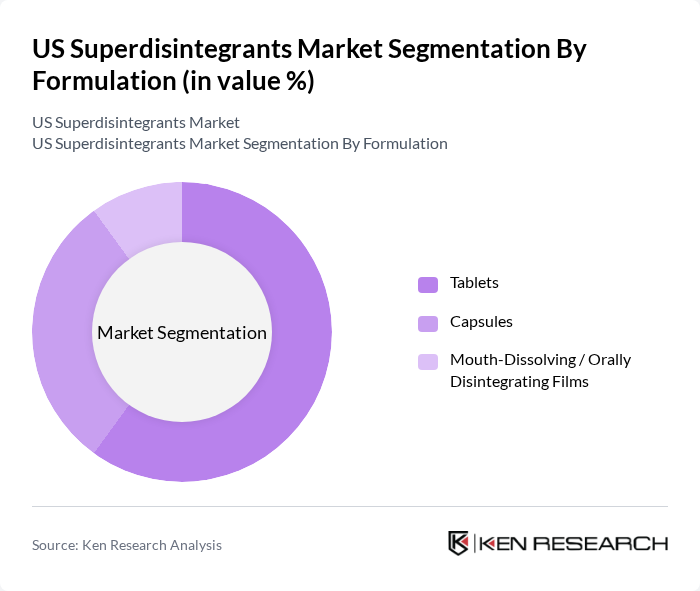
US Superdisintegrants Market segmentation by Formulation.

US Superdisintegrants Market Competitive Landscape

The US Superdisintegrants Market is characterized by a dynamic mix of regional and international players. Leading participants such as Ashland Global Holdings Inc., BASF SE, Evonik Industries AG, JRS Pharma GmbH & Co. KG, FMC Corporation, Colorcon, Inc., DuPont de Nemours, Inc., Merck KGaA, Croda International Plc, Ingredion Incorporated, Roquette Frères, Sigma-Aldrich (Merck Group), HPM Chemicals & Fertilizers Ltd., Sentaur Chemicals Inc., Polyplastics Co., Ltd. contribute to innovation, geographic expansion, and service delivery in this space.

Ashland Global Holdings Inc.

1924

Wilmington, Delaware

BASF SE

1865

Ludwigshafen, Germany

Evonik Industries AG

2007

Essen, Germany

JRS Pharma GmbH & Co. KG

1878

Rosenberg, Germany

FMC Corporation

1884

Philadelphia, Pennsylvania

Company

Establishment Year

Headquarters

Company Size (Large, Mid, Emerging)

US Superdisintegrants Revenue (USD, Latest FY)

US Superdisintegrants Revenue CAGR (3–5 Years)

US Market Share (%)

R&D Intensity (% of Revenue)

New Product Launches / Line Extensions (Annual Count)

US Superdisintegrants Market Industry Analysis

Growth Drivers

  • Increasing Demand for Formulation Efficiency:The US pharmaceutical industry is projected to reach $600 billion in future, driven by the need for more efficient drug formulations. Superdisintegrants play a crucial role in enhancing the dissolution rates of tablets, which is essential for bioavailability. As the industry focuses on reducing production costs and improving patient outcomes, the demand for superdisintegrants is expected to rise significantly, with an estimated increase of 15% in usage in future.
  • Rise in Generic Drug Production:The US generic drug market is anticipated to grow to $100 billion in future, fueled by the expiration of patents for several blockbuster drugs. This surge in generic drug production necessitates the use of superdisintegrants to ensure that these formulations meet the required bioequivalence standards. As generic drugs account for over 90% of prescriptions in the US, the demand for effective superdisintegrants is expected to increase, supporting market growth.
  • Technological Advancements in Drug Delivery Systems:The US is witnessing rapid advancements in drug delivery technologies, with the market projected to reach $200 billion in future. Innovations such as nanotechnology and targeted delivery systems are enhancing the efficacy of superdisintegrants. These advancements are expected to drive the adoption of superdisintegrants in new formulations, as they improve the solubility and absorption of poorly soluble drugs, thereby expanding their application in the pharmaceutical sector.

Market Challenges

  • Stringent Regulatory Requirements:The US pharmaceutical industry faces rigorous regulatory scrutiny, with the FDA enforcing strict guidelines on the use of excipients, including superdisintegrants. Compliance with these regulations can be costly and time-consuming, often requiring extensive testing and documentation. In future, the FDA is expected to increase its focus on the safety and efficacy of excipients, posing a significant challenge for manufacturers aiming to introduce new superdisintegrants into the market.
  • High Competition Among Key Players:The US superdisintegrants market is characterized by intense competition, with major players such as BASF, Ashland, and JRS Pharma dominating the landscape. This competitive environment leads to price wars and increased marketing expenditures, which can strain profit margins. In future, the market is expected to see further consolidation, making it challenging for smaller manufacturers to compete effectively and gain market share.

US Superdisintegrants Market Future Outlook

The US superdisintegrants market is poised for significant growth, driven by the increasing demand for efficient drug formulations and the rise of generic drug production. As technological advancements continue to reshape drug delivery systems, the integration of innovative superdisintegrants will become essential. Additionally, the focus on personalized medicine will further propel the need for tailored formulations, creating a dynamic landscape for superdisintegrants in the coming years. The market is expected to adapt to these trends, fostering new opportunities for growth and development.

Market Opportunities

  • Expansion of Biopharmaceuticals:The biopharmaceutical sector in the US is projected to reach $300 billion in future, creating a substantial opportunity for superdisintegrants. As biopharmaceuticals often require specialized formulations, the demand for effective excipients will increase, allowing manufacturers to innovate and cater to this growing market segment.
  • Increasing R&D Investments:With R&D spending in the US pharmaceutical industry expected to exceed $100 billion in future, there is a significant opportunity for superdisintegrant manufacturers. Increased investments in research will drive the development of novel formulations, enhancing the demand for advanced superdisintegrants that meet evolving pharmaceutical needs.

Scope of the Report

SegmentSub-Segments
By Product Type

Croscarmellose Sodium

Crospovidone

Sodium Starch Glycolate

Ion-Exchange Resins

Modified Cellulose

Other Superdisintegrants

By Formulation

Tablets

Capsules

Mouth-Dissolving / Orally Disintegrating Films

By Therapeutic Area

Gastrointestinal Diseases

Neurological Diseases

Oncology

Infectious Diseases

Cardiovascular Diseases

Hematological Diseases

Inflammatory Diseases

Other Therapeutic Areas

By Customer Type

Originator / Branded Pharmaceutical Companies

Generic Drug Manufacturers

Contract Development and Manufacturing Organizations (CDMOs/CMOs)

Research and Academic Institutions

Other Industrial Users

By Superdisintegrant Source

Synthetic Superdisintegrants

Natural Superdisintegrants

Co-Processed Superdisintegrants

By US Region

Northeast

Midwest

South

West

Key Target Audience

Investors and Venture Capitalist Firms

Government and Regulatory Bodies (e.g., Food and Drug Administration, Environmental Protection Agency)

Pharmaceutical Manufacturers

Biotechnology Companies

Contract Research Organizations

Raw Material Suppliers

Pharmaceutical Packaging Companies

Quality Control and Assurance Agencies

Players Mentioned in the Report:

Ashland Global Holdings Inc.

BASF SE

Evonik Industries AG

JRS Pharma GmbH & Co. KG

FMC Corporation

Colorcon, Inc.

DuPont de Nemours, Inc.

Merck KGaA

Croda International Plc

Ingredion Incorporated

Roquette Freres

Sigma-Aldrich (Merck Group)

HPM Chemicals & Fertilizers Ltd.

Sentaur Chemicals Inc.

Polyplastics Co., Ltd.

Table of Contents

Market Assessment Phase

1. Executive Summary and Approach


2. US Superdisintegrants Market Overview

2.1 Key Insights and Strategic Recommendations

2.2 US Superdisintegrants Market Overview

2.3 Definition and Scope

2.4 Evolution of Market Ecosystem

2.5 Timeline of Key Regulatory Milestones

2.6 Value Chain & Stakeholder Mapping

2.7 Business Cycle Analysis

2.8 Policy & Incentive Landscape


3. US Superdisintegrants Market Analysis

3.1 Growth Drivers

3.1.1 Increasing Demand for Formulation Efficiency
3.1.2 Rise in Generic Drug Production
3.1.3 Technological Advancements in Drug Delivery Systems
3.1.4 Growing Pharmaceutical Industry in the US

3.2 Market Challenges

3.2.1 Stringent Regulatory Requirements
3.2.2 High Competition Among Key Players
3.2.3 Fluctuating Raw Material Prices
3.2.4 Limited Awareness Among Small Manufacturers

3.3 Market Opportunities

3.3.1 Expansion of Biopharmaceuticals
3.3.2 Increasing R&D Investments
3.3.3 Collaborations and Partnerships
3.3.4 Emerging Markets for Superdisintegrants

3.4 Market Trends

3.4.1 Shift Towards Natural and Organic Superdisintegrants
3.4.2 Adoption of Advanced Manufacturing Technologies
3.4.3 Focus on Personalized Medicine
3.4.4 Integration of AI in Drug Formulation

3.5 Government Regulation

3.5.1 FDA Guidelines on Superdisintegrants
3.5.2 Compliance with cGMP Standards
3.5.3 Environmental Regulations on Manufacturing
3.5.4 Intellectual Property Rights Protection

4. SWOT Analysis


5. Stakeholder Analysis


6. Porter's Five Forces Analysis


7. US Superdisintegrants Market Market Size, 2019-2024

7.1 By Value

7.2 By Volume

7.3 By Average Selling Price


8. US Superdisintegrants Market Segmentation

8.1 By Product Type

8.1.1 Croscarmellose Sodium
8.1.2 Crospovidone
8.1.3 Sodium Starch Glycolate
8.1.4 Ion-Exchange Resins
8.1.5 Modified Cellulose
8.1.6 Other Superdisintegrants

8.2 By Formulation

8.2.1 Tablets
8.2.2 Capsules
8.2.3 Mouth-Dissolving / Orally Disintegrating Films

8.3 By Therapeutic Area

8.3.1 Gastrointestinal Diseases
8.3.2 Neurological Diseases
8.3.3 Oncology
8.3.4 Infectious Diseases
8.3.5 Cardiovascular Diseases
8.3.6 Hematological Diseases
8.3.7 Inflammatory Diseases
8.3.8 Other Therapeutic Areas

8.4 By Customer Type

8.4.1 Originator / Branded Pharmaceutical Companies
8.4.2 Generic Drug Manufacturers
8.4.3 Contract Development and Manufacturing Organizations (CDMOs/CMOs)
8.4.4 Research and Academic Institutions
8.4.5 Other Industrial Users

8.5 By Superdisintegrant Source

8.5.1 Synthetic Superdisintegrants
8.5.2 Natural Superdisintegrants
8.5.3 Co-Processed Superdisintegrants

8.6 By US Region

8.6.1 Northeast
8.6.2 Midwest
8.6.3 South
8.6.4 West

9. US Superdisintegrants Market Competitive Analysis

9.1 Market Share of Key Players

9.2 Cross Comparison of Key Players

9.2.1 Company Name
9.2.2 Company Size (Large, Mid, Emerging)
9.2.3 US Superdisintegrants Revenue (USD, Latest FY)
9.2.4 US Superdisintegrants Revenue CAGR (3–5 Years)
9.2.5 US Market Share (%)
9.2.6 R&D Intensity (% of Revenue)
9.2.7 New Product Launches / Line Extensions (Annual Count)
9.2.8 ANDA / NDA Filings Supported per Year
9.2.9 Capacity Utilization Rate (%)
9.2.10 Geographic Footprint in the US (No. of Manufacturing / Technical Sites)
9.2.11 Key Supply Agreements with Top Pharma / CDMOs (Count)
9.2.12 Gross Margin (%) – Excipients / Superdisintegrants Portfolio
9.2.13 Average Selling Price Positioning vs Peers
9.2.14 On-Time Delivery Performance (%)
9.2.15 Quality / Regulatory Track Record (US FDA Inspections, Warning Letters)

9.3 SWOT Analysis of Top Players

9.4 Pricing Analysis

9.5 Detailed Profile of Major Companies

9.5.1 Ashland Global Holdings Inc.
9.5.2 BASF SE
9.5.3 Evonik Industries AG
9.5.4 JRS Pharma GmbH & Co. KG
9.5.5 FMC Corporation
9.5.6 Colorcon, Inc.
9.5.7 DuPont de Nemours, Inc.
9.5.8 Merck KGaA
9.5.9 Croda International Plc
9.5.10 Ingredion Incorporated
9.5.11 Roquette Frères
9.5.12 Sigma-Aldrich (Merck Group)
9.5.13 HPM Chemicals & Fertilizers Ltd.
9.5.14 Sentaur Chemicals Inc.
9.5.15 Polyplastics Co., Ltd.

10. US Superdisintegrants Market End-User Analysis

10.1 Procurement Behavior of Key Ministries

10.1.1 Government Procurement Policies
10.1.2 Budget Allocations for Pharmaceuticals
10.1.3 Supplier Selection Criteria
10.1.4 Contract Management Practices

10.2 Corporate Spend on Infrastructure & Energy

10.2.1 Investment Trends in Pharmaceutical Infrastructure
10.2.2 Energy Efficiency Initiatives
10.2.3 Budgeting for R&D
10.2.4 Corporate Social Responsibility Spending

10.3 Pain Point Analysis by End-User Category

10.3.1 Challenges in Sourcing Superdisintegrants
10.3.2 Quality Assurance Issues
10.3.3 Regulatory Compliance Difficulties
10.3.4 Cost Management Concerns

10.4 User Readiness for Adoption

10.4.1 Awareness of Superdisintegrants Benefits
10.4.2 Training and Support Needs
10.4.3 Technology Adoption Barriers
10.4.4 Feedback Mechanisms

10.5 Post-Deployment ROI and Use Case Expansion

10.5.1 Measurement of ROI
10.5.2 Case Studies of Successful Implementations
10.5.3 Future Use Case Opportunities
10.5.4 Long-term Partnerships and Collaborations

11. US Superdisintegrants Market Future Size, 2025-2030

11.1 By Value

11.2 By Volume

11.3 By Average Selling Price


Go-To-Market Strategy Phase

1. Whitespace Analysis + Business Model Canvas

1.1 Market Gaps Identification

1.2 Value Proposition Development

1.3 Revenue Streams Analysis

1.4 Key Resources and Activities

1.5 Customer Segments and Relationships

1.6 Channels for Distribution

1.7 Cost Structure Overview


2. Marketing and Positioning Recommendations

2.1 Branding Strategies

2.2 Product USPs

2.3 Target Market Positioning

2.4 Communication Strategies

2.5 Digital Marketing Approaches


3. Distribution Plan

3.1 Urban Retail Strategies

3.2 Rural NGO Tie-ups

3.3 E-commerce Distribution Channels

3.4 Logistics and Supply Chain Management


4. Channel & Pricing Gaps

4.1 Underserved Routes

4.2 Pricing Bands Analysis

4.3 Competitor Pricing Strategies

4.4 Customer Willingness to Pay


5. Unmet Demand & Latent Needs

5.1 Category Gaps Identification

5.2 Consumer Segments Analysis

5.3 Product Development Opportunities

5.4 Market Entry Strategies


6. Customer Relationship

6.1 Loyalty Programs

6.2 After-sales Service

6.3 Customer Feedback Mechanisms

6.4 Community Engagement Initiatives


7. Value Proposition

7.1 Sustainability Initiatives

7.2 Integrated Supply Chains

7.3 Customer-Centric Innovations

7.4 Competitive Differentiation Strategies


8. Key Activities

8.1 Regulatory Compliance

8.2 Branding Initiatives

8.3 Distribution Setup

8.4 Market Research and Analysis


9. Entry Strategy Evaluation

9.1 Domestic Market Entry Strategy

9.1.1 Product Mix Considerations
9.1.2 Pricing Band Strategies
9.1.3 Packaging Innovations

9.2 Export Entry Strategy

9.2.1 Target Countries Identification
9.2.2 Compliance Roadmap Development

10. Entry Mode Assessment

10.1 Joint Ventures

10.2 Greenfield Investments

10.3 Mergers & Acquisitions

10.4 Distributor Model Evaluation


11. Capital and Timeline Estimation

11.1 Capital Requirements Analysis

11.2 Timelines for Market Entry


12. Control vs Risk Trade-Off

12.1 Ownership vs Partnerships

12.2 Risk Mitigation Strategies


13. Profitability Outlook

13.1 Breakeven Analysis

13.2 Long-term Sustainability Strategies


14. Potential Partner List

14.1 Distributors

14.2 Joint Ventures

14.3 Acquisition Targets


15. Execution Roadmap

15.1 Phased Plan for Market Entry

15.1.1 Market Setup
15.1.2 Market Entry
15.1.3 Growth Acceleration
15.1.4 Scale & Stabilize

15.2 Key Activities and Milestones

15.2.1 Milestone Planning
15.2.2 Activity Tracking

Research Methodology

ApproachModellingSample

Phase 1: Approach1

Desk Research

  • Industry reports from pharmaceutical associations and market research firms
  • Published articles and white papers on superdisintegrants and their applications
  • Regulatory documents and guidelines from the FDA and other relevant bodies

Primary Research

  • Interviews with formulation scientists at pharmaceutical companies
  • Surveys with procurement managers in the excipient supply chain
  • Field interviews with R&D heads focusing on drug delivery systems

Validation & Triangulation

  • Cross-validation of data through multiple industry sources and expert opinions
  • Triangulation of market size estimates from sales data and production statistics
  • Sanity checks through expert panel discussions and feedback loops

Phase 2: Market Size Estimation1

Top-down Assessment

  • Analysis of the overall pharmaceutical market size and growth trends
  • Segmentation of superdisintegrants by type, application, and region
  • Incorporation of trends in oral drug formulations and patient compliance

Bottom-up Modeling

  • Volume estimates based on production capacities of leading superdisintegrant manufacturers
  • Cost analysis derived from pricing models of various excipients
  • Estimation of market share based on sales data from key players

Forecasting & Scenario Analysis

  • Multi-variable regression analysis incorporating market drivers such as aging population and chronic diseases
  • Scenario planning based on potential regulatory changes and technological advancements
  • Development of baseline, optimistic, and pessimistic forecasts through 2030

Phase 3: CATI Sample Composition1

Scope Item/SegmentSample SizeTarget Respondent Profiles
Pharmaceutical Formulation Development120Formulation Scientists, R&D Managers
Excipient Procurement Strategies90Procurement Managers, Supply Chain Analysts
Market Trends in Drug Delivery80Market Analysts, Product Managers
Regulatory Compliance in Excipients60Regulatory Affairs Specialists, Quality Assurance Managers
Innovations in Superdisintegrants70Research Scientists, Industry Experts

Frequently Asked Questions

What is the current value of the US Superdisintegrants Market?

The US Superdisintegrants Market is valued at approximately USD 150 million, driven by the increasing demand for efficient oral solid drug formulations and the growing prevalence of chronic diseases.

What factors are driving the growth of the US Superdisintegrants Market?

Which regions dominate the US Superdisintegrants Market?

What are the main types of superdisintegrants used in the market?

Other Regional/Country Reports

USA Superdisintegrants Market Size Share Growth Drivers Trends Opportunities & Forecast 2025–2030

Indonesia Superdisintegrants Market

Malaysia Superdisintegrants Market

KSA Superdisintegrants Market

APAC Superdisintegrants Market

SEA Superdisintegrants Market

Why Buy From Us?

Refine Robust Result (RRR) Framework

What makes us stand out is that our consultants follow Robust, Refine and Result (RRR) methodology. Robust for clear definitions, approaches and sanity checking, Refine for differentiating respondents' facts and opinions, and Result for presenting data with story.

Our Reach Is Unmatched

We have set a benchmark in the industry by offering our clients with syndicated and customized market research reports featuring coverage of entire market as well as meticulous research and analyst insights.

Shifting the Research Paradigm

While we don't replace traditional research, we flip the method upside down. Our dual approach of Top Bottom & Bottom Top ensures quality deliverable by not just verifying company fundamentals but also looking at the sector and macroeconomic factors.

More Insights-Better Decisions

With one step in the future, our research team constantly tries to show you the bigger picture. We help with some of the tough questions you may encounter along the way: How is the industry positioned? Best marketing channel? KPI's of competitors? By aligning every element, we help maximize success.

Transparency and Trust

Our report gives you instant access to the answers and sources that other companies might choose to hide. We elaborate each steps of research methodology we have used and showcase you the sample size to earn your trust.

Round the Clock Support

If you need any support, we are here! We pride ourselves on universe strength, data quality, and quick, friendly, and professional service.

Why Clients Choose Us?

400000+
Reports in repository
150+
Consulting projects a year
100+
Analysts
8000+
Client Queries in 2022








