Vietnam Agro Textile Market Report Size Share Growth Drivers Trends Opportunities & Forecast 2025–2030

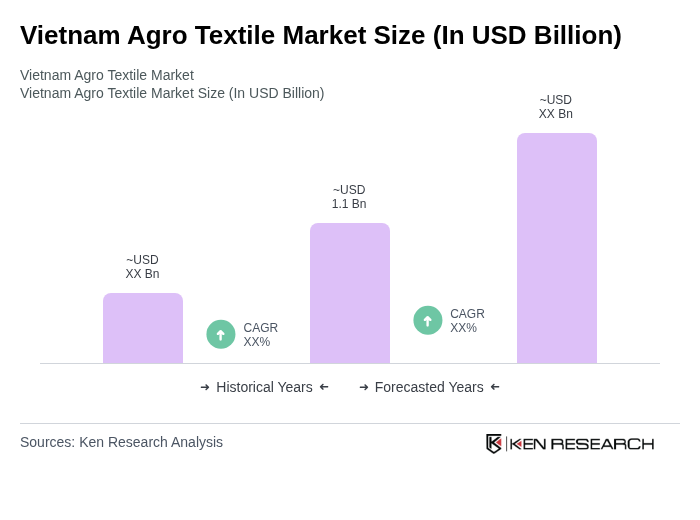
The Vietnam agro textile market, worth USD 1.1 billion, is growing rapidly due to adoption of shade nets, mulch films, and modern techniques for enhanced crop yield and sustainability.

Region:Asia

Author(s):Rebecca

Product Code:KRAB2082

Pages:85

Published On:January 2026
About the Report

Base Year 2024

Vietnam Agro Textile Market Overview

  • The Vietnam Agro Textile Market is valued at USD 1.1 billion, based on a five-year historical analysis, as a specialized and fast-growing niche within Vietnam’s broader technical and industrial textile production base. This growth is primarily driven by the increasing demand for higher agricultural productivity, accelerated adoption of protected cultivation and modern farming techniques (including drip irrigation, mulching, and greenhouse cultivation), and the rising awareness of sustainable and climate-resilient agricultural practices promoted through national programs to modernize agriculture and rural areas. The market has seen a significant uptick in the use of agro textiles such as shade nets, mulch films, insect nets, and aquaculture nets, which enhance crop yield, reduce input losses, and protect against heat stress, pests, soil erosion, and extreme weather events.
  • Key players relevant to agro textile and agri-related polymer-based solutions in Vietnam include Hoang Ha Group (involved in nets and woven plastic products), Duy Tan Plastics Manufacturing Corporation (a leading plastics converter supplying films and related products), and Binh Minh Plastics Joint Stock Company, which provide materials and products used in irrigation, mulching, shading, and aquaculture infrastructure. These companies benefit from extensive domestic distribution networks, established brand recognition in plastic and technical material segments, and ongoing investments in product quality and processing technology to meet the diverse requirements of open-field farming, horticulture, and aquaculture.
  • In recent years, the Vietnamese government has introduced a series of policies to promote sustainable agricultural production and the application of advanced materials, including agro textiles, through support for high-tech agriculture zones, digital transformation in farming, and incentives for upgrading farm infrastructure. A key framework is the Law on Crop Production 2018 issued by the National Assembly, together with guiding decrees and circulars from the Ministry of Agriculture and Rural Development, which set out standards on cultivation practices, input management, and technical measures for crop protection and soil conservation, encouraging the adoption of protective covers, mulching, and netting systems to improve efficiency and reduce environmental impact. Within this broader policy environment, budgetary allocations under agricultural modernization and rural development programs support research, extension services, and partial subsidies for technologies such as greenhouse covers, shading, and protective nets, with cumulative public and donor-backed funding for high-tech and climate-resilient agriculture amounting to several hundred million United States dollars in recent years.
Vietnam Agro Textile Market Size

Vietnam Agro Textile Market Segmentation

By Product Type:The product type segmentation includes various categories such as Shade Nets, Mulch Mats and Mulch Films, Anti-hail and Bird Protection Nets, Anti-insect and Windbreak Nets, Ground Covers and Weed Control Fabrics, Fishing and Aquaculture Nets, and Others. This structure aligns with the broader technical textile classification used in Vietnam’s textile industry, where agro textiles are recognized as a key subset alongside industrial and protective textiles. Among these, Shade Nets are particularly popular in Vietnam’s fruit, vegetable, and flower-growing regions due to their effectiveness in reducing solar radiation, moderating temperature, and limiting evapotranspiration, which is critical under increasingly frequent heatwaves and irregular rainfall. The increasing focus on sustainable farming practices and climate-smart agriculture, including investments in shaded nurseries, net houses, and protected seedling production, has led to a surge in demand for these products, supporting their role as one of the dominant segments in the market.
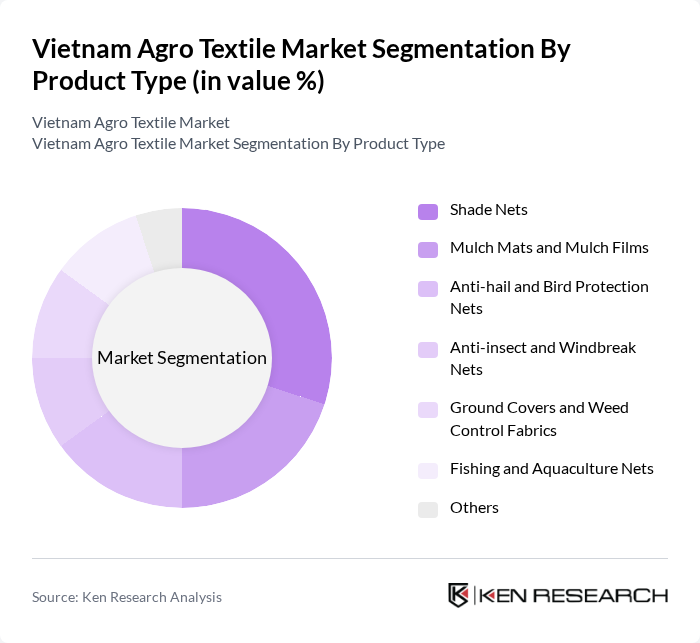
Vietnam Agro Textile Market segmentation by Product Type.

By End-Use Sector:The end-use sector segmentation encompasses Open-field Agriculture (Food & Cash Crops), Horticulture & Floriculture, Greenhouse & Protected Cultivation, Aquaculture & Fisheries, Landscaping & Infrastructure, and Others. This segmentation is consistent with Vietnam’s agricultural structure, where large areas are devoted to rice and cash crops, alongside rapidly expanding fruit, vegetable, and flower cultivation and a strong aquaculture industry. Open-field agriculture is the leading segment, driven by the need for increased food production, higher yields per hectare, and the adoption of mulching, crop covers, and windbreak nets to enhance crop resilience, reduce post-harvest losses, and stabilize quality. The growing population, strong export orientation for key crops, and national targets for improving food security and value-added agricultural exports have further propelled this segment’s growth, while horticulture, floriculture, and aquaculture increasingly adopt specialized shade, insect, and containment nets.
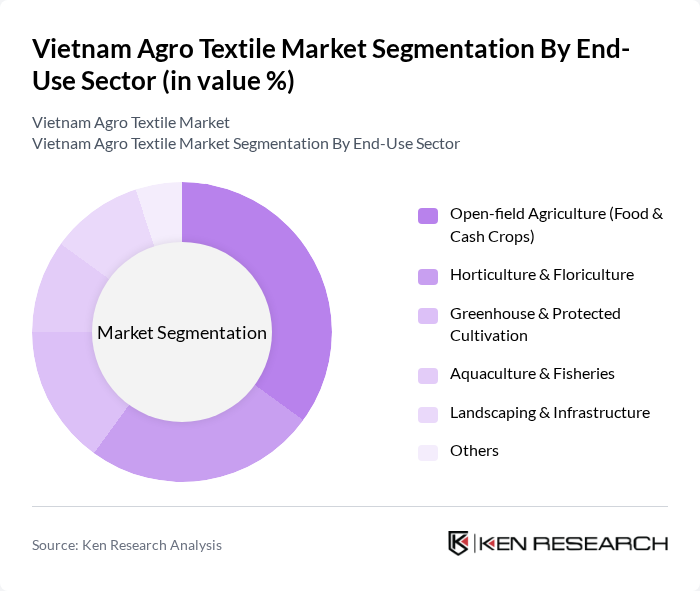
Vietnam Agro Textile Market segmentation by End-Use Sector.

Vietnam Agro Textile Market Competitive Landscape

The Vietnam Agro Textile Market is characterized by a dynamic mix of regional and international players. Leading participants such as Vietnam National Textile and Garment Group (Vinatex), Thanh Cong Textile Garment Investment Trading JSC, TNG Investment & Trading Joint Stock Company, Viet Tien Garment Corporation, Phong Phu Corporation, Century Synthetic Fiber Corporation, Nam Dinh Textile Garment Joint Stock Corporation, Dong Nai Garment Corporation, Saigon 3 Garment Joint Stock Company, Hoa Tho Textile – Garment Joint Stock Corporation, Binh Minh Plastics Joint Stock Company, Rang Dong Plastic Joint Stock Company, Duc Giang Corporation, Nha Be Garment Corporation, and other emerging agro textile manufacturers in Vietnam contribute to innovation, geographic expansion, and service delivery in this space by leveraging existing strengths in synthetic fibers, woven fabrics, and plastic processing to expand into higher-value technical and agro textile applications.

Vietnam National Textile and Garment Group (Vinatex)

1995

Hanoi, Vietnam

Thanh Cong Textile Garment Investment Trading JSC

1976

Ho Chi Minh City, Vietnam

TNG Investment & Trading Joint Stock Company

1979

Thai Nguyen, Vietnam

Viet Tien Garment Corporation

1976

Ho Chi Minh City, Vietnam

Phong Phu Corporation

1964

Ho Chi Minh City, Vietnam

Company

Establishment Year

Headquarters

Group Size (Large, Medium, or Small as per industry convention)

Vietnam Agro Textile Revenue (USD million)

3-year CAGR in Agro Textile Revenue

EBITDA Margin (%) from Agro Textile Operations

Capex Intensity (% of Revenue) in Capacity & Technology

Market Share in Vietnam Agro Textile Segment (%)

Vietnam Agro Textile Market Industry Analysis

Growth Drivers

  • Increasing Demand for Sustainable Textiles:The global market for sustainable textiles is projected to reach $8.25 billion in future, driven by consumer preferences for eco-friendly products. In Vietnam, the textile industry is responding to this trend, with over 60% of manufacturers investing in sustainable practices. This shift is supported by the Vietnamese government’s commitment to reducing carbon emissions by 20% in future, enhancing the appeal of agro textiles in both domestic and international markets.
  • Government Support for Agricultural Innovation:The Vietnamese government allocated approximately $1.5 billion in future to promote agricultural innovation, including agro textiles. This funding aims to enhance productivity and sustainability in the textile sector. Additionally, initiatives such as the National Target Program for Sustainable Development of Agriculture and Rural Areas are fostering research and development, which is crucial for advancing agro textile technologies and practices, thereby boosting market growth.
  • Rising Awareness of Eco-Friendly Products:Consumer awareness regarding the environmental impact of textiles is increasing significantly. In Vietnam, surveys indicate that 70% of consumers are willing to pay more for eco-friendly products. This trend is further supported by the rise of social media campaigns promoting sustainable living. As a result, local agro textile producers are capitalizing on this shift, with a reported 30% increase in sales of eco-friendly textile products in future, indicating a robust market demand.

Market Challenges

  • Competition from Low-Cost Imports:The Vietnamese agro textile market faces significant pressure from low-cost imports, particularly from countries like China and Bangladesh. In future, imports accounted for 40% of the textile market share in Vietnam, leading to price wars that threaten local producers. This competition undermines profit margins and poses a challenge for domestic manufacturers striving to maintain quality while remaining competitive in pricing.
  • Limited Access to Advanced Technology:Many Vietnamese agro textile manufacturers struggle with limited access to advanced technology, which hampers productivity and innovation. A report indicated that only 25% of local firms have adopted modern textile manufacturing technologies in future. This technological gap results in inefficiencies and lower product quality, making it difficult for these companies to compete effectively in the global market, where technological advancements are crucial for success.

Vietnam Agro Textile Market Future Outlook

The future of the Vietnam agro textile market appears promising, driven by increasing consumer demand for sustainable products and government initiatives supporting innovation. As the global focus on sustainability intensifies, Vietnamese manufacturers are likely to enhance their production processes and product offerings. Additionally, the integration of digital technologies in production is expected to streamline operations, improve efficiency, and foster collaboration with international brands, positioning Vietnam as a key player in the sustainable textile sector.

Market Opportunities

  • Growth in Organic Farming:The rise of organic farming in Vietnam presents a significant opportunity for agro textile producers. With organic farming increasing by 15% annually, there is a growing demand for organic cotton and other natural fibers. This trend allows local manufacturers to diversify their product lines and cater to eco-conscious consumers, potentially increasing market share and profitability.
  • Development of Biodegradable Materials:The development of biodegradable materials is gaining traction in the agro textile sector. With the global biodegradable textile market expected to reach $1.5 billion in future, Vietnamese companies can leverage this trend by investing in research and development. This shift not only aligns with environmental goals but also meets the increasing consumer demand for sustainable alternatives, enhancing competitiveness in the market.

Scope of the Report

SegmentSub-Segments
By Product Type

Shade Nets

Mulch Mats and Mulch Films

Anti-hail and Bird Protection Nets

Anti-insect and Windbreak Nets

Ground Covers and Weed Control Fabrics

Fishing and Aquaculture Nets

Others

By End-Use Sector

Open-field Agriculture (Food & Cash Crops)

Horticulture & Floriculture

Greenhouse & Protected Cultivation

Aquaculture & Fisheries

Landscaping & Infrastructure

Others

By Application Function

Crop Protection (Pest, Bird, and Hail Protection)

Microclimate Management (Shade, Temperature, Humidity)

Soil Erosion and Weed Control

Water Management (Irrigation Support, Moisture Retention)

Post-harvest Handling & Packaging

Others

By Distribution Channel

Direct Institutional Sales (Projects, Cooperatives)

Agricultural Input Dealers & Distributors

Specialized Agro-Equipment Retailers

Online & E-commerce Platforms

Others

By Material

Polyethylene (HDPE / LDPE)

Polypropylene

Polyester & Other Synthetic Fibers

Natural Fibers (Jute, Coir, etc.)

Biodegradable / Bio-based Materials

Others

By Region

Northern Vietnam

Central Vietnam

Southern Vietnam

Others

By Innovation Level

Conventional Agro Textiles

High-performance / Functional Agro Textiles

Smart & Sensor-enabled Agro Textiles

Others

Key Target Audience

Investors and Venture Capitalist Firms

Government and Regulatory Bodies (e.g., Ministry of Agriculture and Rural Development, Ministry of Industry and Trade)

Manufacturers and Producers

Distributors and Retailers

Textile Export Promotion Agencies

Industry Associations (e.g., Vietnam Textile and Apparel Association)

Financial Institutions

Raw Material Suppliers

Players Mentioned in the Report:

Vietnam National Textile and Garment Group (Vinatex)

Thanh Cong Textile Garment Investment Trading JSC

TNG Investment & Trading Joint Stock Company

Viet Tien Garment Corporation

Phong Phu Corporation

Century Synthetic Fiber Corporation

Nam Dinh Textile Garment Joint Stock Corporation

Dong Nai Garment Corporation

Saigon 3 Garment Joint Stock Company

Hoa Tho Textile Garment Joint Stock Corporation

Binh Minh Plastics Joint Stock Company

Rang Dong Plastic Joint Stock Company

Duc Giang Corporation

Nha Be Garment Corporation

Other Emerging Agro Textile Manufacturers in Vietnam

Table of Contents

Market Assessment Phase

1. Executive Summary and Approach


2. Vietnam Agro Textile Market Overview

2.1 Key Insights and Strategic Recommendations

2.2 Vietnam Agro Textile Market Overview

2.3 Definition and Scope

2.4 Evolution of Market Ecosystem

2.5 Timeline of Key Regulatory Milestones

2.6 Value Chain & Stakeholder Mapping

2.7 Business Cycle Analysis

2.8 Policy & Incentive Landscape


3. Vietnam Agro Textile Market Analysis

3.1 Growth Drivers

3.1.1 Increasing demand for sustainable textiles
3.1.2 Government support for agricultural innovation
3.1.3 Rising awareness of eco-friendly products
3.1.4 Expansion of export markets

3.2 Market Challenges

3.2.1 Competition from low-cost imports
3.2.2 Limited access to advanced technology
3.2.3 Fluctuating raw material prices
3.2.4 Regulatory compliance issues

3.3 Market Opportunities

3.3.1 Growth in organic farming
3.3.2 Development of biodegradable materials
3.3.3 Increasing investment in R&D
3.3.4 Collaboration with international brands

3.4 Market Trends

3.4.1 Shift towards circular economy practices
3.4.2 Adoption of smart textiles
3.4.3 Focus on local sourcing
3.4.4 Integration of digital technologies in production

3.5 Government Regulation

3.5.1 Environmental protection laws
3.5.2 Subsidies for sustainable practices
3.5.3 Quality standards for agro textiles
3.5.4 Trade agreements impacting exports

4. SWOT Analysis


5. Stakeholder Analysis


6. Porter's Five Forces Analysis


7. Vietnam Agro Textile Market Market Size, 2019-2024

7.1 By Value

7.2 By Volume

7.3 By Average Selling Price


8. Vietnam Agro Textile Market Segmentation

8.1 By Product Type

8.1.1 Shade Nets
8.1.2 Mulch Mats and Mulch Films
8.1.3 Anti-hail and Bird Protection Nets
8.1.4 Anti-insect and Windbreak Nets
8.1.5 Ground Covers and Weed Control Fabrics
8.1.6 Fishing and Aquaculture Nets
8.1.7 Others

8.2 By End-Use Sector

8.2.1 Open-field Agriculture (Food & Cash Crops)
8.2.2 Horticulture & Floriculture
8.2.3 Greenhouse & Protected Cultivation
8.2.4 Aquaculture & Fisheries
8.2.5 Landscaping & Infrastructure
8.2.6 Others

8.3 By Application Function

8.3.1 Crop Protection (Pest, Bird, and Hail Protection)
8.3.2 Microclimate Management (Shade, Temperature, Humidity)
8.3.3 Soil Erosion and Weed Control
8.3.4 Water Management (Irrigation Support, Moisture Retention)
8.3.5 Post-harvest Handling & Packaging
8.3.6 Others

8.4 By Distribution Channel

8.4.1 Direct Institutional Sales (Projects, Cooperatives)
8.4.2 Agricultural Input Dealers & Distributors
8.4.3 Specialized Agro-Equipment Retailers
8.4.4 Online & E-commerce Platforms
8.4.5 Others

8.5 By Material

8.5.1 Polyethylene (HDPE / LDPE)
8.5.2 Polypropylene
8.5.3 Polyester & Other Synthetic Fibers
8.5.4 Natural Fibers (Jute, Coir, etc.)
8.5.5 Biodegradable / Bio-based Materials
8.5.6 Others

8.6 By Region

8.6.1 Northern Vietnam
8.6.2 Central Vietnam
8.6.3 Southern Vietnam
8.6.4 Others

8.7 By Innovation Level

8.7.1 Conventional Agro Textiles
8.7.2 High-performance / Functional Agro Textiles
8.7.3 Smart & Sensor-enabled Agro Textiles
8.7.4 Others

9. Vietnam Agro Textile Market Competitive Analysis

9.1 Market Share of Key Players

9.2 Cross Comparison of Key Players

9.2.1 Company Name
9.2.2 Group Size (Large, Medium, or Small as per industry convention)
9.2.3 Vietnam Agro Textile Revenue (USD million)
9.2.4 3-year CAGR in Agro Textile Revenue
9.2.5 EBITDA Margin (%) from Agro Textile Operations
9.2.6 Capex Intensity (% of Revenue) in Capacity & Technology
9.2.7 Market Share in Vietnam Agro Textile Segment (%)
9.2.8 Export Intensity (% of Agro Textile Sales Exported)
9.2.9 Production Capacity Utilization (%)
9.2.10 Average Realization per Tonne (USD/tonne)
9.2.11 R&D Spend (% of Revenue) Focused on Agro Textiles
9.2.12 Product Basket Breadth (No. of Agro Textile SKUs)
9.2.13 Customer Concentration (Top-5 Customers % of Sales)
9.2.14 Credit Period Offered (Days)
9.2.15 On-time Delivery Rate (%)

9.3 SWOT Analysis of Top Players

9.4 Pricing Analysis

9.5 Detailed Profile of Major Companies

9.5.1 Vietnam National Textile and Garment Group (Vinatex)
9.5.2 Thanh Cong Textile Garment Investment Trading JSC
9.5.3 TNG Investment & Trading Joint Stock Company
9.5.4 Viet Tien Garment Corporation
9.5.5 Phong Phu Corporation
9.5.6 Century Synthetic Fiber Corporation
9.5.7 Nam Dinh Textile Garment Joint Stock Corporation
9.5.8 Dong Nai Garment Corporation
9.5.9 Saigon 3 Garment Joint Stock Company
9.5.10 Hoa Tho Textile – Garment Joint Stock Corporation
9.5.11 Binh Minh Plastics Joint Stock Company
9.5.12 Rang Dong Plastic Joint Stock Company
9.5.13 Duc Giang Corporation
9.5.14 Nha Be Garment Corporation
9.5.15 Other Emerging Agro Textile Manufacturers in Vietnam

10. Vietnam Agro Textile Market End-User Analysis

10.1 Procurement Behavior of Key Ministries

10.1.1 Ministry of Agriculture and Rural Development
10.1.2 Ministry of Industry and Trade
10.1.3 Ministry of Natural Resources and Environment
10.1.4 Others

10.2 Corporate Spend on Infrastructure & Energy

10.2.1 Investment in Agro Textile Infrastructure
10.2.2 Energy Efficiency Initiatives
10.2.3 Sustainable Practices Adoption
10.2.4 Others

10.3 Pain Point Analysis by End-User Category

10.3.1 Farmers
10.3.2 Agricultural Cooperatives
10.3.3 Exporters
10.3.4 Others

10.4 User Readiness for Adoption

10.4.1 Awareness of Agro Textiles
10.4.2 Training and Support Needs
10.4.3 Financial Readiness
10.4.4 Others

10.5 Post-Deployment ROI and Use Case Expansion

10.5.1 ROI Measurement Techniques
10.5.2 Case Studies of Successful Implementations
10.5.3 Future Use Case Opportunities
10.5.4 Others

11. Vietnam Agro Textile Market Future Size, 2025-2030

11.1 By Value

11.2 By Volume

11.3 By Average Selling Price


Go-To-Market Strategy Phase

1. Whitespace Analysis + Business Model Canvas

1.1 Market Gaps Identification

1.2 Business Model Development


2. Marketing and Positioning Recommendations

2.1 Branding Strategies

2.2 Product USPs


3. Distribution Plan

3.1 Urban Retail vs Rural NGO Tie-ups


4. Channel & Pricing Gaps

4.1 Underserved Routes

4.2 Pricing Bands


5. Unmet Demand & Latent Needs

5.1 Category Gaps

5.2 Consumer Segments


6. Customer Relationship

6.1 Loyalty Programs

6.2 After-sales Service


7. Value Proposition

7.1 Sustainability

7.2 Integrated Supply Chains


8. Key Activities

8.1 Regulatory Compliance

8.2 Branding

8.3 Distribution Setup


9. Entry Strategy Evaluation

9.1 Domestic Market Entry Strategy

9.1.1 Product Mix
9.1.2 Pricing Band
9.1.3 Packaging

9.2 Export Entry Strategy

9.2.1 Target Countries
9.2.2 Compliance Roadmap

10. Entry Mode Assessment

10.1 JV

10.2 Greenfield

10.3 M&A

10.4 Distributor Model


11. Capital and Timeline Estimation

11.1 Capital Requirements

11.2 Timelines


12. Control vs Risk Trade-Off

12.1 Ownership vs Partnerships


13. Profitability Outlook

13.1 Breakeven Analysis

13.2 Long-term Sustainability


14. Potential Partner List

14.1 Distributors

14.2 JVs

14.3 Acquisition Targets


15. Execution Roadmap

15.1 Phased Plan for Market Entry

15.1.1 Market Setup
15.1.2 Market Entry
15.1.3 Growth Acceleration
15.1.4 Scale & Stabilize

15.2 Key Activities and Milestones


Research Methodology

ApproachModellingSample

Phase 1: Approach1

Desk Research

  • Analysis of industry reports from Vietnamese textile associations and government publications
  • Review of trade statistics and export-import data from the General Department of Vietnam Customs
  • Examination of market trends and forecasts from international textile market research firms

Primary Research

  • Interviews with key stakeholders in the agro textile supply chain, including manufacturers and distributors
  • Surveys targeting agricultural cooperatives and farmers utilizing agro textiles
  • Field visits to textile production facilities to gather insights on operational practices and challenges

Validation & Triangulation

  • Cross-validation of findings through comparison with historical market data and growth trends
  • Triangulation of insights from primary interviews with secondary data sources
  • Sanity checks conducted through expert panels comprising industry veterans and academic researchers

Phase 2: Market Size Estimation1

Top-down Assessment

  • Estimation of market size based on national agricultural output and textile consumption rates
  • Segmentation of the market by agro textile types, including nets, covers, and fabrics
  • Incorporation of government agricultural policies and initiatives promoting sustainable practices

Bottom-up Modeling

  • Collection of production data from leading agro textile manufacturers in Vietnam
  • Estimation of market demand based on usage rates among different agricultural sectors
  • Cost analysis of agro textile products to determine pricing strategies and market potential

Forecasting & Scenario Analysis

  • Development of forecasting models based on historical growth rates and emerging market trends
  • Scenario analysis considering factors such as climate change impacts and technological advancements
  • Creation of multiple growth scenarios (baseline, optimistic, and pessimistic) through 2030

Phase 3: CATI Sample Composition1

Scope Item/SegmentSample SizeTarget Respondent Profiles
Agro Textile Manufacturers60Production Managers, Quality Control Supervisors
Agricultural Cooperatives50Cooperative Leaders, Procurement Officers
Farmers Utilizing Agro Textiles80Smallholder Farmers, Large-scale Farmers
Distributors and Retailers40Supply Chain Managers, Retail Buyers
Research and Development Experts40Textile Engineers, Agricultural Researchers

Frequently Asked Questions

What is the current value of the Vietnam Agro Textile Market?

The Vietnam Agro Textile Market is valued at approximately USD 1.1 billion, reflecting a specialized and rapidly growing segment within the country's broader textile production landscape, driven by increasing agricultural productivity and sustainable practices.

What are the main products in the Vietnam Agro Textile Market?

What factors are driving growth in the Vietnam Agro Textile Market?

Who are the key players in the Vietnam Agro Textile Market?

Other Adjacent Reports

South Africa Technical Textile Market

KSA Agricultural Film Market

Belgium Irrigation System Market

Egypt Greenhouse Equipment Market

South Africa Aquaculture Equipment Market

Australia Crop Protection Market Outlook to 2027FIndia Synthetic Fiber Market Outlook to 2030Bahrain Plastic Packaging Market Report Size Share Growth Drivers Trends Opportunities & Forecast 2025–2030UAE Geotextile Market

Thailand Sustainable Agriculture Market

Why Buy From Us?

Refine Robust Result (RRR) Framework

What makes us stand out is that our consultants follow Robust, Refine and Result (RRR) methodology. Robust for clear definitions, approaches and sanity checking, Refine for differentiating respondents' facts and opinions, and Result for presenting data with story.

Our Reach Is Unmatched

We have set a benchmark in the industry by offering our clients with syndicated and customized market research reports featuring coverage of entire market as well as meticulous research and analyst insights.

Shifting the Research Paradigm

While we don't replace traditional research, we flip the method upside down. Our dual approach of Top Bottom & Bottom Top ensures quality deliverable by not just verifying company fundamentals but also looking at the sector and macroeconomic factors.

More Insights-Better Decisions

With one step in the future, our research team constantly tries to show you the bigger picture. We help with some of the tough questions you may encounter along the way: How is the industry positioned? Best marketing channel? KPI's of competitors? By aligning every element, we help maximize success.

Transparency and Trust

Our report gives you instant access to the answers and sources that other companies might choose to hide. We elaborate each steps of research methodology we have used and showcase you the sample size to earn your trust.

Round the Clock Support

If you need any support, we are here! We pride ourselves on universe strength, data quality, and quick, friendly, and professional service.

Why Clients Choose Us?

400000+
Reports in repository
150+
Consulting projects a year
100+
Analysts
8000+
Client Queries in 2022








