Vietnam Burner Management System BMS Market Size Share Growth Drivers Trends Opportunities & Forecast 2025–2030

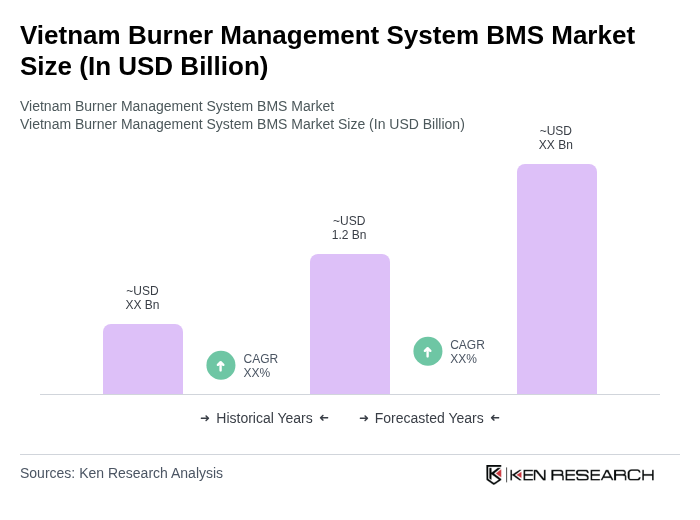
Vietnam BMS market grows with automation demand, valued at USD 1.2 Bn.

Region:Asia

Author(s):Rebecca

Product Code:KRAB0853

Pages:96

Published On:December 2025
About the Report

Base Year 2024

Vietnam Burner Management System BMS Market Overview

  • The Vietnam Burner Management System BMS Market is valued at USD 1.2 billion, based on a five?year historical analysis. Growth is driven by accelerating demand for operational efficiency, labor cost pressures, and expanding smart factory investments across electronics, textiles, and energy industries, fostering increasing uptake of automation technologies including control systems related to BMS applications.
  • Key players in this market include Siemens, ABB, Schneider Electric, Mitsubishi Electric, Honeywell, and Rockwell Automation, whose solutions support control systems analogous to BMS functions. Adoption is concentrated in industrial hubs including Ho Chi Minh City, Binh Duong, and Da Nang, where manufacturers seek enhanced safety and process control, driving regional demand for automation services.
  • In 2024, Vietnam's government announced a strategic plan to enhance domestic metal ore processing capabilities. This plan includes an investment of USD 500 million to upgrade facilities and adopt advanced mining technologies. The initiative aims to reduce reliance on imported ores and increase the value-added processing of local resources, positioning Vietnam as a competitive player in the global metal ore market.
Vietnam Burner Management System BMS Market Size

Vietnam Burner Management System BMS Market Segmentation

By Type:The market is segmented into various types of burners, including industrial, commercial, residential, specialty, and others. Industrial burners dominate the market due to their extensive use in manufacturing and energy sectors, where efficiency and safety are paramount. The increasing focus on automation and safety regulations further drives the demand for advanced burner management systems in industrial applications.
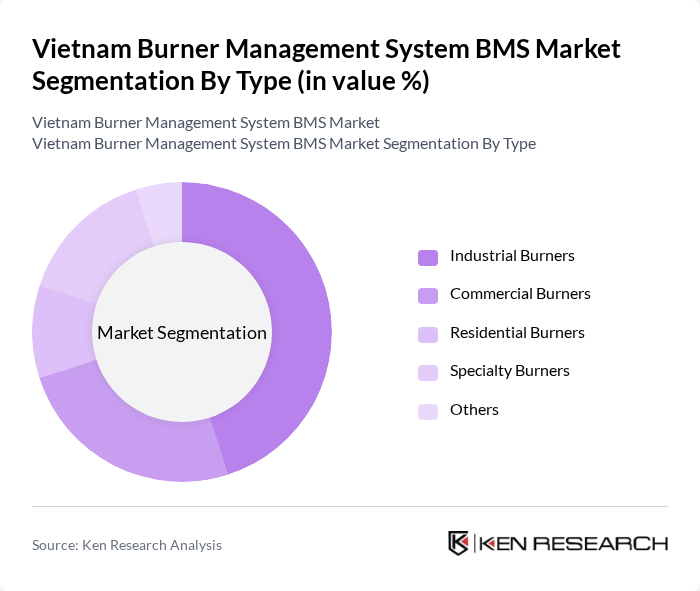
Vietnam Burner Management System BMS Market segmentation by Type.

By End-User:The end-user segmentation includes oil & gas, power generation, manufacturing, chemical processing, and others. The oil & gas sector is the leading end-user, driven by stringent safety regulations and the need for efficient operations. The increasing investments in renewable energy and power generation technologies also contribute to the growth of burner management systems in these sectors.
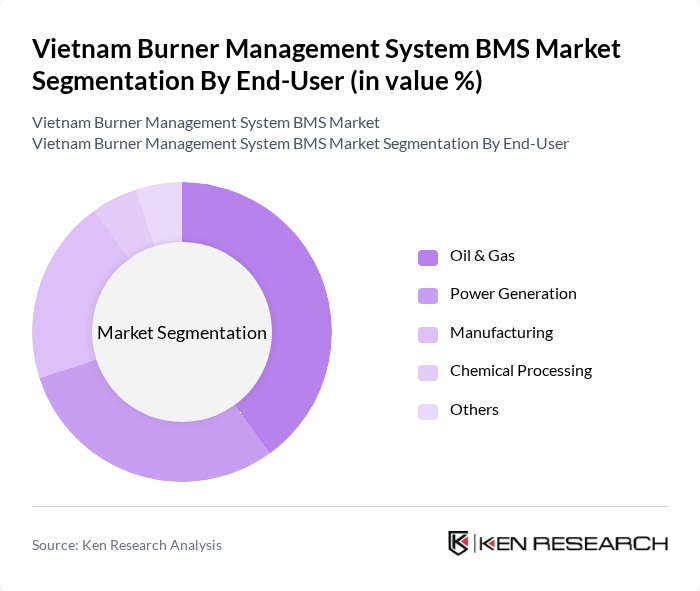
Vietnam Burner Management System BMS Market segmentation by End-User.

Vietnam Burner Management System BMS Market Competitive Landscape

The Vietnam Burner Management System BMS Market is characterized by a dynamic mix of regional and international players. Leading participants such as Honeywell International Inc., Siemens AG, Emerson Electric Co., Schneider Electric SE, Yokogawa Electric Corporation, ABB Ltd., General Electric Company, Rockwell Automation, Inc., KROHNE Group, Endress+Hauser AG, Mitsubishi Electric Corporation, Babcock & Wilcox Enterprises, Inc., Metso Corporation, Intergraph Corporation, DCS Group contribute to innovation, geographic expansion, and service delivery in this space.

Honeywell International Inc.

1906

Charlotte, North Carolina, USA

Siemens AG

1847

Munich, Germany

Emerson Electric Co.

1890

St. Louis, Missouri, USA

Schneider Electric SE

1836

Rueil-Malmaison, France

ABB Ltd.

1988

Zurich, Switzerland

Company

Establishment Year

Headquarters

Group Size (Large, Medium, or Small as per industry convention)

Revenue Growth Rate

Market Penetration Rate

Customer Retention Rate

Pricing Strategy

Product Innovation Rate

Vietnam Burner Management System BMS Market Industry Analysis

Growth Drivers

  • Digital Economy Contribution to GDP:The digital economy in Vietnam contributed USD 18.3 billion to the GDP in future, reflecting a significant growth trajectory. This expansion is driven by enhanced digital infrastructure and platforms, which are crucial for the adoption of advanced industrial control systems like Burner Management Systems (BMS). As industries increasingly digitize, the demand for sophisticated safety and efficiency solutions in industrial operations is expected to rise, further propelling the BMS market.
  • E-commerce Revenue:Vietnam's e-commerce retail sales reached USD 25 billion in future, showcasing a robust growth in online commerce. This surge in e-commerce is driving higher industrial power demand, necessitating enhanced burner safety and efficiency systems. As businesses scale their operations to meet consumer needs, the integration of BMS becomes essential to ensure operational safety and compliance with emerging industrial standards, thereby fostering market growth.
  • Major Power Infrastructure Investment:Vietnam has committed USD 136.3 billion to national power development by future, significantly increasing its generation capacity. This investment includes the expansion of renewable and nuclear energy sources, which will drive the demand for burner management systems in thermal facilities. As the energy landscape evolves, BMS will play a critical role in ensuring safe and efficient operations across diverse energy generation methods, thus supporting market growth.

Market Challenges

  • Risk to Renewable Energy Investments:Over USD 13 billion in solar and wind investments are at risk due to changes in retroactive feed-in tariff policies, with approximately USD 4 billion particularly vulnerable among solar projects. This regulatory instability can hinder the deployment of new power projects, subsequently affecting the demand for burner management systems in these facilities. The uncertainty surrounding investment returns may deter potential stakeholders from committing to BMS solutions.
  • Complex Regulatory Framework for Power Projects:The introduction of Decree No. 56/2025 has clarified master planning and bidding processes for power projects, yet it also introduces complexities. Projects with capacities less than or equal to 1 kV may be excluded from official plans, creating uncertainty for BMS suppliers. This regulatory ambiguity can complicate demand forecasting and hinder the strategic planning necessary for market participants to thrive.

Vietnam Burner Management System BMS Market Future Outlook

The Vietnam Burner Management System market is poised for significant evolution, driven by emerging energy technologies and the expansion of digital infrastructure. The new Electricity Law, effective in future, will facilitate the integration of gas-to-power projects, creating new demand for BMS tailored to these systems. Additionally, advancements in digital connectivity, such as the Asia Direct Cable, will enhance remote monitoring capabilities, further supporting the adoption of sophisticated BMS solutions across various industrial sectors.

Market Opportunities

  • Gas-to-Power Project BMS Integration:Projects utilizing imported LNG are eligible for commissioning before future, while domestic gas projects have a deadline of future. This clear policy framework allows BMS providers to strategically position themselves in the growing gas infrastructure market, ensuring they meet the evolving safety and efficiency requirements of these new energy systems.
  • Renewable Hybrid System Expansion:The regulatory environment is increasingly favoring onshore and rooftop solar projects with battery storage, as outlined in Decree 57. This shift towards hybrid thermal-renewable systems necessitates integrated BMS solutions that can adapt to the complexities of renewable energy and storage interfaces, presenting a significant opportunity for market players to innovate and expand their offerings.

Scope of the Report

SegmentSub-Segments
By Type

Industrial Burners

Commercial Burners

Residential Burners

Specialty Burners

Others

By End-User

Oil & Gas

Power Generation

Manufacturing

Chemical Processing

Others

By Region

Northern Vietnam

Southern Vietnam

Central Vietnam

Others

By Technology

Combustion Control Systems

Flame Detection Systems

Safety Interlock Systems

Others

By Application

Process Heating

Steam Generation

Thermal Oxidation

Others

By Investment Source

Private Investments

Government Funding

International Aid

Others

By Policy Support

Government Subsidies

Tax Incentives

Regulatory Support

Others

Key Target Audience

Investors and Venture Capitalist Firms

Government and Regulatory Bodies (e.g., Ministry of Industry and Trade, Ministry of Natural Resources and Environment)

Manufacturers and Producers of Burner Management Systems

Oil and Gas Companies

Power Generation Companies

Industrial Equipment Suppliers

Safety and Compliance Organizations

Energy Sector Trade Associations

Players Mentioned in the Report:

Honeywell International Inc.

Siemens AG

Emerson Electric Co.

Schneider Electric SE

Yokogawa Electric Corporation

ABB Ltd.

General Electric Company

Rockwell Automation, Inc.

KROHNE Group

Endress+Hauser AG

Mitsubishi Electric Corporation

Babcock & Wilcox Enterprises, Inc.

Metso Corporation

Intergraph Corporation

DCS Group

Table of Contents

Market Assessment Phase

1. Executive Summary and Approach


2. Vietnam Burner Management System BMS Market Overview

2.1 Key Insights and Strategic Recommendations

2.2 Vietnam Burner Management System BMS Market Overview

2.3 Definition and Scope

2.4 Evolution of Market Ecosystem

2.5 Timeline of Key Regulatory Milestones

2.6 Value Chain & Stakeholder Mapping

2.7 Business Cycle Analysis

2.8 Policy & Incentive Landscape


3. Vietnam Burner Management System BMS Market Analysis

3.1 Growth Drivers

3.1.1 Increasing industrial safety regulations
3.1.2 Rising demand for energy efficiency
3.1.3 Technological advancements in automation
3.1.4 Growth in the oil and gas sector

3.2 Market Challenges

3.2.1 High initial investment costs
3.2.2 Lack of skilled workforce
3.2.3 Regulatory compliance complexities
3.2.4 Competition from alternative safety systems

3.3 Market Opportunities

3.3.1 Expansion in renewable energy sectors
3.3.2 Government incentives for safety systems
3.3.3 Increasing adoption of IoT in industrial applications
3.3.4 Potential for international partnerships

3.4 Market Trends

3.4.1 Shift towards integrated safety solutions
3.4.2 Growing focus on predictive maintenance
3.4.3 Adoption of cloud-based management systems
3.4.4 Emphasis on real-time monitoring technologies

3.5 Government Regulation

3.5.1 Implementation of stricter safety standards
3.5.2 Regulations promoting energy efficiency
3.5.3 Guidelines for hazardous materials management
3.5.4 Compliance requirements for industrial operations

4. SWOT Analysis


5. Stakeholder Analysis


6. Porter's Five Forces Analysis


7. Vietnam Burner Management System BMS Market Market Size, 2019-2024

7.1 By Value

7.2 By Volume

7.3 By Average Selling Price


8. Vietnam Burner Management System BMS Market Segmentation

8.1 By Type

8.1.1 Industrial Burners
8.1.2 Commercial Burners
8.1.3 Residential Burners
8.1.4 Specialty Burners
8.1.5 Others

8.2 By End-User

8.2.1 Oil & Gas
8.2.2 Power Generation
8.2.3 Manufacturing
8.2.4 Chemical Processing
8.2.5 Others

8.3 By Region

8.3.1 Northern Vietnam
8.3.2 Southern Vietnam
8.3.3 Central Vietnam
8.3.4 Others

8.4 By Technology

8.4.1 Combustion Control Systems
8.4.2 Flame Detection Systems
8.4.3 Safety Interlock Systems
8.4.4 Others

8.5 By Application

8.5.1 Process Heating
8.5.2 Steam Generation
8.5.3 Thermal Oxidation
8.5.4 Others

8.6 By Investment Source

8.6.1 Private Investments
8.6.2 Government Funding
8.6.3 International Aid
8.6.4 Others

8.7 By Policy Support

8.7.1 Government Subsidies
8.7.2 Tax Incentives
8.7.3 Regulatory Support
8.7.4 Others

9. Vietnam Burner Management System BMS Market Competitive Analysis

9.1 Market Share of Key Players

9.2 Cross Comparison of Key Players

9.2.1 Company Name
9.2.2 Group Size (Large, Medium, or Small as per industry convention)
9.2.3 Revenue Growth Rate
9.2.4 Market Penetration Rate
9.2.5 Customer Retention Rate
9.2.6 Pricing Strategy
9.2.7 Product Innovation Rate
9.2.8 Operational Efficiency
9.2.9 Customer Satisfaction Score
9.2.10 Market Share Percentage

9.3 SWOT Analysis of Top Players

9.4 Pricing Analysis

9.5 Detailed Profile of Major Companies

9.5.1 Honeywell International Inc.
9.5.2 Siemens AG
9.5.3 Emerson Electric Co.
9.5.4 Schneider Electric SE
9.5.5 Yokogawa Electric Corporation
9.5.6 ABB Ltd.
9.5.7 General Electric Company
9.5.8 Rockwell Automation, Inc.
9.5.9 KROHNE Group
9.5.10 Endress+Hauser AG
9.5.11 Mitsubishi Electric Corporation
9.5.12 Babcock & Wilcox Enterprises, Inc.
9.5.13 Metso Corporation
9.5.14 Intergraph Corporation
9.5.15 DCS Group

10. Vietnam Burner Management System BMS Market End-User Analysis

10.1 Procurement Behavior of Key Ministries

10.1.1 Key Procurement Processes
10.1.2 Budget Allocation Trends
10.1.3 Decision-Making Criteria
10.1.4 Supplier Evaluation Metrics

10.2 Corporate Spend on Infrastructure & Energy

10.2.1 Investment Priorities
10.2.2 Spending Trends by Sector
10.2.3 Budget Forecasts
10.2.4 Cost-Saving Initiatives

10.3 Pain Point Analysis by End-User Category

10.3.1 Safety Concerns
10.3.2 Compliance Challenges
10.3.3 Operational Inefficiencies
10.3.4 Technology Integration Issues

10.4 User Readiness for Adoption

10.4.1 Training and Support Needs
10.4.2 Technology Familiarity
10.4.3 Investment Willingness
10.4.4 Change Management Strategies

10.5 Post-Deployment ROI and Use Case Expansion

10.5.1 Performance Metrics
10.5.2 Case Studies of Successful Implementations
10.5.3 Long-term Benefits Analysis
10.5.4 Future Use Case Opportunities

11. Vietnam Burner Management System BMS Market Future Size, 2025-2030

11.1 By Value

11.2 By Volume

11.3 By Average Selling Price


Go-To-Market Strategy Phase

1. Whitespace Analysis + Business Model Canvas

1.1 Market Gaps Identification

1.2 Value Proposition Development

1.3 Revenue Streams Analysis

1.4 Cost Structure Evaluation

1.5 Key Partnerships Exploration

1.6 Customer Segmentation

1.7 Channels of Distribution


2. Marketing and Positioning Recommendations

2.1 Branding Strategies

2.2 Product USPs

2.3 Target Market Identification

2.4 Communication Strategies

2.5 Digital Marketing Approaches


3. Distribution Plan

3.1 Urban Retail Strategies

3.2 Rural NGO Tie-ups

3.3 Logistics and Supply Chain Management

3.4 Distribution Channel Optimization


4. Channel & Pricing Gaps

4.1 Underserved Routes

4.2 Pricing Bands Analysis

4.3 Competitive Pricing Strategies

4.4 Customer Perception of Value


5. Unmet Demand & Latent Needs

5.1 Category Gaps Identification

5.2 Consumer Segments Analysis

5.3 Emerging Trends and Needs

5.4 Future Demand Projections


6. Customer Relationship

6.1 Loyalty Programs Development

6.2 After-sales Service Strategies

6.3 Customer Feedback Mechanisms

6.4 Relationship Management Tools


7. Value Proposition

7.1 Sustainability Initiatives

7.2 Integrated Supply Chains

7.3 Customer-Centric Innovations

7.4 Competitive Advantages


8. Key Activities

8.1 Regulatory Compliance

8.2 Branding Initiatives

8.3 Distribution Setup

8.4 Training and Development


9. Entry Strategy Evaluation

9.1 Domestic Market Entry Strategy

9.1.1 Product Mix Considerations
9.1.2 Pricing Band Strategies
9.1.3 Packaging Innovations

9.2 Export Entry Strategy

9.2.1 Target Countries Analysis
9.2.2 Compliance Roadmap Development

10. Entry Mode Assessment

10.1 Joint Ventures

10.2 Greenfield Investments

10.3 Mergers & Acquisitions

10.4 Distributor Model Evaluation


11. Capital and Timeline Estimation

11.1 Capital Requirements Analysis

11.2 Timelines for Implementation


12. Control vs Risk Trade-Off

12.1 Ownership vs Partnerships

12.2 Risk Management Strategies


13. Profitability Outlook

13.1 Breakeven Analysis

13.2 Long-term Sustainability Strategies


14. Potential Partner List

14.1 Distributors

14.2 Joint Ventures

14.3 Acquisition Targets


15. Execution Roadmap

15.1 Phased Plan for Market Entry

15.1.1 Market Setup
15.1.2 Market Entry
15.1.3 Growth Acceleration
15.1.4 Scale & Stabilize

15.2 Key Activities and Milestones

15.2.1 Milestone Planning
15.2.2 Activity Tracking

Research Methodology

ApproachModellingSample

Phase 1: Approach1

Desk Research

  • Analysis of industry reports from Vietnamese energy and safety regulatory bodies
  • Review of academic publications on burner management systems and safety protocols
  • Examination of market trends through trade journals and industry newsletters

Primary Research

  • Interviews with safety compliance officers in oil and gas companies
  • Surveys with engineering consultants specializing in BMS technology
  • Field visits to industrial sites utilizing burner management systems

Validation & Triangulation

  • Cross-validation of findings with data from industry associations and government reports
  • Triangulation of insights from primary interviews and secondary data sources
  • Sanity checks through expert panels comprising industry veterans

Phase 2: Market Size Estimation1

Top-down Assessment

  • Estimation of market size based on national energy consumption statistics
  • Segmentation by industry verticals such as petrochemicals, power generation, and manufacturing
  • Incorporation of government initiatives promoting safety and efficiency in industrial operations

Bottom-up Modeling

  • Collection of data on installed BMS units from major industrial players
  • Operational cost analysis based on service contracts and maintenance agreements
  • Volume x cost calculations for BMS installations and upgrades

Forecasting & Scenario Analysis

  • Multi-variable regression analysis considering economic growth and regulatory changes
  • Scenario modeling based on potential shifts in energy policies and safety regulations
  • Development of baseline, optimistic, and pessimistic forecasts through 2030

Phase 3: CATI Sample Composition1

Scope Item/SegmentSample SizeTarget Respondent Profiles
Oil & Gas Sector BMS Implementation100Safety Managers, Operations Directors
Power Generation Facilities80Plant Managers, Compliance Officers
Manufacturing Industry Safety Protocols70Engineering Managers, Safety Compliance Leads
Consulting Firms Specializing in BMS50Consultants, Technical Advisors
Regulatory Bodies and Safety Authorities40Policy Makers, Regulatory Analysts

Frequently Asked Questions

What is the current value of the Vietnam Burner Management System (BMS) market?

The Vietnam Burner Management System market is valued at approximately USD 1.2 billion, reflecting a significant growth trajectory driven by the demand for operational efficiency and automation technologies across various industries, including electronics, textiles, and energy.

What factors are driving the growth of the BMS market in Vietnam?

Which industries are the primary users of Burner Management Systems in Vietnam?

Who are the major players in the Vietnam BMS market?

Other Regional/Country Reports

Indonesia Burner Management System BMS Market

Malaysia Burner Management System BMS Market

KSA Burner Management System BMS Market

APAC Burner Management System BMS Market

SEA Burner Management System BMS Market

Thailand Burner Management System BMS Market

Other Adjacent Reports

Why Buy From Us?

Refine Robust Result (RRR) Framework

What makes us stand out is that our consultants follow Robust, Refine and Result (RRR) methodology. Robust for clear definitions, approaches and sanity checking, Refine for differentiating respondents' facts and opinions, and Result for presenting data with story.

Our Reach Is Unmatched

We have set a benchmark in the industry by offering our clients with syndicated and customized market research reports featuring coverage of entire market as well as meticulous research and analyst insights.

Shifting the Research Paradigm

While we don't replace traditional research, we flip the method upside down. Our dual approach of Top Bottom & Bottom Top ensures quality deliverable by not just verifying company fundamentals but also looking at the sector and macroeconomic factors.

More Insights-Better Decisions

With one step in the future, our research team constantly tries to show you the bigger picture. We help with some of the tough questions you may encounter along the way: How is the industry positioned? Best marketing channel? KPI's of competitors? By aligning every element, we help maximize success.

Transparency and Trust

Our report gives you instant access to the answers and sources that other companies might choose to hide. We elaborate each steps of research methodology we have used and showcase you the sample size to earn your trust.

Round the Clock Support

If you need any support, we are here! We pride ourselves on universe strength, data quality, and quick, friendly, and professional service.

Why Clients Choose Us?

400000+
Reports in repository
150+
Consulting projects a year
100+
Analysts
8000+
Client Queries in 2022








