About the Report
Base Year 2024Listen to the audio summary
APAC Alopecia Market Overview
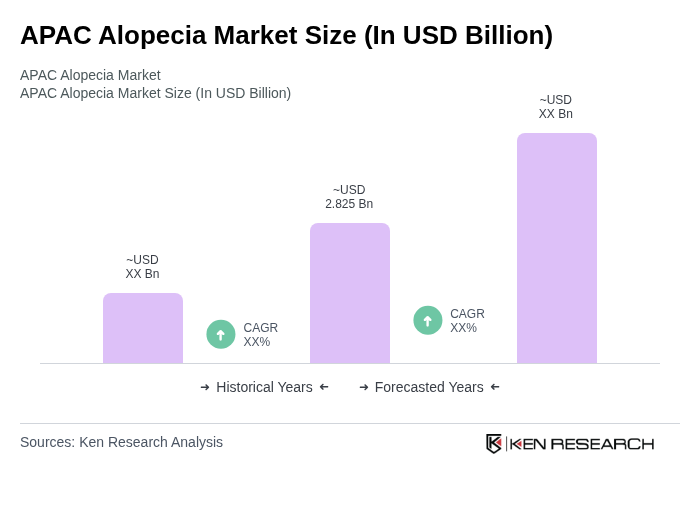
- The APAC Alopecia Market is valued at USD 2.825 billion, based on a five-year historical analysis. This growth is primarily driven by the rising prevalence of hair loss due to lifestyle factors such as stress, pollution, and poor diet, alongside expanding consumer awareness and aesthetic self-care trends. Technological innovations in treatment modalities—including PRP therapy, laser devices, teledermatology, and nutraceuticals—further support regional demand.
- Key players in this market include Japan, China, India, South Korea, and increasingly Southeast Asian nations. These countries dominate the market due to their mature healthcare systems, rising disposable incomes, and strong cosmetic dermatology sectors. Japan’s advanced healthcare infrastructure supports pharmaceutical and surgical therapies, while China and India benefit from growing urbanization and aesthetic consciousness.
- In 2024, South Korea's government proposed expanding public health insurance coverage to include hair-loss treatments beyond medically defined alopecia areata. This initiative addresses concerns of social alienation among young adults and redefines hair-loss care as essential rather than cosmetic.
APAC Alopecia Market Segmentation
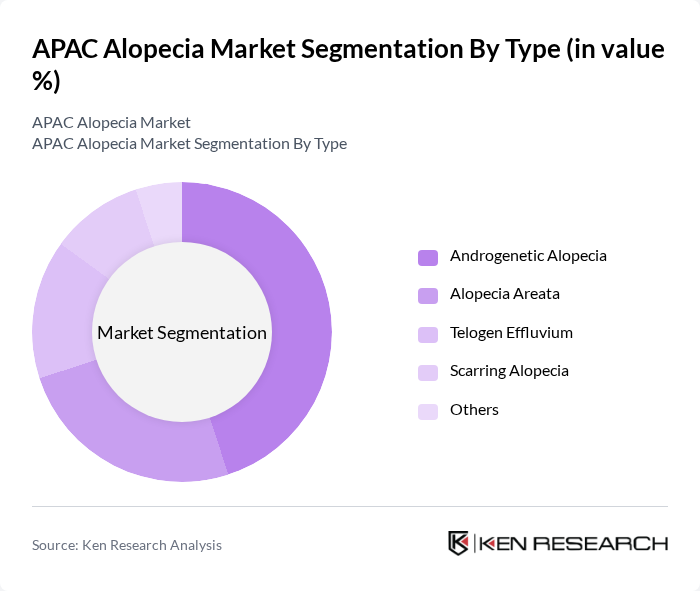
By Type:The market is segmented into various types of alopecia, including Androgenetic Alopecia, Alopecia Areata, Telogen Effluvium, Scarring Alopecia, and Others. Among these, Androgenetic Alopecia is the most prevalent form, accounting for a significant share of the market. This type is commonly associated with genetic factors and is increasingly recognized among both men and women, leading to a surge in demand for effective treatments. The growing awareness of this condition and its psychological impact on individuals has further fueled the market for related therapies.
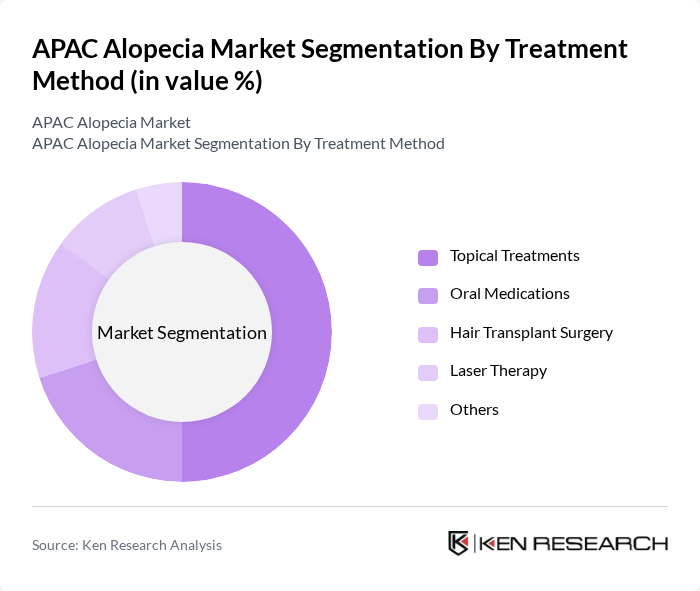
By Treatment Method:The treatment methods for alopecia include Topical Treatments, Oral Medications, Hair Transplant Surgery, Laser Therapy, and Others. Topical Treatments dominate the market due to their ease of use and direct application, making them a preferred choice for many consumers. The increasing availability of over-the-counter products and advancements in formulation technology have contributed to the popularity of topical solutions, which are often seen as the first line of defense against hair loss.
APAC Alopecia Market Competitive Landscape
The APAC Alopecia Market is characterized by a dynamic mix of regional and international players. Leading participants such as Johnson & Johnson, Merck & Co., Pfizer Inc., Novartis AG, GlaxoSmithKline plc, L'Oreal S.A., Procter & Gamble Co., Revivogen, Rogaine, HairMax, Bosley, Aclaris Therapeutics, Follica, Shiseido Company, Limited, and Amgen Inc. contribute to innovation, geographic expansion, and service delivery in this space.
APAC Alopecia Market Industry Analysis
Growth Drivers
- Increasing Prevalence of Alopecia Disorders:The prevalence of alopecia disorders in the APAC region is significant, with approximately 30 million individuals affected in countries like India and Japan alone. According to the World Health Organization, the incidence of alopecia areata is estimated at 0.1% to 0.2% of the population. This growing number of cases drives demand for effective treatments, leading to increased market activity and investment in innovative solutions tailored to diverse consumer needs.
- Rising Awareness About Hair Loss Treatments:Awareness campaigns and educational initiatives have significantly increased public knowledge regarding hair loss treatments. In future, it is estimated that over 60% of individuals experiencing hair loss in APAC are aware of available treatment options, compared to just 40% in the past. This heightened awareness is fostering a more proactive approach to seeking treatment, thereby expanding the market for alopecia solutions and encouraging product development.
- Advancements in Treatment Technologies:The APAC region is witnessing rapid advancements in alopecia treatment technologies, including the development of new pharmaceuticals and minimally invasive procedures. For instance, the introduction of platelet-rich plasma (PRP) therapy has shown promising results, with studies indicating a 70% improvement in hair density among patients. Such innovations are attracting investment and enhancing treatment efficacy, further stimulating market growth in the region.
Market Challenges
- High Cost of Advanced Treatments:The cost of advanced alopecia treatments can be prohibitive, with procedures like hair transplants ranging from $3,000 to $15,000 in major APAC cities. This financial barrier limits access for many potential patients, particularly in developing countries where average incomes are lower. Consequently, the high cost of these treatments poses a significant challenge to market penetration and growth in the region.
- Limited Access to Healthcare Facilities:Access to specialized healthcare facilities remains a challenge in many APAC countries, particularly in rural areas. For example, in India, approximately 70% of the population resides in rural regions, where dermatological services are scarce. This limited access restricts the ability of individuals to seek timely and effective alopecia treatments, thereby hindering overall market growth and patient outcomes in the region.
APAC Alopecia Market Future Outlook
The APAC alopecia market is poised for significant transformation, driven by technological advancements and changing consumer preferences. The shift towards personalized treatment solutions is expected to enhance patient satisfaction and treatment efficacy. Additionally, the rise of telemedicine is facilitating easier access to consultations, particularly in underserved areas. As these trends continue to evolve, they will likely create a more dynamic and responsive market environment, fostering innovation and improving patient outcomes across the region.
Market Opportunities
- Expansion of E-commerce Platforms:The growth of e-commerce platforms presents a significant opportunity for alopecia product sales. In future, online sales in the beauty and personal care sector in APAC are projected to reach $100 billion, providing a robust channel for distributing hair loss treatments and products directly to consumers, thereby enhancing market reach and accessibility.
- Increasing Investment in R&D:There is a growing trend of investment in research and development for new alopecia treatments, with funding in the biotechnology sector in APAC expected to exceed $20 billion in future. This influx of capital is likely to accelerate the development of innovative therapies, creating new market opportunities and improving treatment options for patients suffering from hair loss.
Scope of the Report
| Segment | Sub-Segments |
|---|---|
| By Type | Androgenetic Alopecia Alopecia Areata Telogen Effluvium Scarring Alopecia Others |
| By Treatment Method | Topical Treatments Oral Medications Hair Transplant Surgery Laser Therapy Others |
| By Distribution Channel | Online Retail Pharmacies Dermatology Clinics Supermarkets/Hypermarkets Others |
| By Gender | Male Female Unisex |
| By Age Group | 25 Years 35 Years 45 Years Years and Above |
| By Region | North Asia Southeast Asia South Asia Oceania |
| By Product Formulation | Creams and Lotions Tablets and Capsules Serums Others |
Key Target Audience
Investors and Venture Capitalist Firms
Government and Regulatory Bodies (e.g., Ministry of Health, Food and Drug Administration)
Pharmaceutical Companies
Dermatology Clinics and Healthcare Providers
Cosmetic and Personal Care Product Manufacturers
Health Insurance Companies
Market Access and Reimbursement Specialists
Trade Associations and Industry Groups
Players Mentioned in the Report:
Johnson & Johnson
Merck & Co.
Pfizer Inc.
Novartis AG
GlaxoSmithKline plc
L'Oreal S.A.
Procter & Gamble Co.
Revivogen
Rogaine
HairMax
Bosley
Aclaris Therapeutics
Follica
Shiseido Company, Limited
Amgen Inc.
Table of Contents
Market Assessment Phase
1. Executive Summary and Approach
2. APAC Alopecia Market Overview
2.1 Key Insights and Strategic Recommendations
2.2 APAC Alopecia Market Overview
2.3 Definition and Scope
2.4 Evolution of Market Ecosystem
2.5 Timeline of Key Regulatory Milestones
2.6 Value Chain & Stakeholder Mapping
2.7 Business Cycle Analysis
2.8 Policy & Incentive Landscape
3. APAC Alopecia Market Analysis
3.1 Growth Drivers
3.1.1 Increasing prevalence of alopecia disorders
3.1.2 Rising awareness about hair loss treatments
3.1.3 Advancements in treatment technologies
3.1.4 Growing disposable income in APAC countries
3.2 Market Challenges
3.2.1 High cost of advanced treatments
3.2.2 Limited access to healthcare facilities
3.2.3 Stigma associated with hair loss
3.2.4 Regulatory hurdles in product approvals
3.3 Market Opportunities
3.3.1 Expansion of e-commerce platforms for product sales
3.3.2 Increasing investment in R&D for new treatments
3.3.3 Collaborations with dermatology clinics
3.3.4 Growing demand for natural and organic products
3.4 Market Trends
3.4.1 Shift towards personalized treatment solutions
3.4.2 Rise in telemedicine for alopecia consultations
3.4.3 Increasing popularity of hair restoration surgeries
3.4.4 Focus on holistic approaches to hair health
3.5 Government Regulation
3.5.1 Stricter regulations on hair loss treatment products
3.5.2 Guidelines for clinical trials in dermatology
3.5.3 Approval processes for new treatment technologies
3.5.4 Policies promoting research in hair loss solutions
4. SWOT Analysis
5. Stakeholder Analysis
6. Porter's Five Forces Analysis
7. APAC Alopecia Market Market Size, 2019-2024
7.1 By Value
7.2 By Volume
7.3 By Average Selling Price
8. APAC Alopecia Market Segmentation
8.1 By Type
8.1.1 Androgenetic Alopecia
8.1.2 Alopecia Areata
8.1.3 Telogen Effluvium
8.1.4 Scarring Alopecia
8.1.5 Others
8.2 By Treatment Method
8.2.1 Topical Treatments
8.2.2 Oral Medications
8.2.3 Hair Transplant Surgery
8.2.4 Laser Therapy
8.2.5 Others
8.3 By Distribution Channel
8.3.1 Online Retail
8.3.2 Pharmacies
8.3.3 Dermatology Clinics
8.3.4 Supermarkets/Hypermarkets
8.3.5 Others
8.4 By Gender
8.4.1 Male
8.4.2 Female
8.4.3 Unisex
8.5 By Age Group
8.5.1 18-25 Years
8.5.2 26-35 Years
8.5.3 36-45 Years
8.5.4 46 Years and Above
8.6 By Region
8.6.1 North Asia
8.6.2 Southeast Asia
8.6.3 South Asia
8.6.4 Oceania
8.7 By Product Formulation
8.7.1 Creams and Lotions
8.7.2 Tablets and Capsules
8.7.3 Serums
8.7.4 Others
9. APAC Alopecia Market Competitive Analysis
9.1 Market Share of Key Players
9.2 Cross Comparison of Key Players
9.2.1 Company Name
9.2.2 Group Size (Large, Medium, or Small as per industry convention)
9.2.3 Revenue Growth Rate
9.2.4 Market Penetration Rate
9.2.5 Customer Retention Rate
9.2.6 Product Diversification Index
9.2.7 Pricing Strategy
9.2.8 Brand Equity Score
9.2.9 Distribution Network Efficiency
9.2.10 Customer Satisfaction Index
9.3 SWOT Analysis of Top Players
9.4 Pricing Analysis
9.5 Detailed Profile of Major Companies
9.5.1 Johnson & Johnson
9.5.2 Merck & Co.
9.5.3 Pfizer Inc.
9.5.4 Novartis AG
9.5.5 GlaxoSmithKline plc
9.5.6 L'Oreal S.A.
9.5.7 Procter & Gamble Co.
9.5.8 Revivogen
9.5.9 Rogaine
9.5.10 HairMax
9.5.11 Bosley
9.5.12 Aclaris Therapeutics
9.5.13 Follica
9.5.14 Shiseido Company, Limited
9.5.15 Amgen Inc.
10. APAC Alopecia Market End-User Analysis
10.1 Procurement Behavior of Key Ministries
10.1.1 Government health initiatives
10.1.2 Budget allocation for dermatological treatments
10.1.3 Collaboration with private sectors
10.1.4 Policy frameworks for hair loss treatments
10.2 Corporate Spend on Infrastructure & Energy
10.2.1 Investment in healthcare facilities
10.2.2 Funding for research and development
10.2.3 Expenditure on marketing and outreach
10.2.4 Partnerships with healthcare providers
10.3 Pain Point Analysis by End-User Category
10.3.1 Accessibility to treatment options
10.3.2 Affordability of products
10.3.3 Awareness of available solutions
10.3.4 Quality of care in treatment facilities
10.4 User Readiness for Adoption
10.4.1 Awareness campaigns effectiveness
10.4.2 Availability of information on treatments
10.4.3 Acceptance of new technologies
10.4.4 Willingness to invest in treatments
10.5 Post-Deployment ROI and Use Case Expansion
10.5.1 Measurement of treatment effectiveness
10.5.2 Long-term patient follow-up strategies
10.5.3 Expansion into new markets
10.5.4 Development of complementary products
11. APAC Alopecia Market Future Size, 2025-2030
11.1 By Value
11.2 By Volume
11.3 By Average Selling Price
Go-To-Market Strategy Phase
1. Whitespace Analysis + Business Model Canvas
1.1 Market gaps identification
1.2 Value proposition development
1.3 Revenue model exploration
1.4 Customer segmentation analysis
1.5 Competitive landscape overview
2. Marketing and Positioning Recommendations
2.1 Branding strategies
2.2 Product USPs
2.3 Target audience identification
2.4 Communication strategies
2.5 Digital marketing initiatives
3. Distribution Plan
3.1 Urban retail vs rural NGO tie-ups
3.2 Online vs offline distribution strategies
3.3 Partnership opportunities
3.4 Logistics and supply chain considerations
3.5 Distribution channel effectiveness
4. Channel & Pricing Gaps
4.1 Underserved routes
4.2 Pricing bands
4.3 Competitor pricing analysis
4.4 Value-based pricing strategies
4.5 Customer feedback on pricing
5. Unmet Demand & Latent Needs
5.1 Category gaps
5.2 Consumer segments
5.3 Emerging trends analysis
5.4 Product development opportunities
5.5 Market entry barriers
6. Customer Relationship
6.1 Loyalty programs
6.2 After-sales service
6.3 Customer engagement strategies
6.4 Feedback mechanisms
6.5 Community building initiatives
7. Value Proposition
7.1 Sustainability
7.2 Integrated supply chains
7.3 Unique selling points
7.4 Customer-centric approaches
7.5 Competitive advantages
8. Key Activities
8.1 Regulatory compliance
8.2 Branding
8.3 Distribution setup
8.4 Marketing execution
8.5 Performance monitoring
9. Entry Strategy Evaluation
9.1 Domestic Market Entry Strategy
9.1.1 Product mix
9.1.2 Pricing band
9.1.3 Packaging
9.1.4 Marketing approach
9.1.5 Distribution channels
9.2 Export Entry Strategy
9.2.1 Target countries
9.2.2 Compliance roadmap
9.2.3 Market entry barriers
9.2.4 Partnership opportunities
9.2.5 Risk assessment
10. Entry Mode Assessment
10.1 JV
10.2 Greenfield
10.3 M&A
10.4 Distributor Model
10.5 Mode selection criteria
11. Capital and Timeline Estimation
11.1 Capital requirements
11.2 Timelines
11.3 Funding sources
11.4 Financial projections
11.5 Risk management strategies
12. Control vs Risk Trade-Off
12.1 Ownership vs Partnerships
12.2 Risk assessment frameworks
12.3 Control mechanisms
12.4 Partnership evaluation
12.5 Long-term strategy alignment
13. Profitability Outlook
13.1 Breakeven analysis
13.2 Long-term sustainability
13.3 Profit margin analysis
13.4 Revenue forecasting
13.5 Cost management strategies
14. Potential Partner List
14.1 Distributors
14.2 JVs
14.3 Acquisition targets
14.4 Strategic alliances
14.5 Partnership evaluation criteria
15. Execution Roadmap
15.1 Phased Plan for Market Entry
15.1.1 Market Setup
15.1.2 Market Entry
15.1.3 Growth Acceleration
15.1.4 Scale & Stabilize
15.2 Key Activities and Milestones
15.2.1 Activity timelines
15.2.2 Milestone tracking
15.2.3 Performance metrics
15.2.4 Resource allocation
15.2.5 Risk mitigation plans
Research Methodology
Phase 1: Approach1
Desk Research
- Market reports from industry associations such as the International Society of Hair Restoration Surgery
- Published articles and journals focusing on dermatology and alopecia treatments
- Government health statistics and demographic data from national health ministries across APAC
Primary Research
- Interviews with dermatologists specializing in hair loss treatments
- Surveys conducted with patients undergoing alopecia treatments
- Focus groups with healthcare professionals in the dermatology field
Validation & Triangulation
- Cross-validation of findings through multiple expert interviews
- Triangulation of data from clinical studies and market reports
- Sanity checks through feedback from advisory panels of industry experts
Phase 2: Market Size Estimation1
Top-down Assessment
- Analysis of overall healthcare expenditure trends in APAC countries
- Estimation of alopecia treatment market size based on prevalence rates
- Incorporation of growth rates from emerging treatment modalities and technologies
Bottom-up Modeling
- Data collection from leading alopecia treatment providers and clinics
- Estimation of average treatment costs and patient volumes
- Calculation of market size based on treatment types (e.g., medications, procedures)
Forecasting & Scenario Analysis
- Multi-factor regression analysis incorporating demographic shifts and healthcare access
- Scenario modeling based on potential regulatory changes and market entry of new therapies
- Baseline, optimistic, and pessimistic forecasts through 2030
Phase 3: CATI Sample Composition1
| Scope Item/Segment | Sample Size | Target Respondent Profiles |
|---|---|---|
| Dermatology Clinics | 100 | Dermatologists, Clinic Managers |
| Pharmaceutical Providers | 80 | Product Managers, Sales Representatives |
| Patient Support Groups | 60 | Patients, Advocacy Group Leaders |
| Healthcare Policy Makers | 50 | Health Economists, Policy Analysts |
| Research Institutions | 70 | Researchers, Clinical Trial Coordinators |
Frequently Asked Questions
What is the current value of the APAC Alopecia Market?
The APAC Alopecia Market is valued at approximately USD 2.825 billion, reflecting a significant growth driven by increasing hair loss prevalence, consumer awareness, and advancements in treatment technologies across the region.
What are the main types of alopecia affecting the APAC region?
What treatment methods are commonly used for alopecia in APAC?
How is the APAC Alopecia Market expected to grow in the future?
Other Regional/Country Reports
Malaysia Alopecia Market
KSA Alopecia Market
SEA Alopecia Market
Vietnam Alopecia Market
Thailand Alopecia Market
Other Adjacent Reports
Philippines Cosmetic Dermatology Market
KSA hair care products market report size, share, growth drivers, trends, opportunities & forecast 2025–2030Global Telemedicine Market Report Size, Share, Growth Drivers, Trends, Opportunities & Forecast 2025–2030Bahrain Laser Therapy Market
GCC Nutraceuticals MarketUAE pharmaceutical market report size, share, growth drivers, trends, opportunities & forecast 2025–2030Saudi Arabia biotechnology market Size, Share, Growth Drivers, Trends, Opportunities & Forecast 2025–2030Thailand Healthcare IT Solutions Market
India E-commerce MarketGlobal Personal Care Market Outlook to 2030Why Buy From Us?

What makes us stand out is that our consultants follow Robust, Refine and Result (RRR) methodology. Robust for clear definitions, approaches and sanity checking, Refine for differentiating respondents' facts and opinions, and Result for presenting data with story.

We have set a benchmark in the industry by offering our clients with syndicated and customized market research reports featuring coverage of entire market as well as meticulous research and analyst insights.

While we don't replace traditional research, we flip the method upside down. Our dual approach of Top Bottom & Bottom Top ensures quality deliverable by not just verifying company fundamentals but also looking at the sector and macroeconomic factors.

With one step in the future, our research team constantly tries to show you the bigger picture. We help with some of the tough questions you may encounter along the way: How is the industry positioned? Best marketing channel? KPI's of competitors? By aligning every element, we help maximize success.

Our report gives you instant access to the answers and sources that other companies might choose to hide. We elaborate each steps of research methodology we have used and showcase you the sample size to earn your trust.

If you need any support, we are here! We pride ourselves on universe strength, data quality, and quick, friendly, and professional service.