APAC Laminated Labels Market Size Share Growth Drivers Trends Opportunities & Forecast 2025–2030

APAC laminated labels market grows with industrialization, e-commerce, and sustainable packaging driving demand.

Region:Asia

Author(s):Dev

Product Code:KRAC1466

Pages:82

Published On:December 2025
About the Report

Base Year 2024

APAC Laminated Labels Market Overview

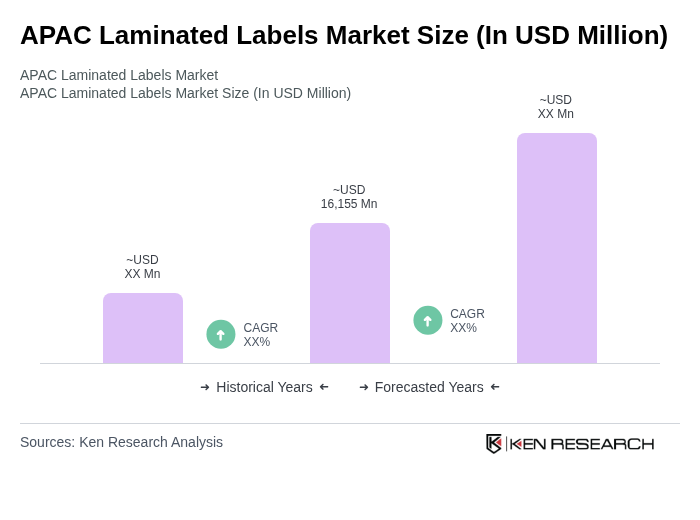
  • The APAC Laminated Labels Market is valued at USD 16,155 million, based on a five-year historical analysis. This growth is primarily driven by rapid industrialization, the expanding food and beverage, pharmaceutical, and e-commerce sectors, increasing demand for high-quality and durable labeling, and innovations in printing technologies enhancing label appeal and functionality.
  • Key players in the region include China, India, Japan, South Korea, and ASEAN members, where manufacturing scale, organized retail growth, and rising consumer packaging sophistication bolster demand. These countries are at the forefront due to their robust manufacturing capabilities and increasing consumer preferences for packaged goods.
  • In 2023, India’s government updated food-contact plastic standards, permitting recycled PET under new safety protocols. This regulatory momentum supports sustainable packaging efforts and encourages eco-friendly label materials, promoting circular packaging practices across the region.
APAC Laminated Labels Market Size

APAC Laminated Labels Market Segmentation

By Type:The laminated labels market is segmented into various types, including pressure-sensitive labels, shrink sleeves, in-mold labels, heat transfer labels, and others. Among these, pressure-sensitive labels dominate the market due to their versatility and ease of application across various industries. The growing demand for efficient labeling solutions in sectors like food and beverage and pharmaceuticals further drives the popularity of pressure-sensitive labels.
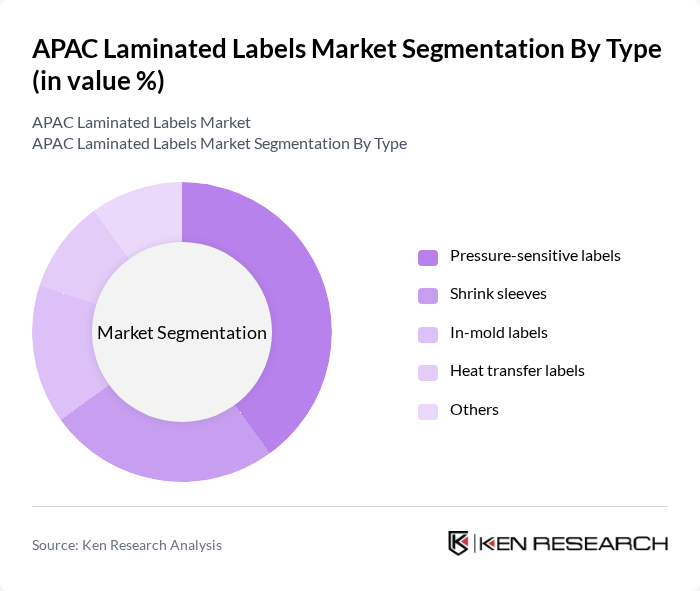
APAC Laminated Labels Market segmentation by Type.

By End-User:The end-user segmentation includes food and beverage, pharmaceuticals, personal care, household products, and others. The food and beverage sector is the leading end-user, driven by the increasing demand for packaged food products and the need for compliance with labeling regulations. The pharmaceutical industry also significantly contributes to the market, requiring high-quality labels for product identification and safety.
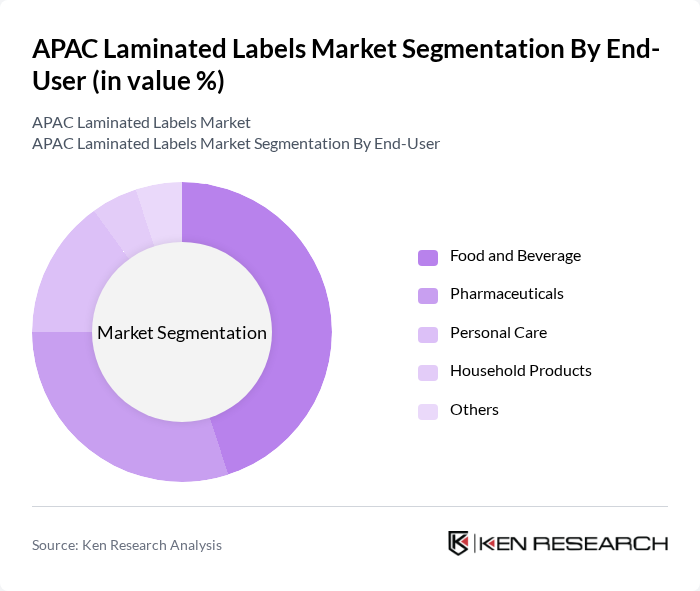
APAC Laminated Labels Market segmentation by End-User.

APAC Laminated Labels Market Competitive Landscape

The APAC Laminated Labels Market is characterized by a dynamic mix of regional and international players. Leading participants such as Avery Dennison Corporation, CCL Industries Inc., UPM Raflatac, Multi-Color Corporation, Sato Holdings Corporation, Brady Corporation, Labelmakers, WS Packaging Group, Fortis Solutions Group, Domtar Corporation, 3M Company, Smurfit Kappa Group, Constantia Flexibles, Oji Holdings Corporation, and Skanem AS contribute to innovation, geographic expansion, and service delivery in this space.

Avery Dennison Corporation

1935

Glendale, California, USA

CCL Industries Inc.

1951

Toronto, Canada

UPM Raflatac

1970

Jyvaskyla, Finland

Multi-Color Corporation

1916

Batavia, Ohio, USA

Sato Holdings Corporation

1940

Tokyo, Japan

Company

Establishment Year

Headquarters

Group Size (Large, Medium, or Small as per industry convention)

Revenue Growth Rate

Market Penetration Rate

Customer Retention Rate

Pricing Strategy

Production Efficiency

APAC Laminated Labels Market Industry Analysis

Growth Drivers

  • High Production Volume in APAC:Asia-Pacific produced nearly 95 billion square meters of laminated labels in the future, accounting for approximately 43 percent of global output. This significant volume reflects the region's rapid industrialization, particularly in countries like China and India, where the demand for laminated labels is driven by the expansion of fast-moving consumer goods (FMCG) and export growth. The robust production capacity positions APAC as a leader in the laminated labels market.
  • Strong Regional Market Share and Demand:In the future, Asia-Pacific held 41.34 percent of the global laminated labels market, bolstered by a 6 percent increase in industrial output and a 12.7 percent rise in chemical manufacturing in China. Additionally, India's Production-Linked Incentive (PLI) programs aim for a 25 percent contribution to GDP from advanced manufacturing in the future, further enhancing the demand for laminated labels in the region.
  • Robust APAC Packaging Labels Market Size:The revenue from packaging labels in Asia-Pacific reached USD 16,153.5 million in the future, highlighting the extensive ecosystem in which laminated labels play a crucial role. This growth is driven by increasing demand in sectors such as food and beverage, pharmaceuticals, and consumer goods, indicating a strong market foundation for laminated labels within the broader packaging industry.

Market Challenges

  • Import Dependence and Raw Material Volatility:The laminated labels sector in Asia-Pacific is heavily reliant on imported film feedstocks, which can lead to significant supply chain vulnerabilities. Disruptions in the availability of essential materials like polyester and polypropylene can result in increased production costs and delays, posing a challenge to manufacturers aiming to maintain competitive pricing and timely delivery.
  • Macro-Economic and Policy Risks:The region's GDP growth slowed to 4.5 percent in the future, down from 5.1 percent in the previous year, primarily due to rising debt levels, trade barriers, and policy uncertainties. These economic headwinds can restrain investments in the laminated labels market, potentially leading to reduced demand for high-value products as businesses become more cautious in their spending and expansion strategies.

APAC Laminated Labels Market Future Outlook

The laminated labels market in APAC is poised for significant transformation, driven by sustainability initiatives and technological advancements. The industry is increasingly adopting eco-friendly materials, such as compostable laminates and recyclable constructions, to meet growing environmental standards. Additionally, the integration of smart packaging technologies, including RFID and QR codes, is enhancing product traceability and brand protection, positioning the market for robust growth in the future as consumer preferences shift towards sustainable and innovative solutions.

Market Opportunities

  • E?Commerce and Export-Driven Demand:The demand for moisture-resistant and durable laminated labels is surging due to the rapid growth of e-commerce and exports in sectors like FMCG and pharmaceuticals. With global retail apparel sales projected to reach USD 2.6 trillion in the future, the laminated labels market stands to benefit significantly from this trend, as businesses seek reliable labeling solutions to enhance product visibility and compliance.
  • Circular Economy & Value Chain Integration:India's PLI initiative for pharmaceuticals and medical devices has generated cumulative sales of INR 2.66 lakh crore (approximately USD 32 billion). This focus on domestic manufacturing encourages local laminated label production, creating opportunities for companies to enhance their capacity and meet compliance requirements in both domestic and export markets, thereby strengthening the overall value chain.

Scope of the Report

SegmentSub-Segments
By Type

Pressure-sensitive labels

Shrink sleeves

In-mold labels

Heat transfer labels

Others

By End-User

Food and Beverage

Pharmaceuticals

Personal Care

Household Products

Others

By Region

North India

South India

East India

West India

By Application

Product labeling

Shipping and logistics

Retail and promotional labels

Others

By Material

Polypropylene

Polyethylene

Vinyl

Paper

Others

By Printing Technology

Flexographic printing

Digital printing

Gravure printing

Offset printing

Others

By Distribution Channel

Direct sales

Distributors

Online sales

Retail

Others

Key Target Audience

Investors and Venture Capitalist Firms

Government and Regulatory Bodies (e.g., Ministry of Commerce, Environmental Protection Agency)

Manufacturers and Producers

Distributors and Retailers

Packaging Industry Associations

Logistics and Supply Chain Companies

Brand Owners and Marketers

Financial Institutions

Players Mentioned in the Report:

Avery Dennison Corporation

CCL Industries Inc.

UPM Raflatac

Multi-Color Corporation

Sato Holdings Corporation

Brady Corporation

Labelmakers

WS Packaging Group

Fortis Solutions Group

Domtar Corporation

3M Company

Smurfit Kappa Group

Constantia Flexibles

Oji Holdings Corporation

Skanem AS

Table of Contents

Market Assessment Phase

1. Executive Summary and Approach


2. APAC Laminated Labels Market Overview

2.1 Key Insights and Strategic Recommendations

2.2 APAC Laminated Labels Market Overview

2.3 Definition and Scope

2.4 Evolution of Market Ecosystem

2.5 Timeline of Key Regulatory Milestones

2.6 Value Chain & Stakeholder Mapping

2.7 Business Cycle Analysis

2.8 Policy & Incentive Landscape


3. APAC Laminated Labels Market Analysis

3.1 Growth Drivers

3.1.1 Increasing demand for sustainable packaging solutions
3.1.2 Growth in the e-commerce sector
3.1.3 Rising consumer awareness regarding product labeling
3.1.4 Technological advancements in printing and materials

3.2 Market Challenges

3.2.1 Fluctuating raw material prices
3.2.2 Stringent regulatory requirements
3.2.3 Competition from alternative labeling solutions
3.2.4 Supply chain disruptions

3.3 Market Opportunities

3.3.1 Expansion into emerging markets
3.3.2 Development of smart labels
3.3.3 Customization and personalization trends
3.3.4 Collaborations with packaging companies

3.4 Market Trends

3.4.1 Shift towards eco-friendly materials
3.4.2 Increased automation in label production
3.4.3 Growth of digital printing technologies
3.4.4 Rising demand for anti-counterfeit labels

3.5 Government Regulation

3.5.1 Compliance with environmental standards
3.5.2 Labeling requirements for food and beverages
3.5.3 Regulations on chemical usage in labels
3.5.4 Import/export regulations affecting labeling materials

4. SWOT Analysis


5. Stakeholder Analysis


6. Porter's Five Forces Analysis


7. APAC Laminated Labels Market Size, 2019-2024

7.1 By Value

7.2 By Volume

7.3 By Average Selling Price


8. APAC Laminated Labels Market Segmentation

8.1 By Type

8.1.1 Pressure-sensitive labels
8.1.2 Shrink sleeves
8.1.3 In-mold labels
8.1.4 Heat transfer labels
8.1.5 Others

8.2 By End-User

8.2.1 Food and Beverage
8.2.2 Pharmaceuticals
8.2.3 Personal Care
8.2.4 Household Products
8.2.5 Others

8.3 By Region

8.3.1 North India
8.3.2 South India
8.3.3 East India
8.3.4 West India

8.4 By Application

8.4.1 Product labeling
8.4.2 Shipping and logistics
8.4.3 Retail and promotional labels
8.4.4 Others

8.5 By Material

8.5.1 Polypropylene
8.5.2 Polyethylene
8.5.3 Vinyl
8.5.4 Paper
8.5.5 Others

8.6 By Printing Technology

8.6.1 Flexographic printing
8.6.2 Digital printing
8.6.3 Gravure printing
8.6.4 Offset printing
8.6.5 Others

8.7 By Distribution Channel

8.7.1 Direct sales
8.7.2 Distributors
8.7.3 Online sales
8.7.4 Retail
8.7.5 Others

9. APAC Laminated Labels Market Competitive Analysis

9.1 Market Share of Key Players

9.2 Cross Comparison of Key Players

9.2.1 Company Name
9.2.2 Group Size (Large, Medium, or Small as per industry convention)
9.2.3 Revenue Growth Rate
9.2.4 Market Penetration Rate
9.2.5 Customer Retention Rate
9.2.6 Pricing Strategy
9.2.7 Production Efficiency
9.2.8 Product Quality Index
9.2.9 Brand Recognition Score
9.2.10 Innovation Rate

9.3 SWOT Analysis of Top Players

9.4 Pricing Analysis

9.5 Detailed Profile of Major Companies

9.5.1 Avery Dennison Corporation
9.5.2 CCL Industries Inc.
9.5.3 UPM Raflatac
9.5.4 Multi-Color Corporation
9.5.5 Sato Holdings Corporation
9.5.6 Brady Corporation
9.5.7 Labelmakers
9.5.8 WS Packaging Group
9.5.9 Fortis Solutions Group
9.5.10 Domtar Corporation
9.5.11 3M Company
9.5.12 Smurfit Kappa Group
9.5.13 Constantia Flexibles
9.5.14 Oji Holdings Corporation
9.5.15 Skanem AS

10. APAC Laminated Labels Market End-User Analysis

10.1 Procurement Behavior of Key Ministries

10.1.1 Government procurement policies
10.1.2 Budget allocation for labeling solutions
10.1.3 Supplier selection criteria
10.1.4 Contract management practices

10.2 Corporate Spend on Infrastructure & Energy

10.2.1 Investment trends in labeling technologies
10.2.2 Budgeting for sustainability initiatives
10.2.3 Spending on compliance and regulatory needs
10.2.4 Cost management strategies

10.3 Pain Point Analysis by End-User Category

10.3.1 Challenges in sourcing quality labels
10.3.2 Issues with label durability
10.3.3 Compliance with labeling regulations
10.3.4 Cost constraints

10.4 User Readiness for Adoption

10.4.1 Awareness of new labeling technologies
10.4.2 Training and support needs
10.4.3 Integration with existing systems
10.4.4 Feedback mechanisms

10.5 Post-Deployment ROI and Use Case Expansion

10.5.1 Measurement of labeling effectiveness
10.5.2 Case studies of successful implementations
10.5.3 Opportunities for scaling solutions
10.5.4 Long-term benefits analysis

11. APAC Laminated Labels Market Future Size, 2025-2030

11.1 By Value

11.2 By Volume

11.3 By Average Selling Price


Go-To-Market Strategy Phase

1. Whitespace Analysis + Business Model Canvas

1.1 Market gaps identification

1.2 Value proposition development

1.3 Revenue model exploration

1.4 Customer segmentation analysis

1.5 Competitive landscape overview

1.6 Key partnerships identification

1.7 Resource allocation strategy


2. Marketing and Positioning Recommendations

2.1 Branding strategies

2.2 Product USPs

2.3 Target audience definition

2.4 Communication channels selection

2.5 Marketing budget allocation


3. Distribution Plan

3.1 Urban retail strategies

3.2 Rural NGO tie-ups

3.3 E-commerce distribution channels

3.4 Direct sales force deployment

3.5 Logistics and supply chain management


4. Channel & Pricing Gaps

4.1 Underserved routes analysis

4.2 Pricing bands evaluation

4.3 Competitor pricing comparison

4.4 Customer willingness to pay assessment

4.5 Discounting strategies


5. Unmet Demand & Latent Needs

5.1 Category gaps identification

5.2 Consumer segments analysis

5.3 Emerging trends exploration

5.4 Product development opportunities

5.5 Feedback collection mechanisms


6. Customer Relationship

6.1 Loyalty programs design

6.2 After-sales service strategies

6.3 Customer engagement initiatives

6.4 Feedback and improvement loops

6.5 Community building efforts


7. Value Proposition

7.1 Sustainability initiatives

7.2 Integrated supply chains

7.3 Cost-saving measures

7.4 Quality assurance processes

7.5 Customer-centric innovations


8. Key Activities

8.1 Regulatory compliance measures

8.2 Branding initiatives

8.3 Distribution setup processes

8.4 Training and development programs

8.5 Performance monitoring systems


9. Entry Strategy Evaluation

9.1 Domestic Market Entry Strategy

9.1.1 Product mix considerations
9.1.2 Pricing band strategies
9.1.3 Packaging innovations

9.2 Export Entry Strategy

9.2.1 Target countries analysis
9.2.2 Compliance roadmap development

10. Entry Mode Assessment

10.1 Joint Ventures

10.2 Greenfield investments

10.3 Mergers & Acquisitions

10.4 Distributor Model evaluation

10.5 Risk assessment


11. Capital and Timeline Estimation

11.1 Capital requirements analysis

11.2 Timelines for market entry

11.3 Resource allocation planning

11.4 Financial projections

11.5 Contingency planning


12. Control vs Risk Trade-Off

12.1 Ownership considerations

12.2 Partnership dynamics

12.3 Risk management strategies

12.4 Control mechanisms

12.5 Long-term sustainability planning


13. Profitability Outlook

13.1 Breakeven analysis

13.2 Long-term sustainability strategies

13.3 Profit margin optimization

13.4 Revenue growth forecasting

13.5 Cost reduction initiatives


14. Potential Partner List

14.1 Distributors identification

14.2 Joint Ventures opportunities

14.3 Acquisition targets

14.4 Strategic alliances

14.5 Partnership evaluation criteria


15. Execution Roadmap

15.1 Phased Plan for Market Entry

15.1.1 Market Setup
15.1.2 Market Entry
15.1.3 Growth Acceleration
15.1.4 Scale & Stabilize

15.2 Key Activities and Milestones

15.2.1 Timeline for key activities
15.2.2 Milestone tracking
15.2.3 Performance evaluation
15.2.4 Adjustment strategies

Research Methodology

ApproachModellingSample

Phase 1: Approach1

Desk Research

  • Industry reports from packaging associations and market research firms
  • Statistical data from government trade and commerce departments
  • Analysis of market trends through academic journals and white papers

Primary Research

  • Interviews with product managers at leading label manufacturing companies
  • Surveys with end-users in the retail and food & beverage sectors
  • Field visits to production facilities to gather qualitative insights

Validation & Triangulation

  • Cross-validation of data from multiple industry sources and reports
  • Triangulation of findings from primary interviews and secondary data
  • Sanity checks through expert panels comprising industry veterans

Phase 2: Market Size Estimation1

Top-down Assessment

  • Analysis of overall packaging market size to estimate laminated labels share
  • Segmentation by application areas such as food, pharmaceuticals, and consumer goods
  • Incorporation of regional growth trends and economic indicators

Bottom-up Modeling

  • Volume estimates based on production capacities of key manufacturers
  • Cost analysis derived from material prices and production processes
  • Estimation of market size based on unit sales and average selling prices

Forecasting & Scenario Analysis

  • Multi-variable forecasting using historical growth rates and market drivers
  • Scenario analysis based on regulatory changes and sustainability trends
  • Development of baseline, optimistic, and pessimistic market projections through 2030

Phase 3: CATI Sample Composition1

Scope Item/SegmentSample SizeTarget Respondent Profiles
Food & Beverage Packaging150Packaging Managers, Quality Assurance Officers
Pharmaceutical Labels100Regulatory Affairs Specialists, Production Supervisors
Consumer Goods Labels120Brand Managers, Marketing Directors
Industrial Applications80Operations Managers, Supply Chain Coordinators
Retail Sector Labeling90Store Managers, Inventory Control Specialists

Frequently Asked Questions

What is the current value of the APAC Laminated Labels Market?

The APAC Laminated Labels Market is valued at approximately USD 16,155 million, reflecting significant growth driven by industrialization, demand from food and beverage, pharmaceuticals, and e-commerce sectors, as well as advancements in printing technologies.

Which countries are leading in the APAC Laminated Labels Market?

What are the main types of laminated labels in the market?

What sectors are the primary end-users of laminated labels?

Other Regional/Country Reports

Indonesia Laminated Labels Market

Malaysia Laminated Labels Market

KSA Laminated Labels Market

SEA Laminated Labels Market

Vietnam Laminated Labels Market

Thailand Laminated Labels Market

Why Buy From Us?

Refine Robust Result (RRR) Framework

What makes us stand out is that our consultants follow Robust, Refine and Result (RRR) methodology. Robust for clear definitions, approaches and sanity checking, Refine for differentiating respondents' facts and opinions, and Result for presenting data with story.

Our Reach Is Unmatched

We have set a benchmark in the industry by offering our clients with syndicated and customized market research reports featuring coverage of entire market as well as meticulous research and analyst insights.

Shifting the Research Paradigm

While we don't replace traditional research, we flip the method upside down. Our dual approach of Top Bottom & Bottom Top ensures quality deliverable by not just verifying company fundamentals but also looking at the sector and macroeconomic factors.

More Insights-Better Decisions

With one step in the future, our research team constantly tries to show you the bigger picture. We help with some of the tough questions you may encounter along the way: How is the industry positioned? Best marketing channel? KPI's of competitors? By aligning every element, we help maximize success.

Transparency and Trust

Our report gives you instant access to the answers and sources that other companies might choose to hide. We elaborate each steps of research methodology we have used and showcase you the sample size to earn your trust.

Round the Clock Support

If you need any support, we are here! We pride ourselves on universe strength, data quality, and quick, friendly, and professional service.

Why Clients Choose Us?

400000+
Reports in repository
150+
Consulting projects a year
100+
Analysts
8000+
Client Queries in 2022








