About the Report
Base Year 2024Australia Argon Gas Market Overview
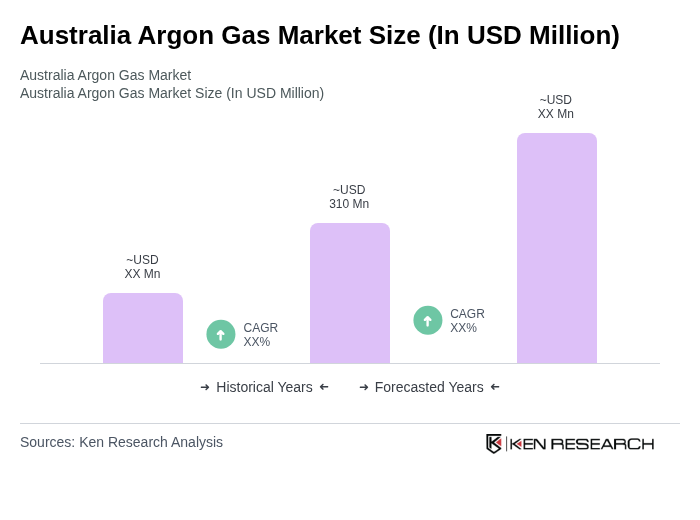
- The Australia Argon Gas Market is valued at USD 310 million, based on a five-year historical analysis and the share of argon within the national industrial gas manufacturing industry. This growth is primarily driven by the increasing demand for argon in various industrial applications, including welding, electronics manufacturing, metal fabrication, and healthcare, where argon is used as an inert shielding and protective gas. The rise in automation, advanced manufacturing (including robotics and CNC-based metalworking), and expanding semiconductor, medical device, and laboratory sectors has significantly contributed to the market's expansion.
- Key demand centers in this market include major cities such as Sydney, Melbourne, and Brisbane, which dominate due to their robust industrial bases, higher concentration of metal fabrication and automotive workshops, electronics and advanced manufacturing facilities, and large hospital and healthcare networks that consume specialty and medical gases. The concentration of industries and logistics infrastructure in these urban centers facilitates easier access to argon production, bulk storage, and distribution networks, further enhancing their market position.
- Industrial gases, including argon, are governed by a comprehensive safety and regulatory framework, notably the Work Health and Safety Regulations 2011 issued under the Model Work Health and Safety Act by Safe Work Australia, which require duty-holders to manage risks associated with hazardous chemicals and gases, including obligations for safe storage, handling, labelling, and emergency preparedness. In parallel, compliance with the Australian Dangerous Goods Code (Edition 7.7) issued by the National Transport Commission sets detailed requirements for the classification, packaging, transport documentation, and vehicle operation for compressed and liquefied gases such as argon in road and rail transport. Together, these instruments mandate strict adherence to safety standards and environmental management across the argon value chain, reinforcing best practices in gas storage, usage, and distribution.
Australia Argon Gas Market Segmentation
By Product Form:The market is segmented into two primary product forms: Gaseous Argon and Liquid Argon. Gaseous Argon is widely used in various applications due to its ease of handling in cylinders, manifolds, and pipeline supply and its suitability as a shielding gas in welding and cutting operations. Liquid Argon is preferred for applications requiring high purity, bulk volumes, and cryogenic temperatures, such as large steel plants, electronics manufacturing, laboratories, and centralized hospital supply systems, where it is stored in insulated tanks and vaporized on demand. The demand for these forms is influenced by their respective roles in industries such as metallurgy, electronics, automotive manufacturing, food processing (modified atmosphere packaging), and healthcare.
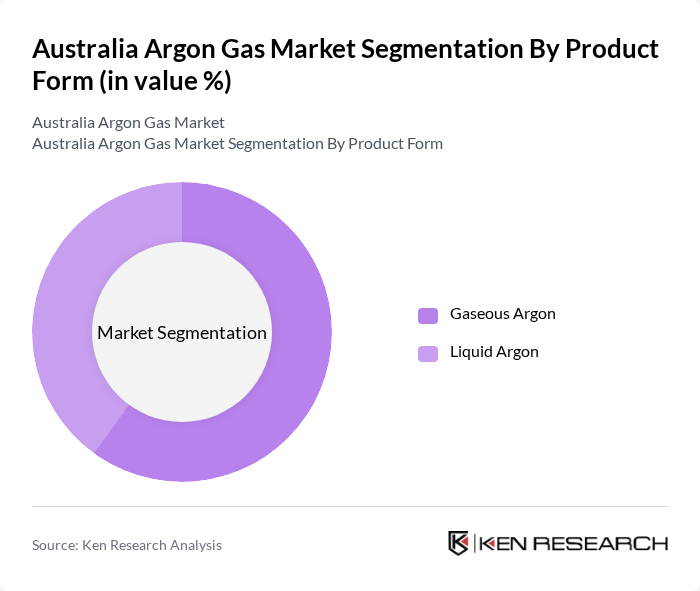
The Gaseous Argon segment dominates the market due to its versatility and widespread use in applications such as welding, metal fabrication, automotive repair, and small-scale manufacturing, where packaged cylinders and bundles are the most practical delivery mode. The ease of transportation, on-site handling, and flexible consumption patterns associated with gaseous argon make it a preferred choice for workshops, construction sites, and dispersed industrial customers. Additionally, the growing trend of automation and robot-assisted welding in manufacturing processes has further increased the demand for shielding gases such as argon-rich mixtures, solidifying gaseous argon’s position as the leading subsegment in the market.
By Mixture Type:The market is categorized into several mixture types, including Pure Argon, Argon–Carbon Dioxide Mixtures, Argon–Oxygen Mixtures, Argon–Helium Mixtures, Argon–Hydrogen Mixtures, and Other Argon Mixtures. Each mixture type serves specific applications: pure argon is critical for gas tungsten arc welding (GTAW/TIG), plasma cutting, and processes requiring an inert atmosphere; argon–carbon dioxide mixtures are widely used in gas metal arc welding (GMAW/MIG) of carbon steels; argon–oxygen mixtures are applied to improve arc stability and wetting in welding of carbon and stainless steels; argon–helium mixtures enhance heat input and penetration for non-ferrous metals and thick sections; and argon–hydrogen mixtures are employed in specialized high-temperature and reducing-atmosphere processes such as plasma welding and certain heat treatments.
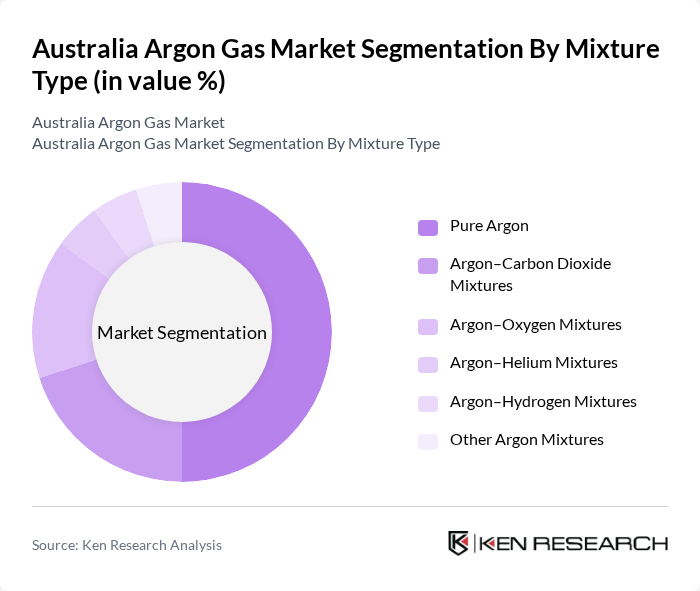
Among the mixture types, Pure Argon leads the market due to its critical role in applications requiring high purity and inertness, such as TIG welding of aluminium and stainless steel, shielding in specialty metal and electronics production, and controlled atmospheres in laboratories and healthcare. The demand for pure argon is further supported by the increasing need for precision and quality assurance in advanced manufacturing and medical device production, where tight tolerance and surface finish requirements make process gas purity a key performance parameter. This trend positions Pure Argon as the dominant subsegment in the mixture type category, while argon-based mixtures continue to grow alongside welding, fabrication, and metalworking activity.
Australia Argon Gas Market Competitive Landscape
The Australia Argon Gas Market is characterized by a dynamic mix of regional and international players. Leading participants such as BOC Limited (Linde plc), Air Liquide Australia Limited, Wesfarmers Chemicals, Energy & Fertilisers, Coregas Pty Ltd, Supagas Pty Ltd, Air Products Australia, Messer Australia, Air Water Australia, Kleenheat Gas, ELGAS Limited, Origin Energy (Industrial Gases & LPG), AGA Gas, Inox Group, Gasco Pty Ltd, Australian Gas Networks Limited contribute to innovation, geographic expansion, and service delivery in this space. Major industrial gas suppliers invest in new air separation units, cylinder filling facilities, and distribution assets to serve argon demand across sectors such as metals, energy, healthcare, and food processing, while also focusing on digital monitoring, telemetry, and customer-service improvements.
Australia Argon Gas Market Industry Analysis
Growth Drivers
- Increasing Demand in Industrial Applications:The Australian argon gas market is experiencing heightened demand, particularly in industries such as metal fabrication and welding. In future, the industrial sector consumed approximately 12,000 tons of argon gas, driven by the growth of the manufacturing sector, which contributed AUD 100 billion to the economy. This trend is expected to continue as industries increasingly adopt argon for its inert properties, enhancing production efficiency and product quality.
- Expansion of the Manufacturing Sector:The Australian manufacturing sector is projected to grow by 3.5% annually, reaching AUD 120 billion in future. This expansion is significantly boosting the demand for argon gas, particularly in processes like steel production and electronics manufacturing. The sector's growth is supported by government initiatives aimed at revitalizing manufacturing, which is expected to increase argon consumption by an estimated 15% over the next two years, further solidifying its market position.
- Technological Advancements in Gas Production:Innovations in gas production technologies are enhancing the efficiency and cost-effectiveness of argon gas production. In future, new methods reduced production costs by 20%, making argon more accessible to various industries. Additionally, advancements in cryogenic distillation and membrane separation technologies are expected to increase production capacity by 25% in future, meeting the rising demand and supporting market growth in Australia.
Market Challenges
- High Production Costs:The production of argon gas in Australia faces significant challenges due to high operational costs, which can reach up to AUD 1,500 per ton. These costs are driven by energy prices and the need for advanced technology. As energy prices are projected to rise by 10% in future, manufacturers may struggle to maintain profitability, potentially leading to increased prices for end-users and limiting market growth.
- Regulatory Compliance Issues:The argon gas market is subject to stringent regulatory frameworks, including safety and environmental standards. Compliance costs can account for up to 15% of total production expenses. In future, new regulations are expected to be introduced, increasing compliance costs further. This could hinder smaller producers' ability to compete, consolidating market power among larger firms and potentially stifling innovation in the sector.
Australia Argon Gas Market Future Outlook
The future of the argon gas market in Australia appears promising, driven by increasing industrial applications and technological advancements. As the manufacturing sector continues to expand, the demand for argon gas is expected to rise significantly. Additionally, the shift towards sustainable practices and the adoption of advanced gas separation technologies will likely enhance production efficiency. However, challenges such as high production costs and regulatory compliance will need to be addressed to ensure sustained growth and competitiveness in the market.
Market Opportunities
- Increasing Use in Electronics Manufacturing:The electronics manufacturing sector is projected to grow by 4% annually, creating a substantial opportunity for argon gas usage. Argon is essential in processes like semiconductor fabrication, where its inert properties prevent contamination. This trend could increase argon demand by approximately 10% in future, positioning it as a critical component in the electronics supply chain.
- Potential in Renewable Energy Storage:The integration of argon gas in renewable energy storage solutions presents a significant market opportunity. As Australia aims to increase its renewable energy capacity to 50% in future, argon can play a vital role in energy storage systems. This could lead to a 15% increase in argon demand, driven by the need for efficient and safe energy storage solutions in the transition to a greener economy.
Scope of the Report
| Segment | Sub-Segments |
|---|---|
| By Product Form | Gaseous Argon Liquid Argon |
| By Mixture Type | Pure Argon Argon–Carbon Dioxide Mixtures Argon–Oxygen Mixtures Argon–Helium Mixtures Argon–Hydrogen Mixtures Other Argon Mixtures |
| By End-use Industry | Metallurgy and Metal Fabrication Electrical and Electronics Healthcare Food & Beverage Energy & Power Generation Automotive Construction Other Industrial End Users |
| By Application | Welding and Metal Fabrication Cutting and Laser Applications Inerting, Blanketing and Shielding Electronics Manufacturing and Processing Lighting and Insulation Cryogenics and Cooling Other Applications |
| By Storage & Supply Mode | Cylinders Bulk and Micro Bulk Tanks On-site / Pipeline Supply |
| By Region | Australia Capital Territory & New South Wales Victoria & Tasmania Queensland Northern Territory & South Australia Western Australia |
Key Target Audience
Investors and Venture Capitalist Firms
Government and Regulatory Bodies (e.g., Australian Competition and Consumer Commission, Department of Industry, Science, Energy and Resources)
Manufacturers and Producers
Distributors and Retailers
Industrial Gas Suppliers
Energy Sector Companies
Environmental Agencies (e.g., Clean Energy Regulator)
Trade Associations (e.g., Australian Gas Association)
Players Mentioned in the Report:
BOC Limited (Linde plc)
Air Liquide Australia Limited
Wesfarmers Chemicals, Energy & Fertilisers
Coregas Pty Ltd
Supagas Pty Ltd
Air Products Australia
Messer Australia
Air Water Australia
Kleenheat Gas
ELGAS Limited
Origin Energy (Industrial Gases & LPG)
AGA Gas
Inox Group
Gasco Pty Ltd
Australian Gas Networks Limited
Table of Contents
Market Assessment Phase
1. Executive Summary and Approach
2. Australia Argon Gas Market Overview
2.1 Key Insights and Strategic Recommendations
2.2 Australia Argon Gas Market Overview
2.3 Definition and Scope
2.4 Evolution of Market Ecosystem
2.5 Timeline of Key Regulatory Milestones
2.6 Value Chain & Stakeholder Mapping
2.7 Business Cycle Analysis
2.8 Policy & Incentive Landscape
3. Australia Argon Gas Market Analysis
3.1 Growth Drivers
3.1.1 Increasing Demand in Industrial Applications
3.1.2 Expansion of the Manufacturing Sector
3.1.3 Technological Advancements in Gas Production
3.1.4 Rising Awareness of Environmental Benefits
3.2 Market Challenges
3.2.1 High Production Costs
3.2.2 Limited Availability of Raw Materials
3.2.3 Regulatory Compliance Issues
3.2.4 Competition from Alternative Gases
3.3 Market Opportunities
3.3.2 Increasing Use in Electronics Manufacturing
3.3.3 Potential in Renewable Energy Storage
3.3.4 Expansion into Emerging Markets
3.4 Market Trends
3.4.1 Shift Towards Sustainable Practices
3.4.2 Increasing Investment in R&D
3.4.3 Adoption of Advanced Gas Separation Technologies
3.4.4 Growing Demand for Specialty Gases
3.5 Government Regulation
3.5.1 Emission Control Regulations
3.5.2 Safety Standards for Gas Handling
3.5.3 Incentives for Clean Technology Adoption
3.5.4 Import Tariffs on Argon Gas
4. SWOT Analysis
5. Stakeholder Analysis
6. Porter's Five Forces Analysis
7. Australia Argon Gas Market Market Size, 2019-2024
7.1 By Value
7.2 By Volume
7.3 By Average Selling Price
8. Australia Argon Gas Market Segmentation
8.1 By Product Form
8.1.1 Gaseous Argon
8.1.2 Liquid Argon
8.2 By Mixture Type
8.2.1 Pure Argon
8.2.2 Argon–Carbon Dioxide Mixtures
8.2.3 Argon–Oxygen Mixtures
8.2.4 Argon–Helium Mixtures
8.2.5 Argon–Hydrogen Mixtures
8.2.6 Other Argon Mixtures
8.3 By End-use Industry
8.3.1 Metallurgy and Metal Fabrication
8.3.2 Electrical and Electronics
8.3.3 Healthcare
8.3.4 Food & Beverage
8.3.5 Energy & Power Generation
8.3.6 Automotive
8.3.7 Construction
8.3.8 Other Industrial End Users
8.4 By Application
8.4.1 Welding and Metal Fabrication
8.4.2 Cutting and Laser Applications
8.4.3 Inerting, Blanketing and Shielding
8.4.4 Electronics Manufacturing and Processing
8.4.5 Lighting and Insulation
8.4.6 Cryogenics and Cooling
8.4.7 Other Applications
8.5 By Storage & Supply Mode
8.5.1 Cylinders
8.5.2 Bulk and Micro Bulk Tanks
8.5.3 On-site / Pipeline Supply
8.6 By Region
8.6.1 Australia Capital Territory & New South Wales
8.6.2 Victoria & Tasmania
8.6.3 Queensland
8.6.4 Northern Territory & South Australia
8.6.5 Western Australia
9. Australia Argon Gas Market Competitive Analysis
9.1 Market Share of Key Players
9.2 Cross Comparison of Key Players
9.2.1 Company Name
9.2.2 Group Size (Large, Medium, or Small as per industry convention)
9.2.3 Australia Argon Revenue (Latest Year, USD Million)
9.2.4 Australia Argon Revenue CAGR (Historical / Forecast)
9.2.5 Argon Volume Sold in Australia (Million m³ or Tons)
9.2.6 Argon Market Share in Australia (%)
9.2.7 EBITDA Margin from Argon Business (%)
9.2.8 Capex Intensity in Argon Operations (% of Sales)
9.2.9 Average Realized Argon Price (USD per m³ or Ton)
9.2.10 Share of Long-term Contracts in Argon Sales (%)
9.2.11 Customer Retention / Renewal Rate (%)
9.2.12 On-time Delivery Performance (%)
9.2.13 Production Utilization Rate (%)
9.2.14 Network Density (Number of Filling Stations / Sites in Australia)
9.2.15 R&D / Innovation Spend (% of Sales)
9.2.16 Number of Key Strategic Partnerships in Australia
9.3 SWOT Analysis of Top Players
9.4 Pricing Analysis
9.5 Detailed Profile of Major Companies
9.5.1 BOC Limited (Linde plc)
9.5.2 Air Liquide Australia Limited
9.5.3 Wesfarmers Chemicals, Energy & Fertilisers
9.5.4 Coregas Pty Ltd
9.5.5 Supagas Pty Ltd
9.5.6 Air Products Australia
9.5.7 Messer Australia
9.5.8 Air Water Australia
9.5.9 Kleenheat Gas
9.5.10 ELGAS Limited
9.5.11 Origin Energy (Industrial Gases & LPG)
9.5.12 AGA Gas
9.5.13 Inox Group
9.5.14 Gasco Pty Ltd
9.5.15 Australian Gas Networks Limited
10. Australia Argon Gas Market End-User Analysis
10.1 Procurement Behavior of Key Ministries
10.1.1 Government Contracts
10.1.2 Budget Allocations
10.1.3 Supplier Selection Criteria
10.1.4 Compliance Requirements
10.2 Corporate Spend on Infrastructure & Energy
10.2.1 Investment Trends
10.2.2 Budget Priorities
10.2.3 Long-term Contracts
10.2.4 Sustainability Initiatives
10.3 Pain Point Analysis by End-User Category
10.3.1 Supply Chain Disruptions
10.3.2 Cost Management
10.3.3 Quality Assurance
10.3.4 Regulatory Compliance
10.4 User Readiness for Adoption
10.4.1 Training and Support Needs
10.4.2 Technology Adoption Rates
10.4.3 Feedback Mechanisms
10.4.4 Change Management Strategies
10.5 Post-Deployment ROI and Use Case Expansion
10.5.1 Performance Metrics
10.5.2 Case Studies
10.5.3 User Satisfaction Surveys
10.5.4 Future Investment Plans
11. Australia Argon Gas Market Future Size, 2025-2030
11.1 By Value
11.2 By Volume
11.3 By Average Selling Price
Go-To-Market Strategy Phase
1. Whitespace Analysis + Business Model Canvas
1.1 Market Gaps Identification
1.2 Value Proposition Development
1.3 Revenue Streams Analysis
1.4 Cost Structure Evaluation
1.5 Key Partnerships
1.6 Customer Segments
1.7 Channels
2. Marketing and Positioning Recommendations
2.1 Branding Strategies
2.2 Product USPs
3. Distribution Plan
3.1 Urban Retail Strategies
3.2 Rural NGO Tie-ups
4. Channel & Pricing Gaps
4.1 Underserved Routes
4.2 Pricing Bands
5. Unmet Demand & Latent Needs
5.1 Category Gaps
5.2 Consumer Segments
6. Customer Relationship
6.1 Loyalty Programs
6.2 After-sales Service
7. Value Proposition
7.1 Sustainability Initiatives
7.2 Integrated Supply Chains
8. Key Activities
8.1 Regulatory Compliance
8.2 Branding Efforts
8.3 Distribution Setup
9. Entry Strategy Evaluation
9.1 Domestic Market Entry Strategy
9.1.1 Product Mix
9.1.2 Pricing Band
9.1.3 Packaging
9.2 Export Entry Strategy
9.2.1 Target Countries
9.2.2 Compliance Roadmap
10. Entry Mode Assessment
10.1 Joint Ventures
10.2 Greenfield Investments
10.3 Mergers & Acquisitions
10.4 Distributor Model
11. Capital and Timeline Estimation
11.1 Capital Requirements
11.2 Timelines
12. Control vs Risk Trade-Off
12.1 Ownership vs Partnerships
13. Profitability Outlook
13.1 Breakeven Analysis
13.2 Long-term Sustainability
14. Potential Partner List
14.1 Distributors
14.2 Joint Ventures
14.3 Acquisition Targets
15. Execution Roadmap
15.1 Phased Plan for Market Entry
15.1.1 Market Setup
15.1.2 Market Entry
15.1.3 Growth Acceleration
15.1.4 Scale & Stabilize
15.2 Key Activities and Milestones
15.2.1 Activity Planning
15.2.2 Milestone Tracking
Research Methodology
Phase 1: Approach1
Desk Research
- Analysis of industry reports from Australian gas associations and regulatory bodies
- Review of market publications and white papers on argon gas applications
- Examination of import/export data from the Australian Bureau of Statistics
Primary Research
- Interviews with key stakeholders in the argon gas supply chain, including manufacturers and distributors
- Surveys targeting end-users in industries such as welding, electronics, and food packaging
- Field visits to production facilities and gas distribution centers for firsthand insights
Validation & Triangulation
- Cross-validation of findings through multiple data sources, including trade journals and market analyses
- Triangulation of qualitative insights from interviews with quantitative data from surveys
- Sanity checks conducted through expert panel reviews and industry roundtables
Phase 2: Market Size Estimation1
Top-down Assessment
- Estimation of total argon gas consumption based on national gas usage statistics
- Segmentation of market size by end-user industries and application types
- Incorporation of growth trends in sectors such as manufacturing and healthcare
Bottom-up Modeling
- Volume estimates derived from production capacities of major argon gas suppliers
- Cost analysis based on pricing structures and distribution expenses
- Calculation of market size using volume x price methodology for each segment
Forecasting & Scenario Analysis
- Multi-variable forecasting models incorporating economic indicators and industry growth rates
- Scenario analysis based on potential regulatory changes and technological advancements
- Development of baseline, optimistic, and pessimistic market projections through 2030
Phase 3: CATI Sample Composition1
| Scope Item/Segment | Sample Size | Target Respondent Profiles |
|---|---|---|
| Welding Industry Applications | 100 | Welding Engineers, Procurement Managers |
| Electronics Manufacturing | 90 | Production Managers, Quality Assurance Specialists |
| Food Packaging Sector | 70 | Packaging Engineers, Supply Chain Coordinators |
| Medical Gas Applications | 60 | Healthcare Administrators, Biomedical Engineers |
| Research and Development Facilities | 50 | Lab Managers, Research Scientists |
Frequently Asked Questions
What is the current value of the Australia Argon Gas Market?
The Australia Argon Gas Market is valued at approximately USD 310 million, reflecting a robust growth trajectory driven by increasing demand across various industrial applications such as welding, electronics manufacturing, and healthcare.
What are the primary applications of argon gas in Australia?
Which cities are the key demand centers for argon gas in Australia?
What are the two main product forms of argon gas?
Other Regional/Country Reports
Other Adjacent Reports
Kuwait Electronics Manufacturing Market
UAE Semiconductor Market Outlook to 2030Middle East Medical Gases Market Size, Share, Growth Drivers, Trends, Opportunities & Forecast 2025–2030Indonesia Automotive Manufacturing Market Outlook to 2030KSA food packaging market size, share, growth drivers, trends, opportunities & forecast 2025–2030Oman Steel Production Market
KSA cryogenic equipment market Size, Share, Growth Drivers, Trends, Opportunities & Forecast 2025–2030Egypt Air Separation Market
Why Buy From Us?

What makes us stand out is that our consultants follow Robust, Refine and Result (RRR) methodology. Robust for clear definitions, approaches and sanity checking, Refine for differentiating respondents' facts and opinions, and Result for presenting data with story.

We have set a benchmark in the industry by offering our clients with syndicated and customized market research reports featuring coverage of entire market as well as meticulous research and analyst insights.

While we don't replace traditional research, we flip the method upside down. Our dual approach of Top Bottom & Bottom Top ensures quality deliverable by not just verifying company fundamentals but also looking at the sector and macroeconomic factors.

With one step in the future, our research team constantly tries to show you the bigger picture. We help with some of the tough questions you may encounter along the way: How is the industry positioned? Best marketing channel? KPI's of competitors? By aligning every element, we help maximize success.

Our report gives you instant access to the answers and sources that other companies might choose to hide. We elaborate each steps of research methodology we have used and showcase you the sample size to earn your trust.

If you need any support, we are here! We pride ourselves on universe strength, data quality, and quick, friendly, and professional service.