About the Report
Base Year 2024Oman Argon Gas Market Overview
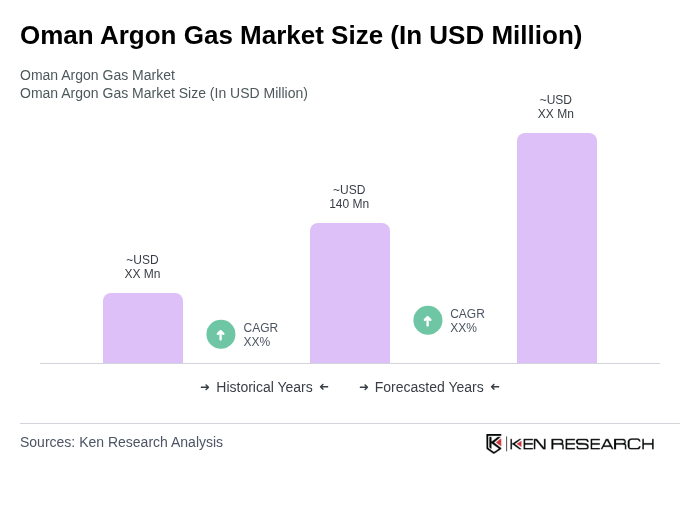
- The Oman Argon Gas Market is valued at USD 140 million, based on a five-year historical analysis and its share within the Middle East industrial gases and Middle East & Africa argon markets. This growth is primarily driven by the increasing demand for argon in various industrial applications, including metal fabrication, electronics, and healthcare, where argon is widely used as an inert shielding gas for welding, metal processing, and in specialty gas mixtures. The expansion of the manufacturing sector, ongoing oil and gas downstream projects, and rising investments in infrastructure and industrial zones have further supported the market's growth by increasing consumption of industrial gases across Oman and the wider Gulf region.
- Key cities such as Muscat, Salalah, and Sohar dominate the Oman Argon Gas Market due to their strategic locations and industrial activities. Muscat, being the capital, serves as a hub for various industries and services, including metal fabrication, construction, and healthcare. Salalah and Sohar are known for their deep-water ports, free zones, and large industrial estates, which host metals, petrochemicals, logistics, and manufacturing facilities, attracting investments and facilitating trade in industrial gases including argon.
- In 2023, the Omani government implemented regulations to promote the safe handling and use of industrial gases, including argon. One of the key binding instruments is the Ministerial Decision No. 286/2008 issuing the Regulation for Occupational Safety and Health for Establishments Governed by the Labour Law, enacted by the Ministry of Manpower (now the Ministry of Labour), which sets mandatory requirements for safe storage, handling, labeling, ventilation, and monitoring of compressed gases and pressurized containers in workplaces, along with periodic inspection and maintenance obligations. In addition, industrial gas operators typically comply with relevant Gulf Standardization Organization (GSO) and international standards such as ISO requirements for cylinders and cryogenic vessels, with Omani authorities requiring adherence to these standards during licensing and inspection of storage, filling, and distribution facilities to protect workers and the environment.
Oman Argon Gas Market Segmentation
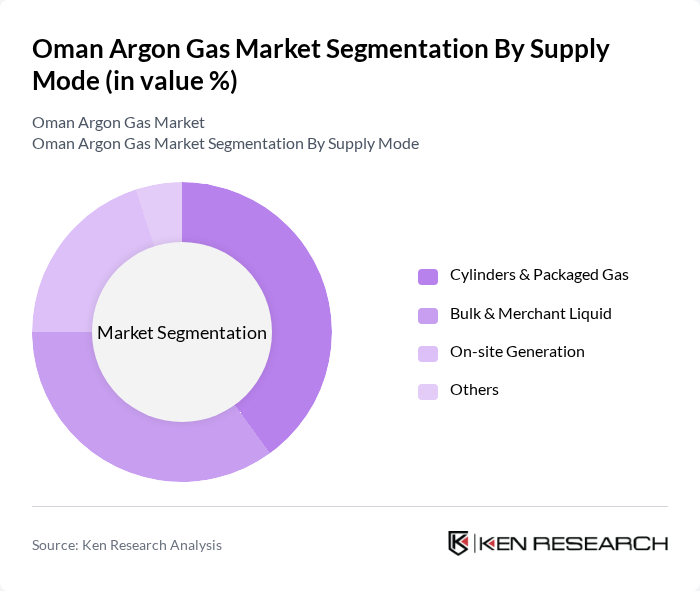
By Supply Mode:The supply mode segmentation includes various methods of delivering argon gas to end-users. The subsegments are Cylinders & Packaged Gas, Bulk & Merchant Liquid, On-site Generation, and Others. Each of these methods caters to different customer needs and applications, influencing the overall market dynamics, and is consistent with broader Middle East industrial gas distribution models where packaged gases serve small and medium users, bulk liquid serves large industrial consumers, and on-site generation is adopted by high-volume continuous users in metals, chemicals, and energy.
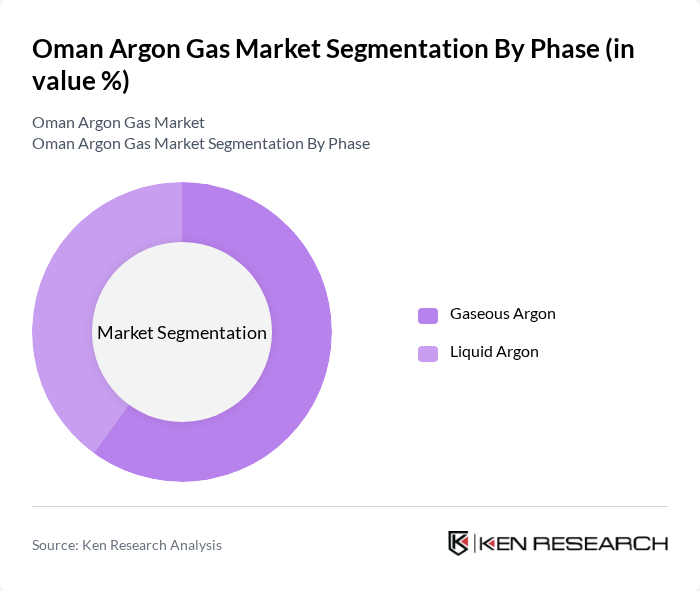
By Phase:The phase segmentation categorizes argon gas into Gaseous Argon and Liquid Argon. Each phase has distinct applications and benefits, influencing customer preferences and market trends: gaseous argon is widely used for welding, cutting, and shielding in metal fabrication, electronics, and laboratory uses, while liquid argon is favored for large-volume users and cryogenic applications where efficient bulk storage and transport are required.
Oman Argon Gas Market Competitive Landscape
The Oman Argon Gas Market is characterized by a dynamic mix of regional and international players. Leading participants such as Air Products and Chemicals, Inc., Linde plc, Air Liquide S.A., Messer Group GmbH, Gulf Cryo, National Gas Company SAOG (Oman), Oman Industrial Gases Co. LLC, Al Ghubrah Industrial Gases (Al Ghubra Gas), Oman Gas Company S.A.O.C., Oman Air Liquide LLC, BOC (a Linde company), Al-Futtaim Engineering, Gulf Industrial Investment Company, and other regional and local argon suppliers contribute to innovation, geographic expansion, and service delivery in this space, supported by growing demand for industrial gases across the GCC and Middle East.
Oman Argon Gas Market Industry Analysis
Growth Drivers
- Increasing Demand from Industrial Applications:The Oman argon gas market is experiencing a surge in demand, particularly from the manufacturing sector, which accounted for approximately 25% of the country's GDP in future. Industries such as metal fabrication and glass production utilize argon for its inert properties, enhancing product quality. The Ministry of Industry and Commerce reported a 15% increase in industrial output in future, indicating a robust growth trajectory that directly benefits argon gas consumption.
- Expansion of Healthcare Sector:The healthcare sector in Oman is projected to grow significantly, with government spending on health expected to reach OMR 1.5 billion by future. Argon gas is increasingly used in medical applications, including cryotherapy and laser surgeries, due to its non-reactive nature. The rise in healthcare investments, coupled with a growing population, is anticipated to drive argon gas demand, contributing to improved patient care and operational efficiency in medical facilities.
- Technological Advancements in Gas Production:Innovations in gas production technologies are enhancing the efficiency and cost-effectiveness of argon gas manufacturing. In future, the introduction of advanced cryogenic distillation methods has reduced production costs by approximately 20%. This technological progress not only increases supply but also improves the purity levels of argon gas, making it more appealing for various applications, thus stimulating market growth in Oman.
Market Challenges
- High Production Costs:The argon gas production process is capital-intensive, with costs estimated at OMR 0.25 per cubic meter. Fluctuations in energy prices, particularly electricity, which constitutes about 30% of production costs, pose significant challenges. As Oman aims to diversify its energy sources, the reliance on traditional energy can hinder the competitiveness of argon gas pricing, impacting overall market growth.
- Limited Infrastructure for Distribution:The distribution network for argon gas in Oman is underdeveloped, with only 40% of the necessary infrastructure in place in future. This limitation affects timely delivery to end-users, particularly in remote areas. The lack of adequate transportation and storage facilities can lead to supply chain disruptions, ultimately constraining market expansion and increasing operational costs for suppliers.
Oman Argon Gas Market Future Outlook
The Oman argon gas market is poised for significant growth, driven by increasing industrial applications and advancements in production technologies. As the healthcare sector expands, the demand for argon in medical applications is expected to rise. Additionally, the government's focus on infrastructure development will likely enhance distribution capabilities. With a growing emphasis on sustainability, the market may also see a shift towards cleaner production methods, aligning with global trends in environmental responsibility and safety standards.
Market Opportunities
- Growth in the Electronics Industry:The electronics sector in Oman is projected to grow by 10% annually, creating a substantial opportunity for argon gas usage in semiconductor manufacturing. Argon is essential for creating inert environments during the production process, which enhances product reliability and performance, thus driving demand in this high-tech industry.
- Potential in the Food Packaging Sector:The food packaging industry is increasingly adopting argon gas for its preservation properties, with a market value expected to reach OMR 200 million by future. As consumer preferences shift towards longer shelf life and quality preservation, argon gas presents a viable solution, offering significant growth potential in this sector.
Scope of the Report
| Segment | Sub-Segments |
|---|---|
| By Supply Mode | Cylinders & Packaged Gas Bulk & Merchant Liquid On-site Generation Others |
| By Phase | Gaseous Argon Liquid Argon |
| By Application | Welding & Metal Fabrication Metallurgy & Heat Treatment Electronics & Semiconductor Healthcare & Laboratory Food & Beverage Processing Energy, Oil & Gas Others |
| By End-Use Industry | Metal Manufacturing & Fabrication Chemicals & Petrochemicals Healthcare Food & Beverages Electronics Construction Oil & Gas Others |
| By Distribution Channel | Direct Sales Distributors & Dealers Online Sales Retail & Industrial Gas Outlets Others |
| By Production Method | Cryogenic Distillation Pressure Swing Adsorption Membrane Separation Others |
| By Purity Grade | Industrial Grade Argon High Purity Argon Ultra High Purity & Specialty Argon Others |
| By Region | Muscat Salalah Sohar Nizwa Others |
Key Target Audience
Investors and Venture Capitalist Firms
Government and Regulatory Bodies (e.g., Ministry of Commerce, Industry and Investment Promotion)
Manufacturers and Producers of Argon Gas
Gas Distribution Companies
Industrial Gas Suppliers
Energy Sector Stakeholders
Environmental Agencies (e.g., Public Authority for Environmental Affairs)
Trade Associations in the Gas Industry
Players Mentioned in the Report:
Air Products and Chemicals, Inc.
Linde plc
Air Liquide S.A.
Messer Group GmbH
Gulf Cryo
National Gas Company SAOG (Oman)
Oman Industrial Gases Co. LLC
Al Ghubrah Industrial Gases (Al Ghubra Gas)
Oman Gas Company S.A.O.C.
Oman Air Liquide LLC
BOC (a Linde company)
Al-Futtaim Engineering
Gulf Industrial Investment Company
Other Regional & Local Argon Suppliers
Table of Contents
Market Assessment Phase
1. Executive Summary and Approach
2. Oman Argon Gas Market Overview
2.1 Key Insights and Strategic Recommendations
2.2 Oman Argon Gas Market Overview
2.3 Definition and Scope
2.4 Evolution of Market Ecosystem
2.5 Timeline of Key Regulatory Milestones
2.6 Value Chain & Stakeholder Mapping
2.7 Business Cycle Analysis
2.8 Policy & Incentive Landscape
3. Oman Argon Gas Market Analysis
3.1 Growth Drivers
3.1.1 Increasing Demand from Industrial Applications
3.1.2 Expansion of Healthcare Sector
3.1.3 Technological Advancements in Gas Production
3.1.4 Rising Awareness of Argon Gas Benefits
3.2 Market Challenges
3.2.1 High Production Costs
3.2.2 Limited Infrastructure for Distribution
3.2.3 Regulatory Compliance Issues
3.2.4 Competition from Alternative Gases
3.3 Market Opportunities
3.3.1 Growth in the Electronics Industry
3.3.2 Potential in the Food Packaging Sector
3.3.3 Expansion of Research and Development Activities
3.3.4 Increasing Use in Welding Applications
3.4 Market Trends
3.4.1 Shift Towards Sustainable Gas Solutions
3.4.2 Rising Investment in Gas Infrastructure
3.4.3 Adoption of Advanced Gas Purification Technologies
3.4.4 Growing Focus on Safety Standards
3.5 Government Regulation
3.5.1 Emission Control Regulations
3.5.2 Safety Standards for Gas Handling
3.5.3 Import Tariffs on Argon Gas
3.5.4 Incentives for Clean Technology Adoption
4. SWOT Analysis
5. Stakeholder Analysis
6. Porter's Five Forces Analysis
7. Oman Argon Gas Market Market Size, 2019-2024
7.1 By Value
7.2 By Volume
7.3 By Average Selling Price
8. Oman Argon Gas Market Segmentation
8.1 By Supply Mode
8.1.1 Cylinders & Packaged Gas
8.1.2 Bulk & Merchant Liquid
8.1.3 On-site Generation
8.1.4 Others
8.2 By Phase
8.2.1 Gaseous Argon
8.2.2 Liquid Argon
8.3 By Application
8.3.1 Welding & Metal Fabrication
8.3.2 Metallurgy & Heat Treatment
8.3.3 Electronics & Semiconductor
8.3.4 Healthcare & Laboratory
8.3.5 Food & Beverage Processing
8.3.6 Energy, Oil & Gas
8.3.7 Others
8.4 By End-Use Industry
8.4.1 Metal Manufacturing & Fabrication
8.4.2 Chemicals & Petrochemicals
8.4.3 Healthcare
8.4.4 Food & Beverages
8.4.5 Electronics
8.4.6 Construction
8.4.7 Oil & Gas
8.4.8 Others
8.5 By Distribution Channel
8.5.1 Direct Sales
8.5.2 Distributors & Dealers
8.5.3 Online Sales
8.5.4 Retail & Industrial Gas Outlets
8.5.5 Others
8.6 By Production Method
8.6.1 Cryogenic Distillation
8.6.2 Pressure Swing Adsorption
8.6.3 Membrane Separation
8.6.4 Others
8.7 By Purity Grade
8.7.1 Industrial Grade Argon
8.7.2 High Purity Argon
8.7.3 Ultra High Purity & Specialty Argon
8.7.4 Others
8.8 By Region
8.8.1 Muscat
8.8.2 Salalah
8.8.3 Sohar
8.8.4 Nizwa
8.8.5 Others
9. Oman Argon Gas Market Competitive Analysis
9.1 Market Share of Key Players
9.2 Cross Comparison of Key Players
9.2.1 Company Name
9.2.2 Group Size (Large, Medium, or Small as per industry convention)
9.2.3 Oman Argon Revenue (USD Million)
9.2.4 3-Year CAGR in Oman Argon Revenue (%)
9.2.5 Argon Volume Sold in Oman (Tonnes per Year)
9.2.6 Market Share in Oman Argon Gas Market (%)
9.2.7 EBITDA Margin from Argon Business (%)
9.2.8 Average Realized Argon Price (USD per Nm³ or per kg)
9.2.9 Capacity Utilization Rate (%)
9.2.10 Capex Intensity in Oman (Capex / Argon Revenue, %)
9.2.11 Number of Production Sites in Oman
9.2.12 Storage & Distribution Assets (Cylinders, Tanks, Trucks – Number)
9.2.13 Contract Mix (Share of Long-term vs Spot Sales, %)
9.2.14 Customer Concentration (Top 5 Customers’ Share, %)
9.2.15 On-time Delivery Performance (%)
9.2.16 Safety Performance (TRIR / Lost-time Incidents)
9.2.17 R&D / Innovation Spend (% of Revenue)
9.3 SWOT Analysis of Top Players
9.4 Pricing Analysis
9.5 Detailed Profile of Major Companies
9.5.1 Air Products and Chemicals, Inc.
9.5.2 Linde plc
9.5.3 Air Liquide S.A.
9.5.4 Messer Group GmbH
9.5.5 Gulf Cryo
9.5.6 National Gas Company SAOG (Oman)
9.5.7 Oman Industrial Gases Co. LLC
9.5.8 Al Ghubrah Industrial Gases (Al Ghubra Gas)
9.5.9 Oman Gas Company S.A.O.C.
9.5.10 Oman Air Liquide LLC
9.5.11 BOC (a Linde company)
9.5.12 Al-Futtaim Engineering
9.5.13 Gulf Industrial Investment Company
9.5.14 Other Regional & Local Argon Suppliers
10. Oman Argon Gas Market End-User Analysis
10.1 Procurement Behavior of Key Ministries
10.1.1 Ministry of Health
10.1.2 Ministry of Industry and Commerce
10.1.3 Ministry of Agriculture and Fisheries
10.1.4 Ministry of Energy and Minerals
10.2 Corporate Spend on Infrastructure & Energy
10.2.1 Investment in Industrial Facilities
10.2.2 Budget Allocation for Healthcare Facilities
10.2.3 Funding for Research Institutions
10.2.4 Expenditure on Food Processing Units
10.3 Pain Point Analysis by End-User Category
10.3.1 Industrial Users
10.3.2 Healthcare Providers
10.3.3 Food Manufacturers
10.3.4 Electronics Manufacturers
10.4 User Readiness for Adoption
10.4.1 Awareness of Argon Gas Benefits
10.4.2 Availability of Infrastructure
10.4.3 Training and Support Needs
10.4.4 Financial Readiness
10.5 Post-Deployment ROI and Use Case Expansion
10.5.1 Measurement of Cost Savings
10.5.2 Evaluation of Performance Improvements
10.5.3 Identification of New Applications
10.5.4 Long-term Sustainability Assessment
11. Oman Argon Gas Market Future Size, 2025-2030
11.1 By Value
11.2 By Volume
11.3 By Average Selling Price
Go-To-Market Strategy Phase
1. Whitespace Analysis + Business Model Canvas
1.1 Market Gaps Identification
1.2 Business Model Development
2. Marketing and Positioning Recommendations
2.1 Branding Strategies
2.2 Product USPs
3. Distribution Plan
3.1 Urban Retail Strategies
3.2 Rural NGO Tie-ups
4. Channel & Pricing Gaps
4.1 Underserved Routes
4.2 Pricing Bands Analysis
5. Unmet Demand & Latent Needs
5.1 Category Gaps
5.2 Consumer Segments
6. Customer Relationship
6.1 Loyalty Programs
6.2 After-sales Service
7. Value Proposition
7.1 Sustainability Initiatives
7.2 Integrated Supply Chains
8. Key Activities
8.1 Regulatory Compliance
8.2 Branding Efforts
8.3 Distribution Setup
9. Entry Strategy Evaluation
9.1 Domestic Market Entry Strategy
9.1.1 Product Mix Considerations
9.1.2 Pricing Band Strategy
9.1.3 Packaging Solutions
9.2 Export Entry Strategy
9.2.1 Target Countries Identification
9.2.2 Compliance Roadmap Development
10. Entry Mode Assessment
10.1 Joint Ventures
10.2 Greenfield Investments
10.3 Mergers & Acquisitions
10.4 Distributor Model
11. Capital and Timeline Estimation
11.1 Capital Requirements
11.2 Timelines for Implementation
12. Control vs Risk Trade-Off
12.1 Ownership Considerations
12.2 Partnerships Evaluation
13. Profitability Outlook
13.1 Breakeven Analysis
13.2 Long-term Sustainability Assessment
14. Potential Partner List
14.1 Distributors
14.2 Joint Ventures
14.3 Acquisition Targets
15. Execution Roadmap
15.1 Phased Plan for Market Entry
15.1.1 Market Setup
15.1.2 Market Entry
15.1.3 Growth Acceleration
15.1.4 Scale & Stabilize
15.2 Key Activities and Milestones
15.2.1 Milestone Planning
15.2.2 Activity Tracking
Research Methodology
Phase 1: Approach1
Desk Research
- Analysis of industry reports from the Oman Ministry of Commerce and Industry
- Review of academic journals and publications on argon gas applications and market trends
- Examination of trade statistics and import/export data from the Oman National Center for Statistics and Information
Primary Research
- Interviews with key stakeholders in the argon gas supply chain, including producers and distributors
- Surveys targeting industrial users of argon gas, such as metal fabrication and electronics manufacturers
- Field interviews with experts in gas applications and technology providers in Oman
Validation & Triangulation
- Cross-validation of findings through multiple data sources, including government reports and industry publications
- Triangulation of market insights from primary interviews with secondary data trends
- Sanity checks conducted through expert panel discussions and feedback sessions
Phase 2: Market Size Estimation1
Top-down Assessment
- Estimation of the argon gas market size based on national gas consumption statistics
- Segmentation of the market by end-user industries, including healthcare, manufacturing, and electronics
- Incorporation of growth forecasts based on regional industrial development plans
Bottom-up Modeling
- Collection of sales data from major argon gas suppliers operating in Oman
- Estimation of market share based on production capacity and distribution networks
- Volume and pricing analysis to derive revenue estimates for each segment
Forecasting & Scenario Analysis
- Utilization of time-series analysis to project future demand based on historical consumption patterns
- Scenario modeling based on potential regulatory changes and technological advancements in gas applications
- Development of baseline, optimistic, and pessimistic forecasts through 2030
Phase 3: CATI Sample Composition1
| Scope Item/Segment | Sample Size | Target Respondent Profiles |
|---|---|---|
| Industrial Gas Suppliers | 60 | Sales Managers, Business Development Executives |
| Manufacturing Sector Users | 40 | Production Managers, Quality Control Supervisors |
| Healthcare Facilities | 40 | Facility Managers, Biomedical Engineers |
| Research Institutions | 40 | Lab Managers, Research Scientists |
| Electronics Manufacturers | 50 | Operations Managers, Supply Chain Coordinators |
Frequently Asked Questions
What is the current value of the Oman Argon Gas Market?
The Oman Argon Gas Market is valued at approximately USD 140 million, reflecting its significance within the Middle East industrial gases sector. This valuation is based on a comprehensive five-year historical analysis of market trends and demand.
What are the primary applications of argon gas in Oman?
Which cities are key players in the Oman Argon Gas Market?
What regulations govern the handling of argon gas in Oman?
Other Regional/Country Reports
Other Adjacent Reports
Oman Oxygen Gas Market
KSA welding equipment market size, share, growth drivers, trends, opportunities & forecast 2025–2030India Metal Fabrication MarketKSA Electronics Manufacturing Market
Middle East Medical Gases Market Size, Share, Growth Drivers, Trends, Opportunities & Forecast 2025–2030KSA cryogenic equipment market Size, Share, Growth Drivers, Trends, Opportunities & Forecast 2025–2030Global Petrochemicals Market Outlook to 2030Thailand Food Packaging Gases Market
Why Buy From Us?

What makes us stand out is that our consultants follow Robust, Refine and Result (RRR) methodology. Robust for clear definitions, approaches and sanity checking, Refine for differentiating respondents' facts and opinions, and Result for presenting data with story.

We have set a benchmark in the industry by offering our clients with syndicated and customized market research reports featuring coverage of entire market as well as meticulous research and analyst insights.

While we don't replace traditional research, we flip the method upside down. Our dual approach of Top Bottom & Bottom Top ensures quality deliverable by not just verifying company fundamentals but also looking at the sector and macroeconomic factors.

With one step in the future, our research team constantly tries to show you the bigger picture. We help with some of the tough questions you may encounter along the way: How is the industry positioned? Best marketing channel? KPI's of competitors? By aligning every element, we help maximize success.

Our report gives you instant access to the answers and sources that other companies might choose to hide. We elaborate each steps of research methodology we have used and showcase you the sample size to earn your trust.

If you need any support, we are here! We pride ourselves on universe strength, data quality, and quick, friendly, and professional service.