About the Report
Base Year 2024Azerbaijan Oil And Gas Downstream Market Overview
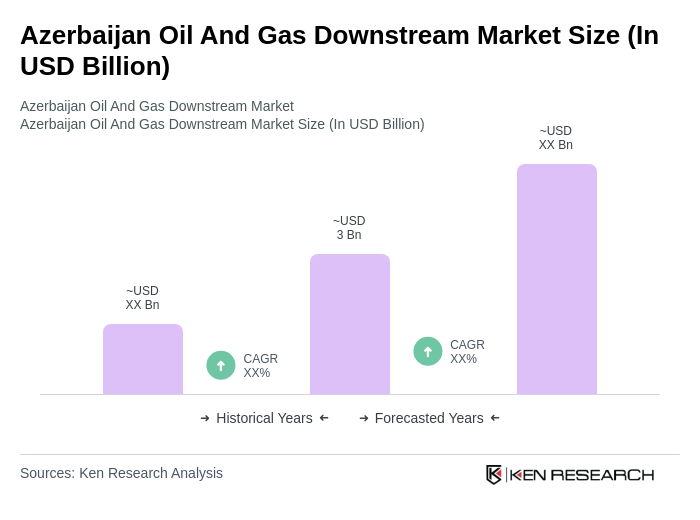
- The Azerbaijan Oil and Gas Downstream Market is valued at USD 3 billion, based on a five-year historical analysis. This market is driven by rising demand for refined petroleum products and petrochemicals, supported by ongoing modernization of the Heydar Aliyev Oil Refinery to produce Euro-5 fuels and improved operational efficiency.
- Baku, the capital city, is the dominant player in the market due to its extensive refining and petrochemical facilities, including the SOCAR Heydar Aliyev Oil Refinery. The Sumgait industrial cluster, hosting SOCAR Polymer and Azerikimya Production Union, is another key hub for petrochemicals and polymers; Ganja is an important regional industrial and logistics center. The concentration of infrastructure and investment in these areas facilitates efficient production and distribution.
- In 2023, Azerbaijan advanced fuel quality to align with European specifications through the refinery’s upgrade to Euro-5 gasoline and diesel, effectively raising domestic fuel quality and reducing emissions from transport fuels. This move is part of broader sector modernization to meet environmental standards and improve public health outcomes.
Azerbaijan Oil And Gas Downstream Market Segmentation
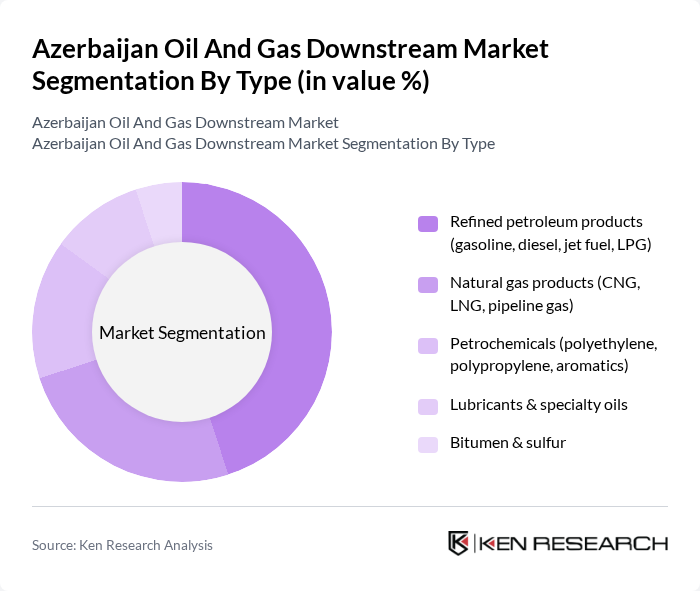
By Type:The market is segmented into refined petroleum products, natural gas products, petrochemicals, lubricants, and bitumen. Refined petroleum products such as gasoline and diesel lead demand due to transport and industrial use, with leadership reinforced by the refinery’s upgrade to Euro-5 fuels. Natural gas products support power, heating, and CNG use, while petrochemicals—including polypropylene and high-density polyethylene from SOCAR Polymer—are expanding within the Sumgait cluster.
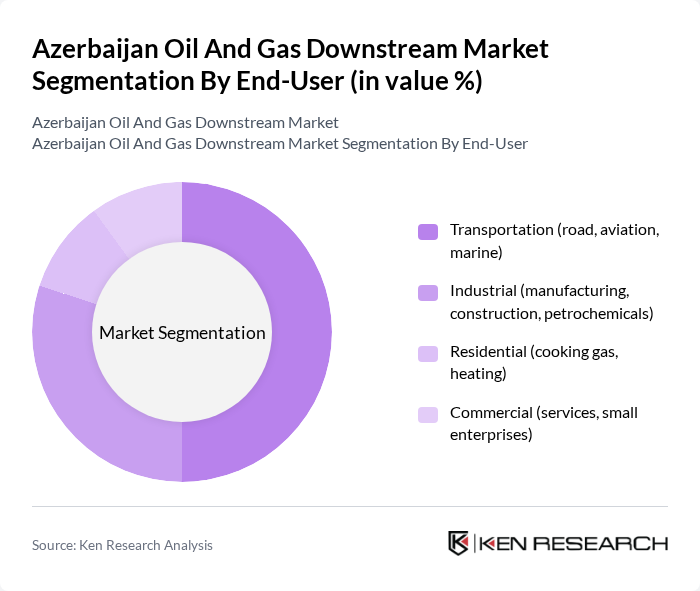
By End-User:The end-user segmentation includes transportation, industrial, residential, and commercial sectors. Transportation remains the leading end-user, reinforced by higher-quality Euro-5 fuels supporting road and aviation demand. Industrial users consume fuels and feedstocks across manufacturing, construction, and petrochemicals, while residential and commercial demand centers on gas for heating and services.
Azerbaijan Oil And Gas Downstream Market Competitive Landscape
The Azerbaijan Oil And Gas Downstream Market features a mix of state and private players. Key participants include SOCAR (State Oil Company of the Azerbaijan Republic), SOCAR Heydar Aliyev Oil Refinery, SOCAR Petroleum QSC (retail and marketing), SOCAR Polymer (Sumgait PP and HDPE), Azerikimya Production Union (SOCAR petrochemicals), Azpetrol Ltd. LLC, LUKOIL Azerbaijan, TotalEnergies Marketing Azerbaijan, Petkim Petrokimya Holding A.?. (SOCAR Turkey), BP Azerbaijan (downstream partnerships and fuels supply), Azerigas (Azerigaz Production Union, gas distribution), Azerenergy (Azerenerji OJSC, fuel supply interface), Air Liquide Azerbaijan (industrial gases), ASCO – Azerbaijan Caspian Shipping Company CJSC (bunkering interface), and Caspian Marine Services Ltd. (marine fuel logistics). These entities support modernization, Euro-5 fuel rollout, polymer capacity expansion, and market coverage across retail and industrial customers.
Azerbaijan Oil And Gas Downstream Market Industry Analysis
Growth Drivers
- Increasing Domestic Energy Demand:Azerbaijan's domestic energy consumption is projected to reach 30 million tons of oil equivalent (Mtoe) in future, driven by industrial growth and urbanization. The country's population is expected to grow to approximately 10 million, increasing energy needs. Additionally, the government aims to enhance energy security, leading to investments in refining capacity, which is currently around 6 million tons per year, to meet rising demand effectively.
- Strategic Investments in Infrastructure:The Azerbaijani government has allocated $1.5 billion for infrastructure development in the oil and gas sector in future. This includes upgrading existing refineries and building new facilities to enhance processing capabilities. The Baku-Tbilisi-Ceyhan pipeline, which transports over 1 million barrels per day, is a critical asset that supports these investments, ensuring efficient distribution and access to international markets, thereby boosting the downstream sector.
- Government Support and Incentives:The Azerbaijani government has introduced various incentives, including tax breaks and subsidies, to attract foreign investment in the oil and gas downstream sector. In future, the government plans to implement a new regulatory framework that simplifies the investment process, aiming to increase foreign direct investment (FDI) by 20% compared to 2023 levels. This supportive environment is crucial for fostering growth and modernization in the industry.
Market Challenges
- Regulatory Compliance Complexities:Navigating the regulatory landscape in Azerbaijan poses significant challenges for downstream operators. The country has over 50 regulations governing environmental standards, safety, and operational practices. Compliance costs are estimated to reach $200 million annually for major players, impacting profitability. The complexity of these regulations can deter new entrants and slow down project timelines, hindering overall market growth.
- Fluctuating Global Oil Prices:The volatility of global oil prices significantly affects Azerbaijan's downstream market. In future, oil prices fluctuated between $70 and $90 per barrel, impacting refining margins. As a result, local refineries faced challenges in maintaining profitability, with average margins dropping to $5 per barrel. This uncertainty complicates long-term planning and investment decisions, creating a cautious approach among stakeholders in the sector.
Azerbaijan Oil And Gas Downstream Market Future Outlook
The Azerbaijan oil and gas downstream market is poised for significant transformation, driven by increasing domestic energy demand and strategic investments in infrastructure. In future, the focus on cleaner fuels and sustainability will shape operational practices, with local refining capabilities expected to expand. The government’s supportive policies will likely attract foreign investments, fostering innovation and modernization. As the market evolves, stakeholders must navigate regulatory complexities and price volatility while capitalizing on emerging opportunities in renewable energy and petrochemical production.
Market Opportunities
- Expansion of Petrochemical Production:Azerbaijan's petrochemical sector is set to grow, with investments projected at $500 million in future. This expansion aims to increase production capacity by 30%, catering to both domestic and export markets. The growing demand for petrochemical products in the region presents a lucrative opportunity for local manufacturers to enhance their market presence and profitability.
- Development of Renewable Energy Sources:The Azerbaijani government plans to invest $300 million in renewable energy projects in future, focusing on solar and wind energy. This initiative aims to diversify the energy mix and reduce dependence on fossil fuels. The integration of renewable sources into the energy portfolio presents significant opportunities for innovation and collaboration with international firms, enhancing sustainability in the downstream sector.
Scope of the Report
| Segment | Sub-Segments |
|---|---|
| By Type | Refined petroleum products (gasoline, diesel, jet fuel, LPG) Natural gas products (CNG, LNG, pipeline gas) Petrochemicals (polyethylene, polypropylene, aromatics) Lubricants & specialty oils Bitumen & sulfur |
| By End-User | Transportation (road, aviation, marine) Industrial (manufacturing, construction, petrochemicals) Residential (cooking gas, heating) Commercial (services, small enterprises) |
| By Application | Fuel & energy supply Chemical and polymer manufacturing Power and heat generation Road construction and infrastructure (bitumen) |
| By Distribution Channel | Direct distribution (B2B contracts) Retail outlets (fuel stations) Wholesalers & distributors Online channels (enterprise portals) |
| By Pricing Mechanism | Regulated pricing (domestic fuels) Market-linked pricing (industrial/commercial) Contract/index-based pricing Export parity pricing |
| By Regulatory Compliance | National fuel quality standards (Euro specs) Environmental and emissions compliance Health, safety, and operational standards Customs and trade compliance |
| By Asset Class | Refining (e.g., SOCAR Heydar Aliyev Oil Refinery) Petrochemicals (SOCAR Polymer, Azerikimya) Storage & terminals Marketing & retail networks |
Key Target Audience
Investors and Venture Capitalist Firms
Government and Regulatory Bodies (e.g., Ministry of Energy, State Oil Company of Azerbaijan Republic)
Oil Refinery Operators
Petrochemical Manufacturers
Logistics and Transportation Companies
Energy Trading Firms
Environmental Regulatory Agencies (e.g., Ministry of Ecology and Natural Resources)
Local and International Oil and Gas Associations
Players Mentioned in the Report:
SOCAR (State Oil Company of the Azerbaijan Republic)
SOCAR Heydar Aliyev Oil Refinery (Baku Oil Refinery)
SOCAR Petroleum QSC (retail and marketing)
SOCAR Polymer (Sumgait PP and HDPE)
Azerikimya Production Union (SOCAR petrochemicals)
Azpetrol Ltd. LLC
LUKOIL Azerbaijan
TotalEnergies Marketing Azerbaijan
Petkim Petrokimya Holding A.S. (SOCAR Turkey)
BP Azerbaijan (downstream partnerships and fuels supply)
Azerigas (Azerigaz Production Union, gas distribution)
Azerenergy (Azerenerji OJSC, fuel supply interface)
Air Liquid e Azerbaijan (industrial gases) corrected: Air Liquide Azerbaijan
ASCO Azerbaijan Caspian Shipping Company CJSC (bunkering interface)
Caspian Marine Services Ltd. (marine fuel logistics)
Table of Contents
Market Assessment Phase
1. Executive Summary and Approach
2. Azerbaijan Oil And Gas Downstream Market Overview
2.1 Key Insights and Strategic Recommendations
2.2 Azerbaijan Oil And Gas Downstream Market Overview
2.3 Definition and Scope
2.4 Evolution of Market Ecosystem
2.5 Timeline of Key Regulatory Milestones
2.6 Value Chain & Stakeholder Mapping
2.7 Business Cycle Analysis
2.8 Policy & Incentive Landscape
3. Azerbaijan Oil And Gas Downstream Market Analysis
3.1 Growth Drivers
3.1.1 Increasing domestic energy demand
3.1.2 Strategic investments in infrastructure
3.1.3 Government support and incentives
3.1.4 Technological advancements in refining
3.2 Market Challenges
3.2.1 Regulatory compliance complexities
3.2.2 Fluctuating global oil prices
3.2.3 Environmental concerns and regulations
3.2.4 Limited access to financing for new projects
3.3 Market Opportunities
3.3.1 Expansion of petrochemical production
3.3.2 Development of renewable energy sources
3.3.3 Strategic partnerships with international firms
3.3.4 Investment in modernization of existing facilities
3.4 Market Trends
3.4.1 Shift towards cleaner fuels
3.4.2 Increasing focus on sustainability
3.4.3 Digital transformation in operations
3.4.4 Growth of local refining capabilities
3.5 Government Regulation
3.5.1 Environmental protection laws
3.5.2 Tax incentives for energy projects
3.5.3 Import/export regulations
3.5.4 Safety and operational standards
4. SWOT Analysis
5. Stakeholder Analysis
6. Porter's Five Forces Analysis
7. Azerbaijan Oil And Gas Downstream Market Market Size, 2019-2024
7.1 By Value
7.2 By Volume
7.3 By Average Selling Price
8. Azerbaijan Oil And Gas Downstream Market Segmentation
8.1 By Type
8.1.1 Refined petroleum products (gasoline, diesel, jet fuel, LPG)
8.1.2 Natural gas products (CNG, LNG, pipeline gas)
8.1.3 Petrochemicals (polyethylene, polypropylene, aromatics)
8.1.4 Lubricants & specialty oils
8.1.5 Bitumen & sulfur
8.2 By End-User
8.2.1 Transportation (road, aviation, marine)
8.2.2 Industrial (manufacturing, construction, petrochemicals)
8.2.3 Residential (cooking gas, heating)
8.2.4 Commercial (services, small enterprises)
8.3 By Application
8.3.1 Fuel & energy supply
8.3.2 Chemical and polymer manufacturing
8.3.3 Power and heat generation
8.3.4 Road construction and infrastructure (bitumen)
8.4 By Distribution Channel
8.4.1 Direct distribution (B2B contracts)
8.4.2 Retail outlets (fuel stations)
8.4.3 Wholesalers & distributors
8.4.4 Online channels (enterprise portals)
8.5 By Pricing Mechanism
8.5.1 Regulated pricing (domestic fuels)
8.5.2 Market-linked pricing (industrial/commercial)
8.5.3 Contract/index-based pricing
8.5.4 Export parity pricing
8.6 By Regulatory Compliance
8.6.1 National fuel quality standards (Euro specs)
8.6.2 Environmental and emissions compliance
8.6.3 Health, safety, and operational standards
8.6.4 Customs and trade compliance
8.7 By Asset Class
8.7.1 Refining (e.g., SOCAR Heydar Aliyev Oil Refinery)
8.7.2 Petrochemicals (SOCAR Polymer, Azerikimya)
8.7.3 Storage & terminals
8.7.4 Marketing & retail networks
9. Azerbaijan Oil And Gas Downstream Market Competitive Analysis
9.1 Market Share of Key Players
9.2 Cross Comparison of Key Players
9.2.1 Company Name
9.2.2 Group Size (state-owned, international JV, private)
9.2.3 Refining throughput (Mtpa) and utilization rate
9.2.4 Retail network size (number of service stations)
9.2.5 Petrochemical capacity (ktpa PE/PP and other products)
9.2.6 Revenue growth rate (3-year CAGR)
9.2.7 Domestic market share by product category
9.2.8 Export share and destinations
9.2.9 Operational efficiency (energy intensity, opex per ton)
9.2.10 ESG and compliance metrics (SOx/NOx, flaring, certifications)
9.3 SWOT Analysis of Top Players
9.4 Pricing Analysis
9.5 Detailed Profile of Major Companies
9.5.1 SOCAR (State Oil Company of the Azerbaijan Republic)
9.5.2 SOCAR Heydar Aliyev Oil Refinery (Baku Oil Refinery)
9.5.3 SOCAR Petroleum QSC (retail and marketing)
9.5.4 SOCAR Polymer (Sumgait PP and HDPE)
9.5.5 Azerikimya Production Union (SOCAR petrochemicals)
9.5.6 Azpetrol Ltd. LLC
9.5.7 LUKOIL Azerbaijan
9.5.8 TotalEnergies Marketing Azerbaijan
9.5.9 Petkim Petrokimya Holding A.?. (SOCAR Turkey)
9.5.10 BP Azerbaijan (downstream partnerships and fuels supply)
9.5.11 Azerigas (Azerigaz Production Union, gas distribution)
9.5.12 Azerenergy (Azerenerji OJSC, fuel supply interface)
9.5.13 Air Liquid e Azerbaijan (industrial gases) – corrected: Air Liquide Azerbaijan
9.5.14 ASCO – Azerbaijan Caspian Shipping Company CJSC (bunkering interface)
9.5.15 Caspian Marine Services Ltd. (marine fuel logistics)
10. Azerbaijan Oil And Gas Downstream Market End-User Analysis
10.1 Procurement Behavior of Key Ministries
10.1.1 Ministry of Energy
10.1.2 Ministry of Ecology and Natural Resources
10.1.3 Ministry of Economy
10.2 Corporate Spend on Infrastructure & Energy
10.2.1 Investment in refining capacity
10.2.2 Expenditure on renewable energy projects
10.2.3 Budget allocation for maintenance and upgrades
10.3 Pain Point Analysis by End-User Category
10.3.1 Supply chain disruptions
10.3.2 Regulatory compliance challenges
10.3.3 Cost management issues
10.4 User Readiness for Adoption
10.4.1 Awareness of new technologies
10.4.2 Training and skill development needs
10.4.3 Financial readiness for investment
10.5 Post-Deployment ROI and Use Case Expansion
10.5.1 Measurement of operational efficiency
10.5.2 Assessment of cost savings
10.5.3 Evaluation of market expansion opportunities
11. Azerbaijan Oil And Gas Downstream Market Future Size, 2025-2030
11.1 By Value
11.2 By Volume
11.3 By Average Selling Price
Go-To-Market Strategy Phase
1. Whitespace Analysis + Business Model Canvas
1.1 Identification of market gaps
1.2 Value proposition development
1.3 Revenue model exploration
1.4 Customer segmentation analysis
1.5 Competitive landscape assessment
2. Marketing and Positioning Recommendations
2.1 Branding strategies
2.2 Product USPs
2.3 Target audience identification
2.4 Communication strategies
3. Distribution Plan
3.1 Urban retail strategies
3.2 Rural NGO tie-ups
3.3 Online distribution channels
3.4 Partnerships with local distributors
4. Channel & Pricing Gaps
4.1 Underserved routes
4.2 Pricing bands analysis
4.3 Competitor pricing strategies
5. Unmet Demand & Latent Needs
5.1 Category gaps identification
5.2 Consumer segments analysis
5.3 Emerging trends and needs
6. Customer Relationship
6.1 Loyalty programs
6.2 After-sales service
6.3 Customer feedback mechanisms
7. Value Proposition
7.1 Sustainability initiatives
7.2 Integrated supply chains
7.3 Competitive advantages
8. Key Activities
8.1 Regulatory compliance
8.2 Branding efforts
8.3 Distribution setup
9. Entry Strategy Evaluation
9.1 Domestic Market Entry Strategy
9.1.1 Product mix considerations
9.1.2 Pricing band analysis
9.1.3 Packaging strategies
9.2 Export Entry Strategy
9.2.1 Target countries identification
9.2.2 Compliance roadmap development
10. Entry Mode Assessment
10.1 Joint Ventures
10.2 Greenfield investments
10.3 Mergers & Acquisitions
10.4 Distributor Model
11. Capital and Timeline Estimation
11.1 Capital requirements analysis
11.2 Timelines for market entry
12. Control vs Risk Trade-Off
12.1 Ownership considerations
12.2 Partnerships evaluation
13. Profitability Outlook
13.1 Breakeven analysis
13.2 Long-term sustainability strategies
14. Potential Partner List
14.1 Distributors
14.2 Joint Ventures
14.3 Acquisition targets
15. Execution Roadmap
15.1 Phased Plan for Market Entry
15.1.1 Market Setup
15.1.2 Market Entry
15.1.3 Growth Acceleration
15.1.4 Scale & Stabilize
15.2 Key Activities and Milestones
15.2.1 Activity timelines
15.2.2 Milestone tracking
Research Methodology
Phase 1: Approach1
Desk Research
- Analysis of government publications and reports on Azerbaijan's oil and gas regulations
- Review of industry reports from energy organizations and market research firms
- Examination of trade statistics and export-import data from the State Statistical Committee of Azerbaijan
Primary Research
- Interviews with executives from major oil refining companies operating in Azerbaijan
- Surveys with industry analysts and consultants specializing in the oil and gas sector
- Field interviews with operational managers at downstream facilities
Validation & Triangulation
- Cross-validation of findings through multiple data sources including trade, production, and consumption statistics
- Triangulation of insights from primary interviews with secondary data trends
- Sanity checks conducted through expert panel discussions and feedback sessions
Phase 2: Market Size Estimation1
Top-down Assessment
- Estimation of market size based on national energy consumption and downstream sector contributions
- Segmentation of the market by product types such as gasoline, diesel, and petrochemicals
- Incorporation of government policies and initiatives impacting downstream investments
Bottom-up Modeling
- Collection of production data from key refineries and processing plants in Azerbaijan
- Operational cost analysis based on input prices and refining margins
- Volume and pricing analysis to establish revenue projections for downstream products
Forecasting & Scenario Analysis
- Multi-variable forecasting models incorporating global oil price trends and local demand shifts
- Scenario analysis based on geopolitical factors and regulatory changes affecting the oil and gas sector
- Development of baseline, optimistic, and pessimistic forecasts through 2030
Phase 3: CATI Sample Composition1
| Scope Item/Segment | Sample Size | Target Respondent Profiles |
|---|---|---|
| Refinery Operations | 120 | Plant Managers, Operations Directors |
| Petrochemical Production | 90 | Product Managers, Chemical Engineers |
| Distribution and Logistics | 60 | Logistics Coordinators, Supply Chain Managers |
| Market Regulation Insights | 50 | Regulatory Affairs Specialists, Policy Analysts |
| Consumer Behavior in Fuel Purchase | 80 | Marketing Managers, Consumer Insights Analysts |
Frequently Asked Questions
What is the current value of the Azerbaijan Oil and Gas Downstream Market?
The Azerbaijan Oil and Gas Downstream Market is valued at approximately USD 3 billion, based on a five-year historical analysis. This valuation reflects the market's growth driven by increasing demand for refined petroleum products and petrochemicals.
What are the key drivers of growth in the Azerbaijan Oil and Gas Downstream Market?
Which regions in Azerbaijan are significant for the oil and gas downstream sector?
How has Azerbaijan improved fuel quality in recent years?
Other Regional/Country Reports
Why Buy From Us?

What makes us stand out is that our consultants follow Robust, Refine and Result (RRR) methodology. Robust for clear definitions, approaches and sanity checking, Refine for differentiating respondents' facts and opinions, and Result for presenting data with story.

We have set a benchmark in the industry by offering our clients with syndicated and customized market research reports featuring coverage of entire market as well as meticulous research and analyst insights.

While we don't replace traditional research, we flip the method upside down. Our dual approach of Top Bottom & Bottom Top ensures quality deliverable by not just verifying company fundamentals but also looking at the sector and macroeconomic factors.

With one step in the future, our research team constantly tries to show you the bigger picture. We help with some of the tough questions you may encounter along the way: How is the industry positioned? Best marketing channel? KPI's of competitors? By aligning every element, we help maximize success.

Our report gives you instant access to the answers and sources that other companies might choose to hide. We elaborate each steps of research methodology we have used and showcase you the sample size to earn your trust.

If you need any support, we are here! We pride ourselves on universe strength, data quality, and quick, friendly, and professional service.