Region:Middle East
Author(s):Dev
Product Code:KRAD3297
Pages:99
Published On:November 2025
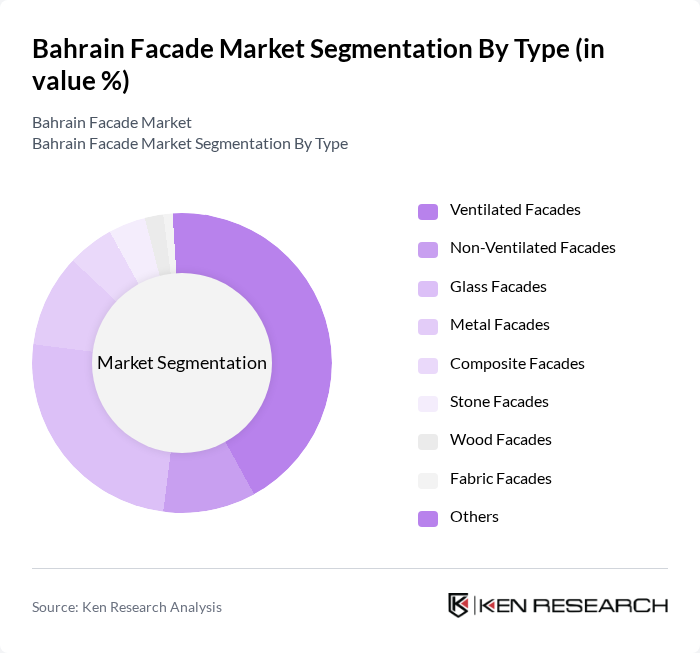
By Type:The facade market is segmented into ventilated facades, non-ventilated facades, glass facades, metal facades, composite facades, stone facades, wood facades, fabric facades, and others. Ventilated facades currently hold the largest market share, driven by their superior energy efficiency, moisture management, and thermal performance, which are increasingly prioritized in new construction. Glass facades remain highly sought after for their aesthetic appeal, natural light provision, and alignment with contemporary architectural trends. The demand for both ventilated and glass facades is supported by the growing preference for sustainable and innovative building designs in commercial and residential sectors.
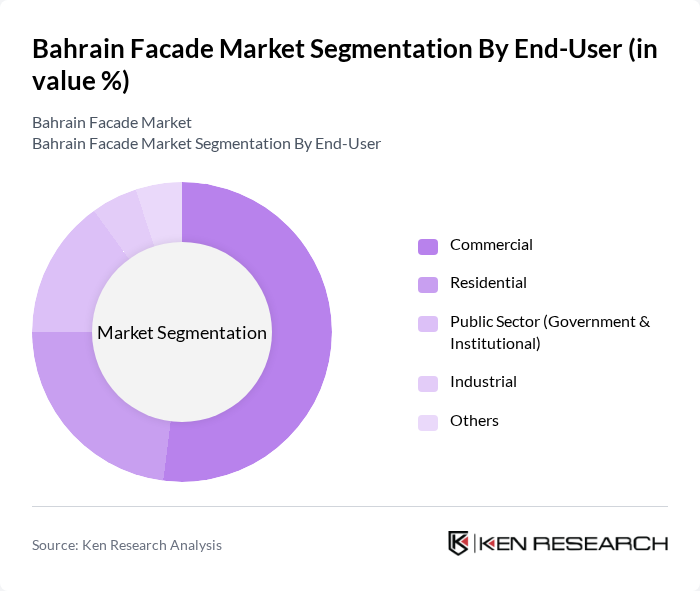
By End-User:The facade market is segmented by end-user into commercial, residential, public sector (government & institutional), industrial, and others. The commercial segment leads the market, supported by a surge in office buildings, retail centers, and mixed-use developments. Demand for modern, energy-efficient, and visually appealing facades in commercial properties is significant, as businesses seek to create attractive environments for clients and employees. Government initiatives promoting urban development and investment in commercial infrastructure further reinforce this trend.
The Bahrain Facade Market is characterized by a dynamic mix of regional and international players. Leading participants such as AluBond Middle East, Gulf Glass Fibre W.L.L., Alico Bahrain W.L.L., Al-Futtaim Engineering, Al-Moayyed Contracting Group, KCC Engineering & Contracting Company, Al-Salam International, Al-Ahlia Contracting Group, Al-Bahar Construction, Al-Mansoori Specialized Engineering, BFG International, Reynaers Middle East, Schüco Middle East, Technal Middle East, Al-Muharraq Group, Al-Bahrain Engineering contribute to innovation, geographic expansion, and service delivery in this space.
The Bahrain facade market is poised for significant growth, driven by urbanization and government initiatives aimed at enhancing infrastructure. As the demand for sustainable and energy-efficient solutions rises, manufacturers are likely to innovate and adapt to meet these needs. The integration of smart technologies in building facades will also play a crucial role in shaping the market landscape. Overall, the future appears promising, with opportunities for growth in both residential and commercial sectors, supported by favorable government policies.
| Segment | Sub-Segments |
|---|---|
| By Type | Ventilated Facades Non-Ventilated Facades Glass Facades Metal Facades Composite Facades Stone Facades Wood Facades Fabric Facades Others |
| By End-User | Commercial Residential Public Sector (Government & Institutional) Industrial Others |
| By Application | High-rise Buildings Shopping Malls & Retail Office Spaces Hospitality (Hotels & Resorts) Educational & Healthcare Institutions Others |
| By Material | Aluminum Steel Glass Composite Materials Stone Terracotta Ceramic Others |
| By Design Type | Curtain Wall Systems Panel Systems Cladding Systems Others |
| By Installation Type | Unitized Systems Stick-built Systems Hybrid/Semi-unitized Systems Others |
| By Region | Northern Governorate Southern Governorate Capital Governorate Muharraq Governorate Others |
| Scope Item/Segment | Sample Size | Target Respondent Profiles |
|---|---|---|
| Commercial Building Facades | 100 | Architects, Project Managers |
| Residential Facade Installations | 80 | Contractors, Home Builders |
| Facade Material Suppliers | 50 | Sales Managers, Product Development Managers |
| Facade Technology Innovations | 40 | R&D Managers, Industry Analysts |
| Facade Maintenance Services | 60 | Facility Managers, Maintenance Supervisors |
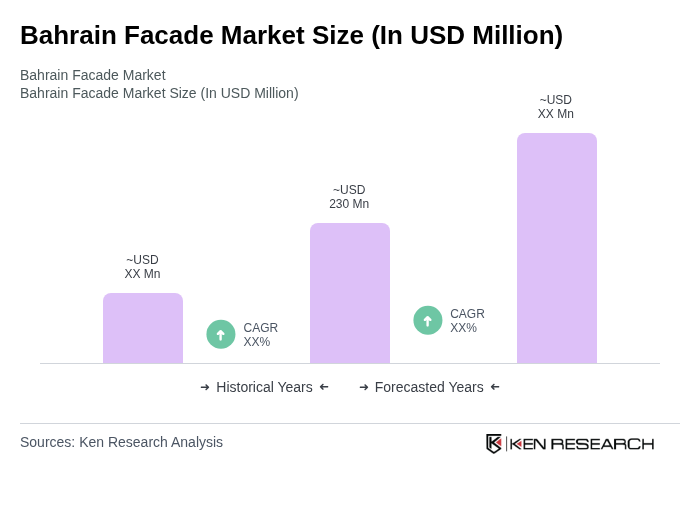
The Bahrain Facade Market is valued at approximately USD 230 million, reflecting growth driven by urbanization, infrastructure development, and a demand for energy-efficient building solutions. This market is expected to continue expanding as sustainability and aesthetic appeal become increasingly prioritized.

What makes us stand out is that our consultants follow Robust, Refine and Result (RRR) methodology. Robust for clear definitions, approaches and sanity checking, Refine for differentiating respondents' facts and opinions, and Result for presenting data with story.

We have set a benchmark in the industry by offering our clients with syndicated and customized market research reports featuring coverage of entire market as well as meticulous research and analyst insights.

While we don't replace traditional research, we flip the method upside down. Our dual approach of Top Bottom & Bottom Top ensures quality deliverable by not just verifying company fundamentals but also looking at the sector and macroeconomic factors.

With one step in the future, our research team constantly tries to show you the bigger picture. We help with some of the tough questions you may encounter along the way: How is the industry positioned? Best marketing channel? KPI's of competitors? By aligning every element, we help maximize success.

Our report gives you instant access to the answers and sources that other companies might choose to hide. We elaborate each steps of research methodology we have used and showcase you the sample size to earn your trust.

If you need any support, we are here! We pride ourselves on universe strength, data quality, and quick, friendly, and professional service.













