Bahrain Glufosinate Ammonium Market Report Size, Share, Growth Drivers, Trends, Opportunities & Forecast 2025–2030

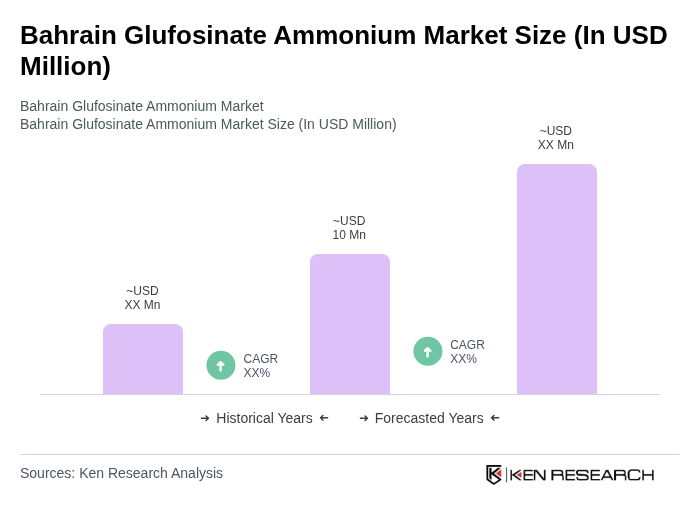
The Bahrain Glufosinate Ammonium Market, valued at USD 10 million, is driven by sustainable farming and effective weed control in high-value crops like fruits and vegetables.

Region:Middle East

Author(s):Shubham

Product Code:KRAD6650

Pages:81

Published On:December 2025
About the Report

Base Year 2024

Bahrain Glufosinate Ammonium Market Overview

  • The Bahrain Glufosinate Ammonium Market is valued at USD 10 million, based on a five-year historical analysis and its share within the Middle East and Africa glufosinate ammonium market, which generated about USD 9.2 million in revenue for the region as a whole. This growth is primarily driven by the increasing demand for effective herbicides in agricultural practices, particularly in the cultivation of high-value crops such as fruits and vegetables, as observed globally for glufosinate ammonium in food crops. The rising awareness of sustainable farming practices, the shift toward conservation agriculture, and the need for efficient weed management solutions in limited arable land conditions have further supported market expansion.
  • Key demand centers for agrochemicals in Bahrain include Manama, the capital, which serves as a central hub for agricultural input distribution and trade, and the Northern Governorate, which hosts a concentration of date palms, vegetable farms, and irrigated agriculture supported by groundwater and treated wastewater use. The presence of agricultural extension services and agrochemical distributors in and around these areas enhances access to glufosinate ammonium products and related crop protection solutions for growers.
  • In 2023, Bahrain’s government strengthened regulations on the safe handling and use of pesticides, including herbicides such as glufosinate ammonium, under the Pesticides (Organization of Handling, Use and Storage) Regulation issued pursuant to the Law on the Organization of the Use and Handling of Pesticides by the Ministry of Municipalities Affairs and Agriculture, which requires prior registration, safety and efficacy evaluation, and approval of all agrochemical products before import, distribution, and use. The framework includes conditions on labeling, storage, transport, licensing of applicators, and adherence to maximum residue limits, with the objective of protecting public health, workers, and the environment while supporting agricultural productivity.
Bahrain Glufosinate Ammonium Market Size

Bahrain Glufosinate Ammonium Market Segmentation

By Formulation Type:The formulation type segment includes various forms of glufosinate ammonium products, which cater to different agricultural needs. The subsegments are Aqueous Soluble Concentrate (SL), Suspension Concentrate (SC), Water-Dispersible Granules (WG/WDG), and Technical Grade (TC). Liquid formulations such as Aqueous Soluble Concentrate (SL) and Suspension Concentrate (SC) are increasingly preferred in global glufosinate ammonium use due to their convenient handling, mixing, and application, which allow precise dosing and effective broad-spectrum weed control in field and horticultural crops. In Bahrain, alignment with these trends and the predominance of irrigated, intensively managed crops support a relatively higher share for Aqueous Soluble Concentrate (SL) within the market.
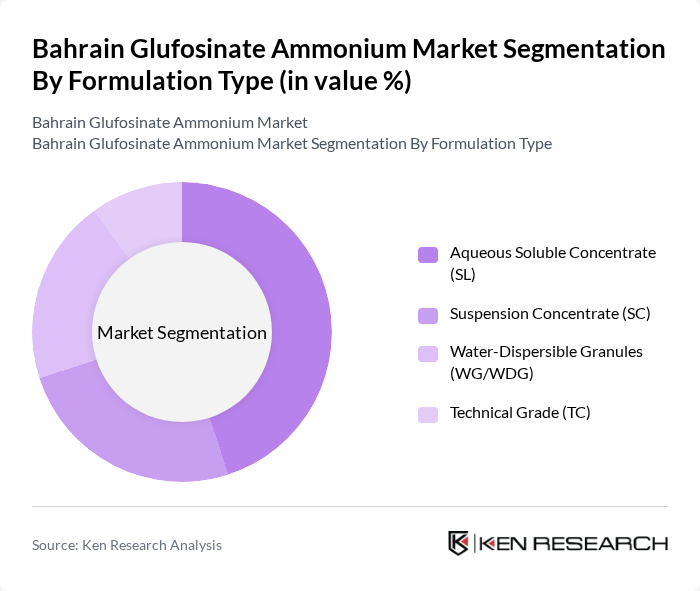
Bahrain Glufosinate Ammonium Market segmentation by Formulation Type.

By Crop Type:The crop type segment encompasses various agricultural categories where glufosinate ammonium is applied. This includes Fruit & Vegetable Crops (e.g., dates, cucurbits, leafy vegetables), Cereal & Forage Crops, Turf, Ornamentals & Landscape Management, and Plantation & Perennial Crops. The Fruit & Vegetable Crops segment is leading the market due to the strategic importance of horticultural production in Bahrain’s limited arable land, the high value of date and greenhouse vegetable crops, and the need for efficient, non-selective weed control compatible with drip and protected cultivation systems. At the global level, food crops and fruit orchards account for a major share of glufosinate ammonium consumption, and similar patterns of use in high-value fruit and vegetable systems are reflected in Bahrain.
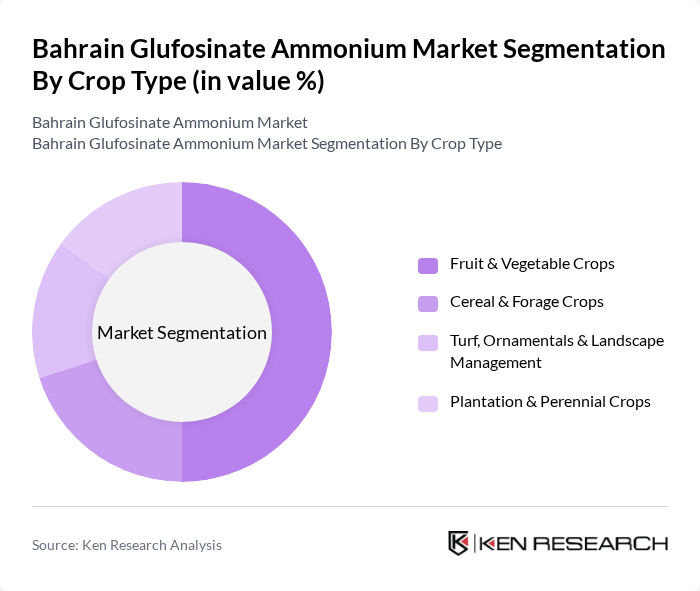
Bahrain Glufosinate Ammonium Market segmentation by Crop Type.

Bahrain Glufosinate Ammonium Market Competitive Landscape

The Bahrain Glufosinate Ammonium Market is characterized by a dynamic mix of regional and international players. Leading participants such as Bayer CropScience AG, BASF SE, Syngenta AG, Corteva Agriscience, UPL Limited, ADAMA Agricultural Solutions Ltd., Nufarm Limited, Zhejiang YongNong Bio-chem Co., Ltd., Lier Chemical Co., Ltd., Jiangsu Huifeng Agrochemical Co., Ltd., Hebei Veyong Bio-Chemical Co., Ltd., Albaugh LLC, Sumitomo Chemical Co., Ltd., FMC Corporation, Local and Regional GCC Distributors (e.g., Bahrain-based agrochemical importers) contribute to innovation, geographic expansion, and service delivery in this space.

Bayer CropScience AG

2002

Monheim am Rhein, Germany

BASF SE

1865

Ludwigshafen, Germany

Syngenta AG

2000

Basel, Switzerland

Corteva Agriscience

2019

Indianapolis, USA

UPL Limited

1969

Mumbai, India

Company

Establishment Year

Headquarters

Bahrain Glufosinate Revenues (USD Million)

Bahrain Glufosinate Volume Sold (Tons per Year)

Market Share in Bahrain Glufosinate Ammonium Market (%)

3-Year CAGR in Bahrain Glufosinate Sales (%)

Average Realized Price per Liter/Kilogram in Bahrain (USD)

Portfolio Breadth in Glufosinate Formulations (Number of SKUs)

Bahrain Glufosinate Ammonium Market Industry Analysis

Growth Drivers

  • Increasing Demand for Sustainable Agriculture:The Bahrain agricultural sector is projected to grow by 3.5% annually, driven by a shift towards sustainable practices. In the future, the government aims to increase organic farming areas by 20%, reflecting a commitment to eco-friendly agriculture. This trend is supported by a 15% rise in consumer preference for sustainably sourced products, indicating a robust market for glufosinate ammonium as a herbicide that aligns with these sustainable practices.
  • Rising Awareness of Herbicide Resistance:With herbicide-resistant weed species increasing by 10% annually in Bahrain, farmers are seeking effective solutions. The demand for glufosinate ammonium is expected to rise as it offers a non-selective herbicide option that can combat resistant weeds. In the future, educational programs are projected to reach 5,000 farmers, enhancing awareness of herbicide resistance and promoting the adoption of glufosinate ammonium as a viable alternative.
  • Government Initiatives Promoting Eco-Friendly Products:The Bahraini government has allocated $2 million for initiatives aimed at promoting eco-friendly agricultural products in the future. This funding supports research and development of sustainable herbicides, including glufosinate ammonium. Additionally, regulations are being established to incentivize the use of environmentally safe products, which is expected to increase market penetration and adoption rates among local farmers by 25% over the next year.

Market Challenges

  • Stringent Regulatory Requirements:The regulatory landscape in Bahrain is becoming increasingly complex, with new herbicide registration processes taking up to 18 months. In the future, the government plans to implement stricter environmental assessments, which could delay market entry for new glufosinate ammonium formulations. This regulatory burden may hinder innovation and limit the availability of effective herbicide solutions for farmers, impacting overall market growth.
  • Competition from Alternative Herbicides:The market for herbicides in Bahrain is highly competitive, with over 30 alternative products available. In the future, the introduction of two new herbicides that claim lower environmental impact could divert attention from glufosinate ammonium. This competition may lead to price pressures and reduced market share for glufosinate ammonium, as farmers may opt for perceived safer or more cost-effective alternatives, challenging its market position.

Bahrain Glufosinate Ammonium Market Future Outlook

The Bahrain glufosinate ammonium market is poised for significant transformation as sustainable agricultural practices gain traction. In the future, advancements in precision agriculture are expected to enhance application efficiency, reducing waste and increasing crop yields. Additionally, the growing trend towards integrated pest management will likely drive demand for glufosinate ammonium as part of holistic farming strategies. These developments indicate a promising future for the market, with potential for increased adoption and innovation in herbicide formulations.

Market Opportunities

  • Development of New Formulations:There is a significant opportunity for developing new glufosinate ammonium formulations tailored to local crops. With a projected increase in crop diversity by 15% in the future, customized solutions can enhance efficacy and farmer satisfaction, potentially increasing market share by 20% within two years.
  • Partnerships with Local Agricultural Bodies:Collaborating with local agricultural organizations can facilitate knowledge transfer and promote glufosinate ammonium usage. In the future, partnerships could reach over 10,000 farmers, enhancing product visibility and adoption rates, ultimately driving sales growth and fostering sustainable agricultural practices in Bahrain.

Scope of the Report

SegmentSub-Segments
By Formulation Type

Aqueous Soluble Concentrate (SL)

Suspension Concentrate (SC)

Water-Dispersible Granules (WG/WDG)

Technical Grade (TC)

By Crop Type

Fruit & Vegetable Crops (e.g., dates, cucurbits, leafy vegetables)

Cereal & Forage Crops

Turf, Ornamentals & Landscape Management

Plantation & Perennial Crops

By Application

Pre-Plant and Pre-Emergence Weed Control

Post-Emergence Weed Control in Orchards and Plantations

Non-Crop Applications (roadsides, industrial areas, utilities)

Glufosinate-Tolerant Crop Systems

By Distribution Channel

Direct Sales to Large Farms and Agroholdings

Agricultural Input Distributors

Agro-Dealer & Cooperative Retail Outlets

Online and Digital Agriculture Platforms

By Packaging Type

Bulk Packaging (>20 Liters / >20 Kilograms)

Mid-Size Packs (5–20 Liters / 5–20 Kilograms)

Small Packs (<5 Liters / <5 Kilograms)

By End-User

Commercial Farms and Agribusinesses

Smallholder Farmers

Government and Municipal Authorities

Landscaping and Facility Management Companies

By Region in Bahrain

Capital Governorate (Manama and surrounding areas)

Northern Governorate

Southern Governorate

Muharraq Governorate

Key Target Audience

Investors and Venture Capitalist Firms

Government and Regulatory Bodies (e.g., Ministry of Agriculture and Marine Resources, Bahrain Environmental Authority)

Manufacturers and Producers of Agrochemicals

Distributors and Retailers of Agricultural Products

Pesticide and Herbicide Importers

Industry Associations (e.g., Bahrain Agricultural Society)

Financial Institutions and Banks

Agrochemical Research and Development Organizations

Players Mentioned in the Report:

Bayer CropScience AG

BASF SE

Syngenta AG

Corteva Agriscience

UPL Limited

ADAMA Agricultural Solutions Ltd.

Nufarm Limited

Zhejiang YongNong Bio-chem Co., Ltd.

Lier Chemical Co., Ltd.

Jiangsu Huifeng Agrochemical Co., Ltd.

Hebei Veyong Bio-Chemical Co., Ltd.

Albaugh LLC

Sumitomo Chemical Co., Ltd.

FMC Corporation

Local and Regional GCC Distributors (e.g., Bahrain-based agrochemical importers)

Table of Contents

Market Assessment Phase

1. Executive Summary and Approach


2. Bahrain Glufosinate Ammonium Market Overview

2.1 Key Insights and Strategic Recommendations

2.2 Bahrain Glufosinate Ammonium Market Overview

2.3 Definition and Scope

2.4 Evolution of Market Ecosystem

2.5 Timeline of Key Regulatory Milestones

2.6 Value Chain & Stakeholder Mapping

2.7 Business Cycle Analysis

2.8 Policy & Incentive Landscape


3. Bahrain Glufosinate Ammonium Market Analysis

3.1 Growth Drivers

3.1.1 Increasing demand for sustainable agriculture
3.1.2 Rising awareness of herbicide resistance
3.1.3 Government initiatives promoting eco-friendly products
3.1.4 Expansion of agricultural land in Bahrain

3.2 Market Challenges

3.2.1 Stringent regulatory requirements
3.2.2 Competition from alternative herbicides
3.2.3 Price volatility of raw materials
3.2.4 Limited awareness among farmers

3.3 Market Opportunities

3.3.1 Development of new formulations
3.3.2 Partnerships with local agricultural bodies
3.3.3 Export potential to neighboring countries
3.3.4 Technological advancements in application methods

3.4 Market Trends

3.4.1 Shift towards integrated pest management
3.4.2 Increasing adoption of precision agriculture
3.4.3 Growth in organic farming practices
3.4.4 Rising consumer demand for chemical-free produce

3.5 Government Regulation

3.5.1 Registration and approval processes for herbicides
3.5.2 Environmental impact assessments
3.5.3 Labeling and safety requirements
3.5.4 Restrictions on usage in sensitive areas

4. SWOT Analysis


5. Stakeholder Analysis


6. Porter's Five Forces Analysis


7. Bahrain Glufosinate Ammonium Market Market Size, 2019-2024

7.1 By Value

7.2 By Volume

7.3 By Average Selling Price


8. Bahrain Glufosinate Ammonium Market Segmentation

8.1 By Formulation Type

8.1.1 Aqueous Soluble Concentrate (SL)
8.1.2 Suspension Concentrate (SC)
8.1.3 Water-Dispersible Granules (WG/WDG)
8.1.4 Technical Grade (TC)

8.2 By Crop Type

8.2.1 Fruit & Vegetable Crops (e.g., dates, cucurbits, leafy vegetables)
8.2.2 Cereal & Forage Crops
8.2.3 Turf, Ornamentals & Landscape Management
8.2.4 Plantation & Perennial Crops

8.3 By Application

8.3.1 Pre-Plant and Pre-Emergence Weed Control
8.3.2 Post-Emergence Weed Control in Orchards and Plantations
8.3.3 Non-Crop Applications (roadsides, industrial areas, utilities)
8.3.4 Glufosinate-Tolerant Crop Systems

8.4 By Distribution Channel

8.4.1 Direct Sales to Large Farms and Agroholdings
8.4.2 Agricultural Input Distributors
8.4.3 Agro-Dealer & Cooperative Retail Outlets
8.4.4 Online and Digital Agriculture Platforms

8.5 By Packaging Type

8.5.1 Bulk Packaging (>20 Liters / >20 Kilograms)
8.5.2 Mid-Size Packs (5–20 Liters / 5–20 Kilograms)
8.5.3 Small Packs (<5 Liters / <5 Kilograms)

8.6 By End-User

8.6.1 Commercial Farms and Agribusinesses
8.6.2 Smallholder Farmers
8.6.3 Government and Municipal Authorities
8.6.4 Landscaping and Facility Management Companies

8.7 By Region in Bahrain

8.7.1 Capital Governorate (Manama and surrounding areas)
8.7.2 Northern Governorate
8.7.3 Southern Governorate
8.7.4 Muharraq Governorate

9. Bahrain Glufosinate Ammonium Market Competitive Analysis

9.1 Market Share of Key Players

9.2 Cross Comparison of Key Players

9.2.1 Company Name
9.2.2 Bahrain Glufosinate Revenues (USD Million)
9.2.3 Bahrain Glufosinate Volume Sold (Tons per Year)
9.2.4 Market Share in Bahrain Glufosinate Ammonium Market (%)
9.2.5 3-Year CAGR in Bahrain Glufosinate Sales (%)
9.2.6 Average Realized Price per Liter/Kilogram in Bahrain (USD)
9.2.7 Portfolio Breadth in Glufosinate Formulations (Number of SKUs)
9.2.8 Geographic Reach within Bahrain (Number of Governorates Served)
9.2.9 Number of Active Distributor/Dealer Partnerships in Bahrain
9.2.10 Registration & Regulatory Approvals Held in GCC Countries (Count)
9.2.11 R&D / Product Registration Spend Related to GCC (% of Sales)
9.2.12 Credit Terms and Channel Support Intensity (Days, Rebates)

9.3 SWOT Analysis of Top Players

9.4 Pricing Analysis

9.5 Detailed Profile of Major Companies

9.5.1 Bayer CropScience AG
9.5.2 BASF SE
9.5.3 Syngenta AG
9.5.4 Corteva Agriscience
9.5.5 UPL Limited
9.5.6 ADAMA Agricultural Solutions Ltd.
9.5.7 Nufarm Limited
9.5.8 Zhejiang YongNong Bio-chem Co., Ltd.
9.5.9 Lier Chemical Co., Ltd.
9.5.10 Jiangsu Huifeng Agrochemical Co., Ltd.
9.5.11 Hebei Veyong Bio-Chemical Co., Ltd.
9.5.12 Albaugh LLC
9.5.13 Sumitomo Chemical Co., Ltd.
9.5.14 FMC Corporation
9.5.15 Local and Regional GCC Distributors (e.g., Bahrain-based agrochemical importers)

10. Bahrain Glufosinate Ammonium Market End-User Analysis

10.1 Procurement Behavior of Key Ministries

10.1.1 Ministry of Agriculture
10.1.2 Ministry of Environment
10.1.3 Ministry of Commerce

10.2 Corporate Spend on Infrastructure & Energy

10.2.1 Investment in Sustainable Practices
10.2.2 Budget Allocation for Herbicides

10.3 Pain Point Analysis by End-User Category

10.3.1 Cost of Inputs
10.3.2 Availability of Products

10.4 User Readiness for Adoption

10.4.1 Training and Support Needs
10.4.2 Awareness of Benefits

10.5 Post-Deployment ROI and Use Case Expansion

10.5.1 Measurement of Effectiveness
10.5.2 Opportunities for Scaling

11. Bahrain Glufosinate Ammonium Market Future Size, 2025-2030

11.1 By Value

11.2 By Volume

11.3 By Average Selling Price


Go-To-Market Strategy Phase

1. Whitespace Analysis + Business Model Canvas

1.1 Market Gaps Identification

1.2 Business Model Framework


2. Marketing and Positioning Recommendations

2.1 Branding Strategies

2.2 Product USPs


3. Distribution Plan

3.1 Urban Retail Strategies

3.2 Rural NGO Tie-ups


4. Channel & Pricing Gaps

4.1 Underserved Routes

4.2 Pricing Bands


5. Unmet Demand & Latent Needs

5.1 Category Gaps

5.2 Consumer Segments


6. Customer Relationship

6.1 Loyalty Programs

6.2 After-sales Service


7. Value Proposition

7.1 Sustainability Initiatives

7.2 Integrated Supply Chains


8. Key Activities

8.1 Regulatory Compliance

8.2 Branding Efforts

8.3 Distribution Setup


9. Entry Strategy Evaluation

9.1 Domestic Market Entry Strategy

9.1.1 Product Mix
9.1.2 Pricing Band
9.1.3 Packaging Considerations

9.2 Export Entry Strategy

9.2.1 Target Countries
9.2.2 Compliance Roadmap

10. Entry Mode Assessment

10.1 Joint Ventures

10.2 Greenfield Investments

10.3 Mergers & Acquisitions

10.4 Distributor Model


11. Capital and Timeline Estimation

11.1 Capital Requirements

11.2 Timelines for Implementation


12. Control vs Risk Trade-Off

12.1 Ownership Considerations

12.2 Partnerships Evaluation


13. Profitability Outlook

13.1 Breakeven Analysis

13.2 Long-term Sustainability


14. Potential Partner List

14.1 Distributors

14.2 Joint Ventures

14.3 Acquisition Targets


15. Execution Roadmap

15.1 Phased Plan for Market Entry

15.1.1 Market Setup
15.1.2 Market Entry
15.1.3 Growth Acceleration
15.1.4 Scale & Stabilize

15.2 Key Activities and Milestones

15.2.1 Activity Timeline
15.2.2 Milestone Tracking

Research Methodology

ApproachModellingSample

Phase 1: Approach1

Desk Research

  • Analysis of market reports from Bahrain's Ministry of Industry and Commerce
  • Review of academic journals and publications on glufosinate ammonium applications
  • Examination of trade statistics and import/export data from Bahrain's Customs Authority

Primary Research

  • Interviews with agricultural experts and agronomists specializing in herbicides
  • Surveys with distributors and retailers of agrochemicals in Bahrain
  • Field visits to farms utilizing glufosinate ammonium for crop management

Validation & Triangulation

  • Cross-validation of findings with industry reports and expert opinions
  • Triangulation of data from government sources, market players, and academic research
  • Sanity checks through feedback from a panel of agribusiness experts

Phase 2: Market Size Estimation1

Top-down Assessment

  • Estimation of total agrochemical market size in Bahrain as a baseline
  • Segmentation of glufosinate ammonium usage by crop type and application method
  • Incorporation of growth trends in organic farming and sustainable agriculture

Bottom-up Modeling

  • Collection of sales data from key distributors of glufosinate ammonium
  • Estimation of average application rates per hectare for various crops
  • Calculation of total market volume based on farm acreage and usage rates

Forecasting & Scenario Analysis

  • Development of predictive models based on historical usage trends and market drivers
  • Scenario analysis considering regulatory changes and environmental impacts
  • Projections of market growth under different agricultural policy frameworks

Phase 3: CATI Sample Composition1

Scope Item/SegmentSample SizeTarget Respondent Profiles
Agrochemical Distributors60Sales Managers, Product Line Managers
Farmers Using Glufosinate Ammonium120Crop Managers, Farm Owners
Agricultural Researchers50Research Scientists, University Professors
Regulatory Authorities40Policy Makers, Environmental Officers
Retailers of Agrochemicals70Store Managers, Procurement Specialists

Frequently Asked Questions

What is the current value of the Bahrain Glufosinate Ammonium Market?

The Bahrain Glufosinate Ammonium Market is valued at approximately USD 10 million, reflecting its share within the broader Middle East and Africa glufosinate ammonium market, which generated around USD 9.2 million in revenue.

What factors are driving the growth of the Glufosinate Ammonium Market in Bahrain?

Which regions in Bahrain are the main demand centers for agrochemicals?

What regulations govern the use of Glufosinate Ammonium in Bahrain?

Other Regional/Country Reports

Indonesia Glufosinate Ammonium Market

Malaysia Glufosinate Ammonium Market

KSA Glufosinate Ammonium Market

APAC Glufosinate Ammonium Market

SEA Glufosinate Ammonium Market

Vietnam Glufosinate Ammonium Market

Why Buy From Us?

Refine Robust Result (RRR) Framework

What makes us stand out is that our consultants follow Robust, Refine and Result (RRR) methodology. Robust for clear definitions, approaches and sanity checking, Refine for differentiating respondents' facts and opinions, and Result for presenting data with story.

Our Reach Is Unmatched

We have set a benchmark in the industry by offering our clients with syndicated and customized market research reports featuring coverage of entire market as well as meticulous research and analyst insights.

Shifting the Research Paradigm

While we don't replace traditional research, we flip the method upside down. Our dual approach of Top Bottom & Bottom Top ensures quality deliverable by not just verifying company fundamentals but also looking at the sector and macroeconomic factors.

More Insights-Better Decisions

With one step in the future, our research team constantly tries to show you the bigger picture. We help with some of the tough questions you may encounter along the way: How is the industry positioned? Best marketing channel? KPI's of competitors? By aligning every element, we help maximize success.

Transparency and Trust

Our report gives you instant access to the answers and sources that other companies might choose to hide. We elaborate each steps of research methodology we have used and showcase you the sample size to earn your trust.

Round the Clock Support

If you need any support, we are here! We pride ourselves on universe strength, data quality, and quick, friendly, and professional service.

Why Clients Choose Us?

400000+
Reports in repository
150+
Consulting projects a year
100+
Analysts
8000+
Client Queries in 2022








