Ken Research Logo

Bahrain Lignin Based Biopolymers Market

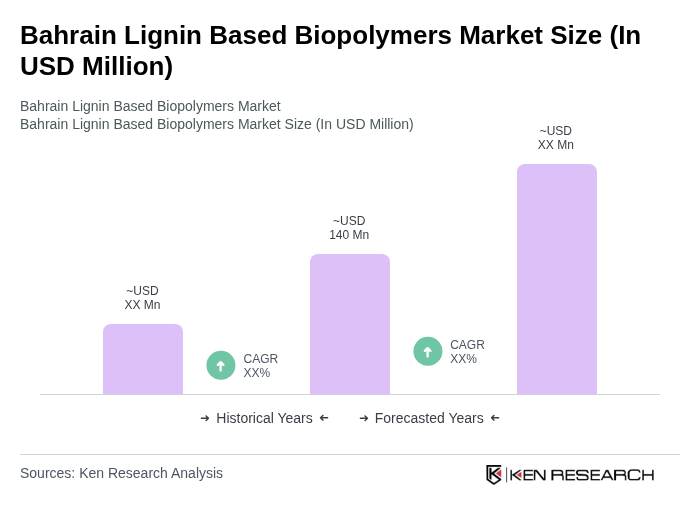
Bahrain Lignin Based Biopolymers Market, valued at USD 140 million, grows due to eco-friendly trends, technological advances, and policies promoting sustainable packaging and construction materials.

Region:Middle East

Author(s):Dev

Product Code:KRAD5293

Pages:92

Published On:December 2025
About the Report

Base Year 2024

Bahrain Lignin Based Biopolymers Market Overview

  • The Bahrain Lignin Based Biopolymers Market is valued at USD 140 million, based on a five-year historical analysis, aligning with the broader bio-based polymers investment and demand trends observed in Bahrain and the Middle East region. This growth is primarily driven by the increasing demand for sustainable materials in various industries, including packaging and construction, as well as the rising awareness of environmental issues. The shift towards bio-based products is further supported by technological advancements in lignin extraction and processing methods, such as improved fractionation, lignin valorization, and lignin-based resins and composites.
  • Key players in this market include Bahrain's Capital Governorate (Manama) and the Northern Governorate, which are leading demand and distribution centers due to their strategic locations, logistics connectivity, and established industrial infrastructure. Industrial zones around Manama host downstream plastic converters, construction chemical distributors, and packaging companies that are early adopters of bio-based and lignin-derived additives rather than large integrated pulp and paper mills, which are more prevalent in North America and Europe. These governorates therefore function as critical hubs for importing lignin-based intermediates, formulating admixtures and bioplastics, and supplying them into local and GCC-wide value chains.
  • In 2023, Bahrain's government strengthened its sustainability framework affecting polymers and packaging, including measures promoting the use of bio-based and recyclable materials in construction and packaging sectors. This policy direction is reinforced by instruments such as the Waste Management Law issued under Legislative Decree No. 35 of 2023 by the Government of Bahrain, which mandates improved waste reduction, segregation, and recovery, encouraging the substitution of conventional plastics with more sustainable alternatives in industrial and municipal streams. Incentives and public procurement preferences linked to circular economy and green building initiatives further support companies adopting lignin-based and other bio-based solutions to reduce plastic waste and enhance the use of renewable resources in industrial applications.
Bahrain Lignin Based Biopolymers Market Size

Bahrain Lignin Based Biopolymers Market Segmentation

By Product Type:The product type segmentation includes Lignosulfonates, Kraft Lignin, Organosolv Lignin, and Hydrolyzed Lignin and Other Specialty Lignin Fractions. Lignosulfonates are the most dominant globally and in regional trade flows due to their extensive applications in construction as plasticizers and water-reducing admixtures, and in agriculture as dispersants and soil conditioners. The increasing focus on sustainable agricultural practices, low-carbon concrete, and eco-friendly chemical additives is driving the demand for Lignosulfonates. Kraft Lignin follows closely, with growing use in the production of bioplastics, phenol-replacement resins, adhesives, and carbon-fiber precursors, supported by technology advances in kraft lignin purification and functionalization.
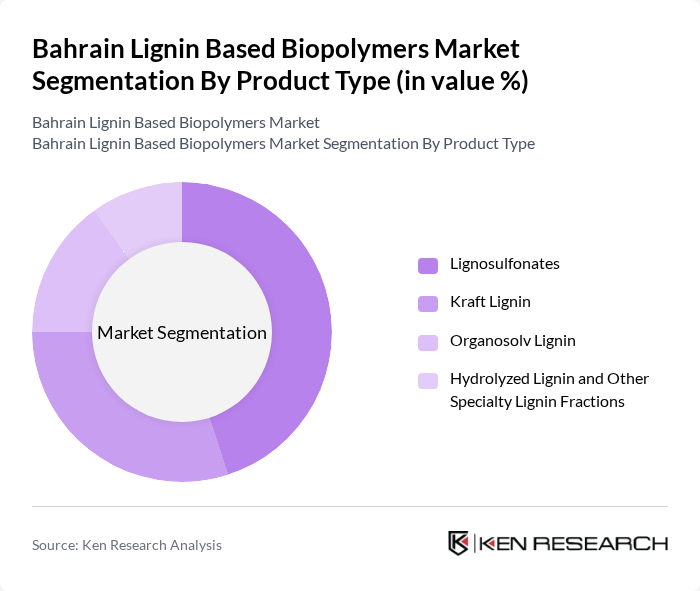
Bahrain Lignin Based Biopolymers Market segmentation by Product Type.

By End-Use Industry:The end-use industry segmentation includes Packaging & Bioplastics, Construction & Concrete Admixtures, Agriculture & Agrochemicals, Automotive & Transportation Composites, and Energy, Chemicals & Others. The Packaging & Bioplastics segment is leading the market, supported by consumer preference for biodegradable and bio-based materials, and by regional and global restrictions on single-use plastics that are accelerating the shift towards lignin-containing bioplastics, paper-coating formulations, and barrier materials. The Construction & Concrete Admixtures segment is also significant, as lignin-based dispersants and water reducers are increasingly used to improve workability and reduce the clinker and cement content of concrete, aligning with green building and low-carbon construction initiatives. Agriculture & Agrochemicals benefit from lignin’s role as a carrier, dispersant, and controlled-release matrix in fertilizers and pesticides, while Automotive & Transportation Composites, along with the Energy, Chemicals & Others category, are gradually adopting lignin-based resins, foams, and carbon materials in lightweight components and specialty chemical applications.
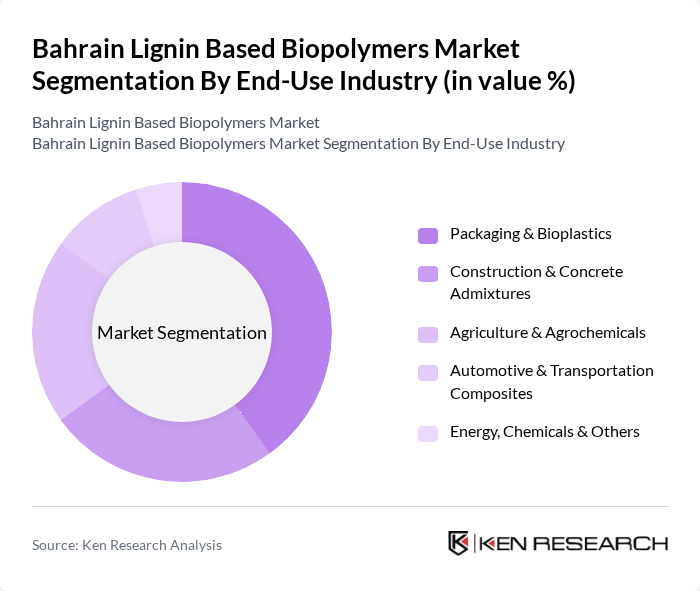
Bahrain Lignin Based Biopolymers Market segmentation by End-Use Industry.

Bahrain Lignin Based Biopolymers Market Competitive Landscape

The Bahrain Lignin Based Biopolymers Market is characterized by a dynamic mix of regional and international players. Leading participants such as Borregaard ASA, Stora Enso Oyj, UPM Biochemicals (UPM-Kymmene Corporation), Domtar Corporation, Ingevity Corporation, West Fraser Timber Co. Ltd., MetGen Oy, Green Science Alliance Co., Ltd., BASF SE, NatureWorks LLC, Archer Daniels Midland Company (ADM), RISE Research Institutes of Sweden, Suzano S.A., Sappi Limited, Middle East Green Chemicals W.L.L. (Bahrain) contribute to innovation, geographic expansion, and service delivery in this space.

Borregaard ASA

1889

Norway

Stora Enso Oyj

1998

Finland

UPM Biochemicals

1996

Finland

Domtar Corporation

1848

USA

Ingevity Corporation

2016

USA

Company

Establishment Year

Headquarters

Regional Presence in Bahrain and GCC (Number of Active Countries / Sites)

Revenues from Lignin-Based Biopolymers in the Middle East (USD Million)

Share of Lignin-Based Biopolymers in Total Company Revenue (%)

3-Year CAGR in Lignin-Based Biopolymers Sales in Bahrain / GCC (%)

Installed Lignin Processing Capacity Serving GCC (kTPA)

Number of Lignin-Based Grades / Product Lines Offered

Bahrain Lignin Based Biopolymers Market Industry Analysis

Growth Drivers

  • Increasing Demand for Sustainable Materials:The global shift towards sustainability is driving the demand for lignin-based biopolymers. In future, the global biopolymer market is projected to reach $25 billion, with lignin-based products accounting for a significant share. Bahrain's commitment to sustainable development, reflected in its Vision 2030 initiative, aims to reduce carbon emissions by 30% by 2030, further boosting the demand for eco-friendly materials in various sectors, including packaging and construction.
  • Government Initiatives Promoting Biopolymers:The Bahraini government has introduced several initiatives to promote the use of biopolymers, including tax incentives and grants for research and development. In future, the government plans to allocate $7 million towards biopolymer research, aiming to enhance local production capabilities. This support is crucial for fostering innovation and attracting investments in the lignin-based biopolymer sector, aligning with global sustainability goals and enhancing economic diversification.
  • Technological Advancements in Lignin Extraction:Recent advancements in lignin extraction technologies have significantly improved yield and efficiency. In future, new extraction methods are expected to increase lignin yield by 30%, making it more economically viable for manufacturers. These innovations not only reduce production costs but also enhance the quality of lignin-based biopolymers, positioning Bahrain as a competitive player in the global market for sustainable materials.

Market Challenges

  • High Production Costs:The production of lignin-based biopolymers remains costly, primarily due to the extraction and processing technologies involved. In future, the average production cost is estimated at $3,500 per ton, which is significantly higher than conventional plastics. This cost disparity poses a challenge for market penetration, as manufacturers may hesitate to switch to biopolymers without substantial price reductions or government subsidies to offset the initial investment.
  • Limited Awareness Among End-Users:Despite the environmental benefits, there is a notable lack of awareness regarding lignin-based biopolymers among end-users. In future, only 50% of manufacturers in Bahrain are expected to utilize biopolymers, primarily due to misconceptions about performance and availability. This limited understanding hampers market growth, necessitating targeted educational campaigns to inform potential users about the advantages and applications of lignin-based products.

Bahrain Lignin Based Biopolymers Market Future Outlook

The future of the Bahrain lignin-based biopolymers market appears promising, driven by increasing environmental awareness and government support. As global demand for sustainable materials rises, local manufacturers are likely to invest in innovative extraction technologies and product development. In future, the market is expected to witness a surge in collaborations between industry players and research institutions, fostering advancements in biopolymer applications. This collaborative approach will enhance Bahrain's position in the regional market, paving the way for sustainable growth and economic diversification.

Market Opportunities

  • Expansion into New Applications:There is significant potential for lignin-based biopolymers to penetrate new markets, such as automotive and electronics. In future, the automotive sector is projected to adopt biopolymers for lightweight components, potentially increasing demand by 20%. This diversification can enhance market resilience and open new revenue streams for local manufacturers.
  • Collaborations with Research Institutions:Partnerships with research institutions can drive innovation in lignin-based products. In future, collaborative projects are expected to yield at least five new biopolymer formulations, enhancing product performance and expanding application areas. Such collaborations can also attract funding and expertise, further strengthening Bahrain's biopolymer industry.

Scope of the Report

SegmentSub-Segments
By Product Type

Lignosulfonates

Kraft Lignin

Organosolv Lignin

Hydrolyzed Lignin and Other Specialty Lignin Fractions

By End-Use Industry

Packaging & Bioplastics

Construction & Concrete Admixtures

Agriculture & Agrochemicals

Automotive & Transportation Composites

Energy, Chemicals & Others

By Application

Dispersants & Plasticizers

Adhesives & Binders

Biopolymer Blends & Composites

Carbon Fibers, Resins & Other High-Value Applications

By Source Industry

Pulp & Paper Mills

Biorefineries

Other Industrial Side-Streams

By Distribution Channel

Direct Sales to Industrial Customers

International Traders & Chemical Distributors

Online B2B Platforms

Others

By Region within Bahrain

Capital Governorate (Manama)

Northern Governorate

Southern Governorate

Muharraq Governorate & Others

By Policy & Incentive Support

Industrial Subsidies & Concessional Financing

Tax Exemptions & Customs Duty Relief

R&D Grants & Innovation Programs

Sustainability, ESG & Green Procurement Incentives

Key Target Audience

Investors and Venture Capitalist Firms

Government and Regulatory Bodies (e.g., Bahrain Ministry of Industry and Commerce)

Manufacturers and Producers of Biopolymers

Distributors and Retailers of Biopolymer Products

Biopolymer Research and Development Organizations

Industry Associations (e.g., Bahrain Chamber of Commerce and Industry)

Financial Institutions and Banks

Environmental NGOs and Sustainability Advocates

Players Mentioned in the Report:

Borregaard ASA

Stora Enso Oyj

UPM Biochemicals (UPM-Kymmene Corporation)

Domtar Corporation

Ingevity Corporation

West Fraser Timber Co. Ltd.

MetGen Oy

Green Science Alliance Co., Ltd.

BASF SE

NatureWorks LLC

Archer Daniels Midland Company (ADM)

RISE Research Institutes of Sweden

Suzano S.A.

Sappi Limited

Middle East Green Chemicals W.L.L. (Bahrain)

Table of Contents

Market Assessment Phase

1. Executive Summary and Approach


2. Bahrain Lignin Based Biopolymers Market Overview

2.1 Key Insights and Strategic Recommendations

2.2 Bahrain Lignin Based Biopolymers Market Overview

2.3 Definition and Scope

2.4 Evolution of Market Ecosystem

2.5 Timeline of Key Regulatory Milestones

2.6 Value Chain & Stakeholder Mapping

2.7 Business Cycle Analysis

2.8 Policy & Incentive Landscape


3. Bahrain Lignin Based Biopolymers Market Analysis

3.1 Growth Drivers

3.1.1 Increasing demand for sustainable materials
3.1.2 Government initiatives promoting biopolymers
3.1.3 Rising awareness of environmental issues
3.1.4 Technological advancements in lignin extraction

3.2 Market Challenges

3.2.1 High production costs
3.2.2 Limited awareness among end-users
3.2.3 Competition from conventional plastics
3.2.4 Regulatory hurdles

3.3 Market Opportunities

3.3.1 Expansion into new applications
3.3.2 Collaborations with research institutions
3.3.3 Development of innovative products
3.3.4 Export potential to neighboring markets

3.4 Market Trends

3.4.1 Shift towards biodegradable materials
3.4.2 Increased investment in R&D
3.4.3 Growth of circular economy initiatives
3.4.4 Rising consumer preference for eco-friendly products

3.5 Government Regulation

3.5.1 Biopolymer production standards
3.5.2 Environmental impact assessments
3.5.3 Incentives for sustainable practices
3.5.4 Import/export regulations for biopolymers

4. SWOT Analysis


5. Stakeholder Analysis


6. Porter's Five Forces Analysis


7. Bahrain Lignin Based Biopolymers Market Market Size, 2019-2024

7.1 By Value

7.2 By Volume

7.3 By Average Selling Price


8. Bahrain Lignin Based Biopolymers Market Segmentation

8.1 By Product Type

8.1.1 Lignosulfonates
8.1.2 Kraft Lignin
8.1.3 Organosolv Lignin
8.1.4 Hydrolyzed Lignin and Other Specialty Lignin Fractions

8.2 By End-Use Industry

8.2.1 Packaging & Bioplastics
8.2.2 Construction & Concrete Admixtures
8.2.3 Agriculture & Agrochemicals
8.2.4 Automotive & Transportation Composites
8.2.5 Energy, Chemicals & Others

8.3 By Application

8.3.1 Dispersants & Plasticizers
8.3.2 Adhesives & Binders
8.3.3 Biopolymer Blends & Composites
8.3.4 Carbon Fibers, Resins & Other High-Value Applications

8.4 By Source Industry

8.4.1 Pulp & Paper Mills
8.4.2 Biorefineries
8.4.3 Other Industrial Side-Streams

8.5 By Distribution Channel

8.5.1 Direct Sales to Industrial Customers
8.5.2 International Traders & Chemical Distributors
8.5.3 Online B2B Platforms
8.5.4 Others

8.6 By Region within Bahrain

8.6.1 Capital Governorate (Manama)
8.6.2 Northern Governorate
8.6.3 Southern Governorate
8.6.4 Muharraq Governorate & Others

8.7 By Policy & Incentive Support

8.7.1 Industrial Subsidies & Concessional Financing
8.7.2 Tax Exemptions & Customs Duty Relief
8.7.3 R&D Grants & Innovation Programs
8.7.4 Sustainability, ESG & Green Procurement Incentives

9. Bahrain Lignin Based Biopolymers Market Competitive Analysis

9.1 Market Share of Key Players

9.2 Cross Comparison of Key Players

9.2.1 Company Name
9.2.2 Regional Presence in Bahrain and GCC (Number of Active Countries / Sites)
9.2.3 Revenues from Lignin-Based Biopolymers in the Middle East (USD Million)
9.2.4 Share of Lignin-Based Biopolymers in Total Company Revenue (%)
9.2.5 3-Year CAGR in Lignin-Based Biopolymers Sales in Bahrain / GCC (%)
9.2.6 Installed Lignin Processing Capacity Serving GCC (kTPA)
9.2.7 Number of Lignin-Based Grades / Product Lines Offered
9.2.8 Number of Key Customers in Bahrain by End-Use Segment
9.2.9 Average Realized Price in Bahrain (USD/ton)
9.2.10 R&D Intensity for Lignin-Based Biopolymers (% of Segment Revenue)
9.2.11 Number of Sustainability / ESG Certifications & Compliance Programs

9.3 SWOT Analysis of Top Players

9.4 Pricing Analysis

9.5 Detailed Profile of Major Companies

9.5.1 Borregaard ASA
9.5.2 Stora Enso Oyj
9.5.3 UPM Biochemicals (UPM-Kymmene Corporation)
9.5.4 Domtar Corporation
9.5.5 Ingevity Corporation
9.5.6 West Fraser Timber Co. Ltd.
9.5.7 MetGen Oy
9.5.8 Green Science Alliance Co., Ltd.
9.5.9 BASF SE
9.5.10 NatureWorks LLC
9.5.11 Archer Daniels Midland Company (ADM)
9.5.12 RISE Research Institutes of Sweden
9.5.13 Suzano S.A.
9.5.14 Sappi Limited
9.5.15 Middle East Green Chemicals W.L.L. (Bahrain)

10. Bahrain Lignin Based Biopolymers Market End-User Analysis

10.1 Procurement Behavior of Key Ministries

10.1.1 Ministry of Industry and Commerce
10.1.2 Ministry of Environment
10.1.3 Ministry of Works, Municipalities Affairs and Urban Planning
10.1.4 Others

10.2 Corporate Spend on Infrastructure & Energy

10.2.1 Investment in Sustainable Materials
10.2.2 Budget Allocation for R&D
10.2.3 Expenditure on Green Technologies
10.2.4 Others

10.3 Pain Point Analysis by End-User Category

10.3.1 Cost Constraints
10.3.2 Quality Assurance Issues
10.3.3 Supply Chain Disruptions
10.3.4 Others

10.4 User Readiness for Adoption

10.4.1 Awareness Levels
10.4.2 Training Needs
10.4.3 Infrastructure Readiness
10.4.4 Others

10.5 Post-Deployment ROI and Use Case Expansion

10.5.1 Performance Metrics
10.5.2 User Feedback Mechanisms
10.5.3 Scalability Potential
10.5.4 Others

11. Bahrain Lignin Based Biopolymers Market Future Size, 2025-2030

11.1 By Value

11.2 By Volume

11.3 By Average Selling Price


Go-To-Market Strategy Phase

1. Whitespace Analysis + Business Model Canvas

1.1 Market Gaps Identification

1.2 Value Proposition Development

1.3 Revenue Streams Analysis

1.4 Cost Structure Evaluation

1.5 Key Partnerships Exploration

1.6 Customer Segmentation

1.7 Channels of Distribution


2. Marketing and Positioning Recommendations

2.1 Branding Strategies

2.2 Product USPs

2.3 Target Market Identification

2.4 Communication Strategies

2.5 Digital Marketing Approaches

2.6 Customer Engagement Tactics

2.7 Performance Metrics


3. Distribution Plan

3.1 Urban Retail Strategies

3.2 Rural NGO Tie-ups

3.3 E-commerce Integration

3.4 Logistics and Supply Chain Management

3.5 Distribution Partnerships

3.6 Inventory Management

3.7 Performance Tracking


4. Channel & Pricing Gaps

4.1 Underserved Routes

4.2 Pricing Bands Analysis

4.3 Competitor Pricing Strategies

4.4 Customer Willingness to Pay

4.5 Price Sensitivity Analysis

4.6 Discount Strategies

4.7 Pricing Model Development


5. Unmet Demand & Latent Needs

5.1 Category Gaps

5.2 Consumer Segments Analysis

5.3 Emerging Trends Identification

5.4 Product Development Opportunities

5.5 Market Entry Barriers

5.6 Customer Feedback Integration

5.7 Future Demand Projections


6. Customer Relationship

6.1 Loyalty Programs

6.2 After-sales Service

6.3 Customer Support Strategies

6.4 Feedback Mechanisms

6.5 Relationship Management Tools

6.6 Community Engagement

6.7 Performance Metrics


7. Value Proposition

7.1 Sustainability Initiatives

7.2 Integrated Supply Chains

7.3 Customer-Centric Approaches

7.4 Competitive Advantages

7.5 Value Creation Strategies

7.6 Market Differentiation

7.7 Performance Metrics


8. Key Activities

8.1 Regulatory Compliance

8.2 Branding Initiatives

8.3 Distribution Setup

8.4 Marketing Campaigns

8.5 Training and Development

8.6 Performance Tracking

8.7 Continuous Improvement


9. Entry Strategy Evaluation

9.1 Domestic Market Entry Strategy

9.1.1 Product Mix
9.1.2 Pricing Band
9.1.3 Packaging

9.2 Export Entry Strategy

9.2.1 Target Countries
9.2.2 Compliance Roadmap

10. Entry Mode Assessment

10.1 Joint Ventures

10.2 Greenfield Investments

10.3 Mergers & Acquisitions

10.4 Distributor Model

10.5 Risk Assessment

10.6 Strategic Partnerships

10.7 Performance Metrics


11. Capital and Timeline Estimation

11.1 Capital Requirements

11.2 Timelines

11.3 Funding Sources

11.4 Financial Projections

11.5 Risk Management Strategies

11.6 Performance Metrics


12. Control vs Risk Trade-Off

12.1 Ownership vs Partnerships

12.2 Risk Mitigation Strategies

12.3 Performance Metrics


13. Profitability Outlook

13.1 Breakeven Analysis

13.2 Long-term Sustainability

13.3 Financial Health Indicators

13.4 Performance Metrics


14. Potential Partner List

14.1 Distributors

14.2 Joint Ventures

14.3 Acquisition Targets

14.4 Strategic Alliances

14.5 Performance Metrics


15. Execution Roadmap

15.1 Phased Plan for Market Entry

15.1.1 Market Setup
15.1.2 Market Entry
15.1.3 Growth Acceleration
15.1.4 Scale & Stabilize

15.2 Key Activities and Milestones

15.2.1 Activity Planning
15.2.2 Milestone Tracking

Research Methodology

ApproachModellingSample

Phase 1: Approach1

Desk Research

  • Industry reports from Bahrain's Ministry of Industry and Commerce
  • Market analysis publications from regional trade associations
  • Academic journals focusing on biopolymers and lignin applications

Primary Research

  • Interviews with key stakeholders in the biopolymer supply chain
  • Surveys targeting manufacturers of lignin-based products
  • Focus groups with end-users in the packaging and automotive sectors

Validation & Triangulation

  • Cross-referencing data from multiple industry reports and publications
  • Expert reviews from industry veterans and academic professionals
  • Sanity checks through comparative analysis of historical market trends

Phase 2: Market Size Estimation1

Top-down Assessment

  • Analysis of national production statistics for lignin and biopolymers
  • Evaluation of market demand across various end-use industries
  • Incorporation of government policies promoting sustainable materials

Bottom-up Modeling

  • Volume estimates based on production capacities of local manufacturers
  • Cost analysis derived from raw material pricing and processing expenses
  • Market segmentation by application areas such as packaging and textiles

Forecasting & Scenario Analysis

  • Trend analysis using historical data to project future growth rates
  • Scenario modeling based on potential regulatory changes and market dynamics
  • Development of optimistic, pessimistic, and realistic market forecasts through 2030

Phase 3: CATI Sample Composition1

Scope Item/SegmentSample SizeTarget Respondent Profiles
Biopolymer Manufacturers100Production Managers, R&D Directors
Packaging Industry Stakeholders80Product Development Managers, Sustainability Officers
Automotive Component Suppliers70Procurement Managers, Quality Assurance Heads
Textile Manufacturers60Operations Managers, Supply Chain Coordinators
Research Institutions and Academia50Research Scientists, Professors in Polymer Science

Frequently Asked Questions

What is the current value of the Bahrain Lignin Based Biopolymers Market?

The Bahrain Lignin Based Biopolymers Market is valued at approximately USD 140 million, reflecting a growing trend towards bio-based polymers in Bahrain and the broader Middle East region, driven by increasing demand for sustainable materials.

What are the main drivers of growth in the Bahrain Lignin Based Biopolymers Market?

Which product types dominate the Bahrain Lignin Based Biopolymers Market?

What end-use industries are driving demand for lignin-based biopolymers in Bahrain?

Other Regional/Country Reports

Indonesia Lignin Based Biopolymers Market

Malaysia Lignin Based Biopolymers Market

KSA Lignin Based Biopolymers Market

APAC Lignin Based Biopolymers Market

SEA Lignin Based Biopolymers Market

Vietnam Lignin Based Biopolymers Market

Why Buy From Us?

Refine Robust Result (RRR) Framework

What makes us stand out is that our consultants follow Robust, Refine and Result (RRR) methodology. Robust for clear definitions, approaches and sanity checking, Refine for differentiating respondents' facts and opinions, and Result for presenting data with story.

Our Reach Is Unmatched

We have set a benchmark in the industry by offering our clients with syndicated and customized market research reports featuring coverage of entire market as well as meticulous research and analyst insights.

Shifting the Research Paradigm

While we don't replace traditional research, we flip the method upside down. Our dual approach of Top Bottom & Bottom Top ensures quality deliverable by not just verifying company fundamentals but also looking at the sector and macroeconomic factors.

More Insights-Better Decisions

With one step in the future, our research team constantly tries to show you the bigger picture. We help with some of the tough questions you may encounter along the way: How is the industry positioned? Best marketing channel? KPI's of competitors? By aligning every element, we help maximize success.

Transparency and Trust

Our report gives you instant access to the answers and sources that other companies might choose to hide. We elaborate each steps of research methodology we have used and showcase you the sample size to earn your trust.

Round the Clock Support

If you need any support, we are here! We pride ourselves on universe strength, data quality, and quick, friendly, and professional service.

Why Clients Choose Us?

400000+
Reports in repository
150+
Consulting projects a year
100+
Analysts
8000+
Client Queries in 2022








