About the Report
Base Year 2024Listen to the audio summary
Mexico Agrochemicals Market Overview
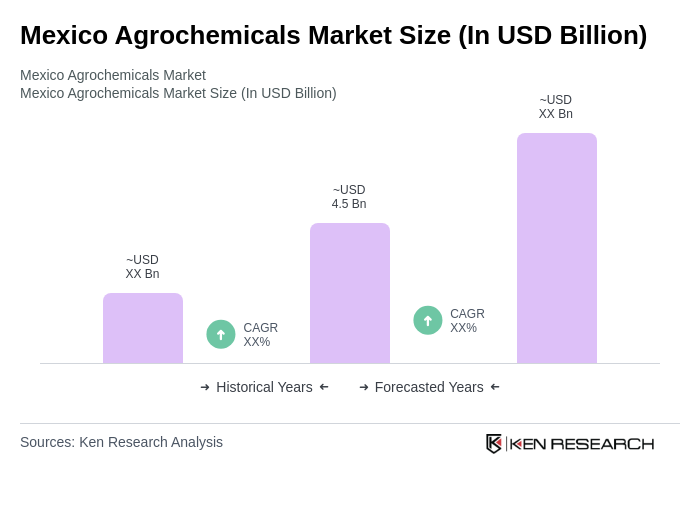
- The Mexico Agrochemicals Market is valued at USD 4.5 billion, based on a five-year historical analysis. This growth is primarily driven by the increasing demand for food production, advancements in agricultural technology, and the need for sustainable farming practices, as farmers adopt inputs to boost yields, meet export standards, and manage climate-related stress. The rising population and urbanization have further intensified the need for effective agrochemical solutions to enhance crop yield and quality.
- Key regions dominating the market include Sinaloa, Jalisco, and Guanajuato, which are known for their extensive agricultural activities. These areas benefit from favorable climatic conditions, fertile soil, and a strong agricultural infrastructure, making them ideal for the cultivation of various crops. The concentration of agribusinesses and research institutions in these regions also contributes to their market dominance.
- In 2023, the Mexican government advanced measures aimed at promoting sustainable agricultural practices, including tighter controls around pesticide use and encouraging low-toxicity and biological alternatives through regulatory scrutiny by health and agriculture authorities. These efforts aim to reduce environmental impact while ensuring food security and enhancing the overall health of the agricultural sector.
Mexico Agrochemicals Market Segmentation
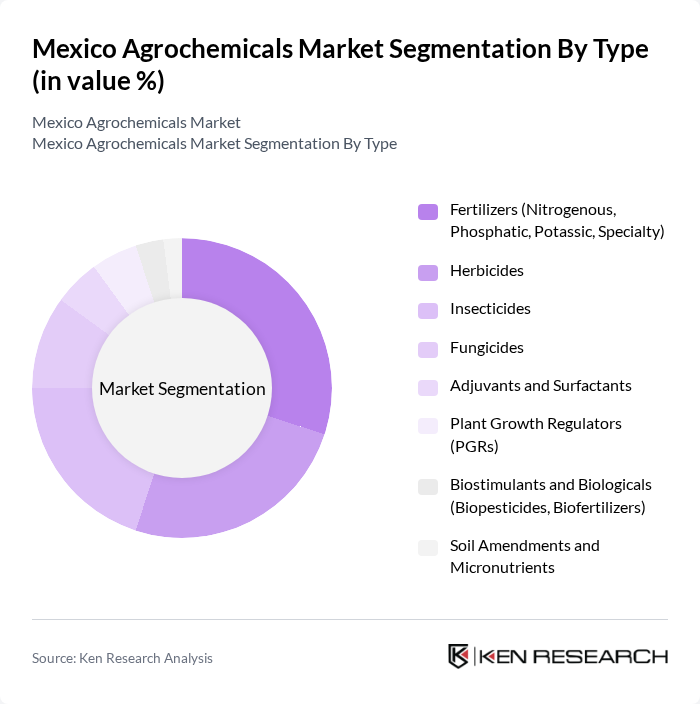
By Type:The agrochemicals market can be segmented into various types, including fertilizers, herbicides, insecticides, fungicides, adjuvants and surfactants, plant growth regulators (PGRs), biostimulants and biologicals, and soil amendments and micronutrients. Each of these subsegments plays a crucial role in enhancing agricultural productivity and addressing specific crop needs.
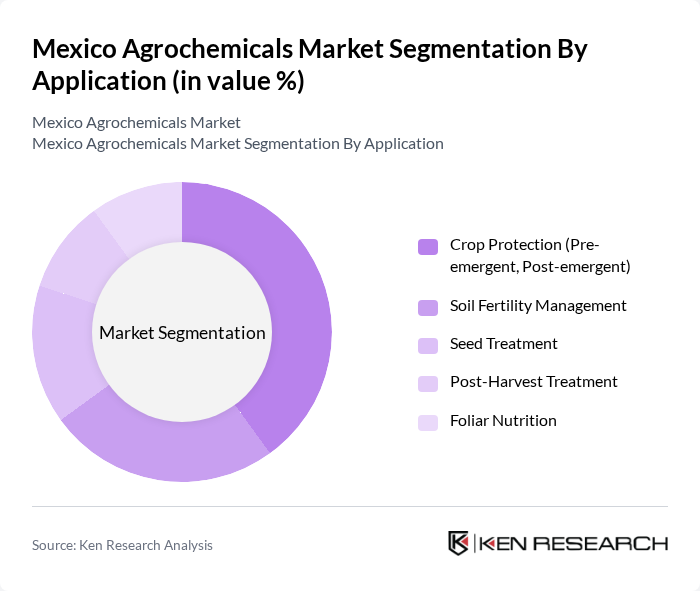
By Application:The applications of agrochemicals are diverse, including crop protection (both pre-emergent and post-emergent), soil fertility management, seed treatment, post-harvest treatment, and foliar nutrition. Each application serves a specific purpose in the agricultural process, ensuring optimal crop growth and yield, with crop protection and soil fertility remaining core use-cases among Mexican producers.
Mexico Agrochemicals Market Competitive Landscape
The Mexico Agrochemicals Market is characterized by a dynamic mix of regional and international players. Leading participants such as Bayer de México, S.A. de C.V. (Bayer CropScience), Syngenta México, S.A. de C.V., BASF Mexicana, S.A. de C.V., Corteva Agriscience México, S. de R.L. de C.V., FMC Agroquímica de México, S. de R.L. de C.V., ADAMA México, S.A. de C.V., Nufarm México, S.A. de C.V., UPL México, S.A. de C.V., Nutrien Ag Solutions México, S. de R.L. de C.V., Yara México, S.A. de C.V., Sumitomo Chemical México, S.A. de C.V., Rovensa Group (Tradecorp México / Oro Agri México), Helm de México, S.A. de C.V. (HELM AG), ICL Specialty Fertilizers México, S.A. de C.V., SQM México, S.A. de C.V. contribute to innovation, geographic expansion, and service delivery in this space.
Mexico Agrochemicals Market Industry Analysis
Growth Drivers
- Increasing Demand for Food Security:The Mexican population is projected to reach 130 million in future, driving the need for enhanced agricultural productivity. The government aims to increase food production by 20% to meet this demand, necessitating the use of agrochemicals. In future, the agricultural sector contributed approximately $30 billion to the GDP, highlighting the critical role of agrochemicals in ensuring food security and supporting economic stability.
- Adoption of Precision Agriculture:The precision agriculture market in Mexico is expected to grow significantly, with investments projected to reach $1.5 billion in future. This growth is driven by the need for efficient resource management, as farmers increasingly adopt technologies that optimize input usage. The integration of agrochemicals with precision farming techniques can enhance crop yields by up to 30%, making it a vital growth driver in the agrochemicals sector.
- Rising Awareness of Sustainable Farming Practices:In future, the organic farming sector in Mexico is expected to grow to $1.2 billion, reflecting a shift towards sustainable practices. This trend is supported by increasing consumer demand for organic products, with 60% of consumers willing to pay a premium for sustainably sourced food. Agrochemical companies are responding by developing eco-friendly products, aligning with the market's sustainability goals and driving growth in the sector.
Market Challenges
- Regulatory Compliance Complexities:The agrochemical industry in Mexico faces stringent regulatory frameworks, with over 200 regulations governing pesticide use. Compliance costs can exceed $500,000 for companies seeking to register new products. These complexities can hinder innovation and slow down the introduction of new agrochemical solutions, posing a significant challenge for market players aiming to remain competitive.
- Environmental Concerns and Sustainability Issues:Increasing scrutiny over environmental impacts has led to heightened regulations on chemical usage. In future, approximately 40% of agrochemical products faced restrictions due to environmental concerns. This trend is expected to continue, with potential fines reaching $1 million for non-compliance, creating a challenging landscape for companies that must balance productivity with environmental stewardship.
Mexico Agrochemicals Market Future Outlook
The Mexico agrochemicals market is poised for transformation as it embraces sustainable practices and technological advancements. By 2024, the integration of digital farming solutions is expected to enhance operational efficiency, while the shift towards biopesticides and biofertilizers will cater to the growing demand for environmentally friendly products. Companies that adapt to these trends will likely gain a competitive edge, positioning themselves favorably in a rapidly evolving market landscape.
Market Opportunities
- Growth in Organic Farming:The organic farming sector is projected to expand significantly, with an estimated 15% annual growth rate. This presents opportunities for agrochemical companies to develop organic-certified products, catering to the increasing consumer preference for sustainable agriculture. Companies that invest in this segment can tap into a lucrative market, enhancing their product portfolios and market share.
- Technological Advancements in Agrochemicals:Innovations in agrochemical formulations and application technologies are expected to drive market growth. Investments in R&D are projected to reach $300 million in future, enabling the development of more effective and environmentally friendly products. Companies that leverage these advancements can improve crop yields and reduce environmental impact, positioning themselves as leaders in the market.
Scope of the Report
| Segment | Sub-Segments |
|---|---|
| By Type | Fertilizers (Nitrogenous, Phosphatic, Potassic, Specialty) Herbicides Insecticides Fungicides Adjuvants and Surfactants Plant Growth Regulators (PGRs) Biostimulants and Biologicals (Biopesticides, Biofertilizers) Soil Amendments and Micronutrients |
| By Application | Crop Protection (Pre-emergent, Post-emergent) Soil Fertility Management Seed Treatment Post-Harvest Treatment Foliar Nutrition |
| By End-User | Commercial Farmers and Agribusinesses Smallholder Farmers Agricultural Cooperatives and Producer Organizations Government and Extension Agencies |
| By Distribution Channel | Direct Sales to Large Growers Agri-Retailers and Farm Supply Stores Distributors/Wholesalers Online and Omni-channel Platforms |
| By Region | Northwest (Sinaloa, Sonora, Baja California) Northeast (Tamaulipas, Nuevo León, Coahuila) Bajío and West (Guanajuato, Jalisco, Michoacán) Central (Estado de México, Puebla, Hidalgo) South–Southeast (Veracruz, Chiapas, Oaxaca, Yucatán) |
| By Product Formulation | Liquid Formulations (EC, SC, SL) Solid Formulations (WG, WP, Granular) Controlled/Slow-Release and Encapsulated |
| By Price Range | Premium Products Mid-Range Products Budget Products |
Key Target Audience
Investors and Venture Capitalist Firms
Government and Regulatory Bodies (e.g., Secretaría de Agricultura y Desarrollo Rural, Comisión Federal para la Protección contra Riesgos Sanitarios)
Manufacturers and Producers
Distributors and Retailers
Agrochemical Importers and Exporters
Industry Associations (e.g., Asociación Nacional de Fabricantes de Productos Químicos para la Agricultura)
Environmental NGOs and Advocacy Groups
Financial Institutions and Banks
Players Mentioned in the Report:
Bayer de Mexico, S.A. de C.V. (Bayer CropScience)
Syngenta Mexico, S.A. de C.V.
BASF Mexicana, S.A. de C.V.
Corteva Agriscience Mexico, S. de R.L. de C.V.
FMC Agroquimica de Mexico, S. de R.L. de C.V.
ADAMA Mexico, S.A. de C.V.
Nufarm Mexico, S.A. de C.V.
UPL Mexico, S.A. de C.V.
Nutrien Ag Solutions Mexico, S. de R.L. de C.V.
Yara Mexico, S.A. de C.V.
Sumitomo Chemical Mexico, S.A. de C.V.
Rovensa Group (Tradecorp Mexico / Oro Agri Mexico)
Helm de Mexico, S.A. de C.V. (HELM AG)
ICL Specialty Fertilizers Mexico, S.A. de C.V.
SQM Mexico, S.A. de C.V.
Table of Contents
Market Assessment Phase
1. Executive Summary and Approach
2. Mexico Agrochemicals Market Overview
2.1 Key Insights and Strategic Recommendations
2.2 Mexico Agrochemicals Market Overview
2.3 Definition and Scope
2.4 Evolution of Market Ecosystem
2.5 Timeline of Key Regulatory Milestones
2.6 Value Chain & Stakeholder Mapping
2.7 Business Cycle Analysis
2.8 Policy & Incentive Landscape
3. Mexico Agrochemicals Market Analysis
3.1 Growth Drivers
3.1.1 Increasing demand for food security
3.1.2 Adoption of precision agriculture
3.1.3 Rising awareness of sustainable farming practices
3.1.4 Government support for agricultural productivity
3.2 Market Challenges
3.2.1 Regulatory compliance complexities
3.2.2 Environmental concerns and sustainability issues
3.2.3 Price volatility of raw materials
3.2.4 Competition from generic products
3.3 Market Opportunities
3.3.1 Growth in organic farming
3.3.2 Technological advancements in agrochemicals
3.3.3 Expansion into under-served rural markets
3.3.4 Collaborations with agricultural tech firms
3.4 Market Trends
3.4.1 Shift towards biopesticides and biofertilizers
3.4.2 Increasing use of digital farming solutions
3.4.3 Focus on integrated pest management
3.4.4 Rise in demand for customized agrochemical solutions
3.5 Government Regulation
3.5.1 Stricter pesticide registration processes
3.5.2 Implementation of environmental protection laws
3.5.3 Subsidies for sustainable farming practices
3.5.4 Regulations on chemical usage in agriculture
4. SWOT Analysis
5. Stakeholder Analysis
6. Porter's Five Forces Analysis
7. Mexico Agrochemicals Market Market Size, 2019-2024
7.1 By Value
7.2 By Volume
7.3 By Average Selling Price
8. Mexico Agrochemicals Market Segmentation
8.1 By Type
8.1.1 Fertilizers (Nitrogenous, Phosphatic, Potassic, Specialty)
8.1.2 Herbicides
8.1.3 Insecticides
8.1.4 Fungicides
8.1.5 Adjuvants and Surfactants
8.1.6 Plant Growth Regulators (PGRs)
8.1.7 Biostimulants and Biologicals (Biopesticides, Biofertilizers)
8.1.8 Soil Amendments and Micronutrients
8.2 By Application
8.2.1 Crop Protection (Pre-emergent, Post-emergent)
8.2.2 Soil Fertility Management
8.2.3 Seed Treatment
8.2.4 Post-Harvest Treatment
8.2.5 Foliar Nutrition
8.3 By End-User
8.3.1 Commercial Farmers and Agribusinesses
8.3.2 Smallholder Farmers
8.3.3 Agricultural Cooperatives and Producer Organizations
8.3.4 Government and Extension Agencies
8.4 By Distribution Channel
8.4.1 Direct Sales to Large Growers
8.4.2 Agri-Retailers and Farm Supply Stores
8.4.3 Distributors/Wholesalers
8.4.4 Online and Omni-channel Platforms
8.5 By Region
8.5.1 Northwest (Sinaloa, Sonora, Baja California)
8.5.2 Northeast (Tamaulipas, Nuevo León, Coahuila)
8.5.3 Bajío and West (Guanajuato, Jalisco, Michoacán)
8.5.4 Central (Estado de México, Puebla, Hidalgo)
8.5.5 South–Southeast (Veracruz, Chiapas, Oaxaca, Yucatán)
8.6 By Product Formulation
8.6.1 Liquid Formulations (EC, SC, SL)
8.6.2 Solid Formulations (WG, WP, Granular)
8.6.3 Controlled/Slow-Release and Encapsulated
8.7 By Price Range
8.7.1 Premium Products
8.7.2 Mid-Range Products
8.7.3 Budget Products
9. Mexico Agrochemicals Market Competitive Analysis
9.1 Market Share of Key Players
9.2 Cross Comparison of Key Players
9.2.1 Company Name (Mexico operating entity)
9.2.2 Mexico Revenue or Sales Mix (% of LATAM/Mexico)
9.2.3 3-Year Revenue CAGR in Mexico
9.2.4 Market Coverage (States/Regions served, dealer count)
9.2.5 Portfolio Breadth (Fertilizers, CP: herbicides/insecticides/fungicides, biologicals, PGRs)
9.2.6 Registration Footprint (number of COFEPRIS/SENASICA approvals)
9.2.7 Price Positioning (premium, value, economy)
9.2.8 Distribution Strength (direct vs distributor-led share)
9.2.9 Local Manufacturing/Blending Capacity (yes/no; plants in Mexico)
9.2.10 R&D and Field Support (demo plots, technical reps, trials per year)
9.2.11 Sustainability/Biologicals Share (% of sales)
9.3 SWOT Analysis of Top Players
9.4 Pricing Analysis
9.5 Detailed Profile of Major Companies
9.5.1 Bayer de México, S.A. de C.V. (Bayer CropScience)
9.5.2 Syngenta México, S.A. de C.V.
9.5.3 BASF Mexicana, S.A. de C.V.
9.5.4 Corteva Agriscience México, S. de R.L. de C.V.
9.5.5 FMC Agroquímica de México, S. de R.L. de C.V.
9.5.6 ADAMA México, S.A. de C.V.
9.5.7 Nufarm México, S.A. de C.V.
9.5.8 UPL México, S.A. de C.V.
9.5.9 Nutrien Ag Solutions México, S. de R.L. de C.V.
9.5.10 Yara México, S.A. de C.V.
9.5.11 Sumitomo Chemical México, S.A. de C.V.
9.5.12 Rovensa Group (Tradecorp México / Oro Agri México)
9.5.13 Helm de México, S.A. de C.V. (HELM AG)
9.5.14 ICL Specialty Fertilizers México, S.A. de C.V.
9.5.15 SQM México, S.A. de C.V.
10. Mexico Agrochemicals Market End-User Analysis
10.1 Procurement Behavior of Key Ministries
10.1.1 Ministry of Agriculture
10.1.2 Ministry of Environment
10.1.3 Ministry of Economy
10.2 Corporate Spend on Infrastructure & Energy
10.2.1 Investment in Sustainable Practices
10.2.2 Funding for Agrochemical Research
10.3 Pain Point Analysis by End-User Category
10.3.1 Cost of Agrochemicals
10.3.2 Availability of Quality Products
10.3.3 Access to Information and Training
10.4 User Readiness for Adoption
10.4.1 Awareness of New Technologies
10.4.2 Willingness to Invest in Innovations
10.5 Post-Deployment ROI and Use Case Expansion
10.5.1 Measurement of Yield Improvements
10.5.2 Assessment of Cost Savings
11. Mexico Agrochemicals Market Future Size, 2025-2030
11.1 By Value
11.2 By Volume
11.3 By Average Selling Price
Go-To-Market Strategy Phase
1. Whitespace Analysis + Business Model Canvas
1.1 Identification of Market Gaps
1.2 Value Proposition Development
1.3 Revenue Model Structuring
1.4 Key Partnerships and Resources
1.5 Customer Segmentation
1.6 Cost Structure Analysis
1.7 Channels of Distribution
2. Marketing and Positioning Recommendations
2.1 Branding Strategies
2.2 Product USPs
2.3 Target Market Identification
2.4 Communication Strategy
2.5 Digital Marketing Approaches
3. Distribution Plan
3.1 Urban Retail Strategies
3.2 Rural NGO Tie-Ups
3.3 Logistics and Supply Chain Management
3.4 Distribution Partnerships
4. Channel & Pricing Gaps
4.1 Underserved Routes
4.2 Pricing Bands Analysis
4.3 Competitor Pricing Strategies
5. Unmet Demand & Latent Needs
5.1 Category Gaps
5.2 Consumer Segments Analysis
5.3 Emerging Trends and Needs
6. Customer Relationship
6.1 Loyalty Programs
6.2 After-Sales Service
6.3 Customer Feedback Mechanisms
7. Value Proposition
7.1 Sustainability Initiatives
7.2 Integrated Supply Chains
7.3 Competitive Advantages
8. Key Activities
8.1 Regulatory Compliance
8.2 Branding Initiatives
8.3 Distribution Setup
9. Entry Strategy Evaluation
9.1 Domestic Market Entry Strategy
9.1.1 Product Mix Considerations
9.1.2 Pricing Band Strategy
9.1.3 Packaging Innovations
9.2 Export Entry Strategy
9.2.1 Target Countries Identification
9.2.2 Compliance Roadmap Development
10. Entry Mode Assessment
10.1 Joint Ventures
10.2 Greenfield Investments
10.3 Mergers & Acquisitions
10.4 Distributor Model Evaluation
11. Capital and Timeline Estimation
11.1 Capital Requirements
11.2 Timelines for Implementation
12. Control vs Risk Trade-Off
12.1 Ownership vs Partnerships
13. Profitability Outlook
13.1 Breakeven Analysis
13.2 Long-Term Sustainability Strategies
14. Potential Partner List
14.1 Distributors
14.2 Joint Ventures
14.3 Acquisition Targets
15. Execution Roadmap
15.1 Phased Plan for Market Entry
15.1.1 Market Setup
15.1.2 Market Entry
15.1.3 Growth Acceleration
15.1.4 Scale & Stabilize
15.2 Key Activities and Milestones
15.2.1 Milestone Planning
15.2.2 Activity Tracking
Research Methodology
Phase 1: Approach1
Desk Research
- Analysis of market reports from agricultural associations and government agencies
- Review of academic journals and publications on agrochemical usage trends in Mexico
- Examination of trade statistics and import/export data from customs authorities
Primary Research
- Interviews with agronomists and agricultural extension officers to gather insights on agrochemical application
- Surveys with farmers and agricultural cooperatives regarding purchasing behavior and preferences
- Discussions with regulatory bodies to understand compliance and policy impacts on the agrochemical market
Validation & Triangulation
- Cross-validation of findings through multiple data sources, including industry reports and expert opinions
- Triangulation of market data with historical trends and future projections
- Sanity checks through feedback from a panel of industry experts and stakeholders
Phase 2: Market Size Estimation1
Top-down Assessment
- Estimation of total agrochemical market size based on national agricultural output and crop acreage
- Segmentation of market size by product type (herbicides, insecticides, fungicides) and application method
- Incorporation of government agricultural policies and subsidy impacts on agrochemical usage
Bottom-up Modeling
- Collection of sales data from leading agrochemical manufacturers and distributors
- Estimation of average consumption rates per hectare for various crops
- Calculation of market size based on volume sold and average pricing across different agrochemical categories
Forecasting & Scenario Analysis
- Development of forecasting models using historical growth rates and market drivers
- Scenario analysis based on potential changes in agricultural practices and environmental regulations
- Projections of market growth under different economic conditions and technological advancements through 2030
Phase 3: CATI Sample Composition1
| Scope Item/Segment | Sample Size | Target Respondent Profiles |
|---|---|---|
| Corn Agrochemical Usage | 150 | Farmers, Agronomists, Crop Consultants |
| Cotton Pest Management Practices | 100 | Farm Managers, Agricultural Extension Workers |
| Fruit and Vegetable Agrochemical Applications | 80 | Horticulturists, Cooperative Leaders |
| Regulatory Compliance Insights | 60 | Regulatory Officials, Compliance Managers |
| Market Trends in Organic Agrochemicals | 70 | Organic Farmers, Sustainability Advocates |
Frequently Asked Questions
What is the current value of the Mexico Agrochemicals Market?
The Mexico Agrochemicals Market is valued at approximately USD 4.5 billion, driven by the increasing demand for food production, advancements in agricultural technology, and the need for sustainable farming practices to enhance crop yields and quality.
Which regions in Mexico dominate the Agrochemicals Market?
What are the main types of agrochemicals used in Mexico?
How is the Mexican government promoting sustainable agricultural practices?
Why Buy From Us?

What makes us stand out is that our consultants follow Robust, Refine and Result (RRR) methodology. Robust for clear definitions, approaches and sanity checking, Refine for differentiating respondents' facts and opinions, and Result for presenting data with story.

We have set a benchmark in the industry by offering our clients with syndicated and customized market research reports featuring coverage of entire market as well as meticulous research and analyst insights.

While we don't replace traditional research, we flip the method upside down. Our dual approach of Top Bottom & Bottom Top ensures quality deliverable by not just verifying company fundamentals but also looking at the sector and macroeconomic factors.

With one step in the future, our research team constantly tries to show you the bigger picture. We help with some of the tough questions you may encounter along the way: How is the industry positioned? Best marketing channel? KPI's of competitors? By aligning every element, we help maximize success.

Our report gives you instant access to the answers and sources that other companies might choose to hide. We elaborate each steps of research methodology we have used and showcase you the sample size to earn your trust.

If you need any support, we are here! We pride ourselves on universe strength, data quality, and quick, friendly, and professional service.