Bahrain Orthopedic Surgical Planning Software Market Report Size, Share, Growth Drivers, Trends, Opportunities & Forecast 2025–2030

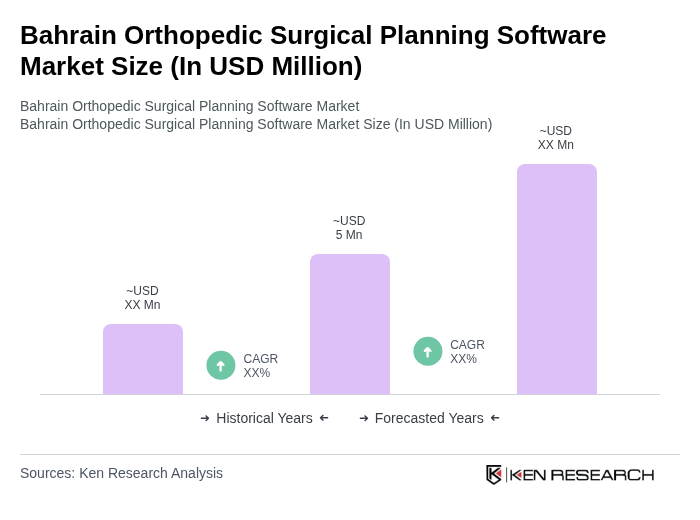
The Bahrain Orthopedic Surgical Planning Software Market, valued at USD 5 million, is growing due to increasing orthopedic surgeries, tech innovations, and government health initiatives.

Region:Middle East

Author(s):Dev

Product Code:KRAD4405

Pages:93

Published On:December 2025
About the Report

Base Year 2024

Bahrain Orthopedic Surgical Planning Software Market Overview

  • The Bahrain Orthopedic Surgical Planning Software Market is valued at USD 5 million, based on a five-year historical analysis. This growth is primarily driven by the increasing prevalence of orthopedic disorders associated with ageing, obesity, and sports injuries, along with advances in imaging, 3D planning, and navigation technologies that improve accuracy in joint replacement and spine procedures. The broader integration of digital solutions such as cloud-based planning platforms, AI-assisted templating, and patient-specific 3D models is steadily improving surgical precision and patient outcomes.
  • Key demand clusters in this market are major healthcare hubs such as Manama, which serves as the capital and primary concentration point for tertiary hospitals and specialist centers, and other urban areas like Muharraq and Riffa with growing private and public hospital capacity. The dominance of these regions is attributed to their relatively advanced healthcare infrastructure, higher density of orthopedic and sports medicine specialists, and an increasing installed base of digital imaging, PACS, and navigation systems that can be integrated with orthopedic planning software.
  • In 2023, Bahrain’s government continued to promote digital health and hospital information systems under its broader eHealth and health-system modernization agenda, but no publicly available regulation was identified that explicitly mandates the use of digital health technologies or orthopedic surgical planning software in all public hospitals; therefore, this should be reframed as a policy direction rather than a legal requirement. Current initiatives instead focus on strengthening electronic medical records, telehealth, and broader health information exchanges, which indirectly encourage hospitals to adopt advanced planning tools to improve patient safety, documentation, and surgical workflows.
Bahrain Orthopedic Surgical Planning Software Market Size

Bahrain Orthopedic Surgical Planning Software Market Segmentation

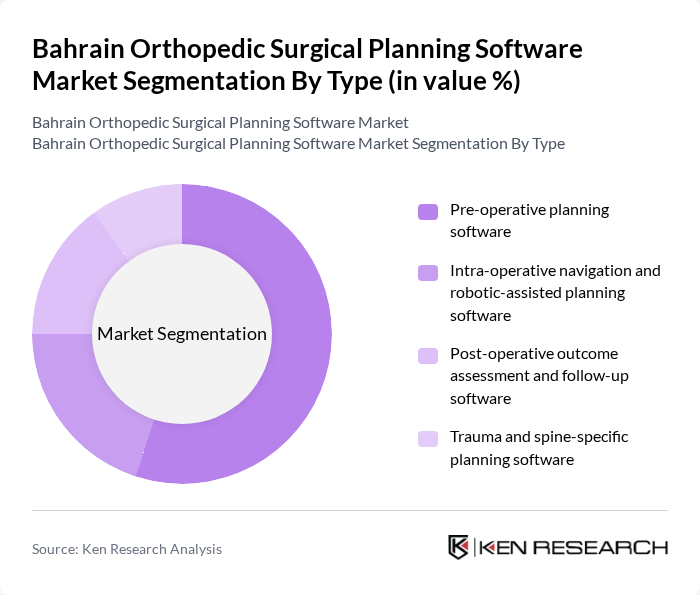
By Type:The market is segmented into four main types of software solutions. The pre-operative planning software is crucial for preparing surgical procedures, enabling templating, implant sizing, and simulation based on radiographs or 3D imaging, while intra-operative navigation and robotic-assisted planning software enhance precision and reproducibility during surgeries. Post-operative outcome assessment and follow-up software support functional scoring, imaging review, and complication tracking, and trauma and spine-specific planning software address complex deformity, fracture, and spinal instrumentation cases that require highly specialized workflows. The pre-operative planning software currently dominates the market due to its critical role in surgical success and efficiency.
Bahrain Orthopedic Surgical Planning Software Market segmentation by Type.

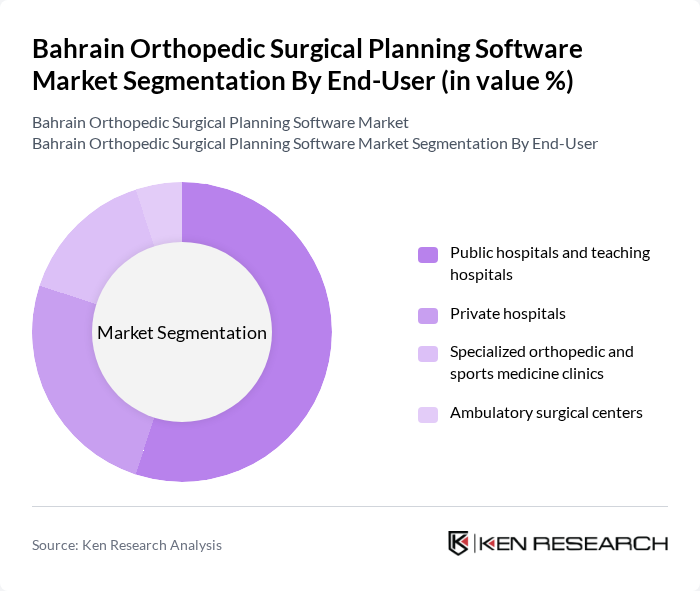
By End-User:The end-user segmentation includes public hospitals and teaching hospitals, private hospitals, specialized orthopedic and sports medicine clinics, and ambulatory surgical centers. Public hospitals and teaching hospitals are the largest segment due to their extensive patient base, concentration of high-complexity procedures (joint replacement, trauma, spine), and their role as early adopters of digital planning platforms integrated with PACS and hospital information systems. The increasing number and sophistication of private hospitals and specialized clinics in Bahrain and the wider GCC, combined with rising medical tourism and elective sports-injury care, is also contributing to the growth of this market as these facilities invest in pre-operative planning, navigation, and cloud-based collaboration tools.
Bahrain Orthopedic Surgical Planning Software Market segmentation by End-User.

Bahrain Orthopedic Surgical Planning Software Market Competitive Landscape

The Bahrain Orthopedic Surgical Planning Software Market is characterized by a dynamic mix of regional and international players. Leading participants such as Stryker Corporation, Zimmer Biomet Holdings, Inc., DePuy Synthes (Johnson & Johnson MedTech), Smith & Nephew plc, Brainlab AG, 3D Systems Corporation, Materialise NV, mediCAD Hectec GmbH, Formus Labs Ltd, PeekMed (PEEK HEALTH S.A.), OrthoView (OrthoPlanner), OrthoGrid Systems, Inc., Radlink, Inc., THINK Surgical, Inc., EOS imaging contribute to innovation, geographic expansion, and service delivery in this space.

Stryker Corporation

1941

Kalamazoo, Michigan, USA

Zimmer Biomet Holdings, Inc.

1927

Warsaw, Indiana, USA

DePuy Synthes (Johnson & Johnson MedTech)

1895

Somerville, New Jersey, USA

Smith & Nephew plc

1856

London, UK

Brainlab AG

1989

Munich, Germany

Company

Establishment Year

Headquarters

Regional presence in Bahrain and wider GCC (install base, reference sites)

Revenue and CAGR from orthopedic planning software in MEA

Number of orthopedic procedures supported annually in Bahrain

Market share in Bahrain orthopedic surgical planning software

Depth of product portfolio (joints, trauma, spine, oncology) and upgrade roadmap

Deployment mix (cloud vs on-premise) and cybersecurity posture

Bahrain Orthopedic Surgical Planning Software Market Industry Analysis

Growth Drivers

  • Increasing Prevalence of Orthopedic Surgeries:The demand for orthopedic surgeries in Bahrain is on the rise, with over 10,500 procedures performed annually as of now. This increase is driven by an aging population, with 16% of Bahrain's residents aged 60 and above, leading to higher incidences of conditions like arthritis and fractures. The World Health Organization projects that the number of orthopedic surgeries will continue to grow by 6% annually, further boosting the need for specialized surgical planning software.
  • Advancements in Surgical Technology:The orthopedic surgical landscape is evolving rapidly, with technological advancements such as minimally invasive techniques and robotic-assisted surgeries. In the current period, the adoption of these technologies increased by 25% in Bahrain's hospitals, enhancing surgical outcomes and recovery times. This trend necessitates sophisticated surgical planning software to optimize procedures, thereby driving market growth as healthcare providers seek to integrate these innovations into their practices.
  • Government Initiatives to Improve Healthcare Infrastructure:The Bahraini government has allocated approximately $1.8 billion for healthcare infrastructure improvements in the near future. This investment aims to enhance medical facilities and technology, including surgical planning software. With a focus on modernizing healthcare services, the government is fostering an environment conducive to adopting advanced orthopedic solutions, which is expected to significantly increase the market for surgical planning software in the coming years.

Market Challenges

  • High Costs of Software Implementation:The initial investment required for orthopedic surgical planning software can exceed $120,000, which poses a significant barrier for many healthcare facilities in Bahrain. This high cost includes not only the software itself but also training and integration expenses. As a result, many hospitals may delay or forgo implementation, limiting the overall market growth and accessibility of advanced surgical planning tools.
  • Resistance to Change Among Healthcare Professionals:Many healthcare professionals in Bahrain exhibit resistance to adopting new technologies, with studies indicating that over 65% prefer traditional methods. This reluctance stems from concerns about the learning curve and potential disruptions to established workflows. Consequently, this resistance can hinder the widespread adoption of orthopedic surgical planning software, impacting its market penetration and growth potential.

Bahrain Orthopedic Surgical Planning Software Market Future Outlook

The future of the orthopedic surgical planning software market in Bahrain appears promising, driven by technological advancements and increasing healthcare investments. As hospitals modernize their facilities, the integration of AI and machine learning into surgical planning is expected to enhance precision and efficiency. Additionally, the growing emphasis on patient-centric care will likely lead to more personalized surgical solutions, further propelling market growth and adoption of innovative software solutions in the near future.

Market Opportunities

  • Expansion of Telemedicine and Remote Consultations:The rise of telemedicine in Bahrain, with a reported 35% increase in remote consultations in the current period, presents a significant opportunity for orthopedic surgical planning software. This trend allows for better pre-operative assessments and follow-ups, enhancing patient care and expanding the market for software solutions that facilitate remote surgical planning.
  • Integration with AI and Machine Learning Technologies:The incorporation of AI and machine learning into surgical planning software can revolutionize the orthopedic field. With Bahrain's healthcare sector investing over $250 million in AI technologies in the near future, there is a substantial opportunity for software developers to create intelligent systems that improve surgical outcomes and streamline processes, thereby increasing market demand.

Scope of the Report

SegmentSub-Segments
By Type

Pre-operative planning software

Intra-operative navigation and robotic-assisted planning software

Post-operative outcome assessment and follow-up software

Trauma and spine-specific planning software

By End-User

Public hospitals and teaching hospitals

Private hospitals

Specialized orthopedic and sports medicine clinics

Ambulatory surgical centers

By Deployment Model

On-premise (license-based)

Cloud-based (SaaS)

Hybrid deployment

Web and mobile-access portals

By Functionality

D/3D imaging, templating, and simulation

Digital templating for joint replacement and trauma

Integration with PACS/RIS and hospital information systems

AI-enabled planning, analytics, and reporting

By Region

Northern Governorate

Southern Governorate

Capital Governorate

Muharraq Governorate

By User Experience

Intuitive user interface and workflow efficiency

Level of customization and localization (Arabic/English, Bahraini protocols)

Availability of remote training, clinical support, and updates

Integration effort and interoperability with existing hospital IT systems

By Pricing Model

Subscription-based (per user or per procedure)

Perpetual license with annual maintenance

Outcome-based or volume-based contracts

Bundled with imaging/implant or robotic systems

Key Target Audience

Investors and Venture Capitalist Firms

Government and Regulatory Bodies (e.g., Ministry of Health, Bahrain)

Orthopedic Surgeons and Medical Professionals

Healthcare Providers and Hospitals

Medical Device Manufacturers

Health Insurance Companies

Technology Providers and Software Developers

Healthcare IT Solutions Firms

Players Mentioned in the Report:

Stryker Corporation

Zimmer Biomet Holdings, Inc.

DePuy Synthes (Johnson & Johnson MedTech)

Smith & Nephew plc

Brainlab AG

3D Systems Corporation

Materialise NV

mediCAD Hectec GmbH

Formus Labs Ltd

PeekMed (PEEK HEALTH S.A.)

OrthoView (OrthoPlanner)

OrthoGrid Systems, Inc.

Radlink, Inc.

THINK Surgical, Inc.

EOS imaging

Table of Contents

Market Assessment Phase

1. Executive Summary and Approach


2. Bahrain Orthopedic Surgical Planning Software Market Overview

2.1 Key Insights and Strategic Recommendations

2.2 Bahrain Orthopedic Surgical Planning Software Market Overview

2.3 Definition and Scope

2.4 Evolution of Market Ecosystem

2.5 Timeline of Key Regulatory Milestones

2.6 Value Chain & Stakeholder Mapping

2.7 Business Cycle Analysis

2.8 Policy & Incentive Landscape


3. Bahrain Orthopedic Surgical Planning Software Market Analysis

3.1 Growth Drivers

3.1.1 Increasing prevalence of orthopedic surgeries
3.1.2 Advancements in surgical technology
3.1.3 Rising demand for personalized surgical solutions
3.1.4 Government initiatives to improve healthcare infrastructure

3.2 Market Challenges

3.2.1 High costs of software implementation
3.2.2 Resistance to change among healthcare professionals
3.2.3 Data security and privacy concerns
3.2.4 Limited awareness of software benefits

3.3 Market Opportunities

3.3.1 Expansion of telemedicine and remote consultations
3.3.2 Integration with AI and machine learning technologies
3.3.3 Collaborations with educational institutions for training
3.3.4 Growing focus on patient-centric care

3.4 Market Trends

3.4.1 Shift towards cloud-based solutions
3.4.2 Increasing use of 3D printing in surgical planning
3.4.3 Adoption of mobile applications for surgical planning
3.4.4 Emphasis on interoperability among healthcare systems

3.5 Government Regulation

3.5.1 Compliance with health data protection laws
3.5.2 Regulations on software certification and approval
3.5.3 Guidelines for electronic health records integration
3.5.4 Standards for software usability and accessibility

4. SWOT Analysis


5. Stakeholder Analysis


6. Porter's Five Forces Analysis


7. Bahrain Orthopedic Surgical Planning Software Market Market Size, 2019-2024

7.1 By Value

7.2 By Volume

7.3 By Average Selling Price


8. Bahrain Orthopedic Surgical Planning Software Market Segmentation

8.1 By Type

8.1.1 Pre-operative planning software
8.1.2 Intra-operative navigation and robotic-assisted planning software
8.1.3 Post-operative outcome assessment and follow-up software
8.1.4 Trauma and spine-specific planning software

8.2 By End-User

8.2.1 Public hospitals and teaching hospitals
8.2.2 Private hospitals
8.2.3 Specialized orthopedic and sports medicine clinics
8.2.4 Ambulatory surgical centers

8.3 By Deployment Model

8.3.1 On-premise (license-based)
8.3.2 Cloud-based (SaaS)
8.3.3 Hybrid deployment
8.3.4 Web and mobile-access portals

8.4 By Functionality

8.4.1 2D/3D imaging, templating, and simulation
8.4.2 Digital templating for joint replacement and trauma
8.4.3 Integration with PACS/RIS and hospital information systems
8.4.4 AI-enabled planning, analytics, and reporting

8.5 By Region

8.5.1 Northern Governorate
8.5.2 Southern Governorate
8.5.3 Capital Governorate
8.5.4 Muharraq Governorate

8.6 By User Experience

8.6.1 Intuitive user interface and workflow efficiency
8.6.2 Level of customization and localization (Arabic/English, Bahraini protocols)
8.6.3 Availability of remote training, clinical support, and updates
8.6.4 Integration effort and interoperability with existing hospital IT systems

8.7 By Pricing Model

8.7.1 Subscription-based (per user or per procedure)
8.7.2 Perpetual license with annual maintenance
8.7.3 Outcome-based or volume-based contracts
8.7.4 Bundled with imaging/implant or robotic systems

9. Bahrain Orthopedic Surgical Planning Software Market Competitive Analysis

9.1 Market Share of Key Players

9.2 Cross Comparison of Key Players

9.2.1 Company name
9.2.2 Regional presence in Bahrain and wider GCC (install base, reference sites)
9.2.3 Revenue and CAGR from orthopedic planning software in MEA
9.2.4 Number of orthopedic procedures supported annually in Bahrain
9.2.5 Market share in Bahrain orthopedic surgical planning software
9.2.6 Depth of product portfolio (joints, trauma, spine, oncology) and upgrade roadmap
9.2.7 Deployment mix (cloud vs on-premise) and cybersecurity posture
9.2.8 Average implementation time and training hours per site
9.2.9 Integration coverage with local PACS/RIS and robotic systems
9.2.10 Average price per license/procedure and discounting to key accounts

9.3 SWOT Analysis of Top Players

9.4 Pricing Analysis

9.5 Detailed Profile of Major Companies

9.5.1 Stryker Corporation
9.5.2 Zimmer Biomet Holdings, Inc.
9.5.3 DePuy Synthes (Johnson & Johnson MedTech)
9.5.4 Smith & Nephew plc
9.5.5 Brainlab AG
9.5.6 3D Systems Corporation
9.5.7 Materialise NV
9.5.8 mediCAD Hectec GmbH
9.5.9 Formus Labs Ltd
9.5.10 PeekMed (PEEK HEALTH S.A.)
9.5.11 OrthoView (OrthoPlanner)
9.5.12 OrthoGrid Systems, Inc.
9.5.13 Radlink, Inc.
9.5.14 THINK Surgical, Inc.
9.5.15 EOS imaging

10. Bahrain Orthopedic Surgical Planning Software Market End-User Analysis

10.1 Procurement Behavior of Key Ministries

10.1.1 Budget allocation for orthopedic software
10.1.2 Decision-making processes
10.1.3 Evaluation criteria for software selection
10.1.4 Others

10.2 Corporate Spend on Infrastructure & Energy

10.2.1 Investment in healthcare technology
10.2.2 Funding for surgical innovations
10.2.3 Partnerships with tech firms
10.2.4 Others

10.3 Pain Point Analysis by End-User Category

10.3.1 Challenges faced by hospitals
10.3.2 Issues in surgical centers
10.3.3 Concerns of orthopedic clinics
10.3.4 Others

10.4 User Readiness for Adoption

10.4.1 Training needs of healthcare professionals
10.4.2 Technological infrastructure assessment
10.4.3 Attitudes towards new software
10.4.4 Others

10.5 Post-Deployment ROI and Use Case Expansion

10.5.1 Measurement of software effectiveness
10.5.2 Expansion into new surgical procedures
10.5.3 Long-term cost savings analysis
10.5.4 Others

11. Bahrain Orthopedic Surgical Planning Software Market Future Size, 2025-2030

11.1 By Value

11.2 By Volume

11.3 By Average Selling Price


Go-To-Market Strategy Phase

1. Whitespace Analysis + Business Model Canvas

1.1 Market gaps identification

1.2 Value proposition development

1.3 Revenue model exploration

1.4 Customer segmentation analysis

1.5 Competitive landscape overview

1.6 Key partnerships identification

1.7 Operational framework design


2. Marketing and Positioning Recommendations

2.1 Branding strategies

2.2 Product USPs

2.3 Target audience definition

2.4 Communication channels selection

2.5 Marketing budget allocation

2.6 Performance metrics establishment


3. Distribution Plan

3.1 Urban retail vs rural NGO tie-ups

3.2 Distribution channel optimization

3.3 Logistics and supply chain management

3.4 Partnership with local distributors

3.5 Direct sales strategies


4. Channel & Pricing Gaps

4.1 Underserved routes

4.2 Pricing bands

4.3 Competitor pricing analysis

4.4 Customer willingness to pay

4.5 Value-based pricing strategies


5. Unmet Demand & Latent Needs

5.1 Category gaps

5.2 Consumer segments

5.3 Emerging trends identification

5.4 Future needs forecasting


6. Customer Relationship

6.1 Loyalty programs

6.2 After-sales service

6.3 Customer feedback mechanisms

6.4 Community engagement strategies


7. Value Proposition

7.1 Sustainability

7.2 Integrated supply chains

7.3 Cost-effectiveness

7.4 Enhanced patient outcomes


8. Key Activities

8.1 Regulatory compliance

8.2 Branding

8.3 Distribution setup

8.4 Training and support


9. Entry Strategy Evaluation

9.1 Domestic Market Entry Strategy

9.1.1 Product mix
9.1.2 Pricing band
9.1.3 Packaging

9.2 Export Entry Strategy

9.2.1 Target countries
9.2.2 Compliance roadmap

10. Entry Mode Assessment

10.1 JV

10.2 Greenfield

10.3 M&A

10.4 Distributor Model


11. Capital and Timeline Estimation

11.1 Capital requirements

11.2 Timelines


12. Control vs Risk Trade-Off

12.1 Ownership vs Partnerships


13. Profitability Outlook

13.1 Breakeven analysis

13.2 Long-term sustainability


14. Potential Partner List

14.1 Distributors

14.2 JVs

14.3 Acquisition targets


15. Execution Roadmap

15.1 Phased Plan for Market Entry

15.1.1 Market Setup
15.1.2 Market Entry
15.1.3 Growth Acceleration
15.1.4 Scale & Stabilize

15.2 Key Activities and Milestones

15.2.1 Milestone planning
15.2.2 Activity tracking

Frequently Asked Questions

What is the current value of the Bahrain Orthopedic Surgical Planning Software Market?

The Bahrain Orthopedic Surgical Planning Software Market is valued at approximately USD 5 million, reflecting a growing demand driven by the increasing prevalence of orthopedic disorders and advancements in surgical technologies.

What factors are driving the growth of the orthopedic surgical planning software market in Bahrain?

Which regions in Bahrain are the primary demand clusters for orthopedic surgical planning software?

What types of software solutions are available in the Bahrain orthopedic surgical planning market?

Other Regional/Country Reports

Qatar Orthopedic Surgical Planning Software Market Report Size, Share, Growth Drivers, Trends, Opportunities & Forecast 2025–2030

Indonesia Orthopedic Surgical Planning Software Market

Malaysia Orthopedic Surgical Planning Software Market

KSA Orthopedic Surgical Planning Software Market

APAC Orthopedic Surgical Planning Software Market

SEA Orthopedic Surgical Planning Software Market

Other Adjacent Reports

Why Buy From Us?

Refine Robust Result (RRR) Framework

What makes us stand out is that our consultants follow Robust, Refine and Result (RRR) methodology. Robust for clear definitions, approaches and sanity checking, Refine for differentiating respondents' facts and opinions, and Result for presenting data with story.

Our Reach Is Unmatched

We have set a benchmark in the industry by offering our clients with syndicated and customized market research reports featuring coverage of entire market as well as meticulous research and analyst insights.

Shifting the Research Paradigm

While we don't replace traditional research, we flip the method upside down. Our dual approach of Top Bottom & Bottom Top ensures quality deliverable by not just verifying company fundamentals but also looking at the sector and macroeconomic factors.

More Insights-Better Decisions

With one step in the future, our research team constantly tries to show you the bigger picture. We help with some of the tough questions you may encounter along the way: How is the industry positioned? Best marketing channel? KPI's of competitors? By aligning every element, we help maximize success.

Transparency and Trust

Our report gives you instant access to the answers and sources that other companies might choose to hide. We elaborate each steps of research methodology we have used and showcase you the sample size to earn your trust.

Round the Clock Support

If you need any support, we are here! We pride ourselves on universe strength, data quality, and quick, friendly, and professional service.

Why Clients Choose Us?

400000+
Reports in repository
150+
Consulting projects a year
100+
Analysts
8000+
Client Queries in 2022








